What Is AP Human Geography Unit 1 About?
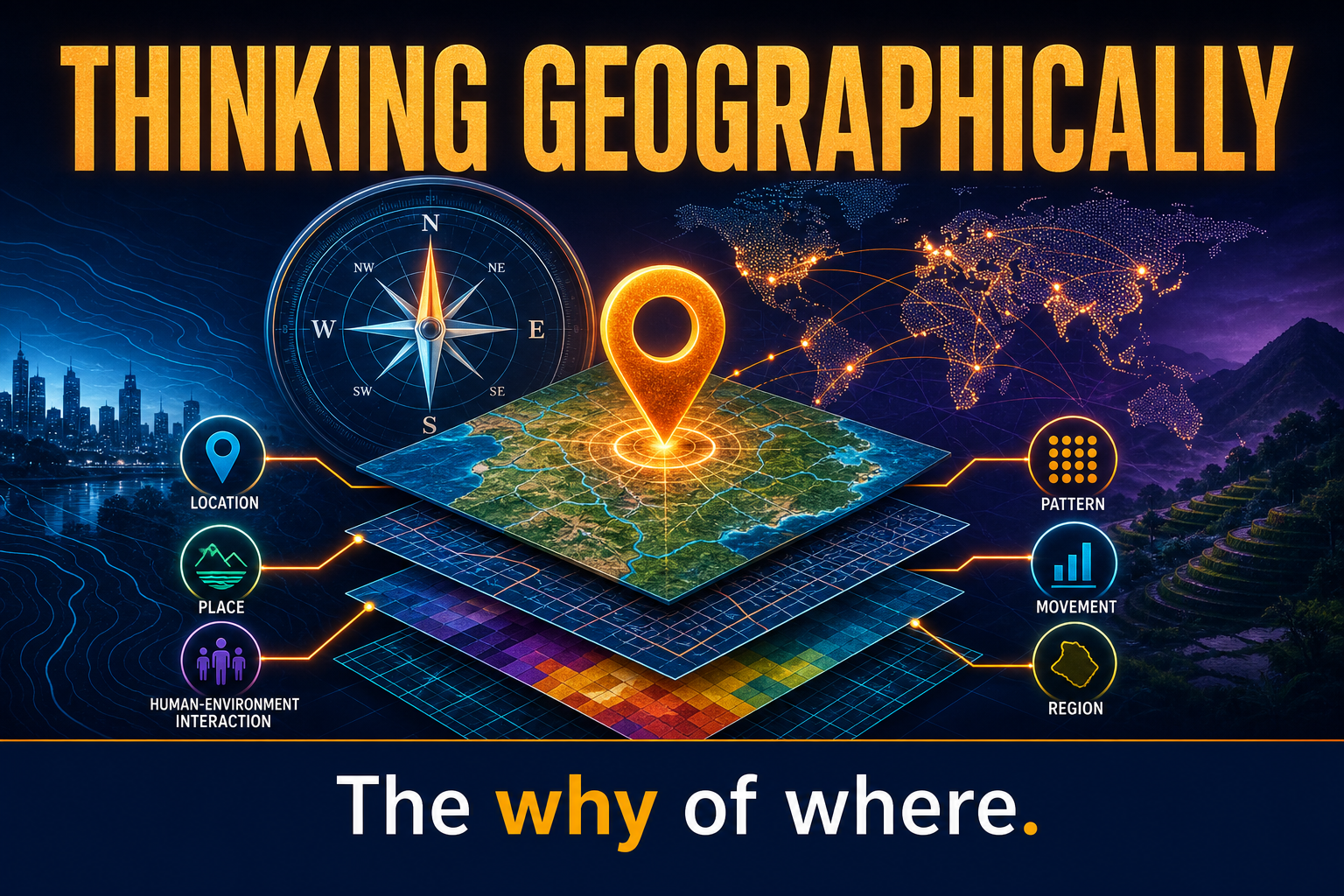
Thinking Geographically is the toolkit unit—maps, data, scale, and regions show up on every AP HUG exam.
AP Human Geography Unit 1, Thinking Geographically, teaches students how geographers ask questions, use maps, analyze spatial patterns, interpret geographic data, and explain why places, regions, and human activities are arranged the way they are.
Key Takeaways
- Geographers study the "why of where."
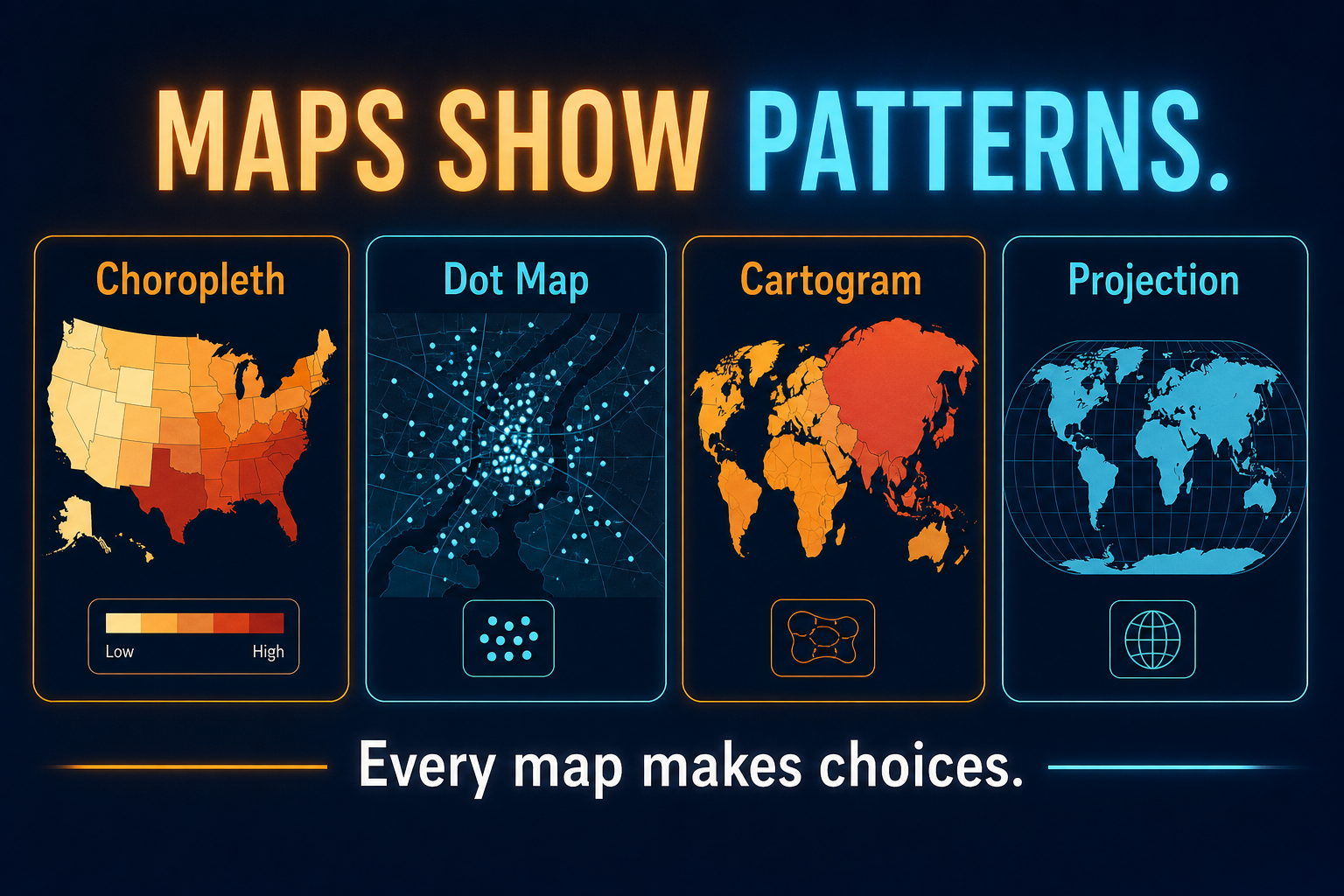
- Maps simplify reality and always involve choices.
- Scale affects what patterns you can see.
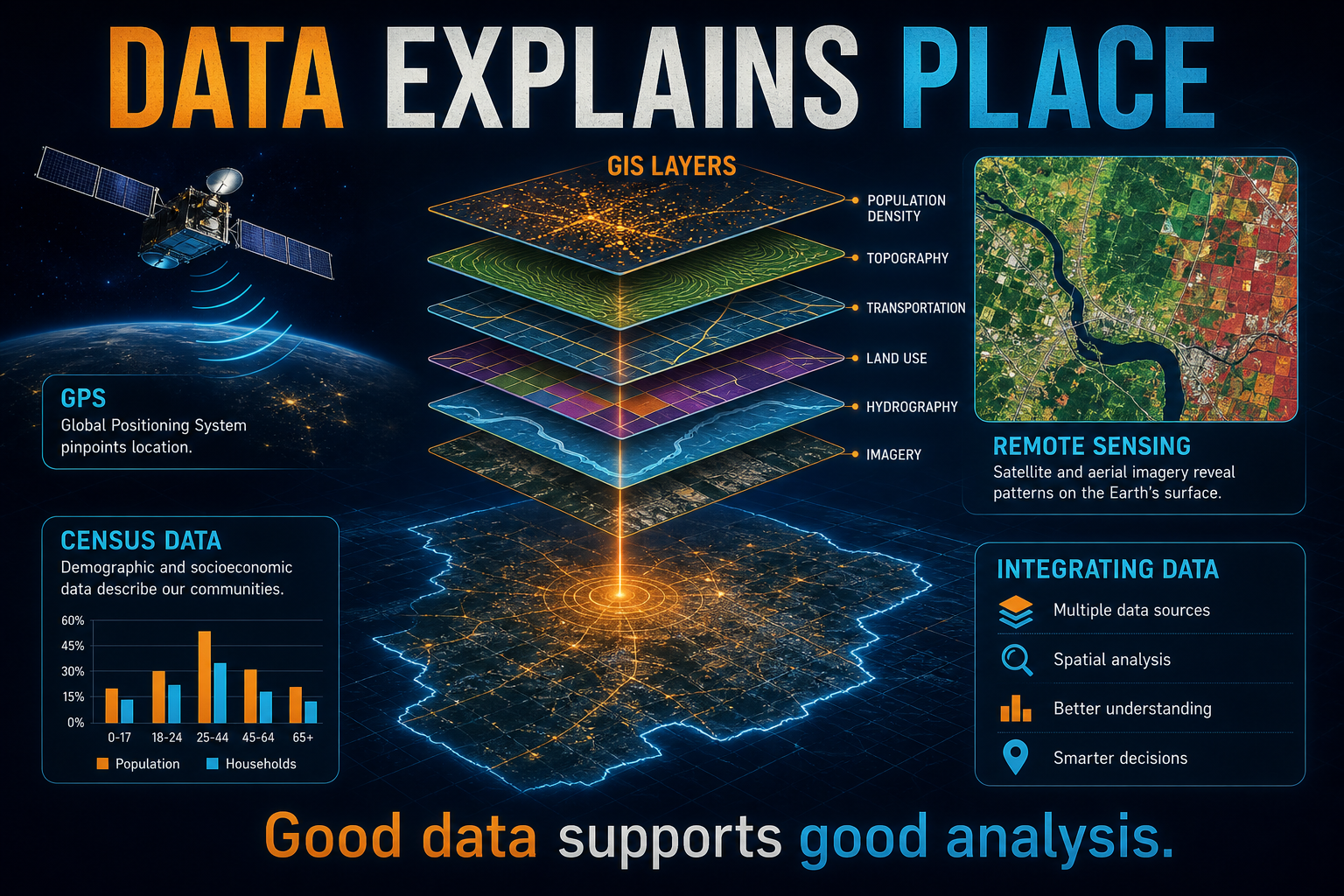
- Geographic data can be quantitative, qualitative, reliable, biased, private, or incomplete.
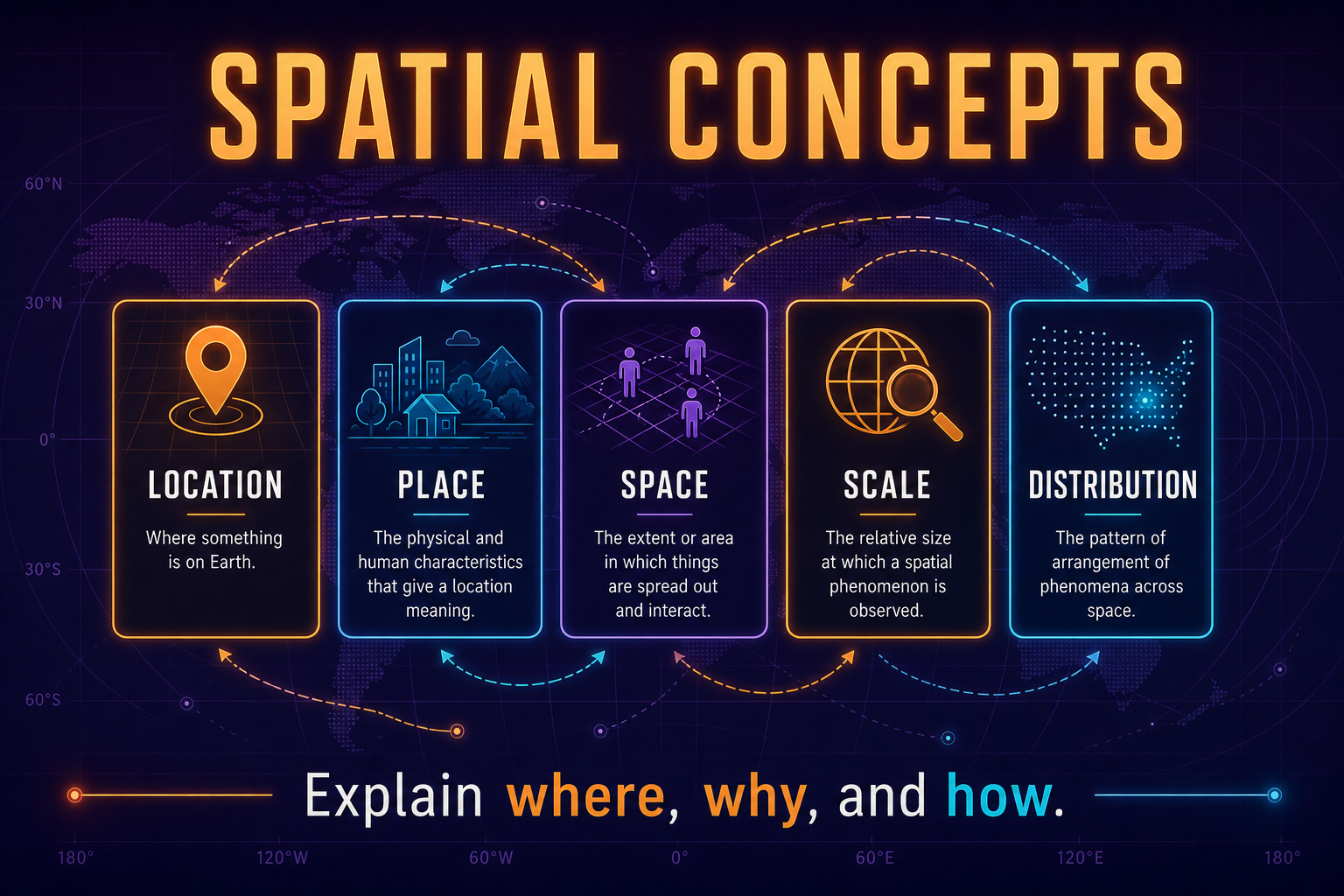
- Spatial concepts such as place, location, space, distribution, distance decay, and regions appear across the entire AP Human Geography course.
Unit 1 skills underpin every other AP Human Geography unit. When you need population patterns, open Unit 2 population and migration (especially after reviewing census data). For culture and diffusion, use Unit 3 cultural patterns. Political geography builds on scale and regions in Unit 4. Rural land-use maps connect to Unit 5 agriculture, and urban GIS examples preview Unit 6 cities. Browse the full course on the AP Human Geography course page.
AP Human Geography Unit 1 Review Slides
Maps, spatial concepts, geographic data, scale, and regions—the core ideas from Thinking Geographically in one slide walkthrough.
AP Human Geography Unit 1 Topics
Four clusters organize maps, geographic data, spatial concepts, and regions—filter by path or browse every guide.
Cluster 1 · Maps: Maps and map interpretation plus ten child guides.
Cluster 2 · Data: Geographic data and technology plus ten child guides.
Cluster 3 · Spatial concepts: Spatial concepts plus nine child guides.
Cluster 4 · Regions: Regions and patterns—distribution and spatial analysis also appear in clusters 3 and 4.
Maps and Map Interpretation
Parent guide for maps and map interpretation—start here, then open child topics.
Open guide →Introduction to Maps
How geographers use maps to ask spatial questions.
Open guide →Map Purpose and Geographic Questions
Match map goals to geographic questions.
Open guide →Reference vs Thematic Maps
General location maps versus single-theme maps.
Open guide →Map Types
Eight AP map types with selector tool and practice.
Open guide →Choropleth Maps
Shaded areas for rates and percentages.
Open guide →Dot Distribution Maps
Dots show clustering and approximate counts.
Open guide →Isoline Maps
Equal-value lines for continuous fields.
Open guide →Cartograms
Resized areas to compare magnitude.
Open guide →Map Projections
Mercator, Robinson, Peters, and distortion trade-offs.
Open guide →Map Scale and Generalization
Cartographic scale, detail, and simplification.
Open guide →Geographic Data and Technology
Parent guide for geographic data and technology—start here, then open child topics.
Open guide →GIS
Layer and analyze spatial data.
Open guide →GPS
Satellite positioning for exact coordinates.
Open guide →Remote Sensing
Observe Earth from satellites and aircraft.
Open guide →Quantitative Geographic Data
Numbers, counts, and measurable patterns.
Open guide →Qualitative Geographic Data
Interviews, narratives, and perception.
Open guide →Census Data
Official population and household counts.
Open guide →Survey Data and Sampling
Field surveys, samples, and bias.
Open guide →Geotagged Data
Location-linked social and mobile data.
Open guide →Data Reliability and Bias
Trust, error, and representation.
Open guide →Geospatial Privacy
Location tracking and ethical limits.
Open guide →Spatial Concepts
Parent guide for spatial concepts—start here, then open child topics.
Open guide →Absolute Location
Exact coordinates on Earth's surface.
Open guide →Relative Location
Position compared to other places.
Open guide →Place
Location plus meaning and character.
Open guide →Space
Physical and social dimensions of location.
Open guide →Distribution
How features are arranged across space.
Open guide →Spatial Analysis
Patterns, overlays, and map-based reasoning.
Open guide →Distance Decay
Interaction weakens with distance.
Open guide →Space-Time Compression
Technology shrinks perceived distance.
Open guide →Scale of Analysis
Local, regional, national, and global frames.
Open guide →Regions and Patterns
Parent guide for regions and patterns—start here, then open child topics.
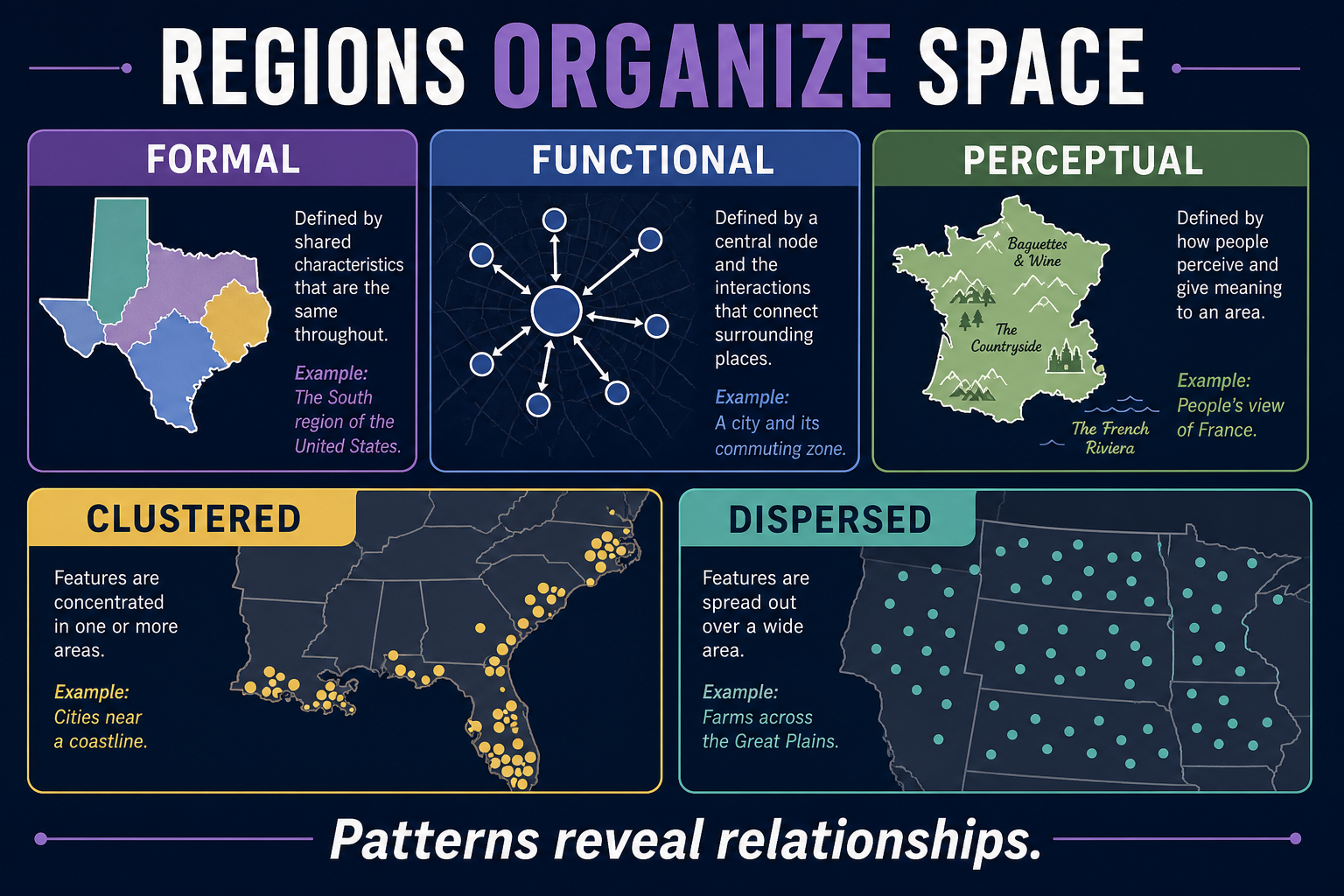
Open guide →Formal, Functional, and Perceptual Regions
Three region types with AP examples.
Open guide →Distribution Patterns
Clustered, dispersed, and linear arrangements.
Open guide →Spatial Analysis
Connect patterns to processes on maps.
Open guide →Clustered vs Dispersed
Spacing patterns that show process.
Open guide →Unit 1 Practice Questions
Exam-style MCQs with explanations and weak-topic review.
Open guide →Unit 1 FRQ Practice
Free-response prompts with scoring guidance.
Open guide →Most Important Unit 1 Vocabulary
Twenty high-yield terms for map, data, scale, and region prompts on the AP exam.
Showing all 20 terms
Location
Where something is on Earth's surface using absolute or relative coordinates.
Place
A location with unique physical and human characteristics that give it meaning.
Space
The physical gap or distance between two or more points on Earth's surface.
Scale
The relationship between distance on a map and distance on Earth, or the level of analysis.
Region
An area defined by one or more unifying characteristics such as language, function, or identity.
Spatial pattern
The geometric arrangement of features across space, such as clustered or dispersed.
Distribution
How phenomena are spread or arranged across a geographic area.
Density
The frequency of a phenomenon within a given area.
Concentration
How clustered or spread out features are within an area.
Clustered pattern
Features grouped close together in one or more areas.
Dispersed pattern
Features spread relatively evenly across space.
Distance decay
The tendency for interaction to decrease as distance increases.
Space-time compression
The reduction in perceived distance due to faster transport and communication.
GIS
A computer system that stores, layers, and analyzes spatial data.
GPS
A satellite-based system that provides exact latitude and longitude.
Remote sensing
Collecting information about Earth's surface from satellites or aircraft.
Geotagged data
Digital information linked to a specific geographic coordinate.
Map projection
A method for transferring Earth's curved surface onto a flat map.
Choropleth map
A thematic map that shades predefined areas to show a variable, usually a rate.
Cartogram
A map that distorts area size to represent a statistic such as population or GDP.
How to Study AP Human Geography Unit 1
Five steps you can repeat in 10–15 minutes until map and scale prompts feel automatic.
Learn the core spatial concepts first.
Review map types and what each map shows.
Practice identifying scale, pattern, and distribution.
Compare types of geographic data and technology.
Finish with MCQs and FRQs.
Need a deeper map pass? Start with map types or scale of analysis before the full Unit 1 practice question set.
Unit 1 Exam Skill Builder
Four skills that show up on map stimuli, data scenarios, and Unit 1 FRQs.
Identify a pattern
What to do: Name whether features are clustered, dispersed, linear, or random and cite map evidence.
Common exam mistake: Calling every grouping clustered without checking spacing or density.
Describe the scale of analysis
What to do: State whether the pattern is summarized at local, regional, national, or global level.
Common exam mistake: Confusing map scale (cartographic ratio) with scale of analysis.
Explain why a map is useful
What to do: Match the variable to the map type and explain what the legend shows.
Common exam mistake: Picking a choropleth for raw totals when rates or dot maps fit better.
Evaluate data reliability
What to do: Ask who collected the data, how it was sampled, and whether bias or privacy limits apply.
Common exam mistake: Treating all numeric data as equally trustworthy without citing source or method.
AP Human Geography Unit 1 Practice Preview
Five sample MCQs—click an answer to reveal the explanation, then open the full practice set.
Preview 1 of 5
Unit 1 previewAP Human Geography Unit 1 FRQ Preview
Two short prompts—practice Claim, Evidence, Reasoning before the full FRQ bank.
FRQ 1 · GIS and urban planning
A city government uses GIS to compare population density, public transit access, and income levels.
A. Define GIS.
B. Explain one benefit of using GIS for urban planning.
C. Explain one limitation or concern related to geographic data.
FRQ 2 · Scale of analysis
A national map shows low unemployment across a country, but local maps reveal several neighborhoods with high unemployment.
A. Define scale of analysis.
B. Explain how scale can change the interpretation of data.
C. Explain why local-scale analysis may be useful for policy decisions.
10-question diagnostic
Answer all 10 to spot gaps before the full 50-question MCQ set.
Unit 1 flashcards
Tap to flip. Every 5th card shows an ad with a 3-second delay before the next card.
AP-style practice questions
50 MCQs on maps, GIS, spatial concepts, scale, and regions with live scoring.
Practice AP HUG-Style Written Responses (Unit 1)
After each MCQ set, apply your knowledge using short free-response prompts modeled on the AP exam.
For every scenario, follow this exact structure:
- Identify Evidence: What data, trend, or observation is given?
- Explain the Mechanism: What process explains this? (use Unit 1 concepts like map type selection, scale, diffusion, and spatial data interpretation)
- Justify the Claim: Connect your explanation back to the question using precise vocabulary.
Your response framework (use every time)
Claim: State your answer clearly
Evidence: Cite specific data or details from the prompt
Reasoning: Explain how and why the science supports your claim
Example
Prompt: A student uses a choropleth map to compare raw population totals by country. Explain why that can mislead.
Strong response
Claim: The map may distort interpretation because choropleths are better for rates than raw totals.
Evidence: Large countries occupy more area visually, which can exaggerate perceived magnitude.
Reasoning: When raw totals are shaded by area, map size and value are conflated, so density or percentage maps better represent relative patterns.
Why this matters
AP graders score more than a final answer—they score how well you use evidence, apply mechanisms, and communicate reasoning clearly.
Practicing this structure after MCQs builds the exact skills needed to earn full points on test day.
Unit 1 mastery checklist
Before you open Unit 2, you should be able to do each of these without notes—Unit 1 skills return on almost every AP HUG exam section.
- Pick the best map type for a given variable (rates vs counts vs movement).
- Separate GIS, GPS, and remote sensing in one sentence each.
- Explain scale of analysis without confusing it with map scale.
- Classify a region example as formal, functional, or perceptual.
- Score at least 80% on the 50-question MCQ set with explanations read for every miss.
Preview later units: Unit 2 population and migration, Unit 3 cultural patterns, Unit 4 political patterns, Unit 5 agriculture, and Unit 6 cities.
Frequently asked questions
What is AP Human Geography Unit 1 about?
AP Human Geography Unit 1 is about thinking geographically. Students learn how to use maps, spatial concepts, geographic data, regions, scale, and patterns to explain where things are and why they are there.
What does thinking geographically mean?
Thinking geographically means asking spatial questions about location, place, distance, scale, distribution, patterns, and human-environment relationships.
What are the most important Unit 1 concepts?
The most important Unit 1 concepts include maps, scale, location, place, space, distribution, regions, GIS, GPS, remote sensing, geographic data, distance decay, and spatial analysis.
How do I study AP Human Geography Unit 1?
Start with spatial concepts, then review map types, geographic data, scale of analysis, regions, and patterns. Finish by practicing MCQs and FRQs that require explanation, comparison, and interpretation.
Can Unit 1 appear in AP Human Geography FRQs?
Yes. Unit 1 concepts often support FRQs because students may need to interpret maps, describe spatial patterns, explain scale of analysis, or evaluate geographic data.
What is the difference between map scale and scale of analysis?
Map scale describes the relationship between distance on a map and distance on Earth. Scale of analysis describes the geographic level being studied, such as local, regional, national, or global.
Is there an AP HUG Unit 1 Quizlet or Scribd version?
Yes—third-party sites host flashcard-style Unit 1 sets under many titles. This page keeps 60 explained flashcards, 50 MCQs with reasoning, FRQ-style prompts, and topic guides in one place so you are not stitching five tabs together on exam week.
How do I get AP HUG Unit 1 test answers?
Released AP Human Geography exams do not publish secure MCQ keys, and sharing live test content violates College Board policy. The legal substitute is deliberate practice with explained questions—use the diagnostic, MCQ bank, and FRQ outlines here and study why each distractor fails.
What's the best way to review AP HUG Units 1-1?
Master Unit 1 map types, scale of analysis, GIS, and regions on this hub first. When choropleth versus dot map choices feel automatic, continue to Unit 2 population and migration for cumulative AP Human Geography review.
Next: start AP Human Geography Unit 2
Keep your momentum. Continue directly into Unit 2 so your review stays connected across concepts and exam skills.