Beginner-friendly
Start with AP Human Geography
No prerequisites. Vocabulary-heavy but rewards consistent daily review. Best for 9th–10th graders or any first AP.
Open AP HUG →Find your AP course, start with the right study path, and build a daily practice habit. Open any course below for full units, study guides, and practice—this page is your starting point, not the whole library.
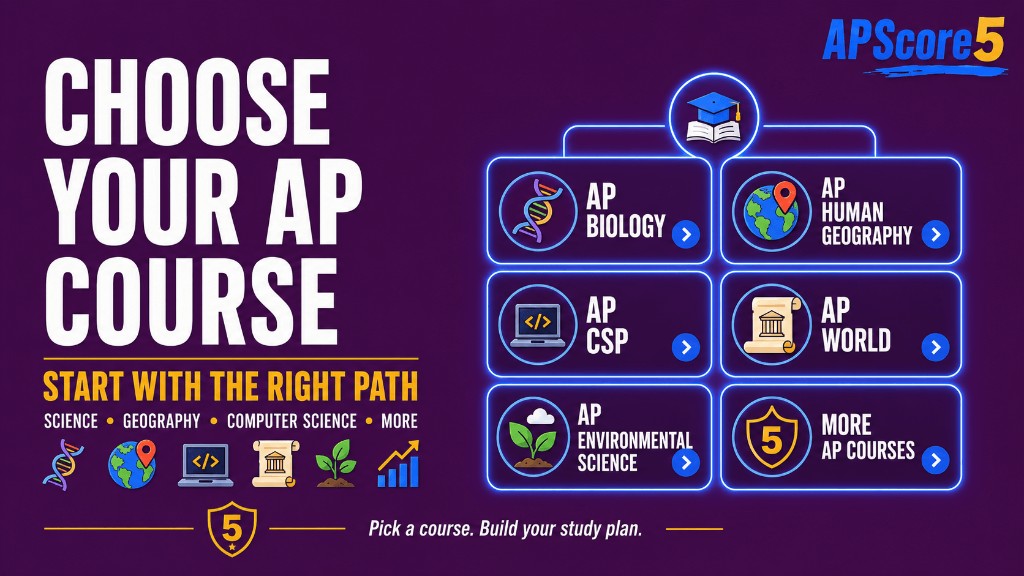
Picking your first AP course matters more than students realize. Some courses build foundational skills you will reuse in later APs, while others are best taken once you have already practiced AP-style questions. The matrix below shows which APScore5 course matches different starting points.
No prerequisites. Vocabulary-heavy but rewards consistent daily review. Best for 9th–10th graders or any first AP.
Open AP HUG →No coding experience required. Covers programming basics, data, the internet, and computing's social impact.
Open AP CSP →Best for students who have already taken honors biology or chemistry. Focuses on processes, FRQs, and data analysis.
Open AP Bio →| Course | Difficulty | Best for | Workload |
|---|---|---|---|
| AP Human Geography | ★★☆☆☆ | First AP, vocabulary learners | Light–moderate |
| AP Computer Science Principles | ★★☆☆☆ | Tech-curious students | Moderate (Create Task project) |
| AP Biology | ★★★★☆ | Strong science background | Heavy |
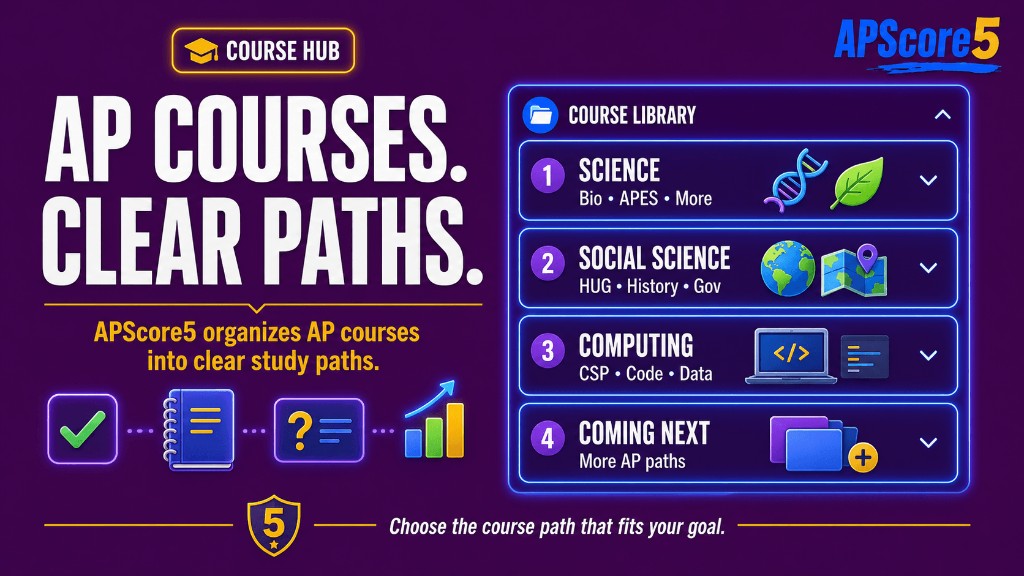
Start with one of the courses below. Each card opens that subject’s home page, where you can move through units, topics, study resources, and practice at your pace.
Build a study path through the major ideas of biology, from cells and energy to genetics, evolution, and ecology.
Study maps, population, migration, culture, political geography, agriculture, urban patterns, and development.
Practice the core ideas of computing, including algorithms, data, the internet, programming logic, and computing impact.
Pick a course, drill the unit you are on, answer short practice sets, and let weak-topic signals tell you what to revisit tomorrow.
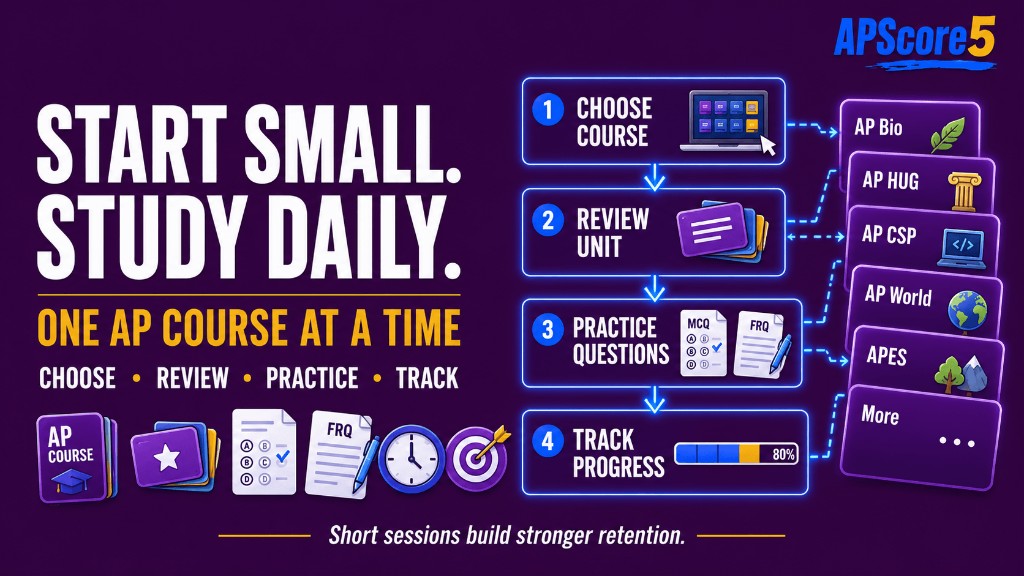
Start with the AP subject you are taking now.
Review the current unit or the one that feels hardest.
Answer short sets and review explanations.
Use weak-topic signals to know what to study next.
Today’s courses cover Biology, Human Geography, and Computer Science Principles with full unit paths and practice. When we add another AP subject, it will ship with the same depth—not just a logo on a card.
Create a free account if you want product updates when new courses launch, or check back here as we post new tiles.
Create Free Account →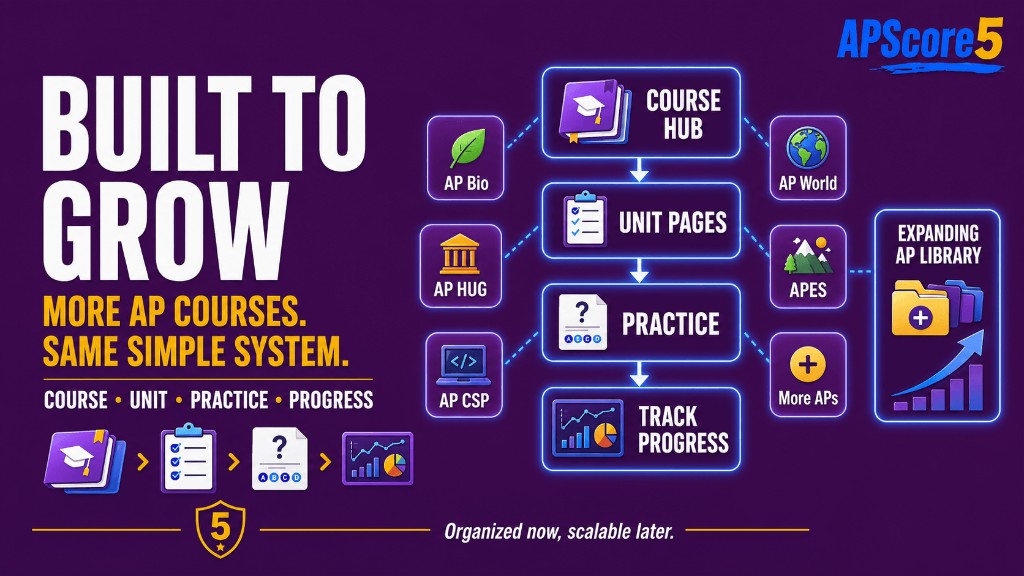
Students and parents can also browse school and education listings through Public Schools.
Short answers for students choosing where to start—written so you can skim the list quickly.
You can open full study paths for AP Biology, AP Human Geography, and AP Computer Science Principles—each with units, topics, practice questions, and review built for that exam.
Start with the AP course you are taking now or the one with the nearest exam date. Open your current unit first, or jump to a topic that keeps showing up as weak on practice sets.
Pick a course below to open that subject’s overview page. That is where you move unit by unit, answer practice sets, and track weak topics—this page simply helps you choose which subject to enter.
Most students benefit from 10 to 20 minutes of focused daily practice. Consistency matters more than long sessions.
Yes. As you complete missions and question sets, APScore5 surfaces accuracy, streaks, weak topics, and readiness signals inside each course.
Start with units and topic-level practice until the concepts feel stable. Add fuller practice tests when you are ready to rehearse timing, stamina, and mixed-topic readiness.
Yes. Use APScore5 for short retrieval practice and explanations that reinforce what your teacher assigns—especially on topics that still feel shaky after class.
We publish new subjects here once complete unit coverage and practice are ready. Watch the homepage and this page for additional course cards, or create a free account if you want product updates when new subjects ship.
Start with your current AP course, answer a few questions, and use your progress to decide what to study next.
Start Daily Practice →