Clustered Pattern
Features are grouped together in one or more pockets.
AP Human Geography · Unit 1 · Spatial Patterns
Learn how to identify grouped, spread-out, and evenly spaced patterns on maps, explain why they form, and use physical and human causes in AP-style answers.
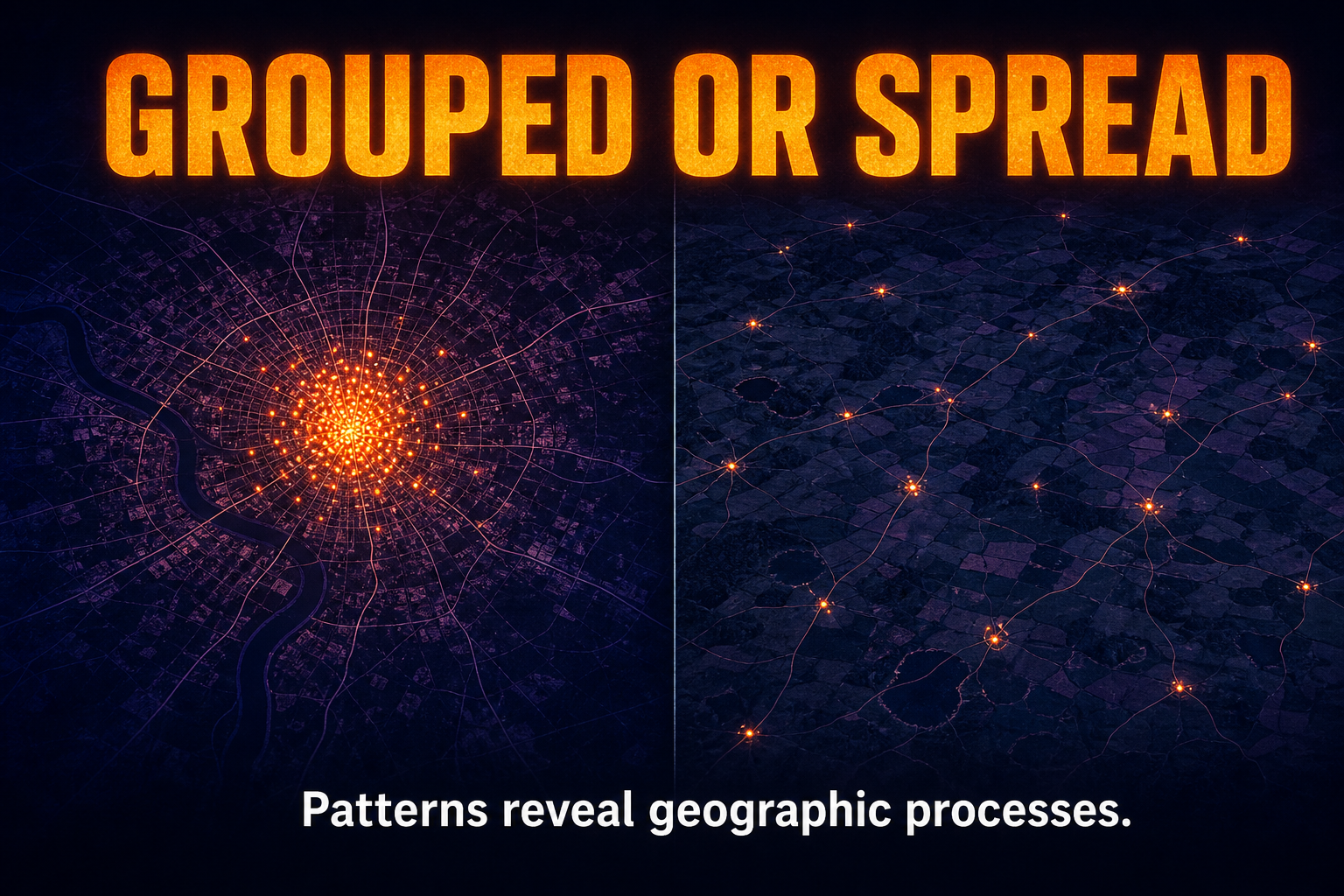
Clustered and dispersed patterns describe how geographic features are arranged across space. A clustered pattern means features are grouped tightly in specific areas. A dispersed pattern means features are spread out across an area. In AP Human Geography, students use these terms to describe distribution, explain why patterns form, and connect map evidence to physical and human processes.
If a prompt asks whether features are grouped, spread apart, evenly spaced, or arranged along a line, it is testing spatial pattern and distribution.
Clustered = grouped. Dispersed = spread. Uniform = evenly spaced.
Features are grouped together in one or more pockets.
Features are spread apart across space.
Features are evenly spaced in a regular pattern.
The number of people or features per unit of area.
Clustered describes arrangement, while density describes amount per area.
Compare distribution, space, spatial analysis, and scale of analysis when a prompt mixes amount, arrangement, and geographic level.
Clustered, dispersed, and uniform are pattern words used to describe distribution. Distribution means how something is arranged across space. Clustered features bunch together, dispersed features spread out, and uniform features follow a regular spacing.
Features are grouped together in one or more pockets.
Features are spread out across space.
Features are evenly spaced in a regular pattern.
How a feature is arranged across space.
The number of features or people per unit of area.
How close together or spread apart features are.
The clustering of activities or firms because being near each other creates benefits.
The arrangement of where people live across space.
Clustered and dispersed describe concentration within distribution. Use spatial analysis when you explain patterns with map evidence, and scale of analysis when a pattern changes at a different geographic level.
A clustered pattern appears when features concentrate in specific places instead of spreading evenly. Clustering often happens when places benefit from being close to resources, markets, transportation, labor, culture, or other related activities.
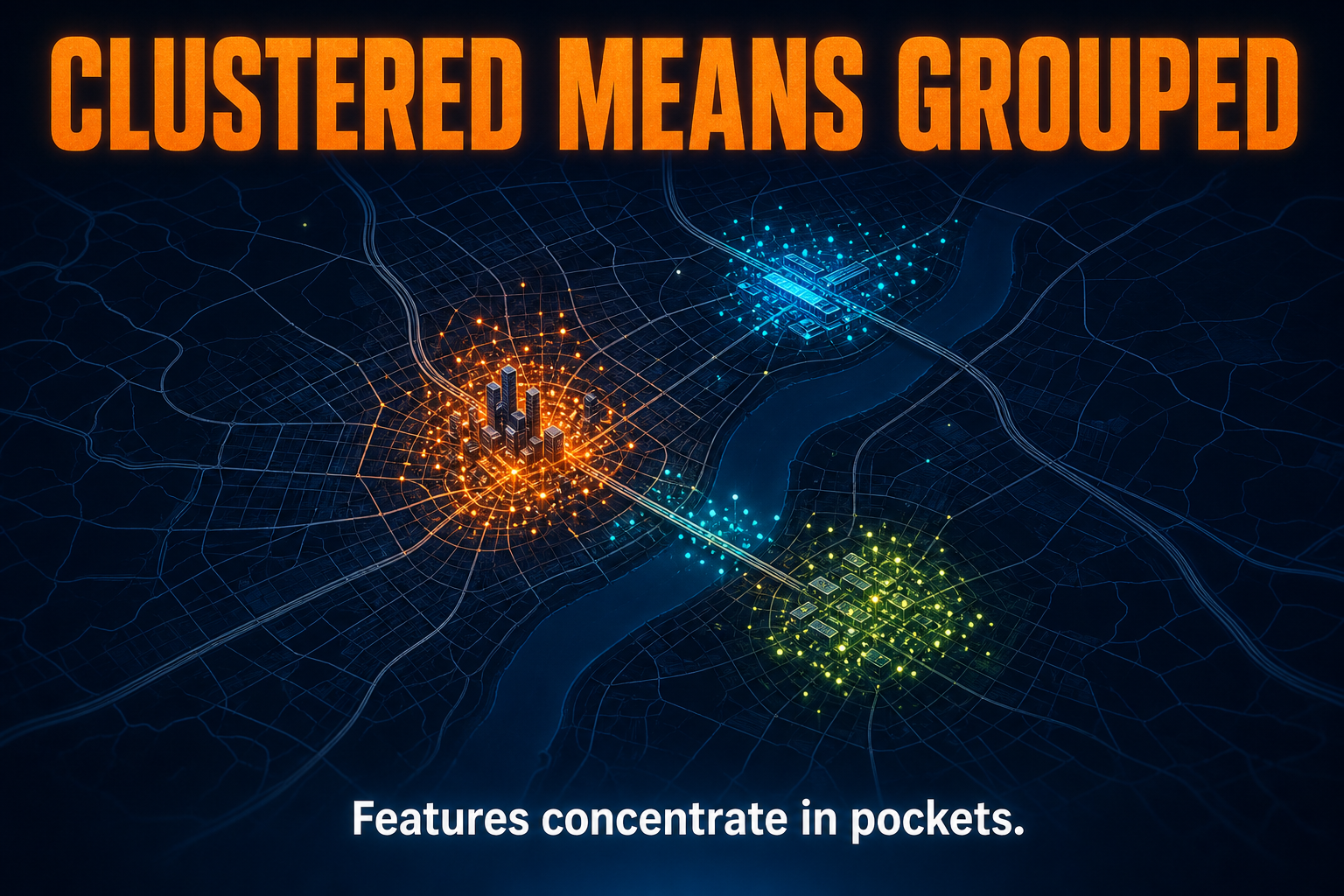
Example: People cluster in cities because jobs, services, transportation, and housing concentrate there.
Example: Offices cluster downtown for access, visibility, and agglomeration benefits.
Example: Firms cluster near skilled labor, universities, venture capital, and supplier networks.
Example: Cultural groups may cluster for social support, businesses, language, and institutions.
Example: Corn and soy production cluster where soil, climate, infrastructure, and markets align.
Example: Warehouses cluster near ports, rail yards, highways, and distribution centers.
When explaining a clustered pattern, use agglomeration language: shared labor, suppliers, markets, infrastructure, information, or cultural networks.
A dispersed pattern appears when features are spread out across space. Dispersion often happens when activities need large land areas, avoid competition, follow zoning rules, or require spacing for coverage, grazing, safety, or resources.
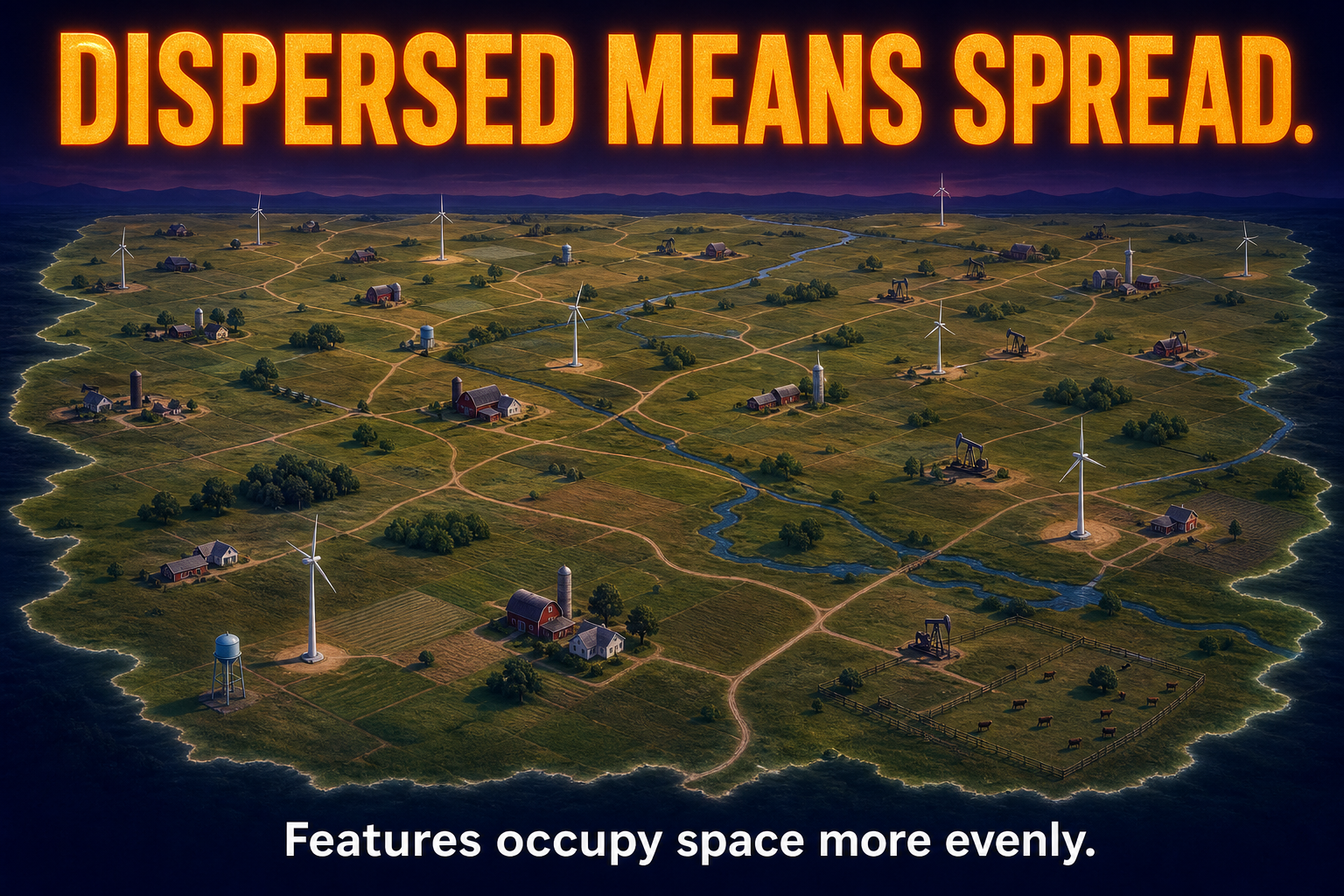
Example: Ranches disperse because grazing requires large land areas.
Example: Mechanized grain farms are spread across large fields.
Example: Turbines are spaced apart to capture wind efficiently.
Example: Towers may be spaced to provide coverage over a broad area.
Example: Zoning and land values can produce spread-out homes.
Example: Wells may be spread according to resource locations and technical spacing needs.
When explaining dispersed patterns, name the spacing need: land, resource, zoning, safety, coverage, or environmental constraint.
AP questions often test whether students can distinguish clustered, dispersed, and uniform patterns. Uniform patterns are a special kind of regular spacing. Dispersed patterns are spread out, but not always evenly spaced.
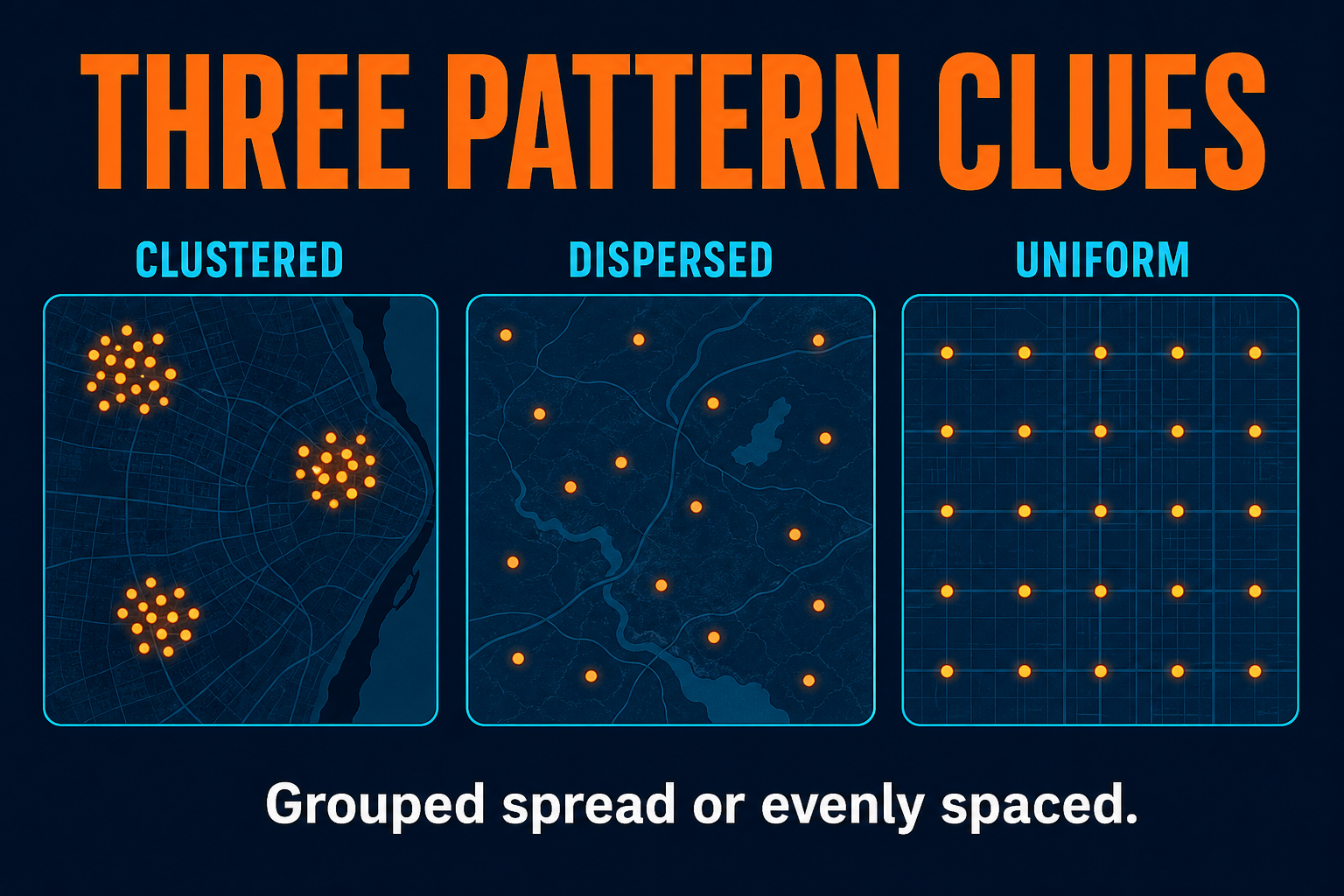
| Pattern | Meaning | Example | AP clue |
|---|---|---|---|
| Clustered | Features group together | Downtown offices or ethnic neighborhoods | Bunched, concentrated, pockets, core |
| Dispersed | Features spread apart | Ranches or scattered farms | Spread out, scattered, low concentration |
| Uniform | Features are evenly spaced | Township grid or planned service towers | Regular spacing, grid, equal distance |
| Linear | Features follow a line | Settlements along a river or road | Corridor, coast, river, highway |
Uniform is not the same as dispersed. Uniform means regular spacing; dispersed means spread out and may be irregular.
Students often confuse clustering with density. Density measures how many features exist per unit area. Clustering describes whether those features are grouped together or spread apart. A place can be dense but not strongly clustered, or clustered but not very dense.
| Term | Main question | Example | Student trap |
|---|---|---|---|
| Density | How many per area? | 100 people per square kilometer | Amount |
| Clustered | Are features grouped together? | Most people live in one corner of the county | Arrangement |
| Dispersed | Are features spread apart? | Farms spaced across a rural plain | Spacing |
| Concentration | How close or spread out? | Features are tightly concentrated | Closeness |
If a prompt asks how many per area, use density. If it asks whether features bunch or spread, use concentration or pattern language.
Patterns have causes. AP answers should not stop at clustered or dispersed. Students should explain the physical or human process that creates the pattern.
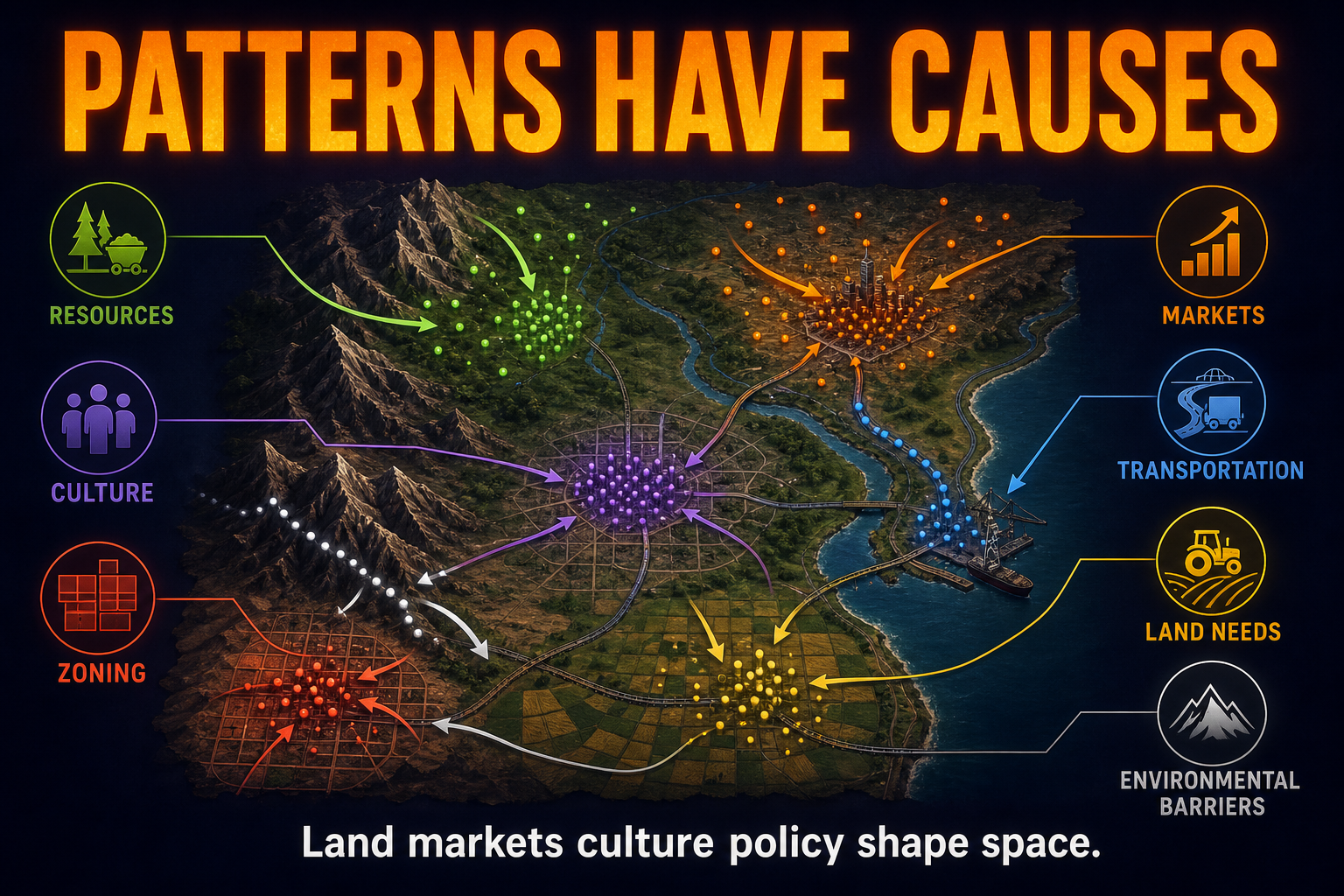
A strong answer gives at least one physical cause and one human cause when the prompt asks why a pattern exists.
Agriculture is one of the easiest ways to understand clustered and dispersed patterns. Intensive farming may cluster near markets, water, labor, or infrastructure. Extensive ranching and grain farming often disperse because they need more land.
Pattern: Clustered regional concentration
Why: Fertile soils, climate, grain elevators, markets, and historical specialization.
Pattern: Dispersed
Why: Large grazing areas and low stocking density.
Pattern: Regional belt with dispersed farms inside it
Why: Climate, mechanization, large fields, rail and market access.
Pattern: Clustered
Why: Shared infrastructure, labor, water, and market access.
Pattern: Clustered in suitable climate zones
Why: Climate, soil, water, and processing networks.
Pattern: May appear linear or uniform
Why: Engineering, water access, survey grids, or field layout.
Clustered and dispersed patterns also appear in Unit 5 Agriculture when students compare intensive crop regions, ranching, and large-scale grain farming.
Settlements can also be clustered, dispersed, linear, or uniform. The pattern depends on transportation, land use, environment, economics, policy, and cultural history.
Example: Homes group around a church, market, crossroads, or water source.
Example: Farmhouses spread across farmland.
Example: Homes or businesses follow a road, river, coast, or rail line.
Example: Planned grid towns or survey-based rural spacing.
Example: A metro area concentrates people, jobs, services, and infrastructure.
Example: Large-lot zoning spreads homes outward.
Settlement patterns connect to space as the framework for distance and arrangement, and to spatial analysis when you interpret map evidence about where people live.
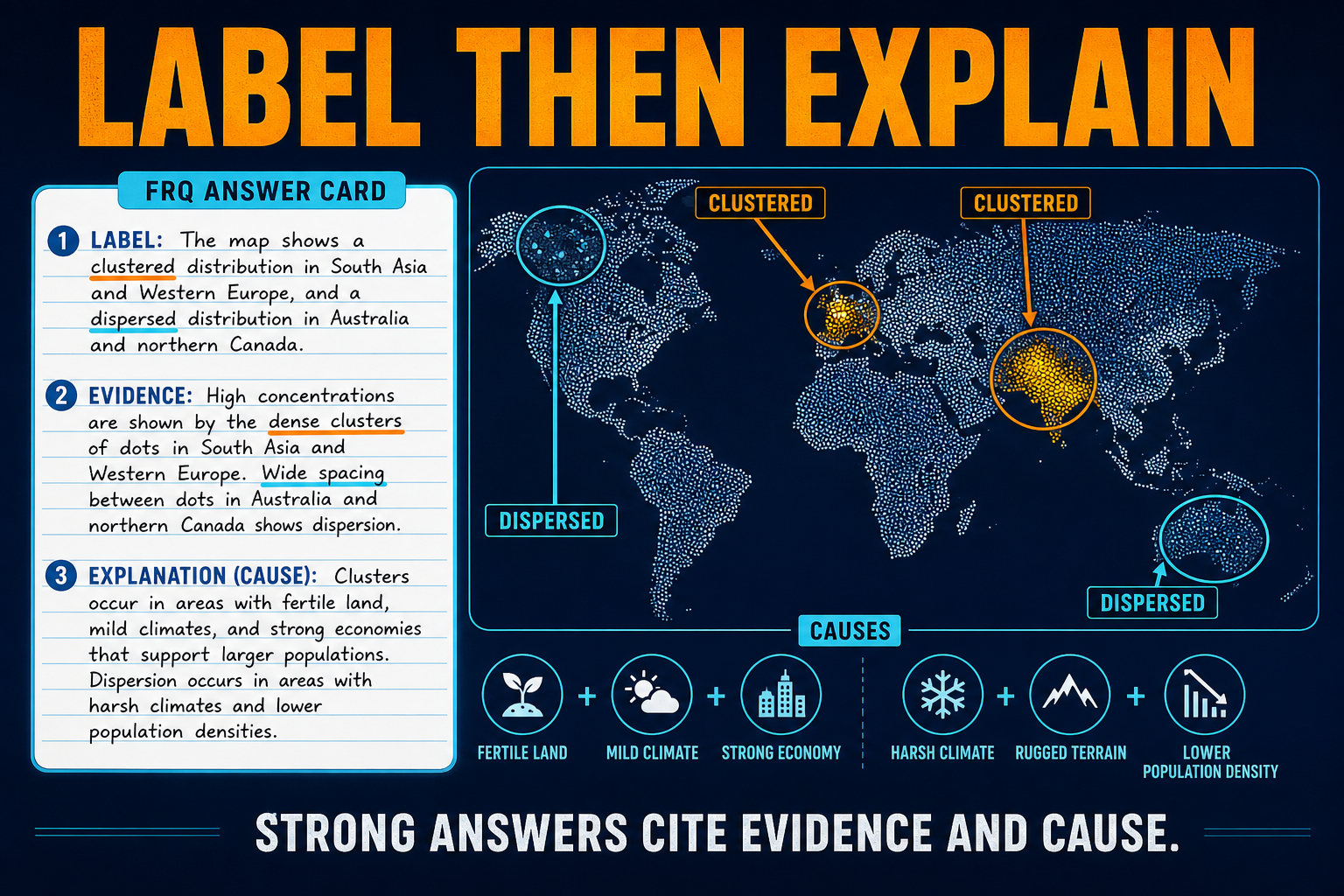
AP map questions reward evidence. Do not just guess the pattern. Look at spacing, empty areas, clusters, corridors, scale, and the map legend.
Strong AP answers do not just name the pattern; they cite visible map evidence such as bunching, empty areas, corridors, regular spacing, or uneven distribution.
Identify what is being mapped.
Look for bunching or empty zones.
Check whether spacing is irregular or regular.
Look for linear alignments along roads, rivers, coasts, or borders.
Compare local and regional scales.
Use the map legend and scale bar.
Name the pattern.
Explain why it matters.
Example: The map shows a clustered pattern because most points are concentrated near the coast while inland areas have few points. This may reflect port access, urban labor markets, and transportation networks, which make coastal locations more attractive for settlement and trade.
Hospitals, labs, and specialists cluster near academic medical centers.
AP exam clue: Agglomeration creates shared expertise and patient access.
Turbines disperse across windy rural land.
AP exam clue: Spacing and land needs shape dispersion.
Businesses, houses of worship, and cultural services cluster in a neighborhood.
AP exam clue: Culture, language, and social networks can create clustering.
Ranches spread across western rangeland.
AP exam clue: Extensive land use creates dispersed settlement.
Warehouses cluster near highways, ports, airports, and rail yards.
AP exam clue: Transportation access creates clustering.
Hospitals cluster in regional hubs while patients are dispersed across counties.
AP exam clue: Service access depends on spatial pattern.
Housing may cluster on available or risky land near job centers.
AP exam clue: Economic pressure and land access shape settlement patterns.
Towers are spaced to provide coverage across a region.
AP exam clue: Dispersed or uniform spacing can be planned.
Fix: Density counts amount per area; clustering describes arrangement.
Fix: Uniform means evenly spaced; dispersed means spread out and may be irregular.
Fix: Cite map evidence such as bunching, empty zones, corridors, or spacing.
Fix: A pattern can look clustered nationally but dispersed locally.
Fix: Explain why the pattern forms, not just what it looks like.
Fix: Include physical and human causes when possible.
Fix: Some patterns are linear, uniform, peripheral, or dispersed.
Fix: Explain how the pattern affects services, trade, land use, inequality, or planning.
Example: The map shows a dispersed pattern because cattle ranches are spread across large areas of the western Great Plains. A physical cause is the need for large grazing areas in semi-arid environments. A human cause is extensive land use tied to ranching and property patterns. The pattern matters because dispersed settlement makes services, transportation, and infrastructure more difficult to provide.
Cattle ranches across the western Great Plains show what pattern?
A. A clustered pattern occurs when features are grouped together in one or more concentrated areas.
B. A dispersed pattern occurs when features are spread out across space.
C. A physical factor that could cause dispersion is the need for large grazing areas in a semi-arid environment. Ranches may spread out because livestock require extensive land.
D. A human factor that could cause clustering is agglomeration near a transportation corridor or town center. Farms, markets, and services may cluster because roads, labor, suppliers, and customers are easier to access.
Use these clustered vs dispersed practice questions to test definitions, map patterns, agriculture examples, agglomeration, uniform vs dispersed traps, and FRQ reasoning.
Use these flashcards to review clustered, dispersed, and uniform patterns, distribution vocabulary, agriculture examples, and AP exam clues.
Clustered and dispersed patterns describe how geographic features are arranged across space. Clustered features are grouped together, while dispersed features are spread apart.
Clustered distribution means features are concentrated in one or more areas instead of being evenly spread across the whole space.
Dispersed distribution means features are spread out across an area, often with wide spacing between them.
Clustered patterns show features grouped together, while dispersed patterns show features spread apart across space.
Downtown office towers, ethnic neighborhoods, tech firms near universities, and warehouses near ports are examples of clustered patterns.
Cattle ranches, large grain farms, wind turbines, scattered wells, and large-lot rural homes are examples of dispersed patterns.
Clustered patterns occur because features may benefit from being near markets, labor, transportation, suppliers, resources, services, or cultural networks.
Dispersed patterns occur when activities need large land areas, resource spacing, safety buffers, zoning separation, grazing land, or broad service coverage.
Clustered means grouped together, dispersed means spread apart, and uniform means evenly spaced in a regular pattern.
No. Density measures how many features exist per unit area. Clustering describes whether features are grouped together or spread apart.
No. Dispersed means spread out, while uniform means evenly spaced. A dispersed pattern can be irregular, but a uniform pattern has regular spacing.
Look for bunching, empty zones, spacing, corridors, and scale. Then cite map evidence and explain why the pattern may have formed.
Agglomeration explains clustering because firms or activities may benefit from locating near shared labor, suppliers, markets, infrastructure, information, or services.
Crops may cluster where soils, climate, markets, and infrastructure are favorable, while ranching and large grain farms may disperse because they need extensive land.
Students should label the pattern, cite map evidence, explain a physical cause, explain a human cause, and state the geographic significance.