What shows up on the map or in the data?
Describe where something is clustered, dispersed, concentrated, connected, growing, shrinking, or changing. Start with distribution language—density, concentration, pattern—before you explain why.
One clear path through all seven units, exam structure, practice questions, vocabulary flashcards, and a dashboard-style study flow that shows what to study next. Built for busy students who need consistency, not cramming.
Think of it as the class that explains why the map looks the way it does. Why do megacities cluster along coastlines? Why do people migrate? Why is corn grown in Iowa and coffee in Ethiopia? AP Human Geography gives students vocabulary and models to answer those questions.
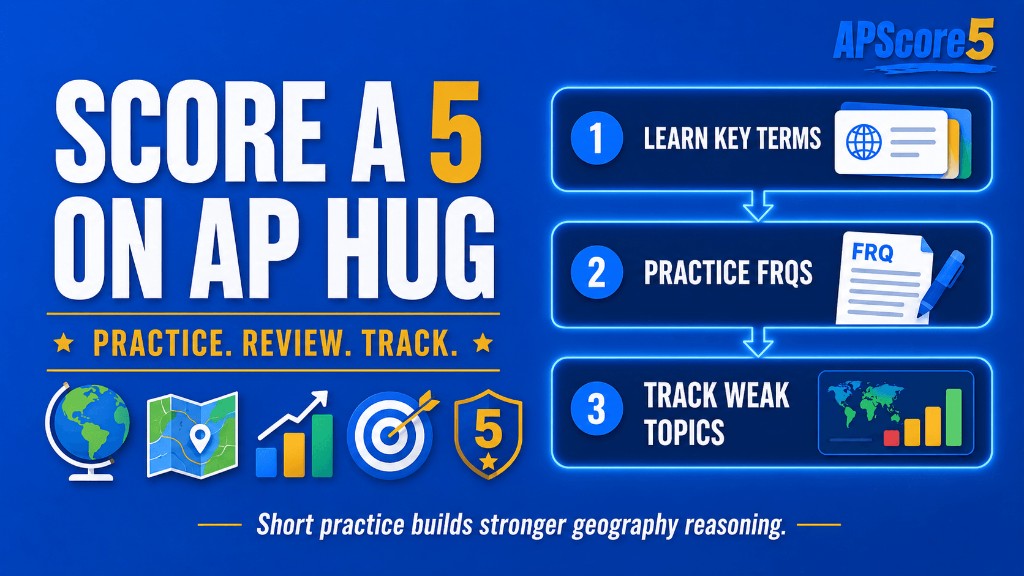
Strong AP HUG answers usually move through four moves in order: spot the pattern, name the process, label the scale, then ground it with an example.
Describe where something is clustered, dispersed, concentrated, connected, growing, shrinking, or changing. Start with distribution language—density, concentration, pattern—before you explain why.
Link the pattern to a process such as migration, diffusion, urbanization, development, agriculture, boundary change, cultural change, trade, or globalization—whatever the stimulus is actually asking you to discuss.
Name the scale of analysis: local, regional, national, or global. The same pattern can look different when you zoom in or out, and AP graders reward explicit scale vocabulary.
Tie the idea to a named place, map region, chart segment, or scenario in the prompt. Examples turn definitions into evidence-based geography.
Example: A fast-growing city is not just “urbanization.” A stronger AP HUG answer explains that rural-to-urban migration increases city population, changes land use, expands suburbs, and creates challenges such as housing pressure, traffic, or unequal access to services—using scale and process language from your stimulus.
AP Human Geography is usually a medium-difficulty AP course. It is not math-heavy and does not require a lab, but it has a large vocabulary load and the exam expects students to apply models, not just memorize definitions.
AP HUG is the most common first AP class in U.S. high schools because it builds the academic habits you will reuse in every later AP — close reading of stimulus material, vocabulary recall, and short precise FRQ writing — without any of the math or lab work that make other intro APs steep.
AP HUG is organized into 7 units, each weighted by its share of the AP exam. Use this breakdown to plan your study time — Units 2 and 5 alone make up roughly a third of the test, so they reward extra practice. The full unit roadmap with topics is below.
Thinking Geographically · 8–10%
Population & Migration · 12–17%
Cultural Patterns · 12–17%
Political Patterns · 12–17%
Agriculture · 12–17%
Cities & Urban Land Use · 12–17%
Industrialization & Development · 12–17%
These tactics come up repeatedly in high-scoring AP HUG essays. Build the habits during practice and they become automatic on test day.
Copy these stems into practice until they feel automatic—then swap in vocabulary from the prompt.
_____ is the process/pattern where…One reason this pattern occurs is…This leads to…At the local/regional/national/global scale…The map/data shows…For example, in…The first place differs from the second place because…This fits the _____ model because…Strong FRQ answers are usually short, labeled, and specific. You do not need long essays. You need precise sentences that define, explain, and apply the concept.
AP Human Geography questions use verbs on purpose. Match your answer depth to the verb—especially on FRQs.
Give the meaning of the term.
Show how or why something happens.
Connect the concept to a real place, map, data pattern, or scenario.
Tip: If the prompt says explain, do not stop at the definition.
Most lost AP HUG points come from a small number of repeat mistakes. Knowing what they are is half the fix.
Every study plan should start with the scoreboard. Multiple-choice and FRQ sections are equally important.
| Section | Questions | Time | Weight |
|---|---|---|---|
| Section I: Multiple Choice | 60 MCQs | 60 minutes | 50% |
| Section II: Free Response | 3 FRQs | 75 minutes | 50% |
| Total | 63 questions | 2 hours 15 minutes | 100% |
Units stack skills: spatial thinking from Unit 1 shows up inside migration maps, cultural diffusion, boundary disputes, farm regions, city models, and development indicators.
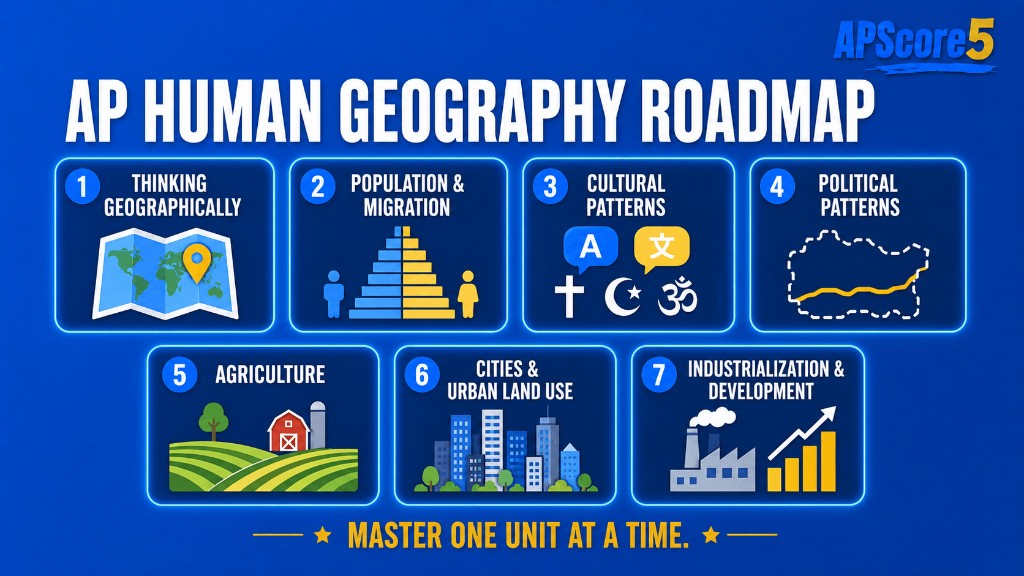
Maps, scale, regions, data types, and spatial patterns—the toolkit you reuse on almost every stimulus. Unit 1 hub →
Where people live, how populations change, and why people move—core drivers behind demographic maps and FRQ scenarios. Unit 2 hub →
How culture spreads, mixes, and shapes landscapes—from language and religion to globalization and identity. Unit 3 hub →
How political power creates boundaries, states, nationalism, devolution, and conflict—often paired with maps and data. Unit 4 hub →
How people use land for food—from subsistence to commercial systems and agricultural change. Unit 5 hub →
How settlements grow into urban systems—models, density challenges, and sustainability pressures in metropolitan areas. Unit 6 hub →
Why some regions industrialize and develop faster—trade, inequality, measures like GDP/HDI, and global economic networks. Unit 7 hub →
Use this roadmap to understand what each unit covers, why it matters on the exam, and the mistake students often make. Unit-specific pages can go deeper without this pillar competing with them.
Maps, scale, regions, GIS, diffusion, and spatial thinking.
Density, population pyramids, DTM, Malthus, migration, and push-pull factors.
Language, religion, cultural landscapes, diffusion, globalization, and identity.
States, nations, boundaries, gerrymandering, devolution, and supranationalism.
Agricultural revolutions, subsistence and commercial agriculture, von Thünen, and food systems.
Urban hierarchy, city models, gentrification, suburbanization, and urban sustainability.
Industrialization, development measures, Weber, Wallerstein, Rostow, outsourcing, and reshoring.
AP Human Geography questions often include maps, graphs, tables, population pyramids, satellite images, and infographics. Before answering, slow down and read the visual like evidence.
Flip one card at a time to build the vocabulary foundation students need for MCQs and FRQs.
A 60-second signup gives students a personal study map, saved practice, and a progress bar for every unit.
Start Free — Track My Progress →Answer one question at a time. The diagnostic now includes 20 questions across all seven units so students can quickly see where they are strong and where they should review next.
Do one flashcard session, one MCQ, and one quick reflection on what you missed. The goal is consistency, not marathon studying.
They review wrong answers, write a one-sentence correction, and return to weak topics after a short gap.
These quick comparison answers help students choose the right first AP class and give search engines clear, snippet-ready answers. Deep concept definitions such as DTM, von Thünen, Burgess, Rostow, and Wallerstein should live on separate microtopic pages.
AP Human Geography is usually easier as a first AP course because it focuses on spatial patterns, maps, vocabulary, and models. AP World History is broader and more reading-heavy because it covers long time periods, civilizations, causation, continuity, and comparison.
| Course | Best for students who like | Main challenge |
|---|---|---|
| AP Human Geography | Maps, cities, culture, migration, population, global patterns | Learning vocabulary and applying models to real examples |
| AP World History | Empires, revolutions, trade networks, major historical change | Heavy reading, timelines, evidence, and essay writing |
AP Human Geography studies how people organize space through population, culture, agriculture, cities, politics, and economic development. AP Environmental Science studies ecosystems, pollution, energy, climate, resources, and human impact on the natural environment.
| Course | Focus | Typical question style |
|---|---|---|
| AP Human Geography | Human patterns across space | Interpret maps, models, population data, and urban/agricultural examples |
| AP Environmental Science | Environmental systems and human impact | Apply science concepts to ecosystems, pollution, energy, and sustainability |
Choose AP Human Geography first if you like maps, global issues, cities, migration, and cultural patterns. Choose AP Psychology first if you like behavior, memory, learning, personality, disorders, and the brain. Both can work as a first AP, but AP Human Geography builds early social-studies and FRQ skills.
| Course | Better fit | Study style |
|---|---|---|
| AP Human Geography | Students who like world patterns and visual examples | Short daily vocabulary, model practice, and map/data interpretation |
| AP Psychology | Students who like people, behavior, and memory science | Term memorization, experiments, examples, and concept application |
Use these logistics guides before your final review week so there are no surprises on registration, fees, or test-day rules.
AP Human Geography is medium-difficulty among AP courses. It is not math-heavy and has no lab, but it has a large vocabulary load and asks students to apply models to real scenarios.
Yes. AP Human Geography is often a strong first AP class because the reading is manageable, the math is light, and the skills transfer to other AP social studies courses.
No. AP Human Geography is a social science course focused on spatial patterns. History organizes events mainly through time; human geography organizes human activity through space.
AP Human Geography studies where people live, why they move, how cultures spread, how cities grow, how food systems work, and how economies develop.
The exam is 2 hours and 15 minutes. Section I has 60 multiple-choice questions in 60 minutes, and Section II has 3 free-response questions in 75 minutes.
The best way is to study 5 to 10 minutes a day with vocabulary flashcards, concept practice, and explanations for missed questions.
Many students find Unit 6, Cities and Urban Land Use, difficult because it includes several city models and requires applying them to real regions.
You can browse and try some practice without an account, but a free account saves progress, tracks weak areas, and helps build a personalized study path.
The fastest way to improve your AP Human Geography score is to start with Unit 1. It builds the foundation for every other unit — maps, scale, regions, diffusion, and spatial thinking.
Learn maps, diffusion, regions, and scale — the core ideas used across the entire AP Human Geography course.
Test your understanding instantly and see how AP Human Geography questions are asked.
Five minutes a day compounds into stronger recall, better FRQ answers, and more confidence by exam day.
⏱ Takes less than 5 minutes to get started
Most students should start with Unit 1 — don’t skip the foundation.
Start Unit 1 Now →