AP Courses AP Biology AP Biology Units AP Human Geography AP HUG Units AP Computer Science Principles AP CSP Units
Practice Daily Practice Practice by Course Practice by Topic Practice Tests
AP Exam Resources AP Exam Dates Registration Fees Scores & Credit What to Bring
Start Practicing → Login
AP Human Geography · Unit 1 · Microtopic

Cartograms in AP Human Geography

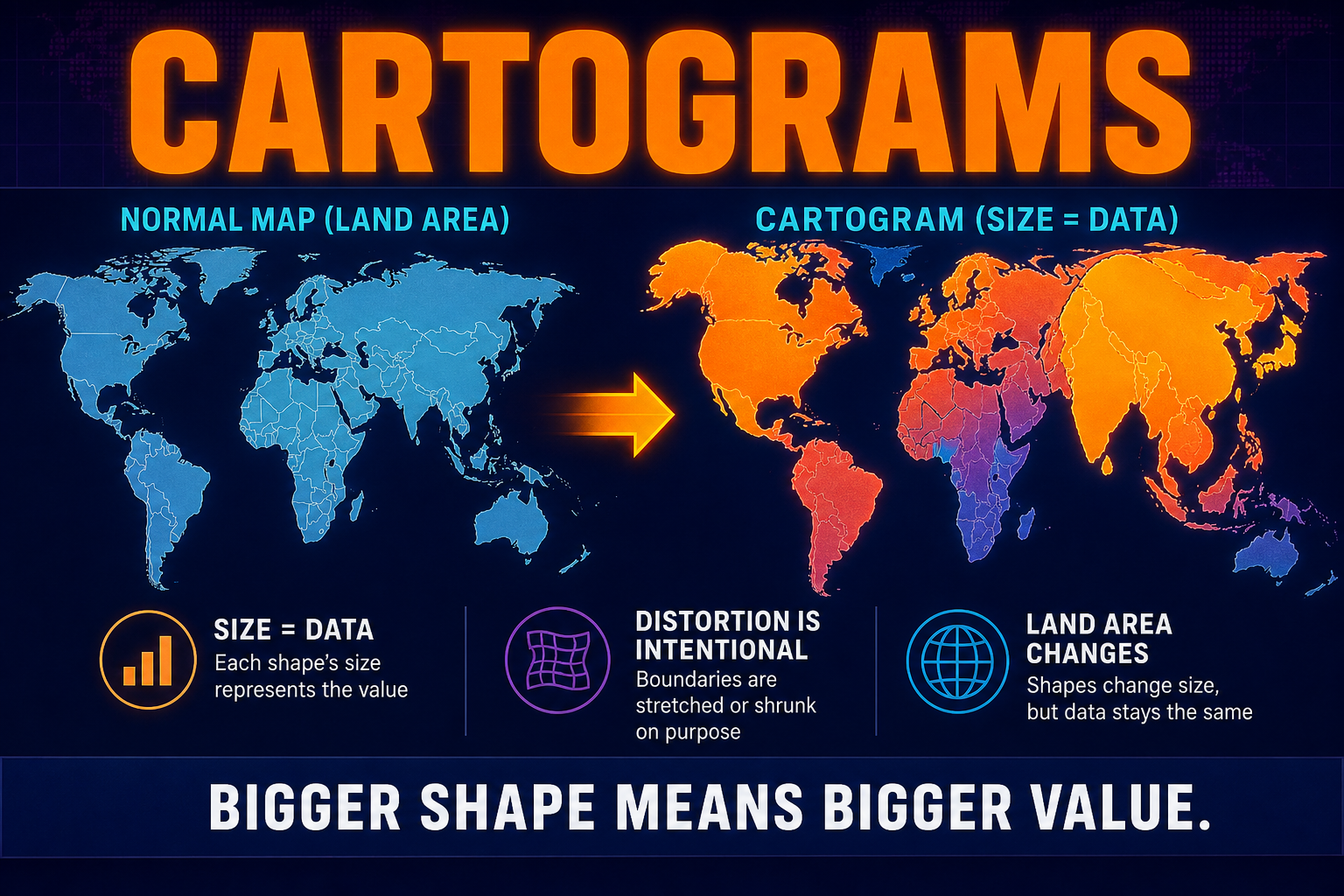
A cartogram is a thematic map that resizes regions by a data variable—population, GDP, votes—so bigger shapes mean bigger values, not bigger land area.

Practice with real AP Human Geography examples, compare spatial evidence across maps, and review with 22 flashcards plus 16 AP-style questions with explanations.

Updated May 5, 2026 Reviewed by APScore5 Editorial Team

Learn in 7 mins · Practice in 10 mins

Unit 1 · 8-10% of exam Thematic map type 22 flashcards 16 AP-style questions
Size = data, not land Big value, big shape
Data over geography Intentional distortion
22 flashcards Cartogram vocabulary deck
3 → 4+ score path 3 → 4+ score path
Bar chart, percent sign, and pyramid icons. % Charts turn numeric evidence into geographic claims
Quantitative data feeds the maps and graphs AP loves.
Direct answer

What is a cartogram in AP Human Geography?

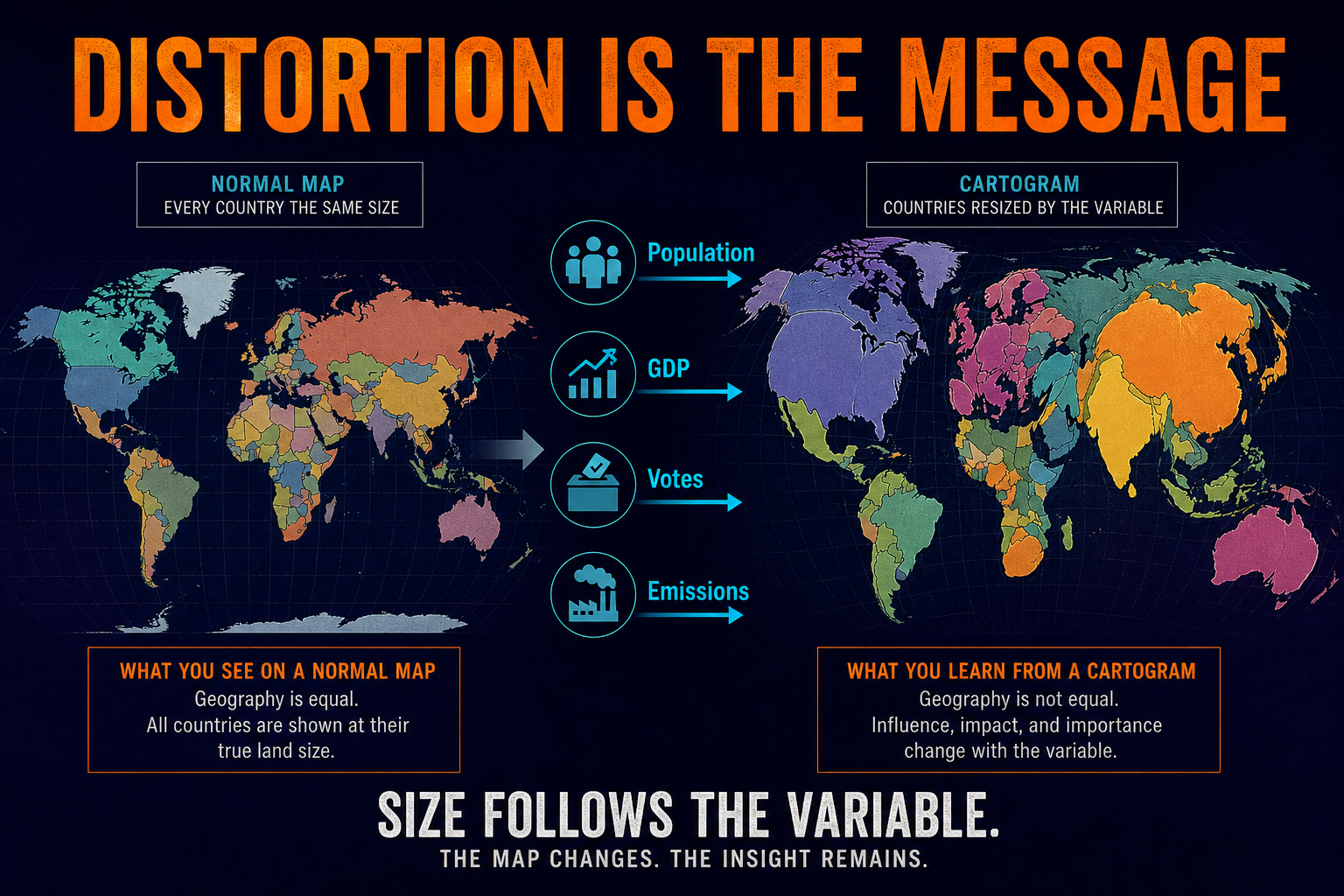
A cartogram is a thematic map that resizes region size or shape to show a data variable like population, GDP, election votes, or emissions. On a cartogram, larger polygons mean larger mapped values rather than larger land areas—so a world population cartogram can make India and China look huge while Canada and Australia shrink.

What is cartogram
Figure - A cartogram study pattern analysis
Simple definition

Cartogram — the simple version

In one sentence: A cartogram is a thematic map that resizes places based on data values.

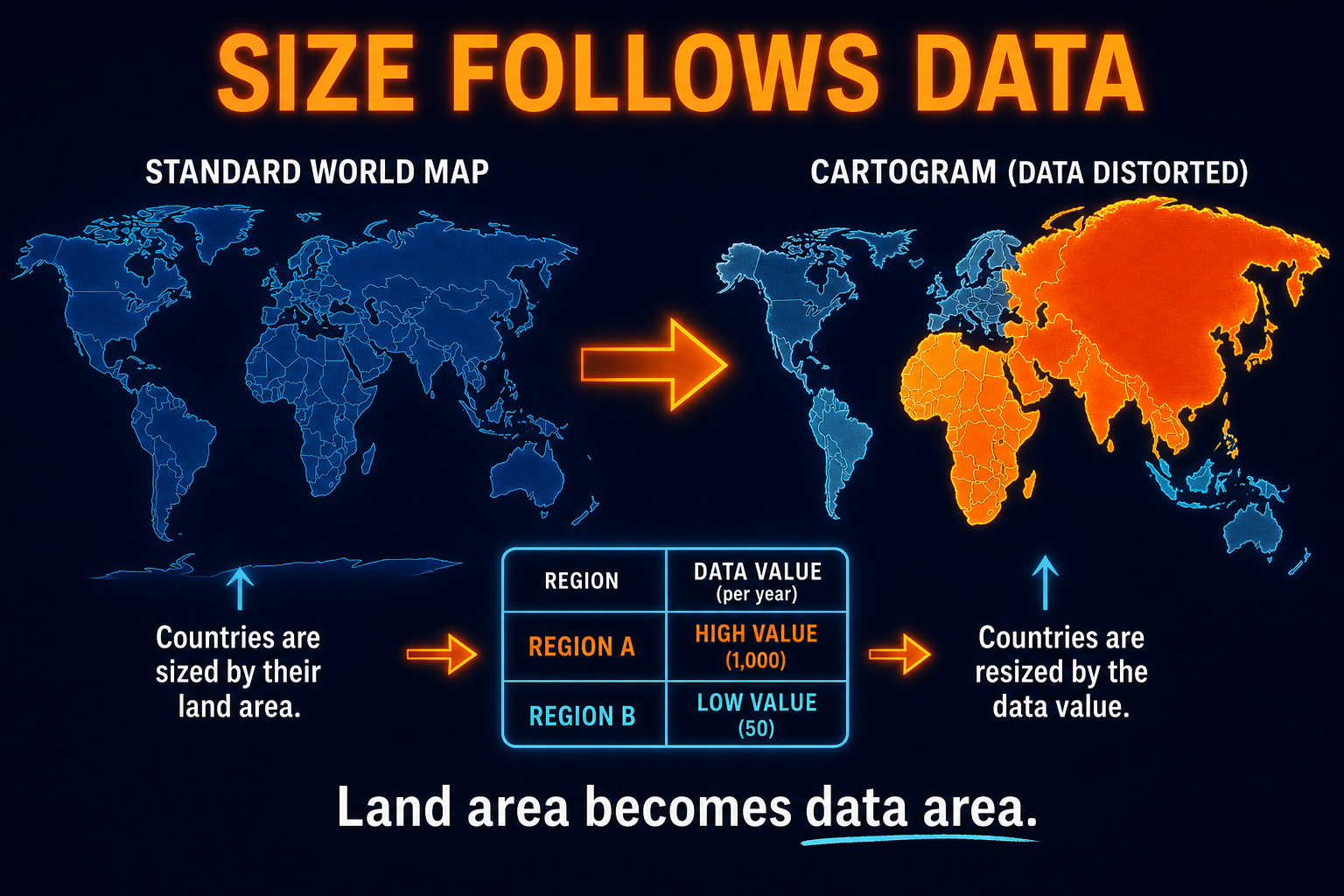
A regular world map shows Canada as huge because of land area. A population cartogram shrinks Canada and enlarges India because size on the map follows population totals.

Overview

What is a cartogram?

Standard political maps keep true land area. A population cartogram warps those shapes so the story is how many people, not how many square miles. Cartograms are thematic maps: the cartographer resizes regions so the map shows a data variable—totals, shares, or rates—instead of true geography.

Cartograms at a glance

Compare a standard land-area map with a population cartogram side by side.

Land map vs population cartogram
Same world—size shows data, not land area.
Exam lens
AP shortcut: Cartogram = thematic map where size shows data, not land area.

Cartograms reward the habit of reading titles and legends first. Every stretched polygon is a design choice: the cartographer chose to emphasize magnitude, not physical geography.

Full definition

Cartogram AP Human Geography definition

Formal definition: A cartogram is a thematic map that distorts geographic area to represent a variable such as population, GDP, election votes, or emissions. Area on the map is proportional to the chosen data value, not physical land area.

Thematic map

Cartograms focus on one variable and are not for navigation.

Intentional distortion

Shape change is the communication device, not a mistake.

Size = data

Larger polygons indicate higher values of the mapped variable.

Built from quantitative data

Most are generated with GIS and tabular indicators.

How it works

How cartograms distort space

A cartogram changes area so mapped values are easy to compare. Regular maps show physical size; cartograms show variable size.

It's a number

Density, income brackets expressed numerically, percentages, counts per unit time—all quantitative.

It's measurable

Distance, travel time, crop yield per acre, emissions per capita—each uses standardized units.

It's comparable

You can rank states, contrast decades, or benchmark neighborhoods because the metric stays stable.

It's plottable

Chart-ready figures feed histograms, scatterplots, box plots, population pyramids, and thematic maps.

It supports math

Averages, growth rates, z-scores, and projections begin with quantitative measurements—not vibes.

It looks objective first

Numbers feel neutral, yet sampling frames and definitions still need critique—always pair enthusiasm with caution.

Examples

What does a cartogram look like in real life?

In a population cartogram, India and China expand while Canada and Australia shrink because area represents total population instead of land area. Use the side-by-side model in Cartograms at a glance when you need a quick mental picture.

Examples

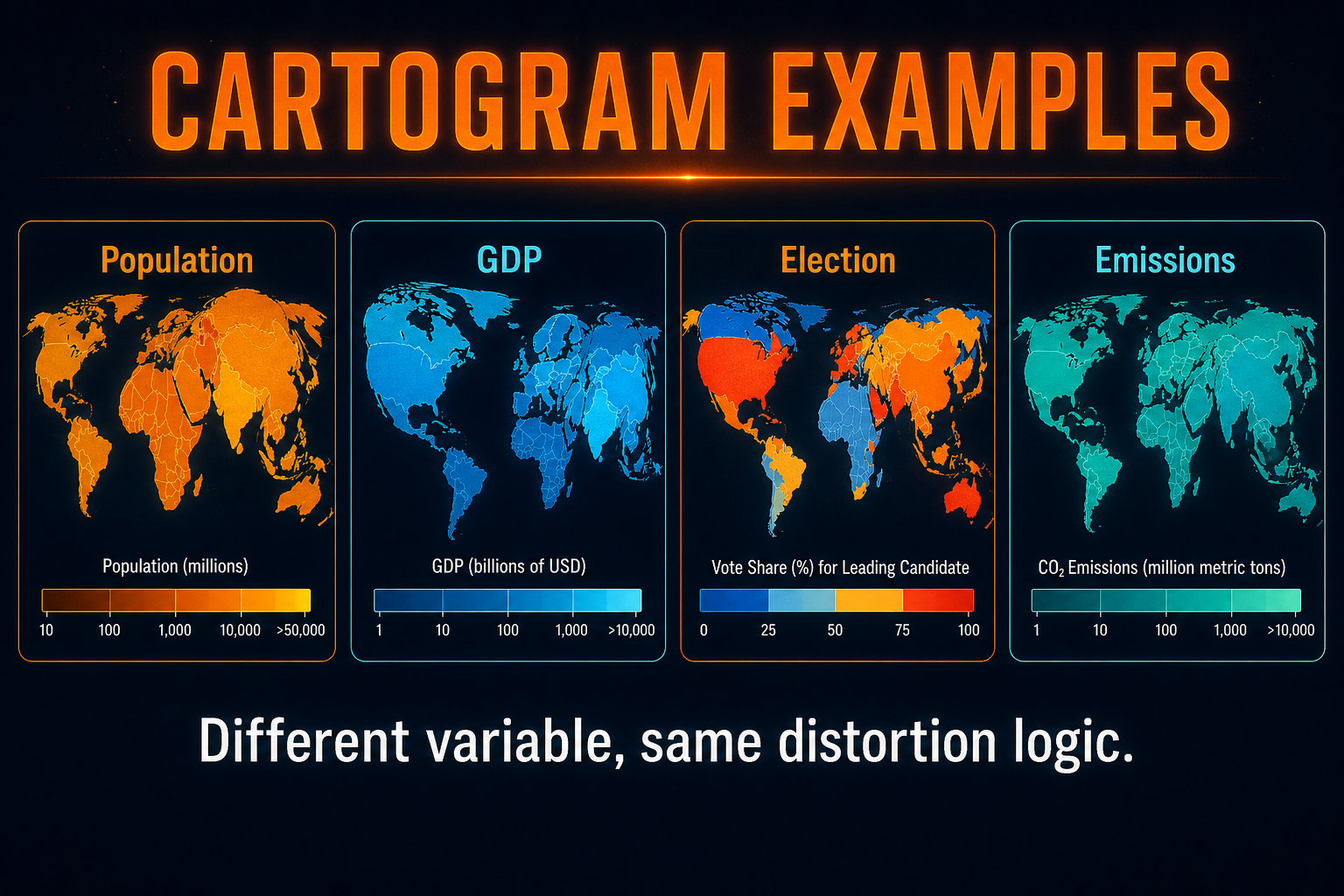
Eight cartogram examples AP students should know

Population cartogram

India and China dominate by total population.

GDP cartogram

U.S., China, Japan, and Germany enlarge.

Election cartogram

States resize by electoral votes or voter totals.

Carbon emissions

Major emitters expand dramatically.

Internet users

High-population connected countries expand.

COVID case totals

Outbreak burden appears quickly.

Migration totals

Regions resize by inflow/outflow magnitude.

Olympic medals

Countries resize by medal count.

Uses cartogram
Figure - Eight cartogram examples students uses
Exam playbook

How cartograms appear on the AP exam

In multiple-choice questions

Items usually test vocabulary (“What kind of map resizes area?”), stimulus reading (identify the variable in the title/legend), or comparison (cartogram vs choropleth vs reference map).

In free-response questions

Stimuli may pair a standard map with a cartogram, ask you to describe a pattern, explain why a country enlarges, or describe a tradeoff of intentional distortion.

Common stimulus types

World or regional population cartograms, U.S. election cartograms, or side-by-side maps that switch from land area to a social or economic total.

AP writing formula

Strong AP answer structure: Variable (name what is mapped) → distortion (what grows or shrinks) → pattern (core geographic claim) → explanation (process or significance). If the prompt requests a limitation, add one sentence on shape, distance, or adjacency.

Quick Check

Test yourself in 5 seconds

A cartogram resizes regions based on:

Types

Types of cartograms

Four cartogram types compared: Contiguous, Non-contiguous, Dorling, and Value-by-area, each showing the same four regions rendered differently.
Same data — four visual approaches.
  • Contiguous: Regions remain connected but stretch and compress.
  • Non-contiguous: Regions resize independently and may separate.
  • Dorling: Regions become circles sized by data values.
  • Value-by-area: General family where area is proportional to value.
Map family

Are cartograms thematic maps?

Yes. Cartograms are thematic maps because they prioritize one data theme over precise geographic shape.

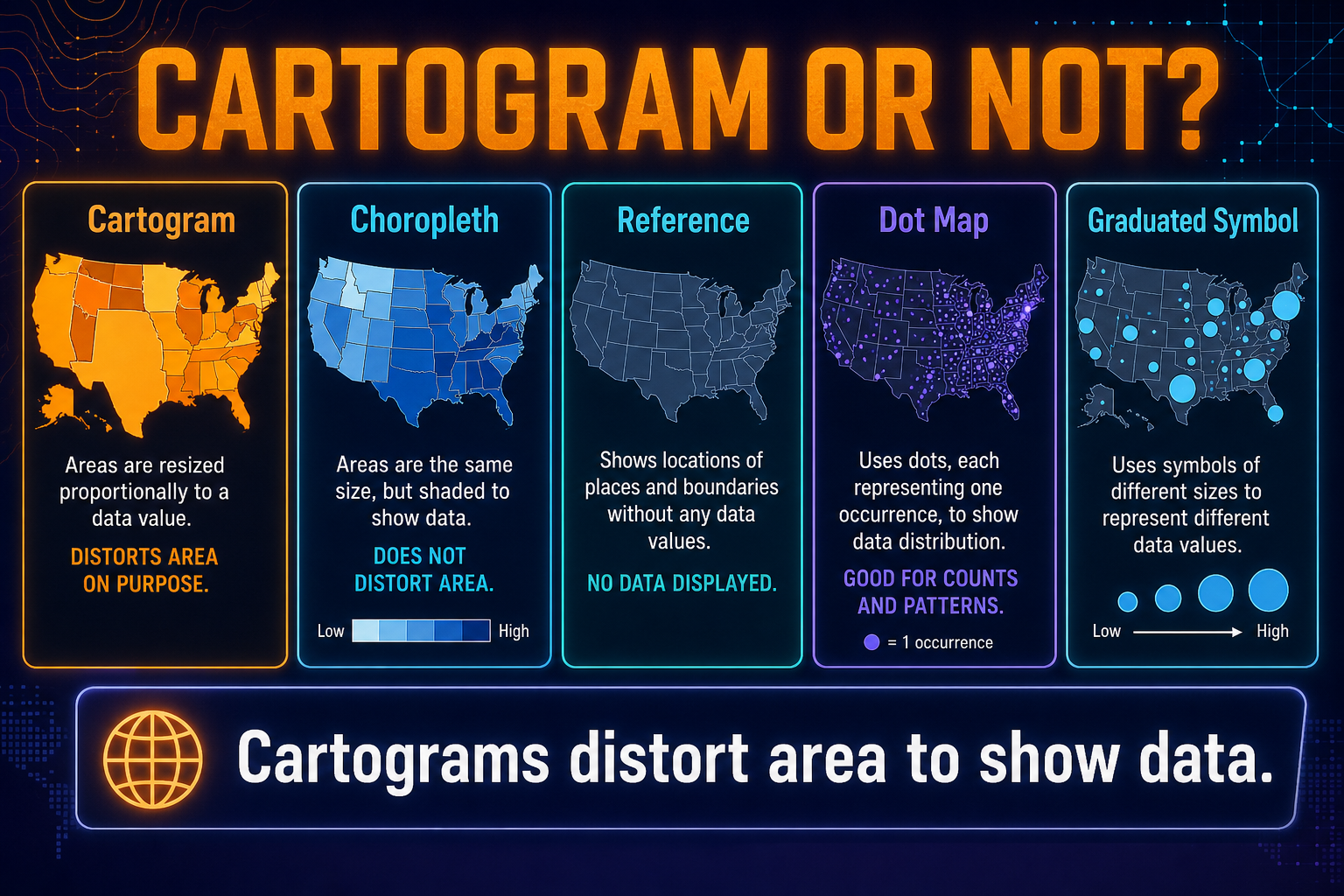
FeatureCartogramChoropleth
MethodResizes areaUses color shading
Best forTotal magnitudeRates and percentages
LimitationDistorted shapesLarge polygons can dominate visual weight

Exam takeaway: Same dataset, different visual emphasis. Cartograms emphasize totals; choropleths emphasize rates.

Compare

Cartogram vs choropleth map

Both are thematic maps, but they encode data differently. A cartogram resizes regions by value. A choropleth keeps boundaries fixed and uses color classes. Use cartograms for magnitude totals and choropleths for rates by region.

Exam lens

Cartogram vs reference map

Reference maps preserve shape and location for orientation. Cartograms distort shape to highlight variable magnitude across regions.

What AP questions may ask

  • Identify a pattern shown by numerical data.
  • Compare two countries or regions.
  • Explain why a value is high or low.
  • Describe change over time.
  • Use data to support a claim.
  • Explain a limitation of the data.
  • Connect data to a geographic model or theory.

Typical task verbs

  • Describe numeric patterns or trends.
  • Compare countries, neighborhoods, or cohorts.
  • Explain why a value might be high or low.
  • Connect figures to models (DTM, bid-rent, epidemiologic transition).
  • Critique data limitations tied to source, scale, or vintage.

Weak FRQ: “Country A has a birth rate of 35.” Strong FRQ: “Country A’s birth rate exceeds Country B’s, implying faster natural increase—possibly because of lower female secondary enrollment, limited contraceptive access, or agricultural labor needs.”

Keep the chain explicit: Number → Pattern → Explanation → Geographic significance.

Why distortion

Why cartograms distort space

  • Stale releases: Fast-growing metros may outpace older census cycles.
  • Sampling bias: Surveys collected at single hubs miss entire commuting cultures.
  • Scale mismatch: National averages flatten pockets of deep poverty.
  • Hidden dispersion: Medians or means may conceal inequality within tracts.
  • Definition drift: Countries classify “urban” or “literacy” differently.
  • Method differences: Two countries may count the same indicator using different rules, making direct comparisons tricky.

Whenever a stimulus asks about reliability, loop back to data reliability and bias and rehearse how you would critique the evidence before accepting the map’s story.

Another pressure test is to ask who benefits when a number looks “clean.” Crowd-sourced traffic apps and social feeds can be dominated by certain neighborhoods, over-weighting tech-savvy travelers. Even official agencies may publish mid-year estimates that miss rapid displacement after a storm. The fix in your writing is the same: name the vintage, the geography, the collection method, and the group you suspect is undercounted. That language keeps you honest while still using quantitative data as the spine of the answer.

Finally, treat limitations as part of the geographic story, not an afterthought. A student who says, “The poverty rate is 12% but the survey skipped unhoused residents, so the true value is likely higher near transit depots” is doing advanced work: the number still matters, but the critique shows you understand how place and process shape data quality.

Benefits

Why cartograms are useful

  1. Repeating the number without explaining the pattern. AP graders want analysis, not a paraphrased table.
  2. Confusing quantitative with qualitative. Numbers signal quantitative evidence; descriptions signal qualitative evidence.
  3. Treating numbers as absolute truth. Data can be biased, outdated, or measured at the wrong scale.
  4. Forgetting to mention scale. A national figure can hide regional differences.
  5. Skipping the comparison. Say “high compared to what?” whenever you call a value high or low.
  6. Missing the geographic significance. Always connect the statistic to a place, pattern, or process.
  7. Ignoring the source. Census, survey, satellite, and app-based feeds each carry different limits.
Limitations

What are the limitations of cartograms?

  • Shapes and adjacency can be hard to recognize.
  • Distance and direction are not reliable.
  • Not useful for navigation tasks.
  • Single-variable focus can oversimplify complex places.
How to read

How to interpret cartograms on the AP exam

Use this flow: Variable → Distortion → Pattern → Explanation. First identify the variable from title and legend. Then identify enlarged and shrunken regions. Finally explain what that pattern reveals geographically.

How read cartogram
Figure - Interpret cartograms on exam read cartogram
Common mistakes

Mistakes that cost easy points

  1. Reading size as land area instead of data value.
  2. Ignoring title and legend before interpretation.
  3. Confusing cartograms with choropleths.
  4. Treating distortion as an error instead of a design choice.
  5. Describing patterns without naming the mapped variable.
  6. Using cartograms for exact location/distance claims.
  7. Forgetting cartograms are thematic maps.
Flashcards

Twenty-two flip cards — cartograms

Every fifth card transition shows an ad placeholder with a three-second countdown before the next card appears.

Practice

Cartogram AP Human Geography practice questions (16 AP-style MCQs)

Use the score card to track accuracy. After every fifth answered question you will see an ad placeholder with a three-second countdown before the next question loads.

FRQ skill

Practice FRQ — Population cartogram

Prompt: A geographer uses a world cartogram in which countries are resized by total population. India, China, and Indonesia appear larger than on a standard political map, while Canada and Australia appear smaller.

  • Part A: Define cartogram.
  • Part B: Explain why India and China appear larger.
  • Part C: Explain one advantage of this map type.
  • Part D: Explain one limitation of this map type.
Frq on cartogram practice
Figure - Practice frq population cartogram on
Reading a cartogram on the FRQ: simplified population cartogram with annotations, plus the four-step writing formula — Variable, Distortion, Pattern, Explanation.
Use the same four-step structure on every cartogram FRQ.

Sample 4-point response

A. A cartogram is a thematic map that distorts region size based on a data value such as population or GDP.

B. India and China appear larger because the cartogram resizes area by total population, and both countries have high population totals.

C. One advantage is that population concentration is easier to compare quickly than on a political map where land area dominates visual attention.

D. One limitation is that shape, distance, and direction are distorted, so the map is not suitable for navigation or true area comparison.

Rubric (4 pts)

Part A: Must mention “numerical” and tie data to places or patterns.

Part B: Names a specific indicator from the scenario.

Part C: Connects density to urban growth—not only defining density.

Part D: Explains why median income is limiting (for example, masks variation or inequality).

Common misses

Listing numbers without explaining spatial pattern, treating median income as a perfect poverty score, or mentioning density without linking it to growth processes.

One-minute recap

Cartogram recap

AP shortcut: Cartogram = thematic map where size shows data, not land area.
  • Big shape means big mapped value.
  • Cartograms are thematic maps, not reference maps.
  • Population, GDP, elections, and emissions are classic variables.
  • Use Variable → Distortion → Pattern → Explanation on FRQs.
FAQ

Frequently asked questions

What is a cartogram in AP Human Geography?

A cartogram is a thematic map that distorts region size based on a data value such as population, GDP, emissions, or election totals.

What is a simple example of a cartogram?

A world population cartogram where India and China enlarge while Canada and Australia shrink.

What does a cartogram show?

It shows a data theme through resized map areas rather than through true land-area geometry.

Are cartograms thematic maps?

Yes. Cartograms are thematic maps because they prioritize one data theme over location accuracy.

Why are cartograms distorted?

Distortion is intentional so map area can represent data magnitude rather than physical land area.

What is the difference between a cartogram and a choropleth map?

Cartograms resize area; choropleths keep area fixed and use color classes.

What is the difference between a cartogram and a reference map?

Reference maps preserve location and shape for orientation; cartograms prioritize data comparison.

What are main cartogram types?

Contiguous, non-contiguous, Dorling, and value-by-area forms are the major categories.

What is one weakness of cartograms?

Shape and distance distortion can make navigation and exact location interpretation difficult.

What is a population cartogram?

A map where region size is proportional to total population.

How should I read a cartogram on AP exam day?

Use Variable → Distortion → Pattern → Explanation and cite the mapped variable explicitly.

Synthesis

Keep Unit 1 skills working across every unit

Treat this microtopic as living vocabulary—reuse these habits whenever stimuli combine maps, tables, interviews, or timelines.

Exam stimuli

Pair sources before you lock an answer

Read legends, scales, units, and captions together—decide whether evidence supports a regional trend or a misleading aggregation inside one polygon.

Units 2–7 bridge

Population through development

Population change, cultural diffusion, borders, rural systems, urban service gaps, and economic indicators all reward the spatial precision you practice in Unit 1.

FRQ craft

Claim → evidence → significance

Name the place, pull a detail from the stimulus, connect to a course concept, and end with a consequences sentence—skip definition dumps.

Evidence hygiene

Scale, time, and bias

Call out who collected the data, at what geography, and when. Note missing groups when quantitative and qualitative pieces disagree.

Continue learning

Related Unit 1 guides

Start Free Practice & Track Progress →