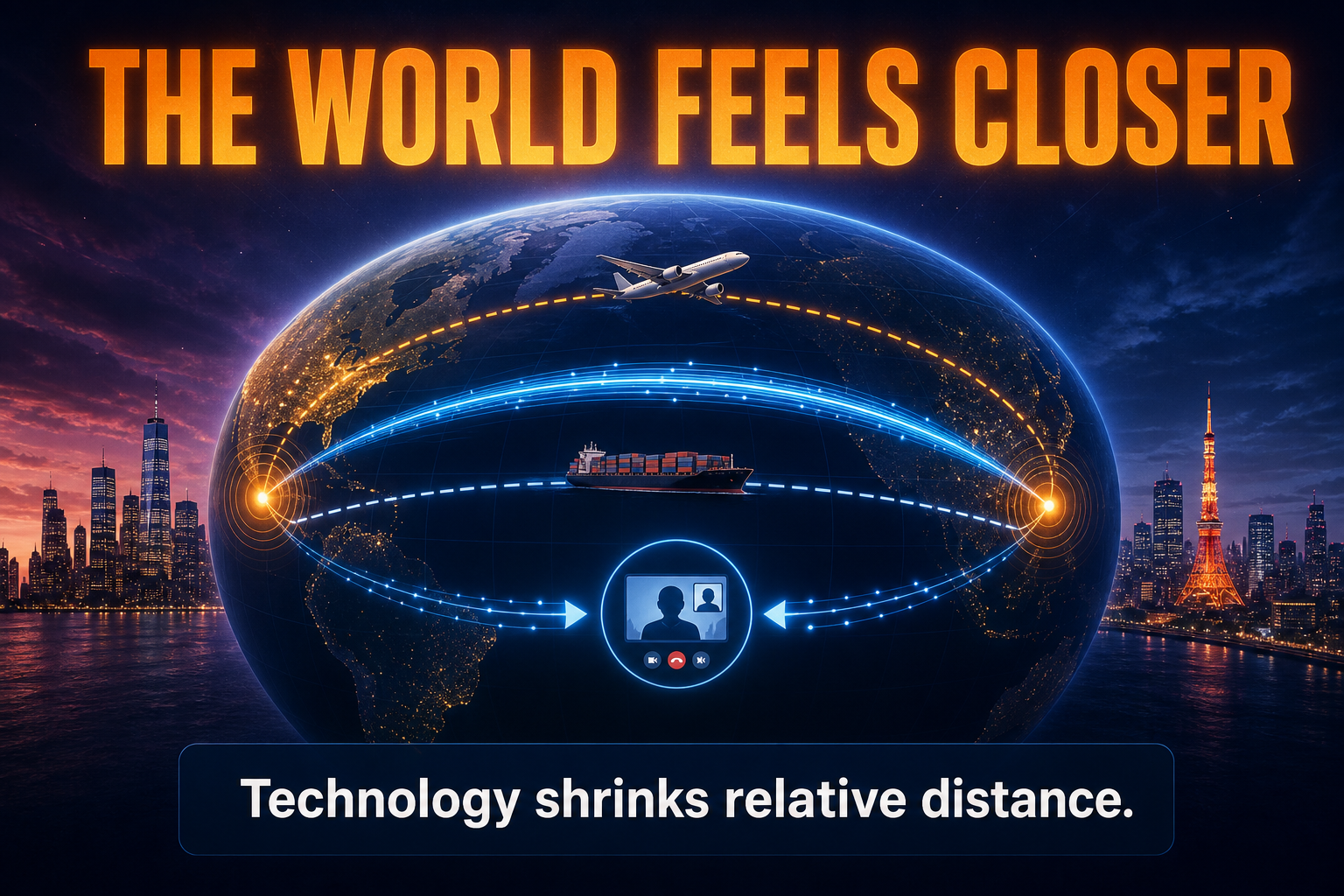
Learn how transportation, communication, logistics, and digital technology shrink relative distance, speed up interaction, intensify globalization, and create uneven access across places.
Updated June 5, 2026 · Reviewed by APScore5 Editorial Team
Time-space compression explains how technology reduces the time, cost, and effort needed to connect across distance.
Quick answer
⚡
What Is Time-Space Compression in AP Human Geography?
Time-space compression is the process by which transportation and communication technologies reduce the time, cost, and effort needed to connect across distance. In AP Human Geography, it explains why distant places can feel closer through airplanes, container shipping, highways, railroads, satellites, smartphones, video calls, GPS, and the internet, even though absolute distance does not change.
AP exam clue
If the prompt says technology makes travel, trade, communication, migration networks, or cultural diffusion faster across long distances, think time-space compression.
Time-space compression means relative distance shrinks.
Absolute distance stays the same, but time, cost, and effort decrease.
Transportation compresses movement of people and goods.
Communication compresses movement of information and ideas.
Compression supports globalization, but access is uneven because of digital divides, income, infrastructure, borders, and political barriers.
Memory Shortcut
Compression = same miles, less time.
Miles stay fixed.
Travel gets faster.
Communication becomes instant.
Trade gets easier.
Access is unequal.
Start Here: How to Use This Time-Space Compression Guide
Learn the definition of time-space compression.
Compare absolute distance with relative distance.
Study transportation and communication examples.
Connect compression to globalization, diffusion, migration, and distance decay.
Finish with MCQs, flashcards, and FRQ practice.
Section 1
📖
Time-Space Compression Definition
Time-space compression is the reduction in relative distance caused by faster transportation, communication, logistics, and infrastructure. Absolute distance, or miles between places, does not change. What changes is how long, costly, or difficult it feels to interact across that distance.
Time-space compression
Definition
The shrinking of relative distance because technology reduces time, cost, or effort.
Absolute distance
Definition
The measurable physical distance between two places, such as miles or kilometers.
Relative distance
Definition
Distance measured by time, cost, effort, accessibility, or perceived closeness.
Friction of distance
Definition
The slowing effect that distance has on movement, interaction, and exchange.
Transportation technology
Definition
Tools and systems that move people and goods faster, such as trains, planes, ships, highways, and logistics networks.
Communication technology
Definition
Tools and systems that move information faster, such as telegraph, phones, satellites, fiber optics, internet, and smartphones.
Globalization
Definition
Increasing economic, cultural, political, and technological connections among places.
Digital divide
Definition
Unequal access to digital technology and internet infrastructure.
Compression builds on core Unit 1 ideas such as space, relative location, and absolute location when you explain how technology changes perceived distance without changing physical coordinates.
Section 2
📏
Absolute Distance vs Relative Distance
Time-space compression only makes sense when students separate absolute distance from relative distance. Absolute distance is fixed physical distance. Relative distance changes when technology, infrastructure, income, borders, or communication access changes.
Concept
Meaning
AP Example
Exam Clue
Absolute distance
Physical distance measured in miles or kilometers
New York and London remain thousands of miles apart
Miles, kilometers, latitude and longitude
Relative distance
Distance measured by time, cost, effort, or accessibility
A flight or video call makes New York and London feel closer
Hours, dollars, effort, travel time, bandwidth
Time-space compression
Reduction in relative distance
A video call replaces weeks of letter exchange
Technology reduces friction
Distance decay
Interaction usually declines as distance increases
People shop more often at nearby stores than distant stores
Friction remains, but may weaken
AP Exam Tip
Never say the Earth physically shrinks. Say relative distance decreases while absolute distance stays the same.
Time-space compression reduces relative distance, while absolute distance between places stays the same.
Pair this section with the distance decay guide when you explain how friction of distance still shapes interaction even when technology speeds up connection.
Section 3
🚂
Transportation and Time-Space Compression
Transportation technology compresses space by reducing the time and cost of moving people and goods. Railroads, steamships, automobiles, highways, airplanes, container ships, high-speed rail, ports, airports, and logistics systems make distant places more connected.
Railroads
Shortened overland travel and connected inland regions to cities and ports.
Steamships
Reduced ocean travel time and made long-distance trade more predictable.
Automobiles and highways
Expanded commuting, suburbanization, road trips, trucking, and regional travel.
Commercial aviation
Turned intercontinental travel from weeks or days into hours.
Container shipping
Lowered shipping costs and made global supply chains easier.
High-speed rail
Compressed travel time between major cities and regions.
Logistics networks
Combined warehouses, GPS, routing, ports, trucks, planes, and data to reduce delivery delays.
Canals and chokepoints
Shortened routes by connecting major water bodies and concentrating trade flows.
Transportation compression changes how distance decay works for people and goods because travel time and cost fall even when miles stay fixed.
Transportation technologies compress space by reducing the time and cost required to move people and goods.Section 4
📡
Communication and Time-Space Compression
Communication technology compresses space by reducing the time needed to exchange information and ideas. Telegraphs, telephones, satellites, fiber optics, email, social media, smartphones, GPS, video calls, and translation tools allow people to interact across distance almost instantly.
Telegraph
Moved messages faster than physical transportation.
Telephone
Allowed real-time voice communication across distance.
Satellite communication
Expanded communication across oceans, remote areas, and global networks.
Fiber optic cables
Moved huge amounts of data quickly between world regions.
Internet and email
Made information exchange nearly instant for connected users.
Smartphones
Made communication, navigation, banking, and media access mobile.
Video calls
Allowed face-to-face interaction without physical travel.
GPS and routing apps
Reduced travel uncertainty and optimized movement through space.
Communication compression connects directly to GPS and routing tools that reduce uncertainty about movement through space.
Communication technologies compress space by allowing information, ideas, images, and money to move almost instantly across distance.Section 5
⏳
Time-Space Compression Through Time
Technology
What it compressed
Geographic effect
Steamships
Ocean travel and trade time
Made intercontinental movement faster and more predictable.
Railroads
Overland travel and freight
Connected inland regions to markets and cities.
Telegraph
Information delay
Separated communication speed from transportation speed.
Commercial aviation
Human mobility
Made same-day intercontinental travel possible.
Container shipping
Freight cost and port handling
Expanded global supply chains.
Internet
Information exchange
Made communication, finance, media, and services nearly instant.
Smartphones
Mobile access
Put navigation, communication, banking, and media into daily life.
GPS and logistics platforms
Route planning and delivery time
Improved last-mile delivery, ride-sharing, freight tracking, and supply chain coordination.
Section 6
🌍
Time-Space Compression and Globalization
Time-space compression supports globalization because it makes distant places easier to connect. Faster transportation and communication help goods, people, money, culture, jobs, services, and ideas move across borders more quickly. However, compression is not the same as globalization. Compression is the reduced friction; globalization is the increased connection and integration that can result.
Trade
Container shipping lowers the cost of global production networks.
Culture
Music, fashion, movies, and memes spread quickly through digital media.
Migration
Migrants maintain contact with families through phones, messaging apps, and remittances.
Business services
Call centers, remote work, and outsourcing depend on fast communication.
Tourism
Air travel and booking platforms make distant destinations more accessible.
Finance
Money and market information move rapidly across global financial networks.
Supply chains
Just-in-time production depends on fast shipping, tracking, and coordination.
Political movements
Activists coordinate across borders through digital platforms.
AP Exam Tip
Do not define globalization as time-space compression. Write that compression helps enable globalization by reducing time, cost, and effort across distance.
Time-space compression helps globalization by making distant economic, cultural, political, and social connections faster and easier.
Time-space compression can weaken distance decay, but it does not eliminate distance decay. Distance still matters because cost, time, infrastructure, borders, language, income, culture, and access continue to shape interaction.
Concept
Meaning
AP Example
Exam Clue
Distance decay
Interaction usually decreases as distance increases
People are more likely to visit nearby stores
Distance creates friction
Time-space compression
Technology reduces the friction of distance
Video calls, aviation, and shipping make distant places easier to reach
Technology reduces relative distance
Both together
Distance still matters, but its effect may weaken
A person can video call overseas but still shop locally
Compression modifies distance decay
AP Exam Tip
The best answer says compression weakens distance decay for some flows, not all flows.
Time-space compression can weaken distance decay for some flows, but it does not erase distance because cost, borders, infrastructure, culture, and access still matter.
Read the full distance decay guide when MCQs ask whether compression eliminates distance or only weakens its effect for some flows.
Section 8
🔄
Time-Space Convergence vs Time-Space Compression
Time-space convergence is a related idea that describes how travel times between places decrease as transportation improves. Time-space compression is broader because it includes transportation, communication, economic change, globalization, and the social experience of a shrinking world.
Concept
Meaning
Example
AP clue
Time-space compression
Relative distance shrinks because technology reduces time, cost, or effort
Video calls, air travel, container shipping, internet
Broader Unit 1 and globalization concept
Time-space convergence
Travel times between fixed places decline over time
Railroads or highways reduce travel time between two cities
Often transportation-focused
Relative distance
Distance measured by time, cost, or effort
A cheap flight makes a distant city feel closer
Core idea behind both
When convergence changes how connected a place feels, compare it with relative location and scale of analysis to show how the same technology can look different at local, national, and global scales.
Section 9
⚠️
Uneven Time-Space Compression
Time-space compression is uneven. Some people, regions, and countries experience stronger compression because they have airports, highways, ports, broadband, smartphones, money, passports, political freedom, and reliable infrastructure. Others remain less connected.
Digital divide
People without broadband or devices have less access to instant communication.
Income inequality
Fast travel may exist, but not everyone can afford flights, data plans, or shipping.
Rural isolation
Rural communities may have slower internet, fewer flights, and weaker transport links.
Borders and visas
Political boundaries can slow or block movement even when technology is fast.
Censorship and surveillance
Governments may limit online communication or track digital movement.
Infrastructure gaps
Poor roads, ports, electricity, or cables reduce compression.
Environmental costs
Aviation, shipping, and logistics can increase emissions and energy use.
Last-mile problem
Global movement may be fast, but local delivery or access can remain slow.
Time-space compression is uneven because people and places have different access to technology, infrastructure, income, mobility, and political freedom.
The digital divide is a core example of uneven access; evaluate who is missing from fast networks using the data reliability and bias guide.
Section 10
💡
Time-Space Compression Scenarios
Telemedicine
Example
A rural patient consults a specialist by video instead of driving hours.
AP clue
Tests communication compression and uneven broadband access.
Limitation
Rural areas may lack reliable internet.
Same-day delivery
Example
Warehouses near cities plus routing software shrink delivery delay.
AP clue
Logistics compression example on MCQs.
Limitation
Last-mile access varies by neighborhood.
Container shipping
Example
Standardized containers lower freight cost across oceans.
AP clue
Connects compression to global trade and supply chains.
Limitation
Port access is uneven globally.
Airline hubs
Example
Hub airports connect distant cities through one-day flights.
AP clue
Time-space convergence and aviation compression.
Limitation
Ticket cost limits who benefits.
Fiber optic internet
Example
High-speed cables move data across continents in milliseconds.
AP clue
Communication compression for outsourcing and remote work.
Limitation
Fiber maps show uneven infrastructure.
Migrant family messaging
Example
Families maintain ties through phones and remittance apps.
AP clue
Compression supports migration networks without daily travel.
Limitation
Device and data access vary.
Streaming media and cultural diffusion
Example
Shows and music spread globally within days.
AP clue
Links compression to cultural globalization.
Limitation
Censorship can block content in some countries.
Disaster relief logistics
Example
Air cargo and GPS routing deliver aid quickly after disasters.
AP clue
Compression helps emergency response across distance.
Limitation
Damaged infrastructure slows local delivery.
Section 11
🚫
Common Time-Space Compression Mistakes
Saying the world physically shrinks
Fix: Absolute distance stays the same; relative distance decreases.
Confusing compression with globalization
Fix: Compression reduces friction; globalization is increased connection and integration.
Saying distance decay disappears
Fix: Compression may weaken distance decay, but distance still matters.
Only mentioning the internet
Fix: Include transportation, communication, logistics, and infrastructure.
Forgetting uneven access
Fix: Digital divides, income, infrastructure, borders, and censorship affect who benefits.
Ignoring cost
Fix: A route can be technically fast but financially inaccessible.
Forgetting environmental costs
Fix: Shipping, aviation, and logistics can increase emissions.
Using vague "world is smaller" language
Fix: Explain the specific technology and the exact time, cost, or effort reduced.
Common Mistake: Writing that the world physically shrinks without explaining which technology reduced time, cost, or effort and who lacks access.
Section 12
🎯
AP Exam Strategy for Time-Space Compression
In MCQs
Look for faster communication, travel, shipping, routing, or logistics.
Identify whether the example reduces time, cost, effort, or delay.
Separate absolute distance from relative distance.
Connect compression to globalization, diffusion, migration, trade, or distance decay.
Watch for digital divide and uneven access.
In FRQs
Define time-space compression using relative distance.
Example: Fiber optic internet reduces the time needed to exchange information across countries, allowing firms to outsource services and coordinate global teams. This supports globalization by making distant labor markets easier to connect, but the benefits are uneven because rural or low-income areas may lack reliable broadband.
Time-space compression is also a spatial analysis concept because students explain how technology changes interaction, accessibility, flows, and relationships across space.
Prompt: A geographer studies how transportation and communication technologies have made the world more interconnected over the past two centuries.
A. Define time-space compression.
B. Identify two technologies that have contributed to time-space compression.
C. Explain one effect of time-space compression on globalization.
D. Explain one limitation or critique of time-space compression.
Suggested answer:
A. Time-space compression is the reduction in relative distance caused by technology that lowers the time, cost, or effort needed to connect across physical distance.
B. Commercial aviation contributed by allowing people to travel between continents in hours rather than weeks or days. The internet contributed by allowing information, images, messages, and money to move almost instantly across distance.
C. Time-space compression supports globalization by making trade, communication, outsourcing, migration networks, cultural diffusion, and supply chains faster and easier across long distances.
D. One limitation is uneven access. People without broadband, smartphones, money for travel, passports, or reliable infrastructure experience less compression than wealthy or urban populations.
Rubric
Part A: Must mention reduced relative distance and time, cost, or effort.
Part B: Must identify two valid transportation, communication, or logistics technologies and explain how each reduces friction.
Part C: Must connect compression to globalization, trade, diffusion, migration, supply chains, or economic/cultural integration.
Part D: Must explain a valid limitation such as digital divide, income inequality, infrastructure gaps, borders, censorship, environmental costs, or last-mile barriers.
Time-Space Compression Practice Questions for AP Human Geography
Use these time-space compression practice questions to test whether you can identify transportation and communication examples, absolute vs relative distance, globalization links, distance decay, uneven access, and strong FRQ writing moves.
Use these flashcards to review compression vocabulary, transportation and communication examples, globalization, distance decay, uneven access, and AP writing formulas.
What is time-space compression in AP Human Geography?
Time-space compression is the process by which transportation and communication technologies reduce the time, cost, or effort needed to connect across distance. It makes relative distance shrink while absolute distance stays the same.
What is a simple definition of time-space compression?
Time-space compression means the world feels closer because technology makes travel, communication, trade, and information exchange faster or cheaper.
What is an example of time-space compression?
A video call between people on different continents is an example because communication happens instantly even though the physical distance between them remains large.
What technologies cause time-space compression?
Examples include railroads, steamships, airplanes, highways, container ships, telegraphs, telephones, satellites, fiber optic cables, the internet, smartphones, GPS, and logistics platforms.
What is the difference between absolute distance and relative distance?
Absolute distance is physical distance measured in miles or kilometers. Relative distance is distance measured by time, cost, effort, accessibility, or perceived closeness.
How does time-space compression relate to globalization?
Time-space compression supports globalization by making long-distance trade, communication, migration networks, outsourcing, cultural diffusion, finance, and supply chains faster and easier.
Is time-space compression the same as globalization?
No. Time-space compression is the reduction of time, cost, or effort across distance. Globalization is the increasing connection and integration of places that can result from that reduced friction.
How does time-space compression relate to distance decay?
Time-space compression can weaken distance decay by making distant interaction easier, but it does not eliminate distance decay because cost, time, infrastructure, borders, and access still matter.
What is time-space convergence?
Time-space convergence is the related idea that travel times between places decrease as transportation improves. It is often more transportation-focused than time-space compression.
Why is time-space compression uneven?
Time-space compression is uneven because people and places have different access to broadband, smartphones, transportation, income, passports, infrastructure, and political freedom.
What is the digital divide?
The digital divide is unequal access to digital technology and internet infrastructure. It limits who benefits from digital forms of time-space compression.
How should students write about time-space compression in an FRQ?
Use this formula: technology, reduced time or cost, new interaction pattern, geographic effect, and uneven access or limitation.