What is AP Biology Unit 3?
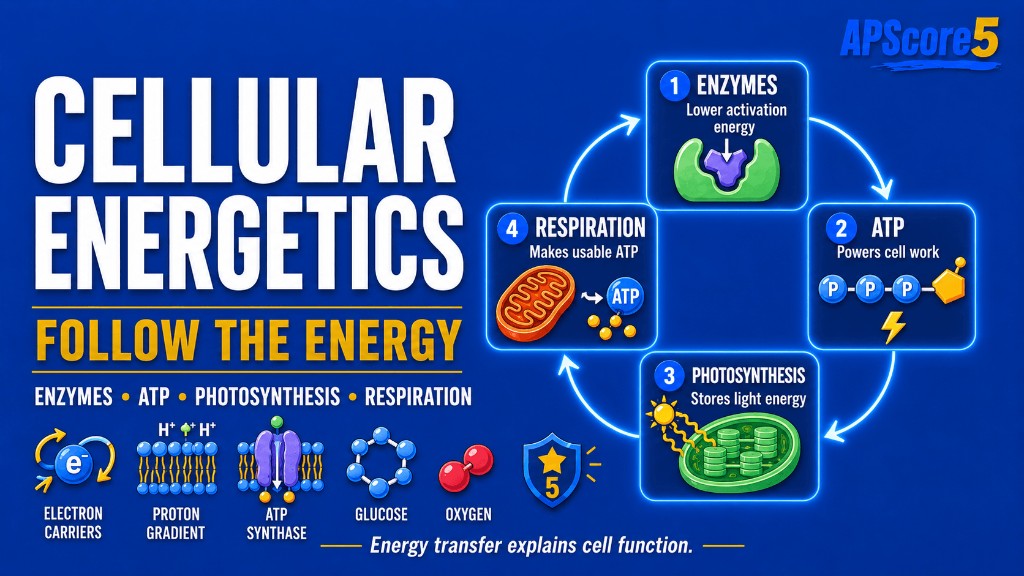
For the AP exam, Unit 3 is not about memorizing pathway names alone. Students need to explain how enzymes lower activation energy, how ATP couples energy-releasing and energy-requiring reactions, how photosynthesis stores light energy in sugars, and how cellular respiration transfers energy from glucose into ATP.
Unit 3 answer chain
Energy source → Energy carrier → Membrane or enzyme mechanism → Cell outcome.
Example
If oxygen is unavailable, the electron transport chain slows or stops because oxygen is the final electron acceptor. NADH cannot unload electrons efficiently, NAD+ becomes limited, and glycolysis needs fermentation to regenerate NAD+ so a small amount of ATP can still be made.
Use this AP Biology study guide as your hub for Unit 3, then open the microtopic pages when you need a deeper photosynthesis overview or cellular respiration overview.
The Unit 3 Thinking Formula
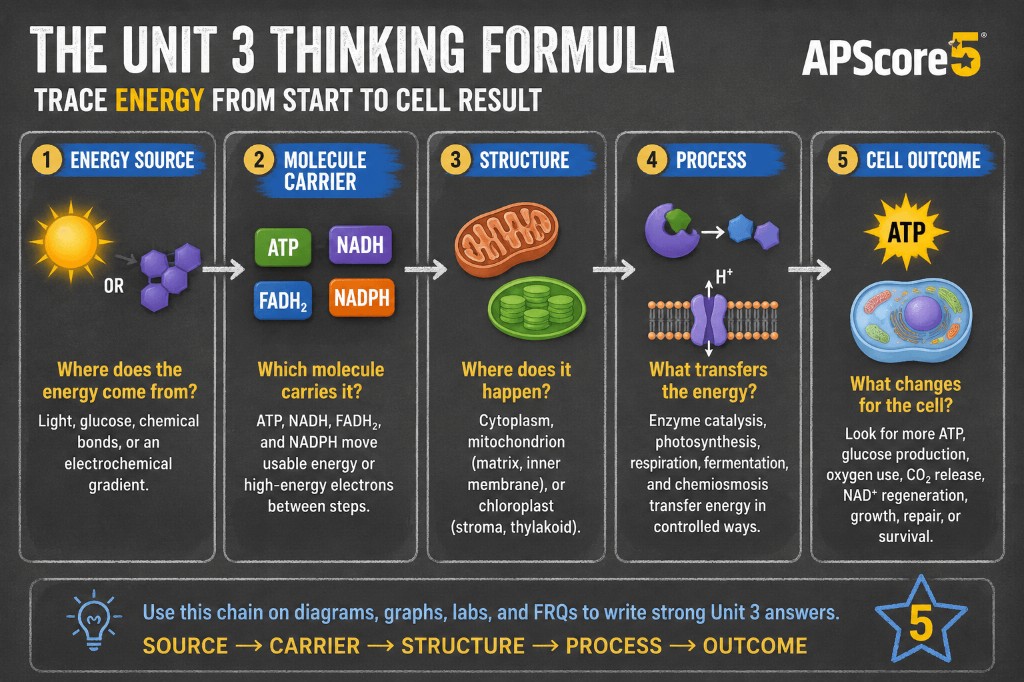
Direct answer: Unit 3 makes sense when you trace energy through a molecule, structure, process, and cell result. Use this formula whenever a question gives you a pathway diagram, graph, lab condition, or FRQ scenario.
Where does the energy come from?
Light, glucose, chemical bonds, or an electrochemical gradient can provide the starting energy.
Which molecule carries it?
ATP, NADH, FADH2, and NADPH move usable energy or high-energy electrons between steps.
Where does it happen?
Name the cytoplasm, mitochondrion, chloroplast, matrix, stroma, thylakoid, or membrane.
What transfers the energy?
Enzyme catalysis, photosynthesis, respiration, fermentation, and chemiosmosis all transfer energy in controlled ways.
What changes for the cell?
Look for more ATP, glucose production, oxygen use, CO2 release, NAD+ regeneration, growth, repair, or survival.
Example
During cellular respiration, glucose provides high-energy electrons. NADH and FADH2 carry those electrons to the electron transport chain. The inner mitochondrial membrane uses the electron energy to build a proton gradient. ATP synthase uses that gradient to make ATP.
10-question diagnostic
Start with a quick check before reading. If you miss a question, name the energy source, carrier, structure, process, and outcome before moving on.
Big Ideas in AP Biology Unit 3
Direct answer: Unit 3 asks how energy moves through living systems and how cells control that movement. These cards replace memorization with mechanisms you can use on MCQs, graphs, experiments, and FRQs.
Enzymes and active sites
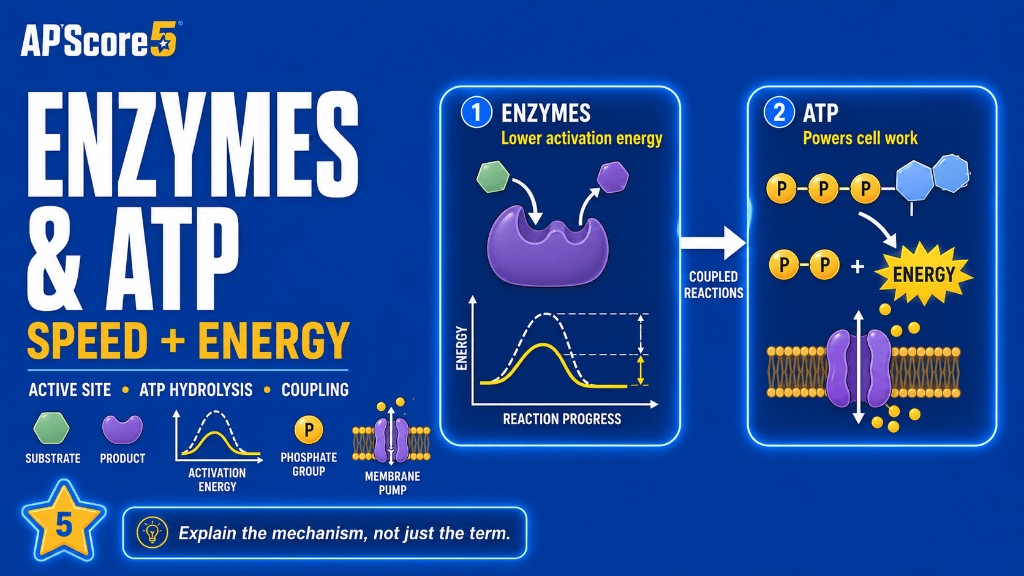
Enzymes speed reactions by lowering activation energy. The active site is the region where the substrate binds. Enzyme shape matters because a change in pH, temperature, or a mutation can change the active site and reduce function. AP Biology questions often ask students to connect enzyme structure to reaction rate using data from a graph or experiment.
Enzymes do not add energy to a reaction and they are not used up. They make the reaction easier to start by lowering activation energy.
ATP and energy coupling
ATP is a short-term energy-transfer molecule. Cells use ATP hydrolysis to power processes that require energy, such as active transport, movement, biosynthesis, and signaling. Energy coupling means an energy-releasing reaction helps drive an energy-requiring reaction.
ATP is not long-term energy storage. Glucose and fats store more energy; ATP is used quickly for immediate cellular work.
Photosynthesis
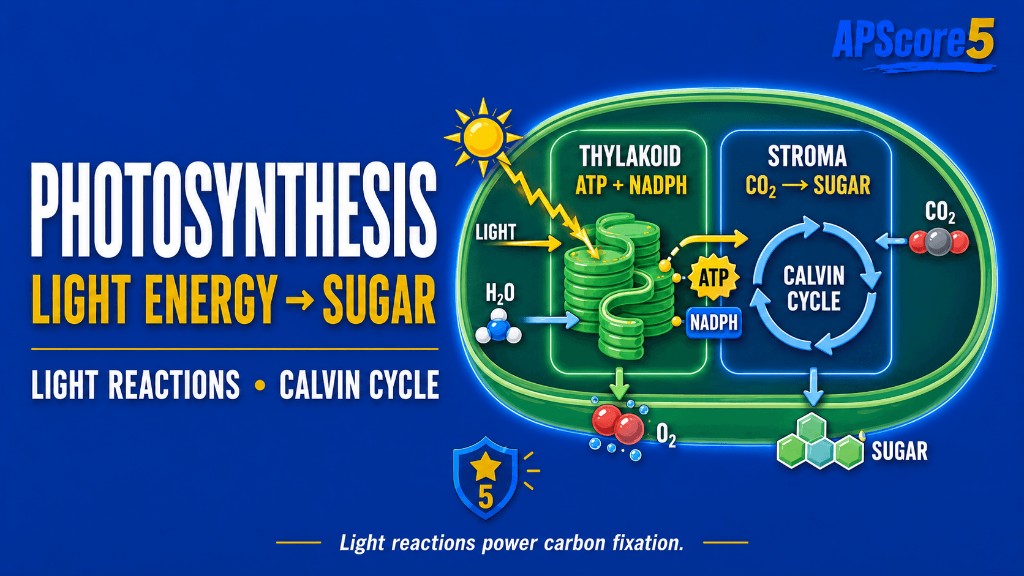
Photosynthesis converts light energy into chemical energy stored in sugars. The light reactions occur in the thylakoid membranes and produce ATP and NADPH. The Calvin cycle occurs in the stroma and uses ATP and NADPH to fix carbon dioxide into sugar. Water is split during the light reactions, releasing oxygen as a by-product.
Do not say the Calvin cycle directly needs light. It uses ATP and NADPH made by the light reactions.
Cellular respiration
Cellular respiration transfers energy from glucose to ATP. Glycolysis occurs in the cytoplasm and produces pyruvate, ATP, and NADH. The Krebs cycle occurs in the mitochondrial matrix and releases CO2 while producing electron carriers. The electron transport chain uses NADH and FADH2 to build a proton gradient across the inner mitochondrial membrane. ATP synthase uses that gradient to make most of the ATP.
Oxygen does not directly make ATP. Oxygen accepts electrons at the end of the electron transport chain, allowing electron flow and ATP production to continue.
Fermentation
Fermentation allows glycolysis to continue when oxygen is unavailable by regenerating NAD+. It produces much less ATP than aerobic respiration because it does not use the electron transport chain. Lactic acid fermentation and alcohol fermentation are different ways cells recycle NADH back to NAD+.
Fermentation does not produce lots of ATP. Its main purpose is regenerating NAD+ so glycolysis can continue.
Energy use, fitness, and survival
Cells that capture and use energy efficiently can grow, repair damage, maintain homeostasis, and respond to their environment. In AP Biology, energy connects molecular processes to survival and fitness. A change in enzyme function, light availability, oxygen level, or membrane structure can affect ATP production and therefore affect organism function.
Do not stop at "less energy." Explain the specific effect: less ATP, slower active transport, reduced biosynthesis, reduced movement, reduced growth, or lower survival.
How Enzyme Questions Work
Direct answer: enzyme questions ask you to connect a changed condition to enzyme shape, active-site binding, collisions, and reaction rate. Enzymes are proteins, so ideas from Unit 1 Chemistry of Life and water properties help explain why pH, hydrogen bonding, and temperature affect enzyme shape.
Five-step enzyme checklist
- Identify the substrate and product.
- Look at the reaction rate, not just the final amount.
- Check the independent variable: temperature, pH, substrate concentration, enzyme concentration, inhibitor, or mutation.
- Explain how the variable changes enzyme shape, active site binding, or collision frequency.
- Predict the effect on reaction rate.
Mini examples
- Higher temperature may increase rate at first, but high heat can denature the enzyme.
- Extreme pH can change enzyme shape and reduce active-site binding.
- More substrate can increase rate until enzymes become saturated.
- Competitive inhibitors reduce substrate binding at the active site.
- Noncompetitive inhibitors change enzyme function by binding somewhere else.
Do not write "the enzyme dies." Enzymes are proteins, not living things. Say the enzyme denatures or the active site changes shape.
ATP and Energy Coupling Without Confusion
Direct answer: ATP hydrolysis releases usable energy when the bond to the terminal phosphate is broken. Cells often use that energy by transferring a phosphate group to another molecule, changing its shape or reactivity. This helps drive processes that would not happen easily on their own.
ATP hydrolysis
ATP becomes ADP and inorganic phosphate, releasing energy that can be coupled to cell work.
Phosphate transfer
A phosphate group can be transferred to another molecule, changing its shape or activity.
Cellular work
Cells use ATP for active transport, movement, biosynthesis, protein phosphorylation, and signaling.
Examples
- Active transport pumps ions against a gradient.
- Motor proteins move along the cytoskeleton.
- Kinases phosphorylate proteins in signaling pathways.
- Cells build larger molecules from smaller monomers.
ATP also powers signaling and cell processes you will revisit in Unit 4 Cell Communication and Cell Cycle. Regulation and homeostasis often depend on ATP supply and feedback mechanisms.
Photosynthesis: Light Reactions vs Calvin Cycle
Direct answer: photosynthesis captures light energy in the chloroplast, uses that energy to make ATP and NADPH, then uses ATP and NADPH to build sugar from carbon dioxide. Chloroplast membranes and compartments connect this topic to Unit 2 Cell Structure and Function.
| Process | Location | Inputs | Outputs | Main job | AP clue |
|---|---|---|---|---|---|
| Light reactions | Thylakoid membranes | Light, water, ADP, NADP+ | ATP, NADPH, oxygen | Capture light energy and energize electrons | Water split, oxygen released |
| Calvin cycle | Stroma | CO2, ATP, NADPH | G3P/sugar precursor, ADP, NADP+ | Fix carbon into organic molecules | Carbon fixation, Rubisco, sugar building |
The light reactions and Calvin cycle depend on each other. The light reactions provide ATP and NADPH. The Calvin cycle returns ADP and NADP+ so the light reactions can continue.
Do not say plants get energy from the Calvin cycle. The Calvin cycle uses ATP and NADPH to build sugars.
Cellular Respiration: Follow the Electrons
Direct answer: the easiest way to understand cellular respiration is to follow electrons. Glucose is broken down, and high-energy electrons are transferred to NAD+ and FAD to form NADH and FADH2. These carriers deliver electrons to the electron transport chain. Electron movement powers proton pumping, the proton gradient powers ATP synthase, and oxygen accepts the electrons at the end.
Mitochondrial membranes and compartmentalization come from Unit 2 Cell Structure and Function; the full stage-by-stage guide is the cellular respiration overview.
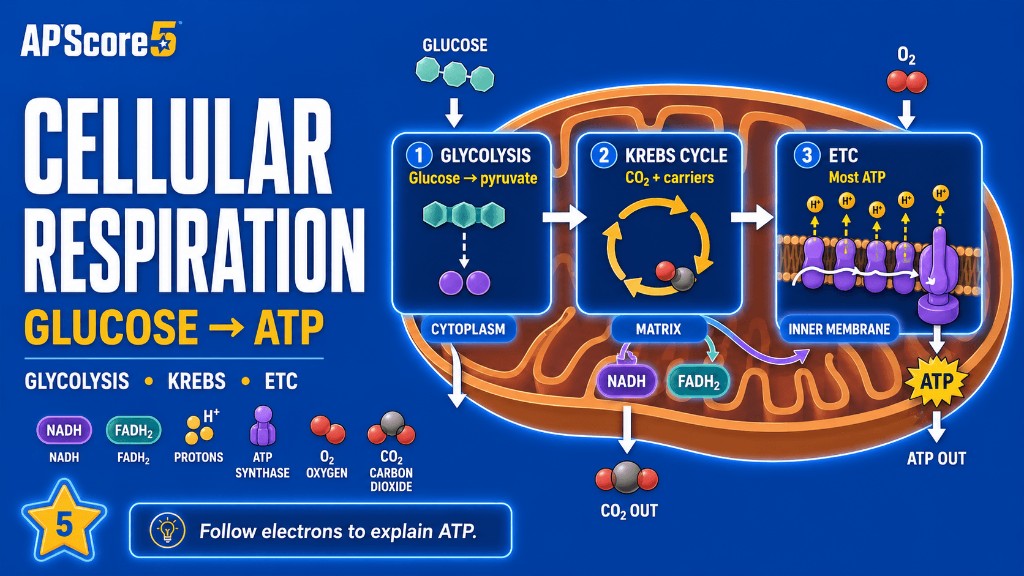
Glycolysis
Location: cytoplasm.
Main point: glucose becomes pyruvate; small ATP and NADH produced.
Pyruvate oxidation
Location: mitochondrial matrix.
Main point: pyruvate becomes acetyl-CoA; CO2 and NADH produced.
Krebs cycle
Location: mitochondrial matrix.
Main point: acetyl-CoA is broken down; CO2, NADH, FADH2, and small ATP produced.
Electron transport chain
Location: inner mitochondrial membrane.
Main point: electrons power proton pumping; oxygen accepts electrons.
Chemiosmosis
Location: inner mitochondrial membrane.
Main point: protons move through ATP synthase to make ATP.
Do not memorize only ATP numbers. AP questions usually test why ATP production changes when oxygen, glucose, membranes, or electron carriers change.
Photosynthesis vs Cellular Respiration
Direct answer: photosynthesis and cellular respiration are connected through matter and energy flow, but they are not simple opposites in every detail. Both use membranes, electron transport chains, proton gradients, and ATP synthase, but they serve different cell goals.
| Feature | Photosynthesis | Cellular respiration |
|---|---|---|
| Main purpose | Store light energy in sugars | Transfer energy from glucose to ATP |
| Organelle | Chloroplast | Mitochondrion |
| Key membrane | Thylakoid membrane | Inner mitochondrial membrane |
| Electron carriers | NADP+/NADPH | NAD+/NADH and FAD/FADH2 |
| Gas connection | Uses CO2, releases O2 | Uses O2, releases CO2 |
| Gradient | Proton gradient helps make ATP | Proton gradient helps make ATP |
| Big idea | Builds energy-rich molecules | Releases usable cellular energy |
Fermentation: Why Cells Use It When Oxygen Is Low
Direct answer: when oxygen is low, the electron transport chain cannot continue normally because oxygen is the final electron acceptor. NADH builds up and NAD+ becomes limited. Fermentation regenerates NAD+ so glycolysis can continue producing a small amount of ATP.
| Type | What happens | Example | AP clue |
|---|---|---|---|
| Lactic acid fermentation | Pyruvate accepts electrons and lactate forms | Human muscle cells, some bacteria | No CO2 release in the basic pathway |
| Alcohol fermentation | Pyruvate becomes ethanol and CO2 | Yeast | CO2 release, bread/beer contexts |
Fermentation is not used because it is efficient. It is used because it keeps glycolysis running when oxygen is unavailable.
Unit 3 Graphs and Experiments: What to Look For
Direct answer: AP Biology often asks you to explain a trend, not just describe it. Always connect the trend to a mechanism such as enzyme shape, light capture, oxygen use, electron flow, or proton-gradient formation.
Enzyme rate graph
Look for optimum temperature or pH, denaturation, saturation, and inhibitor effects.
Photosynthesis graph
Look for light intensity, CO2 concentration, temperature, oxygen production, or sugar output.
Respiration graph
Look for oxygen consumption, CO2 production, ATP production, fermentation, or metabolic rate.
Chromatography/pigment data
Look for pigments that absorb different wavelengths and support light capture.
Respirometer data
Look for oxygen use as evidence of respiration rate.
After describing a graph, explain the mechanism behind the slope, peak, plateau, or drop.
AP Biology Unit 3 FRQ Answer Formula
Direct answer: Unit 3 FRQs score mechanism and evidence. Use this framework: Claim → Energy transfer → Mechanism → Evidence → Prediction.
Claim
State the answer directly.
Energy transfer
Identify what energy or electrons are moving.
Mechanism
Explain the enzyme, pathway, membrane, carrier, or gradient involved.
Evidence
Use the prompt's graph, data, diagram, or condition.
Prediction
Explain what happens if light, oxygen, pH, temperature, substrate, or membrane function changes.
Do not write vague answers like "the cell makes less energy." Say what specifically changes: less ATP, less NADPH, slower Calvin cycle, reduced oxygen production, fewer protons crossing ATP synthase, or fermentation increases.
Unit 3 FRQ scenario cards
Scenario 1: Enzyme temperature
Prompt: An enzyme-catalyzed reaction increases as temperature rises from 10°C to 35°C, then drops sharply above 45°C. Explain the pattern.
Strong answer: The reaction rate increases at first because molecules move faster and collide more often with the enzyme. Above 45°C, the enzyme may denature, changing the active site shape and reducing substrate binding, so the reaction rate drops.
Scenario 2: Low light and photosynthesis
Prompt: A plant exposed to low light produces less glucose. Explain the mechanism.
Strong answer: Low light reduces electron excitation in the light reactions, so less ATP and NADPH are produced. Because the Calvin cycle uses ATP and NADPH to fix carbon, glucose production decreases.
Scenario 3: No oxygen and respiration
Prompt: Predict what happens to ATP production when oxygen is unavailable in a eukaryotic cell.
Strong answer: ATP production decreases because oxygen is the final electron acceptor in the electron transport chain. Without oxygen, electron flow slows or stops, the proton gradient weakens, and ATP synthase produces less ATP. Fermentation may regenerate NAD+ so glycolysis can continue making a small amount of ATP.
Scenario 4: ATP synthase blocked
Prompt: A chemical blocks ATP synthase in mitochondria. Predict the effect on ATP production.
Strong answer: ATP production decreases because protons cannot flow through ATP synthase to drive ATP formation. Even if the electron transport chain pumps protons, the cell cannot efficiently use the proton gradient to make ATP.
Scenario 5: Competitive inhibitor
Prompt: A molecule similar in shape to the substrate binds to an enzyme's active site. Explain the effect on reaction rate.
Strong answer: This is competitive inhibition. The inhibitor competes with the substrate for the active site, so fewer substrate molecules bind and the reaction rate decreases.
Scenario 6: Fermentation
Prompt: Explain why cells use fermentation when oxygen is unavailable.
Strong answer: Fermentation regenerates NAD+ from NADH, allowing glycolysis to continue. This lets the cell produce a small amount of ATP without using the electron transport chain.
Common Unit 3 Mistakes That Cost Points
Saying enzymes add energy
Fix: Enzymes lower activation energy.
Saying ATP is long-term energy storage
Fix: ATP is short-term energy transfer.
Saying the Calvin cycle directly requires light
Fix: The Calvin cycle uses ATP and NADPH made by light reactions.
Saying oxygen makes ATP
Fix: Oxygen accepts electrons so the ETC can continue.
Memorizing pathway names without locations
Fix: Know cytoplasm, matrix, inner membrane, thylakoid, and stroma.
Saying fermentation is efficient
Fix: Fermentation mainly regenerates NAD+ so glycolysis continues.
Saying "less energy" in FRQs
Fix: Name the specific molecule or process affected.
Unit 3 Must-Know Terms
Use this glossary to check whether each term helps you explain a mechanism, graph, or cell outcome.
| Term | Student-friendly meaning | AP exam use |
|---|---|---|
| Enzyme | Protein catalyst that speeds a reaction. | Explain reaction-rate changes. |
| Active site | Region where substrate binds. | Connect shape to specificity. |
| Substrate | Reactant an enzyme acts on. | Identify what binds the enzyme. |
| Product | Substance formed by a reaction. | Measure reaction output. |
| Activation energy | Energy needed to start a reaction. | Enzymes lower it. |
| Denaturation | Protein shape disruption. | Explains rate drops at high heat or extreme pH. |
| Competitive inhibitor | Blocks the active site. | Reduces substrate binding. |
| Noncompetitive inhibitor | Binds away from active site. | Changes enzyme function. |
| ATP | Immediate energy-transfer molecule. | Powers cell work. |
| ADP | Lower-energy ATP product. | Regenerated into ATP. |
| Energy coupling | Using one reaction to drive another. | Explains ATP-powered work. |
| Phosphorylation | Adding a phosphate group. | Changes molecule activity. |
| NADH | Electron carrier in respiration. | Feeds electrons to ETC. |
| FADH2 | Electron carrier in respiration. | Feeds electrons to ETC. |
| NADPH | Electron carrier in photosynthesis. | Supplies Calvin cycle reducing power. |
| Photosynthesis | Stores light energy in sugars. | Trace light to chemical energy. |
| Light reactions | Thylakoid reactions making ATP and NADPH. | Oxygen released from water splitting. |
| Calvin cycle | Stroma reactions fixing carbon. | Uses ATP and NADPH. |
| Chlorophyll | Pigment that absorbs light. | Explains wavelength data. |
| Thylakoid | Chloroplast membrane sacs. | Light reaction location. |
| Stroma | Fluid inside chloroplast. | Calvin cycle location. |
| Carbon fixation | CO2 added to organic molecules. | Starts sugar-building. |
| Cellular respiration | Transfers glucose energy to ATP. | Trace electrons and ATP. |
| Glycolysis | Glucose becomes pyruvate. | Cytoplasm, small ATP, NADH. |
| Pyruvate oxidation | Pyruvate becomes acetyl-CoA. | Links glycolysis to Krebs cycle. |
| Krebs cycle | Acetyl-CoA broken down in matrix. | CO2, NADH, FADH2 made. |
| Citric acid cycle | Another name for Krebs cycle. | Recognize both labels. |
| Electron transport chain | Membrane proteins pass electrons. | Builds proton gradient. |
| Chemiosmosis | ATP made using proton flow. | Explains ATP synthase. |
| Proton gradient | H+ difference across a membrane. | Stores potential energy. |
| ATP synthase | Enzyme that makes ATP from proton flow. | Connect gradient to ATP. |
| Oxidative phosphorylation | ATP formation using ETC and oxygen. | Main ATP source in aerobic respiration. |
| Fermentation | Regenerates NAD+ without oxygen. | Keeps glycolysis running. |
| Lactic acid fermentation | Pyruvate becomes lactate. | No CO2 in basic pathway. |
| Alcohol fermentation | Pyruvate becomes ethanol and CO2. | Yeast and CO2 release. |
Quick Self-Check Before Practice
If you cannot answer 6 of 8, review the concept cards before starting MCQs.
- Can I explain how enzymes lower activation energy?
- Can I tell the difference between ATP and glucose as energy molecules?
- Can I explain how light reactions support the Calvin cycle?
- Can I follow electrons through cellular respiration?
- Can I explain why oxygen is needed for aerobic respiration?
- Can I explain why fermentation regenerates NAD+?
- Can I interpret a graph about enzyme rate, photosynthesis rate, or respiration rate?
- Can I write a Unit 3 FRQ answer using mechanism and evidence?
AP Bio Unit 3 flashcards
Use flashcards after the concept sections so each term connects to energy movement, electron carriers, pathway location, or a cell outcome.
AP Bio Unit 3 practice questions (MCQ)
Answer targeted Unit 3 questions, then read the answer explanations for the mechanism you missed. For extra review, use practice by topic, practice by course, daily practice, or longer practice tests.
5-10 minute daily study loop
Day 1
Review enzyme graphs and write one rate explanation.
Day 2
Trace ATP, NADH, FADH2, and NADPH through pathways.
Day 3
Review the photosynthesis overview and compare light reactions with the Calvin cycle.
Day 4
Review the cellular respiration overview and follow electrons to oxygen.
Day 5
Answer 10 MCQs and write why each missed answer was wrong.
Day 6-7
Write two FRQ scenario answers using claim, mechanism, evidence, and prediction.
Save your progress
Create a free account to keep your score history, flashcard work, and practice streak together.
AP Bio Unit 1-3 cumulative review
Build cumulative accuracy by connecting chemistry, cell structure, and energy. Protein shape from Unit 1 Chemistry of Life helps explain enzymes, while membranes and compartmentalization from Unit 2 Cell Structure and Function help explain chloroplasts, mitochondria, and chemiosmosis.
Keep Learning AP Biology
Use these next steps when a Unit 3 idea depends on earlier chemistry, cell structure, or later communication topics.
Review Unit 1 Chemistry of Life
Protein shape, pH, water, and macromolecules help explain enzyme behavior.
Review Unit 2 Cell Structure and Function
Mitochondria, chloroplasts, membranes, and compartmentalization make energy transfer possible.
Practice photosynthesis overview
Focus on light reactions, Calvin cycle, chloroplast structure, and NADPH.
Practice cellular respiration overview
Trace glycolysis, Krebs cycle, ETC, chemiosmosis, and fermentation.
Start Unit 4 Cell Communication and Cell Cycle
ATP, protein shape, and regulation connect directly to signaling and cell processes.
AP Biology Unit 3 Review Slides
Walk through how enzymes tune reaction rates, how ATP couples exergonic steps to cell work, and how chloroplasts and mitochondria use membranes to move electrons and protons—then open the FAQ for quick checks before Unit 4.
AP Biology Unit 3 FAQs
What does AP Biology Unit 3 Cellular Energetics test?
AP Biology Unit 3 tests how cells capture, transfer, and use energy. Students should understand enzymes, ATP, energy coupling, photosynthesis, cellular respiration, fermentation, electron carriers, proton gradients, and how changes in conditions affect energy processes.
What is the best way to study AP Bio Unit 3?
Study Unit 3 by following energy and electrons. For each process, ask where the energy starts, which carrier moves it, where the process happens, and what the cell produces. Then practice graphs and FRQs about enzyme rate, photosynthesis rate, respiration rate, oxygen availability, and ATP production.
How should I write AP Bio Unit 3 FRQ answers?
Use the formula: claim → energy transfer → mechanism → evidence → prediction. Name the process, explain how energy or electrons move, use data from the prompt, and predict a specific effect such as less ATP, less NADPH, slower Calvin cycle activity, or increased fermentation.
What is the difference between photosynthesis and cellular respiration?
Photosynthesis stores light energy in sugars, while cellular respiration transfers energy from glucose into ATP. Photosynthesis occurs in chloroplasts and uses light reactions and the Calvin cycle. Cellular respiration occurs through glycolysis, the Krebs cycle, and the electron transport chain.
Why is oxygen important in cellular respiration?
Oxygen is the final electron acceptor in the electron transport chain. Without oxygen, electrons cannot flow normally, the proton gradient weakens, ATP synthase makes less ATP, and cells may rely on fermentation to regenerate NAD+ for glycolysis.
Is there an AP Bio Unit 3 flashcard or study guide version?
Yes. A useful Unit 3 study guide should include enzymes, ATP, photosynthesis, respiration, fermentation, electron carriers, and FRQ reasoning. Flashcards help with vocabulary, but students also need practice explaining mechanisms, interpreting graphs, and predicting cell outcomes.
How should I check my AP Bio Unit 3 answers?
Check your answers by reading the explanation and identifying the mechanism. For MCQs, explain why the correct choice is right and why each wrong choice is wrong. For FRQs, check whether your answer includes a claim, mechanism, evidence, and specific prediction.
What is the hardest part of AP Bio Unit 3?
Many students find Unit 3 difficult because the processes are connected. Enzymes affect reaction rates, ATP powers cell work, photosynthesis builds sugars, respiration transfers energy to ATP, and fermentation supports glycolysis when oxygen is low. The best strategy is to connect each step to energy movement.
Next: start AP Biology Unit 4
Keep your momentum. Continue directly into Unit 4 so your review stays connected across concepts and exam skills.