AP Biology Unit 7 Key Takeaways
- Individuals do not evolve; populations evolve.
- Natural selection acts on heritable variation.
- Evolution is measured as changes in allele frequencies.
- Fitness means reproductive success.
- Hardy-Weinberg helps test whether a population is evolving.
- Evidence, phylogeny, and speciation explain evolutionary relationships.
Learning journey
AP Biology Unit 7 Learning Journey
Work through every Unit 7 topic below. Each card links to a full study guide or practice page so you can move from natural selection basics to Hardy-Weinberg math, evidence, phylogeny, speciation, and exam-style practice.
Natural SelectionLearn how selection pressures favor heritable traits that increase reproductive success.Study guide
Artificial SelectionCompare human-directed selection with natural selection.Study guide
Evolutionary FitnessUnderstand why fitness means reproductive success, not strength.Study guide
Types of Natural SelectionMaster directional, stabilizing, and disruptive selection graphs.Study guide
Population GeneticsTrack gene pools, allele frequencies, and genotype frequencies.Study guide
Hardy-Weinberg EquilibriumUse p, q, p², 2pq, and q² to test population change.Study guide
Hardy-Weinberg PracticePractice allele frequency, carrier frequency, and genotype calculations.Practice
Evidence of EvolutionConnect fossils, homologous structures, molecular data, and biogeography.Study guide
Common AncestryExplain how shared traits and DNA similarities support common ancestry.Study guide
Phylogenetic Trees and CladogramsRead nodes, clades, outgroups, and shared derived traits.Study guide
SpeciationLearn how populations become separate species.Study guide
Reproductive IsolationCompare prezygotic and postzygotic barriers.Study guide
Practice QuestionsTest Unit 7 concepts with AP-style MCQs.Practice
FRQ PracticePractice writing evidence-based Unit 7 FRQ explanations.Practice
Suggested study path: Suggested path: natural selection → fitness → selection types → population genetics → Hardy-Weinberg → evidence → common ancestry → phylogenetic trees → speciation → reproductive isolation → practice questions → FRQ practice.
AP Biology Unit 7 Natural Selection Review Slides
Use this slide deck for a fast Unit 7 review of natural selection, Hardy-Weinberg, evidence of evolution, and speciation before you open the topic guides below.
Unit 7 Reasoning Ladder
Use this chain on MCQs and FRQs to explain population-level evolutionary change.
AP exam clue: AP exam clue: Strong Unit 7 answers explain population-level change, not individual effort or need.
Unit 7 Big Ideas
| Concept | What it means | AP exam clue |
|---|---|---|
| Evolution | Change in allele frequencies in a population over time. | Define population change, not individual change. |
| Natural selection | Nonrandom survival and reproduction based on heritable phenotypes. | Name variation, pressure, and reproductive success. |
| Fitness | Reproductive success in a specific environment. | Avoid equating fitness with strength. |
| Adaptation | Heritable trait that improves fitness in an environment. | Environment-dependent, not universally best. |
| Hardy-Weinberg | No-evolution baseline for comparing expected and observed genotype frequencies. | Deviation suggests an assumption is violated. |
| Common ancestry | Shared evolutionary origin supported by homologous traits and molecular similarity. | Connect evidence to relationship, not progress. |
| Phylogeny | Hypothesis of evolutionary relationships among species. | Read most recent common ancestor, not tip order. |
| Speciation | Formation of new species when populations diverge and become reproductively isolated. | Reduced gene flow is the starting clue. |
| Reproductive isolation | Barriers that prevent successful interbreeding between populations. | Prezygotic vs postzygotic barriers. |
Natural Selection Overview
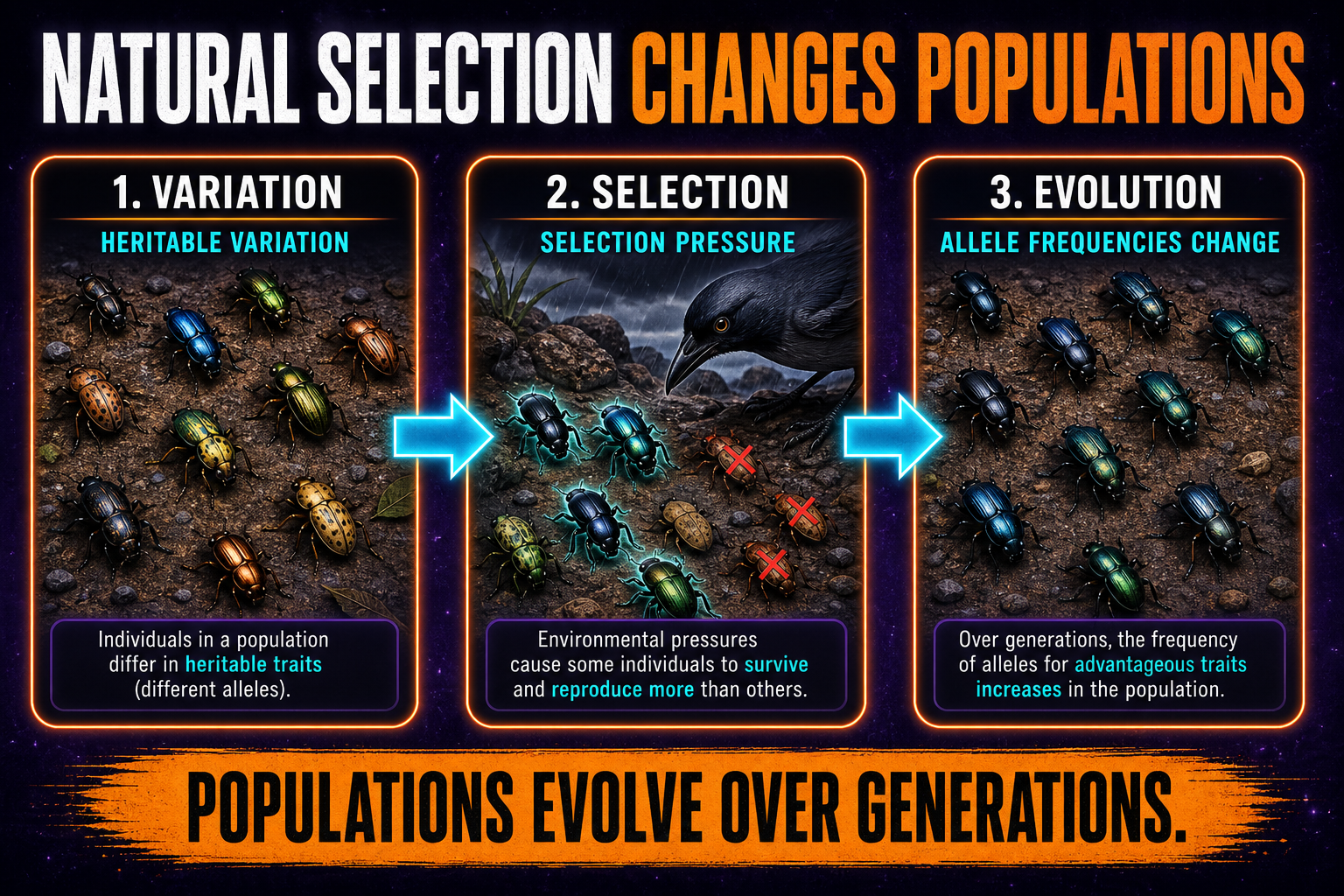
Natural selection changes populations when heritable variation affects reproductive success in a specific environment. Natural selection acts on individuals, but populations evolve.
Individuals in a population differ in traits. Some differences are genetic and can be passed to offspring. The environment makes some phenotypes more successful than others, so alleles linked to higher reproductive success may become more common across generations.
For the full reasoning chain, selection types, and practice, use the natural selection AP Biology guide.

| Mechanism | Random or nonrandom? | Biggest clue | Effect |
|---|---|---|---|
| Natural selection | Nonrandom | Trait affects survival/reproduction | Adaptive alleles may increase |
| Genetic drift | Random | Small population, chance event | Alleles change by chance |
| Gene flow | Often nonrandom movement | Migration between populations | Populations become more similar or new alleles enter |
| Mutation | Random source of variation | DNA sequence change | New alleles can appear |
| Nonrandom mating | Nonrandom | Mate choice or inbreeding | Genotype frequencies shift |
Fitness and Adaptation
In AP Biology, fitness means how well an organism passes its genes to the next generation. Fitness is measured by reproductive success, not by being the strongest, fastest, or longest-lived. A trait can be helpful in one environment and harmful in another.
For examples, graphs, and practice questions, open the evolutionary fitness AP Biology guide.
Common mistake: Fitness is environment-dependent. There is no universally best trait.
Population Genetics and Hardy-Weinberg
Evolution occurs when allele frequencies change. Hardy-Weinberg equilibrium predicts genotype frequencies when a population is not evolving at a gene: p + q = 1 and p² + 2pq + q² = 1.

Track gene pools and allele frequencies in the population genetics guide, learn the baseline logic in Hardy-Weinberg equilibrium, and drill calculations in Hardy-Weinberg practice.
Bottleneck effect
A random event sharply reduces population size. Survivors may not represent the original gene pool.
Founder effect
A small group starts a new population. Allele frequencies reflect the founders, not the source population.
Common mistake: q is an allele frequency. q² is a genotype frequency.
Hardy-Weinberg Assumptions
Hardy-Weinberg is a null model, not a claim that real populations never evolve. If observed data differ from expected values, at least one assumption may be violated: no mutation, no migration, no natural selection, very large population size, or random mating.
Evidence of Evolution and Common Ancestry
Evidence for evolution supports common ancestry and change over time. Strong AP answers connect evidence to a mechanism or relationship.
Fossils
Show changes in organisms over time and extinct forms.
Homologous structures
Similar structures from common ancestry, even if functions differ.
Vestigial structures
Reduced structures inherited from ancestors.
Molecular evidence
DNA, RNA, and protein similarities show evolutionary relationships.
Biogeography
Species distribution patterns reflect geography and evolutionary history.
Embryology
Developmental similarities can support common ancestry.
Deepen each evidence type in the evidence of evolution guide and the common ancestry AP Biology guide.
Phylogenetic Trees and Cladograms
Phylogenetic trees show hypotheses about evolutionary relationships. Closest relatives are identified by the most recent common ancestor, not by which tips appear next to each other visually.
For nodes, clades, outgroups, and shared derived traits, use the phylogenetic trees and cladograms guide.
AP exam clue: Read common ancestors and shared derived traits, not visual ladder position.
Speciation and Reproductive Isolation
Speciation occurs when populations become reproductively isolated and diverge over time. Geographic, behavioral, temporal, or genetic barriers can reduce gene flow.
Prezygotic barriers
Prevent fertilization before a zygote forms.
Postzygotic barriers
Reduce hybrid survival or fertility after fertilization.
Study full speciation pathways in the speciation AP Biology guide and reproductive isolation guide.
AP Biology Unit 7 Data Patterns
Diagnostic
Unit 7 Diagnostic Quiz
10 questions covering natural selection, fitness, Hardy-Weinberg, drift, gene flow, evidence, phylogenies, and speciation.
Question 1 of 10Start
Flashcards
AP Biology Unit 7 Flashcards
60 flashcards covering natural selection, Hardy-Weinberg, evidence, phylogeny, and speciation vocabulary.
Card 1 of 60Tap card to flip
Practice
AP Biology Unit 7 Practice Questions
50 MCQs with explanations across natural selection, population genetics, Hardy-Weinberg, evidence, phylogenies, and speciation.
0Correct
0Answered
0%Accuracy
StartStatus
Question 1 of 50Start
FRQ strategy
AP Biology Unit 7 FRQ Strategy
Unit 7 FRQs score evidence-based population reasoning. A strong answer names the mechanism, cites the evidence, and predicts the allele-frequency effect across generations.
FRQ answer template
The population has variation in ____. The selection pressure/mechanism is ____. Individuals with ____ have higher reproductive success because ____. Therefore, allele frequency ____ over generations. The evidence is ____.
Mini FRQ scenarios with strong answers
Natural selection
Strong answer: Brown beetles have higher fitness in this environment because they are less visible to predators and are more likely to survive and reproduce. If color is heritable, alleles associated with brown coloration may increase in frequency over generations.
Antibiotic resistance
Strong answer: The antibiotic acts as a selection pressure. Bacteria with resistance alleles survive and reproduce more than susceptible bacteria, so resistance alleles become more common in the population.
Genetic drift
Strong answer: This is genetic drift because allele frequencies changed by chance after a random event. The effect is stronger in small populations, and the surviving gene pool may not represent the original population.
Gene flow
Strong answer: Gene flow can introduce new alleles or change existing allele frequencies in the receiving population. It can also make the two populations more genetically similar if migration continues.
Hardy-Weinberg deviation
Strong answer: One Hardy-Weinberg assumption may be violated, such as natural selection, migration, mutation, genetic drift, or nonrandom mating. For example, if one genotype has higher survival, selection can shift genotype and allele frequencies away from expected values.
Phylogenetic tree
Strong answer: Species A and B are more closely related to each other because they share a more recent common ancestor. This does not mean A evolved from B; it means they share a common ancestral lineage.
Speciation
Strong answer: Geographic isolation reduces gene flow between the populations. Over time, mutation, selection, and genetic drift can cause the populations to diverge. If reproductive isolation evolves, the populations may become separate species.
Common Unit 7 Mistakes That Cost Points
Animals evolved because they needed to survive.
AP Bio wording: Heritable variation already existed; individuals with favorable traits reproduced more.
Individuals evolve.
AP Bio wording: Individuals are selected; populations evolve.
Fitness means strongest.
AP Bio wording: Fitness means reproductive success.
Natural selection creates mutations.
AP Bio wording: Mutations create variation; selection acts on phenotypes produced by variation.
Genetic drift helps organisms adapt.
AP Bio wording: Drift is random and can increase, decrease, or eliminate alleles regardless of benefit.
Hardy-Weinberg means evolution is happening.
AP Bio wording: Hardy-Weinberg is the no-evolution baseline.
Phylogenetic trees show which species is more advanced.
AP Bio wording: Trees show common ancestry, not progress.
Unit 7 Must-Know Terms
| Term | Student-friendly meaning | AP exam use |
|---|---|---|
| Evolution | Allele-frequency change over time. | Define population change. |
| Population | Same species in one area. | Unit of evolution. |
| Gene pool | All alleles in a population. | Track variation. |
| Allele frequency | How common an allele is. | Measure evolution. |
| Genotype frequency | How common a genotype is. | Hardy-Weinberg comparisons. |
| Natural selection | Nonrandom reproductive success. | Explain adaptive change. |
| Selection pressure | Environmental factor favoring traits. | Identify cause. |
| Fitness | Reproductive success. | Avoid strength trap. |
| Reproductive success | Passing genes to offspring. | Fitness evidence. |
| Adaptation | Heritable trait that improves fitness. | Explain helpful traits. |
| Heritable variation | Genetic differences passed on. | Selection requirement. |
| Mutation | DNA change creating alleles. | Variation source. |
| Genetic drift | Random frequency change. | Small population clue. |
| Bottleneck effect | Drift after population crash. | Random survivor clue. |
| Founder effect | Drift in new small population. | Island/colony clue. |
| Gene flow | Allele movement between populations. | Migration clue. |
| Nonrandom mating | Mate choice or inbreeding. | Genotype frequency shifts. |
| Hardy-Weinberg equilibrium | No-evolution baseline. | Expected frequencies. |
| p and q | Allele frequencies. | p + q = 1. |
| p² + 2pq + q² | Genotype-frequency equation. | Find expected genotypes. |
| Directional selection | One extreme favored. | Shifted distribution. |
| Stabilizing selection | Average favored. | Narrower distribution. |
| Disruptive selection | Both extremes favored. | Two peaks clue. |
| Artificial selection | Human-chosen breeding. | Domestication examples. |
| Sexual selection | Mating success affects fitness. | Mate choice traits. |
| Common ancestry | Shared evolutionary origin. | Tree reasoning. |
| Homologous structures | Similar structure from ancestry. | Evidence of evolution. |
| Vestigial structures | Reduced ancestral structures. | Evidence clue. |
| Molecular evidence | DNA/protein similarity. | Relationship evidence. |
| Phylogenetic tree | Relationship diagram. | Common ancestor reading. |
| Cladogram | Branching relationship diagram. | Shared trait reasoning. |
| Clade | Ancestor and descendants. | Group identification. |
| Shared derived trait | New trait shared by a clade. | Branch evidence. |
| Outgroup | Reference lineage outside group. | Root trees. |
| Speciation | Formation of new species. | Isolation reasoning. |
| Reproductive isolation | No successful interbreeding. | Speciation requirement. |
| Prezygotic barrier | Prevents fertilization. | Before-zygote clue. |
| Postzygotic barrier | Weak or sterile hybrids. | After-zygote clue. |
| Extinction | Loss of a species. | Environmental change reasoning. |
Practice and FRQ Hub
AP Biology Unit 7 FAQ
What is AP Biology Unit 7 about?
AP Biology Unit 7 Natural Selection explains how populations evolve over generations. Students study heritable variation, natural selection, fitness, allele frequency change, Hardy-Weinberg equilibrium, evidence of evolution, phylogenetic trees, speciation, and reproductive isolation.
Is Unit 7 Natural Selection hard?
Unit 7 is moderate to challenging because questions combine vocabulary, data interpretation, and population-level reasoning. Tracing variation, mechanism, and allele-frequency change step by step usually improves MCQ and FRQ scores.
What is natural selection in AP Biology?
Natural selection is a mechanism of evolution where individuals with heritable traits that improve survival or reproductive success in a specific environment tend to leave more offspring, so those alleles can become more common across generations.
What does fitness mean in AP Biology?
Fitness means reproductive success. An organism with higher fitness passes more genes to the next generation. Fitness depends on the environment and does not simply mean strongest, fastest, or longest-lived.
What is Hardy-Weinberg equilibrium?
Hardy-Weinberg equilibrium is a no-evolution baseline for a gene in a population. If observed genotype frequencies differ from expected values using p + q = 1 and p² + 2pq + q² = 1, at least one assumption may be violated.
What evidence supports evolution?
Evidence includes fossils, homologous and vestigial structures, molecular data, biogeography, and embryology. Strong AP answers connect the evidence to common ancestry or evolutionary change over time.
How do phylogenetic trees show common ancestry?
Phylogenetic trees show evolutionary relationships through branch points. Species that share a more recent common ancestor are more closely related. The tree does not show that one modern species evolved from another modern species.
What is speciation?
Speciation occurs when populations become reproductively isolated and diverge over time until they are separate species. Geographic, behavioral, temporal, or genetic barriers can reduce gene flow and allow divergence.
What is reproductive isolation?
Reproductive isolation prevents successful interbreeding between populations. Prezygotic barriers block fertilization; postzygotic barriers reduce hybrid survival or fertility after fertilization.
How should I study AP Biology Unit 7?
Start with the learning journey on this page, run the diagnostic, drill flashcards, practice Hardy-Weinberg problems, interpret phylogenetic trees, and write short FRQ chains that connect mechanism, evidence, and allele-frequency change.
What are common Unit 7 FRQ mistakes?
Common mistakes include saying organisms evolved because they needed to, claiming individuals evolve, confusing fitness with strength, treating genetic drift as adaptive, and reading phylogenetic trees as ladders of progress.
Continue learning
Next: AP Biology Unit 8 Ecology
Selection pressures connect to environments, populations, communities, and ecosystems. Continue into Unit 8 to link evolution with ecology.