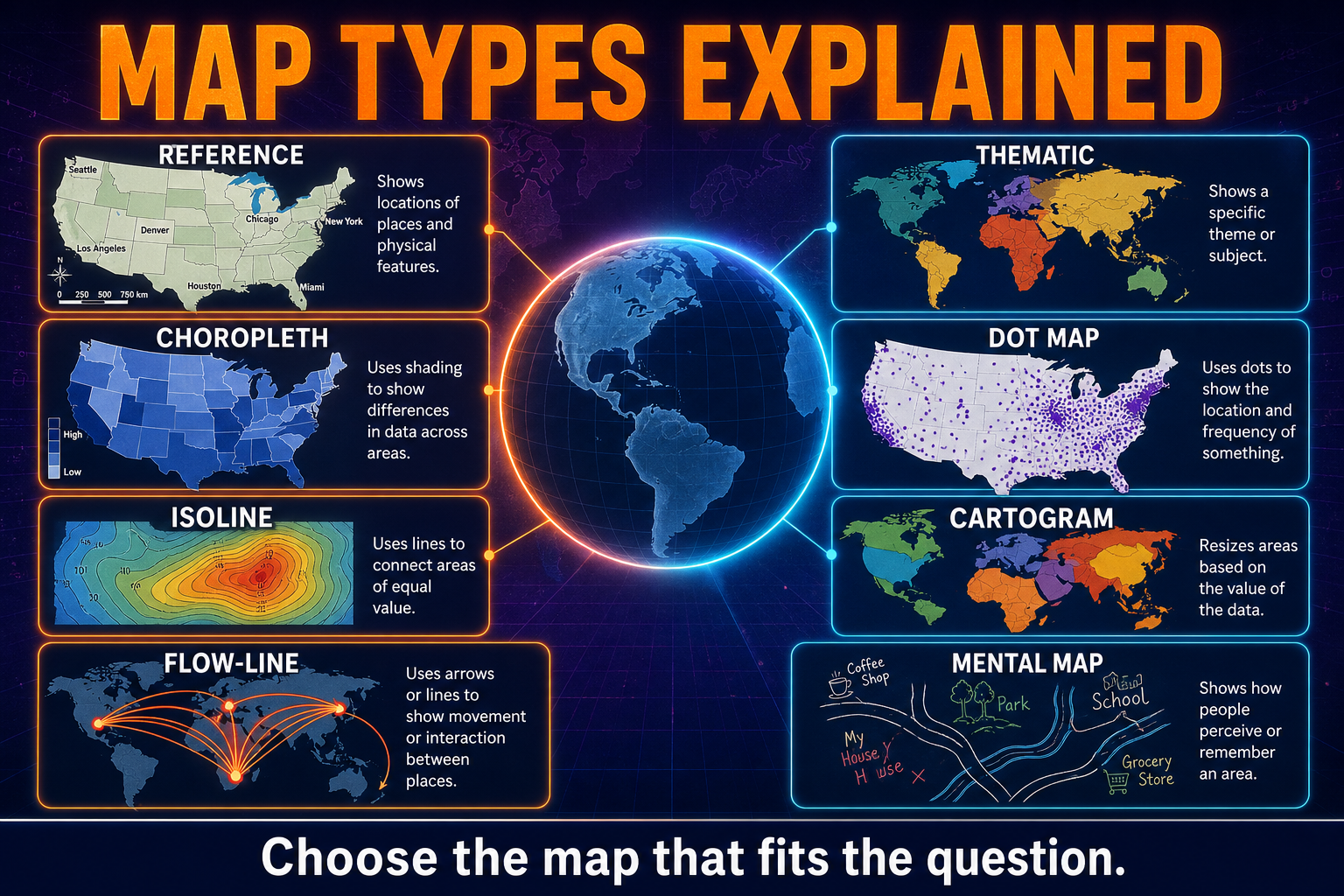
Learn how to identify, compare, and choose the right map type for AP Human Geography Unit 1, including reference maps, thematic maps, choropleth maps, dot distribution maps, isoline maps, cartograms, flow-line maps, and mental maps.
Updated June 5, 2026 · Reviewed by APScore5 Editorial Team
AP Human Geography map types help students choose the right visual tool for location, data, density, movement, and spatial patterns.
Quick answer
⚡
What Are Map Types in AP Human Geography?
Map types are categories of maps that show different kinds of geographic information. In AP Human Geography, students use reference maps to locate places and thematic maps to explain patterns in data. Common thematic map types include choropleth maps, dot distribution maps, isoline maps, graduated symbol maps, cartograms, and flow-line maps.
Reference maps help locate places and features.
Thematic maps show data patterns and spatial relationships.
Choropleth maps are best for rates or percentages by area.
Dot distribution maps show where features are clustered or dispersed.
Choosing the right map type depends on the geographic question, data type, and scale.
Start Here: How to Use This Map Types Guide
First decide whether the map is reference or thematic.
Match the map type to the data: rates, counts, movement, continuous values, or perception.
Check the legend, scale, units, and data source.
Practice with MCQs to avoid common AP map traps.
Move to FRQ practice after you can explain why each map type fits a question.
Section 1
⚖️
Reference Maps vs Thematic Maps
A reference map answers where is it? A thematic map answers what pattern exists?
Feature
Reference Map
Thematic Map
Main purpose
Locate places and features.
Show a theme, data pattern, or relationship.
Common examples
Road map, political map, physical map, topographic map.
Common mistake: A political map and a physical map are both reference maps — the College Board uses "type" for technique (choropleth, isoline, etc.), not subject matter.
Section 2
🗺️
The Main AP Human Geography Map Types
Each card below summarizes definition, best use, and the trap AP Human Geography students hit most often.
Reference Map
Definition
A reference map shows where places and features are located.
Match map choice to data structure before you read symbology: locate vs explain, counts vs rates, continuous vs categorical, movement vs perception.
Need to locate roads, cities, borders, or rivers? Use a reference map.Need to compare rates or percentages by area? Use a choropleth map.Need to show where features cluster inside a region? Use a dot distribution map.Need to show raw counts at point locations? Use a graduated symbol map.Need to show continuous values like elevation or temperature? Use an isoline map.Need to show movement between places? Use a flow-line map.Need to show data by resizing places? Use a cartogram.Need to show perception or lived experience? Use a mental map.
Data or Question
Best Map Type
Why
Locate features
Reference map
Shows where places and features are.
Rates by area
Choropleth map
Shades regions by comparable values.
Counts at points
Graduated symbol map
Symbol size shows total magnitude.
Density or clustering
Dot distribution map
Dots show where features concentrate.
Continuous values
Isoline map
Lines connect equal values.
Movement
Flow-line map
Arrows show direction and volume.
Land area is misleading
Cartogram
Resizes places by data.
Perception
Mental map
Shows how people imagine or remember places.
The best map type depends on whether the question is about location, rates, counts, movement, continuous values, or perception.
Fix: Use choropleth maps for rates, percentages, density, or normalized values.
Confusing dot maps with exact locations
Fix: Dots often show approximate distribution, not exact addresses.
Calling every colorful map thematic
Fix: Ask whether color represents data or just design.
Ignoring scale and aggregation
Fix: County, state, and national maps can reveal different patterns.
Treating cartogram distortion as an error
Fix: In a cartogram, distortion is the point.
Forgetting line thickness on flow maps
Fix: Thicker arrows usually mean greater volume.
Using isolines for categories
Fix: Isolines work for continuous values, not categories like religion or crop type.
Treating mental maps as objective
Fix: Mental maps show perception, not precise measured geography.
Most map-type mistakes happen when students ignore the data unit, map purpose, scale, or legend.Section 5
📝
AP Exam Strategy for Map Types
Map types appear on both MCQs and FRQs. Train yourself to name the map, cite the data rule, describe the pattern, and note one limitation.
In multiple-choice questions
In multiple-choice questions:
Match a scenario to the best map type.
Compare two map thumbnails.
Identify misuse of totals, rates, or scale.
Explain what a legend or symbol means.
In FRQs
In FRQs:
Choose which map best supports a claim.
Justify why a map type fits the data.
Explain one limitation of the map.
Connect a spatial pattern to a geographic process.
Strong AP answer formula: Question → Map Type → Data/Symbol Rule → Pattern → Limitation
Example: A choropleth map is appropriate because the data are rates by census tract. The map can reveal spatial clustering of high asthma rates, but it may hide variation within each tract.
AP Exam Tip: Read the legend before the pattern — units and scale decide whether a choropleth, dot map, or graduated symbol map is honest.
Quick Check
Test yourself in 5 seconds
A cartogram distorts:
Answer: C — Cartograms resize regions to reflect a mapped variable such as population or GDP.
Section 6
📋
Map Types FRQ Preview
Prompt: A geographer is studying childhood asthma rates across a metropolitan area. They have data for every census tract.
A. Identify the map type that would best display rates of childhood asthma by tract.
B. Explain why a graduated symbol map would be a poor choice for this dataset.
C. Describe one limitation of the map type you chose in part A.
Suggested answer:
A. A choropleth map would best display childhood asthma rates by census tract because the data are rates attached to polygon areas.
B. A graduated symbol map would be weaker because it is better for raw counts at point locations, not rates across census tracts.
C. A choropleth map may hide variation within each tract, and the pattern could change if the data were mapped at a different scale.
Map type practice helps students move from recognizing map categories to explaining why a map fits a geographic question.
Use these 50 AP-style questions to practice identifying the right map type, reading legends, comparing spatial patterns, and avoiding common map mistakes.
What are the main types of maps in AP Human Geography?
The main map types in AP Human Geography include reference maps, thematic maps, choropleth maps, dot distribution maps, graduated symbol maps, isoline maps, cartograms, flow-line maps, and mental maps.
What is the difference between a reference map and a thematic map?
A reference map helps locate places and features, while a thematic map shows a specific pattern, theme, or data variable.
Which map type is best for rates or percentages by area?
A choropleth map is usually best for rates, percentages, densities, or ratios by area, such as population density by county or unemployment rate by state.
Which map type is best for showing movement?
A flow-line map is best for showing movement between places, such as migration, trade, transportation, remittances, or disease spread.
Which map type is best for showing clusters inside a region?
A dot distribution map is useful for showing clusters or dispersed patterns inside a region because dots reveal where features are concentrated.
Why are cartograms useful if they distort shapes?
Cartograms are useful because the distortion communicates the data. Regions become larger or smaller based on a variable such as population, GDP, votes, or disease burden.
When should I use a graduated symbol map instead of a choropleth map?
Use a graduated symbol map for raw counts at point locations, such as total population of cities or airport passengers. Use a choropleth map for rates or ratios across areas.
What is the biggest mistake students make with map types?
The biggest mistake is choosing a map type without checking the data. Students should first ask whether the data are locations, rates, raw counts, continuous values, movement, or perception.