Quick answer
What is AP Biology?
AP Biology is a college-level high school biology course that explains how living systems work. Students study life from molecules and cells to genetics, evolution, and ecosystems. The exam rewards more than memorization: you need to explain biological processes, interpret data, analyze models, design investigations, and write evidence-based free-response answers.
Before you start
AP Biology key takeaways
- AP Biology has 8 major units, from Chemistry of Life to Ecology.
- The exam tests reasoning, not just vocabulary: graphs, models, experiments, claims, and evidence matter.
- Your best study path is diagnostic first: find the unit that costs you the most points, then review it deeply.
- FRQs need a repeatable writing method: answer the command verb, use evidence, and explain the biological mechanism.
- Daily short practice beats last-minute cramming: MCQs, flashcards, and FRQ drills build exam confidence faster.
Your study cycle
How to use this AP Biology study guide
Do not study AP Biology as eight disconnected chapters. Use this page as your command center: diagnose, learn, practice, write, and review.
- Diagnose your weak units Use the 8-question sampler to see where to start. Not started
- Learn by unit Open the unit guide that matches your weakest area. 0 / 8 units
- Practice AP Biology questions Use MCQs to test whether you can apply the concept. 0 / 25 cards
- Write stronger FRQs Practice claim, evidence, reasoning, and command verbs. Not visited
- Review before exam day Use the 7-day plan to prioritize high-value review. Plan not opened
Next up: take the 8-question sampler to find your weakest unit.
Pick your study mode
Where are you right now?
Three modes. Each one highlights the sections of this page that matter most for where you are.
Picking a mode adds a small "Recommended for you" badge to the right sections below.
Today's mission
Your 5-minute AP Biology mission
Small daily moves stack into real readiness. Pick one card—your streak updates when you start.
3 MCQs from your weakest unit
Auto-selected based on your sampler results.
Start daily practice →5 vocab flashcards
High-frequency AP Bio terms. Flip until you got 'em.
Open flashcards →1 FRQ paragraph
Use the Claim → Evidence → Reasoning framework.
See FRQ framework →Daily streak: 0 days. Sign up free to track your streak across devices.
Three ways to start
Use this page your way
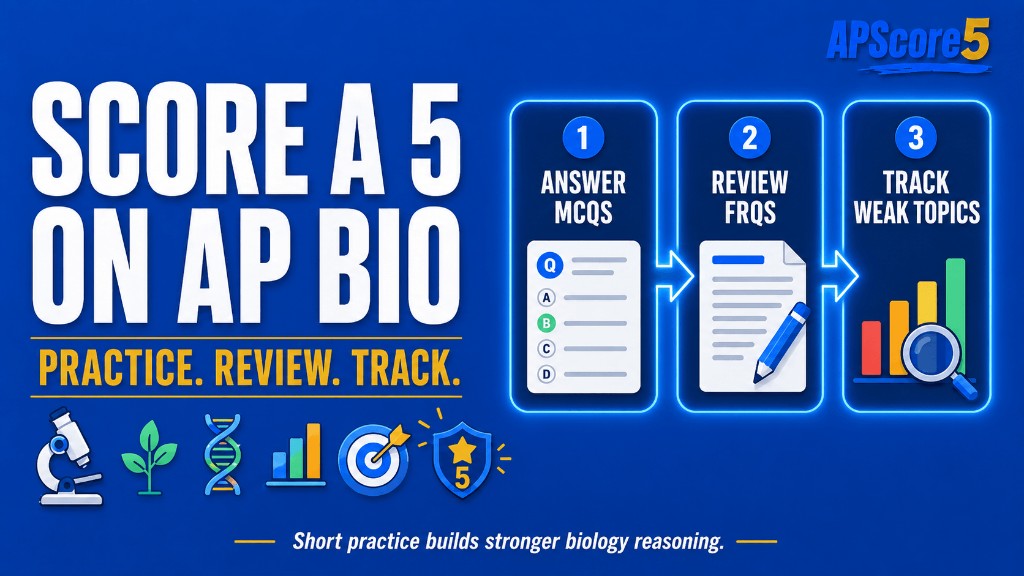
Sample every unit
Eight quick questions show where you’re strong and what to open first.
Open sampler →
Study one unit deeply
Each unit card links to a hub with topics, practice, and mistakes to avoid.
Browse units →
Build vocabulary fast
Flip high-frequency terms, then pair them with daily practice.
Flashcards →Honest difficulty check
Is AP Biology hard?
AP Biology is usually considered a challenging AP science course. It is content-heavy, but the bigger challenge is applying ideas to data, experiments, models, and FRQs.
What makes it harder than it looks
- A large amount of vocabulary, processes, and models.
- Processes like photosynthesis, respiration, gene expression, and natural selection.
- FRQs that require evidence-based explanations and data interpretation.
- Graphs, experimental data, models, and biological scenarios.
What makes it manageable
- Most math is manageable: percentages, ratios, probability, and basic graph interpretation.
- Recurring patterns make the course easier once core systems are understood.
- Visual models and diagrams help connect processes.
- Daily 5–10 minute practice helps retain details across units.
Exam skills
What AP Biology really tests
AP Biology is not only a content exam. Strong students know the vocabulary, but high-scoring students can use that vocabulary to explain mechanisms, analyze data, and justify claims.
Concept explanation
Explain biological processes clearly instead of dropping disconnected terms.
Data and graph analysis
Read axes, compare groups, describe trends, and connect evidence to biology.
Experimental design
Identify variables, controls, hypotheses, and valid conclusions from investigations.
Scientific argumentation
Make a claim, support it with evidence, and explain why the evidence matters.
Exam overview
AP Biology exam format
The AP Biology exam has two major sections: multiple choice and free response. Each section counts for half of the exam score.
Section I: Multiple Choice
60 questions · 1 hour 30 minutes · 50% of score
- Discrete questions
- Question sets based on data, diagrams, models, or scenarios
- Strong focus on applying concepts, not just recalling definitions
Section II: Free Response
6 questions · 1 hour 30 minutes · 50% of score
- 2 long free-response questions
- 4 short free-response questions
- Common tasks include data analysis, experimental design, visual models, and scientific explanations
Tip: Do not save FRQ practice for the end. Start writing short explanations early so your answers become clear, direct, and evidence-based.
Course roadmap
AP Biology units explained
AP Biology is organized into eight major units. Use this roadmap to choose the right unit guide, then go deeper into the topic pages inside each unit.
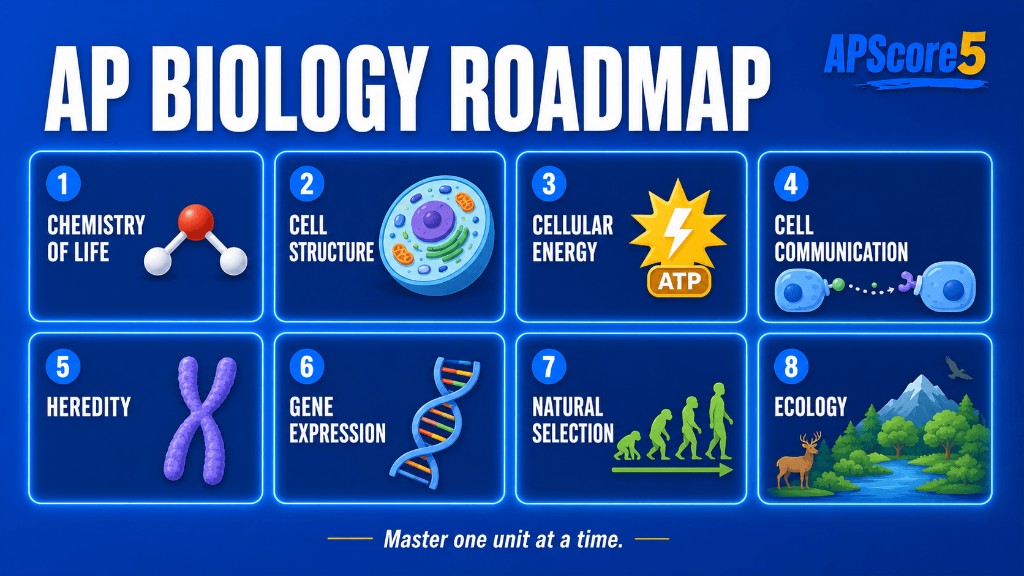
1
Unit 1 · 8–11% of examFoundational
Chemistry of Life
Start with the molecules that make life possible: water, carbon, macromolecules, proteins, carbohydrates, lipids, and nucleic acids.
WaterMacromoleculesCarbohydratesProteins
Common trap: Students memorize molecules but forget to connect structure to function.
2
Unit 2 · 10–13% of examFoundational
Cell Structure and Function
Review organelles, membranes, transport, compartmentalization, surface area, diffusion, osmosis, and how cell structure supports function.
OrganellesMembranesTransportSA:V ratio
Common trap: Students confuse osmosis, diffusion, and active transport.
3
Unit 3 · 12–16% of examCore
Cellular Energetics
Focus on enzymes, energy transfer, photosynthesis, cellular respiration, ATP, and how cells capture and use energy.
EnzymesATPPhotosynthesisRespiration
Common trap: Students memorize steps without explaining energy flow.
4
Unit 4 · 10–15% of examCore
Cell Communication and Cell Cycle
Study signal transduction, feedback mechanisms, checkpoints, mitosis, and how cells coordinate growth and response.
SignalingFeedbackMitosisCheckpoints
Common trap: Students forget that cell communication often changes gene expression or enzyme activity.
5
Unit 5 · 8–11% of examCore
Heredity
Review meiosis, inheritance, genetic variation, Punnett squares, probability, and how traits pass from parents to offspring.
MeiosisGeneticsPunnett squaresVariation
Common trap: Students mix up mitosis and meiosis or confuse genotype with phenotype.
6
Unit 6 · 12–16% of examCore
Gene Expression and Regulation
Connect DNA, RNA, transcription, translation, regulation, mutations, biotechnology, viruses, and gene expression.
DNARNATranslationRegulation
Common trap: Students know the central dogma but struggle to explain regulation.
7
Unit 7 · 13–20% of examCapstone
Natural Selection
Master evolution, selection, population genetics, Hardy-Weinberg, phylogeny, evidence for evolution, and speciation.
SelectionEvolutionHardy-WeinbergSpeciation
Common trap: Students treat evolution as individual change instead of population change.
8
Unit 8 · 10–15% of examCapstone
Ecology
Study populations, communities, ecosystems, energy flow, biodiversity, disruptions, and interactions between organisms and environments.
Energy flowPopulation growthFood websBiodiversity
Common trap: Students confuse energy flow with matter cycling.
Why this order works
How the 8 AP Biology units connect
AP Biology units build on each other. Chemistry (Unit 1) sets up cells (Unit 2), which sets up energy flow (Unit 3). Genetics (Units 5-6) feeds evolution (Unit 7), which feeds ecology (Unit 8). Studying out of order works — but knowing the connections makes every unit easier.
The energy chain
Unit 1 → Unit 2 → Unit 3
Macromolecules form cell parts. Cell membranes control what enters. Enzymes inside cells run photosynthesis and respiration to make ATP.
From signal to gene
Unit 4 → Unit 6
Cells communicate using signaling pathways. Many of those signals change gene expression — turning genes on or off.
Heredity to evolution
Unit 5 → Unit 6 → Unit 7
Meiosis creates genetic variation. Gene expression shapes phenotypes. Natural selection acts on phenotypes, changing allele frequencies.
FRQ tip: AP graders reward answers that connect concepts across units. "Selection on a phenotype" is stronger when you mention the underlying gene expression change.
Score strategy
How to get a 5 on AP Biology
To get a 5 on AP Biology, you need more than long study sessions. You need a repeatable system: understand the unit, practice exam-style questions, fix weak spots, and write clear FRQs.
- Start with your weakest unitUse the sampler or your recent mistakes to decide where your review will create the biggest score gain.
- Explain the mechanismFor every process, ask: What starts it? What changes? What result does it produce? Why does it matter?
- Practice with dataGraphs, tables, experimental results, and models are where many AP Biology points are won or lost.
- Write FRQs with a structureAnswer the command verb, use specific biology, cite evidence when given, and explain your reasoning.
- Review mistakes, not just notesYour wrong answers show exactly what to study next. Turn every miss into a flashcard, mini-explanation, or unit review.
Personalized check
Your AP Biology starting point
Eight quick questions sample one idea per unit. Finish to see your strongest unit, your first repair target, three suggested topic pages, and a shortcut button to start studying.
Create a free account to sync progress across devices. You can still finish this sampler and jump into topics below without signing up.
Answer to unlock explanation.
Your snapshot
Strongest sampled unit
—
First repair target
—
Recommended next topics
Results stay in this browser until you clear site data or click retake.
Exam weight + fixes
AP Biology unit priority guide
Use priority as a weekly lens—not a reason to skip units. Every unit appears on the exam; “Review” still matters for fast recall.
| Unit | What to master | Common mistake | Priority | Practice |
|---|---|---|---|---|
| 1 · Chemistry of Life | Water properties, macromolecule structure → function | Listing parts without explaining hydrogen bonding or specificity | Review | Unit 1 hub → |
| 2 · Cell Structure | Membranes, transport, surface-area reasoning | Mixing up tonicity outcomes or ignoring selective permeability | High | Unit 2 hub → |
| 3 · Energetics | Enzymes, photosynthesis vs respiration, ATP accounting | Saying “mitochondria make energy” without tracing electrons/NADH | High | Unit 3 hub → |
| 4 · Signaling & cycle | Signal flow, feedback, checkpoints | Naming steps without linking receptor → response | Medium | Unit 4 hub → |
| 5 · Heredity | Meiosis vs mitosis, inheritance math | Confusing segregation with independent assortment | Medium | Unit 5 hub → |
| 6 · Gene expression | Central dogma, regulation, tech vocabulary | Skipping “when/how much” regulation logic | High | Unit 6 hub → |
| 7 · Natural selection | Selection vs drift, Hardy-Weinberg setup | Treating evolution as individual change | High | Unit 7 hub → |
| 8 · Ecology | Energy vs matter, population/community models | Confusing pyramid energy with biomass | Medium | Unit 8 hub → |
Need a specific topic?
Jump from the AP Biology roadmap to topic practice
This course page gives you the big picture. For detailed explanations, examples, MCQs, and FRQs, use the unit and topic pages below.
Foundations
Cells and energy
Genes, heredity, and evolution
Avoid easy point losses
Common AP Biology mistakes students make
Memorizing terms without mechanisms
Knowing a term is not enough. You need to explain how the process works and why it affects the organism, cell, or ecosystem.
Ignoring graphs and tables
Many questions hide the answer in the data. Always read the title, axes, units, trends, and comparison groups.
Writing vague FRQ answers
Words like “it changes” or “it helps” are usually too vague. Name the biological process and explain the cause-effect relationship.
Studying only the easiest units
Your score improves faster when you target the units you miss most often, not the units you already like.
Free response
How to write AP Biology FRQs
Use a four-part loop so every sentence earns points: answer directly, cite biology, explain mechanism, and show precise vocabulary.
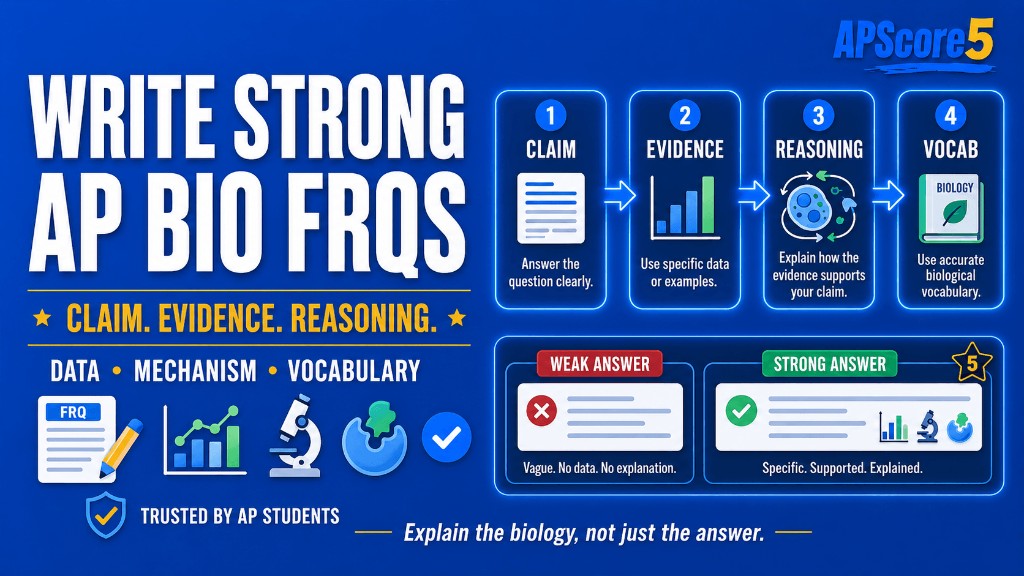
- Claim: Answer the prompt in one focused sentence.
- Evidence: Pull from data, trends, figures, or a named biological fact.
- Reasoning: Explain why the evidence supports the claim using a mechanism.
- Vocabulary: Drop in accurate AP Bio terms (enzyme, allele, selective pressure, etc.).
Mini-FRQ: Explain how a mutation in an enzyme’s active site could affect cellular respiration.
Weak answer pattern
“The enzyme breaks and respiration stops.”
Too vague—no mechanism, no link to substrates or ATP yield.
Strong answer pattern
Claim: The mutation can lower respiration flux.
Evidence + reasoning: Active-site shape sets substrate orientation; if binding drops, the catalytic rate of downstream ATP-producing steps falls.
Vocabulary: activation energy, enzyme-substrate complex, oxidative phosphorylation.
Cram week
7-day AP Biology study plan
Built for a tight week: each day pairs a 20-minute focus block with one FRQ or data skill so practice stays exam-shaped.
Day 1
Diagnostic + Units 1–2
Focus: Properties of water + membrane transport reasoning.
20-minute task: Finish the eight-question sampler, then rewrite two missed explanations in your own words.
Practice: Water properties guide
FRQ / data: Explain cohesion vs adhesion using one exam sentence each.
Day 2
Cellular energetics
Focus: Photosynthesis vs respiration + ATP accounting.
20-minute task: Draw glycolysis → ETC as a flowchart without peeking, then fix gaps.
Practice: Respiration overview
FRQ / data: Interpret a bar graph of oxygen consumption.
Day 3
Signaling + heredity
Focus: Receptor → response + meiosis vs mitosis.
20-minute task: Write feedback vs feedforward in two separate scenarios.
Practice: Mitosis vs meiosis
FRQ / data: Describe how a signal shuts down faster in negative feedback.
Day 4
Gene expression + biotech
Focus: Central dogma timing + regulation vocabulary.
20-minute task: Compare transcription vs translation locations aloud.
Practice: Transcription vs translation
FRQ / data: Predict phenotype change from a promoter mutation.
Day 5
Natural selection + Hardy-Weinberg
Focus: Selection on phenotypes + allele math setup.
20-minute task: Solve one p + q = 1 problem and narrate assumptions.
Practice: Hardy-Weinberg guide
FRQ / data: Explain why allele frequencies change when drift acts.
Day 6
Ecology + data analysis
Focus: Energy pyramids + population/community graphs.
20-minute task: Trace carbon through producers → consumers → decomposers.
Practice: Energy flow section
FRQ / data: Compare energy vs biomass pyramids using one sentence each.
Day 7
Mixed review + FRQ sprint
Focus: Random mixed recall + timed writing.
20-minute task: Two timed paragraphs on unfamiliar prompts—stop when the timer ends.
Practice: Mixed AP Bio practice
FRQ / data: Peer-grade using the Claim/Evidence/Reasoning checklist above.
Vocabulary flashcards
Practice the highest-frequency AP Biology terms
Flip one card at a time to build the vocabulary foundation students need for MCQs, data questions, and FRQs.
Term
Tap to reveal definition
Definition
Tap to flip back
Card 1 of 25
Save your journey
Your AP Biology dashboard. Free. No credit card.
A 60-second signup turns this page into a personalized study system.
See your weak units instantly
Sampler results + missed questions feed your personal weak-topic map across all 8 units.
Build a Bio streak
5 minutes a day, tracked across devices. Most 5-scorers practice daily for 30+ days.
FRQ feedback that improves
Practice FRQ prompts and get a checklist-based score using the Claim → Evidence → Reasoning framework.
Study strategy
The 5-to-10 minute daily AP Biology routine
Daily routine
Do one flashcard session, one MCQ, and one quick correction from a missed question. The goal is consistency, not marathon studying.
What top scorers do
They review wrong answers, explain the biological process in one sentence, and return to weak topics after a short gap.
Compare AP courses
AP Biology vs Other AP Science Classes
These quick comparison answers help students choose the right AP science path and give search engines clear, snippet-ready answers. Deep concept definitions such as photosynthesis, cellular respiration, Hardy-Weinberg, and gene expression should live on separate microtopic pages.
AP Biology vs AP Chemistry: which is harder?
AP Biology is usually more reading-, concept-, and data-heavy, while AP Chemistry is more math- and problem-solving-heavy. AP Biology is better for students who like living systems, genetics, evolution, and ecology. AP Chemistry is better for students who like equations, reactions, stoichiometry, and atomic structure.
| Course | Best for students who like | Main challenge |
|---|---|---|
| AP Biology | Cells, genetics, evolution, ecology, experiments, and data | Connecting many systems and writing clear FRQ explanations |
| AP Chemistry | Reactions, equations, atomic structure, bonding, and calculations | Problem solving, math setup, and multi-step calculations |
AP Biology vs AP Environmental Science: what is the difference?
AP Biology studies living systems at molecular, cellular, organismal, population, and ecosystem levels. AP Environmental Science focuses more on ecosystems, pollution, energy use, resources, and environmental impact.
| Course | Focus | Typical question style |
|---|---|---|
| AP Biology | Life processes and biological systems | Interpret data, explain mechanisms, and connect structure to function |
| AP Environmental Science | Environment, resources, pollution, and sustainability | Apply science concepts to environmental problems and human impact |
AP Biology vs AP Psychology: which should I take first?
Choose AP Biology first if you want a lab-science style challenge and are interested in medicine, life science, genetics, or ecology. Choose AP Psychology first if you prefer behavior, memory, learning, and brain-related concepts with more term-based study.
| Course | Better fit | Study style |
|---|---|---|
| AP Biology | Students who like science mechanisms and experimental data | Daily process review, model practice, graph interpretation, and FRQs |
| AP Psychology | Students who like behavior, memory, learning, and mental processes | Term memorization, examples, and concept application |
Review slides
AP Biology review slides
Slide deck for course-wide review before the FAQ—use it to refresh big ideas across units, then open the questions below.
FAQ
AP Biology FAQ
Is AP Biology hard?
AP Biology is challenging because it combines content knowledge with data analysis, experimental design, and written explanations. It becomes much easier when you study by unit, practice consistently, and review mistakes.
How many units are in AP Biology?
AP Biology has 8 major units: Chemistry of Life, Cell Structure and Function, Cellular Energetics, Cell Communication and Cell Cycle, Heredity, Gene Expression and Regulation, Natural Selection, and Ecology.
What is the best way to study for AP Biology?
The best way to study for AP Biology is to diagnose weak units first, review concepts by unit, practice MCQs, write FRQs, and keep a mistake log so each study session targets a real weakness.
How do I get a 5 on AP Biology?
To get a 5, focus on understanding biological mechanisms, interpreting data, practicing exam-style MCQs, and writing clear FRQ answers that use evidence and reasoning.
Which AP Biology unit is hardest?
Many students find Cellular Energetics, Gene Expression and Regulation, and Natural Selection difficult because they require process reasoning, data interpretation, and strong connections between concepts.
Should I study AP Biology units in order?
If you are new to the course, studying in order helps because later units build on earlier ideas. If you are reviewing for the exam, start with your weakest unit first and use the roadmap to fill gaps.
What should I practice first: MCQs or FRQs?
Start with a few MCQs to check understanding, then write short FRQ explanations. MCQs show whether you recognize the concept; FRQs show whether you can explain it clearly.
Can I review AP Biology in 7 days?
Yes, but a 7-day review should be targeted. Focus on weak units, high-value exam skills, data analysis, and FRQ writing instead of trying to reread every note.