Pair sources before you lock an answer
Read legends, scales, units, and captions together—decide whether evidence supports a regional trend or a misleading aggregation inside one polygon.
Isoline Maps in AP Human Geography explains how this topic appears across places and scales. Use it to interpret map evidence, compare spatial patterns, and write precise AP-style geographic explanations.
Practice with real AP Human Geography examples, compare spatial evidence across maps, and review with 22 flashcards plus 16 AP-style questions with explanations.
Learn in 7 mins · Practice in 10 mins
An isoline map connects points of equal value with continuous lines—contours for elevation, isotherms for temperature, isobars for pressure—so gradients appear smooth instead of chunky polygons. Readers trace ridges, fronts, and steep slopes by following line spacing and labeled intervals on AP stimuli.
Unit 1 is about 8–10% of the AP Human Geography exam.
This guide connects classroom vocabulary to maps you already see on phones and TV: temperature curves, hiking contours, and pressure lines.
If you are meeting the word isoline for the first time, keep one sentence in mind:
In one sentence: A line on the map where every point along it has the same value.
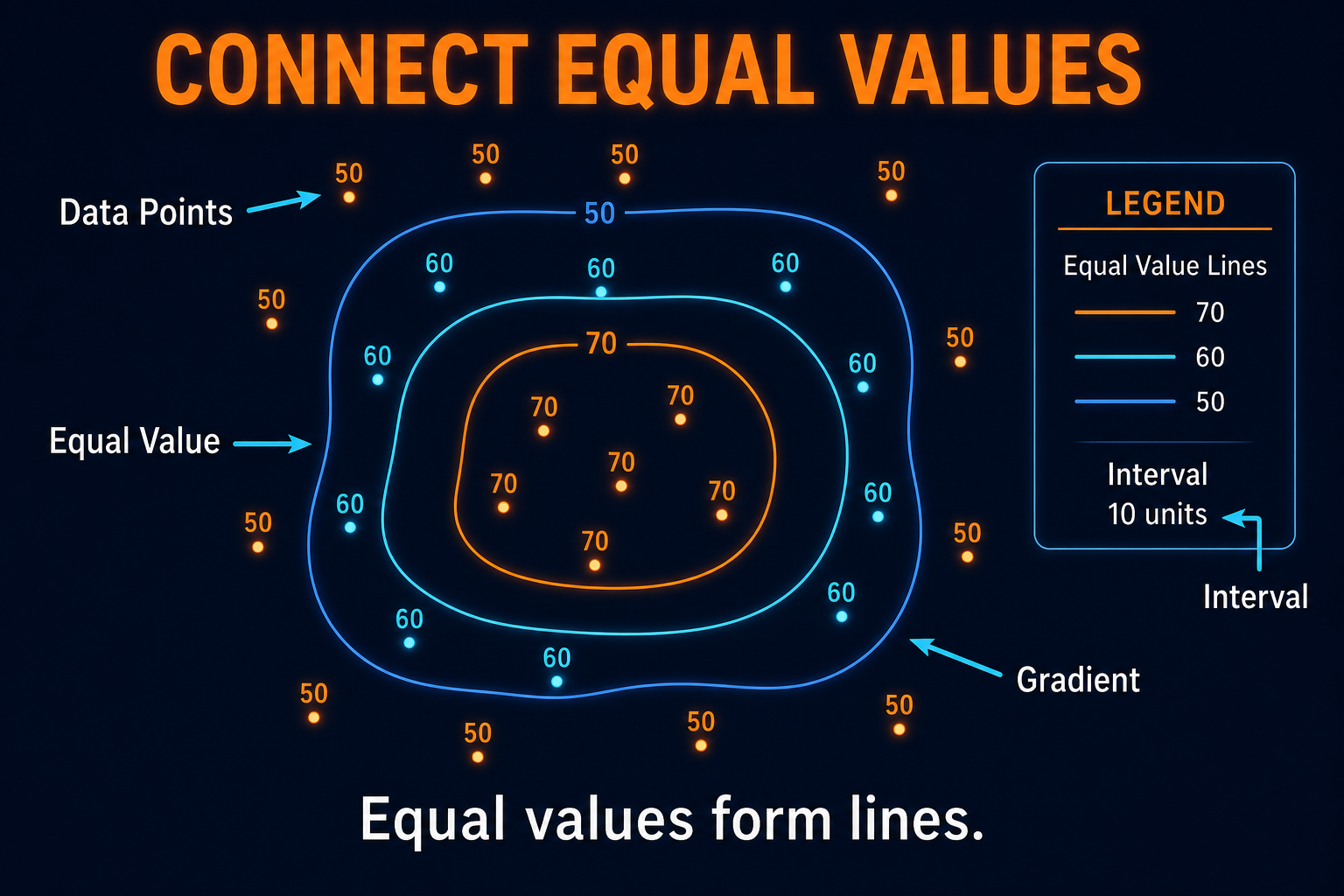
Picture a 70°F isotherm on a national forecast map. Walk along that line in any direction and the modeled temperature stays 70°F until you cross a different line. Step away and you move into warmer or cooler air masses. The same logic applies to a contour labeled 1,000 feet on a topographic-style read: every point on that contour shares the same elevation. Cross toward the next higher contour and you climb one interval; cross toward the next lower contour and you descend one interval.
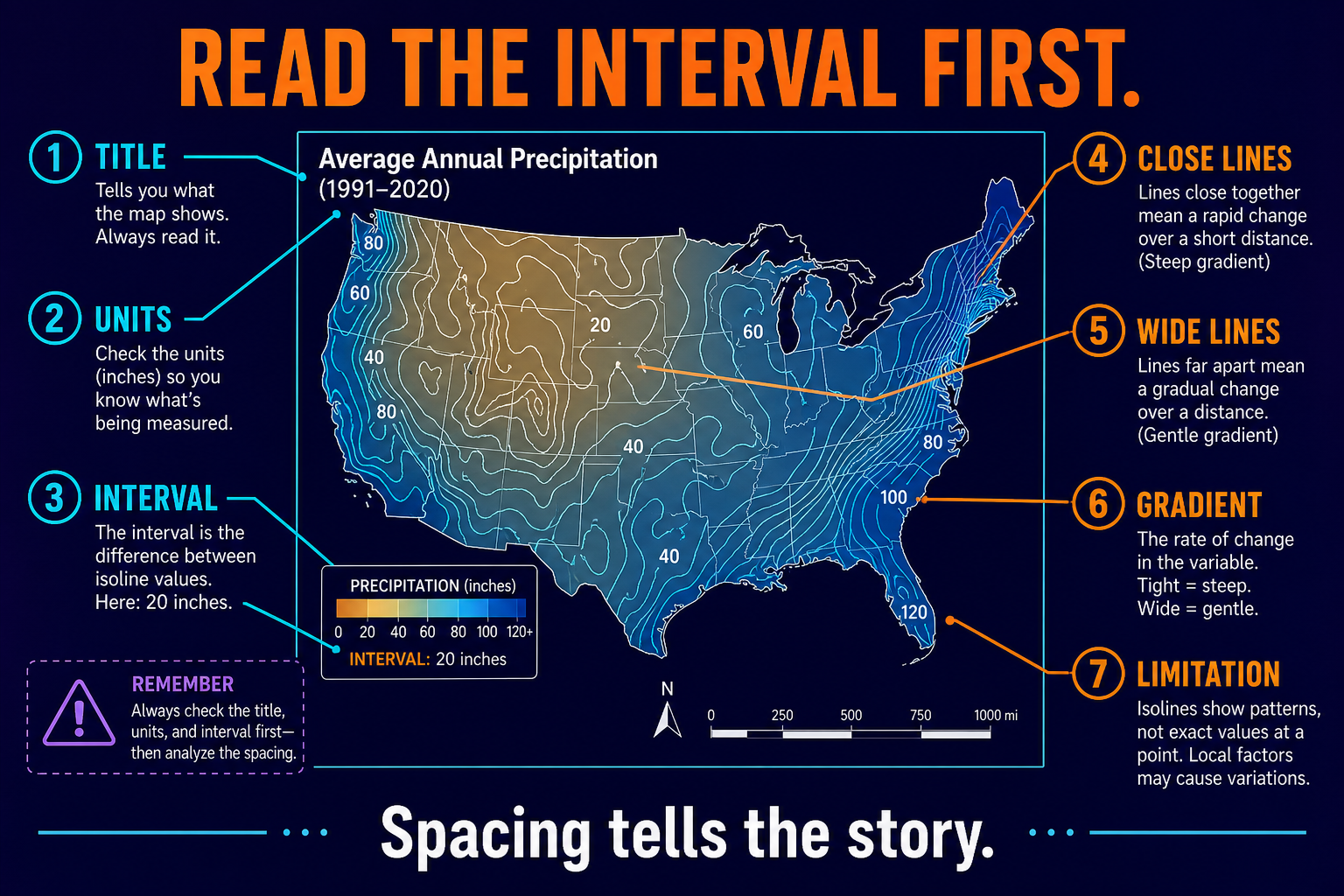
Students who freeze on MCQs usually forget the interval. The interval is the fixed step between neighboring lines—maybe every 40 feet, maybe every 2°C. Without the interval, “many lines” does not mean much. With the interval, you can estimate real change: crossing five lines at a 40-foot interval means roughly 200 feet of vertical change along your path, which is a concrete claim you can defend in writing.
An isoline map (also called an isopleth map) is a thematic map that draws lines of equal value so you can read how a continuous variable changes across space. Every point on one line shares the same measurement—elevation, temperature, rainfall, pressure, or travel time—while the distance between neighboring lines shows how quickly that value changes from place to place.
Where lines pack tightly, the gradient is steep; where they spread wide, change is gentle. If you have watched a weather forecast with smooth temperature curves or used a trail map with contour lines around a ridge, you already know the routine AP rewards: read the title, confirm the interval in the legend, then treat spacing as evidence.
AP Human Geography places isoline maps inside Unit 1 because they teach how geographers represent fields—quantities that exist across an area rather than only inside neat polygons. That matters later when you study climate impacts on agriculture, storm tracks near coasts, or elevation effects on settlement. The classification habit is the same: name the variable, name whether it is continuous, name the symbol system, then decide what story the map argues.
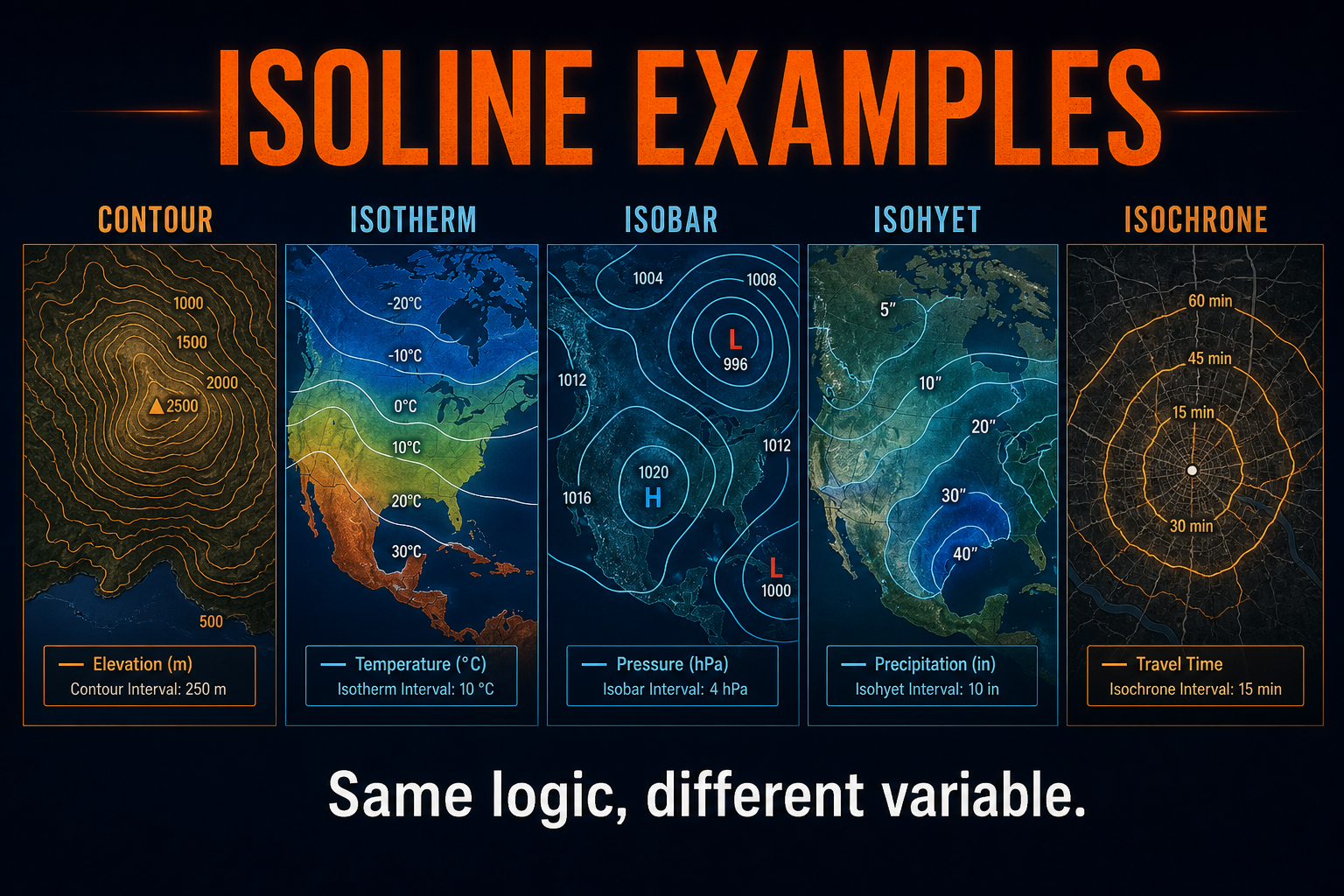
The word iso comes from Greek for equal. That shared root shows up in vocabulary AP loves: isobar (equal pressure), isotherm (equal temperature), isohyet (equal rainfall), isochrone (equal travel time), and isohypse (equal elevation on many technical maps). They are the same map family with different measured variables. On exam day, do not treat those names as unrelated facts—if you can explain one, you can explain the pattern behind the others.
Formal definition: An isoline map (or isopleth map) is a thematic map that displays a continuous spatial variable using lines that connect points of equal value. The curvature and spacing of the lines communicate how quickly the variable changes across the map.
FRQ-ready sentence: An isoline map is a thematic map that uses lines connecting points of equal value to show patterns of continuous spatial data, such as elevation, temperature, or rainfall. Add one map detail from the stimulus—interval, units, year—and you are already writing like a geographer instead of a guesser.
Every point on the same line shares the same measured value. That is the non-negotiable definition feature. Roads and borders can be lines too, but they are not isolines unless they are drawn as equal-value lines for a variable—which they almost never are.
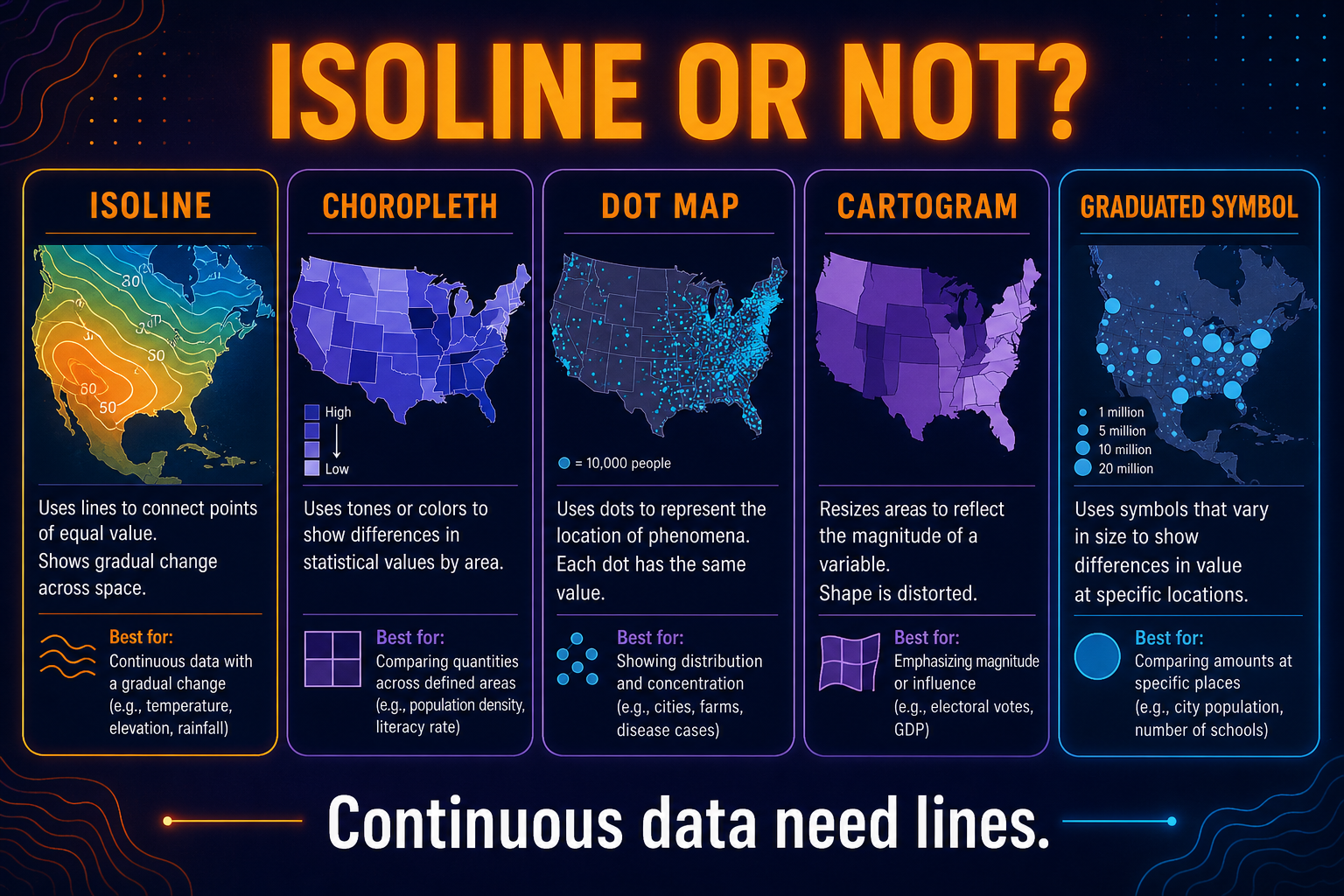
The variable should make sense “in between” places: temperature, elevation, precipitation, pressure, travel time. If the story is only “winner by state,” you are usually in choropleth territory instead.
Tight spacing means a steep field: rapid change per mile. Wide spacing means a gentle field. On topography, tight brown lines can mark cliffs; on pressure maps, tight isobars often align with stronger winds near fronts.
Legends list the step between lines. AP items sometimes hide the interval in the caption, so train yourself to hunt for it in both places before you answer a slope question.
A topographic map is a famous isoline subtype where the variable is elevation. Agencies publish quads; hikers carry them; AP uses simplified topo stimuli in skills questions.
Same structure, different variables. Naming the correct “iso-” term is often a one-point swing on vocabulary items.
Close the section in your notes with one plain sentence: Isoline maps draw equal-value lines across continuous data, and spacing shows how fast the value changes. That sentence travels to climate references in later units, to physical geography overlays, and to any stimulus where the College Board wants you to interpret a field rather than a table.
Direct answer: A standard isoline map represents three dimensions—two horizontal dimensions for position on the ground (east-west and north-south, often read as longitude and latitude on a projected page) and one additional dimension encoded by the lines for the variable being measured, such as elevation in feet or temperature in degrees. The paper is flat, but the line pattern lets your brain reconstruct hills, ridges, pressure highs, or temperature ridges.
Teachers sometimes call this a “2.5D” representation because the page is physically flat while the contour field acts like a surface hovering above it. That language is fine in class notes, but on the AP exam prefer the precise “three dimensions” wording unless the stem forces a different frame. Pair the idea with an example: a topo quad is flat print that still communicates relief because each contour is an equal-elevation slice through the terrain surface.
Practice the six-step drill on two different stimuli back-to-back: one temperature map and one topographic excerpt. If you can complete the drill in under forty seconds, you have enough automaticity to spend your thinking time on the harder “why” or “so what” prompts instead of decoding basics.
Examples win FRQ evidence points because they prove you can transfer vocabulary to recognizable media. Pick three favorites and memorize them cold: weather temperature (isotherms), topographic elevation (contours), and air pressure (isobars). Add rainfall isohyets for agriculture questions, isochrones for urban access questions, and magnetic declination or noise contours for specialty contexts.
Forecast panels curve isotherms through regions sharing similar highs. The story is gradient and air mass boundaries, not state averages alone.
USGS-style quads and trail maps show relief. Cliffs pack contours; meadows spread them. This is the isoline example most students can sketch from memory.
Long-distance hikers read elevation profiles built from contour data to plan water carries and snow windows. Mention profiles only if the prompt allows cross-section thinking.
Annual precipitation maps often smooth totals across space so wet coasts and dry interiors read as fields, which fits isolines better than abrupt state boxes.
Surface charts show highs, lows, and fronts. Tight isobars warn of strong pressure gradients and wind.
Planners map “30 minutes from downtown” rings for transit and site selection. Time is treated as a continuous field from network access.
Navigation charts publish equal-declination lines for compass correction. It is niche but still isoline logic.
Environmental maps ring airports or plants with equal-exposure lines for public health review.
Common thread: every example above relies on continuous measurements that can be interpolated across space. If your data only exist as totals inside fixed polygons—and the story is about those polygons—reach for choropleth reasoning first.
Isoline maps matter because geography constantly asks you to reason about gradients—how quickly conditions change as you move. Climate shifts, hazard exposure, and service access all have gradient stories. Lines are a compact notation for those stories on paper or screens.
| Advantages | Disadvantages |
|---|---|
| Shows continuous data with clear gradient cues | Can feel abstract for first-time readers |
| Spacing communicates rate of change directly | Sparse real measurements make interpolation uncertain |
| Works for many variables (temp, pressure, rainfall) | Usually emphasizes one variable at a time |
| Standard in meteorology and surveying | Bad interval choice can flatten or exaggerate patterns |
| Pairs well with shading or hillshades | Clutter rises when lines, labels, and relief stack together |
The limitation most FRQs want is interpolation: cartographers draw smooth lines between sampled points, so any single line placement is a model, not a direct measurement at every pixel. Saying so shows you understand data ethics and uncertainty, not just vocabulary.
A topographic map is a type of isoline map whose variable is elevation. All topo maps are isoline, but not every isoline map is topographic—temperature isotherms are isolines too. If a prompt shows contour feet or meters, call the family isoline and name elevation as the variable.
| Feature | Isoline map | Choropleth map |
|---|---|---|
| Symbol | Lines of equal value | Shaded classes by region |
| Data type | Continuous field | Regional summaries |
| Example | Isotherms across the U.S. | Median income by county |
Dot maps show discrete or aggregated point symbols for counts. Isolines show smooth fields. If you see same-size dots clustering, think dot density; if you see labeled equal-value loops, think isoline.
Start every review session by sketching a hill with three contour lines on paper, labeling an interval, and narrating which side is steeper. That thirty-second habit anchors spacing logic before you open any digital stimulus. Then open two contrasting maps: one temperature field and one topo excerpt. Run the same six questions on each—variable, interval, highs, lows, spacing, path—so your brain treats isolines as one family with different variables instead of unrelated graphics.
When you miss a multiple-choice item, rewrite the wrong answer into a true statement about some other map type. For example, if you mistakenly picked choropleth language for an isotherm map, write one sentence explaining when choropleths actually fit. That conversion step stops repeated errors faster than rereading the explanation passively.
Connect isolines forward to Unit 2 population density conversations and Unit 5 agriculture climate inputs. Many later maps reuse isoline thinking even when the unit title changes. If you can name how rainfall gradients affect crop choice, you are already using isoline literacy outside Unit 1 headings.
For free response, draft a reusable three-sentence skeleton: sentence one defines isolines with equal values and continuity; sentence two cites a real example with variable and interval; sentence three names one advantage (gradient readability) and one limitation (interpolation). Keep that skeleton in your notes app so you spend exam time customizing evidence instead of inventing structure.
Pair reading with calculation. Pick two points on a printed topo snippet, count contour crossings, multiply by the interval, and compare your result to the map’s labeled spot heights if provided. Small arithmetic checks catch misread intervals early. If your count implies a 600-foot climb but the map labels only a 200-foot rise, revisit whether you crossed index contours or auxiliary ticks.
Discuss uncertainty honestly. If a stem shows sparse weather stations and smooth isotherms, acknowledge that analysts interpolated between observations. AP human geography rewards students who treat maps as authored arguments rather than neutral photographs. Mentioning station density or ocean data gaps can earn nuance points when prompts invite critique.
Finally, alternate timed and untimed passes. Untimed passes build accuracy; timed passes build stamina. Aim for two timed passes weekly during map-heavy review weeks, each with sixteen mixed items including at least four isoline prompts, so classification speed stays sharp without crowding out other units.
Bring reference versus thematic language into isoline answers when prompts ask you to classify the map family. Isoline maps are thematic when they encode measured fields—even though topo maps also support location tasks. Naming that dual role shows mature geographic reasoning.
Use GIS vocabulary sparingly but accurately: many modern isoline layers are computed from raster surfaces or triangulated samples. You do not need software names to score; you need clear ideas about data behind the lines.
When you compare projections, remember that isoline shape can be distorted by the projection just like country shapes. If a question pairs isolines with projection choice, separate the two decisions: projection affects geometry; isolines still encode equal values on that projected plane.
Practice translating color-filled isotherm bands into words without relying on hue alone. Describe the band as “the region between the 80°F and 85°F isotherms” so your answer stays colorblind-accessible and precise. That habit also helps you avoid vague phrases like “the hot part” on FRQs.
End each week with a one-minute summary out loud: define isoline, name two examples, explain spacing, name one limitation. If you can do that without notes, you are ready to rotate back into broader map type practice sets for mixed review.
Keep a running list of “evidence sentences” you trust—short clauses you can drop under any isoline stimulus. Examples: “tight isotherms mark a sharp temperature gradient,” “widely spaced contours imply gentle relief,” “isohyets summarize rainfall as a field rather than a table.” When you build that list over time, you spend less energy inventing wording on exam day and more energy checking the stem’s exact question.
Identify isoline type, interpret spacing as gradient, or contrast with choropleth polygons.
Describe a temperature or elevation field, explain gradient steepness, or relate lines to real-world risk.
Weather maps, topo contours, classroom contour exercises.
Strong AP answer structure: Line (what equal value means) → Spacing (steep vs gentle) → Pattern → Geographic process.
Isolines connect points with:
Every fifth card advance shows an ad placeholder with a three-second countdown before the next card appears.
Prompt: Geographers use isoline maps to show how continuous variables change across space.
A. An isoline map is a thematic map that uses lines connecting points of equal value to show patterns of continuous spatial data, such as elevation, temperature, or rainfall.
B. A topographic map of a mountain region uses contour lines to show elevation—every point on one contour shares the same height above sea level.
C. An advantage is that line spacing shows how quickly elevation changes, helping hikers spot steep slopes. A limitation is interpolation: lines estimate values between measured points rather than sampling every location.
Rubric: Part A needs equal-value lines plus continuity. Part B needs a named example and variable. Part C needs one concrete advantage and one concrete limitation—avoid vague “confusing map” answers.
An isoline map (or isopleth map) is a thematic map that uses lines connecting points of equal value to show how a continuous variable like temperature, elevation, or rainfall changes across space.
A topographic map of a mountain region is the most familiar example because contour lines connect points of equal elevation. Other examples include weather temperature maps with isotherms, pressure maps with isobars, rainfall maps with isohyets, and travel time maps with isochrones.
A map where lines connect points that share the same measurement—same elevation, same temperature, or same rainfall total—so you can see how that measurement changes across an area.
Iso comes from Greek and means equal. An isoline is therefore a line of equal value. Terms like isobar, isotherm, and isohyet reuse the same root for different variables.
They show continuous spatial data such as elevation on topo maps, temperature on forecasts, rainfall totals, air pressure, travel time from a center, and sometimes pollution or noise fields. Pilots, hikers, forecasters, and planners rely on them for operational decisions.
They communicate gradients clearly: line spacing shows where a variable changes quickly or slowly, which is hard to express with tables alone. That gradient information supports hazard, navigation, and planning analysis.
A topographic map is a specific type of isoline map where the variable is elevation. All topographic maps are isoline maps, but not all isoline maps are topographic—a temperature isotherm map is still an isoline map with a different variable.
Isoline maps use lines of equal value to show continuous fields across space. Choropleth maps use color classes within regions such as counties or states when the story is tied to those boundaries.
Three: two horizontal dimensions for location on the map and one dimension for the variable encoded by the isolines, such as elevation or temperature. The page is flat, but the lines carry that third measurement.
They rely on interpolation between measured points, so lines are modeled estimates rather than direct readings everywhere. They also usually emphasize one variable at a time, and cluttered designs can overwhelm readers.
Most directly in Unit 1 map interpretation, but similar stimuli return whenever exams show continuous fields for climate, physical geography, or hazard contexts in later units.
Treat this microtopic as living vocabulary—reuse these habits whenever stimuli combine maps, tables, interviews, or timelines.
Read legends, scales, units, and captions together—decide whether evidence supports a regional trend or a misleading aggregation inside one polygon.
Population change, cultural diffusion, borders, rural systems, urban service gaps, and economic indicators all reward the spatial precision you practice in Unit 1.
Name the place, pull a detail from the stimulus, connect to a course concept, and end with a consequences sentence—skip definition dumps.
Call out who collected the data, at what geography, and when. Note missing groups when quantitative and qualitative pieces disagree.