Dot distribution maps use repeated dots to show where features are concentrated, sparse, clustered, or dispersed.
Quick answer
⚡
What Is a Dot Distribution Map in AP Human Geography?
A dot distribution map, also called a dot density map, is a thematic map that uses dots to show where a feature occurs and how concentrated it is across space. Each dot represents one item or a fixed number of items shown in the legend, such as 1 dot = 10,000 people or 1 dot = 100 farms.
Dot distribution maps show location, clustering, and concentration.
Each dot represents a fixed value from the legend.
Dense dot areas show higher concentration.
Sparse dot areas show lower concentration.
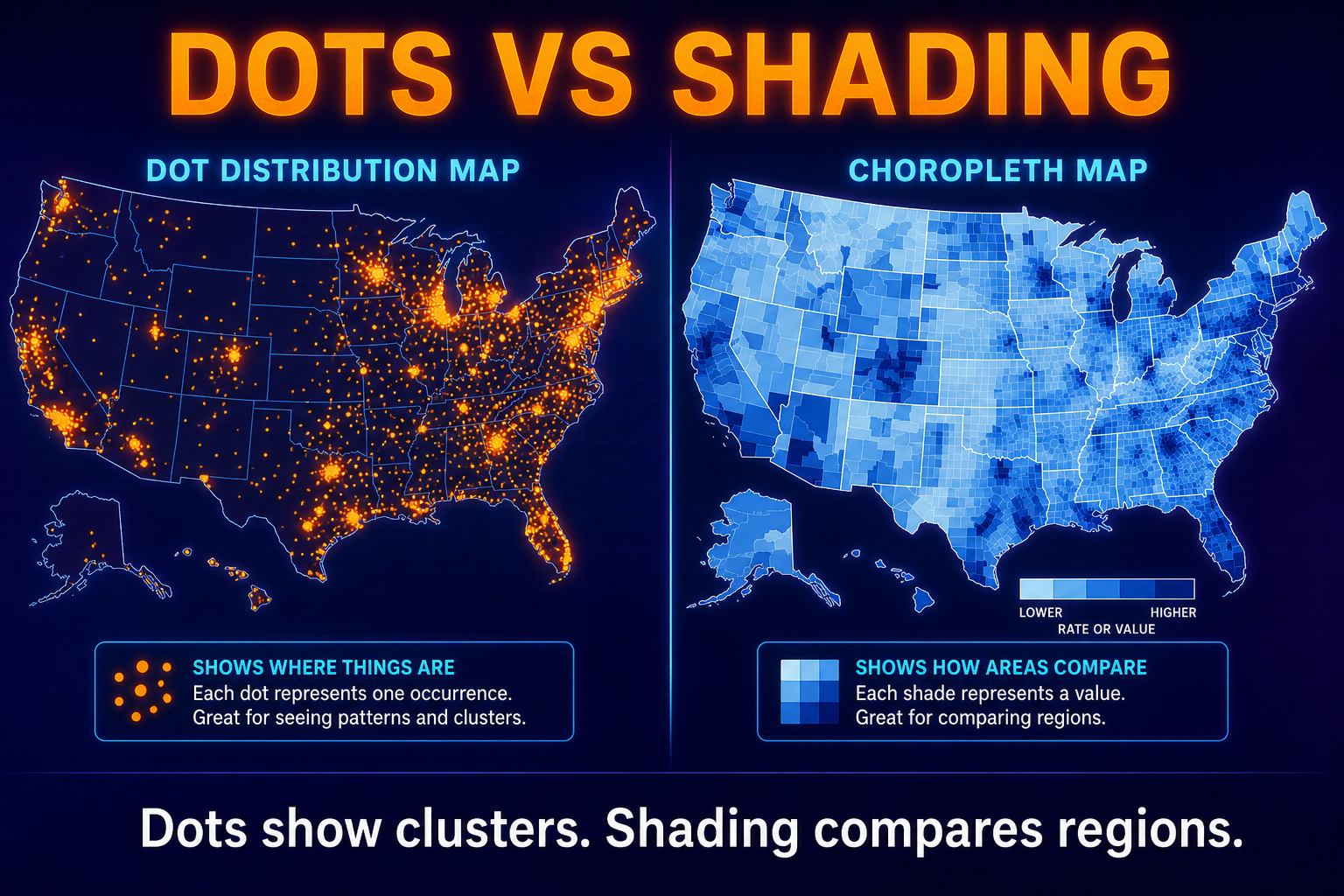
Dot maps reveal patterns inside regions that choropleth maps can hide.
Memory Shortcut
Dot map = dots show distribution.
Dots show where features occur.
Clusters show concentration.
Sparse dots show low presence.
The legend tells what each dot represents.
Section 1
📖
Dot Distribution Map Definition
A dot distribution map is a thematic map that uses repeated dots to show the location and concentration of a phenomenon. The legend tells what each dot represents. For example, one dot might equal 1,000 people, 100 farms, or 10 stores. The same design is also called a dot density map, and AP scoring treats both labels as interchangeable.
Dot value
The number or amount represented by one dot.
Cluster
Many dots close together, showing concentration.
Sparse area
Few dots or no dots, showing low concentration.
Distribution
The way features are arranged across space.
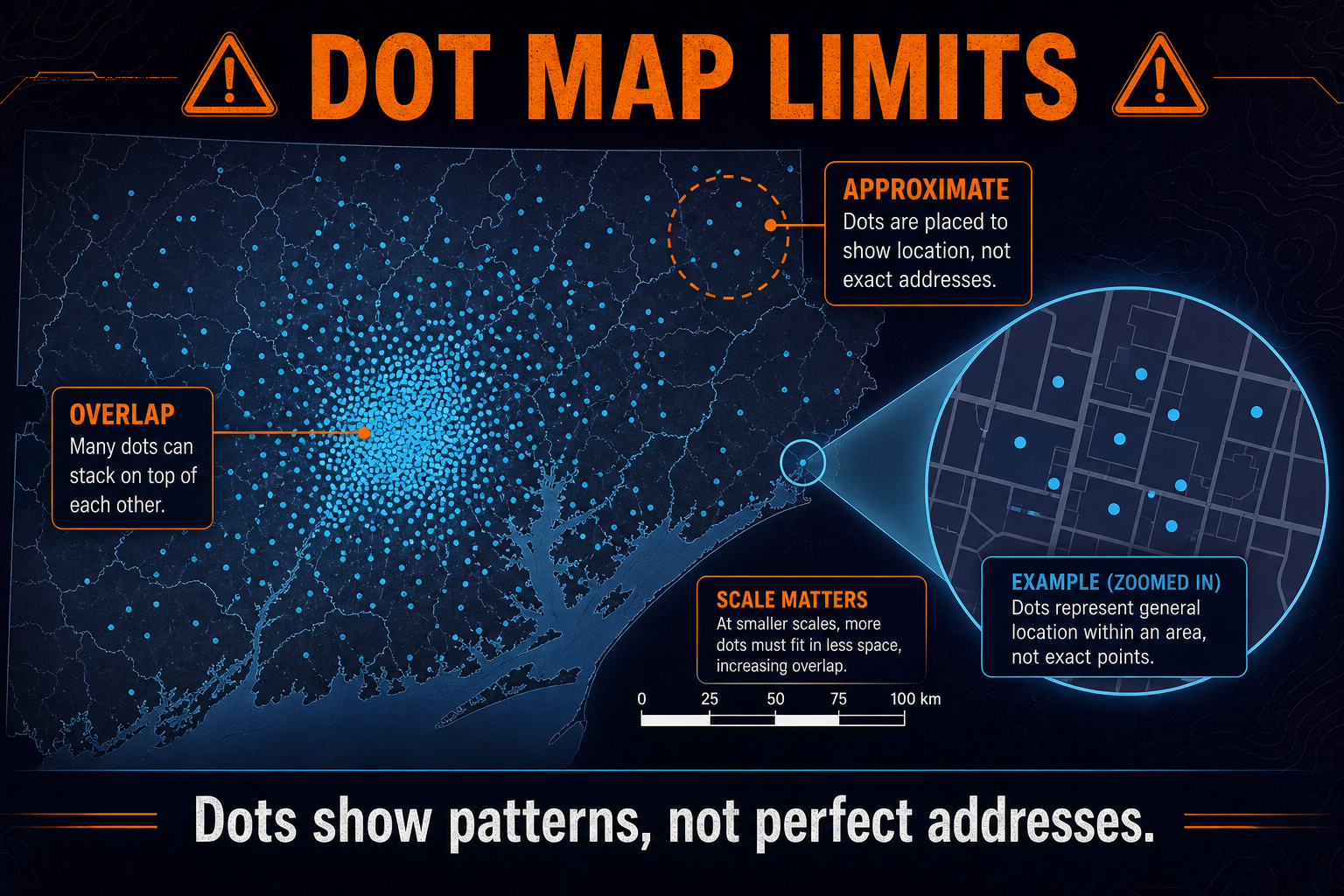
Approximate placement
Dots often show general concentration, not exact addresses.
Dot distribution maps start with a dataset and a geographic area. The mapmaker chooses a dot value, then places dots to represent where the phenomenon occurs. Dense clusters show high concentration, while empty or sparse areas show low concentration.
AP Exam Tip
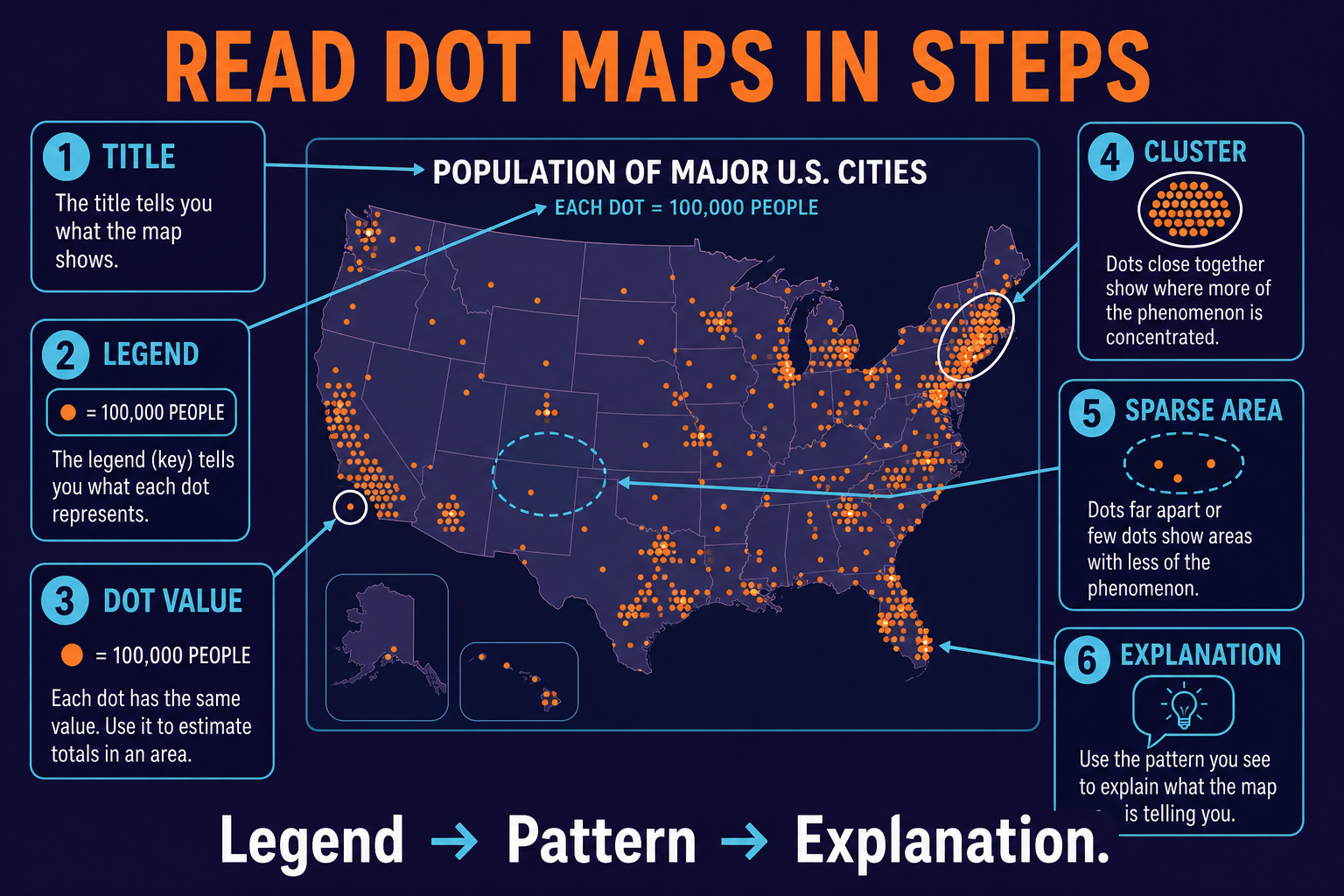
Always read the legend first. If the legend says 1 dot = 50,000 people, a cluster of dots represents a much larger population than it may first appear.
A dot distribution map uses a legend to explain how much each dot represents, then shows where dots cluster or spread out.
Walk through these seven checkpoints in order — the same sequence AP readers expect on map interpretation questions.
Read the title.
The title tells you what phenomenon the dots represent.
Check the legend and dot value.
Find what one dot equals before you estimate totals.
Identify where dots cluster.
Dense piles signal high concentration in that area.
Identify sparse or empty areas.
Few dots show low presence or absence of the feature.
Describe the pattern using geographic vocabulary.
Use clustered, dispersed, sparse, dense, linear, or concentrated.
Explain one possible reason for the pattern.
Connect to climate, jobs, water access, transportation, or history.
Mention one limitation.
Note approximate dot placement, scale, or visual clutter.
Strong dot map interpretation starts with the legend, then describes clusters, sparse areas, patterns, explanations, and limitations.
Weak answer: There are lots of dots.
Strong AP answer: The dots are clustered in the Northeast and along the West Coast, showing high population concentration in those regions. This pattern may reflect urbanization, coastal trade, jobs, and transportation networks. However, the dots may not represent exact household locations.
Use spatial analysis vocabulary and scale of analysis to explain why the same dot map can look different at national versus local scales.
Section 4
🔵
What Dot Distribution Maps Show
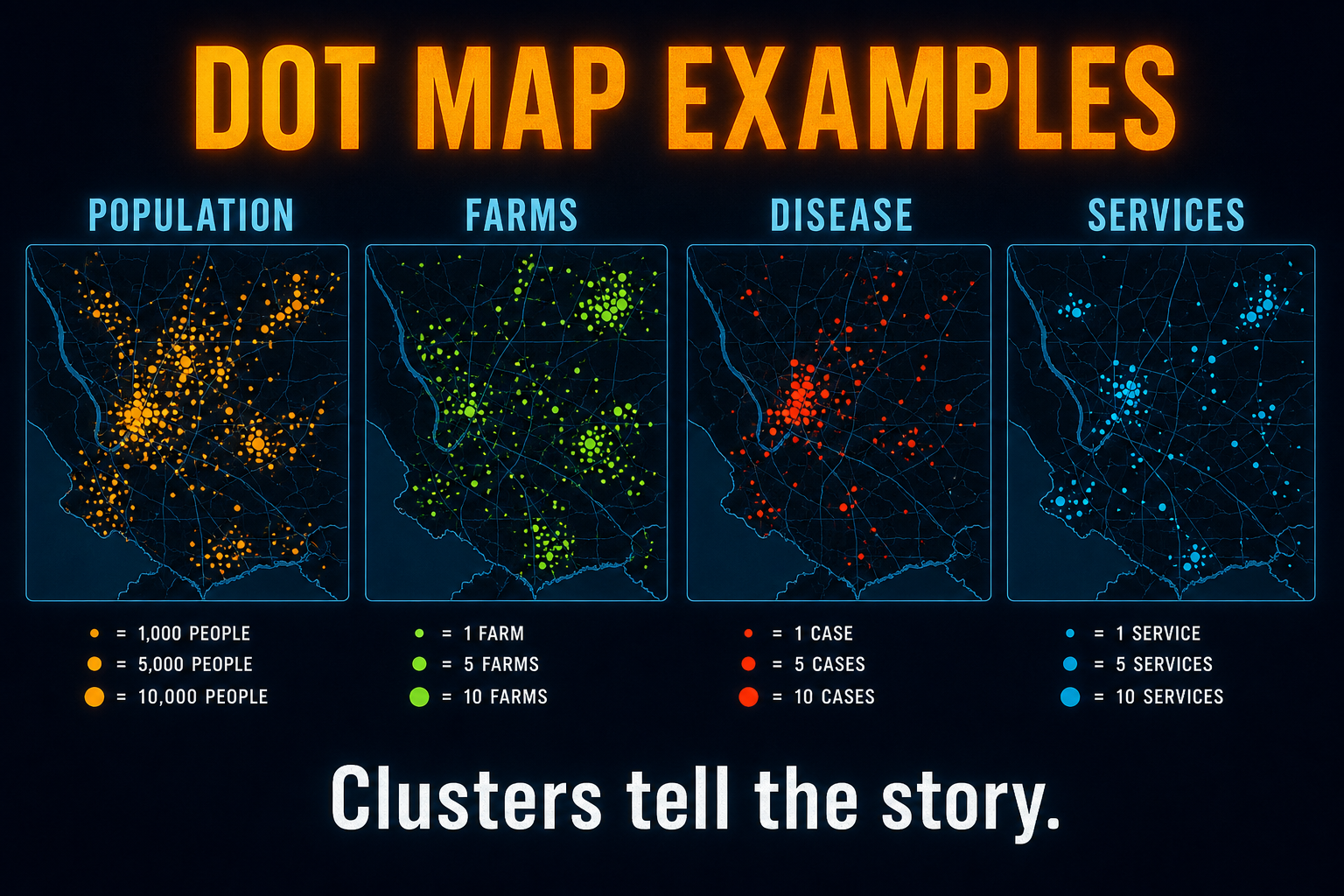
Population distribution
What the dots represent
Each dot may equal a fixed number of people.
What a cluster might mean
Clusters often appear near large cities and coastlines.
Farms and agriculture
What the dots represent
Each dot may equal a set number of farms.
What a cluster might mean
Clusters may reflect fertile soil and agricultural regions.
Disease outbreaks
What the dots represent
Each dot may equal one case or a set number of cases.
What a cluster might mean
Clusters may show an outbreak area.
Religious groups
What the dots represent
Dots show where members of a group live.
What a cluster might mean
Clusters may reflect migration or settlement history.
Language communities
What the dots represent
Dots show where speakers of a language live.
What a cluster might mean
Clusters may follow historic migration corridors.
Businesses and services
What the dots represent
Dots show store or service locations.
What a cluster might mean
Clusters may appear near highways or downtowns.
Schools, hospitals, or clinics
What the dots represent
Dots show facility locations.
What a cluster might mean
Sparse areas may reveal service gaps.
Stores, factories, or transportation hubs
What the dots represent
Dots show economic or infrastructure points.
What a cluster might mean
Clusters may follow trade routes or labor markets.
Scale also matters. A national dot map shows broad patterns, while a county-level dot map can show more local detail. On FRQs, always notice whether the map uses states, counties, cities, or another scale before explaining the pattern.
Section 5
🌍
Real-World Dot Distribution Map Examples
Population distribution
Example
One dot equals 10,000 people.
Pattern
Clusters near large cities and coastlines.
Farmland distribution
Example
One dot equals 100 farms.
Pattern
Clusters in agricultural regions.
Disease cases
Example
One dot equals one case or a set number of cases.
Pattern
Clusters may show an outbreak area.
Religious group distribution
Example
Dots show where members of a religious group live.
Pattern
Clusters may reflect migration or settlement history.
Retail stores
Example
Dots show store locations.
Pattern
Clusters may appear near highways, suburbs, or downtowns.
Services and clinics
Example
Dots show clinic locations.
Pattern
Sparse areas may reveal service gaps.
Dot distribution maps are useful for showing where people, farms, cases, services, or businesses cluster across space.
Contemporary exam writers also pair dot maps with GIS and GPS data when explaining how modern maps are built.
Fix: Use words like clustered, dispersed, sparse, dense, linear, and concentrated.
Confusing dot maps with choropleth maps
Fix: Dot maps use dots; choropleths use shaded regions.
Confusing dot maps with graduated symbol maps
Fix: Dot maps use many same-size dots; graduated symbols use different-sized symbols.
Ignoring scale
Fix: National, state, county, and city dot maps show different levels of detail.
Describing without explaining
Fix: After naming the pattern, explain why it might exist.
Common Mistake: Confusing dot maps with choropleth shading is one of the fastest ways to lose points on map-type MCQs.
Section 10
📝
AP Exam Strategy for Dot Distribution Maps
In MCQs
Identify the map type.
Read the dot value.
Describe clusters and sparse areas.
Compare dot maps to choropleths.
Avoid confusing dot maps with graduated symbol maps.
In FRQs
Define dot distribution map.
Describe the spatial pattern.
Use vocabulary such as clustered, dispersed, sparse, dense, and linear.
Explain one cause or consequence of the pattern.
Explain one limitation.
Legend → Pattern → Explanation → Limitation
Example: The dot distribution map shows one dot for every 100 dairy farms. The dots are clustered in Wisconsin and Minnesota, showing a regional concentration in the Upper Midwest. This pattern may reflect climate, feed availability, and dairy market connections. However, the dots may not show exact farm locations.
Prompt: A dot distribution map shows the location of dairy farms across a region of the United States.
A. Define dot distribution map.
B. Describe the spatial pattern shown by the dots.
C. Explain one limitation of using a dot distribution map.
Suggested answer:
A. A dot distribution map is a thematic map that uses dots to show where a feature is located and how concentrated it is, with each dot representing a fixed value from the legend.
B. The dots are clustered in the Upper Midwest, especially Wisconsin and Minnesota, while the South and interior West show fewer dots. This shows a regional concentration of dairy farming.
C. A limitation is that dots may not mark exact farm locations because cartographers often place dots approximately within reporting areas to show concentration.
Rubric
Part A: Must mention dots, fixed value, and distribution/concentration.
Part B: Must describe a spatial pattern and name a geographic area.
Part C: Must explain a valid limitation such as approximate placement, visual clutter, dot value choice, or scale.
Use these dot distribution map practice questions to test whether you can read dot values, identify clusters, compare map types, and explain limitations.
A dot distribution map is a thematic map that uses dots to show where a feature occurs and how concentrated it is. Each dot represents one item or a fixed number of items shown in the legend.
What is another name for a dot distribution map?
A dot distribution map is also called a dot density map. The two terms are used in the same way on the AP Human Geography exam.
What does each dot represent on a dot distribution map?
Each dot represents a fixed value chosen by the mapmaker, such as 1 dot = 10,000 people or 1 dot = 100 farms.
What is a dot distribution map best used for?
A dot distribution map is best used for showing spatial distribution, clusters, sparse areas, and concentration.
How is a dot distribution map different from a choropleth map?
A dot distribution map uses dots to show where features are located or clustered, while a choropleth map uses color shading to compare values across regions.
How is a dot distribution map different from a graduated symbol map?
A dot distribution map uses many same-size dots, while a graduated symbol map uses symbols of different sizes to show total values at specific locations.
Can dot distribution maps show exact locations?
Not always. Dots are often placed approximately within a region to show concentration rather than exact addresses.
Why are dot distribution maps useful in AP Human Geography?
Dot distribution maps help students describe spatial patterns using AP vocabulary such as clustered, dispersed, dense, sparse, linear, and concentrated.
What is the biggest limitation of dot distribution maps?
The biggest limitation is that dot placement may be approximate, so the map usually shows general concentration rather than exact locations.