AP Courses AP Biology AP Biology Units AP Human Geography AP HUG Units AP Computer Science Principles AP CSP Units
Practice Daily Practice Practice by Course Practice by Topic Practice Tests
AP Exam Resources AP Exam Dates Registration Fees Scores & Credit What to Bring
Start Practicing → Login
AP Human Geography · Unit 1.3 · Microtopic

Remote Sensing in AP Human Geography

Remote Sensing in AP Human Geography explains how this topic appears across places and scales. Use it to interpret map evidence, compare spatial patterns, and write precise AP-style geographic explanations.

Practice with real AP Human Geography examples, compare spatial evidence across maps, and review with 22 flashcards plus 16 AP-style questions with explanations.

Updated May 4, 2026 Reviewed by APScore5 Editorial Team

Learn in 7 mins · Practice in 10 mins

Unit 1.3 · Geographic Technologies Data from above 22 flashcards 16 AP-style questions
Data from a distance Satellites, drones, aircraft
Imagery + sensors Optical, thermal, radar, lidar
22 flashcards Remote sensing deck
3 → 4+ score path Image → pattern → meaning
Satellite orbiting Earth with sensor beams. Remote sensing = data from above
Platforms vary—exam skill is naming imagery type & pattern.
Direct answer

What is remote sensing in AP Human Geography?

Remote sensing gathers surface information from aircraft, drones, or satellites without always visiting each pixel on the ground. Analysts classify land cover, trace burn scars, monitor urban spread, and compare dates so FRQ evidence can cite imagery alongside ground-truth samples when prompts show multispectral scenes.

Remote sensing and imagery in AP Human Geography

Remote sensing is how geographers collect information about Earth’s surface without standing on every parcel they study. Orbiting satellites, piloted aircraft, small drones, and fixed sensors all record reflected or emitted energy and turn it into images or measurements analysts can map. That workflow powers classic AP stimuli: Amazon forest loss, suburban expansion, hurricane flood footprints, urban heat islands in thermal scenes, and nighttime lights used as development proxies.

College Board wants you to separate jobs clearly: GPS answers where a receiver sits on the planet; remote sensing answers what the surface looks like from above at a moment in time or across years; GIS layers those images with roads, census polygons, hazards, and countless other themes so planners can ask spatial questions. Mixing the verbs—collect, locate, analyze—is the fastest way to lose a MCQ point.

Strong FRQs still move beyond naming the technology. Once you identify an aerial or orbital perspective, describe the spatial pattern (sprawl, fragmentation, clustering of lights), explain plausible drivers (zoning, highway investment, migration), and connect significance back to human geography concepts such as suburbanization, environmental stress, or uneven development. Practice saying sensor type when you know it—optical versus thermal versus radar—because limits change with sensor physics.

This guide walks definitions, platforms, classroom-ready examples, paired technologies, honest limits, and writing drills aligned with released-item tone. Finish with the deck and MCQs so vocabulary sticks under timed pressure.

When you build study groups, rotate who plays “skeptical grader” while another student defends a map: the skeptic should press for limitations, missing metadata, and alternative explanations. That back-and-forth trains the caution remote sensing items reward. Keep a one-page cheat sheet of standard sensor trade-offs so you can deploy vocabulary fast on test day without inventing shaky science.

Remote sensing diagram

Sensors · orbit · pixels
Direct answer

What is remote sensing in AP Human Geography?

Remote sensing is the process of collecting information about Earth’s surface from a distance—typically via satellites, aircraft, drones, or ground-based sensors aimed outward—so the researcher does not need physical contact with each pixel’s ground location. A Landsat scene showing cropland expansion, an aerial transect of coastline erosion, or a drone orthophoto after flooding all qualify because data arrive through sensors mounted away from the ground.

The forty-to-sixty-word exam habit: name platform (satellite / aerial / drone), name product (image, thermal scan, radar backscatter), state the spatial pattern, then bridge to a human process. Avoid stopping at “there is deforestation.” Say where patches occur relative to roads or rivers, whether change accelerates in recent decades, and why policy or markets might matter.

AP shortcut: Remote sensing collects geographic data from far away. Pair it with GPS ground-control points and GIS overlays—GPS fixes exact coordinates; GIS stacks imagery with census and infrastructure layers; remote sensing supplies the overhead view.

Remote sensing reshaped human geography because field crews alone cannot canvass continents weekly or revisit disaster zones overnight. Repeat passes create time series—urban footprints marching into farmland, reservoirs shrinking under drought, ice shelves retreating—that quantitative geographers chart alongside socio-economic variables from census data. Once scenes sit inside GIS, analysts overlay flood zones with median income, identify vulnerable neighborhoods, and communicate maps to policymakers.

Simple definition

Remote sensing — the simple version

In one sentence: Collecting geographic data from far away.

A satellite passes over tropical forest every sixteen days; each swath records spectral signatures of canopy and bare soil. A municipal drone documents floodlines along culverts after heavy rain. A forestry plane photographs timber harvest boundaries. None require visits to every household—yet each yields spatial evidence instructors love to drop into stimulus packets.

Formal-framed simple definition: Remote sensing is the collection of information about Earth’s surface from a distance using satellites, aircraft, drones, or sensors that measure energy reflected or emitted from land, water, or ice.
Full definition

Remote sensing AP Human Geography definition

Formal framing: Remote sensing is the science and practice of acquiring information about Earth’s surface without direct contact, typically through satellite imagery, aerial photography, drone surveys, or specialized sensors capturing visible light, heat, microwave returns, or lidar pulses. Analysts preprocess scenes—atmospheric correction, georeferencing—before mapping land cover, estimating biomass, or measuring elevation change.

AP-friendly paragraph you can paste into FRQs: “Remote sensing collects geographic information from a distance through satellites, aircraft, drones, or sensors. It lets geographers observe land use, urban growth, agriculture, environmental change, and disaster damage without visiting each location. Interpretation still requires context from surveys, policy documents, or interviews.”

Course frameworks sometimes call this family of tools “Earth observation” in college syllabi. On the AP exam, stay with the curriculum language—remote sensing—so your answers match the key terms readers expect in scoring guidelines. If a stimulus lists multiple dates, cite them explicitly when explaining change detection.

Data from a distance

No field visit required for each pixel; orbiting or airborne platforms scale across regions.

Multiple platforms

Satellites, aircraft, drones, and ground sensors support different resolutions and revisit times.

Change over time

Stacking 2000 vs 2025 scenes reveals sprawl, logging roads, or shoreline retreat.

Pairs with GIS

Imagery becomes raster layers beside roads, parcels, and demographics inside GIS.

Sensor variety

Optical (visible), thermal (heat), radar (cloud-penetrating), lidar (elevation and canopy height).

Feeds spatial analysis

Downstream work asks where, how fast, and for whom—see spatial analysis.

Mechanism

How remote sensing collects geographic data

Sensors measure electromagnetic energy leaving the surface or returning from active pulses. Analysts assign pixels to classes—urban, water, forest—or derive indices such as NDVI for vegetation health. You rarely need physics formulas on the AP exam; you do need to say that satellite platforms capture repeated coverage while drones capture ultra-fine detail over smaller footprints.

SourceWhat it collectsExample
SatelliteImages and sensor grids from orbitForest loss, metropolitan growth, storm clouds
AircraftAerial imagery oblique or nadirAgricultural patterns, corridor mapping
DroneLow-altitude high-detail framesFlood damage near buildings, construction monitoring
Thermal sensorHeat emissionsUrban heat islands, active fires
Radar sensorMicrowave backscatter through cloudsFlood extent in rainy tropics
LidarLaser returns for elevationForest canopy height, buried archaeology hints

For AP Human Geography, emphasize that remote sensing delivers spatial data from a distance; pairing it with ground verification or household surveys closes the “why” gap images alone leave open.

Passive optical satellites rely on sunlight reflected from Earth, which is why nighttime studies shift to thermal or lights products unless radar illuminates the scene itself. Active sensors such as radar or lidar carry their own energy source—expensive but decisive when clouds persist or when elevation matters.

Calibration matters beyond trivia: two analysts comparing scenes years apart must ensure atmospheric corrections align or brightness shifts might fake false trends. You usually sketch this idea on FRQs rather than deriving equations—mention “atmospheric interference” or “sun-angle differences” as credible uncertainty sources.

Examples

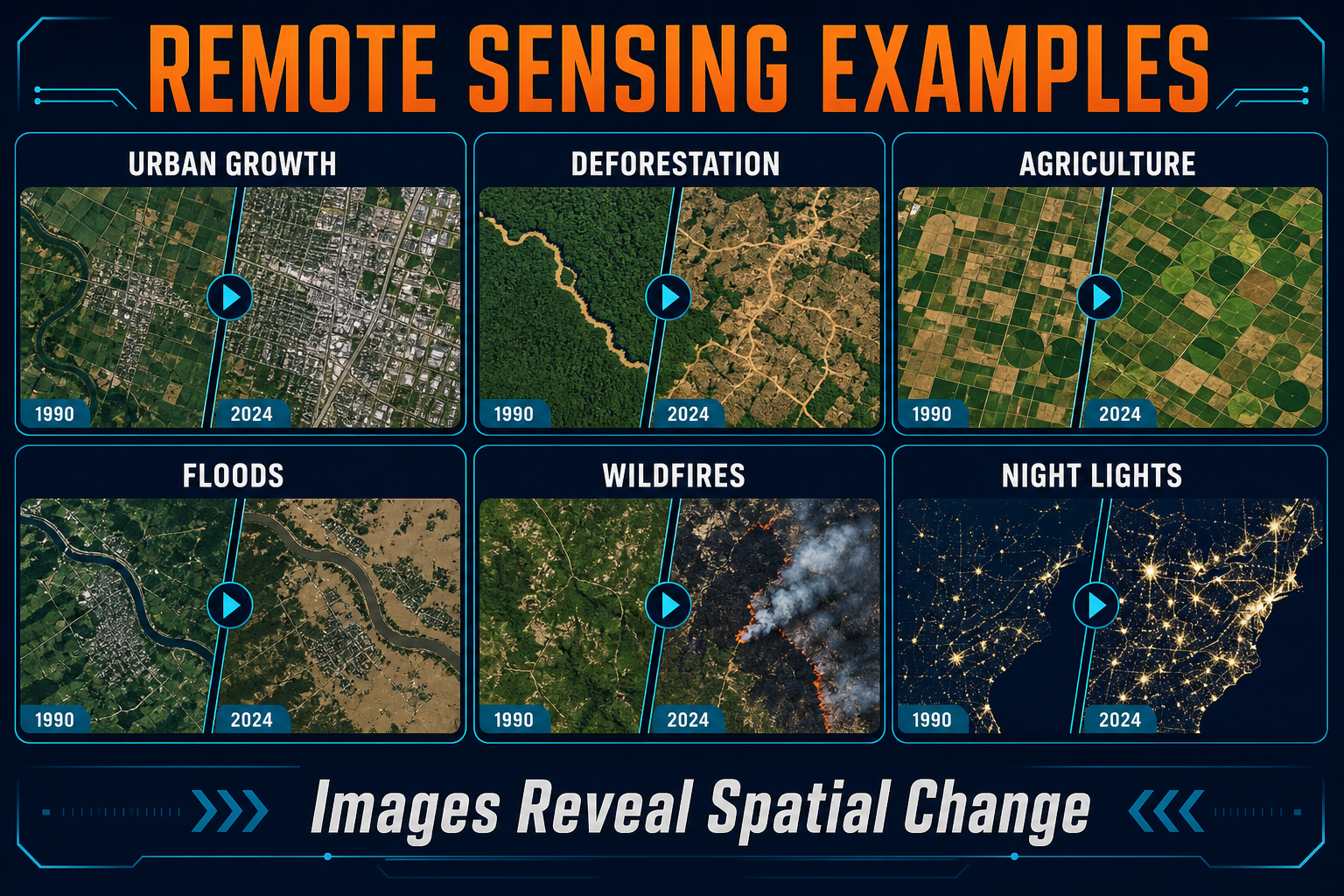
Remote sensing examples AP students should know

Urban expansion

Compare decades of imagery to show farmland converting to subdivisions and arterial roads—links to suburbanization (Unit 6).

Agricultural landscapes

Center-pivot circles, terraced hillsides, and large-scale monoculture blocks appear clearly from above (Unit 5).

Deforestation

Amazon clearing patterns and road networks appear in optical time series—classic human-environment stimulus.

Nighttime lights

VIIRS “Black Marble” styles highlight electrification clusters—development proxies (Unit 7).

Flood footprints

Post-hurricane inundation mapping guides relief routing when streets disappear underwater.

Thermal cities

Urban heat islands stand out against cooler rural surroundings—connect built environment and climate.

Refugee camps

Temporary shelter growth visible when ground access is limited—ethical interpretation required.

Coastal change

Repeat shoreline imagery tracks erosion, nourishment projects, or engineered harbors.

Exam writers expect you to read legend cues: acquisition date, sensor, false-color composites. If the legend shows infrared vegetation in bright red, say so—demonstrates you understand how energy is displayed, not just that “green equals trees.”

Uses

How geographers use remote sensing in human geography

  • Urban growth and sprawl — temporal stacks reveal leapfrog development and annexation patterns.
  • Land cover change — forest-to-pasture transitions signal commodity frontiers.
  • Agriculture — crop rotation geometry, irrigation pivots, and drainage ditches become visible seasonally.
  • Disasters — fires, floods, landslides, and storm surge alter signatures overnight.
  • Pollution events — smoke plumes, sediment plumes, and oil slicks appear at landscape scale.
  • Climate-linked stress — drought browning, snowpack shrinkage, and vegetation anomalies integrate with climate narratives.
  • Settlement estimation — rooftop counts and night lights proxy population distribution cautiously.
  • Transportation — new highways, ports, and bridges reshape accessibility patterns visible from above.
  • Coastal management — erosion hotspots guide seawalls, dunes, or retreat policies.
  • Conflict or displacement monitoring — imagery can show burned villages or expanding camps when reporting is contested—raise ethics whenever interpreting vulnerable places.

This list feeds directly into spatial analysis exercises: imagery supplies evidence layers; census and survey layers explain who bears consequences.

Transportation and logistics stories now draw on automatically sensed traffic speeds and ship positions; even if the AP item does not name the feed, you can still argue that remote monitoring of movement supports infrastructure decisions about where to widen lanes, add bus lanes, or stage humanitarian relief.

Worked example

Remote sensing example — suburban growth in a U.S. metro

A researcher compares cloud-free summer images from 2005, 2015, and 2025. Former agricultural grids show new cul-de-sacs, parking lots with high albedo, and widened arterials. Forest patches shrink on the urban fringe while commercial strips cluster near interchange exits.

AP-style synthesis: The time series indicates outward metropolitan expansion—consistent with suburbanization or sprawl as commuters seek larger lots or newer housing. Remote sensing alone cannot prove whether credit availability, zoning, or employer relocation caused the shift; pairing imagery with economic data, mobility surveys, or planning documents strengthens causality claims responsibly.

Link to census data for income and tenure patterns in new tracts, and to GIS to overlay school districts or transit availability—showing who gains access and who remains transit-poor.

Benefits

Why remote sensing matters in human geography

BenefitExplanation
Large-area coverageSingle satellite swaths span countries—ideal for regional land-use summaries.
Temporal monitoringArchives allow decadal comparisons for climate and policy evaluation.
Hazard zonesPlatforms record disaster zones when ground travel is unsafe.
Visual clarityPatterns like sprawl edges show quickly to mixed audiences.
GIS integrationGeoreferenced scenes align with vector layers for modeling exposure.
Planning supportGovernments rely on imagery for zoning enforcement and recovery metrics.
Cost at scaleOrbital monitoring often beats exhaustive field transects over huge regions.
Limitations

Limitations of remote sensing

LimitationExplanationExample
Cloud coverOptical sensors lose surface view.Tropical rainy-season gaps frustrate monthly composites.
ResolutionCoarse pixels miss alleys or informal paths.Small roads invisible until drone flights.
InterpretationImages show outcomes, not motives.Sprawl visible; household decisions require surveys.
CostHigh-resolution commercial scenes may strain budgets.NGOs mix free coarse data with spot drone hires.
Privacy ethicsFine imagery may expose yards or secure sites.See geospatial privacy.
Temporal gapsRevisit intervals miss rapid events between passes.Flash floods between acquisitions.
ExpertiseClassification errors propagate if training data biased.Mislabeled informal housing distorts maps.

FRQ anchor sentence: “Imagery shows land-cover change but not always why policies or markets shifted—combine remote sensing with interviews, administrative records, or economic indicators.” That sentence alone often earns interpretation credit.

Exam practice

How to read a remote sensing stimulus like an AP grader

Released items almost always hand you a figure before the questions. Start with the caption: date, season, region, and—if provided—sensor or platform. A summer image of a mid-latitude city will show tree canopy in true color; a false-color agricultural scene may paint healthy vegetation in bright red. State those display choices so readers know you are looking at a representation, not naively equating color with “tree equals green.”

Next, identify the spatial extent. National-scale mosaics highlight broad regional contrasts; metro-scale tiles reveal block-level swap of farmland to rooftops. If the question pairs a national map with a local photo, practice narrating how scale changes the story—a pattern that looks uniform nationwide may split dramatically at the county level when you add income layers from the census.

Then name the change process the image most directly supports. Deforestation scenes show land-cover conversion, not automatically “bad governance.” Night-lights growth may track electrification, but it can also overstate well-being if informal settlements lack meters yet host dense populations—cue caution linking luminosity to quality of life.

Practice translating visuals into verbs graders recognize: sprawl, infilling, fragmentation, linear settlement along corridors, clustered vs dispersed industry. Tie verbs to units—urban morphology belongs with Unit 6; commodity frontiers with Unit 5; electrification proxies with Unit 7.

For hazards, compare pre- and post-event footprints when both appear; when only post-event imagery exists, qualify conclusions (“possible inundation extent”) rather than pretending certainty. Mention revisit limits—without a before image you infer damage partly from debris spectral signatures and survivor reports.

Bring ethics in briefly whenever displaced populations or militarized zones appear; imagery can retraumatize communities if circulated casually. That maturity signals university-ready geography thinking.

Finally, rehearse two-minute spoken explanations aloud using random NASA or USGS EarthExplorer thumbnails (even screenshots from class). Force yourself through the chain: platform hint → pattern → plausible mechanism → data you still need (survey, prices, interviews). If you can repeat that chain twenty times across diverse landscapes—desert oasis boomtowns, Appalachian coal seams, Dutch polders—you will rarely freeze when Section II drops an unfamiliar false-color tile.

Add methodological humility: satellite classifications disagree when training pixels blur informal housing with bare soil. Mention mixed pixels at suburb edges where lawns and canopy coexist inside one coarse grid cell— graders reward recognition that edge pixels inflate error rates.

Link workflows outward: after proposing GIS overlays, name one non-remote sensing dataset—maybe parcel zoning shapefiles or highway expansion timelines—to show integrated reasoning.

When items pair imagery with a short news excerpt, treat the two sources as checks on each other. A headline about export bans might explain why satellite-measured idled fields appear even while NDVI still looks green—crops can stand unharvested. Likewise, a stimulus quoting environmental activists might contrast with a government map showing reforestation—your job is to weigh partial truths, not pick the graphic you like.

Finally, keep unit vocabulary fresh: say gentrification only when before-and-after land use plus demographic evidence supports it; say deindustrialization when rust-belt plant footprints hollow out; say sovereignty if cross-border river pollution shows up in imagery but policy response differs by country. Each term tightens the conceptual lift readers expect from a 5-level response.

Compare

Remote sensing vs GPS vs GIS

TechnologyMain purposeExample
Remote sensingCollect surface information from a distanceSatellite scene of logging scars
GPSDetermine precise coordinatesPhone displays latitude/longitude
GISLayer and analyze spatial datasetsRaster imagery plus cadastral parcels
One-line contrasts: Remote sensing gathers imagery and measurements; GPS supplies ground truth coordinates; GIS analyzes combinations of layers from both.

Workflow story for FRQs: survey crews collect GPS points for training pixels, satellites capture seasonal imagery, GIS merges imagery with parcel data to target conservation payments—each technology plays a distinct role.

Exam traps

Mistakes that cost easy points on the AP exam

  • Using remote sensing, GPS, and GIS interchangeably—match verbs to the correct tool.
  • Treating images as self-explanatory—always push toward interpretation and significance.
  • Ignoring spatial and spectral resolution—know what detail the sensor can actually resolve.
  • Skipping time context—single snapshots mislead; pair dates when possible.
  • Claiming imagery is “perfect truth”—clouds, shadows, and classification error exist.
  • Forgetting to name platform or sensor family when the stem gives clues.
  • Omitting limitations on FRQs—add clouds, cost, or socio-political context gaps.
Exam playbook

How remote sensing appears on the AP exam

In multiple-choice questions

Distinguish remote sensing from GIS and GPS; interpret what imagery reveals about land cover or change over time.

In free-response questions

Use an image time series to explain urban growth, deforestation, or storm damage with geographic vocabulary.

Common stimulus types

Satellite false-color images, before/after disaster pairs, night lights.

AP writing formula

Strong AP answer structure: Sensor / platformWhat is measuredSpatial patternProcess or changeLimit (clouds, resolution, timing).

Quick Check

Test yourself in 5 seconds

Which is an example of remote sensing?

Flashcards

Twenty-two flip cards — remote sensing essentials

Every fifth card transition shows an ad placeholder with a three-second countdown before the next card appears.

Practice

Remote sensing practice questions (16 AP-style MCQs)

Use the score card to track accuracy. After every fifth answered question you will see an ad placeholder with a three-second countdown before the next question loads.

FRQ skill

Practice FRQ — land use change near a fast-growing city

Prompt: A geographer uses satellite images to study land use change around a fast-growing city.

  • Part A: Define remote sensing.
  • Part B: Explain how remote sensing can show urban growth.
  • Part C: Explain ONE limitation of remote sensing for this kind of study.
  • Part D: Describe how remote sensing data could be combined with another technology to strengthen the analysis.

Sample 4-point response

A. Remote sensing is the collection of geographic information from a distance, usually through satellites, aircraft, drones, or sensors.

B. Comparing images from 2005 and 2025 can show cropland or forest replaced by roads, housing, and commercial rooftops—evidence of outward urban expansion or sprawl.

C. Imagery shows land-cover change but may not explain why growth occurred; motives often require economic data, interviews, or planning documents.

D. Analysts import imagery into GIS and stack census data, zoning layers, and transit lines to relate visual change to population composition and services.

Rubric (4 pts)

A — Mentions distance-based collection plus sensors or platforms.

B — Links multi-date imagery to measurable land-cover change.

C — Names a genuine limitation (clouds, resolution, interpretation, cost).

D — Pairs imagery with another technology or dataset and explains added insight.

Common misses

Stopping at “the city got bigger,” forgetting dates, or citing GIS as identical to remote sensing instead of a complementary workflow.

One-minute recap

Remote sensing recap

Bottom line: Remote sensing gathers overhead evidence across space and time. Pair it with GPS control points, GIS overlays, and human-context data so interpretations explain patterns—not just describe colors on a scene.
  • Platforms include satellites, aircraft, and drones—each trades coverage for detail.
  • Sensor choice matters: optical, thermal, radar, lidar answer different AP prompts.
  • Night lights, heat, and land-cover maps anchor Unit 5–7 bridges.
  • Limitations are fair game: clouds, resolution, interpretation, privacy.
  • Writing recipe: name acquisition → identify pattern → interpret → connect significance.
Exam lab

Remote sensing under exam timing: spectral cues to rubric-ready sentences

Stimulus paragraphs love phrases such as “multispectral,” “synthetic aperture radar,” “repeat orbit,” and “atmospheric correction.” Your job is not to impress with jargon—it is to tie each cue to what the sensor actually measures and what remains uncertain after processing.

Step one—name acquisition. State whether energy reflected sunlight, emitted thermal radiation, or active microwave backscatter produced the image. That single classification prevents half the MCQ traps that swap remote sensing with interviews or with GPS dots alone.

Step two—pair resolution types. Spatial resolution answers “how small an object can you see?” Spectral resolution answers “how many bands distinguish materials?” Temporal resolution answers “how often does the platform revisit?” If the stem stresses flood monitoring through clouds, radar time series beats a single optical snapshot—say so plainly.

Step three—interpret, don’t decorate. Describe land-cover change as evidence of process—urban expansion, forest loss, drying reservoirs—not as a color quiz. When night-lights intensify along a corridor, connect brightness to economic activity and infrastructure timing while admitting informal settlements may stay dim.

Scale discipline. A thirty-meter pixel smooths smallholder plots; a sub-meter scene shows rooflines but not motives. Note mismatch between pixel scale and the social question before claiming neighborhood-level conclusions from regional summaries.

Ground linkage. Explain why analysts cross-check imagery with GPS control points, field visits, or surveys when prompts ask about validation. Remote sensing extends vision—it does not replace human testimony when cultural meaning is on the rubric.

GIS handoff sentence. Practice one clause you can drop anywhere: “We imported classified scenes into GIS to overlay parcels, zoning, and census tracts.” That shows you know imagery becomes geographic argument only after integration.

Ethics flag. High-resolution data can expose yards, camps, or sacred sites—bridge to geospatial privacy when stems describe volunteer mapping or crisis crowdsourcing so graders see you treat overhead data as socially consequential.

Two-minute drill. Pick any exam-style figure, speak four sentences: platform class, pattern named, plausible process, limitation acknowledged. Stop when limitation sounds specific—cloud cover, shadow, seasonality—not when it sounds like “data might be wrong.”

Night-before habit: rehearse how optical, thermal, and radar each behave during monsoon season so you do not panic when a passage drops meteorology into an agriculture question.

Closing check: if you removed every adjective from your FRQ paragraph, would geographic nouns and processes still stand? If yes, you wrote evidence; if no, tighten before you submit.

FAQ

Frequently asked questions

What is remote sensing in AP Human Geography?

Remote sensing is the collection of geographic data from a distance, usually using satellites, aircraft, drones, or sensors. It helps geographers study land use, urban growth, agriculture, disasters, and environmental change.

What is an example of remote sensing?

A satellite image showing deforestation in the Amazon, urban expansion around a city, flood damage after a hurricane, or nighttime lights showing economic activity.

How is remote sensing used in geography?

Geographers use it to observe large areas, track change over time, map land use, monitor disasters, study agriculture, and analyze human-environment interaction.

What is the difference between remote sensing and GPS?

Remote sensing collects images and data from a distance. GPS finds the exact location of a person or object using satellites. Both use satellites but for different purposes.

What is the difference between remote sensing and GIS?

Remote sensing collects data. GIS analyzes data, often combining remote sensing imagery with other layers like roads or population.

What is one limitation of remote sensing?

Remote sensing images must be interpreted. They show what changed but not why it changed — additional data is needed for explanation.

Can remote sensing see through clouds?

Optical sensors cannot. Radar sensors can. That's why radar is used for flood mapping in cloudy regions.

What is "resolution" in remote sensing?

The level of detail in an image. High-resolution imagery shows small features; low-resolution imagery shows only broad patterns.

Are drones a form of remote sensing?

Yes. Drones capture low-altitude high-detail imagery and are increasingly used for disaster mapping, agriculture, and urban planning.

How does remote sensing connect to AP Human Geography units?

Unit 1 (geographic technologies), Unit 5 (agriculture), Unit 6 (urban growth), Unit 7 (development), and human-environment interaction questions across the course.

Why does remote sensing raise privacy concerns?

High-resolution imagery can reveal personal activity, vehicles, and homes. See the geospatial privacy microtopic for the full picture.

Synthesis

Keep imagery interpretation tied to human outcomes

Treat each stimulus as a chain: sensor → pattern → process → policy or lived experience.

Pair sources

Overlay imagery with people data

After you describe land-cover change, bring in census, mobility, or interview evidence so FRQs show you understand social impacts—not only pixels.

Ethics

Vulnerable places need care

Camp, conflict, or disaster imagery can harm communities if interpreted recklessly—note uncertainty and respect privacy norms.

Next tech

Move along the Unit 1.3 path

Follow with GPS precision, spatial analysis reasoning, then geospatial privacy guardrails—those pages close the technology loop.

Exam craft

Significance sentences

End each paragraph with “therefore planners / migrants / ecosystems experience…” to convert description into AP-level argumentation.

Continue learning

Related Unit 1.3 guides

Start Free Practice & Track Progress →