Pair sources before you lock an answer
Read legends, scales, units, and captions together—decide whether evidence supports a regional trend or a misleading aggregation inside one polygon.
Absolute Location in AP Human Geography explains how this topic appears across places and scales. Use it to interpret map evidence, compare spatial patterns, and write precise AP-style geographic explanations.
Practice with real AP Human Geography examples, compare spatial evidence across maps, and review with 22 flashcards plus 15 AP-style questions with explanations.
Learn in 7 mins · Practice in 10 mins
Absolute location specifies a precise position using latitude and longitude or UTM so every reader agrees on the exact point without reference to other places. AP stimuli often ask you to state coordinates or decide whether a description is absolute versus relative.
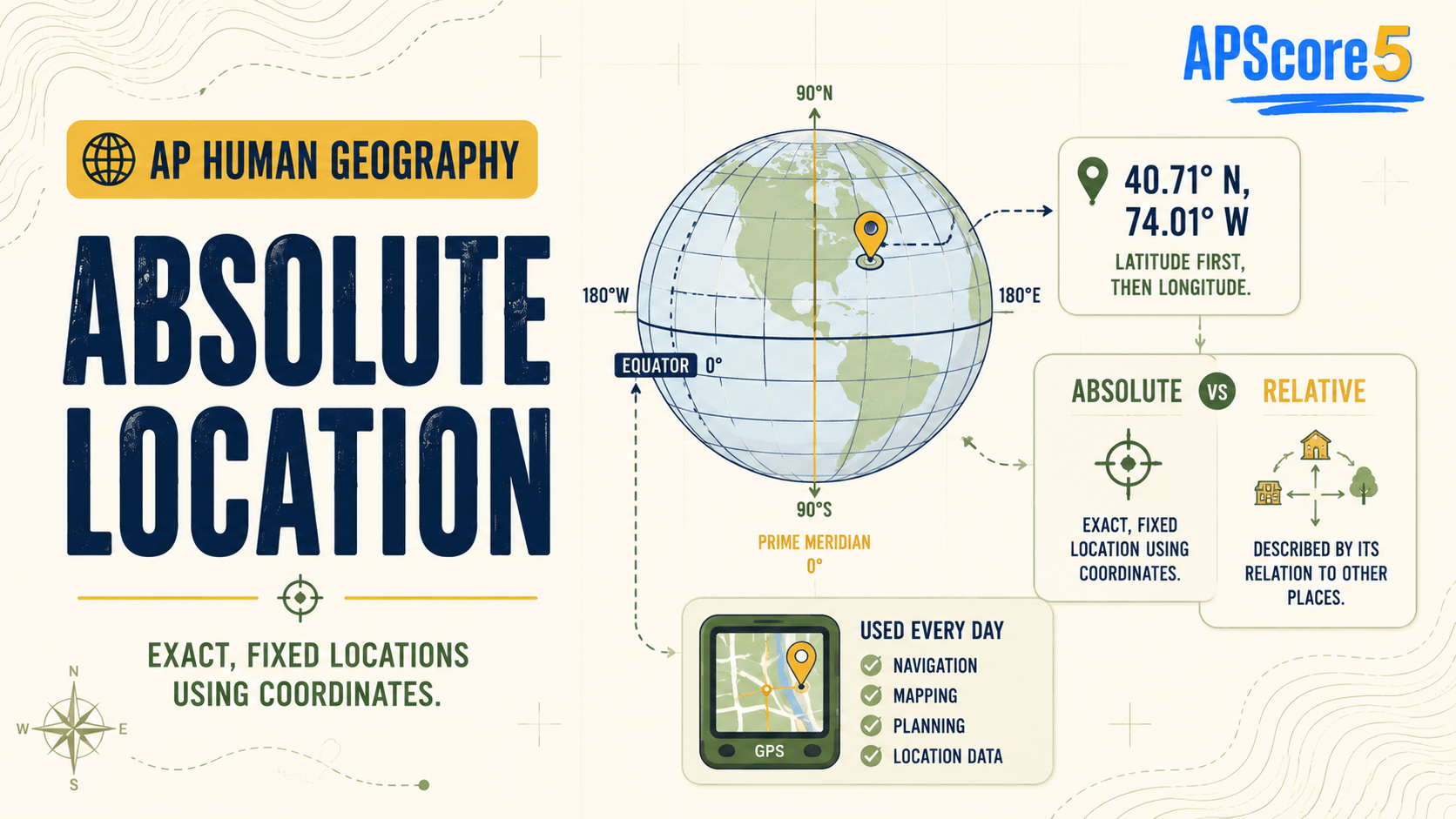
In one sentence: Absolute location is the exact position of a place on Earth, written as coordinates.
Unit 1 accounts for roughly 8–10% of the AP Human Geography exam. Location vocabulary shows up in almost every FRQ because spatial thinking is the course backbone. This guide pairs crisp definitions with coordinate fluency so you can label stimuli correctly and avoid the mix-up with relative location.
Absolute location is the exact, fixed spot of a place on Earth written as latitude and longitude coordinates. It does not change when crowds shift or labels change. For example, the absolute location of Paris is roughly 48.86° N, 2.35° E, and that pair stays the same whether you are measuring tourism flows or rainfall. Absolute location is one of two location descriptions you must separate cleanly — the other is relative location, which compares a place to landmarks and neighbors.
Why memorize another vocabulary pair? Because modern life runs on the same numbers geographers teach. GPS receivers in phones, satellite-navigation boxes in aircraft, port pilots plotting harbor approaches, and parcel databases storing street addresses all assume one shared coordinate fabric. National grid systems and mailing addresses are localized cousins of the same idea: identify one spot unambiguously so nobody argues about which intersection you mean. When Amazon routes a package or a hurricane tracker plots eyewall position, the pipe carrying that information is absolute location expressed digitally.
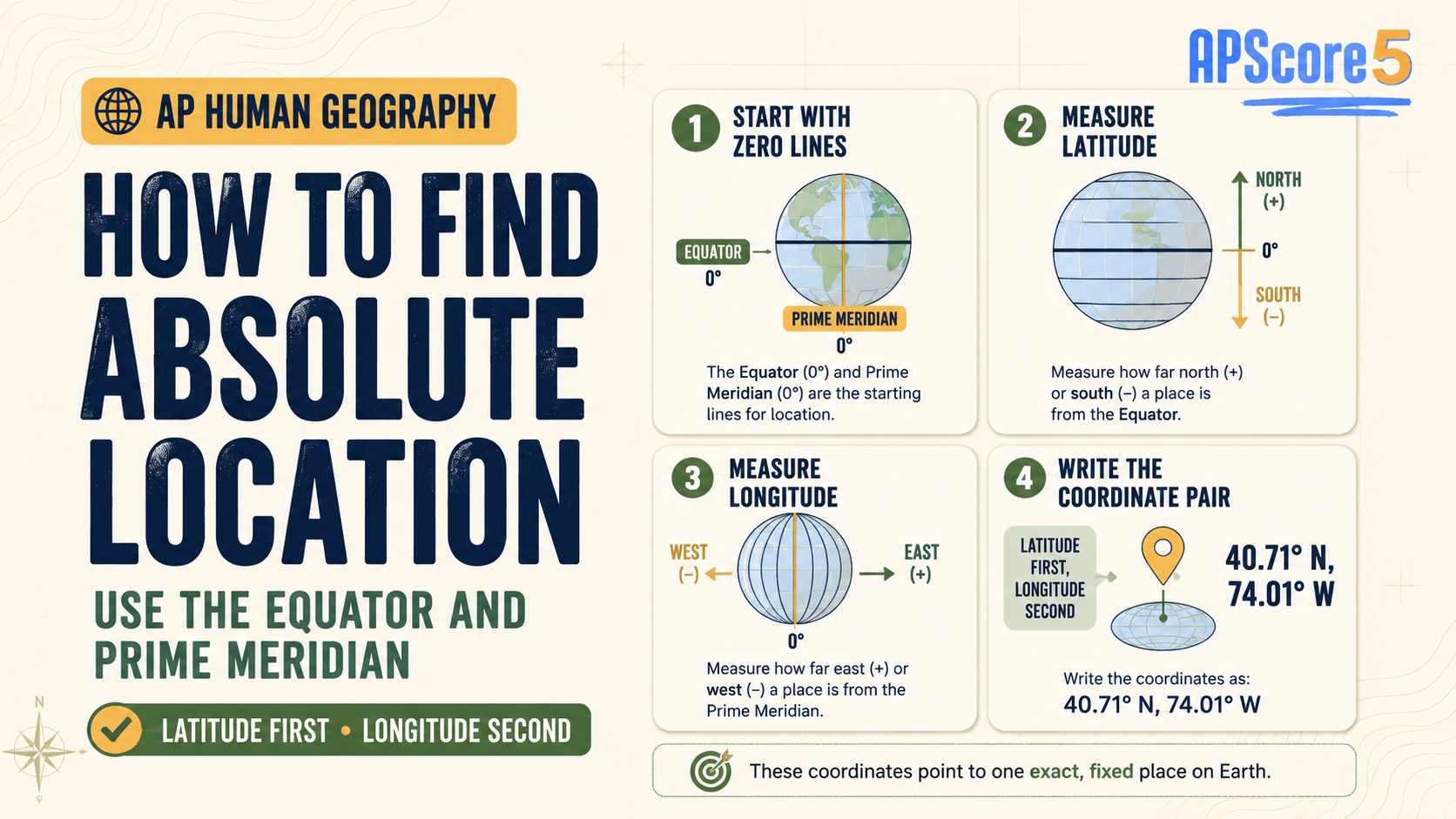
Students preparing for the AP exam should treat coordinates like grammar — boring until a single mistake breaks meaning. Write latitude first, attach N or S, then longitude with E or W. Skip a hemisphere label and you have accidentally pointed to three other places on Earth. Pair this page with the GPS basics microtopic when you need the tech story, then return here for vocabulary discipline.
Absolute location pins down exactly where a place is using a coordinate system that works the same anywhere on Earth.
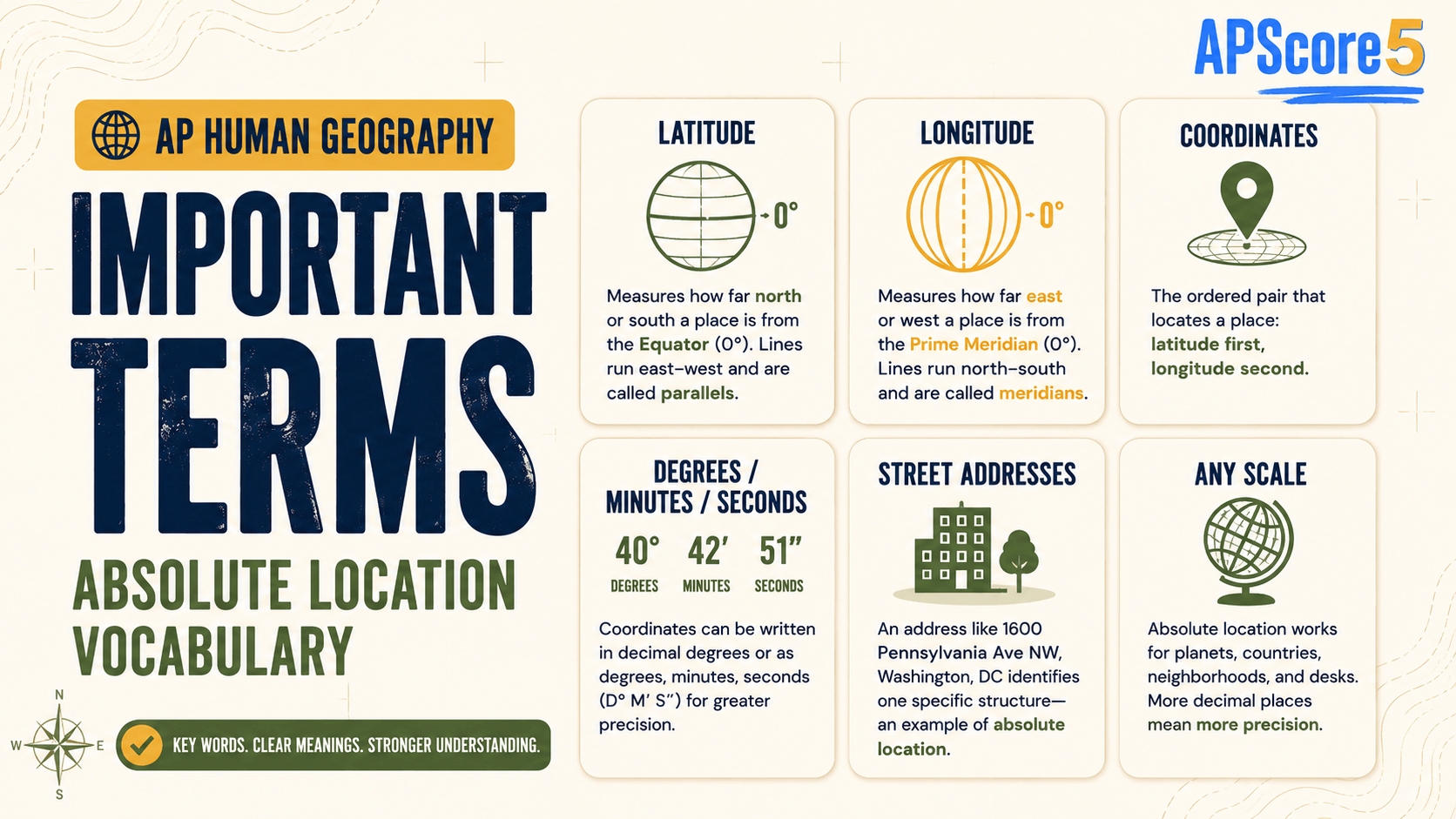
Geographers inherited the mathematical grid from centuries of navigation math, but the learning goal for Unit 1 is practical recognition: you should describe how parallels measure north-south separation from the equator while meridians measure east-west separation from the Prime Meridian, then combine those measurements into an ordered pair. Examiners reward sentences that name both components explicitly rather than calling coordinates “just numbers.”
Measures how far north or south a place is from the equator (0°). Lines of latitude run east-west and are called parallels. The North Pole sits at 90° N and the South Pole at 90° S.
Measures how far east or west a place is from the Prime Meridian (0°). Lines of longitude run north-south and are called meridians. They extend to 180° E and 180° W, meeting near the International Date Line.
The ordered pair locating a place: latitude first, longitude second. Example: New York City sits near 40.71° N, 74.01° W.
Coordinates may appear as decimals (40.71° N) or D° M′ S″. Both can describe the same corner; FRQs accept either when you are precise.
An address like 1600 Pennsylvania Avenue NW, Washington, DC is also absolute location because it singles out one structure.
Absolute location works for planets, countries, neighborhoods, and desks. Precision grows as you add decimal places — exam prompts rarely need more than two decimals unless a stimulus demands it.
The entire purpose of this system is interoperability: two classrooms on opposite coasts should plot the same dot when given the same pair. Once that reliability exists, GIS layers for population, hazards, or soil types can stack on top without confusion. When you explain absolute location on an FRQ, emphasize both universality and limitation — coordinates describe position, not meaning, which is why place remains a separate vocabulary word.
How do GPS devices determine your absolute location? Each satellite broadcasts a timestamp; the receiver compares arrival times to triangulate distance. Once four or more satellites align in view, the chip solves for latitude, longitude, and elevation — the same structure you write by hand in class, only automated. Mapping apps simply render that solution atop imagery. That is why practice questions keep pairing “signals from satellites” with absolute location: the College Board wants you to connect tool behavior to the geographic concept, not treat GPS as magic jargon.
Bookmark this table when a stimulus mentions world regions without printing a map. Examiners love dropping capital cities as shorthand for countries. Coordinates below are rounded to two decimals for city centers.
| Place | Absolute location (lat, long) |
|---|---|
| Paris, France | 48.86° N, 2.35° E |
| London, England | 51.51° N, 0.13° W |
| Rome, Italy | 41.90° N, 12.50° E |
| Berlin, Germany | 52.52° N, 13.41° E |
| Tokyo, Japan | 35.68° N, 139.69° E |
| Beijing, China | 39.90° N, 116.41° E |
| New Delhi, India | 28.61° N, 77.21° E |
| Cairo, Egypt | 30.04° N, 31.24° E |
| Moscow, Russia | 55.76° N, 37.62° E |
| Sydney, Australia | 33.87° S, 151.21° E |
| Addis Ababa, Ethiopia | 9.03° N, 38.74° E |
| Mexico City, Mexico | 19.43° N, 99.13° W |
| Brasília, Brazil | 15.79° S, 47.88° W |
| Ottawa, Canada | 45.42° N, 75.70° W |
| New York City, USA | 40.71° N, 74.01° W |
| Washington, D.C., USA | 38.91° N, 77.04° W |
| Chicago, USA | 41.88° N, 87.63° W |
| Los Angeles, USA | 34.05° N, 118.24° W |
| Houston, USA | 29.76° N, 95.37° W |
| White House (1600 Pennsylvania Ave NW) | 38.90° N, 77.04° W |
Whole countries do not have a single absolute location because territory stretches across space. If a prompt casually asks for “Italy’s absolute location,” the safe FRQ strategy is to supply Rome’s coordinates or explicitly say you are citing the capital as a proxy for the state’s geographic centroid. Graders prefer honesty about scale over a fake single point averaged across the peninsula. Likewise, large federations (United States, Brazil, Russia) will never match one coordinate pair — call out the regional city you chose.
Need map practice tying colors to coordinates? Pair this table with choropleth interpretation skills so you can connect shaded regions back to representative cities without inventing data.
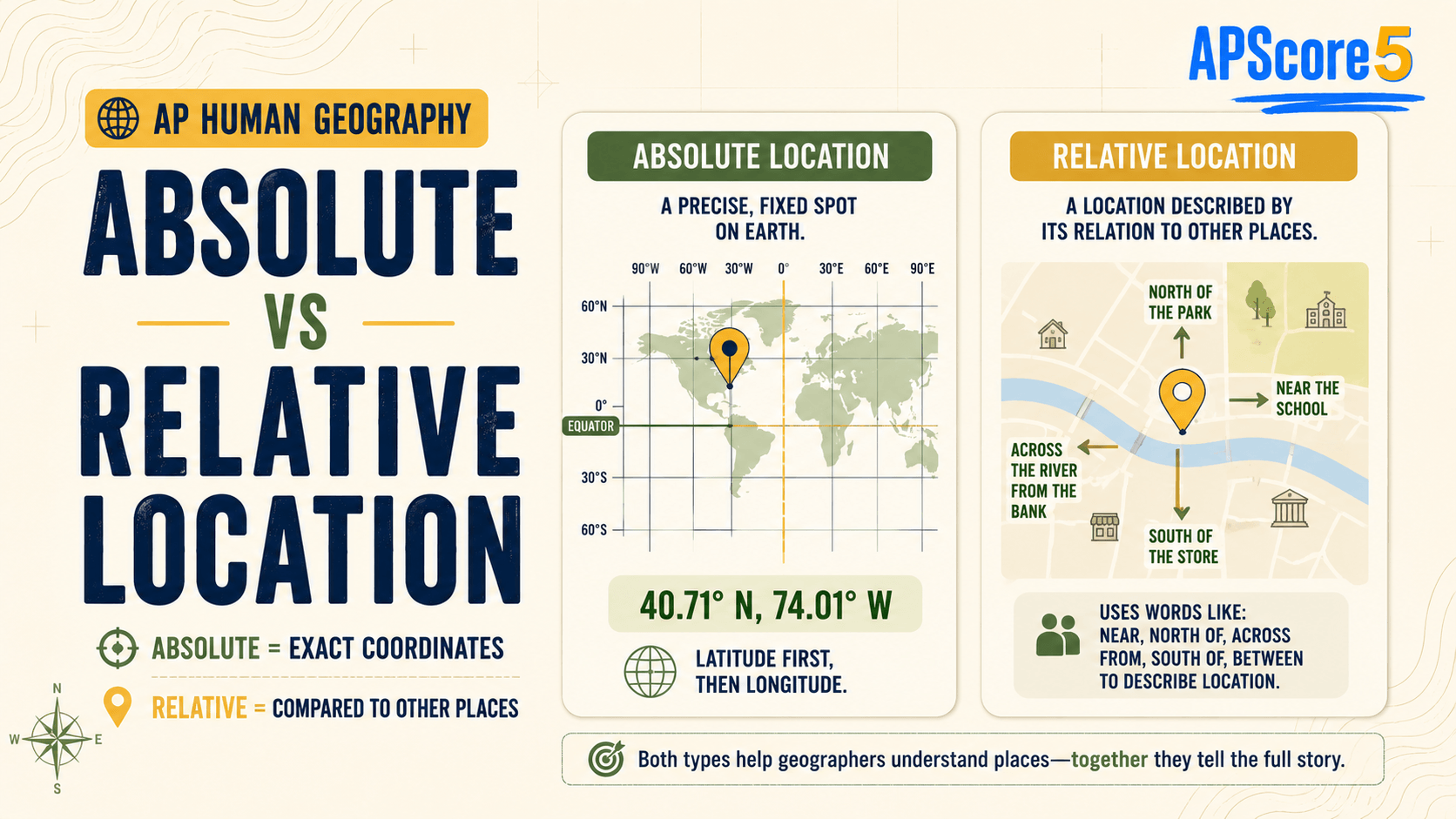
This comparison is the Unit 1 classic. Both describe location, but they answer different questions and use different evidence.
| Feature | Absolute location | Relative location |
|---|---|---|
| What it tells you | The exact, fixed spot on Earth | Where a place is compared to other places |
| How it is expressed | Latitude and longitude, or a precise address | Words like “near,” “north of,” “across the river from” |
| Does it change? | No — coordinates stay fixed for everyday use | Yes — new roads, borders, or labels can shift descriptions |
| Example | Paris at 48.86° N, 2.35° E | Paris lies in northern France on the Seine, southeast of London |
| Best for | GPS, navigation, mapping APIs | Everyday language and human context |
| AP clue | Numbers with ° symbols → absolute | Neighbor relationships → relative |
Strong answers integrate both. Absolute location gets responders to the dot; relative location explains why that dot mattered historically — trade routes crossed it, rival empires buffered it, migration corridors brushed it. On FRQs, mention coordinates when the prompt demands precision, then layer relative explanation when the question shifts to interaction.
Pilots, ship crews, and drivers rely on repeated coordinate fixes to stay on course when landmarks disappear.
Consumer maps translate GPS fixes into turn-by-turn guidance without requiring users to read raw decimals.
Dispatch centers ingest handset coordinates so crews reach cardiac arrests or wildfire evacuations faster.
Warehouses geocode every dock door; carriers optimize millions of stops using coordinate-aware routing engines.
Meteorologists anchor radar pixels to lat/long so watches/warnings match civic boundaries.
Parcel databases record boundary vertices as coordinate strings so titles stay defensible in court.
For AP Human Geography, emphasize that absolute location is culturally neutral — it does not care about language or politics. That neutrality is exactly why GIS analysts trust it as a base layer. Culture enters later when you overlay ethnicity, religion, or GDP onto those points.
Contrast that stability with relative location: finish a highway bypass and an entire town’s relative description changes overnight even though downtown’s latitude stayed put. AP readers reward answers that articulate why relative descriptions drift while numeric anchors do not.
Handheld units for hikers and surveyors typically achieve roughly 3–10 meter accuracy in open sky.
Right-click or long-press reveals decimal coordinates for any screen point.
Combines imagery with precise cursor readouts — ideal for verifying landmarks.
Chipsets fuse satellite ranges with Wi-Fi/cellular hints when signals weaken indoors.
Encodes 3 m squares with three dictionary words — helpful where street addresses fail.
ArcGIS, QGIS, and web GIS stack thematic layers atop coordinate foundations.
Which online tools provide coordinates for landmarks? Any GIS viewer plus the major map platforms above. Accuracy expectations depend on sensor quality and sky view — cite realistic uncertainty when an FRQ scenario involves dense urban canyons or forest canopy blocking satellites.
Read coordinates, distinguish absolute from relative location, interpret GPS strings.
Plot meaning from coordinates or compute rough distances using stimulus clues.
Maps with coordinate labels, GPS readouts, airport runway references.
Strong AP answer structure: Coordinate → Place named → Why precision matters → Limit (datum, rounding).
Which is an example of absolute location?
Twenty-two cards cycle vocabulary, hemispheres, city coordinates, and FRQ reminders. Every fifth card transition includes a short ad placeholder with a three-second timer before the next card appears — matching the study cadence we use across AP HuG microtopics.
Use the score card to track accuracy as you move through the set. After every fifth answered question, you will see a brief ad placeholder with a three-second countdown before the next item loads — the same pacing rule we apply on longer MCQ banks.
Prompt: A student is comparing the location of two cities for an AP Human Geography assignment.
A. Absolute location is the exact, fixed spot of a place on Earth expressed as latitude and longitude coordinates that stay the same for everyday purposes.
B. Tokyo, Japan sits near 35.68° N, 139.69° E.
C. Absolute location relies on a fixed global grid, while relative location describes where a place sits using nearby features like rivers, borders, or highways — references that can change when infrastructure or politics change.
Part A (1 pt): Must mention latitude/longitude and fixed position — vague “exact spot” alone does not score.
Part B (1 pt): Needs a real place plus both coordinates with hemisphere letters.
Part C (1 pt): Must contrast numeric grid versus relational description.
Omitting N/S/E/W, describing relative location in Part B, or saying relative location is “wrong” instead of explaining how it differs in kind.
Absolute location is the exact, fixed position of a place on Earth, expressed as latitude and longitude coordinates. The coordinates work as a universal address that does not change for everyday use.
Absolute location uses fixed coordinates (numbers). Relative location uses words to describe where a place is compared to other places, like rivers, roads, or neighboring countries. Relative location can change; absolute location does not.
Paris, France is at about 48.86° N, 2.35° E. Tokyo, Japan is at about 35.68° N, 139.69° E. New York City is at about 40.71° N, 74.01° W. A street address like “1600 Pennsylvania Avenue NW, Washington DC” is also a form of absolute location.
Geographers use latitude (north–south of the equator) and longitude (east–west of the Prime Meridian) to write a coordinate pair. Modern devices like GPS receivers, smartphones, and Google Maps calculate coordinates automatically using satellite signals.
For everyday purposes, no. The coordinates of a fixed point stay the same. Over geologic time, tectonic plate movement can shift coordinates by a few centimeters per year, but this rarely matters for AP-level answers.
It powers GPS navigation, mapping apps, emergency services, weather tracking, shipping and logistics, and property records. It works the same everywhere on Earth, which is why it is the foundation of modern global mapping.
Roughly 48.86° N, 2.35° E. This is the city center of Paris, France.
Roughly 35.68° N, 139.69° E. This is central Tokyo, Japan.
Roughly 40.71° N, 74.01° W. This is lower Manhattan in New York City, USA.
Google Maps, Apple Maps, and Google Earth all show coordinates for any address — right-click or long-press a spot to see the latitude and longitude. Handheld GPS units (Garmin, Magellan) and smartphone GPS chips also give live coordinates wherever you are.
Treat this microtopic as living vocabulary—reuse these habits whenever stimuli combine maps, tables, interviews, or timelines.
Read legends, scales, units, and captions together—decide whether evidence supports a regional trend or a misleading aggregation inside one polygon.
Population change, cultural diffusion, borders, rural systems, urban service gaps, and economic indicators all reward the spatial precision you practice in Unit 1.
Name the place, pull a detail from the stimulus, connect to a course concept, and end with a consequences sentence—skip definition dumps.
Call out who collected the data, at what geography, and when. Note missing groups when quantitative and qualitative pieces disagree.