Formal, Functional, and Perceptual Regions in AP Human Geography
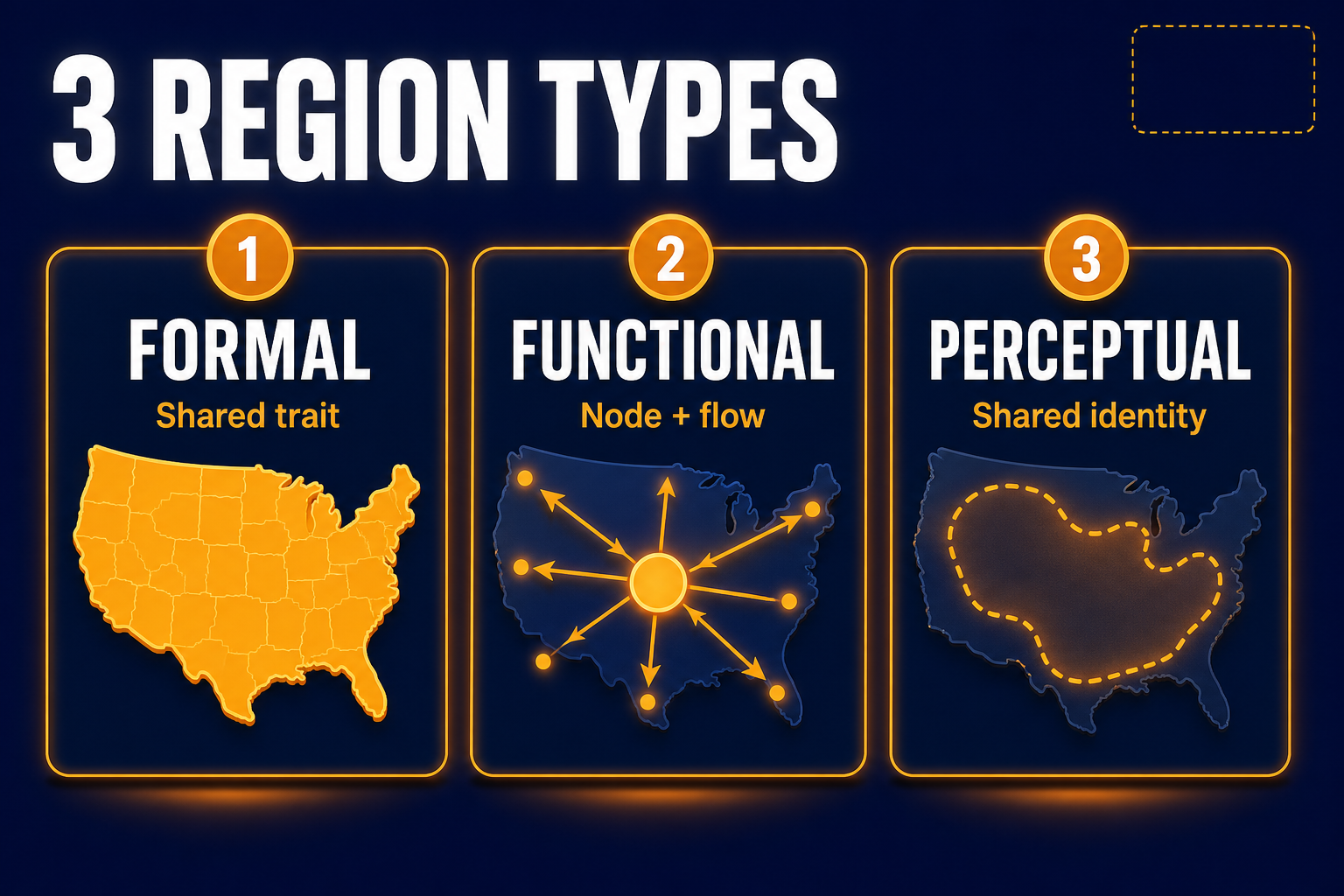
Formal, functional, and perceptual regions in AP Human Geography are three ways geographers classify places. Formal regions share measurable traits, functional regions are organized around a node, and perceptual regions are based on shared identity or cultural perception.
Practice with real AP Human Geography examples, compare spatial evidence across maps, and review with 40 flashcards plus 50 AP-style questions with explanations.
Updated May 30, 2026•Reviewed by APScore5 Editorial Team
Formal regions share traits, functional regions center on nodes, and perceptual regions have fuzzy cultural boundaries.
Formal, Functional, and Perceptual Regions: Quick Definition
Formal, functional, and perceptual regions are three ways geographers classify places. A formal region has a shared measurable trait, a functional region is organized around a central node, and a perceptual region is based on shared identity, culture, or belief.
Start here: Read this once, scan the comparison table next, then use the labs below to practice with real AP-style evidence.
Formal regions use measurable traits, functional regions use nodes and flows, and perceptual regions use shared identity or mental maps.
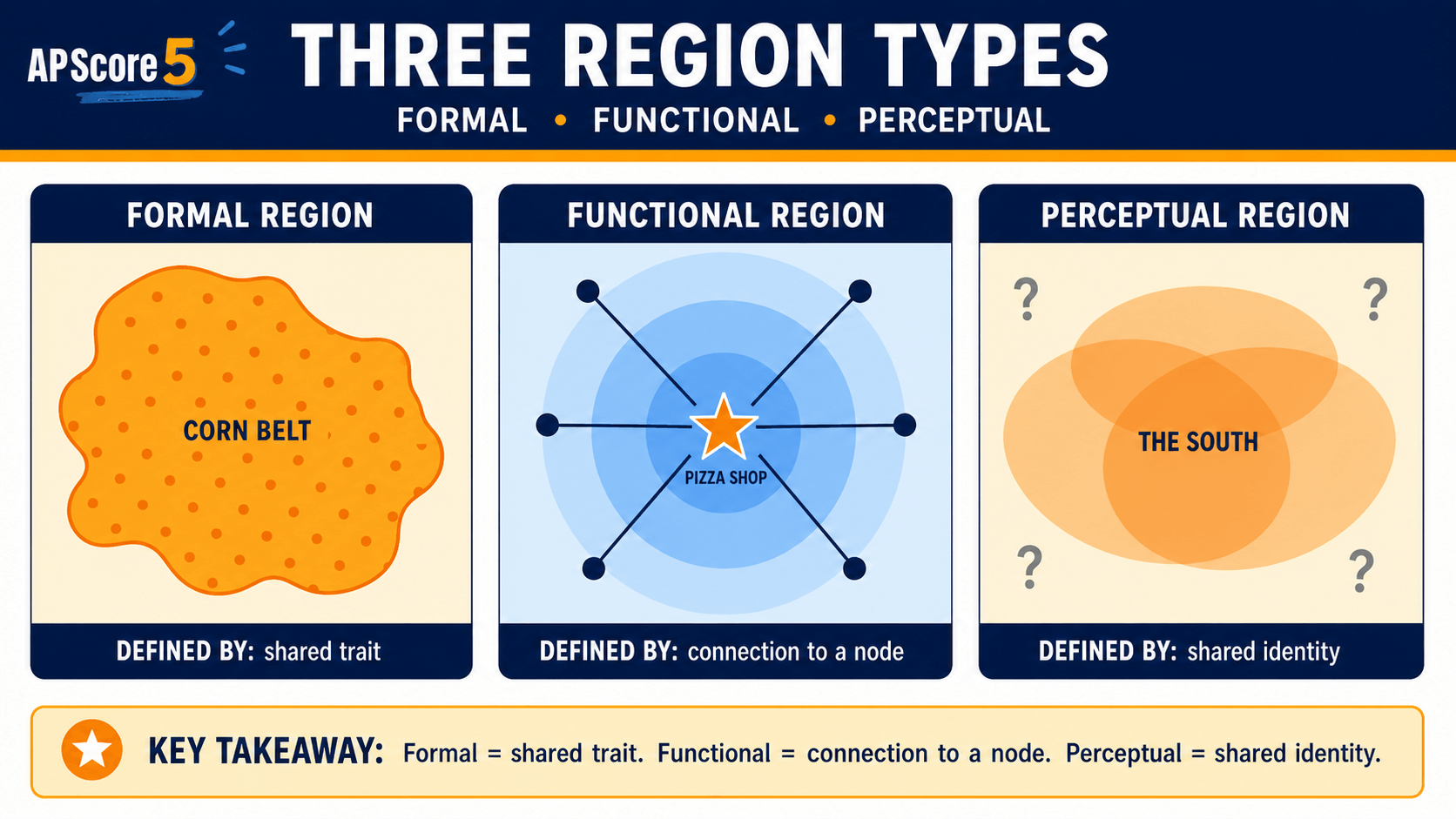
This visual summary helps students compare the three AP Human Geography region types: formal regions are based on measurable sameness, functional regions are based on connections to a node, and perceptual regions are based on how people understand or identify with a place.
AP clue: Look for measurable traits or official boundaries.
N Functional Region
Definition: A functional region is an area organized around a central node, with movement, services, or interaction connecting nearby places to that center.
Examples: metropolitan area, school district, airport service area, pizza delivery zone, newspaper circulation area, watershed.
AP clue: Look for a node, flow, service area, commute pattern, or network.
P Perceptual Region
Definition: A perceptual region is an area based on shared feelings, beliefs, identity, or reputation rather than one fixed measurable trait.
Examples: the South, the Midwest, Silicon Valley, the Bible Belt, the Rust Belt, the Heartland.
AP clue: Look for fuzzy boundaries, cultural identity, mental maps, or phrases like “people think of this area as…”
Formal region
Formal Region AP Human Geography Definition
A formal region — also called a uniform or homogeneous region — is an area where everyone shares one or more measurable characteristics. The defining feature is sameness inside the boundary: language, climate, political status, or dominant land use. On the exam, look for countries, climate zones, crop belts, or any region defined by data you could map.
Formal regions often appear alongside questions about scale in AP Human Geography because the same trait can define a region at local, national, or global levels. Review the full AP Human Geography course page when you want a wider Unit 1 study path.
Formal region
Formal Region Examples
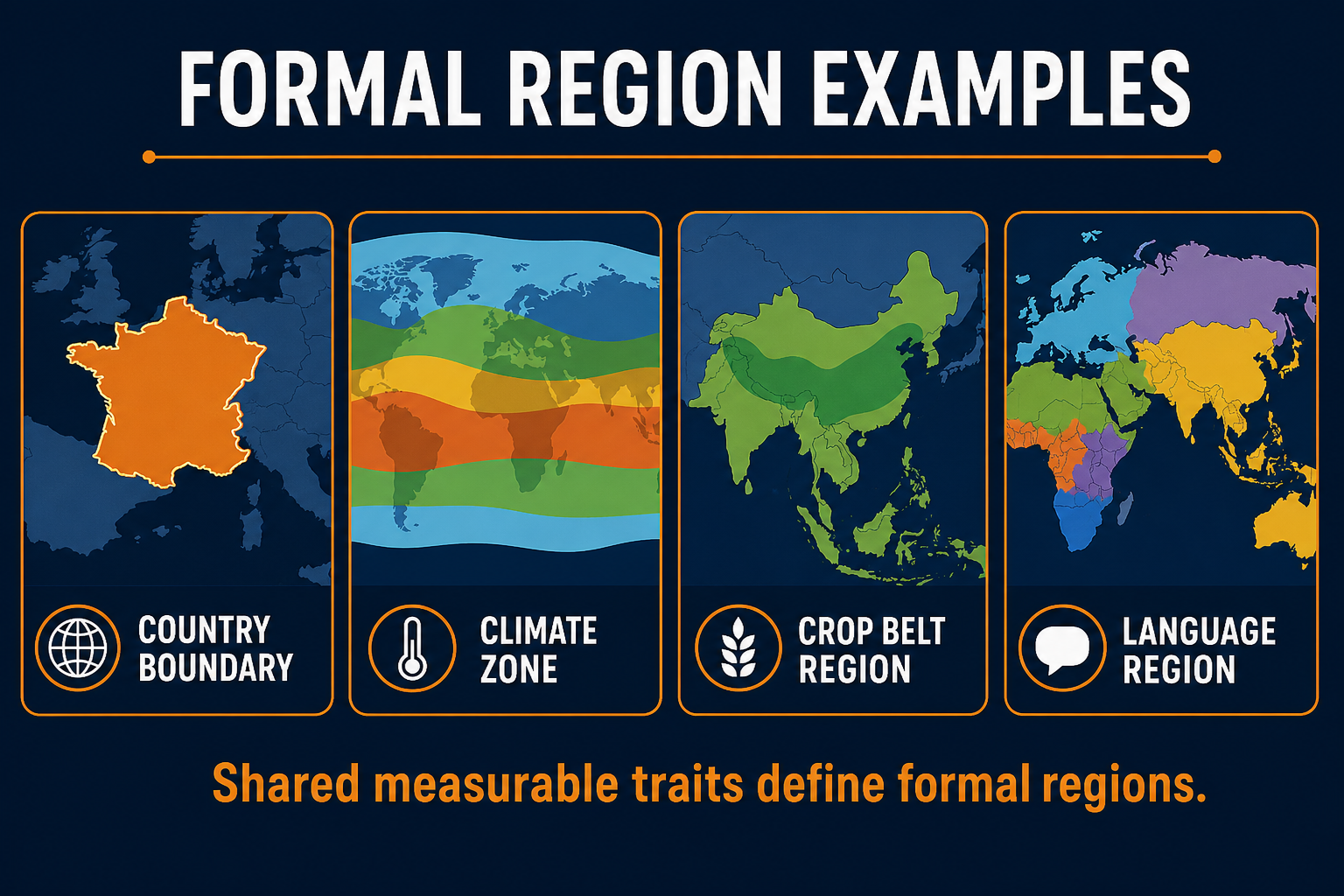
A formal region example is the Sahara Desert because it is defined by the measurable physical trait of aridity. Another formal region example is the Corn Belt because many counties share a dominant agricultural pattern. Countries, states, climate zones, language regions, and crop belts can also be formal regions when the boundary is based on a measurable trait.
Students sometimes search for ‘formal regions examples’ when they mean examples of formal regions, such as countries, states, crop belts, climate zones, and language regions.
United States
Political formal region with a shared government and measurable national boundary.
Texas
State-level formal region defined by uniform legal and political status inside its border.
Sahara Desert
Physical formal region defined by aridity across northern Africa.
Corn Belt
Agricultural formal region where corn dominates land use across many counties.
French-speaking Quebec
Cultural formal region defined by French as the dominant language.
Wheat Belt
Crop-belt formal region where wheat is the dominant agricultural pattern.
European Union
Political formal region defined by treaty membership and shared governance rules.
Tropical climate zone
Physical formal region defined by measurable temperature and precipitation patterns.
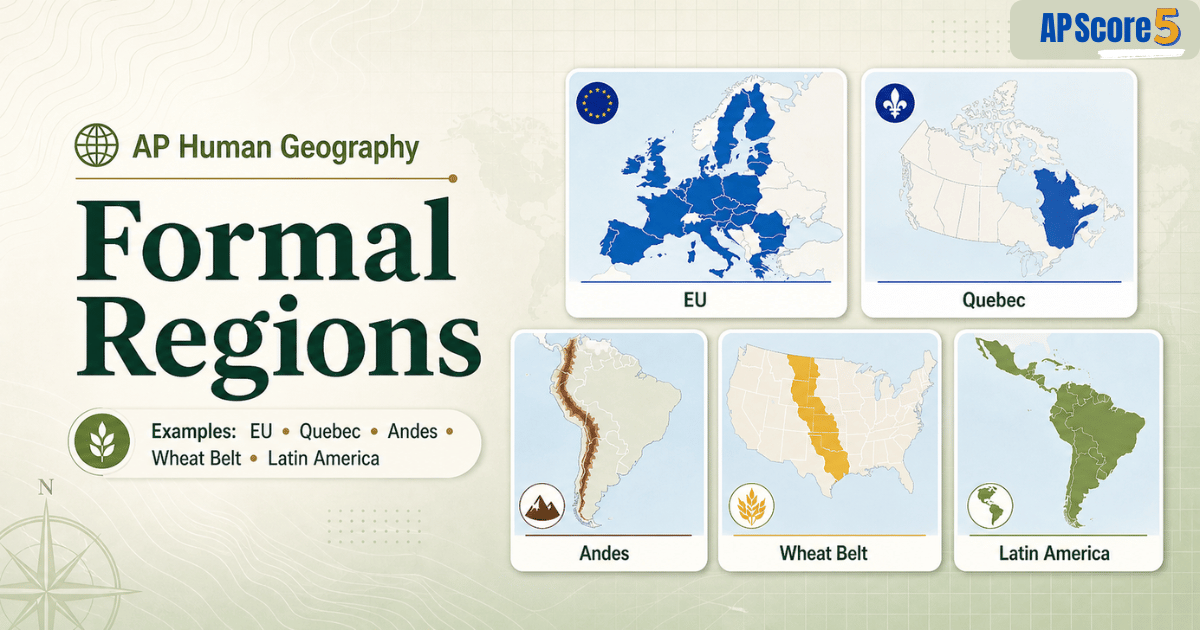
Formal region examples include countries, states, climate zones, language regions, and crop belts because each is based on a measurable shared trait.
Use this image to remember that a formal region is defined by measurable evidence. If the boundary is based on a shared trait such as government, climate, language, religion, or land use, the region is likely formal.
Functional region
Functional Region Meaning
The meaning of a functional region is an area connected by activity around a central node. In AP Human Geography, functional regions are often shown through commuting patterns, delivery zones, school districts, airport service areas, broadcast areas, or trade networks.
Node + flow + service area = functional region
Functional region
What Are Functional Regions?
What are functional regions? Functional regions are areas organized around a central node, where flows such as commuters, deliveries, services, or signals connect nearby places to the center. Influence weakens with distance, which ties directly to distance decay. Every functional region needs a node, a flow (commuters, packages, signals, customers), and a boundary where the node’s influence fades.
Functional Region Examples
Metropolitan areas, school districts, airport service areas, pizza delivery zones, newspaper circulation areas, and watersheds are standard functional region examples on AP Human Geography exams.
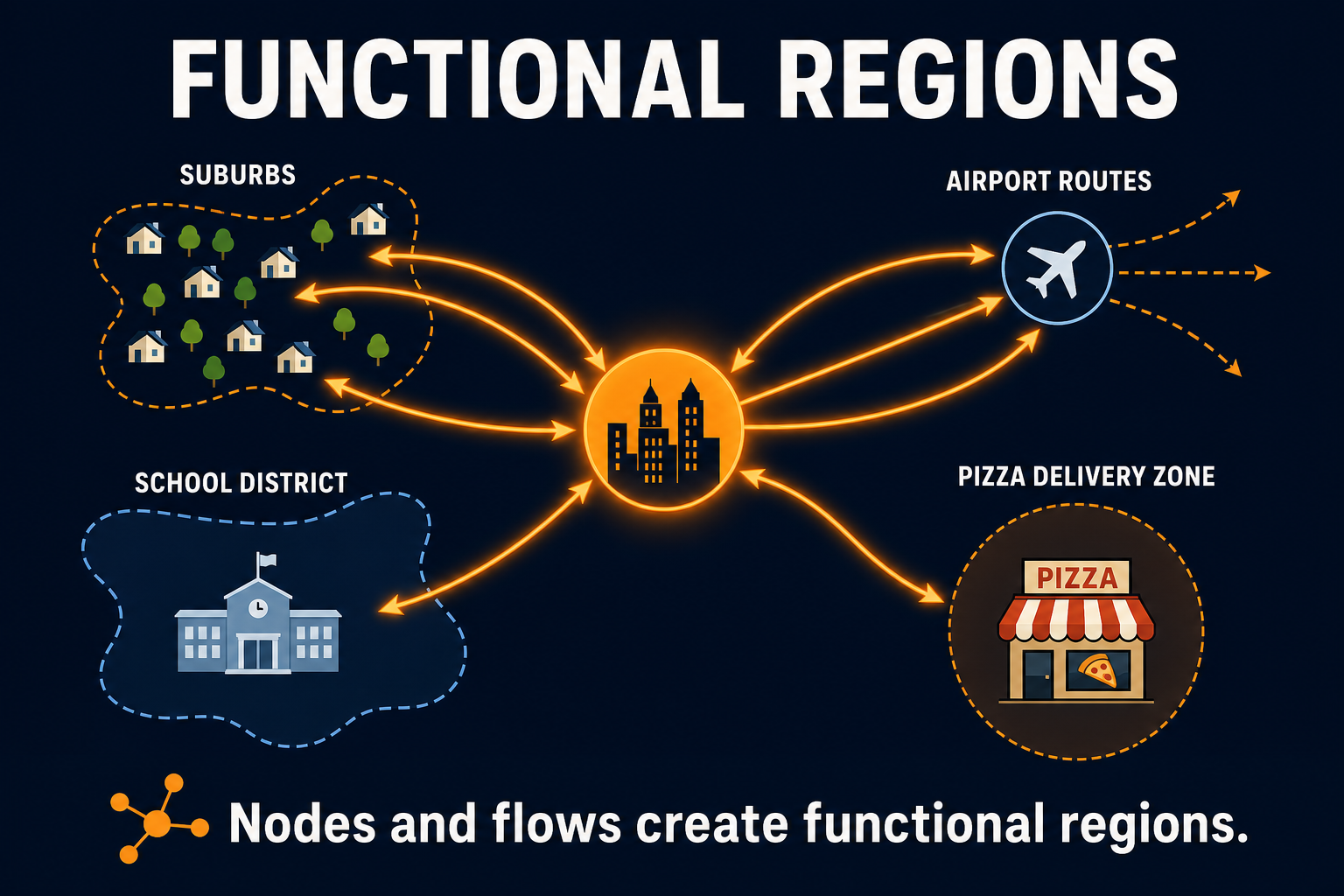
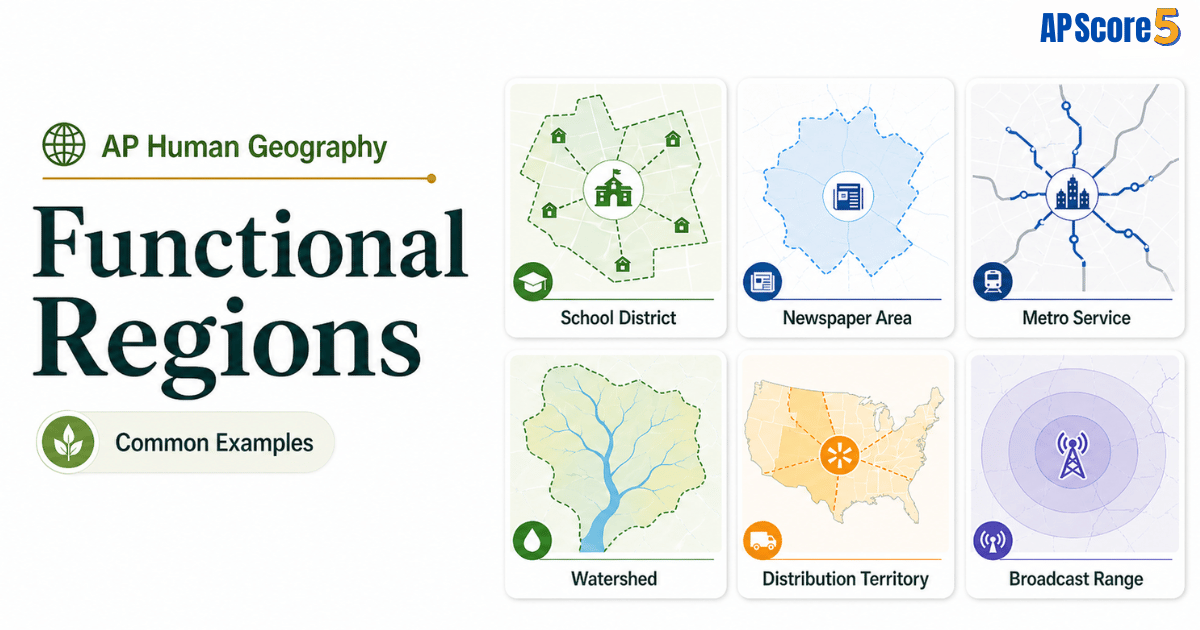
Functional regions are organized around nodes, flows, and service areas, such as metro areas, school districts, airport service zones, and delivery ranges.
Use this image to identify functional regions by looking for a central node and a flow. Common flows include commuters, customers, deliveries, broadcast signals, services, and transportation routes.
Perceptual region
Define Perceptual Region
To define perceptual region, focus on shared identity or belief. A perceptual region is not defined by one official boundary. Instead, people recognize it because of culture, history, reputation, or mental maps. The South is a perceptual region because people disagree about its exact boundaries, but still recognize it as a meaningful cultural area.
Perceptual regions overlap with how geographers discuss place in geography — identity and attachment matter as much as coordinates. For more drills, try AP Human Geography practice by topic after you finish the examples below.
Perceptual Region Examples
Classic perceptual region examples include the South, the Midwest, Silicon Valley, the Bible Belt, the Rust Belt, and the Heartland. Boundaries shift depending on who draws the mental map.
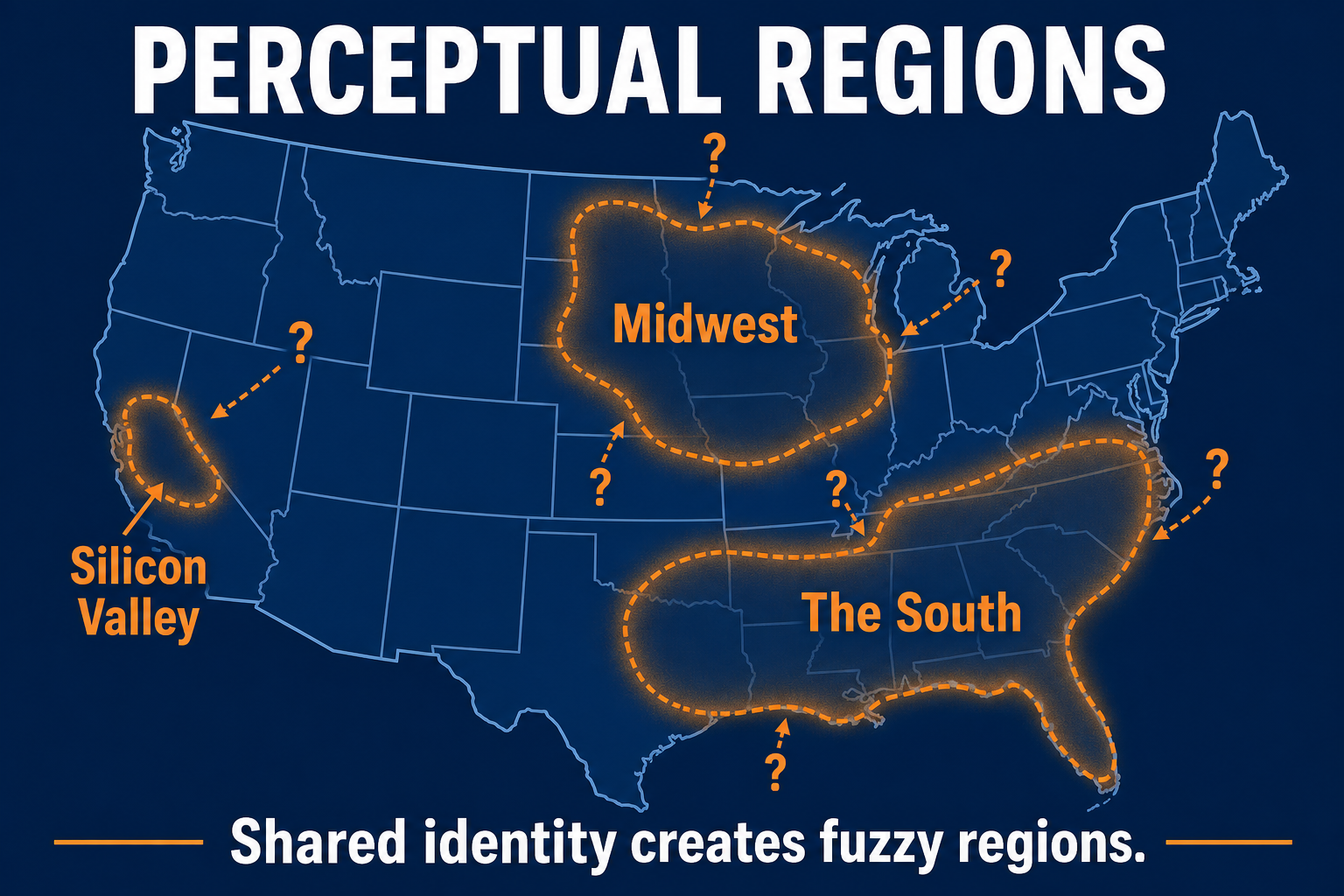
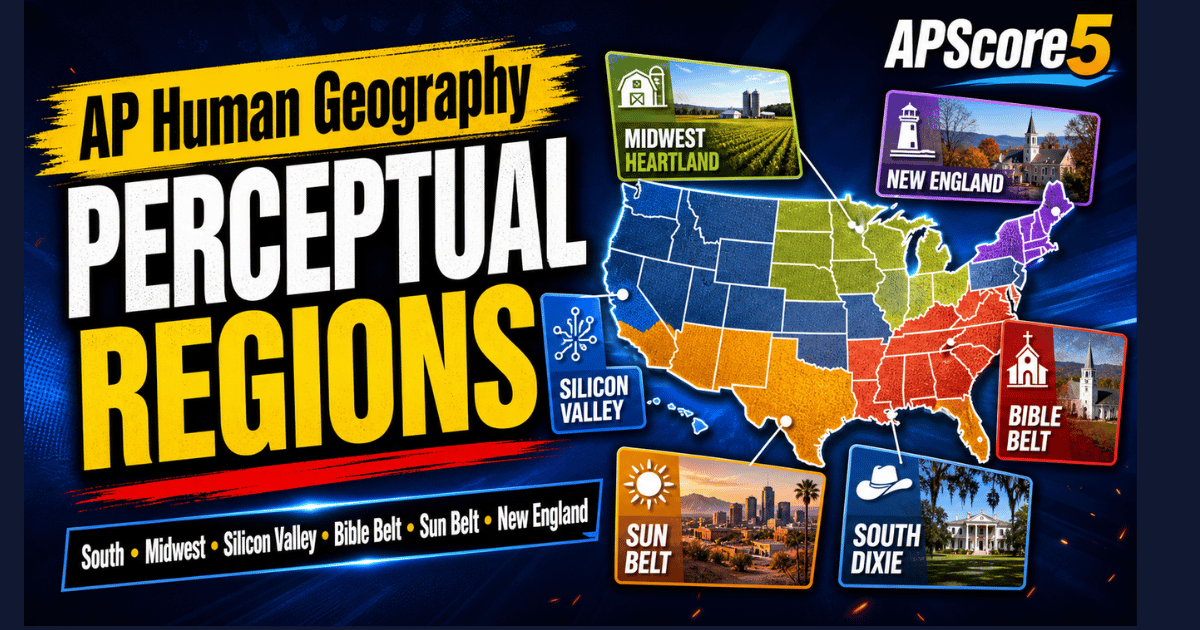
Perceptual regions are based on shared identity, reputation, mental maps, and fuzzy cultural boundaries.
Use this image to remember that perceptual regions are not fake or random. They are real geographic ideas based on shared beliefs about places, even when people disagree about exact boundaries.
How to Identify the Region Type on the AP Exam
1
Ask: Is there a measurable shared trait? If yes, it is probably a formal region.
2
Ask: Is there a central node with flows? If yes, it is probably a functional region.
3
Ask: Is the boundary based on perception or identity? If yes, it is probably a perceptual region.
Common AP Exam Traps
Trap
Correct Thinking
Every shaded map is formal
Only formal if the shading represents a measurable shared trait.
Every useful area is functional
Functional regions need a node and flows.
Perceptual means fake
Perceptual regions are real because people share the mental map.
Next, use the stimulus lab and sorter below to practice identifying the region type from evidence, not just from the name of the place.
Direct answer
AP Exam Answer: Formal, Functional, and Perceptual Regions
In AP Human Geography, formal regions are defined by measurable shared traits, functional regions are defined by nodes and flows, and perceptual regions are defined by shared identity or mental maps. The safest AP answer names the region type, identifies the evidence, and explains why the boundary is clear or fuzzy.
AP exam answer: Formal regions are defined by uniform traits, functional regions by nodes and flows, and perceptual regions by shared identity or mental maps.
Ready to practice? Jump straight to the sorter, MCQs, or flashcards.
Formal, functional, and perceptual regions (Unit 1 guide)
Use this page as the side-by-side reference College Board questions assume you can apply under time pressure: name the definition, spot the node when it matters, and defend why a fuzzy boundary is still geographic evidence. Return to the Unit 1 Thinking Geographically hub for maps, data, and spatial tools, then reinforce weak spots with practice by topic or the FRQ-style prompt on this page.
Memory trick
Memory Trick: Trait, Node, Identity
Use this memory trick: formal = trait, functional = node, perceptual = identity. If the region is based on measurable sameness, choose formal. If it is based on flows around a center, choose functional. If it is based on how people think about a place, choose perceptual.
Three region types — visual summary
▦
Formal
Uniform data · shared trait
◎
Functional
Nodal · flows · TV market
☁
Perceptual
Vernacular · identity
Foundations
What is a region in AP Human Geography?
A region is an area of Earth's surface that shares one or more defining characteristics, distinguishing it from surrounding areas. Geographers use regions to organize the world into manageable units for analysis, much like historians use eras. AP Human Geography tests three region types — formal, functional, and perceptual — each defined by a different kind of unifying logic.
Regions exist at every scale in AP Human Geography, from a neighborhood to a continent. The same place can belong to many regions at once: your street sits inside a city, a state, a climate zone, and maybe two overlapping delivery zones. One location can even fulfill all three region types simultaneously depending on which property you measure (political boundary, metro commute shed, and shared regional identity can all apply without contradiction).
Every region is a deliberate choice about what counts as "the same" — the boundary is an argument about relevance, not a natural fact that exists independent of the variable you mapped.
A region groups places based on the trait, connection, or identity the geographer wants to study.
Uniform / homogeneous
What is a formal region? (uniform / homogeneous region)
A formal region — also called a uniform or homogeneous region — is an area where everyone shares one or more measurable characteristics, such as language, climate, political affiliation, or land use. The defining feature is sameness: inside the boundary the trait is present, outside it isn't. The U.S. Corn Belt, the Sahara Desert, and the country of France are all formal regions.
The unifying characteristic can be physical (climate zone, mountain range, biome) or cultural / political / economic (country borders, dominant language, religious majority, dominant crop).
Boundaries are typically sharp and measurable — though "where exactly does the Corn Belt end?" still requires a threshold (for example, counties where corn is the dominant crop by acreage).
A formal region can sit inside another formal region: Texas (formal political) sits inside the United States (formal political), which sits inside North America (formal physical).
Common AP examples: the European Union, Quebec (French-speaking region), the Andes Mountains, the Wheat Belt, Latin America (Spanish/Portuguese-speaking).
A formal region has a measurable trait that is shared across the area.The Sahara is a formal physical region because aridity is measurable across space.
⚠Common mistake: Don't treat every shaded area on a map as a formal region. If the shading is based on someone's perception (like "the Heartland"), it's perceptual, not formal — even if it looks tidy on paper.
Nodal
What is a functional region? (nodal region)
A functional region — also called a nodal region — is organized around a central focal point (the node) whose influence weakens as distance increases. Activity, services, or interactions flow toward or out from the node, holding the region together as a system rather than a uniform area. A metropolitan area, a ZIP code, an airport service area, and a pizza shop's delivery zone are all functional regions.
Every functional region needs three things: a node (the central organizing point), some kind of flow or interaction (commuters, packages, broadcast signals, customers), and boundaries that mark where the node's influence stops being dominant.
Boundaries are often fuzzy and overlap with neighboring functional regions — your suburb might be inside two grocery-store delivery zones.
Formal regions often lean on census-style counts—when stimuli quote population thresholds, pair boundaries with census data geography vocabulary so “uniform trait” claims stay measurable.
Common AP examples: a school district (organized around schools), a newspaper's circulation area, a city's metro/subway service area, a watershed (organized around a single river system), a Walmart distribution territory, a TV station's broadcast range. See the functional region meaning section above for the node-and-flow formula.
A functional region is strongest near its node and weaker near the edges.A pizza shop delivery zone is functional because orders and drivers flow around a central node.
⚠Common mistake: A functional region is not just any area with a function. The defining feature is that it's organized around a node — without a focal point and a flow, it's not functional even if it has a job to do.
Vernacular
What is a perceptual region? (vernacular region)
A perceptual region — also called a vernacular region — exists primarily in people's minds, defined by shared cultural identity, attitudes, or beliefs about a place rather than by measurable data. Its boundaries are fuzzy, contested, and vary depending on who you ask. "The South," "the Midwest," "Silicon Valley," and "the Bible Belt" are classic perceptual regions.
The defining feature is subjectivity: a perceptual region is real because people believe it's real, not because a single statistic confirms it.
Boundaries are inherently fuzzy. Ask a hundred Americans where "the South" begins, and you'll get a hundred slightly different lines — some include Texas, some don't; some include southern Maryland, most don't.
Formal, functional, and perceptual regions differ by traits, nodes, flows, and shared identity.
This comparison image reinforces the main AP exam distinction: formal regions are based on traits, functional regions are based on nodes and flows, and perceptual regions are based on identity or perception.
Perceptual regions often borrow from formal traits (climate, dialect, history) but go beyond what any one statistic can capture — they encode a felt sense of place.
Are vernacular and perceptual regions the same? For AP purposes, yes. Some textbooks treat them as fully synonymous; others draw subtle distinctions. The College Board uses both terms interchangeably. Return to the define perceptual region summary if you need a quick refresher before the sorter.
“The South” is perceptual because people draw its boundaries differently.Silicon Valley is perceptual when its boundary depends on reputation and shared identity.
⚠Common mistake: Don't confuse "perceptual" with "wrong." Perceptual regions are real geographic phenomena; they just live in shared cultural perception instead of a measurable variable.
Side-by-side
Formal vs functional vs perceptual: side-by-side comparison
Formal regions are defined by shared traits (everyone inside has the same characteristic). Functional regions are defined by connections to a central node (everyone inside interacts with the same focal point). Perceptual regions are defined by shared identity (everyone agrees the place is one thing, even if no single trait captures it). Boundaries get fuzzier as you move from formal to functional to perceptual.
Feature
Formal (uniform)
Functional (nodal)
Perceptual (vernacular)
Defining logic
Shared characteristic
Connection to a central node
Shared cultural perception
Boundary type
Sharp, measurable
Fuzzy at the edges
Highly fuzzy and contested
Center?
Not required
Required (the node)
Not required
Data needed
Measurable trait
Flows / interactions
Surveys, opinions, cultural texts
Classic example
Corn Belt, Sahara
Metro Atlanta, ZIP code
The South, Silicon Valley
AP exam giveaway
Words like "Belt," country names, climate zones
Words like "service area," "metro," "watershed"
Words like "the," nicknames, places that "feel like" a thing
Interactive
AP stimulus lab: spot the region type
Pick a map-style stimulus, classify it as formal, functional, or perceptual, then unlock clue → why → model sentence. Explore all eight before the sorter and MCQs.
U.S. Corn Belt counties
Formal
Which region type fits this stimulus?
Answer correctly to unlock the three reasoning steps below.
Step 1
Clue in the stimulus
Step 2
Why that type
Step 3
Model AP sentence
0 of 8 stimuli explored
Interactive
Triple-stack lab: one place, three region types
Downtown Atlanta sits inside formal Georgia, functional Metro Atlanta, and perceptual "the South" at once. Tap each layer to see how the definition changes while the coordinates stay fixed.
Georgia (formal political region)
Uniform inside
Same coordinates: Peachtree Street in downtown Atlanta can satisfy three region definitions simultaneously — AP graders expect you to name all three.
0 of 3 layers explored
What you see
Evidence on the ground
Why it fits
Defining logic
FRQ line
One sentence to write
Examples
Real-world examples of each region type
Formal region examples
The U.S. Corn Belt — counties across Iowa, Illinois, Indiana, Nebraska, and surrounding states where corn dominates the agricultural landscape.
The Sahara Desert — a physical formal region defined by extreme aridity, spanning roughly 11 countries across northern Africa.
The European Union — a political formal region defined by member-state treaty status.
Quebec, Canada — a cultural formal region defined by French as the dominant first language.
Latin America — a linguistic formal region defined by Spanish or Portuguese as the dominant language.
The Andes Mountains — a physical formal region defined by elevation and geological structure.
Formal regions such as the Corn Belt and Sahara Desert are defined by measurable traits like land use or aridity.
This image supports the formal region examples section by showing that formal regions are based on measurable evidence, not on a central node or personal perception.
Functional region examples
A ZIP code area — organized around a postal sorting facility; mail moves toward and out from the node.
The Atlanta Metropolitan Area — organized around the city of Atlanta, with daily commuting flows defining the boundary.
An airport's service area — organized around the airport, encompassing the population that uses it as their primary hub.
A pizza shop's delivery zone — organized around the shop, bounded by how far a delivery driver can reasonably go.
A newspaper's circulation area — organized around the printing/distribution center.
A watershed — organized around a river system, with all water draining toward a single outlet.
Functional regions are strongest near their central node and weaker near the edges of the service area.
This image supports the functional region explanation by showing how activity, services, and influence flow around a central node.
Perceptual region examples
The South / Dixie — defined by shared cultural identity, history, and accents rather than a single trait.
The Midwest / The Heartland — defined by perceptions of pace, values, and landscape, with boundaries no two Americans fully agree on.
Silicon Valley — defined by perceived concentration of tech industry culture; the actual boundary depends on who's asked.
The Bible Belt — defined by perceived prevalence of evangelical Protestantism, though the term predates any formal religious dataset.
The Sun Belt — defined by perceived sunshine, warm climate, and population growth in the southern U.S.
New England — a perceptual region of six northeastern states united by shared colonial heritage and cultural identity.
Perceptual regions have fuzzy boundaries because they depend on shared culture, identity, reputation, and mental maps.
This image supports the perceptual region explanation by showing why regions such as the South, Midwest, or Silicon Valley can be meaningful even without one official boundary.
Traps
Edge-case lab: when the same name flips types
The most common AP exam trap is treating a region's name as conclusive evidence of its type. Classification follows the definition in the prompt, not the nickname.
The Bible Belt
Perceptual read (default on AP)
Tap a trap to reveal the fix — same rhythm as reviewing missed MCQs.
Interactive
Region sorter activity
Drag each example into the right bucket — some are obvious, a few are deliberately tricky to teach you what AP graders are looking for.
Exam playbook
How formal, functional, and perceptual regions appear on the AP exam
In multiple-choice questions
Sort examples into the three types; explain why borders differ between categories.
In free-response questions
Define each region type and justify an example from a stimulus.
Common stimulus types
Maps of time zones vs airline hubs vs “The South” sketches.
AP writing formula
Strong AP answer structure:Region type → Criteria → Example → Why boundaries fuzzy or sharp.
Quick Check
Test yourself in 5 seconds
A perceptual region is defined by:
Answer: C — Perceptual (vernacular) regions live in collective identity—not only official lines.
Practice
AP-style practice: 50 MCQs and 1 FRQ
Choose an answer for immediate feedback, then use Next question. Work in pages of 10; your score appears after question 50. For more AP Human Geography practice, filter by Unit 1 topics after you finish this set.
Flashcards
Flashcards: lock in the three region types
Forty cards covering definitions, examples, edge cases, and the AP traps that trip up most students.
Card 1 of 40Tap card to flip
Front
Loading…
Quick Review: Formal, Functional, and Perceptual Regions
Formal regions share measurable traits. Functional regions are organized around nodes and flows. Perceptual regions are based on shared identity, belief, or mental maps.
FAQ
Frequently asked questions
What is a formal region in AP Human Geography?
A formal region is an area where people or places share a measurable trait, such as language, climate, religion, government, or land use. AP exam clues include countries, climate zones, crop belts, and other boundaries based on uniform data.
What are examples of formal regions?
Examples include the United States, Texas, the Sahara Desert, the Corn Belt, French-speaking Quebec, the Wheat Belt, the European Union, and tropical climate zones. Each is defined by a shared measurable trait rather than a central node or cultural nickname.
What is the meaning of a functional region?
The meaning of a functional region is an area connected by activity around a central node. Movement, services, or interaction link nearby places to that center — for example commuting patterns, delivery zones, school districts, or airport service areas.
What are functional regions?
Functional regions are areas organized around a central node, where flows such as commuters, deliveries, services, or signals connect nearby places to the center. Metropolitan areas, watersheds, and newspaper circulation areas are classic AP Human Geography examples.
What is an example of a functional region?
A metropolitan area is a textbook functional region example — Atlanta, Chicago, or Dallas anchor regions where surrounding counties interact with a central city through commuting and economic activity. School districts, airport service areas, and pizza delivery zones also qualify.
How do you define perceptual region?
To define perceptual region, focus on shared identity or belief. A perceptual region is not defined by one official boundary; people recognize it because of culture, history, reputation, or mental maps — for example the South, the Midwest, or Silicon Valley.
What is an example of a perceptual region?
The South is a perceptual region example because people disagree about its exact boundaries but still recognize it as a meaningful cultural area. Other examples include the Midwest, Silicon Valley, the Bible Belt, the Rust Belt, and the Heartland.
What is the difference between formal, functional, and perceptual regions?
Formal regions share measurable traits with usually clear boundaries. Functional regions are organized around a central node with flows and fuzzy edges. Perceptual regions are based on shared identity or mental maps with fuzzy, debated boundaries.
Can one place be a formal, functional, and perceptual region at the same time?
Yes. Downtown Atlanta can sit inside formal Georgia, functional Metro Atlanta, and perceptual the South at the same time because each region type uses a different definition of belonging. AP graders expect you to name all three layers when a prompt allows it.
Are perceptual regions and vernacular regions the same?
For AP Human Geography purposes, yes. Some textbooks draw subtle distinctions, but the College Board uses the two terms interchangeably and accepts either name on the exam.
What region type is "the Bible Belt"?
Most often perceptual, because the term is rooted in cultural reputation rather than a fixed metric. If a researcher defines it by a measurable threshold like percent evangelical Protestant, it becomes formal — the classification follows the definition, not the name.
Synthesis
Keep Unit 1 skills working across every unit
Treat this microtopic as living vocabulary—reuse these habits whenever stimuli combine maps, tables, interviews, or timelines.
Exam stimuli
Pair sources before you lock an answer
Read legends, scales, units, and captions together—decide whether evidence supports a regional trend or a misleading aggregation inside one polygon.
Units 2–7 bridge
Population through development
Population change, cultural diffusion, borders, rural systems, urban service gaps, and economic indicators all reward the spatial precision you practice in Unit 1.
FRQ craft
Claim → evidence → significance
Name the place, pull a detail from the stimulus, connect to a course concept, and end with a consequences sentence—skip definition dumps.
Evidence hygiene
Scale, time, and bias
Call out who collected the data, at what geography, and when. Note missing groups when quantitative and qualitative pieces disagree.