What is AP Human Geography Unit 4?
Political geography explains how power is organized over space—and why states cooperate or clash.
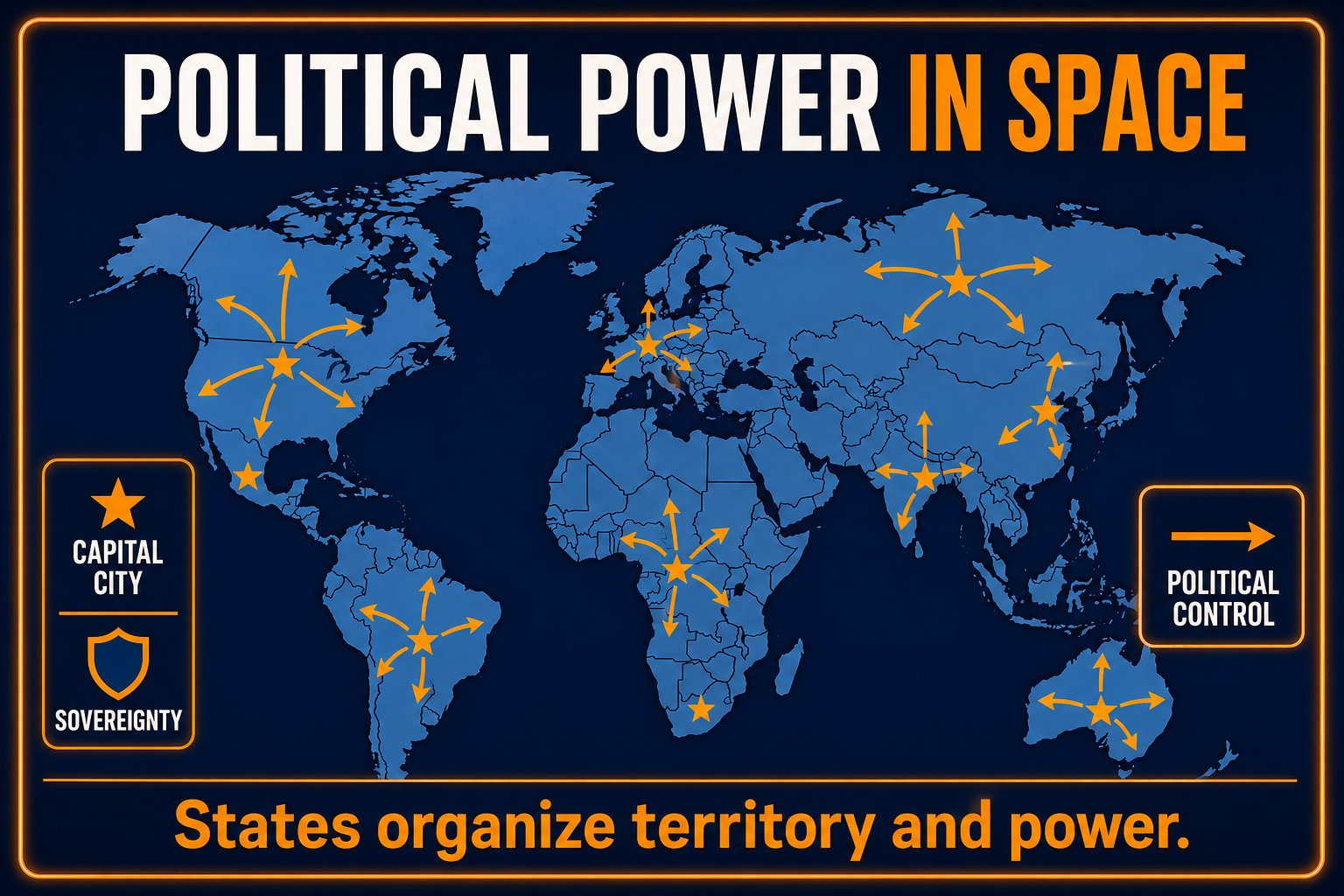
When prompts tie territory to people and livelihoods, link political outcomes across units. Start with Unit 1 scale and regions so you state the analysis scale clearly.
Add Unit 2 migration and refugees when borders move people or split families.
Bring in Unit 3 ethnicity and nationalism whenever identity shapes boundaries or votes.
Use Unit 5 rural land and resources when fights involve farmland, water, or commodity exports.
Say It Fast
- State = political territory with sovereignty
- Nation = cultural identity group
- Boundaries organize political space
- Centripetal forces unify a state
- Centrifugal forces divide a state
- AP answers need concept + evidence + geographic effect
Direct answers (fast)
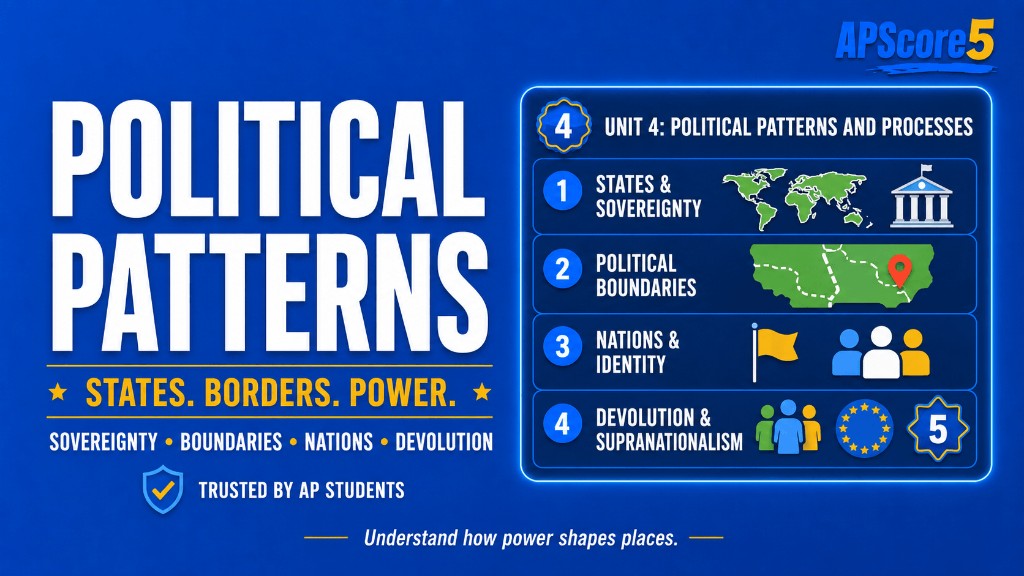
AP Human Geography Unit 4 Review Slides
States, sovereignty, boundaries, devolution, centripetal and centrifugal forces, and gerrymandering—the core political geography ideas in one slide walkthrough.
How to Use This Unit 4 Hub
Use this page as a guided path. Start with states, nations, and sovereignty. Then move into boundaries, disputes, territoriality, internal government structure, devolution, centripetal and centrifugal forces, and gerrymandering. Finish with flashcards, MCQs, FRQs, and the Unit 4 practice hub.
State, nation, nation-state, sovereignty, and territoriality.
Boundary types, origins, disputes, choke points, and territorial control.
Centripetal forces, centrifugal forces, federal systems, unitary systems, and devolution.
Use diagnostic questions, flashcards, MCQs, and FRQ scenarios.
Master AP Human Geography Unit 4 step by step
Pick a learning path—or browse all 14 topic guides. Each page has definitions, examples, practice, and FAQs.
Use this page as your Unit 4 learning hub. Use the Unit 4 Practice Hub when you are ready for mixed MCQs, FRQs, rubrics, and weak-topic diagnosis.
Part 1: What is political geography? State → nation → nation-state → sovereignty
Part 2: How is territory divided and controlled? Political boundaries → types → origins → disputes → territoriality → choke points
Part 3: How is power organized inside states? Federal vs unitary states → devolution
Part 4: What strengthens or weakens states? Centripetal and centrifugal forces
Part 5: How do internal boundaries affect elections? Gerrymandering
Part 6: Can you apply everything? Unit 4 practice questions and review hub
Step 1: State, Nation, and Nation-State
Separate political territory from cultural identity.
Open guide →Step 2: Sovereignty
Legal authority over territory, borders, and recognition.
Open guide →Step 3: Nation-State, Stateless Nation, Multinational State
Why nations and state borders do not always match.
Open guide →Step 4: Political Boundaries
How boundaries organize political authority.
Open guide →Step 5: Types of Boundaries
Physical, geometric, and cultural boundary types.
Open guide →Step 6: Boundary Origins
Antecedent, subsequent, superimposed, and relic boundaries.
Open guide →Step 7: Boundary Disputes
Definitional, locational, operational, and allocational disputes.
Open guide →Step 8: Territoriality
How states claim, mark, defend, and control space.
Open guide →Step 9: Choke Points
Strategic narrow passages that control trade and security.
Open guide →Step 10: Federal vs Unitary States
Shared power vs centralized power inside a state.
Open guide →Step 11: Devolution
Power moving from central governments to regions.
Open guide →Step 12: Centripetal and Centrifugal Forces
Forces that unify a state or pull it apart.
Open guide →Step 13: Gerrymandering
How district lines shape representation and voting power.
Open guide →Step 14: Unit 4 Practice Hub
30 MCQs, 5 FRQs, rubrics, and weak-topic diagnosis.
Open guide →Unit 4 in 60 seconds
- Political geography studies how power is organized across space—not just “who rules,” but how borders and institutions shape daily life.
- States combine territory, population, sovereignty, and government; they defend territoriality through law and force.
- Nations are cultural communities; they may or may not have their own state—think Kurds as a widely cited stateless nation example.
- Boundaries sort jurisdictions; badly fit borders (often superimposed in colonial Africa) fuel dispute.
- Centripetal forces unify; centrifugal forces pull apart—Scotland or Catalonia illustrate centrifugal pressure inside democracies.
- Devolution shifts power downward; supranationalism (EU, UN, NATO) pools power upward for trade, standards, or security.
Unit 4 mastery checklist
0/6 skills checked — tick each box as you can explain it aloud.
How to study Unit 4
- Memorize nation/state vocabulary with examples you can cite on an FRQ—start with the state vs nation vs nation-state guide if terms feel interchangeable.
- Study sovereignty as political authority over territory—internal vs external control and what challenges state power on the exam.
- Work through nation-state mismatch terms (multinational state, multistate nation, stateless nation) with map-ready examples.
- Follow the 14-step topic path from political boundaries through gerrymandering, ending at the Unit 4 practice hub.
- Compare boundary types using the boundary table—then sketch one antecedent and one superimposed scenario.
- Practice interpreting political maps (election shading, autonomous regions, partitions).
- Learn go-to examples: EU supranationalism, NATO alliance, UN cooperation, Belgium/Canada federal/devolution stories, Berlin Wall relic boundary.
- When prompts name Hormuz, Malacca, or Suez, review maritime passages with the choke point study guide (flashcards and MCQs included).
- Write 2–3 timed paragraphs using Claim → Evidence → Geographic reasoning.
For course-wide orientation, open the AP Human Geography course overview.
When you want full-exam pacing, use the AP Human Geography practice tests page.
10-question diagnostic
Answer all 10 to spot gaps before the full 50-question MCQ set.
Big ideas in this unit
Each topic mirrors how Unit 4 shows up on the AP exam—definitions tied to real places, boundary stories, and government designs that manage diversity.
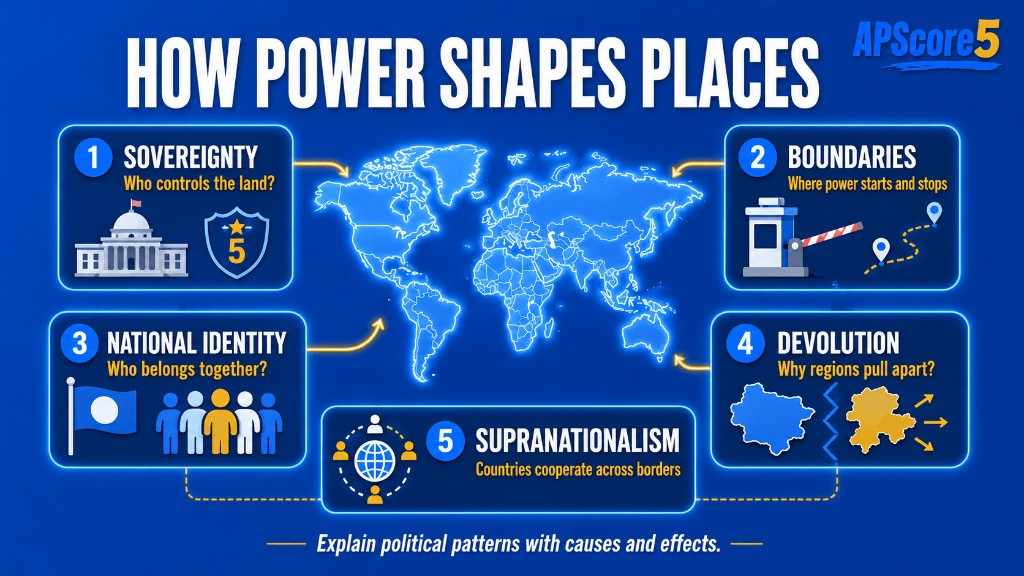
How power shapes places: ask who controls territory, where boundaries start and stop, how national identity is built, why regions push for autonomy, and when states cooperate across borders—then read the topic cards below.
State and nation definitions
Separate cultural nation from sovereign state, then label mismatches: Kurds as a stateless nation, Koreans as a multistate nation, Belgium or Canada as multinational states.
Exam clue: FRQs punish vague “country.” Earn credit by pairing precise terms with map evidence (minorities, autonomous zones, partitions).
State, nation, and nation-state guide → · Unit 4 nation/state section →
Nationalism and state-building forces
Nationalism can bind a population (centripetal symbols, civic rituals) or pull regions apart (separatism, uneven development). Always decide direction using stimulus clues—Scotland, Catalonia, or language policy—not vibes.
Exam clue: “Identify one centripetal and one centrifugal force” needs two contrasting mechanisms in the same country.
Centripetal and centrifugal forces guide → · Nationalism & forces →
Compare with Unit 3 cultural patterns and identity when the stimulus stresses ethnicity or symbols.
Territoriality and choke points
Territoriality is how states defend claimed space—checkpoints, EEZs, bases—not just shaded land on a map. Choke points (Strait of Hormuz, Panama Canal) concentrate leverage—see our choke point study guide so local disruption scales to global trade.
Exam clue: Tie narrow passages to resource flows and security; step up scale with Unit 1 scale.
Boundary types
Stop at “where the line is.” Ask when it was drawn and who drew it—antecedent vs subsequent vs superimposed vs relic vs geometric vs physical vs cultural. African colonial lines vs Berlin Wall traces train classification speed.
Exam clue: Prompt verbs like “drawn before settlement” or “colonial powers ignored ethnic clusters” are boundary-type giveaways.
Boundary function and disputes
Move from line placement to what fights mean: definitional vs locational vs operational vs allocational (oil, fish, rivers). Cross-border kin ties—see Unit 3—often intensify disputes.
Exam clue: Resources near an ambiguous line → argue allocational dispute + boundary legacy (often superimposed or shifting physical).
Unitary vs federal systems
Federal splits enumerated powers (education or taxes in Canada); unitary concentrates policy in the capital. Devolution sends power downward without dissolving the state—pair with autonomy debates after fiscal or identity shocks.
Exam clue: Compare systems using concrete powers, not labels—“fast coordination” vs “regional representation.”
Democracy, autocracy, theocracy
Trace where legitimacy comes from—elections, coercion, or religious authority—and map outcomes for minority rights. Pair redistricting (routine) with gerrymandering (partisan distortion); connect vote maps to electoral geography.
Exam clue: EU economic integration vs NATO defense vs UN diplomacy—three different cooperation jobs; don’t collapse them.
AP HUG Unit 4 flashcards
The deck is grouped by these same topics so vocabulary sticks to scenarios.
Use cards after skimming the sections above. Then run the 10-question diagnostic to surface weak topics.
Finish with the 50 MCQs to drill stimulus-style wording.
Exam clue: If a card feels abstract, tie it to one place name before you move on—memory anchors beat jargon.
Nation vs state vs nation-state
| Term | Meaning | Example | Common mistake |
|---|---|---|---|
| Nation | Cultural group sharing identity, language, religion, or history—not necessarily a government. | Kurdish nation spread across several countries. | Calling any country a “nation” without naming cultural unity. |
| State | Sovereign political unit with defined territory, population, government, and recognition. | Japan as an island state with strong sovereignty. | Confusing “state” with a U.S. state administratively. |
| Nation-state | Borders closely match one dominant nation’s homeland. | Iceland or Portugal—high overlap but never perfectly pure. | Assuming every country is a perfect nation-state. |
State and nation definitions
Plain definition: A state combines territory, population, sovereignty, and government. A nation is a self-identified cultural community. A multinational state hosts multiple nations (Canada); a multistate nation spans states (Koreans in North and South Korea); a stateless nation lacks sovereign territory—often cited with Kurdish populations. For a comparison-first walkthrough with practice MCQs, see the state, nation, and nation-state study guide.
Why AP cares: FRQs reward precise vocabulary tied to maps showing minorities, autonomous zones, or partitions—connect to Unit 3 nationalism.
Mini-check: Why might Belgium be multinational while Koreans illustrate a multistate nation?
Nationalism and centripetal / centrifugal forces
Nationalism mobilizes loyalty around the nation—sometimes reinforcing the state, sometimes fueling separatism or balkanization (fragmentation into smaller units).
Centripetal examples: shared currency, national holidays, elite sports teams, inclusive language policy.
Centrifugal examples: uneven infrastructure, ethnic dominance feelings, independence referenda (Scotland, Catalonia narratives).
Tie refugee flows from Unit 2 migration effects to contested borders here.
Territoriality and choke points
Territoriality is how states claim and defend space—airspace, EEZs, checkpoints—not just land area.
Choke points (Strait of Hormuz, Panama Canal, Suez) concentrate leverage for trade and security—classic stimulus for why disruption in one narrow passage ripples globally. For the eight major passages, oil and trade stats, and FRQ wording, see our choke point study guide.
Frontier vs boundary: A frontier is a zone where control is fuzzy; a boundary is an agreed line—demarcation matters for enforcement.
Use Unit 1 scale when jumping from local checkpoints to global shipping.
Reading boundaries (before the full table)
Always ask: When was the line drawn relative to settlement? Who imposed it? What human or physical feature was ignored?
Quick anchors: African colonial lines → superimposed; Andes watershed → physical; straight latitude segments → geometric; abandoned Cold War walls → relic.
Types of boundaries (AP Human Geography)
| Type | How it forms | Example | AP exam clue |
|---|---|---|---|
| Antecedent | Drawn before cultural landscapes intensify; later frozen in place. | River borders settled early in U.S. expansion narratives. | “Before settlement intensified…” |
| Subsequent | Negotiated after cultures meet—often follows groups. | European borders adjusted after wars. | “Negotiated after conflict / treaty…” |
| Superimposed | Outside power ignores existing cultures—often colonial. | African colonial boundaries splitting ethnic groups. | “Colonial powers drew…” |
| Relic | No longer active politically but still visible socially. | Berlin Wall footprint as cultural memory. | “Former barrier still traced…” |
| Geometric | Straight-line geometry (latitude/longitude). | U.S.–Canada westward segments. | “Straight line across plains…” |
| Physical (natural) | Follows rivers, ridges, deserts. | Andean watershed borders. | “Follows the ridge / river…” |
| Cultural | Follows language, religion, or ethnicity. | Partition lines attempted along ethno-religious clusters. | “Follows majority language island…” |
Boundary function and disputes
Boundaries gate migration, trade, and identity. Disputes can be definitional (what line means), locational (where it sits), operational (how enforcement works), or allocational (resources).
Exam move: Link cross-border ethnic ties back to Unit 3 cultural boundaries when identity crosses the line.
In a second sentence, connect mobility to Unit 2 population and migration if people move because of policy or conflict.
Federal vs unitary systems and devolution
Unitary: capital dominates policy—fast coordination, risk of peripheral resentment.
Federal: constitution divides powers—Canada/Belgium examples pair with autonomy debates.
Devolution: central government voluntarily yields power downward (Scotland, Catalonia narratives)—different from collapse of the state.
Centripetal vs centrifugal forces
| Force type | What it does | Examples | How it appears in FRQs |
|---|---|---|---|
| Centripetal | Unifies people toward capital identity. | National holidays; inclusive civic education; Olympic teams. | Ask students to identify cohesive symbols/policies. |
| Centrifugal | Pulls regions or groups apart. | Independence votes; uneven rail networks; perceived ethnic dominance. | Ask for two tensions inside one country with evidence. |
Electoral geography, regimes, and alliances
Democracy vs autocracy vs theocracy: trace where legitimacy comes from—elections, coercion, or religious authority—and map outcomes for minority rights.
Redistricting vs gerrymandering: redistricting redraws lines routinely; gerrymandering manipulates shapes for partisan gain—cite packing/cracking language.
Supranational bodies: EU economic integration; UN diplomacy/peacekeeping framing; NATO collective defense—each trades sovereignty for coordination.
Enclave/exclave: territory wholly inside another state vs territory separated from mainland (Kaliningrad narrative).
Link farmland or resource fights along borders to Unit 5 agriculture and rural land.
High-Yield Unit 4 vocabulary
Definition + AP-style example + exam watch-line for each term.
Showing all terms
State
Sovereign political unit with territory, population, government.
Example: Recognized UN member.
Watch: Don’t confuse with U.S. “state.”
Nation
Cultural nation linked by identity.
Example: Kurdish nation.
Watch: Nation ≠ always a country.
Nation-state
Borders align tightly with one nation.
Example: Iceland (simple illustration).
Watch: Admit minorities exist.
Multinational state
Multiple nations inside one state.
Example: Belgium.
Watch: Tie to federal/autonomy fixes.
Multistate nation
Nation split across states.
Example: Korean nation—two states.
Watch: Compare to stateless nation.
Stateless nation
No sovereign homeland despite identity.
Example: Kurdish populations region-wide.
Watch: Link autonomy movements.
Sovereignty
Supreme authority inside borders.
Example: Passing national laws.
Watch: Supranational rules qualify—but don’t erase—sovereignty.
Self-determination
Groups seek own political status.
Example: Independence referenda debates.
Watch: Legal norms vs desires clash.
Territoriality
Control/influence over defined space.
Example: Border checkpoints.
Watch: Maritime/EZ angles appear.
Boundary
Legal line separating states.
Example: Treaty demarcation.
Watch: Delimit vs demarcate.
Frontier
Zone where control is uneven.
Example: Migration corridors.
Watch: Not the same as boundary.
Antecedent boundary
Set before cultures fully overlap.
Example: Early river borders.
Watch: Timeline verbs.
Subsequent boundary
Drawn after interaction—often negotiated.
Example: Postwar treaties.
Watch: Evidence of bargaining.
Superimposed boundary
External powers ignore locals.
Example: Colonial Africa lines.
Watch: Ethnic splits emphasized.
Relic boundary
Inactive politically, visible culturally.
Example: Berlin Wall corridor memory.
Watch: Past tense clues.
Geometric boundary
Straight arcs using survey/math.
Example: US–Canada segments.
Watch: Latitude/longitude cues.
Physical boundary
Natural barriers—ridge/river/desert.
Example: Pyrenees ridge lines.
Watch: Rivers shift—disputes return.
Cultural boundary
Follows human geography divides.
Example: Language-majority borders.
Watch: Rarely crisp—overlap zones.
Centripetal force
Unifies state identity.
Example: Shared sporting events.
Watch: Pair with centrifugal counter.
Centrifugal force
Threatens unity.
Example: Separatist parties.
Watch: Name spatial inequality.
Devolution
Power shifts downward to regions.
Example: Scottish Parliament powers.
Watch: Not full independence.
Federal state
Constitutional power split.
Example: Canada.
Watch: Enumerate policy examples.
Unitary state
Capital dominates policy.
Example: France historically cited.
Watch: Fast policy vs resentment.
Gerrymandering
Manipulative district shaping.
Example: Packing urban voters.
Watch: Must imply intent to skew.
Redistricting
Routine line redraw after census.
Example: Seat reapportionment.
Watch: Neutral process ≠ gerrymandering.
Electoral geography
Spatial voting patterns & rules.
Example: Urban vs rural splits.
Watch: Tie maps to outcomes.
Supranationalism
States pool sovereignty upward.
Example: EU institutions.
Watch: Tradeoffs with nationalism.
United Nations
Diplomacy, peacekeeping, norms—not a world government.
Example: Refugee agency framing.
Watch: Limits on enforcement.
European Union
Economic/political integration bloc.
Example: Single market rules.
Watch: Sovereignty pooling examples.
NATO
Collective-defense alliance.
Example: Mutual defense clause framing.
Watch: Military geography angles.
Autonomous region
Area with partial self-rule.
Example: Regional parliaments.
Watch: Devolution vs federalism.
Enclave
Territory entirely inside another state.
Example: Small sovereign pockets globally.
Watch: vs exclave perspective.
Exclave
Territory separated from mainland.
Example: Kaliningrad narrative.
Watch: Supply-chain vulnerability.
Common confusions students miss
Nation vs state
Quick example: Kurds (stateless nation) vs Japan (closer nation-state idealization).
Nation-state vs multinational state
Quick example: Belgium’s linguistic communities.
Multistate nation vs stateless nation
Quick example: Koreans (two states) vs Kurds (many states, no Kurdish sovereign state).
Federal vs unitary government
Quick example: Canada federal contrasted with historically unitary France framing.
Devolution vs supranationalism
Quick example: Scottish Parliament powers vs EU commission regulations.
Physical boundary vs geometric boundary
Quick example: Andes ridge line vs straight US–Canada segments.
Centripetal vs centrifugal forces
Quick example: Olympics centripetal vs independence referendum centrifugal.
Redistricting vs gerrymandering
Quick example: Census reapportionment vs snake-shaped districts.
AP exam skill builder (Unit 4)
Match the command verb before you outline—then chain Claim, Evidence, Geographic reasoning.
Identify
Name the political concept shown.
Sample: “Identify the boundary type drawn without local consent.” → Superimposed boundary.
Describe
Spell out visible patterns without full causal essay.
Sample: “Describe how NATO differs from the EU on sovereignty pooling.” → defense alliance vs economic integration framing.
Explain
Cause → mechanism → outcome across scales.
Sample: “Explain why devolution pressures rose after resource discoveries near an autonomous region.” → fiscal grievances + identity.
Compare
Similarity + difference with a criterion.
Sample: “Compare federal Canada with unitary Japan on managing diversity.” → constitutional autonomy vs centralized norms.
Apply (forces)
Use centripetal/centrifugal vocabulary with country facts.
Sample: “Apply centrifugal forces to Belgium.” → linguistic regions + coalition strain narrative.
Apply (devolution)
Show how regional power shifts affect policy.
Sample: “Explain devolution in the UK context.” → Scottish Parliament taxation/education examples.
One Perfect AP Sentence
Political patterns and processes explain how states organize power across territory, and AP answers should connect political concepts to evidence such as borders, sovereignty, identity, elections, devolution, or alliances.
Do Not Confuse These Unit 4 Terms
| Concept Pair | Difference | AP Clue |
|---|---|---|
| State vs nation | State is political territory; nation is cultural identity | government vs people group |
| Nation-state vs multinational state | Nation-state has one dominant nation; multinational state has multiple nations | one identity vs many identities |
| Centripetal vs centrifugal | Centripetal unifies; centrifugal divides | unity vs division |
| Federal vs unitary | Federal divides power regionally; unitary centralizes power | regional power vs central power |
| Boundary type vs boundary dispute | Type describes border form or origin; dispute describes conflict over it | classification vs conflict |
Unit 4 FRQ Formula
Formula: Concept → Evidence → Geographic Effect
Example: The boundary dispute shows a centrifugal force because competing ethnic claims weaken state unity and increase pressure for autonomy.
Quick self-check
Before MCQs, explain each aloud in under 30 seconds:
- One multinational state vs one multistate nation
- Antecedent vs superimposed boundary
- Centripetal + centrifugal pair for the same country
- Federal vs unitary trade-off
- EU vs NATO cooperation goals
If two items wobble, redo flashcards before grinding MCQs.
AP HUG Unit 4 flashcards
Tap to flip. Every 5th card shows an ad with a 3-second delay before the next card.
AP HUG Unit 4 practice questions (MCQ)
50 questions with rising difficulty and live scoring.
Practice AP HUG-style written responses (Unit 4)
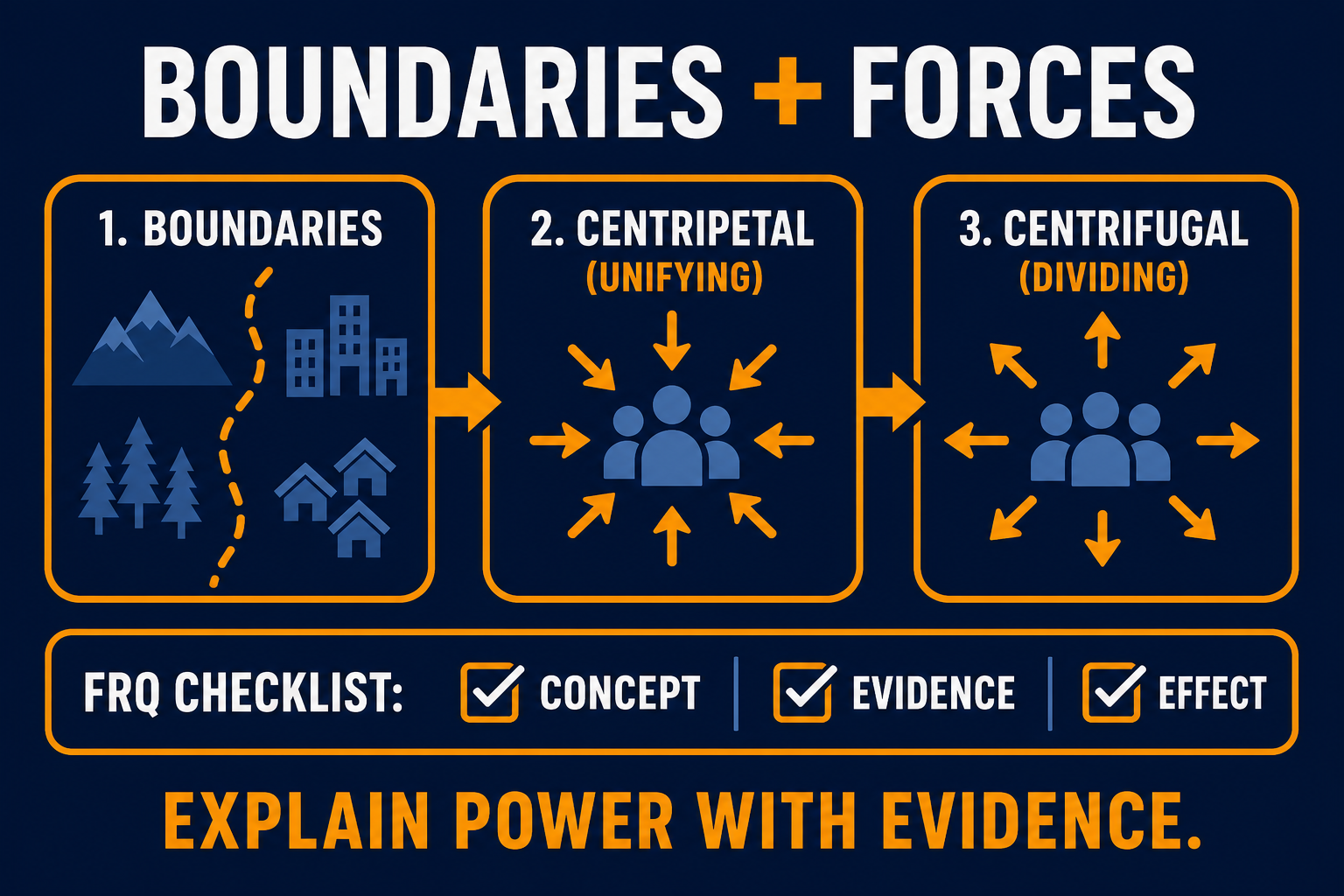
Use Claim → Evidence → Geographic reasoning: interpret the political pattern, anchor it to map or scenario clues, then explain processes (boundaries, sovereignty, forces, institutions) at the correct scale. See the Unit 4 FRQ formula for a quick outline before you write.
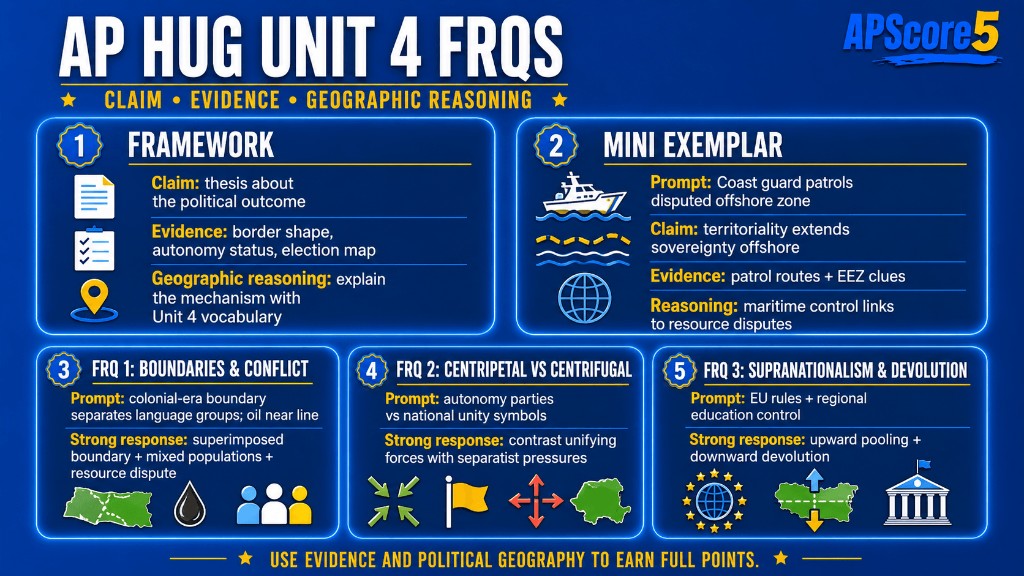
Framework
Claim: One sentence states your thesis about the political outcome (who controls what, and whether tension rises or stabilizes). A second sentence previews which Unit 4 concepts you will use so the reader sees your plan.
Evidence: Pull two concrete facts from the stimulus—maybe border geometry, an autonomy law, vote shading, or patrol routes—before you argue.
Geographic reasoning: Explain why those facts produce the outcome using precise vocabulary (boundary type, dispute category, force direction, institution role). Tie cause to effect across scale when the prompt allows.
Mini exemplar
Prompt snippet: Coast guard patrols disputed offshore zone.
Claim: States extend contests over sovereignty beyond land into maritime space where resources and patrol routes overlap. Territoriality therefore includes offshore enforcement, not only the coastline drawn on a reference map.
Evidence: The stimulus shows armed patrols and references competing EEZ or continental shelf claims near oil or fishery zones.
Geographic reasoning: Maritime zones concentrate allocational disputes because offshore oil or fish rents raise stakes once boundaries stay ambiguous. Strong answers connect patrol behavior to resource geography and name the dispute type.
Unit 4 FRQ drills
FRQ 1 · Boundaries & conflict
Prompt: A colonial-era boundary separates two farming valleys where majority languages differ; protests erupt after oil is found near the line.
Weak answer: Oil discovered near a border often sparks anger, yet stopping at “everyone wants money” hides the map story—there is no mention of legacy boundaries, mixed populations, or whether contest is definitional, locational, or allocational.
Strong answer: Once drilling targets oil or gas along an ambiguous segment, competition shifts toward an allocational dispute because unclear jurisdiction converts underground rents into fights over permits, patrols, and revenue sharing. Layer that onto a superimposed boundary drawn under empire: outside cartographers ignored existing language geographies, so today’s policing arguments recycle colonial line-making along ethnically divided valleys.
Rubric hook: Readers look for dispute vocabulary tied to the stimulus detail about discovery—not a lecture on greed—and for boundary-genesis language that fits “colonial-era.” Geography enters when you explain why contested rents anchor along that inherited line instead of evenly across both valleys.
FRQ 2 · Centripetal vs centrifugal
Prompt: A multinational state faces regional parties demanding autonomy while national holidays still draw huge crowds.
Weak answer: “Nationalism brings everyone together so the country stays stable.” The prompt already signals simultaneous centrifugal institutions—autonomy parties—so a unity-only story ignores half the evidence.
Strong answer: Regional parties pushing autonomy illustrate centrifugal pressure: education budgets, language statutes, or fiscal transfers become bargaining chips that pit provinces against the capital even while elections continue. Crowded independence-day events still operate as centripetal rituals, broadcasting civic membership through flags and shared calendars—Belgium and Canada often appear in classroom comparisons because both balance multinational identities inside one parliamentary framework.
What earns credit: Prize essays pair opposing mechanisms without declaring one “wins.” Tie centrifugal claims to parties named in the prompt; tie centripetal cues to mass rituals also named—same country, competing scales.
FRQ 3 · Supranationalism & devolution
Prompt: A country adopts EU regulatory standards while devolving education policy to regional parliaments.
Weak answer: Brussels writes every law now, so regions lose voice entirely. That reading erases the education-devolution clause and treats integration as total absorption rather than selective rule-sharing.
Strong answer: Devolving schooling lets provinces tailor curricula and hiring closer to voters—classic downward authority sharing without exiting the country. Meanwhile adoption of EU standards pools economic rulemaking upward so trucks, factories, and imports cross borders under shared inspection regimes; households still live under national citizenship even while two directional shifts operate at once.
Scoring edge: Explain why education stays regional while certain technical standards align continent-wide; contrast beats treating EU membership as blanket loss of sovereignty.
Cross-check Unit 3 cultural patterns when prompts foreground language or religion.
Add Unit 2 migration when borders move people or separate kin groups.
5–10 minute daily study loop
Day 1
Nation/state vocabulary + comparison table.
Day 2
10 diagnostic questions + fix misses.
Day 3
Boundary flash drills using boundary clues.
Day 4
Mix flashcards + notes on devolution.
Day 5
Timed MCQ sprint + review explanations.
Day 6–7
Timed FRQ paragraph + practice test planning.
Save your progress
Create a free account to keep your score history and practice streak.
AP HUG Unit 1–4 cumulative review
Rotate units instead of locking into one chapter.
Warm up spatial skills with Unit 1 practice.
Add population scenarios through Unit 2 MCQs.
Blend culture with politics using Unit 3 MCQs.
Return here for Unit 4 flashcards when you need fast recognition of terms.
Switch to Unit 4 MCQs when you want full stimulus-style pacing on boundaries and government types.
Frequently asked questions
What is AP Human Geography Unit 4 about?
Unit 4 is Political Patterns and Processes: how states organize territory, exercise sovereignty, draw and dispute boundaries, balance centripetal and centrifugal forces, structure governments (unitary vs federal), and participate in supranational organizations.
What are political patterns and processes?
They are spatial patterns of political power and the processes that create them—state formation, boundary-making, elections and representation, autonomy movements, devolution, alliances, and conflict across scales from local to global.
What is the difference between a nation and a state?
A nation is a group with shared culture and identity; a state is an independent political unit with territory, population, government, and sovereignty. They do not always overlap—leading to multinational states, multistate nations, and stateless nations.
What are centripetal and centrifugal forces?
Centripetal forces unify a state through shared symbols, institutions, or inclusive policy. Centrifugal forces pull it apart through ethnic tension, inequality, or separatism. AP questions often ask you to name both for one country.
What are the main types of boundaries in AP Human Geography?
Common classifications include antecedent, subsequent, superimposed, relic, geometric, physical (natural), and cultural boundaries—each defined by how and when the border formed relative to settlement and culture.
How do you study for AP Human Geography Unit 4?
Memorize nation/state vocabulary with real examples, practice classifying boundaries from map clues, interpret electoral and federal/unitary scenarios, link Unit 3 identity and Unit 2 migration to political outcomes, and write FRQs using Claim, Evidence, Geographic reasoning.
Is there an AP HUG Unit 4 Quizlet or Scribd version?
Other platforms host flashcard-style sets. This page keeps 60 flashcards with explanations, 50 MCQs with reasoning, and FRQ-style prompts together for one study flow.
How do I get AP HUG Unit 4 test answers?
Real AP exam questions stay secure. Use the 50 practice MCQs here with explanations as a legal prep equivalent.
What's the best way to review AP HUG Units 1-4?
Mix spatial skills from Unit 1, population and migration from Unit 2, cultural geography from Unit 3, and political processes from Unit 4 in short daily sessions with cumulative review.
How hard is the AP HUG Unit 4 MCQ?
The set starts with vocabulary recall and moves to stimulus-style reasoning about boundaries, sovereignty, and political systems.
Where can I find an AP HUG Unit 4 study guide?
Use the tables, vocabulary cards, section explanations, and practice on this page as a full Unit 4 study guide you can repeat in short blocks.
What is the difference between this Unit 4 hub and the Unit 4 practice page?
This Unit 4 hub organizes the full Political Patterns and Processes learning path with topic guides, summaries, flashcards, and review tools. The Unit 4 practice page is for mixed MCQs, FRQs, rubrics, answer explanations, and weak-topic diagnosis.
Next: AP Human Geography Unit 5
Roll straight into agriculture and rural land—boundaries, inputs, and environmental patterns that show up with Unit 4 territorial fights over resources.