AP Courses AP Biology AP Biology Units AP Human Geography AP HUG Units AP Computer Science Principles AP CSP Units
Practice Daily Practice Practice by Course Practice by Topic Practice Tests
AP Exam Resources AP Exam Dates Registration Fees Scores & Credit What to Bring
Start Practicing → Login
AP Human Geography · Unit 3

AP Human Geography Unit 3: Cultural Patterns and Processes

Cultural diffusion, landscape reading, language and religion geography, and identity—with diagnostic checks, 60 flashcards, 50 MCQs, and FRQ-style prompts aligned to AP Human Geography.

Updated April 30, 2026 • Reviewed by APScore5 Editorial Team

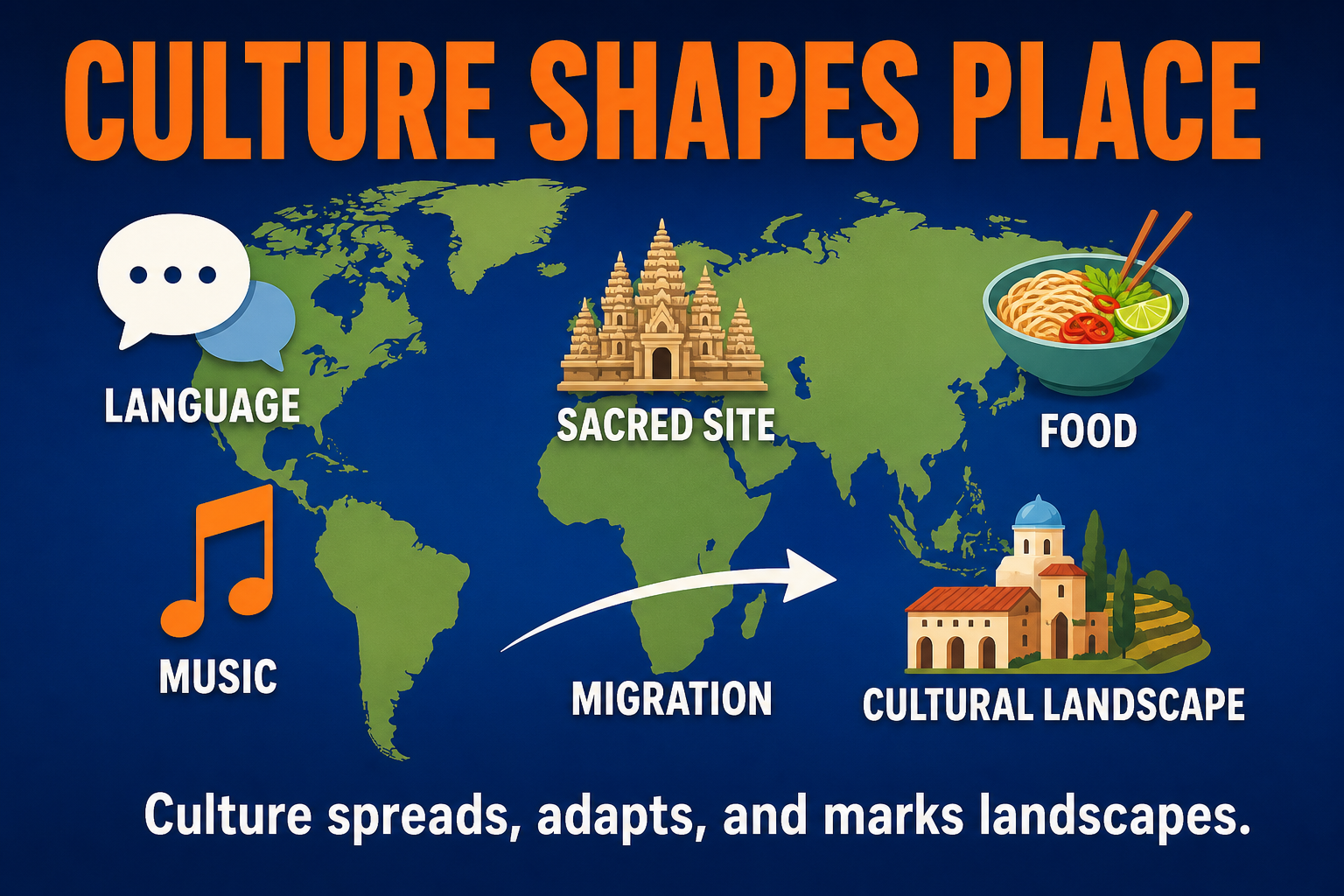
AP HUG Unit 3 cultural banner
Figure - Cultural patterns traits diffusion identity Unit 3

What is AP Human Geography Unit 3?

AP Human Geography Unit 3: Cultural Patterns and Processes asks how people create, share, and change culture across space—then how those patterns show up on the land and in maps, photos, and neighborhood scenes.

Link this unit to Unit 1 spatial patterns, Unit 2 migration (relocation diffusion), and later Unit 4 political geography when identity, citizenship, or borders shape cultural outcomes.

Direct answers (fast)

What topics are in AP HUG Unit 3? Culture traits/complexes, landscape & sequent occupancy, diffusion types, colonial-era spreads, language & religion geography, acculturation and assimilation.

What is cultural diffusion? Spread of a trait through space/time via people moving (relocation) or ideas/practices moving (expansion: hierarchical, contagious, stimulus).

What is cultural landscape? Visible cultural imprint—signage, sacred architecture, fields, storefronts—readable as evidence of identity and history.

Acculturation vs assimilation? Acculturation is mutual cultural exchange in contact zones; assimilation is deeper adoption of a dominant culture, often uneven across language and religion.

AP HUG Unit 3 study workflow
Figure - Learn core terms practice MCQ FRQ track topics

Use flashcards for vocabulary, MCQs for pacing, and the sidebar progress bar while you work—short sessions beat one long cram.

Unit 3 in 60 seconds

  • Culture is learned and shared—not determined only by genetics or climate.
  • Cultural traits spread through diffusion—match mechanism to the map or story.
  • Landscapes show culture—read buildings, crops, signs, and sacred sites as evidence.
  • Language and religion organize regions—often overlapping and contested.
  • Globalization mixes outcomes—similar brands worldwide (convergence) but local remixing (adaptation, syncretism).

Progress checklist

Before exam day, can you…

10-question diagnostic

Question 1 of 10Start

Big ideas in this unit

Each topic below connects visible landscape clues to diffusion mechanisms and social outcomes—what AP graders want beyond vocabulary lists.

AP HUG Unit 3 key concepts
Figure - Unit 3 key concepts traits landscapes diffusion

Culture traits and complexes

Traits are single pieces (language style, diet taboos); complexes bundle traits into systems (e.g., ritual calendars tied to food norms).

Jump to deep dive →

Cultural landscape & sequent occupancy

Places stack histories—roads, shrines, crops reveal earlier occupants and power shifts.

Read landscapes →

Diffusion

Distinguish relocation vs expansion (hierarchical, contagious, stimulus) using movement vs spread-in-place logic.

Diffusion mechanics →

Colonialism

Empires imposed languages, faiths, borders—then locals reworked culture into hybrid institutions.

Impacts & resistance →

Religion & language

Maps show hearths, overlaps, and friction zones—always tie patterns to migration & policy.

Spatial patterns →

Contact & change

Acculturation, assimilation, syncretism explain how identities shift when cultures meet.

Compare outcomes →

High-yieldFRQ-readyCommon mistake

Culture traits and complexes

Plain definition: A culture trait is any single cultural practice or artifact (greeting norms, musical instruments, fasting rules). A culture complex links multiple traits into a working system—think dietary laws tied to holidays and kitchen tools.

Why it matters on the AP exam: Stimulus photos ask what traits imply about identity and process; essays reward tying traits to diffusion, policy, or landscape evidence—not naming lists.

Examples: (1) Head coverings worn as everyday modesty fashion in public spaces. (2) Festival foods tied to harvest calendars. (3) Youth slang spreading via voice-note chats—material + nonmaterial traits bundled.

Common student mistake: Calling every observation “random cultural diversity.” Replace that phrase with which trait, which scale (local vs regional), and which mechanism (diffusion, policy, migration).

Mini-check: Why would two neighborhoods share a religion trait yet show different dining landscapes?

How to use this in an FRQ: Start from visible traits in the prompt (food signage, dress), infer linked complexes (belief + ritual + economy), then name process.

High-yieldFRQ-ready

Cultural landscape and sequent occupancy

Plain definition: The cultural landscape is what you could photograph—fields, temples, alphabets on signs, lot subdivision grids. Sequent occupancy means successive cultural groups leave layered imprints; older layers may survive as roads, field shapes, or shrine reuse.

Why AP cares: “Interpret the image/map” items reward linking symbols on the land to identity, economy, and historical sequence.

Examples: (1) Colonial courthouse plaza reused by independent-era statues. (2) Irrigation canals older than current crops. (3) Mixed-script storefronts after migration waves.

Common mistake: Saying “culture changed” without naming which visible layer replaced or adapted another.

Mini-check: Give two landscape clues that sequent occupancy occurred—not just “different architecture.”

FRQ sentence: “The mosque repurposed as a cultural center shows adaptive reuse—sequent occupancy where sacred fabric persists while function shifts.”

Pair with Unit 1 sense of place when prompts ask how meanings attach to locations.

High-yieldCommon mistake

Relocation and expansion diffusion

Plain definition: Relocation diffusion moves traits because people migrate and carry practices (religion, cuisine, music). Expansion diffusion spreads traits widely while many people stay put—through elites/media (hierarchical), neighbor-to-neighbor spread (contagious), or borrowing principles then adapting (stimulus).

Why AP cares: Half of MCQ traps mix relocation with expansion—watch verbs like “migrated,” “broadcast,” “went viral,” “filtered down from capital cities.”

Examples: (1) Diaspora cooking districts after immigration—relocation. (2) Fashion trend hits capital influencers first—hierarchical expansion. (3) Agricultural extension ideas reworked for local soils—stimulus.

Common mistake: Labeling every internet trend “contagious.” Ask whether spread is ranked (hierarchical), wave-like adjacency (contagious), or principle-only borrowing (stimulus).

Mini-check: If the trait still thrives at the hearth while spreading outward, which diffusion family is implied?

FRQ sentence: “Because migrants opened groceries before mass media reached the district, relocation diffusion—not only contagious expansion—explains the pattern.”

When people move, tie to Unit 2 migration effects.

Relocation vs expansion diffusion

Relocation = trait travels with migrants. Expansion = trait spreads outward from a hearth while staying strong locally; subtypes describe pathways (ranked cities, adjacency, adapted ideas).

TypeWhat happensAP Human Geography exampleHow to spot it in a question
Relocation diffusionPeople move; culture moves with them.Immigrant communities opening bilingual schools or houses of worship overseas.Mentions migration, diaspora, “brought with them,” chain migration.
Hierarchical diffusionIdeas jump to influential nodes (cities, elites) before rural areas.Headquarters brands or policy fashions adopted first in global cities.“Started in capital,” celebrity endorsement, ranked settlement uptake.
Contagious diffusionWavelike spread through proximity—everyone nearby can catch it.Regional pronunciation shifts or agricultural practices spreading farm-to-farm.Maps show contiguous spread; language of neighbors/contact.
Stimulus diffusionUnderlying idea adopted but reworked—trait changes form.Foreign franchise menus localized; smartphone payment copied but adapted to local banking rules.“Adapted,” “modified,” “not identical,” hybrid outcomes.
FRQ-ready

Colonialism and cultural spread

Plain definition: Colonial rule exported languages, religions, legal systems, and settlement patterns—often by force—while generating resistance, hybrid institutions, and uneven development legacies.

Why AP cares: FRQs ask you to connect imperial networks to today’s cultural borders and inequalities—not to debate motives, but to explain spatial outcomes.

Examples: (1) Official colonial languages surviving in courts/schools after independence. (2) Mission-built towns with plaza grids replicated inland. (3) Cash crops reorganizing labor migration patterns.

Common mistake: Treating colonial influence as “everything Western.” Specify institutions (education system, land survey method) and local adaptations.

Mini-check: Name one colonial-era cultural imprint still visible on the landscape and one local response (syncretic faith, renamed street).

FRQ sentence: “Rail nodes built for extraction still organize urban growth—cultural landscape evidence of colonial economic priorities.”

When borders divide cultural groups, preview Unit 4 political geography.

High-yield

Religion and language patterns

Plain definition: Languages map migration, trade, and policy—official languages, multilingual signage, dialect zones. Religions arrange space through sacred structures, pilgrimage networks, burial practices, and holidays that regulate calendars.

Why AP cares: Compare universalizing vs ethnic faith distributions; explain lingua francas; read blended neighborhoods after migration.

Examples: (1) Cross-border dialect continuums. (2) Temple districts alongside minority-language schools. (3) Pilgrimage routes clustering services.

Common mistake: Saying “language equals ethnicity equals religion.” Show overlaps and exceptions.

Mini-check: Why might two neighborhoods share a lingua franca yet maintain separate worship landscapes?

FRQ sentence: “New diaspora grocery + script on signage signal relocation diffusion reshaping the cultural landscape at the block scale.”

Common mistake

Acculturation and assimilation

Plain definition: Acculturation is two-way cultural borrowing in sustained contact (hybrid foods, code-switching). Assimilation describes deeper alignment with a dominant culture—often fastest in public language or consumer habits, slower in private belief.

Why AP cares: Migration FRQs expect you to separate economic integration from cultural retention—segmented outcomes by neighborhood or generation.

Examples: (1) Second-generation bilingual homes with English media. (2) Festivals adopted municipally while sacred calendars persist privately. (3) Ethnic enclaves supporting jobs abroad via remittance ties.

Common mistake: Treating assimilation as automatic or morally “complete.” Note gender/generation differences.

Mini-check: Give one acculturation example that is not full assimilation.

FRQ sentence: “Public schools accelerate language assimilation while weekend-language schools sustain nonmaterial traits—different scales of change.”

Most tested Unit 3 vocabulary

Each card: student-friendly meaning + one concrete example you can drop into an FRQ.

Culture trait

Single cultural element you can observe or practice.

Ex: spice blends sold at a market stall.

Culture complex

Linked traits functioning together.

Ex: holiday + foods + dress norms.

Cultural hearth

Origin region where traits innovate before diffusing.

Ex: faith hearth tied to founder geography.

Cultural landscape

Visible human imprint on land—material culture on display.

Ex: minarets + bilingual signs.

Sequent occupancy

Groups leave stacked imprints through time.

Ex: fort walls inside a modern park.

Relocation diffusion

Culture moves because people migrate.

Ex: diaspora festivals abroad.

Expansion diffusion

Spread from hearth without everyone relocating.

Ex: viral dance mapped city-to-city.

Hierarchical diffusion

Spread through influential nodes first.

Ex: policy piloted in capital firms.

Contagious diffusion

Wavelike proximity spread.

Ex: slang hopping adjacent towns.

Stimulus diffusion

Idea borrowed, form changed.

Ex: sushi burrito hybrid.

Lingua franca

Shared bridge language across groups.

Ex: English for regional aviation crews.

Dialect

Regional speech variant within a language.

Ex: vocabulary shifts along a river valley.

Toponym

Place name revealing history or culture.

Ex: renamed streets after independence.

Universalizing religion

Actively proselytizes; open to converts worldwide.

Ex: missionary networks.

Ethnic religion

Closely tied to a cultural group/region.

Ex: Judaism & Jewish identity links (course-level framing).

Acculturation

Cultural exchange under contact; identities may blend.

Ex: fusion cuisine.

Assimilation

Adopting dominant traits deeply.

Ex: shift to public-school language dominance.

Syncretism

Blend elements from traditions into new practices.

Ex: holidays merging symbols.

Cultural convergence

Traits become more alike—often via media/trade.

Ex: global fast-food presence.

Cultural divergence

Groups differentiate or resist homogenization.

Ex: language revitalization policy.

Common confusions students miss

Acculturation vs assimilation
Wrong shortcut: “They mean the same mixing.”
Better AP reasoning: Acculturation keeps two-way borrowing visible; assimilation stresses absorption into a dominant norm—often partial and uneven.
Relocation diffusion vs expansion diffusion
Wrong shortcut: “If it crosses borders, it must be relocation.”
Better AP reasoning: Expansion can jump borders via media without migrants; relocation requires people carrying the trait—confirm with the stimulus verbs.
Universalizing vs ethnic religions
Wrong shortcut: “Big membership equals universalizing.”
Better AP reasoning: Ask about conversion mission and global diffusion versus deep ties to an ethnic hearth—map distributions carefully.
Cultural landscape vs built environment
Wrong shortcut: “Anything built counts the same.”
Better AP reasoning: Cultural landscape stresses cultural meaning and identity signals; built environment is broader physical fabric—use cultural landscape when prompts ask what beliefs or histories are visible.
Sequent occupancy vs ordinary historical change
Wrong shortcut: “Old buildings equal sequent occupancy.”
Better AP reasoning: Show successive cultural groups leaving layered marks—name at least two eras or peoples evidenced on-site.
Stimulus diffusion vs copying
Wrong shortcut: “They copied the trend.”
Better AP reasoning: Stimulus diffusion keeps the core principle but changes form—prove adaptation, not identical transfer.

AP exam skill builder

Command verbs tell you what evidence to supply—match the verb before you outline.

Identify

Name the concept accurately.

Sample: “Identify the diffusion type shown when chefs migrate and open restaurants abroad.” → Relocation diffusion.

Describe

Spell out what is visible without explaining why yet.

Sample: “Describe cultural landscape evidence on the street.” → bilingual signs, temple façade, food carts.

Explain

Connect cause → mechanism → outcome.

Sample: “Explain why hierarchical diffusion fits this rollout.” → elites adopt first, networks radiate.

Compare

Give similarity and difference with criteria.

Sample: “Compare universalizing and ethnic religion distributions.” → proselytism vs hearth clustering.

Apply

Use the concept in a new scenario.

Sample: “Apply stimulus diffusion to a viral dance localized with instruments.” → principle spreads, form adapts.

AP HUG Unit 3 flashcards

Every 5th card shows an ad placeholder with a 3-second delay before next card.

Card 1 of 60Tap card to flip

Quick self-check

Before MCQs, can you explain each item aloud in under 20 seconds?

  • Two traits vs one culture complex
  • Relocation vs hierarchical diffusion scenario
  • Universalizing vs ethnic religion cue
  • Acculturation vs assimilation with migration evidence
  • One colonial-era landscape imprint still visible today

If two or more feel fuzzy, redo flashcards before grinding MCQs.

AP HUG Unit 3 practice questions (MCQ)

50 questions with rising difficulty and live scoring.

0Correct
0Answered
0%Accuracy
StartStatus
Question 1 of 50Start

Practice AP HUG-style written responses (Unit 3)

Use Claim → Evidence → Geographic reasoning: state your interpretation, anchor it to landscape or map clues from the prompt, then explain the cultural process (diffusion, sequent occupancy, language shift, etc.) at the right scale.

  1. Claim: Your interpretation of the pattern.
  2. Evidence: Observable cultural landscape or diffusion cues from the stimulus.
  3. Geographic reasoning: Why the mechanism fits—tie to Unit 3 vocabulary.

Framework


Never substitute “science” for geography—graders want processes in space, not lab claims.

Mini example (music diffusion)


Claim: Expansion diffusion with local adaptation.

Evidence: Trend reaches distant cities while staying active at the hearth; lyrics change locally.

Geographic reasoning: Media networks enable hierarchical/contagious spread; stimulus diffusion explains altered local forms.

Unit 3 FRQ drills

A. Cultural landscape (city street)

Prompt: A downtown street shows bilingual street signage, a historic mosque next to a modern cultural center, and food carts selling fusion dishes.

Weak answer: “Lots of diversity.”

Strong answer: Names sequent occupancy (religious fabric reused), language policy or migration (bilingual signs), and hybrid foods as syncretism.

Why points: Uses precise vocabulary tied to visible layers + processes.

B. Diffusion (social trend)

Prompt: A dance challenge spreads globally online but each region remixes music and costumes locally.

Weak answer: “It went viral.”

Strong answer: Expansion diffusion via networked hierarchies plus stimulus diffusion because only the rhythm/template travels while performers localize.

Why points: Separates mechanism from mere popularity—shows geographic adaptation.

C. Religion & language (neighborhood)

Prompt: New immigrant households open grocery stores with imported script on packaging while children attend public schools taught in the national language.

Weak answer: “They assimilated completely.”

Strong answer: Contrasts public-language assimilation pressures with landscape clues of cultural retention (script, specialty foods)—possible acculturation without full assimilation.

Why points: Shows countervailing scales (home vs school) common in AP migration prompts.

After drafting, cross-check against Unit 4 if the prompt mentions autonomy, citizenship, or boundaries affecting cultural expression.

5–10 minute daily study loop

Day 1

Review core terms from the first two sections.

Day 2

Answer 10 questions and review explanations.

Day 3

Revisit missed items and explain each correction.

Day 4

Mix flashcards and practice for retention.

Day 5

Run a timed mini-set and check accuracy.

Day 6-7

Repeat weak-topic practice before next unit.

Save your progress

Create a free account to keep your score history and practice streak.

AP HUG Unit 1–3 cumulative review

Mix units daily: pair Unit 1 practice, Unit 2 MCQs, and this page’s flashcards or Unit 3 MCQs instead of studying one chapter in isolation.

Frequently asked questions

What is AP Human Geography Unit 3?

Unit 3 is Cultural Patterns and Processes: how culture is learned and shared, how traits diffuse and shape landscapes, and how language and religion organize space—plus how contact creates acculturation, assimilation, and syncretism.

What topics are in AP HUG Unit 3?

Typical topics include culture traits and complexes, cultural landscape and sequent occupancy, types of diffusion, colonialism and cultural spread, religion and language geography, and cultural change (acculturation, assimilation, convergence, divergence).

What is cultural diffusion in AP Human Geography?

Cultural diffusion is the spread of a cultural trait over space and time through relocation diffusion (movement of people) or expansion diffusion (spread without everyone migrating), including hierarchical, contagious, and stimulus forms.

What is cultural landscape in AP Human Geography?

The cultural landscape is the visible imprint of culture on an area—buildings, signs, crops, sacred sites, street patterns—often read as evidence of identity, history, and economic activity at a specific scale.

What is the difference between acculturation and assimilation?

Acculturation is cultural exchange when groups interact; traits can blend or coexist. Assimilation describes adopting the dominant group’s culture deeply enough that original traits fade—often uneven across language, religion, and daily practice.

How should I study for AP Human Geography Unit 3?

Learn diffusion types with examples, practice reading landscapes from photos or descriptions, link migration from Unit 2 to relocation diffusion, drill MCQs, and write short FRQs using Claim, Evidence, Geographic Reasoning with named places and scales.

Is there an AP HUG Unit 3 Quizlet or Scribd version?

Other platforms host flashcard-style sets. This page keeps 60 flashcards with explanations, 50 MCQs with reasoning, and FRQ-style prompts together for one study flow.

How do I get AP HUG Unit 3 test answers?

Real AP exam questions stay secure. Use the 50 practice MCQs here with explanations as a legal prep equivalent.

What's the best way to review AP HUG Units 1-3?

Mix spatial skills from Unit 1, population and migration from Unit 2, and cultural processes from Unit 3 in short daily sessions with cumulative review.

How hard is the AP HUG Unit 3 MCQ?

The set starts with recall and moves to stimulus-style reasoning—matching prompts to diffusion types, landscape evidence, and cultural boundaries.

Where can I find an AP HUG Unit 3 study guide?

Use the explanations, comparison tables, vocabulary cards, and practice on this page as a full Unit 3 study guide you can repeat in short blocks.

Continue learning

Next: start AP Human Geography Unit 4

Keep your momentum. Continue directly into Unit 4 so your review stays connected across concepts and exam skills.

Start Free Practice & Track Progress →
Unit progress0%