AP Courses AP Biology AP Biology Units AP Human Geography AP HUG Units AP Computer Science Principles AP CSP Units
Practice Daily Practice Practice by Course Practice by Topic Practice Tests
AP Exam Resources AP Exam Dates Registration Fees Scores & Credit What to Bring
Start Practicing → Login
AP Human Geography · Unit 1 · Microtopic

Reference vs Thematic Maps in AP Human Geography

Reference vs Thematic Maps in AP Human Geography explains how this topic appears across places and scales. Use it to interpret map evidence, compare spatial patterns, and write precise AP-style geographic explanations.

Practice with real AP Human Geography examples, compare spatial evidence across maps, and review with 22 flashcards plus 16 AP-style questions with explanations.

Updated May 3, 2026 Reviewed by APScore5 Editorial Team

Learn in 7 mins · Practice in 10 mins

Unit 1 · 8–10% of exam Map classification 22 flashcards 16 AP-style questions
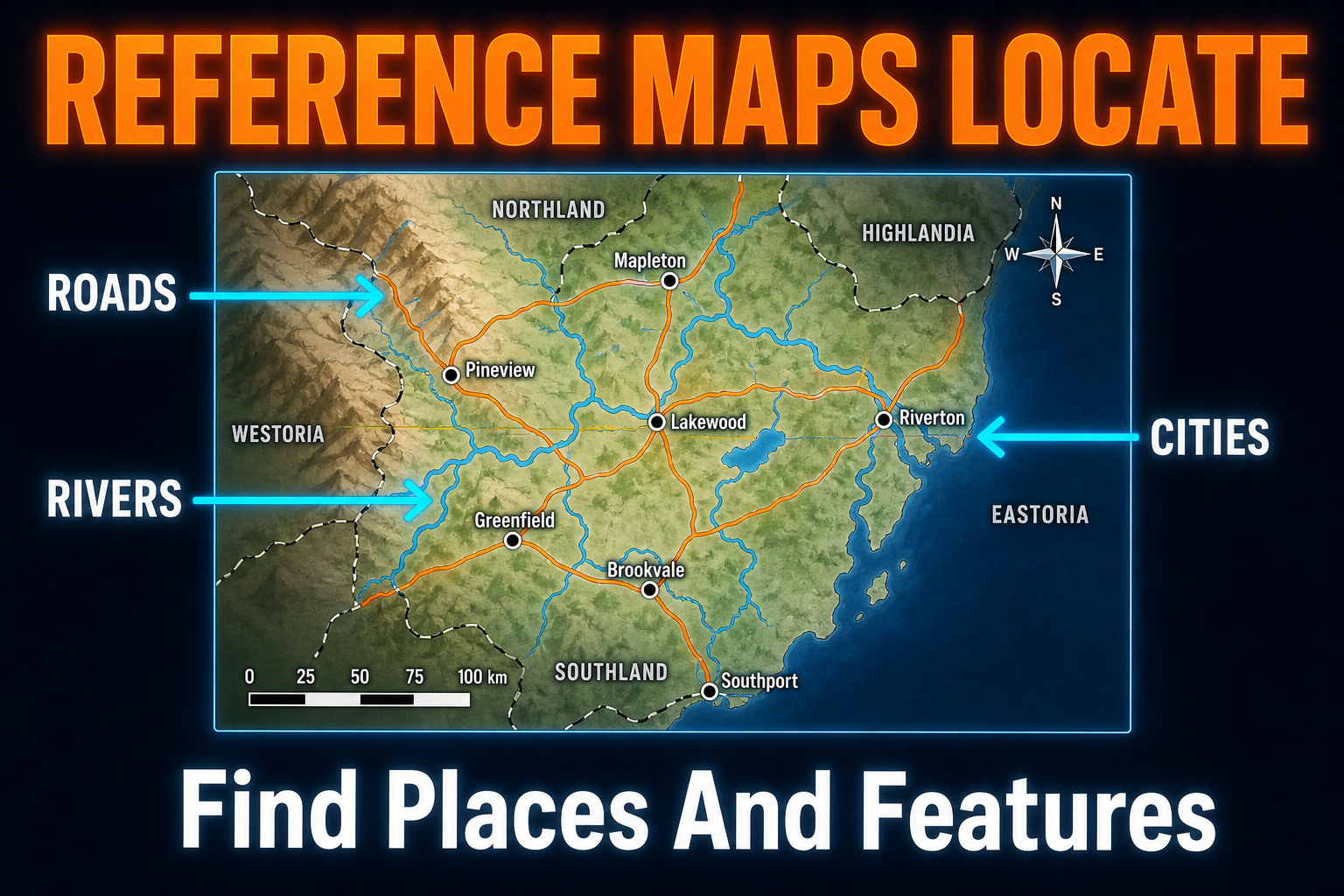
Reference Locate features and routes
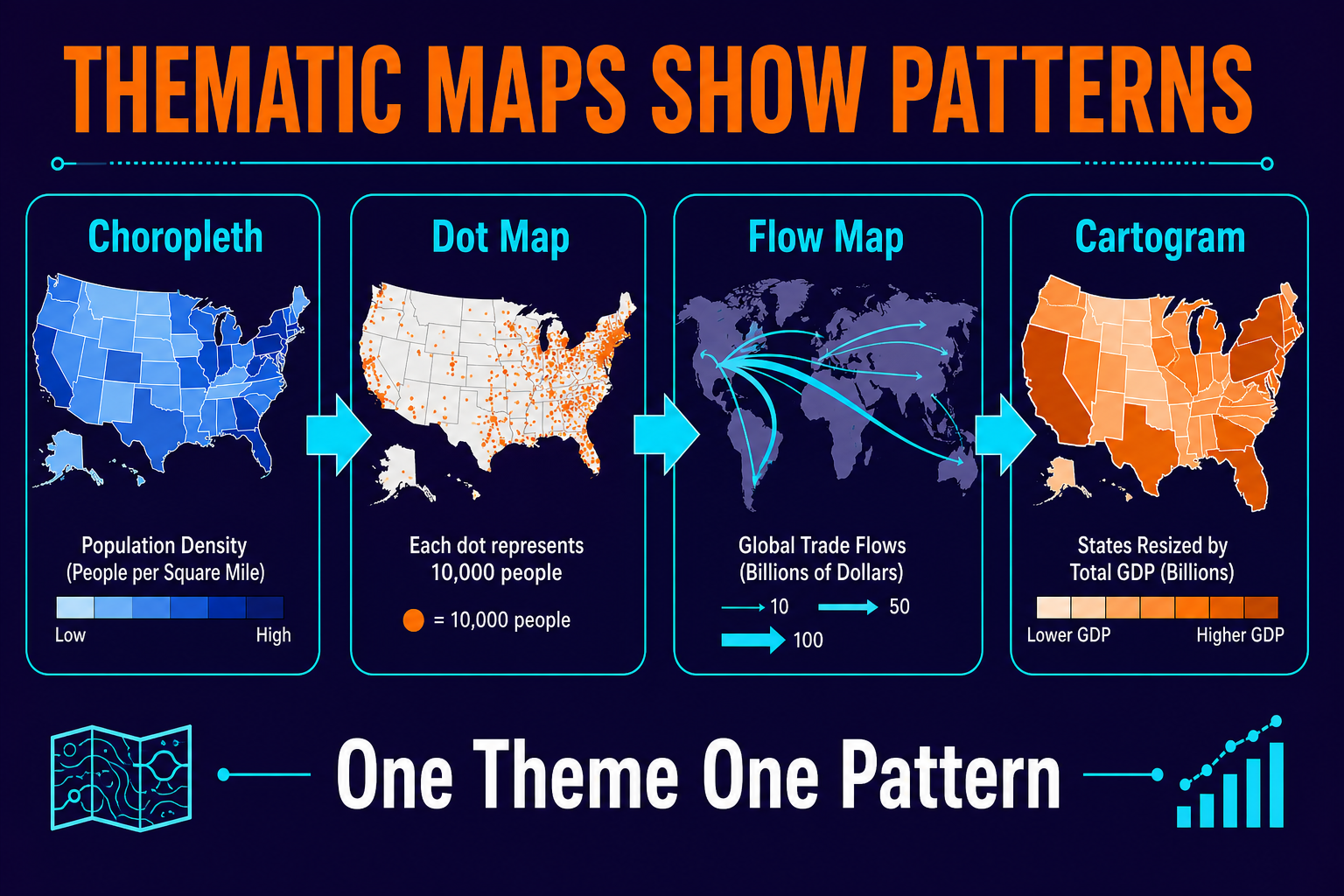
Thematic Show one variable pattern
Legend test Classes signal thematic design
22 + 16 Cards and MCQs with rationales
Side by side reference roads map and thematic choropleth map. Reference Thematic Roads + city = location Shaded rates by zone
Reference locates routes; thematic compares a variable across zones.
Direct answer

What is the difference between reference and thematic maps?

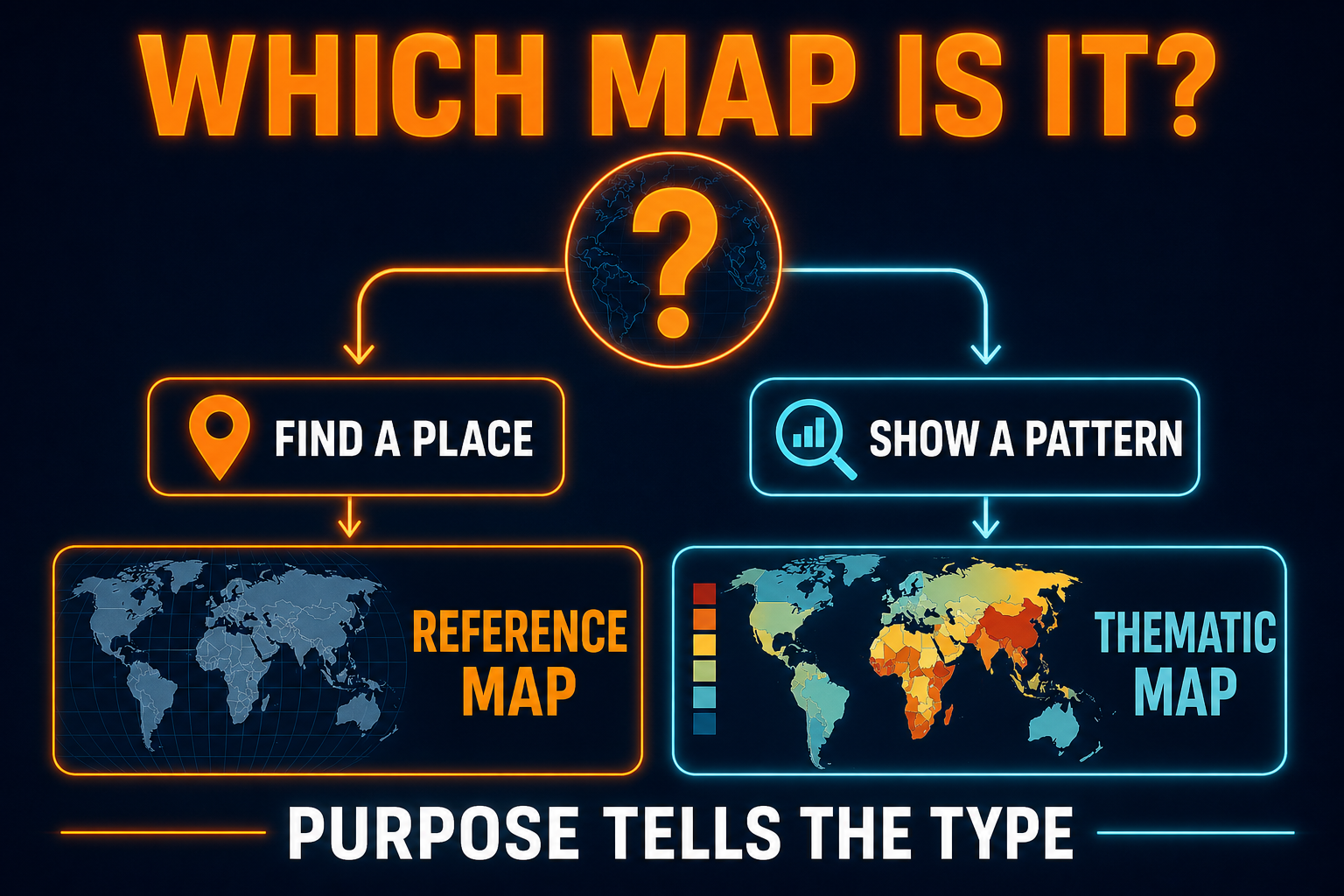
Reference maps foreground accurate locations of boundaries, roads, relief, and hydrography for navigation and orientation at faithful detail. Thematic maps foreground one topic—election margins, income, disease—using color classes or symbols, so AP credit starts with naming that intent before reading regional patterns.

Reference vs Thematic Maps in AP Human Geography (Unit 1)

Unit 1 is about 8–10% of the AP Human Geography exam, and map classification questions reward careful reading.

This guide trains you to decide map purpose using the title, legend, and caption before you commit to an answer choice.

Reference thematic difference
Figure - Reference thematic 1 difference study
Simple definition

Reference vs thematic — the simple version

In one sentence: Reference maps foreground locating borders, cities, roads, and terrain; thematic maps foreground one statistical story using symbols or color classes tied to a legend.

Reference vs thematic — quick contrast

Reference

Navigation, location accuracy, general-purpose legend.

Thematic

One variable or story; patterns over precision.

Direct answer

What is the difference between reference maps and thematic maps in AP Human Geography?

Reference maps emphasize locating roads, boundaries, cities, rivers, and landforms for orientation. Thematic maps emphasize one main variable across space using color classes, dots, isolines, flow widths, or resized geometry. The AP Human Geography Unit 1 exam tests whether you separate location-first design from data-first design, including basemap-plus-layer cases.

Many classroom examples stack a light reference basemap under a thematic layer so readers still recognize place names while comparing a statistic. The reference vs thematic section of our map types guide walks through that stack with examples. When you classify, name the map's primary purpose using the title and legend, not only whether borders or roads appear.

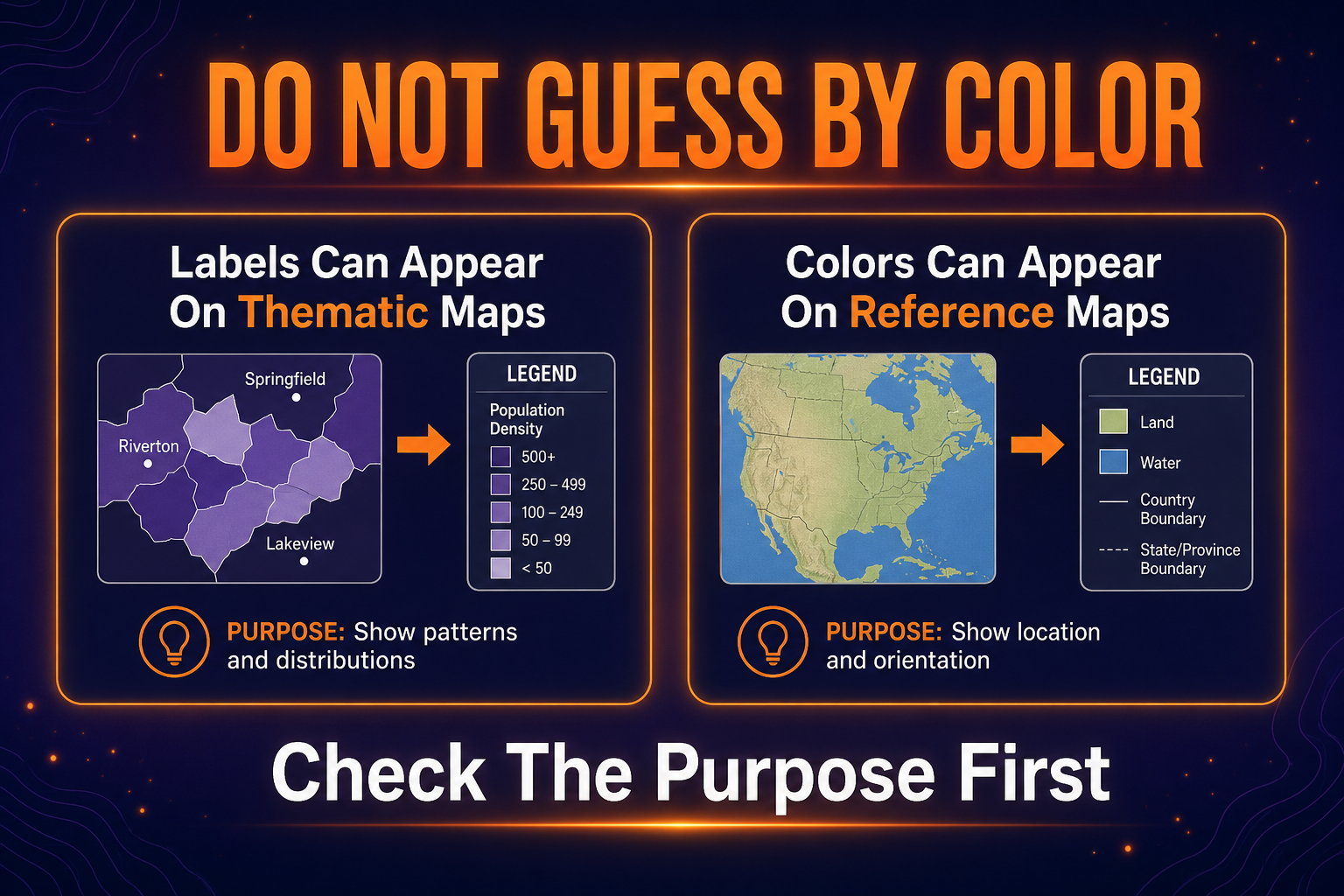
AP shortcut: If the legend explains classes for one mapped statistic, treat the map as thematic even when boundaries and roads appear.

Your study goal is speed with accuracy: name the map's primary purpose in one sentence, then add one piece of evidence from the map face, then add one limitation only if the prompt asks for critique. That sequence matches how many rubric-style responses are organized.

Visual compare

Reference versus thematic map comparison

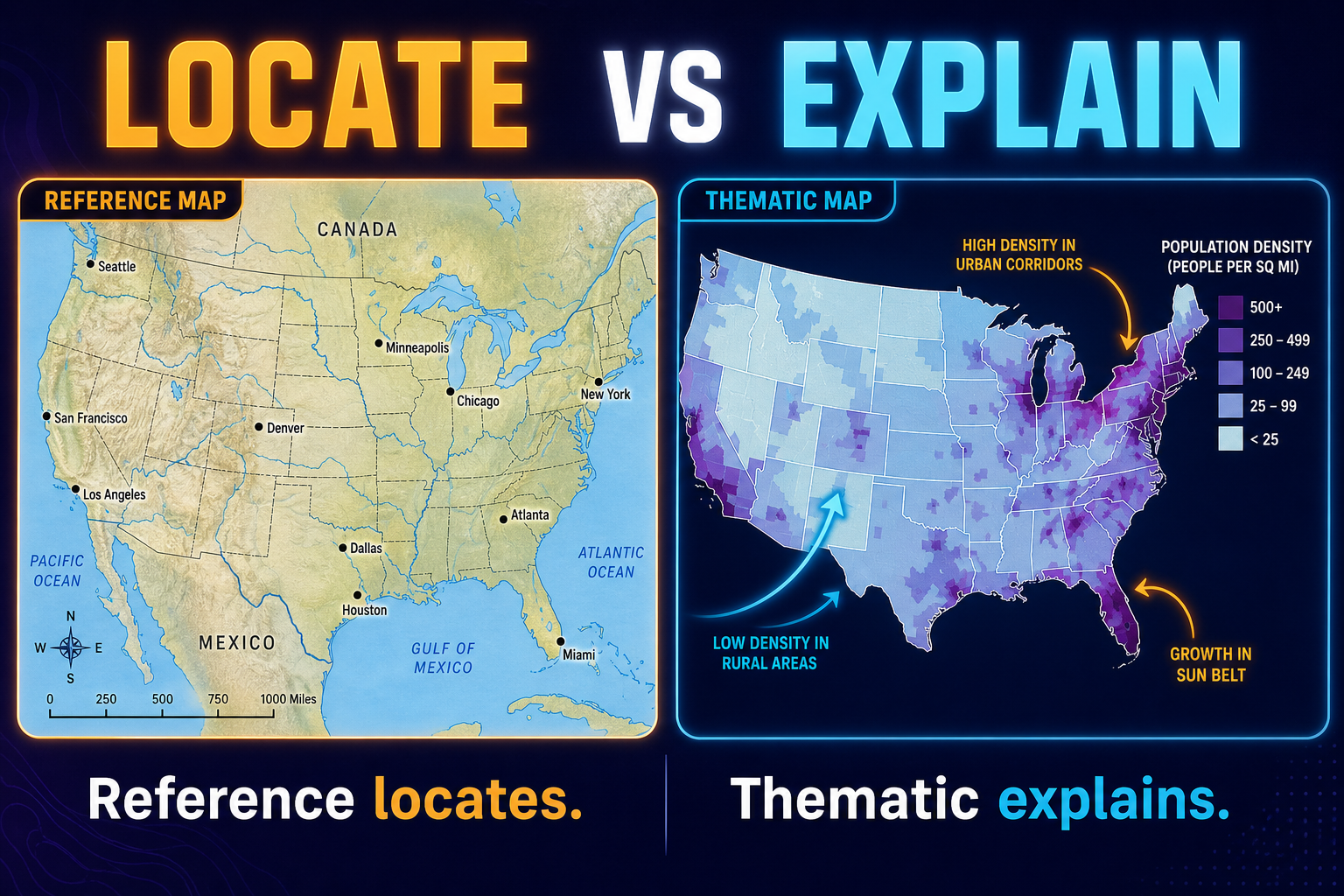
Reference side: the reader’s job is orientation—find borders, cities, roads, rivers, and terrain without decoding a numeric variable across units. Thematic side: the reader’s job is pattern—compare classes, dots, isolines, flow widths, or resized areas using the legend. Same boundaries, different purpose: country lines can appear on both; the title and legend tell you which purpose is primary.

Simplified side-by-side sketch

The SVG below is a teaching sketch, not real census data. It shows the design logic AP expects: the left panel highlights linear networks and a point symbol for a city, while the right panel encodes a rate using color classes inside the same kinds of boundaries you might see on many exam stimuli.

Reference roads compared to thematic shaded zones. Reference map panel Thematic map panel City Locate routes and places Compare a variable by zone
Same outline logic: reference for where, thematic for what varies.
Vocabulary

Definitions you can paste into an FRQ with confidence

Reference map (AP-ready): A map designed mainly to show the location of geographic information such as political boundaries, settlements, transportation networks, and physical features, without making one statistical comparison the central message.

Thematic map (AP-ready): A map designed mainly to show the spatial pattern of a phenomenon using a symbol system tied to categories or numeric ranges, usually explained in a legend.

Reference map example

Political maps, road atlases, many physical wall maps, topographic sheets for terrain reading, and locator insets are reference-first products.

Reference example
Figure - Definitions you can paste reference example

Concrete example: a state highway map that labels interchanges, county lines, and county seats so a driver can plan a route. The legend lists road classes and symbols for capitals—not income brackets, disease rates, or land-cover percentages. If the stem only asks where a city sits relative to a border, that stimulus is behaving like a reference map.

Thematic map example

Common thematic families include choropleth, dot density, isoline fields, flow maps, cartograms, and many GIS output layers.

Thematic example population
Figure - Definitions you can paste thematic example

Concrete example: a county-level map titled “Median rent as % of household income, 2023,” with five color classes in the legend. Boundaries are visible, but the map’s main claim is the rent-burden pattern, so you should classify and defend it as thematic.

Method

What is a reliable map-reading checklist for AP stimuli?

  1. Title: identify the claimed theme and geography level.
  2. Mapped variable: confirm units such as percent, total, dollars, or index values.
  3. Legend: translate classes into plain language.
  4. Year and source: note time mismatch risks if the question is causal.
  5. Projection note: flag distortion if the prompt asks about area or route comparisons.
  6. Primary purpose: decide reference versus thematic last, after evidence.

For choosing a display when the stem names a research question, use the map selection guide on our map types overview and the map purpose and geographic questions walkthrough.

Compare formats

How do common thematic map types differ in what they emphasize?

Map familyWhat the reader comparesTypical AP pitfall
ChoroplethValues across areal units using color classesMapping raw totals when rates are fairer
Dot densityClustering and dispersion of countsTreating each dot as one exact household
IsolineContinuous gradients across a fieldConfusing interval spacing with causation
FlowMovement magnitude and directionIgnoring what line width encodes
CartogramMagnitude differences via resized areasUsing it for precise distance measurement
Exam traps

Which distractors show up most often on reference vs thematic items?

  • Assuming borders imply reference maps even when shading encodes a rate.
  • Assuming color implies thematic maps even when color only shows relief.
  • Calling any world map reference without reading the title and legend.
  • Treating dot maps as raw GPS tracks without reading the dot value key.
  • Choosing a map type based on projection rather than map purpose.
Tools

How does GIS help students explain reference basemaps with thematic overlays?

GIS software stacks layers. A basemap provides reference context: coastlines, streets, labels. Analysts add thematic layers: heat risk, median income classes, land cover categories, or flood zones. When you write about GIS on an exam, describe the stack clearly and explain why separating orientation from statistical display reduces reader confusion.

Apply

How should you classify mixed-purpose classroom posters?

Some classroom posters show shaded terrain plus labeled countries. That poster is still reference-first if no single social statistic is mapped across units. Other posters show countries colored by a development indicator. That poster is thematic because the color scheme is the argument. If both appear, write two sentences: one sentence for the basemap role, one sentence for the thematic variable.

Scenario: emergency evacuation map

If the map highlights evacuation routes and shelters with minimal statistics, reference reading dominates. If the map adds color classes for hazard probability by block group, thematic reading dominates for the hazard layer.

Scenario: national park trail map

Trail maps are reference products for navigation. If a park map adds a heat safety index layer with a legend, you have a thematic add-on layered on reference geometry.

AP walkthrough

How do AP Human Geography stimuli mix reference cues with thematic claims?

How to use this section: learn the variable → level → classify move, then run the drills, then lock retrieval habits.

Many released-style items show a shaded map with a short caption. The quickest scoring move is to name the variable, name the geography level, and then classify the map. If the stem asks you to pick the best map for a research question, match the question to the map family before you worry about projection minutiae. If the stem asks you to critique a map, name one limitation tied to classification, normalization, scale, or legend design.

30-second scan under pressure
  1. Ten seconds: title + legend (classes = thematic signal).
  2. Ten seconds: geography level (country, region, city).
  3. Ten seconds: year or source line if present—then answer.
  4. Stuck between two choices? Return to legend classes; one-variable classes usually mean thematic design. No variable story? Pick the strongest location-first fit.

“This map shows…” drill

Rewrite each stimulus as one sentence beginning This map shows… End with the variable and unit. If you cannot finish without inventing data absent from the map, it is reference-first. If you finish cleanly with a measured attribute, it is thematic.

Pair-map comparison

Stack a political reference map beside a choropleth of literacy by province (see choropleth basics). Boundaries repeat; purposes diverge. Write one similarity and two differences—similarity: both locate provinces; difference one: choropleth encodes rate classes; difference two: political map needs no numeric legend for its main job.

Finally, connect this microtopic to Unit 2 and Unit 7 examples without drifting away from map skills. Population change maps are thematic. Development indicator maps are thematic. Political boundary disputes may be illustrated with reference maps that show claimed lines. The vocabulary travels. What stays constant is the hinge: what is the map trying to prove or show at a glance?

Writing quality & self-checks

  • Verbs beat vague nouns: the map highlights, masks, exaggerates, normalizes, compares—pair each verb with one concrete map feature.
  • Cover the title: infer the theme from the legend alone, then uncover and confirm—legend literacy sticks.
  • Ninth-grade legend sentence: if your translation names a statistic, you are thematic; if only roads, rivers, capitals, you are reference.

Missed MCQs, units, and retrieval

  • After a miss, redraw the decision tree: legend classes, variable presence, primary purpose—three process notes minimum.
  • Rates, z-scores, and indices appear in legends; dollars per acre ≠ total dollars; share of workers ≠ total workers.
  • Test-day cadence: five minutes of flashcards daily; MCQs twice weekly timed; one paragraph drill weekly.
  • Homework maps still train variable, geography level, primary purpose—even when styling differs.
  • Tie-breaker: which answer matches what a reader learns in ten seconds? Strongest overall fit wins.
  • Keep a ten-line glossary notecard (choropleth compares classes; dot density clusters; flow width = volume; cartogram resizes by magnitude; political reference shows borders).

Remember that classification skill is not vanity vocabulary. It is a tool for interpreting evidence. The exam will keep showing you evidence-heavy stimuli across units. The sooner map reading becomes automatic, the more mental energy you keep for harder reasoning later in the section.

Study notes

How should you study reference versus thematic maps in longer sessions?

Skim the H4 headings first—each block is one idea—then dive into the scenarios at the end.

Why map type vocabulary matters on test day

AP Human Geography rewards precise language. When a stimulus shows shaded counties, your first job is not to admire the colors. Your first job is to name what the map is doing for the reader. A thematic map is built to communicate a variable across space. A reference map is built to communicate location and context. That distinction sounds small, but it changes which answer choice is defensible in multiple choice and which justification earns credit in a free response. Practice reading the title, the legend, and the caption as a single argument. If the legend lists classes for one measured attribute, you are usually looking at thematic design even when roads and rivers appear faintly underneath.

Reference maps as general-purpose location tools

Think of reference maps as the maps you would use before you have a hypothesis about society. A political wall map helps you find France. A road map helps you find the exit. A topographic sheet helps you read ridges and valleys. A locator inset helps you understand where a larger map sits on the planet. These products can include color, but color is serving readability of physical or political features, not mapping unemployment rates. When you write for AP, keep the definition anchored in purpose: reference maps answer where is it and what is around it for basic geographic orientation.

Thematic maps as argument tools for patterns

Thematic maps answer how much, how common, how connected, or how clustered. A choropleth map compares a rate across states. A dot density map shows where many cases appear relative to few cases. A flow map highlights movement volume. A cartogram exaggerates size to show magnitude. An isoline map connects equal values across a continuous field. Each design sacrifices something, and each design requires a reader to use the legend carefully. When you revise, practice saying one sentence: this map is thematic because it maps one variable across places and uses symbols that require a legend to interpret.

Political and physical maps: classic reference examples

Political maps emphasize boundaries and capitals. Physical maps emphasize mountains, plains, deserts, and water bodies. Both are reference-heavy because the reader's task is locating geographic facts on the ground. AP questions sometimes add a small thematic overlay, but the exam usually signals the primary purpose through the title. If the title reads world political, you should treat the map as reference-first. If the title reads carbon emissions by country, you should treat the map as thematic even if country lines are visible.

Choropleth logic: why boundaries do not decide type

Choropleth maps need areal units, and areal units need boundaries. That does not convert the map into a reference map. The choropleth's intellectual work is classification: grouping values into ranges and assigning colors. That means the map is arguing a social or environmental pattern. When you critique a choropleth, you can mention scale effects and the modifiable areal unit problem, but classification remains thematic cartography. In MCQs, if you see a rate mapped by county, choose thematic language, not reference language, unless the stem explicitly asks only for a capital location.

Dot density: thematic even when it looks like a star field

Dot density maps represent counts or presence using many point symbols. Each dot might stand for one farm, ten people, or fifty cases depending on the key. The pattern communicates distribution and clustering. Students sometimes confuse dots with raw GPS points. On AP-style items, treat dot fields as thematic summaries rather than literal pinpoints of every individual address. Mention clustering where relevant, and connect the map type to questions about dispersion versus concentration.

Isolines: continuous fields and contour literacy

Isolines connect equal values. Elevation contours are the classic teaching example, but temperature, pressure, and precipitation fields also appear. When isolines map a physical field for location and terrain reading, many classrooms still call the product a reference-style terrain tool. When isolines map a social or environmental variable across regions for comparison, treat the map as thematic in AP framing. If the exam shows tightly packed lines, mention steep gradients; if lines are wide apart, mention gentle change across distance.

Flow maps: movement as a thematic story

Flow maps show movement between nodes: trade, migration, flights, internet traffic, or commodity shipments. Width often communicates magnitude. Direction communicates orientation of the flow. These maps are thematic because they map a phenomenon across a network, not because they label every city. When you explain a flow map in an FRQ, name what moves, name what the line width means, and name one spatial pattern such as a dominant corridor or a surprising weak link between two large places.

Cartograms: deliberate distortion for emphasis

Cartograms resize places to reflect a statistic. That distortion makes magnitude differences obvious, but it also makes distance and shape harder to read literally. The AP reward is recognizing tradeoffs: stronger comparison of totals, weaker geographic fidelity. If a prompt asks whether a cartogram is appropriate, discuss the audience goal. If the goal is comparing population totals across countries, a population cartogram can be strong. If the goal is precise navigation, a cartogram is the wrong tool.

Legends, captions, and source lines: read like a geographer

High-scoring students treat the legend as part of the argument. The legend tells you the measurement unit, the class breaks, and sometimes the year of the data. The caption may warn about uncertainty or normalization. Reference maps can have legends too, but they often label feature types rather than numeric classes. When you practice, rewrite the legend in your own words in one line. That habit prevents you from picking answers based on a quick glance at color rather than on the actual variable being mapped.

Scale, generalization, and what disappears when you zoom out

Reference maps simplify curves and omit small streets when scale changes. Thematic maps also generalize: dot totals are aggregated, choropleth classes collapse detail, and flow maps may bundle many small routes into one arrow. AP questions sometimes test whether you understand that all maps edit reality. Your job is to choose the least misleading map for the question. If the question needs neighborhood-level detail, a national choropleth may be too coarse. If the question needs a national comparison, a huge-scale street map may hide the pattern.

GIS thinking: basemap plus thematic layers

GIS workflows often combine a reference basemap with thematic layers. Analysts need readers to recognize place names while still seeing the statistical overlay. In writing, you can describe that stack explicitly: a reference basemap supports orientation while the thematic layer communicates the pattern under study. That sentence pattern is useful in FRQs that ask about data display decisions. It also helps you avoid a common trap: claiming that roads on a map automatically make the map reference-only.

Stimulus drills: five clues in sixty seconds

Train yourself to scan for title theme, legend classes, mapped variable units, year, and mapped geography level such as county versus country. If three of five point to a single variable story, you are dealing with thematic cartography. If the stem asks where a river meets a city and no variable is encoded, you are dealing with reference cartography. Speed matters because Unit 1 questions often come in clusters and you do not want to burn time debating labels you could resolve with a disciplined checklist.

Common distractors and how to beat them

Distractors often say reference map because boundaries exist, or say thematic map because color exists. Beat them by returning to purpose. Another distractor claims that physical maps are not reference maps because they use rich color. Beat it by defining reference by location emphasis. Another distractor confuses dot density with raw point data. Beat it by citing the dot value from the legend. Another distractor suggests that Mercator projection choice decides thematic versus reference. Projection affects distortion; it does not replace map purpose classification.

FRQ-ready sentences you can reuse with light editing

Here are three reusable frames. First: this map is thematic because it displays one variable across areal units and uses a color scheme tied to data classes in the legend. Second: this map is reference because it emphasizes locating political boundaries and capitals without mapping a single social rate across units. Third: the map combines a reference basemap for orientation with a thematic layer that highlights spatial inequality in the mapped variable. Each frame names purpose, evidence on the map, and a mechanism or limitation when needed.

Practice scenario: median rent in neighborhoods

Imagine a city map where each neighborhood polygon is shaded by median rent quintiles. The correct classification is thematic because rent is the story. The boundaries exist because rent is aggregated to neighborhood polygons. A strong explanation mentions classification breaks and warns that large neighborhoods can hide internal variation. If the prompt asks how to improve the analysis, you might suggest finer-scale data or a companion dot density map for housing units, depending on the question constraints.

Practice scenario: hurricane track and wind swath

A map that shows a storm track with a widening cone is communicating hazard location and forecast uncertainty. Many items still read as thematic hazard communication because color or bands encode wind thresholds or probability classes. Your answer should track the stem language. If the question is purely locate the coastline and the eye, reference skills dominate. If the question encodes intensity classes along the path, thematic reading dominates.

Practice scenario: election cartogram versus election choropleth

A choropleth of vote share by county can mislead when counties differ greatly in land area. A cartogram can emphasize population-weighted outcomes. A strong student compares what each map highlights and what each map hides. This is not about politics; it is about cartographic literacy. Use neutral language about mapped totals and geographic distortion, and tie your reasoning to the question being asked rather than to personal opinions about outcomes.

Connecting map choice to geographic questions

Unit 1 also asks which geographic question you are answering. Location questions often pair with reference products. Pattern questions often pair with thematic products. Relationship questions may require layered thematic reading or comparing two maps at the same scale. When you study, write a two-column chart in your notes: question type on the left, best map family on the right. Revisit the chart weekly so classification becomes automatic rather than improvised under time pressure.

Misleading maps: ethical reading without drama

Thematic maps can mislead when class breaks exaggerate small differences or when raw totals are mapped on unequal areas. Reference maps can mislead when labels are outdated or when projection distortion changes apparent size. AP-style questions sometimes ask you to name a limitation. Do it calmly: name the mapping choice, name what it obscures, and suggest one improvement such as normalization, rate calculation, a different scale, or an added uncertainty note.

Time management: answer the question that was asked

If an MCQ asks for the best map type, do not write a paragraph about projections unless the choices force it. If an FRQ asks for one justification, give one sharp justification with map evidence. If a stimulus includes two maps, spend one sentence on each map's purpose before synthesizing. Examiners reward clarity. The reference versus thematic distinction is often the first hinge that unlocks the rest of a response, so decide it early and move on to mechanism and evidence.

Study plan: three short sessions that stick

Session one: classify ten stimuli without timing yourself, using the legend-first rule. Session two: redo the same ten under a short timer and mark misses. Session three: write five FRQ mini-justifications, each three sentences, each naming map type and one limitation. Rotate in choropleth, dot density, flow, cartogram, and isoline examples so your vocabulary stays broad. Finish each session with five flashcards from this page to keep retrieval active.

Classroom to exam transfer: what changes

In a classroom wall map, colors are friendly and familiar. On an exam, colors are evidence. Treat every map as a document with an author, a date, a mapped variable, and a mapped geography level. That mindset helps you avoid casual guesses. It also helps you connect Unit 1 skills to later units where maps show migration, development indicators, urban structure, and agricultural patterns. The labels change, but the thematic versus reference hinge repeats.

Final precision check before you close the tab

Before you leave this guide, say four definitions out loud: reference map, thematic map, choropleth map, and dot density map. Then explain one way a map can combine reference and thematic elements without contradicting itself. If you can do that in under ninety seconds, you are ready to move into practice questions. Use the quiz below to catch any remaining confusion, then revisit misses with the flashcard deck.

Exam playbook

How reference and thematic maps appears on the AP exam

In multiple-choice questions

Classify a map’s purpose, identify symbols, or choose which map answers a geographic question.

In free-response questions

Explain why a choropleth or dot map fits a research question while a political reference map does not.

Common stimulus types

Side-by-side political vs shaded thematic stimuli; short prompts about map purpose.

AP writing formula

Strong AP answer structure: Map purposeSymbol / variablePatternSignificance for people or policy.

Quick Check

Test yourself in 5 seconds

A choropleth map is a:

Flashcards

Twenty-two flip cards — reference vs thematic essentials

Every fifth card advance triggers an ad placeholder with a three-second countdown before the next card appears.

Practice

Reference vs thematic maps practice questions (16 AP-style MCQs)

FRQ skill

Practice FRQ — justify map choice for a research question

Prompt: A student group studies rent burden across neighborhoods in one city.

  • Part A: Define reference map and thematic map.
  • Part B: Choose which map type the group should publish for comparing rent burden patterns and explain one reason.
  • Part C: Explain one limitation readers should notice when interpreting the shaded map.

Sample 3-point response

A. A reference map emphasizes locating features such as streets and boundaries, while a thematic map emphasizes a variable across space using a symbol scheme explained by a legend.

B. The group should publish a thematic choropleth or similar classified map because rent burden is one variable that must be compared across neighborhood units.

C. A limitation is internal variation: large neighborhoods can contain both high and low rent blocks, so neighborhood-level shading can hide sub-neighborhood inequality.

One-minute recap

Reference vs thematic maps recap

AP shortcut: Legend classes for one variable mean thematic design; location-first labels mean reference design.
  • Reference maps prioritize where features are.
  • Thematic maps prioritize how a variable varies across space.
  • Boundaries appear in both; they do not decide type alone.
  • Color can appear in both; purpose decides meaning.
  • GIS stacks basemap reference context under thematic layers.
FAQ

Frequently asked questions

What is a reference map in AP Human Geography?

A reference map emphasizes where geographic features are located, including roads, political boundaries, cities, coastlines, rivers, and landforms. Its primary purpose is general navigation and context, not comparing one numerical statistic across mapped units.

What is a thematic map in AP Human Geography?

A thematic map communicates one main theme or a closely related set of themes across space, such as rates, totals, categories, densities, or flows. Symbols and colors encode the data story, and a legend usually explains how to read those encodings.

What is the fastest way to tell reference and thematic maps apart on the AP exam?

Read the title and legend first. If the map is built to compare a variable across places using classes, dots, isolines, or flow widths, treat it as thematic. If the map is built mainly to locate boundaries, routes, and terrain, treat it as reference.

Is a political map a reference map or a thematic map?

A standard political map that highlights countries, capitals, and borders is treated as a reference map because its main job is locating political geography. If the same boundaries are used only as containers for shading a rate, the product is usually thematic.

Is a choropleth map reference or thematic?

A choropleth map is thematic because it maps a variable across areal units using a color scheme tied to data classes. Boundaries are supporting context, not the main message.

Can a map look like both reference and thematic at the same time?

Yes. Many published maps stack a light reference basemap under a thematic layer. On the exam, classify by the map's primary purpose and what the legend emphasizes rather than by whether any roads appear.

Do thematic maps always need a legend?

Most exam-style thematic maps include a legend because readers need a key to translate colors or symbols into values or categories. If a legend is missing, the prompt may still give the scheme in the caption, but you should still read it as thematic when a variable is encoded.

Why would a researcher choose a thematic map instead of a reference map?

A thematic map makes a pattern visible, such as hotspots, corridors, clusters, or contrasts between regions. A reference map alone would show where places are, but it would not systematically display the statistic the researcher wants to compare.

What is a common AP Human Geography mistake when classifying map types?

Students sometimes decide map type based only on color or the presence of boundaries. Color can appear on physical reference maps, and boundaries appear on choropleth maps. The fix is to ask what variable the map is arguing about, then match that to thematic design.

Are physical maps reference maps?

Most classroom physical maps are reference maps because they emphasize locating mountains, plains, deserts, and water bodies. They are not usually built to compare one social rate across every labeled place on the sheet.

Where do reference versus thematic map questions appear on the AP Human Geography exam?

They appear most directly in Unit 1 map skills, but the same classification logic returns whenever stimuli include shaded data, dot fields, isolines, flow lines, or cartograms in population, economic, political, and urban units.

Synthesis

Keep Unit 1 skills working across every unit

Treat this microtopic as living vocabulary—reuse these habits whenever stimuli combine maps, tables, interviews, or timelines.

Exam stimuli

Pair sources before you lock an answer

Read legends, scales, units, and captions together—decide whether evidence supports a regional trend or a misleading aggregation inside one polygon.

Units 2–7 bridge

Population through development

Population change, cultural diffusion, borders, rural systems, urban service gaps, and economic indicators all reward the spatial precision you practice in Unit 1.

FRQ craft

Claim → evidence → significance

Name the place, pull a detail from the stimulus, connect to a course concept, and end with a consequences sentence—skip definition dumps.

Evidence hygiene

Scale, time, and bias

Call out who collected the data, at what geography, and when. Note missing groups when quantitative and qualitative pieces disagree.

Continue learning

Related Unit 1 guides

Start Free Practice & Track Progress →