📝 AP Exam Registration
Deadlines, late windows, and signup steps.
Read more →AP Exam Resources
AP exam costs are manageable when you pair official fee facts with a realistic prep plan. Below: typical U.S. dollar amounts for budgeting, prompts coordinators wish families asked earlier, a fee planner you can copy into your notes, and links into APScore5 practice so each exam fee maps to an actual study path.
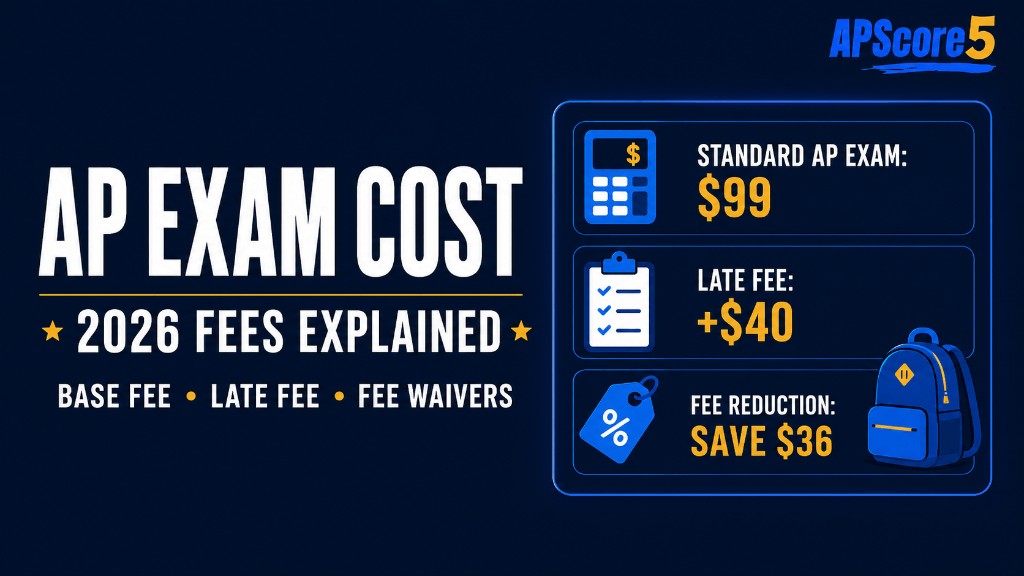
Illustrative graphic—confirm every fee and subsidy line item with your AP coordinator.
College Board publishes authoritative fees; your receipt still depends on district subsidies, late-order windows, and how many exams you can prepare for without burning out. Use this section as a planning lens—then confirm dollars and deadlines with your AP coordinator.
Drop these lines into your notes app and fill in with coordinator-specific numbers.
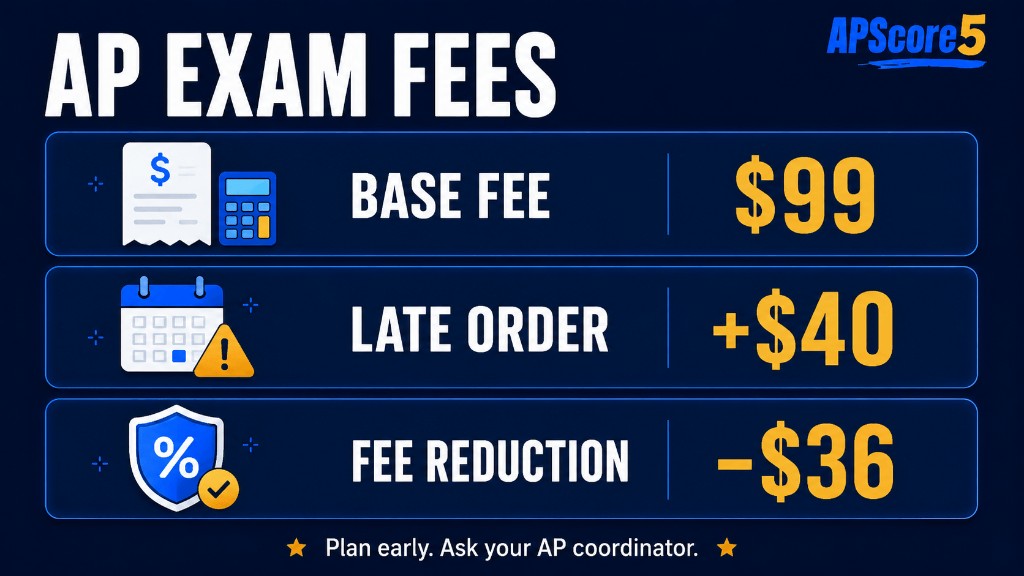
For most U.S. students, the standard AP exam fee is $99 per test, and international testing is often around $129. AP Seminar and AP Research appear on the same published College Board U.S. and international fee tables as other exams for 2026—your coordinator still confirms billing if your district handles Capstone courses differently.
| Exam Type | U.S. Fee | International Fee |
|---|---|---|
| Most AP Exams (incl. AP Seminar / AP Research) | $99 | About $129 |
College Board publishes exceptions or supplements on its fee pages; always match your invoice and coordinator letter to the current AP Students fee table.
Late AP registration generally adds $40 per exam. If a student cancels or does not take an ordered exam, a $40 unused exam fee often applies. These fees are designed to account for late schedule adjustments after schools submit final orders.
Families can avoid this by treating early November as a hard planning target, even when schools offer late windows. The safest approach is to register before the deadline and keep your AP exam dates in one calendar.
College Board runs a fee reduction program for students who meet eligibility criteria; schools typically align initial screening with programs such as free or reduced-price lunch or comparable documentation your district already collects. For 2026, College Board lists a $37 College Board fee reduction per eligible exam for students in the United States—your coordinator applies that subsidy (plus any local aid) and tells you the final amount owed. Amounts can change when national pricing changes, so treat informal “student pays $X” rumors as unreliable unless they appear on your school’s current fee sheet.
Many families qualify and never ask; a five-minute conversation in fall can prevent a spring surprise.
For official program rules, refer to AP Students and your school’s posted AP exam fee letter.
Many states and districts add local funding that can reduce AP exam costs further. Some schools cover part of the exam fee through grants or school-level programs. These supports vary widely, so students should ask directly what programs apply on their campus.
Schools usually collect AP payments through an online portal, check, or in-person payment process. The method and deadline are local, not universal. Always save a receipt or screenshot after payment so you can verify status if records mismatch later.
If a student cancels before the school deadline, a partial refund may be possible. If a student no-shows, schools usually charge the unused exam fee. Emergency situations can be reviewed case by case. Contact your AP coordinator quickly if a health or family event affects attendance.
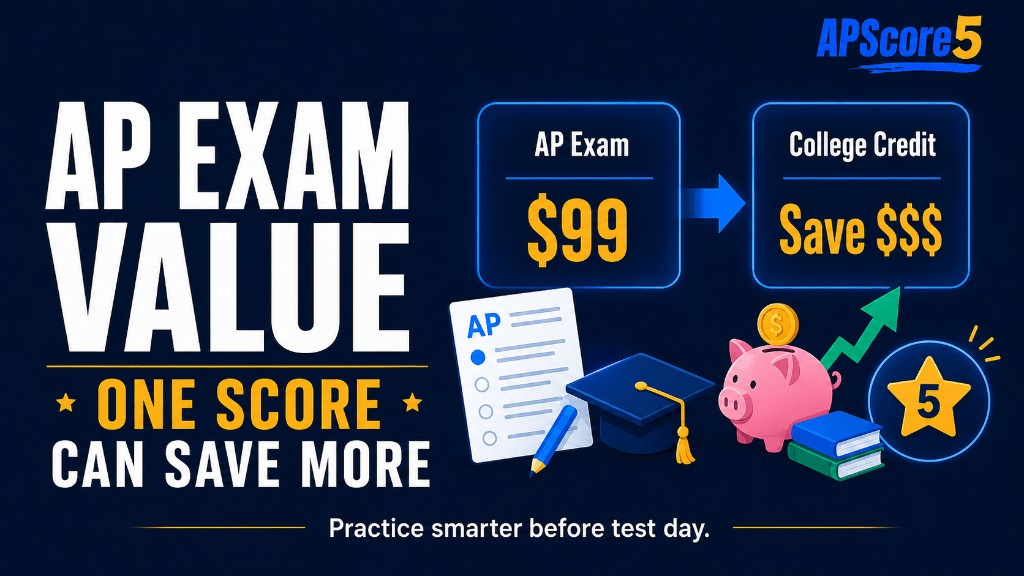
For many students, AP exams can save money later by earning college credit or allowing placement into higher courses. You can use your AP score for college credit and protect that outcome by checking what to bring on test day. One qualifying AP score may replace one college class, and that class can represent far more value than the exam fee itself. AP scores can also strengthen admissions and placement outcomes. For course prep, try AP Biology exam practice, AP Human Geography exam practice, or AP Computer Science Principles practice, then build consistency with daily practice questions and a free account.
Most U.S. AP exams cost $99 in 2026, with higher pricing in many international testing locations.
International administration and testing logistics can raise costs compared with U.S. pricing.
Refund policies vary by school, and unused or cancellation fees can still apply.
Eligible low-income students, often screened through free or reduced-price lunch or similar criteria, may qualify for fee support. For 2026, College Board publishes a $37-per-exam reduction for qualifying students in the U.S.; your coordinator confirms eligibility and the balance on your invoice.
No. National amounts reset when College Board updates exam pricing and subsidy rules. For 2026 the published College Board fee reduction for eligible U.S. students is $37 per exam on AP Students, but your school still applies the credit and tells you what you owe.
AP fees are usually handled through school systems and local subsidies, not health insurance.
In many cases, yes. One AP exam fee is often lower than the tuition for a full college dual-enrollment course.
Use AP Students for authoritative dollar amounts, eligibility, and updates. APScore5 summarizes for planning only.
Last verified: May 10, 2026 against AP Students exam-fees content (including published $37 fee reduction for 2026).
Daily practice beats last-minute cramming. Try APScore5 free.
Start Free Practice →