AP Courses AP Biology AP Biology Units AP Human Geography AP HUG Units AP Computer Science Principles AP CSP Units
Practice Daily Practice Practice by Course Practice by Topic Practice Tests
AP Exam Resources AP Exam Dates Registration Fees Scores & Credit What to Bring
Start Practicing → Login
AP Human Geography · Unit 1.3 · Microtopic

Spatial Analysis in AP Human Geography

Spatial Analysis in AP Human Geography explains how this topic appears across places and scales. Use it to interpret map evidence, compare spatial patterns, and write precise AP-style geographic explanations.

Practice with real AP Human Geography examples, compare spatial evidence across maps, and review with 22 flashcards plus 16 AP-style questions with explanations.

Updated May 4, 2026 Reviewed by APScore5 Editorial Team

Learn in 7 mins · Practice in 10 mins

Unit 1.3 · Geographic Technologies The heart of geography 22 flashcards 16 AP-style questions
Where, why, how Core geographic questions
Patterns across space Cluster, line, network
22 flashcards Spatial analysis deck
3 → 4+ score path Pattern → meaning
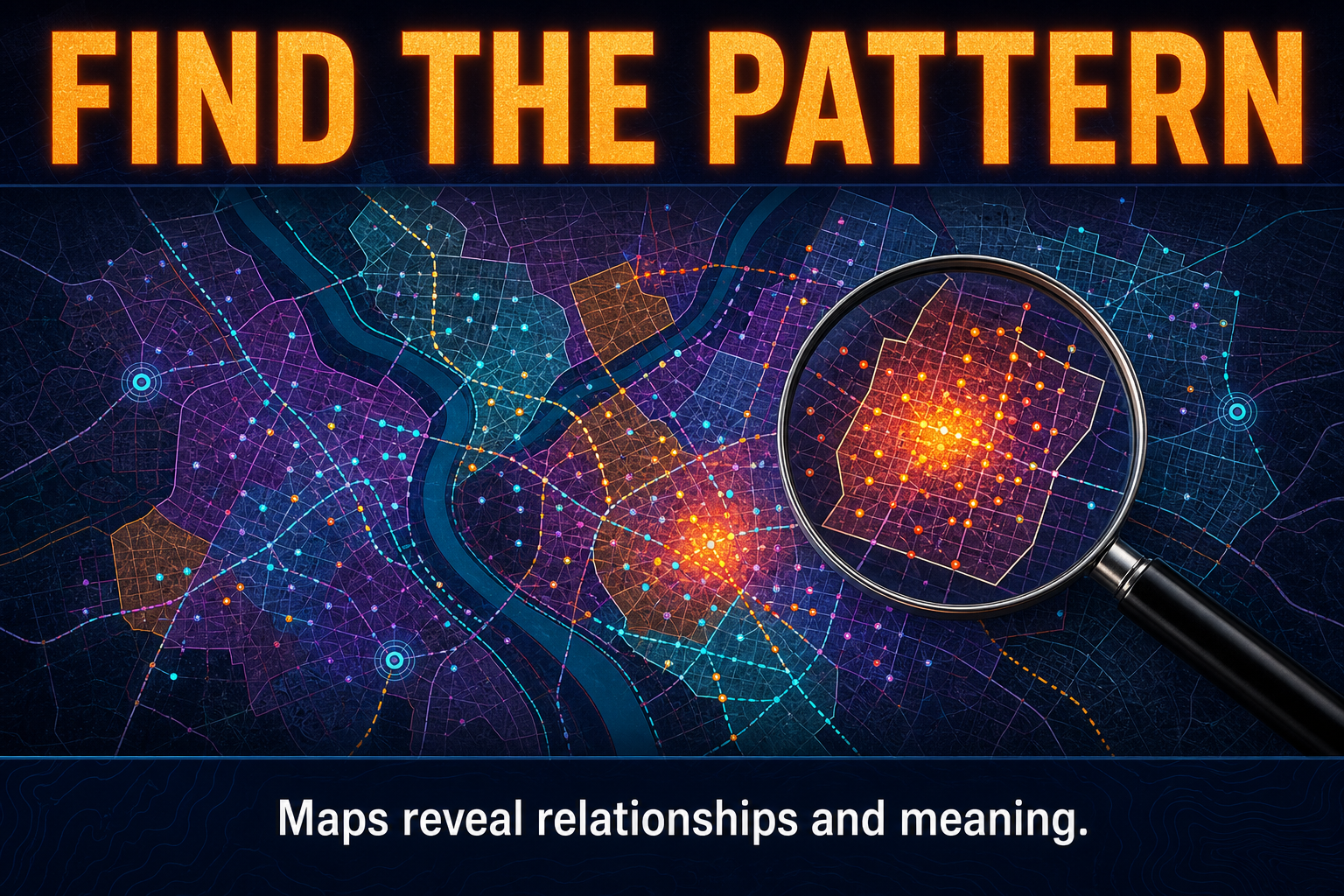
Network dots with connecting lines. Spatial analysis links places & patterns
Name the pattern, then explain why it matters socially.
Direct answer

What is spatial analysis in AP Human Geography?

Spatial analysis studies where events occur, how features cluster or disperse, and which relationships explain the layout you see. Overlaying layers, measuring proximity, and summarizing density turn raw coordinates into arguments graders expect when FRQs demand “explain the spatial pattern.”

Simple definition

Spatial analysis — plain language

In one sentence: Spatial analysis turns coordinates and map layers into explanations about where things cluster, how they relate, and why patterns matter.

Plain language: Instead of listing places, you measure proximity, density, overlay, and association—exactly what FRQs mean by “explain the spatial pattern.”

Spatial patterns and spatial analysis in AP Human Geography

Spatial analysis asks where features sit, how they distribute, and why those arrangements matter for people and environments. It combines maps, GIS, GPS, remote sensing, census polygons, surveys, and field observation into explanations graders can follow—never random decoration.

Unlike disciplines that treat place as background, human geography makes space the argument: sprawl is not only “more houses,” it is a pattern of land conversion at the urban fringe; food access is not only “few stores,” it is the spatial mismatch between low-income clusters and fresh-food networks when car ownership is scarce.

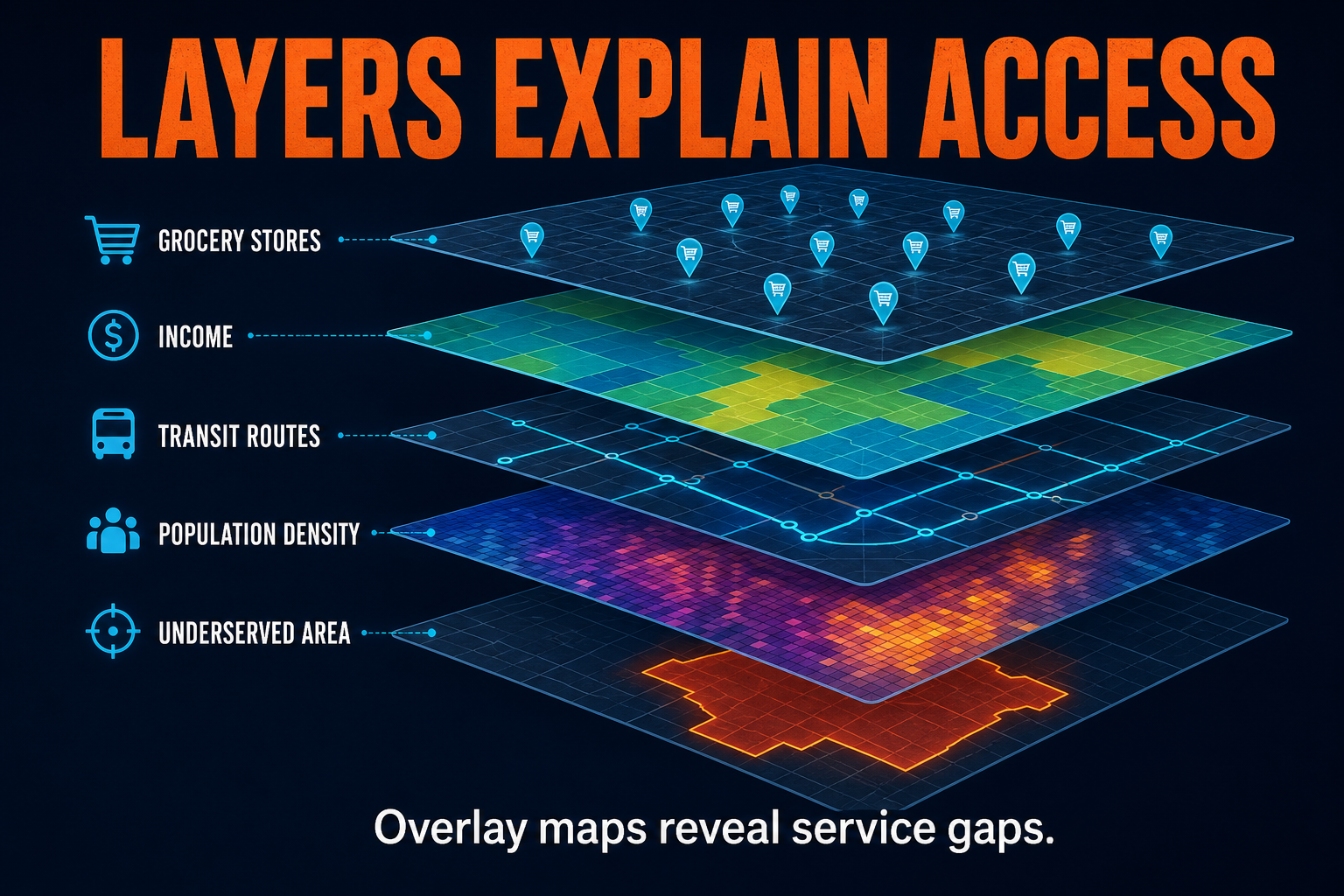
When AP mentions food access, outline overlays you would compare—population pyramids, median income, transit headways, distances to supermarkets versus convenience stores, historical redlining layers—and explain how each sheet changes your verdict about food deserts at different scales of analysis. Strong writers narrate moves from county averages down to walkable blocks because misleading conclusions hide inside overly broad buckets.

Electoral geography prompts reward the same habit: align precinct returns with district geometry, demographic composition, and suburban versus urban density before claiming gerrymandering; spatial analysis distinguishes skewed shapes from authentic cultural divides.

Migration stimuli invite corridor mapping—plot flows against terrain friction, intervening opportunities, and policy walls—so your explanation references distance decay and stepping-stone cities rather than isolated arrows.

Agriculture scenarios pair soil moisture surfaces from remote sensing with commodity prices and property regimes; spatial analysis shows why identical rainfall produces unlike outcomes across tenure systems.

Hazard prompts fuse flood polygons with building ages and income; environmental justice arguments crystallize when vulnerable housing concentrates in low-lying parcels excluded from investment cycles.

Public-health items often hospitalize geography: drive-time buffers around stroke centers intersect elderly density maps to expose dead zones; naming those gaps is spatial analysis in service of equity.

Transit equity blends GTFS route shapes with census car-ownership rates so planners see where riders depend on evening service most.

Cultural diffusion exercises trace hierarchical versus contagious movement along transport skins; map scale determines whether you emphasize global fashion hubs or neighborhood murals.

Borderlands juxtapose wait-time isochrones at checkpoints with kinship clusters on either side; spatial analysis prevents flattening border life into a single line on a reference map.

Tourism pressures appear when hotel counts surge near fragile ecologies while wage housing disperses inland—pattern plus explanation beats repeating “tourism grows.”

Water conflict passages gain depth when headwater dams, irrigation districts, and indigenous treaty polygons appear on shared basemaps; spatial analysis turns competing narratives into testable overlap questions.

Gentrification arguments hinge on block-scale rent tempo compared with historic tenure patterns; choropleth counties alone miss block-by-block displacement.

Segregation metrics such as dissimilarity indices stay grounded when paired with cartographic reality—two cities can share a score yet display wildly different patchworks.

Informal settlement studies combine rooftop signatures from aerial imagery with tenure ambiguity so upgrading plans respect lived parcels rather than cadastral fictions.

Energy-transition homework stacks solar potential rasters with legacy coal employment islands to reveal justice tensions between mitigation speed and labor geography.

Coastal squeeze narratives weave shoreline vectors with protected wetland polygons so students see where retreat versus armor remains feasible.

Refugee logistics stress distance from camps to firewood, water, and labor markets; spatial analysis guards against treating camps as mere points.

Conservation biology crosses highway mortality layers with corridor designs—spatial reasoning ensures bridges land where genetic isolation actually threatens populations.

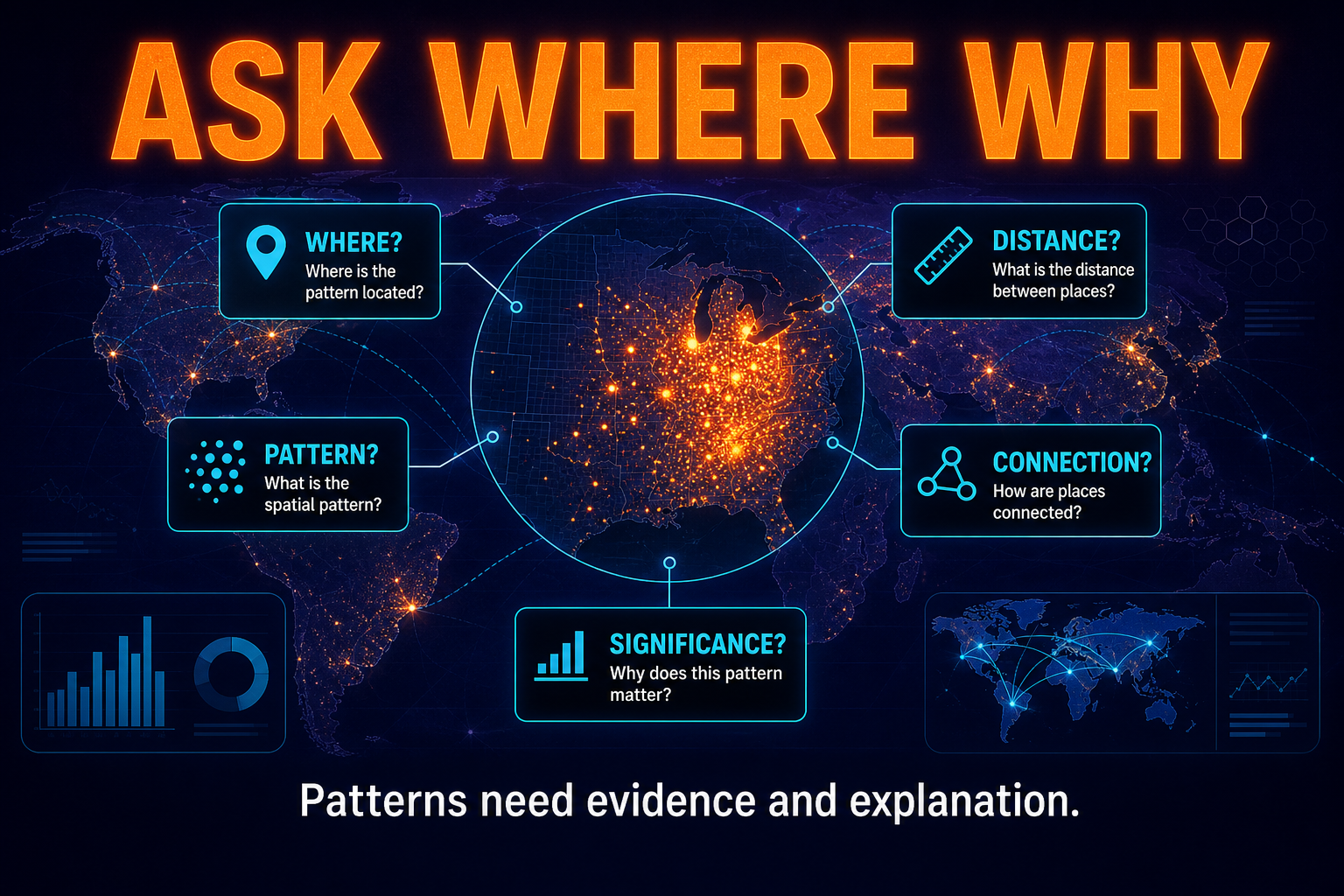
Seven spatial questions

QuestionExample lens
Where?Distribution
Why there?Process / theory
Pattern?Cluster vs disperse
Relationship?Overlay / correlation
Direct answer

What is spatial analysis in AP Human Geography?

Spatial analysis is the study of locations, distances, associations, and change across geographic space. It pairs quantitative layers with qualitative interpretation so maps become arguments rather than decorations.

AP shortcut: Ask where, why there, and so what for every stimulus.

Course-wide review: Unit 2 asks where populations concentrate; Unit 3 asks where cultural traits diffuse; Unit 4 asks how boundaries slice communities; Unit 5 asks how farms occupy land; Unit 6 asks how cities organize nodes and corridors; Unit 7 asks how income maps globally. Spatial analysis is the shared grammar binding those units.

Graders reward verbs—cluster, peripheral, networked—when they match the map legend. Adjectives without geographic meaning (“weird pattern”) earn little.

Questions

What questions spatial analysis asks

QuestionMeaningExample
Where is it?LocationWhere are megacities concentrated?
Why there?ExplanationWhy ports anchor at natural harbors?
What pattern?DistributionClustered fast food vs dispersed farms
What is nearby?Spatial associationHospitals near dense tracts
How far?DistanceAverage commute by census tract
How connected?MovementTrade lanes linking hubs
How changed?Temporal trendSprawl between decades
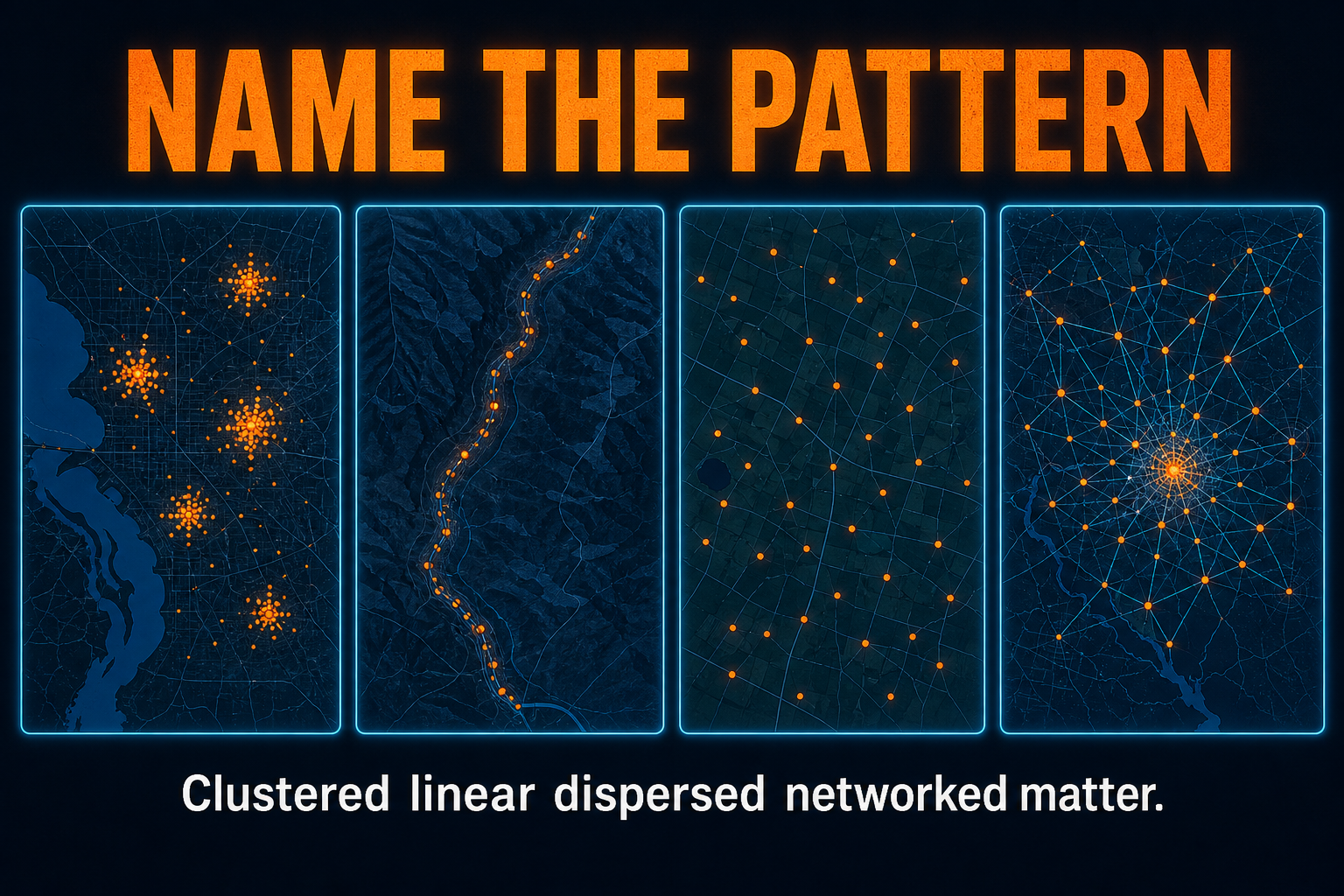
Patterns

What is a spatial pattern?

Clustered

Many points close — Food halls downtown.

Dispersed

Even spacing — Great Plains homesteads.

Linear

Along corridors — Cities on a river.

Peripheral

Ring around core — Suburbs encircling CBD.

Centralized

Peak at core — Jobs downtown.

Random

No obvious rule — Lightning strikes.

Networked

Nodes + links — Airline hubs.

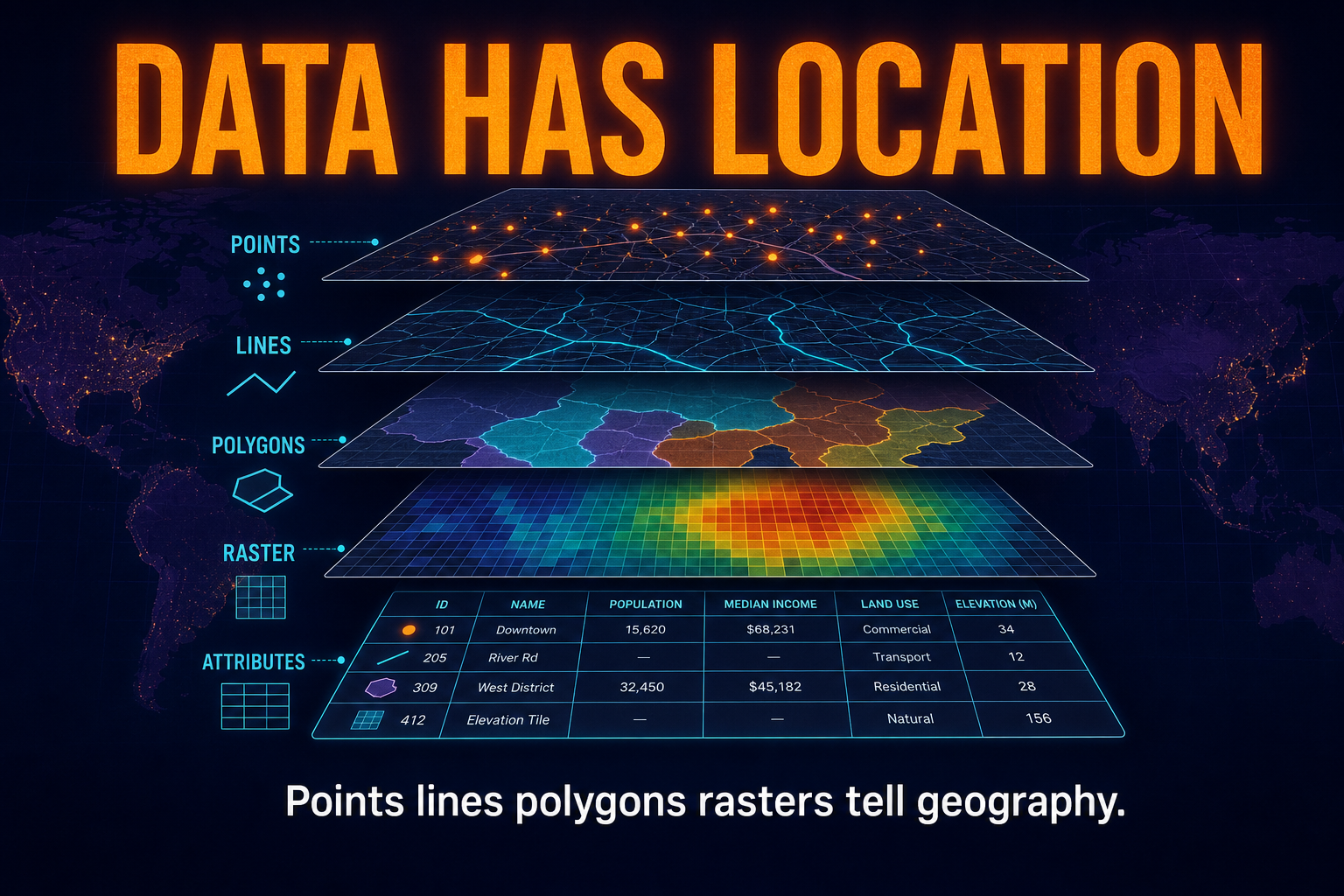
Data

What is spatial data?

Spatial data tie observations to coordinates or polygons—population by tract, GPS stops, flood extents, migration arrows. Without spatial referencing, analysis collapses into tables missing geography’s central insight.

Vector formats carry points, lines, and polygons with attribute tables; raster grids stack satellite brightness values or modeled precipitation. Analysts join those structures inside GIS so a school point inherits census poverty rates from its host tract.

Formats differ by precision: address geocodes vary in accuracy; census blocks shrink uncertainty compared with county totals. Documenting metadata—collection date, projection, sampling frame—prevents silent mismatches when layers originate from different agencies.

Worked example

Hospital site spatial analysis

Planners overlay elderly density, existing hospitals, highways, transit, income, and emergency call densities to locate gaps. Each layer answers part of the access puzzle.

Drive-time isochrones replace straight-line circles when measuring stroke care because roads and traffic alter reachable territory; spatial analysis rewards whichever distance metric matches how patients actually move.

Language-access overlays might tag neighborhoods with large limited-English populations so proposed clinics pair medicine with interpretation resources—noticing culture spatially is still spatial analysis.

Takeaway: Combine census data, GPS samples, and GIS buffers—spatial analysis is integrative.

Association

Spatial association and causation

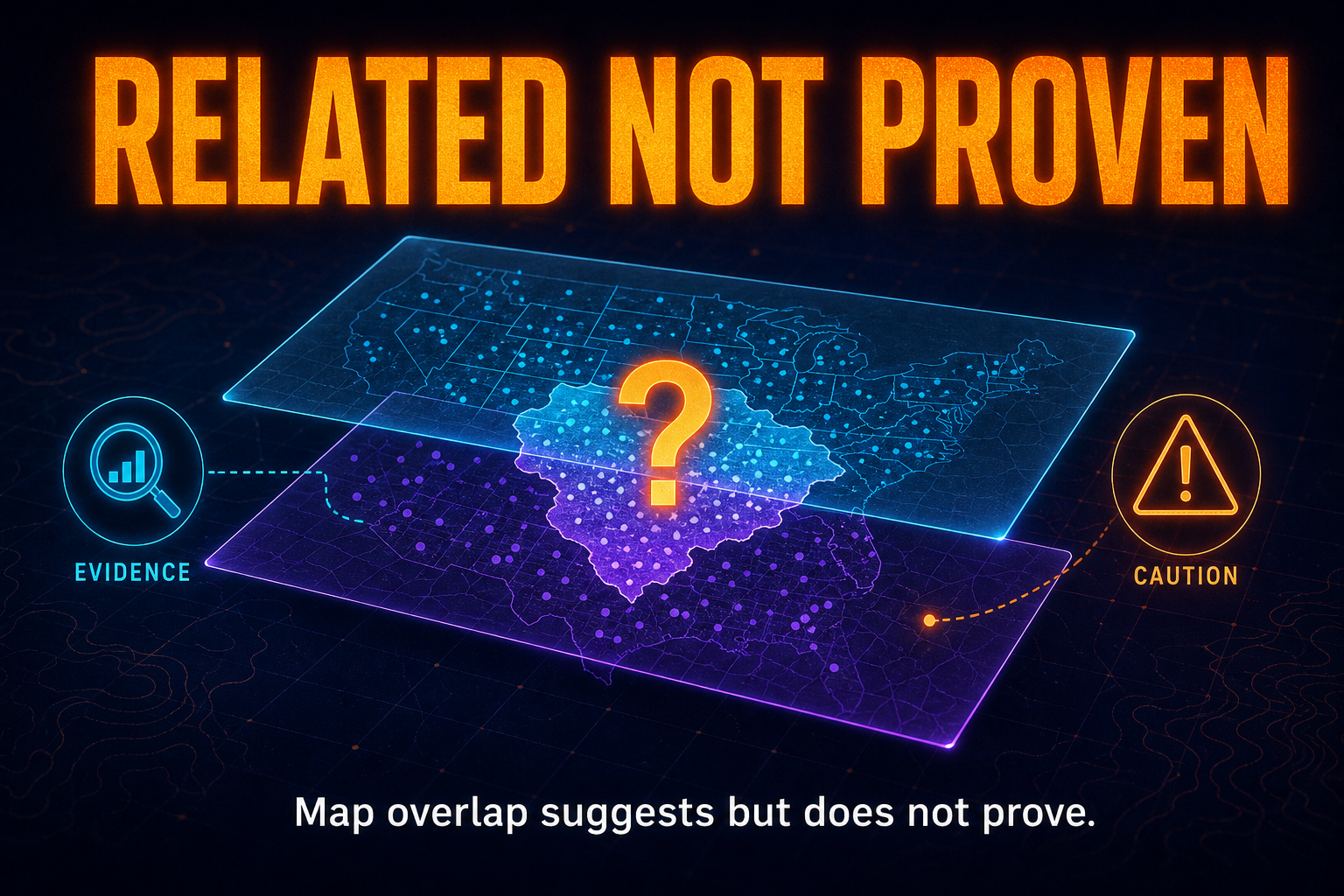
Spatial association means two patterns coincide—lower income and fewer supermarkets, for instance. Association does not prove one caused the other; historical zoning, transit legacy, or discrimination may explain both.

Think of association as a clue, not a verdict. Strong FRQ answers say: “The map suggests a possible relationship between X and Y across neighborhoods; additional evidence about policy history, prices, and interviews would be needed to argue causation.”

Statistical tests may exist behind the scenes, but AP Human Geography rewards conceptual caution—name confounding variables such as highway placement, school catchments, or coastal amenity that could structure both variables you see.

See data reliability and bias when weighing evidence about who was counted, who was left out, and how categories were defined before you infer relationships.

Tools

Tools supporting spatial analysis

  • GIS — Layer and query vector/raster data.
  • GPS — Anchor precise field measurements.
  • Remote sensing — Provide imagery layers.
  • Census — Attach demographics to polygons.
  • Survey — Capture attitudes linked to places.
  • Field observation — Ground-truth map symbols.
  • MapsChoropleth, dot distribution, cartograms, isoline outputs.
Writing

Strong AP writing formula

Pattern → Evidence → Explanation → Geographic significance

Worked paragraph: “Fast-casual restaurants cluster along the interstate exit ramps west of the CBD (pattern). The map legend shows more than eight brands within a half-mile buffer while inner neighborhoods display none (evidence). Highway access and visibility reduce distribution costs for chains reliant on auto commuters, while older zoning downtown favors independent eateries (explanation). The split reinforces car-dependent suburban growth and makes fresh food harder for households without vehicles—an equity issue tied to urban form (significance).”

Notice the paragraph never says “spatial analysis” by name yet demonstrates it. Mimic that discipline on exam day—define terms when prompts demand definitions, otherwise invest sentences in reasoning.

When stimuli include tables plus maps, cite both: “County A lists only two grocers yet the scatter plot shows both hug wealthier hillsides while valley census tracts report median incomes 35% below the metro average.” Numbers strengthen spatial claims.

Why it matters

Why spatial analysis matters

  • Reveals inequality on the ground
  • Supports infrastructure funding choices
  • Tracks environmental change
  • Connects every AP Human Geography unit

Policy windows open when maps make inequity visible: school funding formulas, hospital certificate-of-need rules, and fair-housing reviews all lean on spatial evidence. Students who practice narrating where resources are missing graduate from describing problems to describing pressure points for action.

Business location theory uses the same skill set—retailers, banks, and logistics firms run site-selection models that are private-sector spatial analysis. AP passages about “service gaps” or “banking deserts” expect you to recognize the method even when the question never says GIS.

Climate adaptation adds urgency: wildland-urban interface maps, heat-island intensity surfaces, and storm-surge rasters all feed decisions about insurance, building codes, and managed retreat. Spatial analysis is how communities argue for budgets before disasters arrive.

Because digital twins of cities now update continuously, the line between snapshot maps and live dashboards blurs. Practice reading both: static exam figures still dominate released items, but describe how real planners refresh layers so your answers feel contemporary.

Unit links

Spatial analysis scenarios across the AP course

Population (Unit 2): map age cohorts against childcare deserts to discuss dependency ratios locally; link infant-mortality hot spots to prenatal clinic placement.

Migration (Unit 2): compare remittance flow arrows with job clusters in destination countries; test step-migration ideas by measuring distance between origin villages and first urban stops.

Culture (Unit 3): plot language islands against historic trade nodes; discuss cultural appropriation cases by showing where symbols spread versus where they originated.

Political (Unit 4): measure compactness statistics alongside demographic dot maps; discuss gerrymandering and representational equity with explicit geometry vocabulary.

Agriculture (Unit 5): interpret von Thünen-style rings under real terrain constraints; layer commodity prices, irrigation infrastucture, and property law to explain departures from textbook rings.

Cities (Unit 6): model bid-rent curves with actual transit access; map informal settlements against hazard zones to discuss risk acceptance.

Development (Unit 7): compare GNI per capita choropleths with subnational well-being metrics; discuss false progress when national averages hide interior poverty.

Rehearse one scenario nightly—rotate units so every AP theme feels like a spatial puzzle, not a siloed chapter.

Limits

Limitations

LimitationWhy it matters
Data qualityStale inventories miss new stores; crowdsourced points skew wealthy.
Scale mismatchNational maps hide hyperlocal inequality—compare scales.
Correlation ≠ causationCoincident patterns may share a third driver such as historic zoning.
Geospatial privacyFine GPS traces may be withheld from research—gap itself biases findings.
Symbol designClass breaks and color ramps steer emotional conclusions.
Missing populationsUnsurveyed informal settlements vanish from official layers.
Single-variable focusOne map rarely captures intersectional disadvantage.
Exam stimuli

How to read AP map prompts quickly

Underline verbs—“cluster,” “dispersed,” “corridor,” “buffer”—then match them to vocabulary you can defend. If the map legend shows quantities by shaded polygons, name the map type (choropleth) and caution against interpreting dot-like precision inside large tracts.

When two variables appear side by side, draft a sentence testing spatial association before jumping to policy fixes; graders prefer disciplined inference over sweeping moral claims.

Practice narrating change: if years appear in the corner, compare eras—urban land consumes farmland only when your paragraph cites both snapshots.

If a compass rose and scale bar sit idle, use them: misreading north or distance warps every downstream argument about accessibility.

Finish stimulus drills by stating significance tied to course units—food deserts (urban + development), gerrymandering (political), irrigation rings (agriculture)—so readers see you bridge technique with theory.

Traps

Common mistakes

  • Stopping at “clustered” with no process story—add zoning, rent, or traffic drivers.
  • Confusing correlation with causation when two shaded layers overlap.
  • Ignoring map scale—national choropleths erase neighborhood segregation.
  • Treating maps as neutral—legends embed political choices.
  • Skipping geographic significance—connect patterns to people’s outcomes.
  • Using one data source—pair census counts with field observation when prompts allow.
  • Vague vocabulary—“pattern exists” earns less than naming clustered, linear, or peripheral arrangements.
Exam playbook

How spatial analysis appears on the AP exam

In multiple-choice questions

Identify analysis verbs (overlay, buffer, hotspot); separate analysis from raw collection.

In free-response questions

Interpret GIS-style outputs or explain why two layers together support a conclusion.

Common stimulus types

Heat maps, buffer rings, density surfaces paired with short scenarios.

AP writing formula

Strong AP answer structure: QuestionData/layersMethodPattern foundGeographic explanation.

Quick Check

Test yourself in 5 seconds

Spatial analysis studies:

Flashcards

Twenty-two flip cards

Every fifth card transition shows an ad placeholder with a three-second countdown.

Practice

Sixteen MCQs

FRQ

Practice FRQ — food deserts

Prompt: A geographer studies access to grocery stores in a city. The geographer maps grocery stores, income levels, population density, and public transit routes.

  • Part A: Define spatial analysis.
  • Part B: Explain how spatial analysis can identify food deserts.
  • Part C: Explain ONE limitation of spatial analysis in this scenario.
  • Part D: Explain why spatial association does not automatically prove causation.

Sample 4-point response

A. Spatial analysis is the study of locations, patterns, distributions, distances, and relationships across space.

B. Overlaying stores with income, density, and transit shows neighborhoods where many low-income residents live far from affordable fresh food and lack frequent buses—classic food-access gaps.

C. Store directories may miss informal markets, mobile vendors, or pantry programs, so the map undercounts real food access in some blocks.

D. Low store counts and low incomes can cluster for separate reasons—historic disinvestment, zoning, transport legacy—so coincidence does not prove income alone caused store absence.

Rubric (4 pts)

A — Definition references patterns across space.

B — Links layered maps to identifying underserved areas.

C — Names a concrete data or interpretation limit.

D — Explains correlation versus causation with geographic nuance.

Timed rehearsal

Sketch four bullets in the margin before writing prose—students who outline Part D first rarely forget alternate explanations such as zoning or highway placement.

Recap

Recap

Spatial analysis ties every AP Human Geography storyline to maps and meaning by translating distributions into explanations people can act on.

Before you leave this guide, rehearse three sentences you could drop into any FRQ: one naming a pattern, one citing evidence from the stem, one stating significance for inequality or policy.

Keep linking tools—GIS for overlays, census for people counts, remote sensing for land change—so exam day feels like assembling a toolkit instead of guessing buzzwords.

Exam lab

Spatial analysis under exam timing: workflows that hit every rubric line

Most points evaporate when students recognize a pattern but stop before linking it to process, scale, and human outcomes. Use this lab as a repeatable script for FRQs and stimulus MCQs: first inventory what the figure actually shows, second name the geographic vocabulary that fits, third explain mechanisms, fourth state significance for inequality or policy, fifth acknowledge data limits.

Minute zero—inventory. Circle the legend units, time stamps, scale bar, and north arrow. If the stimulus compares two years, you already owe the reader a change narrative; if it shows one snapshot, avoid imaginary trends unless the prompt implies stability.

Pattern naming drill. Practice aloud: “This is a clustered distribution along highway interchanges” beats “things bunch up.” For polygons, say whether you interpret tract-scale shading or point symbols—mislabeling the display type costs credibility even when your intuition about inequality is correct.

Association paragraph template. Sentence one states what co-locates; sentence two proposes plausible mechanisms (zoning, rent gradients, transit legacy); sentence three lists alternative explanations the College Board expects advanced students to entertain; sentence four closes with why the geographic conclusion still matters for access or safety.

Scale sandwich. Draft one sentence at regional scale, one at municipal scale, one at neighborhood scale when prompts allow layered reasoning. National choropleths smooth away segregation—call that limitation explicitly before proposing hyperlocal follow-up.

Technology pairing checklist. When stems mention imagery, nod toward remote sensing; when they mention coordinate samples, reference GPS; when they mention overlays, cite GIS; when they mention demographics by tract, cite census data. Use names as verbs—layer, buffer, intersect—not as decorative name-drops.

MCQ elimination moves. If an option describes imagery captured from aircraft without ground visits, treat it as remote sensing rather than interviews; if an option describes precise latitude on a handset, treat it as GPS rather than GIS alone; if an option claims correlation proves motive, discard it unless the stem supplies behavioral evidence.

Food-access rehearsal. Outline four bullets: store locations, income surface, transit frequency, population density. Explain spatial mismatch when low-income blocks sit beyond thirty-minute transit access to affordable produce—even if corner stores exist—because quality and price matter for nutrition outcomes.

Hazard rehearsal. Overlay flood depth with housing age and median income; explain why spatial association between flood risk and lower valuations might reflect historical redlining rather than individual choices about where to build.

Migration rehearsal. Connect corridor maps to distance decay and intervening opportunities; avoid treating arrows as moral judgments—describe expected flows given economic gradients, then note policy shocks that reroute people.

Ethics hook. When prompts embed tracking data, bridge to geospatial privacy—analysts may undercount riders who disable location services, skewing spatial conclusions about demand.

Peer review questions. Ask a partner: Did I name a pattern? Did I cite evidence embedded in the stem? Did I explain causes without collapsing correlation into causation? Did I connect to a course unit outcome? If any answer is no, revise before submitting practice essays.

Speed scaffolding. Spend ninety seconds outlining four FRQ parts before writing sentences; students who skip outlining forget Part D most often. Reserve the final sixty seconds to scan for missing geographic significance language—“so what for residents?”—because graders reward explicit stakes.

Synthesis reminder. Spatial analysis is never only math on maps; it is argument about how arrangements of phenomena produce differentiated access to resources, risks, and voice. Keep returning to that human payoff and your practice scores usually follow.

Exam cueStrong spatial analysis response
Dots pile near highwaysName clustering + cite accessibility logic + note externality costs for neighborhoods skipped.
Ring of suburbsUse peripheral pattern language + connect to bid-rent or highway timing—not vague sprawl talk.
Hot spots vs cold spotsDistinguish statistical clustering from random noise; propose field verification.
Two choropleths comparedNote modifiable areal unit risk—changing tract borders shifts correlation appearances.

Capstone timer drill: give yourself eight minutes to answer a released-style prompt using only a pencil outline—no sentences allowed until minute six—then write for two minutes. The outline muscle prevents rambling and preserves geographic vocabulary density graders reward.

Night-before ritual: flip through three disparate units—say agriculture, cities, political—and verbally map one spatial question each onto the pattern-evidence-explanation-significance scaffold so your brain arrives warmed up for mixed stimuli.

When an FRQ pairs qualitative excerpts with map layers, sequence your answer so textual voices explain motivations while spatial layers show constraints—never let quotes float without geographic anchors, and never let polygons speak without human testimony when the prompt supplies both.

If you catch yourself writing “the map shows inequality,” stop and replace with a concrete axis—service minutes, particulate exposure, lot size, tax capacity—so graders see you measuring spatially rather than emoting about shading.

Finish practice essays by asking whether a skeptical planner could redraw your conclusion using the same layers—if yes, you grounded interpretation in observable geography instead of opinion alone. That is the bar you want on exam day and in honors-level coursework.

Microtopic sprint: set a ninety-second timer, describe one stimulus map aloud using only scale-appropriate vocabulary—tract, block group, or hex grid—and stop when you name one limitation tied to the unit outcome language so exam answers stay precise rather than generic.

FAQ

FAQ

What is spatial analysis in AP Human Geography?

Spatial analysis is the study of locations, patterns, distributions, distances, and relationships across space.

What is a spatial pattern?

Clustered, dispersed, linear, peripheral, centralized, random, or networked arrangements.

What is spatial data?

Information connected to location such as GPS points or census polygons.

What is an example of spatial analysis?

Mapping grocery access against income and transit.

Why is spatial analysis important?

It reveals inequality, guides planning, and explains relationships across units.

What is spatial association?

Two geographic patterns appear related in space without automatically proving causation.

What technologies support spatial analysis?

GIS, GPS, remote sensing, census data, surveys, and field observation.

What is one limitation of spatial analysis?

Poor or incomplete data weakens conclusions.

How does spatial analysis relate to map scale?

Different scales reveal different patterns—compare local and regional views.

Does spatial analysis appear in every AP unit?

Yes—population through development rely on spatial reasoning.

What writing formula works best?

Pattern → evidence → explanation → geographic significance.

Synthesis

Blend spatial analysis with stories from the ground

Quantitative overlays explain breadth; interviews and field observation explain depth.

Capstone rehearsal: narrate how you would combine grocery-store proximity surfaces with resident interviews about night-shift work and childcare. Maps might flag a food desert, but oral history reveals why shoppers rely on corner stores—spatial analysis supplies the pattern while qualitative work guards against sterile conclusions.

Repeat for electoral geography: precinct-level vote shares overlay demographic dots, yet listening sessions clarify voter suppression experiences maps alone flatten.

Food systems

Overlay + listen

Pair transit isochrones with pantry schedules when judging access.

Hazards

Risk + justice

Cross flood depth with historic redlining layers before proposing mitigation.

Next

Continue Unit 1.3

Move to geospatial privacy for location-data ethics after spatial reasoning.

Continue

Related guides

Start Free Practice & Track Progress →