Distribution
The overall arrangement of a feature across space.
AP Human Geography · Unit 1 · Spatial Patterns
Learn how geographers describe where things are by using density, concentration, and pattern, then explain the physical and human processes that create those spatial arrangements.
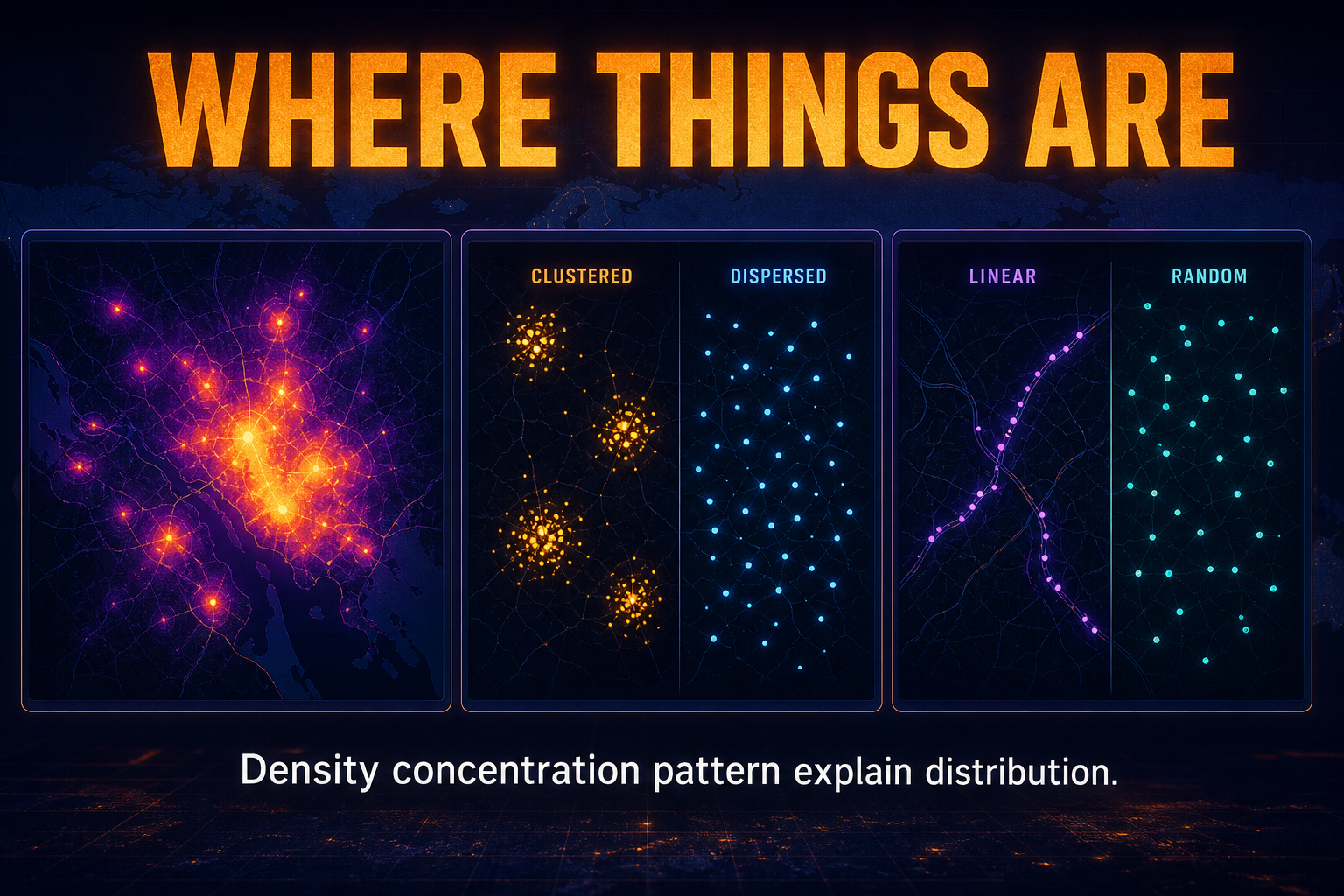
Distribution is the way a geographic feature, population, activity, or process is arranged across space. In AP Human Geography, students describe distribution using three properties: density, concentration, and pattern. Density explains how many features exist per unit area, concentration explains whether features are clustered or dispersed, and pattern explains the geometric arrangement.
If a prompt asks how something is arranged across space, describe density, concentration, and pattern before explaining causes.
Distribution = how much + how close + what shape.
The overall arrangement of a feature across space.
How many people or features exist per unit area.
Whether features are clustered together or dispersed apart.
The visible geometric arrangement, such as linear, random, uniform, clustered, or centralized.
Distribution is the big idea; density, concentration, and pattern are the tools used to describe it.
Compare clustered vs dispersed patterns, spatial analysis, scale of analysis, and dot distribution maps when a map mixes amount, spacing, and arrangement.
Distribution is the spatial arrangement of a phenomenon across Earth's surface. A phenomenon can be people, farms, languages, diseases, stores, roads, services, hazards, jobs, or almost anything that can be mapped.
How a feature or phenomenon is arranged across space.
The number of features or people per unit of area.
How close together or spread apart features are.
The geometric arrangement of features.
Features are grouped together.
Features are spread apart.
Features are evenly spaced.
The location-based arrangement of features across space.
Distribution describes how features arrange across space. Use spatial analysis when you explain patterns with map evidence.
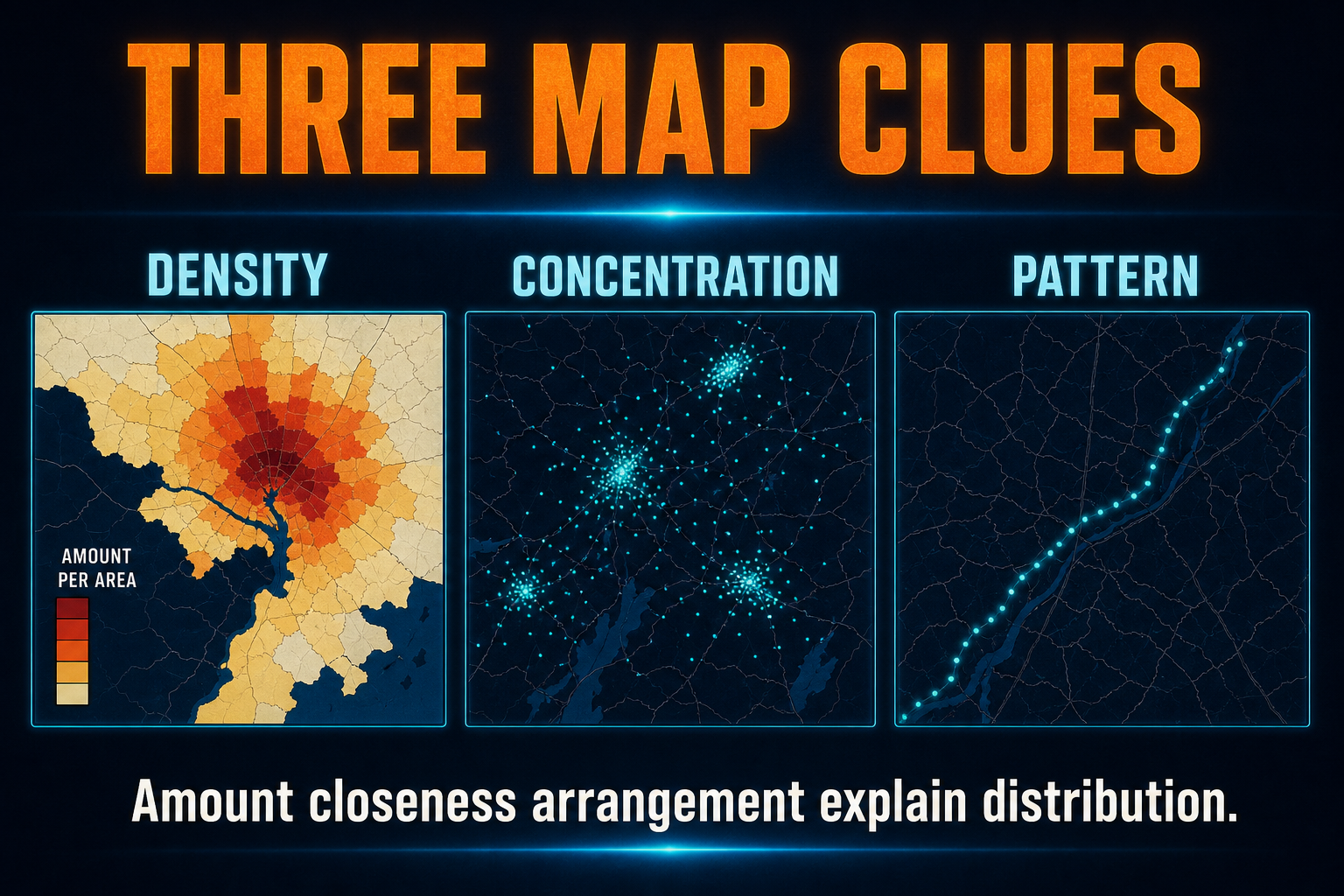
AP Human Geography often uses three properties to describe distribution: density, concentration, and pattern. These three terms help students move beyond vague descriptions like "spread out" and write precise map evidence.
| Property | Question It Answers | Example | AP Clue |
|---|---|---|---|
| Density | How much exists per area? | People per square kilometer | Amount, frequency, ratio, per unit area |
| Concentration | Are features close together or spread apart? | Stores clustered downtown | Clustered, dispersed, concentrated, spread out |
| Pattern | What shape or arrangement appears? | Settlements follow a river | Linear, circular, random, uniform, centralized |
When a prompt asks you to describe a distribution, try to mention all three: density, concentration, and pattern.
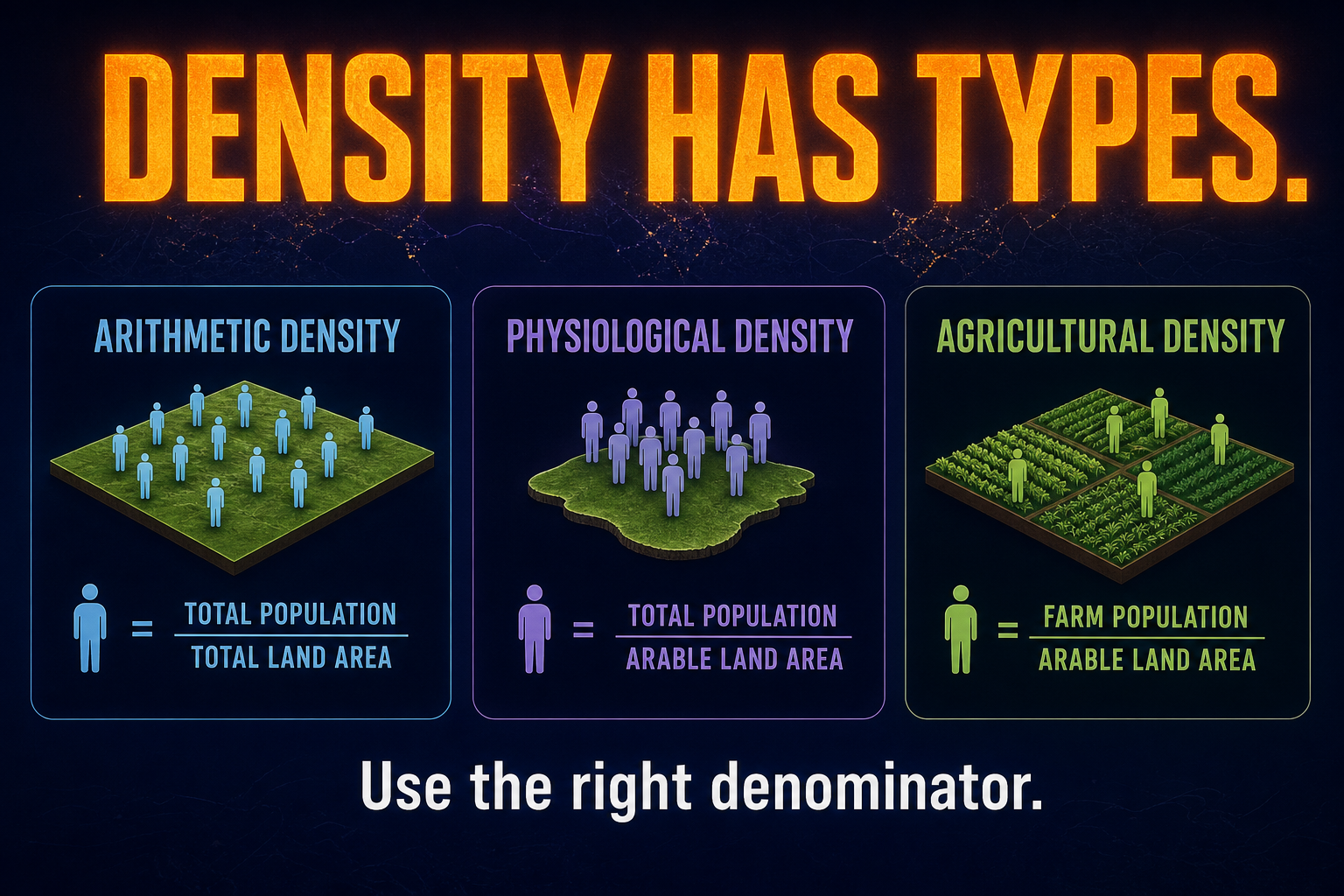
Density measures how many people or features exist per unit of area. AP Human Geography commonly tests arithmetic density, physiological density, and agricultural density; use the population density types guide when you need formulas, examples, MCQs, and FRQ practice.
| Density Type | Formula Idea | What It Shows | AP Use |
|---|---|---|---|
| Arithmetic density | Total population divided by total land area | Overall population density | Quick country or region comparison |
| Physiological density | Total population divided by arable land | Pressure on farmable land | Food and land pressure |
| Agricultural density | Number of farmers divided by arable land | Farm labor intensity | Development and farming technology clues |
If the question mentions arable land, slow down. Physiological density uses total population, while agricultural density uses number of farmers.
Concentration describes whether features are close together or spread apart. A distribution can have the same density but a different concentration if features are arranged differently.
Meaning: Features are grouped together in pockets.
Example: Hospitals clustered in a city center.
Meaning: Features are spread apart.
Example: Ranches spread across dry grassland.
Meaning: Some areas are clustered while others are sparse.
Example: Population clustered in metro areas but sparse in rural interiors.
Meaning: A pattern may look clustered at one scale and dispersed at another.
Example: U.S. population clusters nationally but neighborhoods may show local variation.
Concentration connects to clustered vs dispersed patterns when you explain whether features bunch together or spread apart.
Pattern describes the visible geometric arrangement of features. Naming the pattern is only the first step. Strong AP answers also explain why the pattern exists.
Example: Settlements along a river, road, coast, or rail line.
Example: Land use zones around a city center.
Example: Scattered features with no clear arrangement.
Example: Planned service towers or grid-based settlements.
Example: Jobs concentrated around a central business district.
Example: Branching river or transportation networks.
Example: Idealized market areas in central place theory.
Example: Growth around the edge of a city or region.
Students often confuse distribution with its properties. Distribution is the overall arrangement. Density, concentration, and pattern are the tools used to describe that arrangement.
| Term | Main Meaning | Example | Student Trap |
|---|---|---|---|
| Distribution | Overall arrangement across space | Population is clustered in coastal metros | The whole description |
| Density | Amount per unit area | 300 people per square kilometer | Not the same as clustering |
| Concentration | Closeness or spread | Stores are clustered near downtown | Not a formula |
| Pattern | Geometric arrangement | Homes follow a linear road pattern | Not always clustered or dispersed |
If the prompt says "describe the distribution," do not give only density. Add concentration and pattern when possible.
Spatial distribution patterns help students describe what they see on maps. The most common AP patterns are clustered, dispersed, uniform, linear, and random.
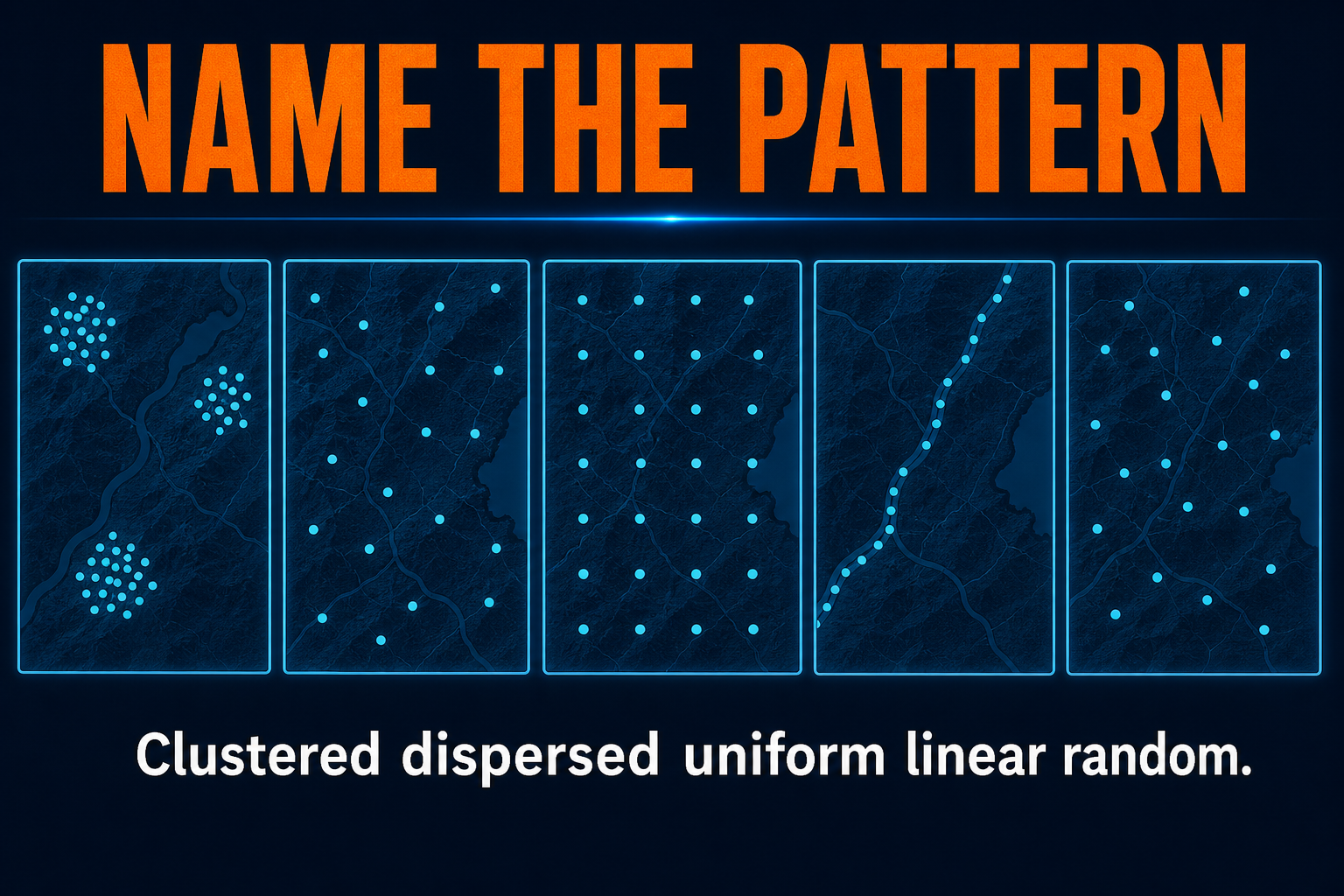
Meaning: Grouped together.
Example: Tech firms near universities.
Meaning: Spread apart.
Example: Ranches across a rural plain.
Meaning: Evenly spaced.
Example: Planned service points.
Meaning: Following a line.
Example: Settlements along a river.
Meaning: No clear pattern.
Example: Lightning strikes.
See clustered vs dispersed patterns for deeper concentration examples, dot distribution maps for location evidence, and choropleth maps, cartograms, or isoline maps when shaded areas, distorted size, or continuous surfaces summarize regional density.
AP map questions reward evidence. Do not just say "it is clustered." Cite what the map shows.
Strong AP answers do not just say "the map is uneven"; they identify where the highest and lowest values appear, describe the concentration, name the pattern, and explain why it matters.
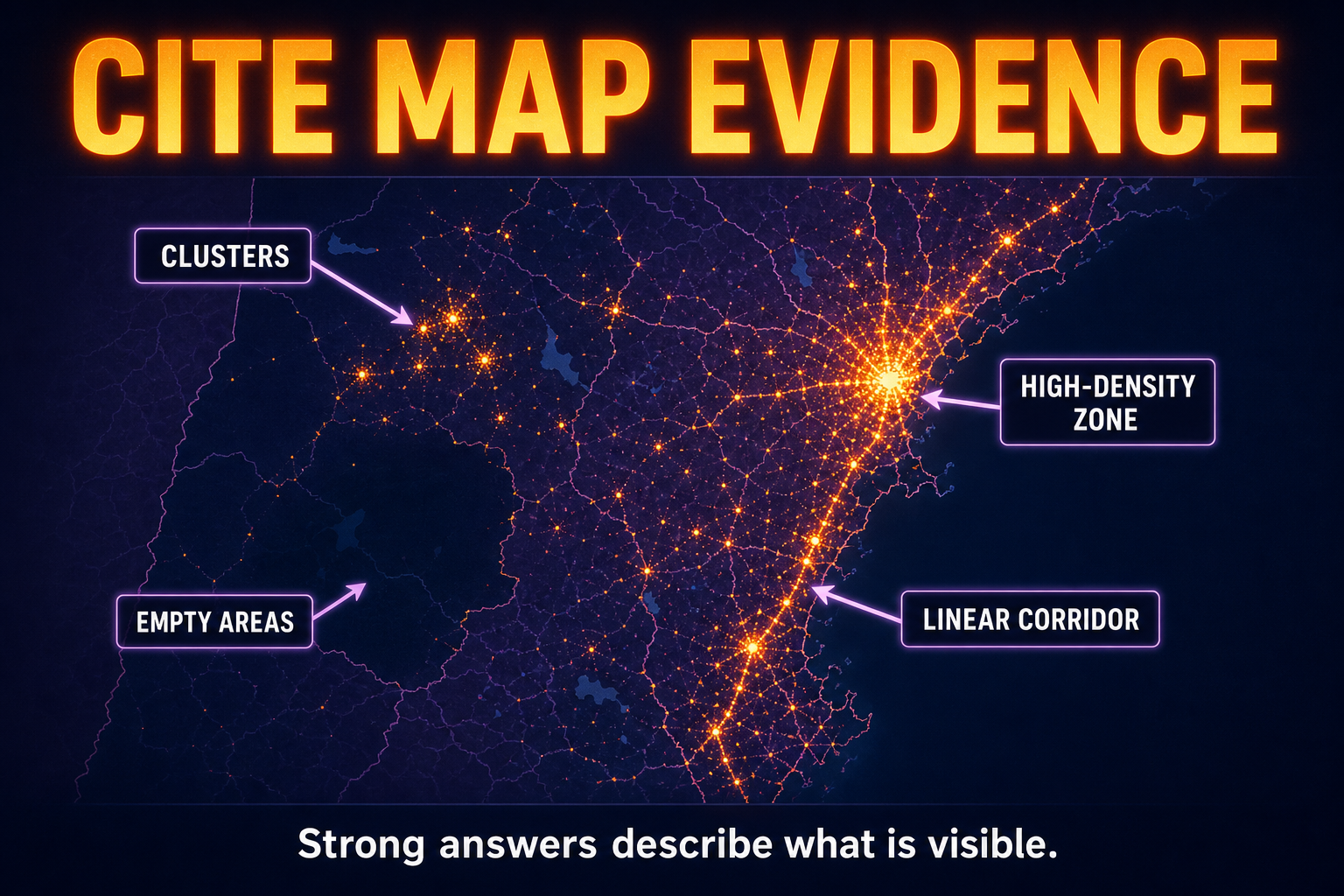
Example: The population distribution is high-density along the coast, clustered in major metropolitan regions, and linear along transportation corridors. This pattern may reflect port access, job concentration, transportation networks, and historical settlement.
Distribution maps can mislead if data are outdated, biased, generalized, or mapped at the wrong scale. Evaluate map quality with the data reliability and bias guide and check map scale and generalization before you generalize from one view.
U.S. population distribution is a useful AP example because it shows all three properties.
High density in large metro areas and lower density in many interior rural areas.
Population is clustered in metropolitan regions, especially in the East, along coasts, and in Sun Belt cities.
There are linear corridors along coasts, interstate highways, and major rivers.
Water access, climate, terrain, and arable land shape settlement.
Jobs, transportation, ports, migration, historical settlement, and economic agglomeration shape the pattern.
Distribution affects representation, infrastructure, services, disaster planning, and economic opportunity.
U.S. population patterns also depend on scale of analysis—national clustering can look different at the neighborhood level.
Students describe density, concentration, and pattern on maps.
Population distribution shows where people live and why migration changes settlement.
Languages, religions, and cultural traits have spatial distributions.
Voting, boundaries, ethnic groups, and state shapes create distributions.
Crops, livestock, and rural settlements have clustered or dispersed patterns.
Urban land use, services, and housing are distributed unevenly across cities.
Wealth, infrastructure, industry, and jobs have uneven spatial distributions.
Population distribution continues in Unit 2 Population and Migration and agricultural patterns in Unit 5 Agriculture. Return to the AP Human Geography course hub or Unit 1 Thinking Geographically hub for the full spatial patterns path. Distance decay and time-space compression help explain why some distributions tighten or spread over time.
Hospitals cluster in cities while rural residents are dispersed.
AP exam clue: Distribution affects service access.
Pollution sources may cluster near low-income neighborhoods.
AP exam clue: Distribution can reveal inequality.
Irrigated crops cluster where water and infrastructure are available.
AP exam clue: Physical and human factors shape distribution.
Broadband access is dense in cities but sparse in rural regions.
AP exam clue: Distribution affects opportunity.
Cases may cluster near transportation hubs or high-density housing.
AP exam clue: Distribution links to diffusion and networks.
Wind turbines may disperse across windy rural land while solar farms cluster near transmission lines.
AP exam clue: Land and infrastructure shape patterns.
Housing growth may form linear corridors along highways.
AP exam clue: Transportation shapes distribution.
New immigrant communities may cluster near jobs, family networks, or cultural institutions.
AP exam clue: Migration reshapes spatial distribution.
Fix: Distribution is the overall arrangement; density is amount per area.
Fix: Describe density, concentration, and pattern together when possible.
Fix: Physiological uses total population; agricultural uses number of farmers.
Fix: Use dispersed, linear, random, or uniform when accurate.
Fix: Cite what the map shows.
Fix: A pattern may change at local, regional, national, or global scale.
Fix: Class breaks, boundaries, and data quality affect interpretation—review data reliability and bias.
Fix: Explain why the distribution matters for services, inequality, planning, risk, or policy.
Example: The distribution of population is high-density near coastal metropolitan areas, clustered in major urban regions, and linear along transportation corridors. Physical factors such as water access and climate, along with human factors such as ports, jobs, and transportation networks, help explain the pattern. This distribution matters because it shapes infrastructure demand, political representation, and service access.
The three properties of distribution are:

A. Distribution is the way a geographic feature, population, activity, or process is arranged across space.
B. The three properties are density, concentration, and pattern.
C. U.S. population distribution has high density in major metropolitan areas, lower density in many interior rural areas, clustered concentration in cities and coastal regions, and linear patterns along coasts, rivers, and transportation corridors.
D. One physical factor is water access or climate, which helps explain settlement near coasts and rivers. One human factor is job concentration or transportation infrastructure, which attracts people to cities and reinforces metropolitan growth.
Use these distribution practice questions to test density types, concentration, spatial patterns, map evidence, and FRQ reasoning.
Use these flashcards to review distribution vocabulary, density formulas, concentration, spatial patterns, and AP exam clues.
Distribution is the way a geographic feature, population, activity, or process is arranged across space. Geographers describe distribution using density, concentration, and pattern.
Distribution means how something is spread or arranged across space.
The three properties of distribution are density, concentration, and pattern.
Density measures how many people or features exist per unit area. Concentration describes whether features are close together or spread apart.
Distribution is the overall spatial arrangement of a feature. Density is one property of distribution that measures amount per unit area.
Distribution describes where something is located or arranged. Diffusion describes how something spreads from one place to another over time.
U.S. population distribution is an example because people are clustered in metropolitan regions, dense along some coasts and urban corridors, and sparse in many interior rural areas.
Spatial distribution is the arrangement of people, activities, features, or processes across geographic space.
Common spatial distribution patterns include clustered, dispersed, uniform, linear, random, centralized, circular, and dendritic patterns.
Clustered distribution means features are grouped together in one or more areas.
Dispersed distribution means features are spread apart across space.
Uniform distribution means features are evenly spaced in a regular pattern.
Geographers analyze distribution by identifying the phenomenon, measuring density, assessing concentration, naming the pattern, citing map evidence, and explaining physical and human causes.
Distributions are shown on maps using dot distribution maps, choropleth maps, graduated symbol maps, isoline maps, flow maps, heat maps, and other spatial visualization methods.
Dot distribution maps show where features are located by placing dots on a map. They are useful for identifying clustering, dispersion, and spatial patterns.
Choropleth maps show distribution by shading areas such as states, counties, or census tracts based on a value, rate, percentage, or density.
Distribution is important because it helps explain inequality, service access, population patterns, hazards, resources, urban growth, agriculture, migration, and development.
Students should describe density, concentration, and pattern, cite map evidence, explain physical and human causes, and state geographic significance.