What is AP Biology Unit 4?

For the AP exam, Unit 4 is about cause and effect. Students need to trace pathways, compare receptor types, explain feedback loops, interpret cell-cycle data, and predict what happens when signaling or checkpoints fail. The strongest answers do not just name a receptor or cell-cycle phase. They explain the mechanism.
Signals tell cells what to do; checkpoints decide whether cells are ready to divide.
Use this AP Biology study guide as your Unit 4 hub, then connect the details back to proteins, membranes, ATP, and genetics as you review.
10-question diagnostic
Start with a quick check. For each miss, ask whether the issue was the signal, receptor, pathway, response, phase, or checkpoint.
Trace the Signal: The 4-Step Cell Communication Map
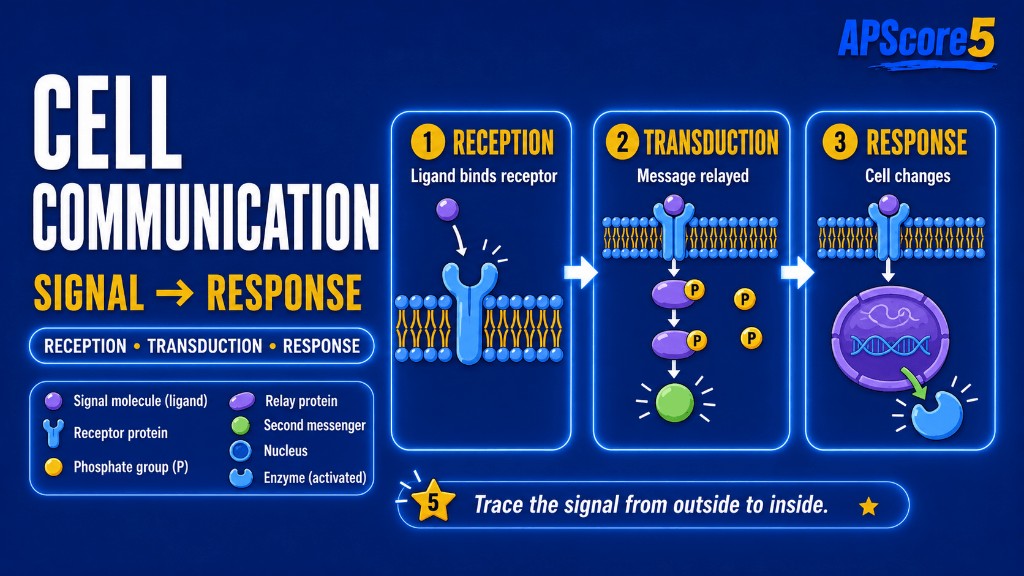
Direct answer: cell communication starts outside or near a cell and ends with a specific response inside the target cell. The AP task is to trace that cause-effect chain without skipping the mechanism.
1. Signal released
A ligand, hormone, neurotransmitter, growth factor, or local chemical message is released.
2. Receptor binds signal
The signal binds a specific receptor on the membrane or inside the cell.
3. Pathway changes activity
A transduction pathway changes protein activity, often through phosphorylation, second messengers, or ion movement.
4. Cell response happens
The cell changes gene expression, enzyme activity, membrane transport, movement, secretion, or division.
Example
A growth factor binds a receptor on the cell membrane. The receptor activates a transduction pathway. Proteins inside the cell become phosphorylated. The cell may activate genes that support growth or division.
- Identify the signal or receptor.
- Explain the pathway.
- Predict the cell response.
- Predict what changes if a receptor or pathway protein mutates.
Membrane receptor shape depends on protein structure from Unit 1 Chemistry of Life, and receptor location depends on membranes from Unit 2 Cell Structure and Function.
Reception, Transduction, Response: What Each Word Really Means
Direct answer: reception detects the signal, transduction relays it inside the cell, and response is what the cell does. A high-scoring answer explains all three steps in order.
Reception
The cell detects the signal. This depends on shape-specific binding between a ligand and a receptor.
Transduction
The signal is converted into internal changes. This may involve relay proteins, phosphorylation cascades, second messengers, or ion flow.
Response
The cell does something. The response may be fast, like opening an ion channel, or slower, like changing gene expression.
Adrenaline binds a receptor. The signal is amplified inside the cell. The cell breaks down stored molecules to release usable energy.
Do not say transduction means the signal enters the cell. Often, the ligand stays outside while the message is relayed inside.
Which Receptor Type Is This?
Direct answer: receptor type can usually be identified from the clue in the prompt. Look for ions, G proteins, second messengers, dimerization, phosphorylation, or a signal that crosses the membrane.

Does the receptor open a channel for ions?
If yes: ligand-gated ion channel. Best clue: fast response, ions move, membrane potential may change.
Does the receptor activate G proteins?
If yes: GPCR. Best clue: signal amplification, cAMP, relay pathway, many cellular responses.
Does the receptor dimerize and phosphorylate tyrosines?
If yes: receptor tyrosine kinase. Best clue: growth factors, phosphorylation, cell growth or division pathways.
Does the signal bind inside the cell?
If yes: intracellular receptor. Best clue: steroid hormones, gene expression changes, lipid-soluble signal.
| Receptor type | Best clue | Typical response speed | Common AP trap |
|---|---|---|---|
| GPCR | G protein or second messenger | Moderate | Students forget amplification |
| RTK | Dimerization and phosphorylation | Moderate to slow | Students forget growth/division connection |
| Ligand-gated ion channel | Ions move through channel | Fast | Students confuse it with active transport |
| Intracellular receptor | Signal crosses membrane | Slow | Students forget it often affects transcription |
Signal Amplification: Why One Signal Can Create a Big Response
Direct answer: signal amplification means one ligand can activate many molecules inside the cell. A receptor may activate several relay proteins. Each relay protein may activate more proteins. This cascade creates a larger response than one signal molecule could produce alone.
1 ligand → 1 receptor → many relay proteins → many activated enzymes → large cell response
AP example
If a mutation blocks an early relay protein, the whole downstream response may decrease. If a receptor is stuck active, the downstream response may continue even without the ligand.
Amplification does not mean the signal molecule gets bigger. It means the number of activated molecules increases.
Phosphorylation cascades also connect to ATP use in Unit 3 Cellular Energetics, because kinases often use ATP to add phosphate groups to proteins.
Feedback Loops: Stability vs Escalation
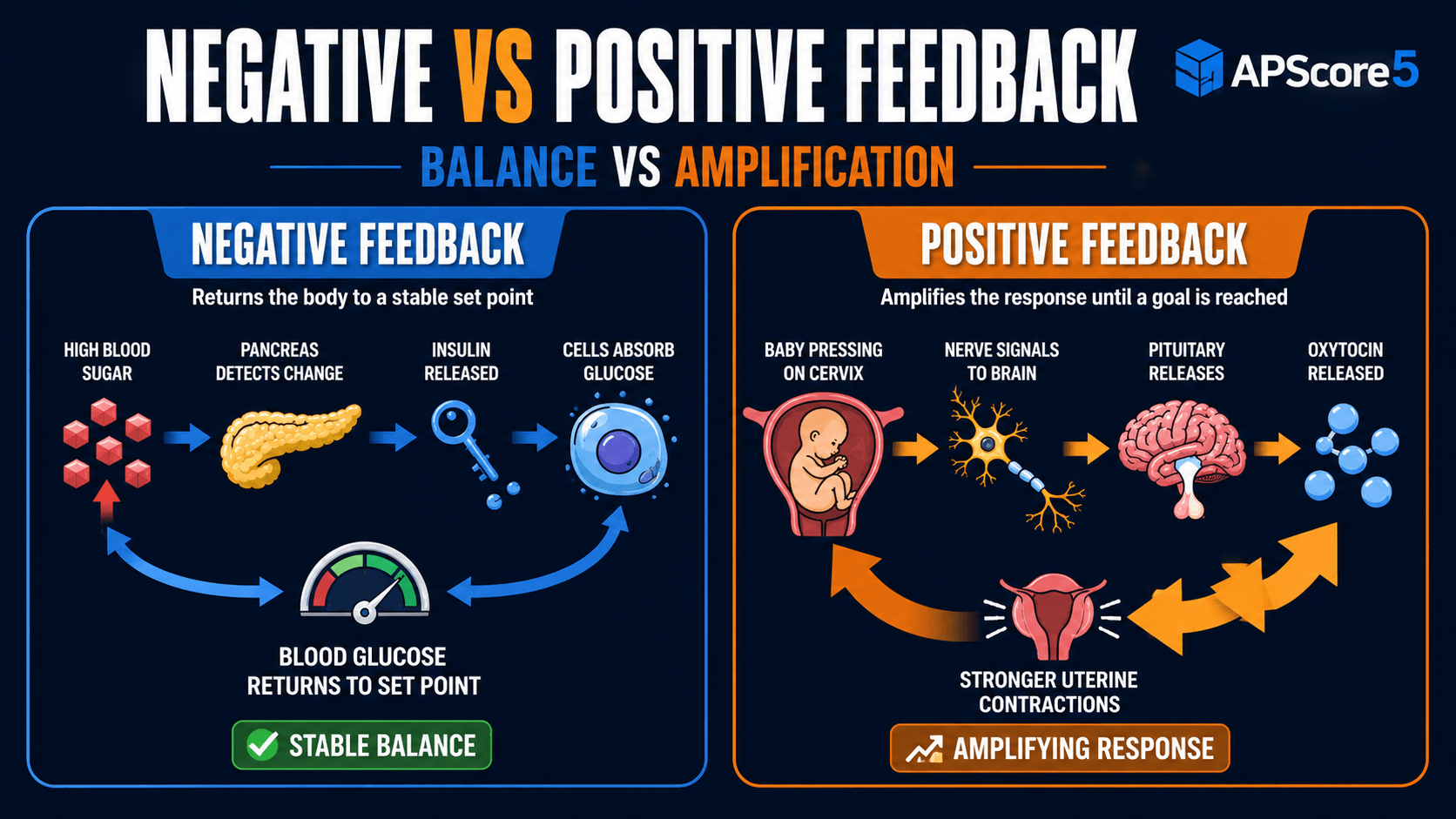
Direct answer: feedback loops control whether a biological response reduces a change or intensifies it. Use the full feedback mechanisms guide when you need more loop examples and practice.

Negative feedback
Negative feedback reduces the original change and helps maintain homeostasis. It is common in body temperature, blood glucose, hormone regulation, and many cellular control systems.
Example: High blood glucose triggers insulin release, which helps cells take in glucose and lowers blood glucose back toward normal.
Positive feedback
Positive feedback increases the original change and pushes a process forward until a specific endpoint is reached. It is useful when the body needs a rapid, decisive response.
Example: During childbirth, oxytocin increases contractions, and stronger contractions trigger more oxytocin until delivery.
Positive feedback is not always good, and negative feedback is not always bad. Positive means amplifies; negative means reduces.
The Cell Cycle as a Quality-Control System
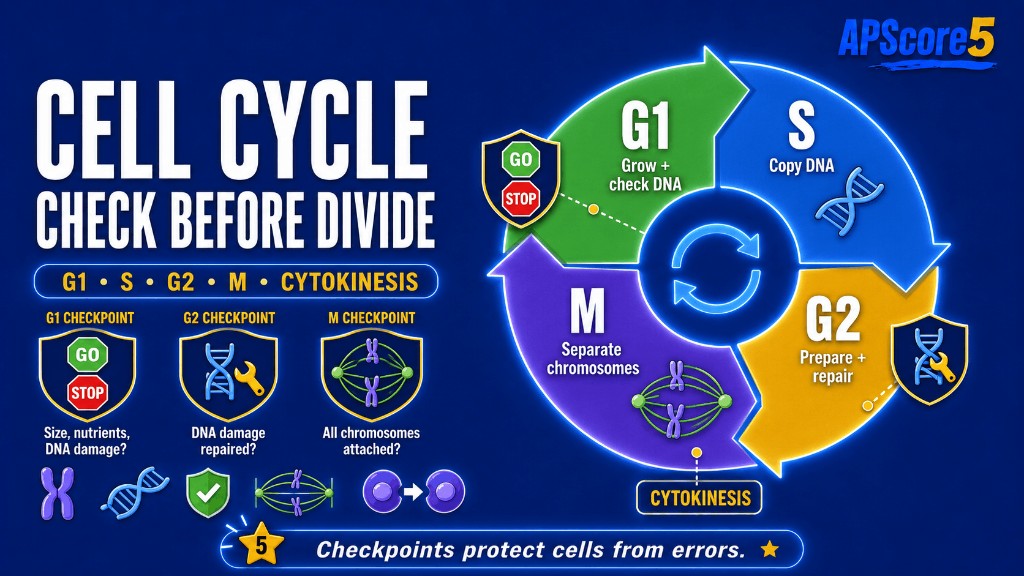
Direct answer: the cell cycle is an ordered system for growth, DNA copying, chromosome separation, and cytoplasm division. Interphase is not a resting stage.

G1
The cell grows and performs normal functions.
S phase
DNA is copied so each future daughter cell can receive genetic information.
G2
The cell prepares for division and checks copied DNA.
M phase
Chromosomes separate during mitosis.
Cytokinesis
The cytoplasm divides, producing separate daughter cells.
AP Bio questions often test why a cell should not move forward, not just what phase comes next.
Checkpoint Logic: Should the Cell Divide?
Direct answer: checkpoints monitor whether the cell should continue. They do not create DNA; they check whether conditions are safe enough for the next stage.
G1 checkpoint asks
- Is the cell large enough?
- Are nutrients and signals available?
- Is DNA damaged?
- Should the cell enter S phase?
G2 checkpoint asks
- Was DNA copied correctly?
- Is DNA damaged?
- Is the cell ready for mitosis?
M checkpoint asks
- Are chromosomes attached to spindle fibers?
- Can sister chromatids separate correctly?
Checkpoints do not create DNA. They monitor whether the cell is ready to continue.
If checkpoints work
Damaged cells pause, repair, or undergo apoptosis.
If checkpoints fail
Cells with DNA errors may continue dividing, increasing the risk of uncontrolled growth.
Cancer Connection: When Signals and Checkpoints Fail
Direct answer: cancer can result when normal controls over growth and division fail. A mutation may keep a growth signal turned on, disable a tumor suppressor pathway, prevent apoptosis, or allow a damaged cell to pass a checkpoint. AP Biology does not require medical-level detail here; it requires the ability to connect a molecular change to a cell-cycle outcome.
If a growth-factor receptor stays active
Division signals may continue.
If a checkpoint protein fails
Damaged DNA may be passed to daughter cells.
If apoptosis is blocked
Abnormal cells may survive instead of being removed.
This section is for biology reasoning, not medical advice.
Unit 4 Lab and Data Skills
Direct answer: in Unit 4, AP questions often ask you to connect data to a mechanism. Do not just describe the graph; explain the pathway.
Scenario A: Signaling pathway mutation
Data pattern: Cells with a receptor mutation divide even when no ligand is added.
Student should explain: The receptor may be active without ligand, causing continuous transduction and growth response.
Scenario B: Checkpoint failure
Data pattern: Cells with DNA damage still enter mitosis.
Student should explain: A checkpoint failed, so the cell did not pause for repair or apoptosis.
Scenario C: Feedback loop
Data pattern: A hormone level rises, then triggers a response that lowers the original stimulus.
Student should explain: This is negative feedback because the response reduces the initial change.
AP Biology Unit 4 FRQ Strategy
Direct answer: Unit 4 FRQs reward precise mechanism. A strong response names the signal, receptor, pathway, phase, or checkpoint, then explains how that piece changes cell behavior.
- Name the signal, receptor, cell-cycle phase, or checkpoint.
- Explain the mechanism using precise vocabulary.
- Connect the mechanism to a cell response.
- Use evidence from the prompt, graph, or data table.
- Predict what changes if a molecule, receptor, or checkpoint fails.
Scenario 1: Receptor mutation
Prompt: A receptor remains active even when no ligand is present. Predict the effect on the cell.
Strong answer: The pathway may stay active without an external signal. Downstream proteins may continue triggering a response, such as gene expression or cell division, even when the signal should be off.
Scenario 2: Signal transduction block
Prompt: A mutation prevents a relay protein from being phosphorylated. Explain the likely effect.
Strong answer: The pathway response may decrease because phosphorylation often activates relay proteins. If the relay protein cannot activate, downstream proteins may not receive the signal, reducing the final cell response.
Scenario 3: Ion channel receptor
Prompt: A ligand binds a receptor and sodium ions quickly enter the cell. Identify the receptor type and explain the response.
Strong answer: This is likely a ligand-gated ion channel because ligand binding opens a channel that allows ions to move across the membrane. The ion movement can rapidly change the cell's membrane potential or activity.
Scenario 4: G1 checkpoint
Prompt: A cell has DNA damage before DNA replication. Explain why the G1 checkpoint matters.
Strong answer: The G1 checkpoint can stop the cell before S phase if DNA is damaged. This prevents the damaged DNA from being copied and passed to daughter cells.
Scenario 5: M checkpoint
Prompt: A drug prevents spindle fibers from attaching to chromosomes. Predict what should happen if the M checkpoint works.
Strong answer: The cell should pause mitosis because chromosomes are not properly attached to spindle fibers. This prevents sister chromatids from separating incorrectly.
Scenario 6: Positive vs negative feedback
Prompt: A response increases the original stimulus until a process reaches an endpoint. Identify the feedback type.
Strong answer: This is positive feedback because the response amplifies the original stimulus. The loop continues until a specific endpoint stops the process.
Common Unit 4 Mistakes That Cost Points
Thinking ligands always enter the cell
Fix: Many ligands bind membrane receptors and stay outside while the signal is relayed inside.
Using reception, transduction, and response as memorized words only
Fix: Explain what happens at each step.
Confusing receptor types
Fix: Use clues: ions = ligand-gated channel, G protein/second messenger = GPCR, dimerization/phosphorylation = RTK.
Saying mitosis includes all of interphase
Fix: Interphase includes G1, S, and G2. Mitosis is nuclear division.
Thinking checkpoints cause division
Fix: Checkpoints monitor readiness and can stop progression.
Saying cancer happens because cells divide fast
Fix: Explain the failed control: active growth signal, failed checkpoint, failed tumor suppressor, or blocked apoptosis.
Unit 4 Must-Know Terms
Use this compact glossary to connect vocabulary to mechanisms, data, and FRQ predictions.
| Term | Student-friendly meaning | AP exam use |
|---|---|---|
| Ligand | Signal molecule that binds a receptor. | Identify the message. |
| Receptor | Protein that detects a signal. | Explain specificity. |
| Reception | Signal detection by receptor. | Start of pathway. |
| Transduction | Internal relay of the message. | Explain pathway steps. |
| Response | Final cell action. | Predict outcome. |
| Signal transduction pathway | Linked steps from receptor to response. | Trace cause and effect. |
| Phosphorylation | Adding a phosphate group. | Turns proteins on or off. |
| Protein kinase | Enzyme that phosphorylates proteins. | Explain cascades. |
| Second messenger | Small internal signaling molecule. | Explain amplification. |
| cAMP | Common second messenger. | GPCR pathway clue. |
| GPCR | Receptor that activates G proteins. | Recognize cAMP and amplification. |
| Receptor tyrosine kinase | Receptor that dimerizes and phosphorylates tyrosines. | Growth pathway clue. |
| Ligand-gated ion channel | Receptor channel opened by ligand. | Fast ion movement. |
| Intracellular receptor | Receptor inside the cell. | Lipid-soluble signals. |
| Signal amplification | One signal activates many molecules. | Explain large responses. |
| Negative feedback | Response reduces the original change. | Homeostasis examples. |
| Positive feedback | Response increases the original change. | Endpoint-driven examples. |
| Homeostasis | Stable internal conditions. | Feedback purpose. |
| Interphase | G1, S, and G2. | Growth and DNA copying. |
| G1 phase | Growth before DNA copying. | G1 checkpoint context. |
| S phase | DNA synthesis. | DNA replication timing. |
| G2 phase | Preparation after DNA copying. | Pre-mitosis check. |
| Mitosis | Nuclear division. | Chromosome separation. |
| Cytokinesis | Cytoplasm division. | Daughter cell formation. |
| Chromosome | DNA-protein structure. | Track genetic material. |
| Sister chromatid | Copied chromosome half. | Separation in mitosis. |
| Spindle fiber | Microtubule that moves chromosomes. | M checkpoint clue. |
| G1 checkpoint | Checks conditions before S phase. | DNA damage before copying. |
| G2 checkpoint | Checks copied DNA before mitosis. | Repair before division. |
| M checkpoint | Checks spindle attachment. | Chromatid separation safety. |
| Cyclin | Regulatory protein that changes over cycle. | Controls CDKs. |
| CDK | Kinase that drives cycle events. | Cell-cycle regulation. |
| Apoptosis | Programmed cell death. | Damaged cell removal. |
| Tumor suppressor | Protein that restrains division. | Failed checkpoint logic. |
| Proto-oncogene | Normal growth-promoting gene. | Mutation can overactivate growth. |
Quick Self-Check Before Practice
If you cannot answer 6 of 8, review the concept sections before starting mixed practice.
- Can I trace reception, transduction, and response?
- Can I tell GPCR, RTK, and ligand-gated ion channels apart?
- Can I explain signal amplification?
- Can I compare negative and positive feedback?
- Can I place G1, S, G2, M, and cytokinesis in order?
- Can I explain what G1, G2, and M checkpoints monitor?
- Can I connect checkpoint failure to uncontrolled growth?
- Can I write a Unit 4 FRQ using mechanism and evidence?
AP Bio Unit 4 flashcards
Use flashcards to connect vocabulary to pathways, receptor clues, checkpoint logic, and cell outcomes.
AP Bio Unit 4 practice questions (MCQ)
Answer targeted Unit 4 questions, then read the answer explanations for the signaling or checkpoint mechanism you missed. You can also use practice by topic, practice by course, daily practice, or longer practice tests.
AP Bio Unit 1-4 cumulative review
Unit 4 depends on earlier units: receptor proteins from Unit 1 Chemistry of Life, membranes and compartmentalization from Unit 2 Cell Structure and Function, and ATP-powered phosphorylation from Unit 3 Cellular Energetics.
Keep Learning AP Biology
Use these next steps when a Unit 4 concept depends on chemistry, cell structure, ATP, feedback, or inheritance.
Review Unit 1 Chemistry of Life
Protein shape explains receptor specificity and kinase function.
Review Unit 2 Cell Structure and Function
Membranes, organelles, and compartmentalization help explain receptor location.
Review Unit 3 Cellular Energetics
ATP powers phosphorylation cascades and cell work.
Open the Feedback Mechanisms guide
Practice negative and positive feedback examples.
Continue to Unit 5 Heredity
Cell division connects directly to chromosome inheritance and meiosis.
Save your progress
Create a free account to keep your score history, flashcard work, and practice streak together.
AP Biology Unit 4 FAQs
What does AP Biology Unit 4 Cell Communication and Cell Cycle test?
AP Biology Unit 4 tests how cells receive and respond to signals and how cells control division. Students should understand reception, transduction, response, receptor types, feedback loops, interphase, mitosis, cytokinesis, checkpoints, and what happens when cell-cycle control fails.
What is the best way to study AP Bio Unit 4?
Study Unit 4 by tracing cause and effect. For cell communication, follow the signal from ligand to receptor to pathway to response. For the cell cycle, ask whether the cell is ready to move forward and what checkpoint would stop it if something is wrong.
How should I write AP Bio Unit 4 FRQ answers?
Name the signal, receptor, pathway step, cell-cycle phase, or checkpoint. Then explain the mechanism, connect it to the cell response, use evidence from the prompt, and predict what changes if a molecule or checkpoint fails.
What is the difference between reception, transduction, and response?
Reception is when a receptor detects a signal. Transduction is when the signal is relayed inside the cell through pathway changes such as phosphorylation or second messengers. Response is the final cell action, such as changing gene expression, enzyme activity, secretion, or division.
What is the difference between negative and positive feedback?
Negative feedback reduces the original change and helps maintain homeostasis. Positive feedback increases the original change and pushes a process toward an endpoint. Negative does not mean bad, and positive does not mean good.
What are the main cell-cycle checkpoints?
The main checkpoints are G1, G2, and M. The G1 checkpoint checks cell size, signals, nutrients, and DNA damage before DNA replication. The G2 checkpoint checks copied DNA before mitosis. The M checkpoint checks whether chromosomes are attached to spindle fibers before separation.
Why do checkpoints matter in AP Biology?
Checkpoints prevent cells with problems from continuing through the cell cycle. If checkpoints fail, cells with damaged DNA may divide, which can increase the risk of uncontrolled growth.
Is there an AP Bio Unit 4 flashcard or study guide version?
Yes. A useful Unit 4 study guide should include signaling vocabulary, receptor types, feedback loops, mitosis, checkpoints, and FRQ reasoning. Flashcards help with vocabulary, but students should also practice explaining pathways and predicting cell outcomes.
How should I check my AP Bio Unit 4 answers?
Check your answers by asking whether your explanation includes a mechanism. For MCQs, explain why the correct answer is right and why the wrong choices are wrong. For FRQs, check whether you named the signal or checkpoint, explained the pathway, and predicted the specific cell response.
Next: start AP Biology Unit 5
Keep your momentum. Continue directly into Unit 5 so cell division stays connected to chromosome inheritance.