AP Human Geography · Unit 1 · Thinking Geographically
Distance Decay in AP Human Geography
Learn why interaction between places usually weakens as distance increases, how friction of distance causes that decline, and how technology can flatten but not erase the distance decay curve.
Updated June 6, 2026 · Reviewed by APScore5 Editorial Team
Distance decay explains why interaction is usually strongest between nearby places and weaker between distant places.
Quick answer
⚡
What Is Distance Decay in AP Human Geography?
Distance decay is the principle that interaction between places usually decreases as distance increases. In AP Human Geography, distance decay helps explain why nearby places often have stronger trade, migration, communication, commuting, shopping, social ties, and cultural influence because longer distances add time, money, effort, and uncertainty.
AP exam clue
If a prompt shows interaction, trade, migration, shopping, commuting, service use, or diffusion weakening as distance increases, it is testing distance decay.
Distance decay means interaction usually weakens as distance increases.
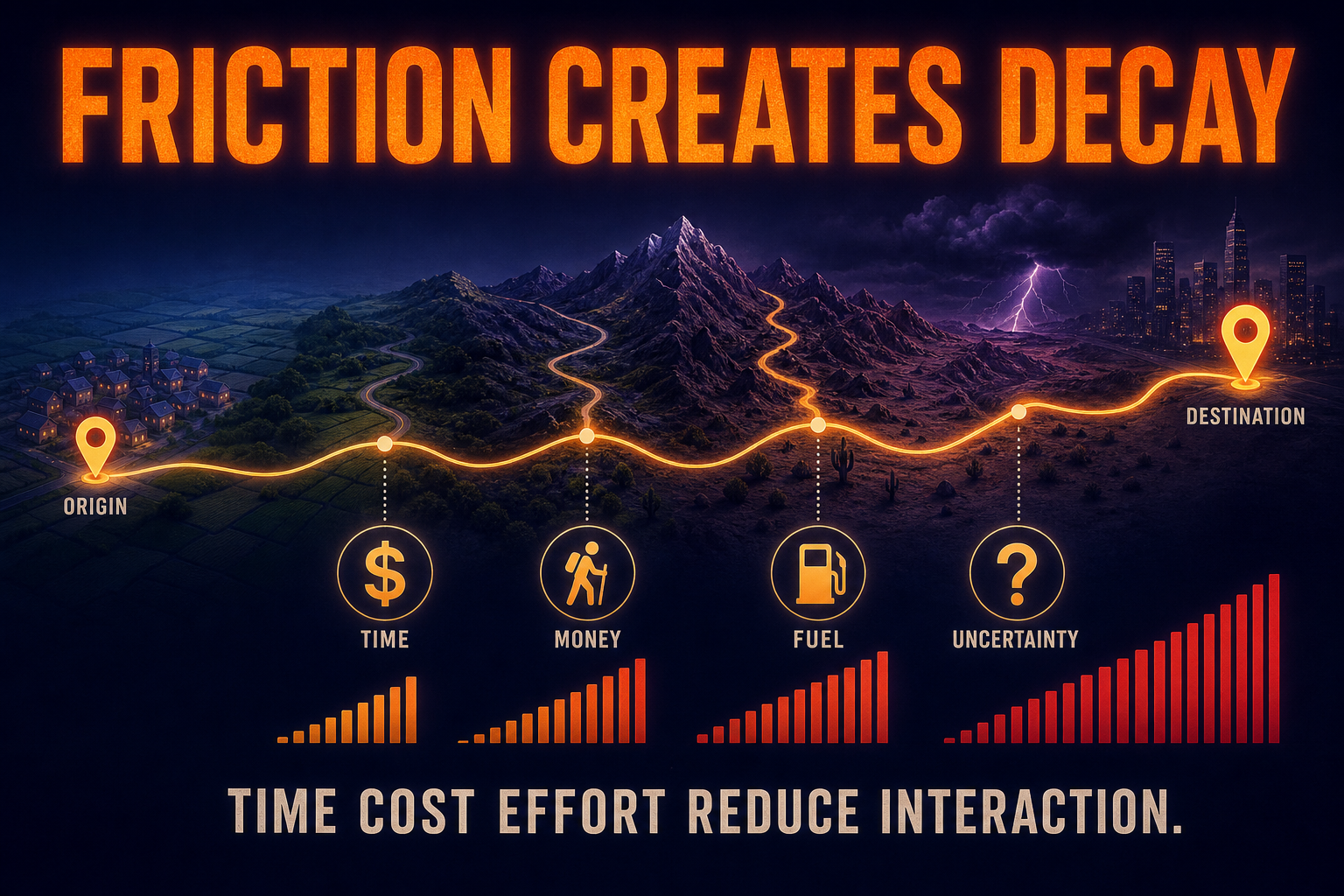
Friction of distance is the cause: distance adds time, money, effort, and uncertainty.
Distance decay appears in migration, trade, shopping, commuting, services, diffusion, and urban patterns.
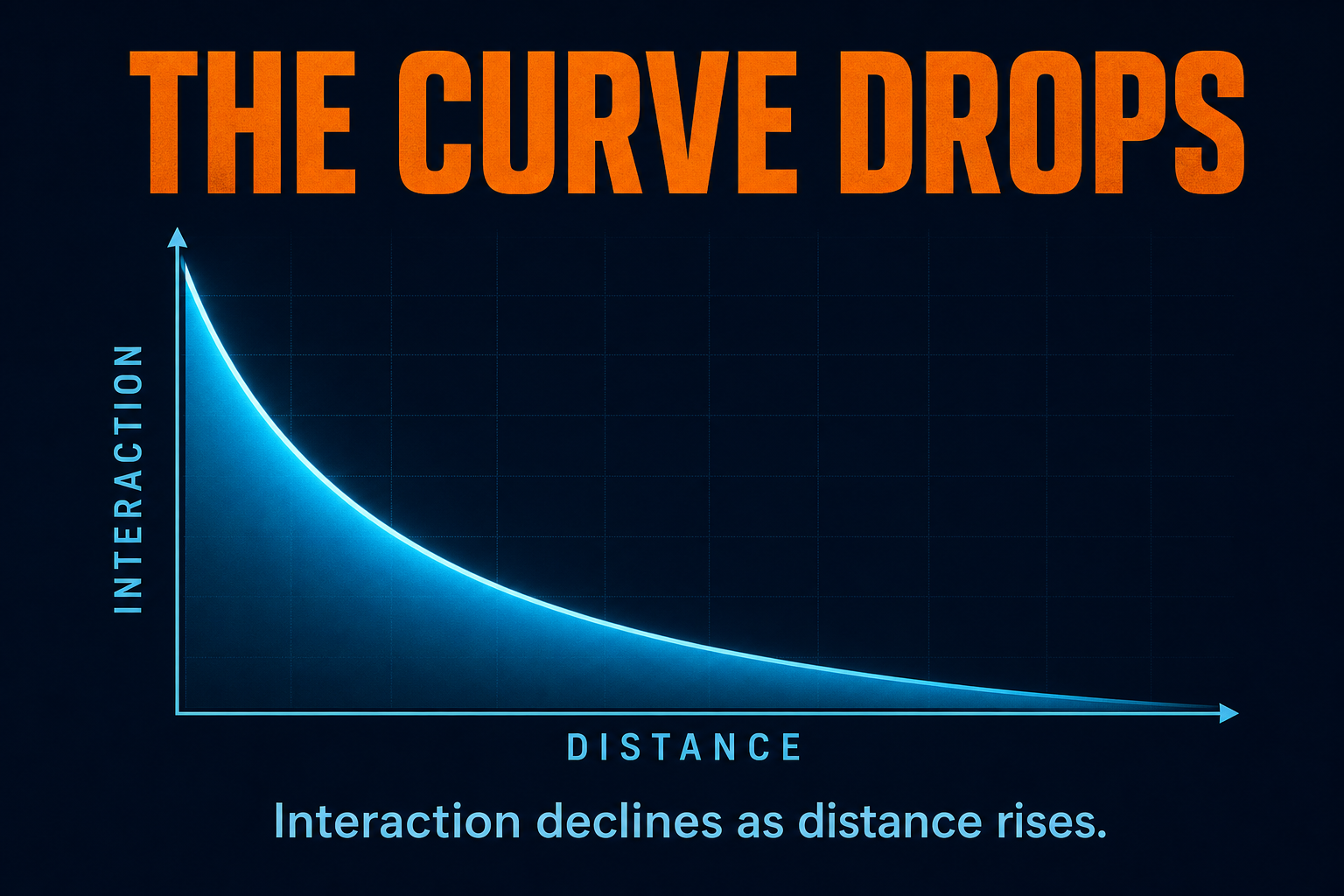
A distance decay graph usually slopes downward as distance rises.
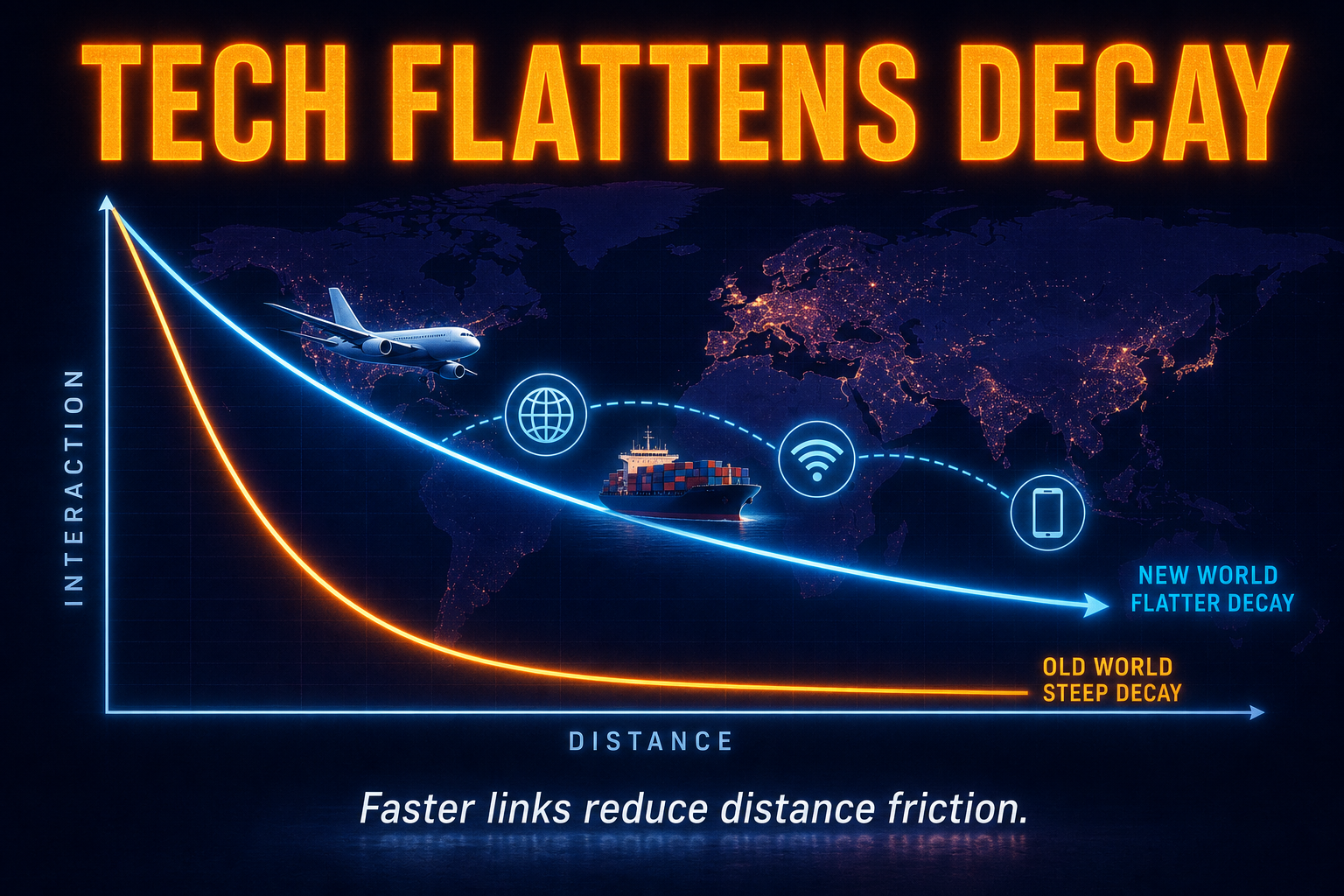
Time-space compression can flatten the curve, but it does not eliminate distance decay.
Distance Decay Summary Slides
Review these Distance Decay summary slides to preview the definition, decay curve, and AP Human Geography vocabulary.
Watch for the chain: distance adds friction, and friction reduces interaction between places.
Memory Shortcut
Distance decay = farther places interact less.
Near = stronger interaction
Far = weaker interaction
Friction = reason
Technology = curve flattener
Examples = migration, trade, services, diffusion
Start Here: How to Use This Distance Decay Guide
Learn the definition of distance decay.
Connect distance decay to friction of distance.
Practice reading the distance decay graph.
Study examples from migration, trade, services, and diffusion.
Finish with MCQs, flashcards, and FRQ practice.
Do Not Confuse Distance Decay, Friction, and Compression
Distance Decay
The pattern: interaction usually decreases as distance increases.
Friction of Distance
The cause: distance adds time, cost, effort, and uncertainty.
The modifier: technology reduces relative distance and can flatten the decay curve.
Relative Distance
Distance measured by time, cost, effort, accessibility, or perceived closeness.
Pair distance decay with space (arrangement across an area), relative location (relational position), and spatial analysis (pattern reasoning) so each concept stays distinct on the exam.
Section 1
📖
Distance Decay Definition
Distance decay is the geographic principle that interaction intensity decreases as distance increases. People, goods, ideas, information, and influence usually move more easily between nearby places than between distant places because distance increases the cost of interaction.
Distance decay
Interaction between places usually decreases as distance increases.
Interaction
Movement, communication, trade, migration, visits, influence, or exchange between places.
Friction of distance
The time, cost, effort, and uncertainty created by distance.
Spatial interaction
The movement or connection of people, goods, ideas, or information across space.
Decay curve
A downward trend showing interaction falling as distance rises.
Effective distance
Distance measured by time, cost, effort, or accessibility rather than miles alone.
Time-space compression
Technology reducing the time, cost, or effort needed to interact across distance.
The simple version is: the farther away something is, the less people usually interact with it. Students shop more often near home, migrants often move shorter distances first, and businesses often trade more with nearby partners because nearby interaction is cheaper and easier.
AP Exam Tip
Do not say long-distance interaction is impossible. Say interaction usually declines as distance increases.
Section 3
📉
Distance Decay Graph
A distance decay graph usually has distance on the x-axis and interaction on the y-axis. The curve starts high at short distances and drops as distance increases. This means nearby places interact more often, while distant places interact less often.
A distance decay graph usually shows interaction high at short distances and lower as distance increases.
X-axis
Distance increases from left to right.
Y-axis
Interaction intensity increases upward.
Steep early drop
Small increases in distance can quickly reduce routine interaction.
Flattening curve
Some long-distance interaction still exists, but at lower intensity.
Technology effect
Better transportation or communication can make the curve less steep.
AP Exam Tip
If a graph shows interaction falling as distance rises, think distance decay.
A steeper curve means distance creates strong friction quickly; a flatter curve means technology, infrastructure, or lower costs weaken the effect of distance.
Section 4
🛣️
Friction of Distance
Friction of distance is the reason distance decay happens. Distance creates barriers that make interaction harder, slower, more expensive, or less predictable.
Friction of distance is the time, money, effort, and uncertainty that cause interaction to weaken over distance.
Time cost
Longer trips take more time.
Money cost
Fuel, shipping, tickets, or delivery fees increase.
Effort cost
Planning, fatigue, and inconvenience increase.
Information cost
Distant places may feel less familiar or predictable.
Risk
Longer routes may involve delays, borders, weather, or uncertainty.
Social cost
Long distance can weaken daily social ties.
Distance decay is the effect; friction of distance is the cause. Pair friction (cause) with distance decay (effect) and space (the framework where interaction occurs).
Section 5
📍
Distance Decay Examples
Distance decay appears in migration, trade, shopping, commuting, service areas, cultural diffusion, and social interaction.
Shopping
People usually visit nearby stores more often than distant stores.
Food delivery
Restaurants often have a delivery radius because longer trips cost more.
Commuting
Workers are less likely to commute very long distances every day.
Migration
People often move to nearby cities, counties, states, or countries before distant places.
Trade
Neighboring countries often trade heavily because shipping and coordination costs are lower.
Cultural diffusion
A cultural trait may spread strongly near a hearth before weakening with distance.
Healthcare access
Clinic use may drop when travel time increases.
Social interaction
People usually see nearby friends more often than faraway friends.
Section 6
🚚
Distance Decay in Migration and Trade
Distance decay is important because it explains real human geography patterns across several AP units.
Shorter-distance migration is often more common because nearby moves reduce travel cost, emotional risk, uncertainty, and loss of social networks. Distance decay also helps explain why shorter-distance migration is often more common than long-distance migration. See Unit 2 Population and Migration for migration patterns.
Trade often declines with distance because shipping, fuel, time, insurance, customs, and coordination costs increase.
Migration effects
nearby moves are easier
social networks remain closer
jobs and culture may be more familiar
uncertainty is lower
Trade effects
shipping costs rise
delivery time increases
supply chains become harder to coordinate
nearby partners may have stronger flows
AP Exam Tip
For FRQs, do not just say "farther equals less." Name the interaction type and the friction source.
Section 7
⚖️
Distance Decay vs Friction of Distance
Concept
Meaning
Example
Role
Distance decay
Interaction decreases as distance increases
Fewer customers come from far zip codes
Effect or pattern
Friction of distance
Distance creates time, cost, effort, and uncertainty
Delivery becomes expensive outside a radius
Cause or mechanism
Spatial interaction
Movement or connection across space
Migration, trade, commuting, diffusion
The flow being measured
Effective distance
Distance measured by time, cost, or effort
A 30-minute train ride feels closer than a 90-minute drive
Not just miles
Distance decay is what happens. Friction of distance explains why it happens. Compare this table with relative location when prompts mix relational position with interaction strength.
Section 8
⏱️
Distance Decay and Time-Space Compression
Time-space compression can weaken distance decay by reducing the time, cost, or effort of interaction across distance. Airplanes, highways, container shipping, smartphones, GPS, video calls, fiber optics, and the internet can make distant places feel closer. However, distance decay does not disappear because cost, time zones, borders, infrastructure, language, culture, and access still matter.
Time-space compression can weaken distance decay by reducing travel, shipping, and communication friction.
Concept
Meaning
Example
Connection
Distance decay
Interaction declines with distance
People shop more often nearby
Distance creates friction
Time-space compression
Technology reduces relative distance
Video calls and flights connect distant places
Can flatten the decay curve
Both together
Distance still matters, but sometimes less
Global business calls are easy, but local friendships may still be stronger
Technology modifies decay
Read the full time-space compression guide when technology reduces travel, shipping, or communication friction without eliminating distance decay.
Section 9
📐
Tobler's First Law
Tobler's First Law says: everything is related to everything else, but near things are more related than distant things. This is not exactly the same as distance decay, but it summarizes the same basic geographic logic: proximity usually strengthens relationships.
Tobler's First Law
Near things tend to be more related than far things.
Distance decay
Interaction tends to decrease as distance increases.
Spatial interaction
The flow or relationship between places.
AP use
Use Tobler's First Law as a supporting idea, not a replacement for explaining friction.
AP Exam Tip
If you mention Tobler's First Law, still explain the mechanism: time, cost, effort, and uncertainty.
Section 10
🗺️
Distance Decay Across AP Human Geography Units
Unit 1 Thinking Geographically
Spatial interaction, maps, graphs, and distance relationships.
Unit 2 Population and Migration
Shorter-distance migration and step migration.
Unit 3 Cultural Patterns
Cultural traits often weaken with distance from a hearth.
Unit 4 Political Patterns
Neighboring states may have stronger alliances, conflicts, or border interactions.
Unit 5 Agriculture
Von Thünen's model connects land use to distance from market and transport cost.
Unit 6 Cities
Commuting, service areas, and land values often vary with distance from the core.
Unit 7 Development
Trade, outsourcing, and supply chains depend partly on distance and cost.
The gravity model in spatial analysis also connects interaction strength to distance. Use scale of analysis when a prompt shifts from local service areas to global trade flows.
Section 11
🧪
Advanced Distance Decay Scenarios
Retail trade areas
A store gets most customers from nearby neighborhoods.
AP exam clue: Customer interaction weakens with distance from the store.
Interstate migration
People often move to nearby states before distant states.
AP exam clue: Distance adds cost, uncertainty, and social-network loss.
Cultural diffusion
A language or custom may be strongest near its hearth.
AP exam clue: Influence often weakens with distance from origin.
Food delivery
A restaurant limits delivery to a radius.
AP exam clue: Time and fuel costs create friction.
Healthcare access
Clinic visits decline as travel time increases.
AP exam clue: Service use drops when access becomes harder.
Trade corridors
Neighboring countries often trade heavily.
AP exam clue: Shipping and coordination costs are lower nearby.
Urban commuting
Daily commuting falls when travel time becomes too long.
AP exam clue: Friction shapes activity space and labor access.
Digital communication
Video calls weaken distance decay for information.
AP exam clue: Time-space compression flattens the curve for some flows.
Section 12
❌
Common Distance Decay Mistakes
Saying distance decay means no long-distance interaction
Fix: Interaction usually decreases, but long-distance interaction can still happen.
Forgetting friction of distance
Fix: Explain time, money, effort, or uncertainty.
Confusing cause and effect
Fix: Friction is the cause; decay is the effect.
Ignoring technology
Fix: Technology can flatten the curve through time-space compression.
Saying technology eliminates distance
Fix: Technology reduces friction for some flows, but distance still matters.
Forgetting interaction type
Fix: Name the flow: migration, trade, visits, shopping, communication, or diffusion.
Misreading the graph
Fix: Distance goes on the x-axis; interaction goes on the y-axis.
Giving vague examples
Fix: Use named examples such as food delivery radius, nearby migration, neighboring-country trade, or service-area decline.
Common Mistake: Describing a distance pattern without naming friction of distance, the interaction type, or how time-space compression may modify the curve.
Section 13
🎯
AP Exam Strategy for Distance Decay
In MCQs
Look for interaction decreasing as distance increases.
Watch for words like nearby, local, radius, corridor, travel time, shipping cost, delivery range, or customer distance.
Identify the interaction type.
Connect the pattern to friction of distance.
Recognize technology as a modifier, not a full eraser.
In FRQs
Define distance decay.
Identify the interaction type.
Explain the distance effect.
Name a friction source.
Add a specific example.
Mention time-space compression if technology reduces friction.
Example: A restaurant may receive most orders from nearby neighborhoods because delivery time, fuel cost, and driver effort increase with distance. This is distance decay because customer interaction decreases as distance from the restaurant increases.
Answer: A — Distance decay means interaction usually weakens as distance increases—not that distance never matters.
Section 15
📋
Distance Decay FRQ Practice
Strong distance decay FRQs identify the interaction, explain how distance reduces it, and name the friction causing the decline.
Prompt: A restaurant in a large metropolitan area maps its online food delivery orders. Most orders come from neighborhoods within five miles of the restaurant, while very few orders come from neighborhoods more than twenty miles away.
A. Define distance decay.
B. Explain how this scenario shows distance decay.
C. Explain how friction of distance causes this pattern.
D. Explain how time-space compression could change the restaurant's delivery pattern.
Suggested answer:
A. Distance decay is the principle that interaction between places usually decreases as distance increases.
B. The restaurant receives many orders from nearby neighborhoods and fewer orders from distant neighborhoods. This shows distance decay because customer interaction weakens as distance from the restaurant increases.
C. Friction of distance causes the pattern because longer delivery trips take more time, cost more money, require more driver effort, and may reduce food quality or reliability.
D. Time-space compression could change the pattern if delivery apps, better routing, faster roads, or logistics technology reduce delivery time and cost. This could expand the restaurant's effective delivery area, although distance would still matter.
Rubric
Part A: Must define distance decay as interaction decreasing as distance increases.
Part B: Must apply the pattern to nearby vs distant orders.
Part C: Must explain time, cost, effort, uncertainty, or another friction source.
Part D: Must explain how technology or transportation can reduce friction and flatten the decay curve without fully eliminating distance.
Distance Decay Practice Questions for AP Human Geography
Use these distance decay practice questions to test definitions, friction of distance, graphs, migration and trade patterns, time-space compression, Tobler's First Law, and FRQ reasoning.
Use these flashcards to review distance decay vocabulary, friction of distance, graphs, migration and trade examples, time-space compression, Tobler's First Law, and AP exam clues.
Distance decay is the principle that interaction between places usually decreases as distance increases. Nearby places tend to have stronger trade, migration, communication, visits, and influence because distance creates time, money, effort, and uncertainty costs.
What is a simple definition of distance decay?
Distance decay means farther places usually interact less.
What is an example of distance decay?
A restaurant receiving many delivery orders from nearby neighborhoods and fewer orders from distant neighborhoods is an example of distance decay.
What does a distance decay graph show?
A distance decay graph shows interaction on the y-axis and distance on the x-axis. The curve usually slopes downward because interaction decreases as distance increases.
What is friction of distance?
Friction of distance is the time, money, effort, and uncertainty created by distance. It is the main cause of distance decay.
What is the difference between distance decay and friction of distance?
Distance decay is the effect, meaning interaction decreases with distance. Friction of distance is the cause, meaning distance adds costs and barriers.
What is Tobler's First Law?
Tobler's First Law says that everything is related to everything else, but near things are more related than distant things.
How does distance decay affect migration?
Distance decay helps explain why shorter-distance migration is often more common than long-distance migration because nearby moves usually cost less and preserve more social connections.
How does distance decay affect trade?
Distance decay helps explain why nearby countries or regions may trade more because shipping, coordination, travel time, and uncertainty are often lower.
Does time-space compression eliminate distance decay?
No. Time-space compression can weaken distance decay by reducing travel, shipping, and communication friction, but distance still matters because of cost, borders, infrastructure, culture, and access.
Where does distance decay appear on the AP Human Geography exam?
Distance decay appears in Unit 1 spatial interaction and also connects to migration, cultural diffusion, agriculture, urban geography, trade, services, and development.
How should students write about distance decay in an FRQ?
Students should define distance decay, identify the interaction type, explain how distance reduces interaction, and name a friction source such as time, cost, effort, or uncertainty.