📝 AP Exam Registration
Get the timeline and signup process before deadlines pass.
Read more →AP Exam Resources
AP scores matter twice: for college credit rules and as honest feedback on where your studying worked. This page covers the 1–5 scale and timing, then adds score-use strategy, common misunderstandings, and how to feed results back into APScore5 practice.
College Board explains what each number means and how to send scores. Students still need a plan for what to do after the number lands—especially when credit policies differ by campus.
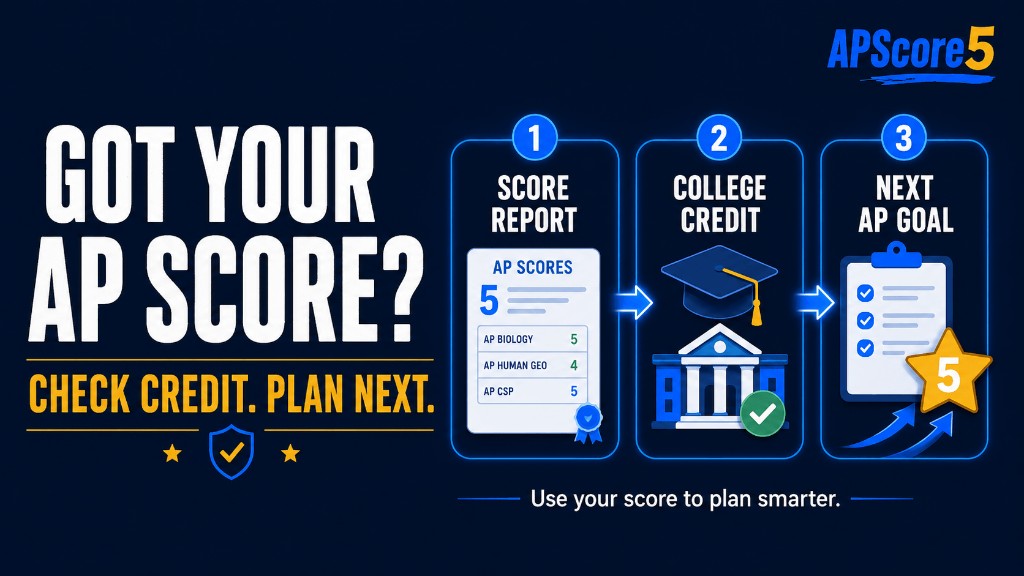
Release timing does not change what you can practice today. Chain summer review to daily practice and log weak topics on practice by course so the next sitting reflects real repair work—not hope.
AP exams use a 1 to 5 scale to describe how strongly your performance matches college-level expectations. A 3 is typically seen as passing, while 4 and 5 tend to earn the widest credit and placement options at selective schools.
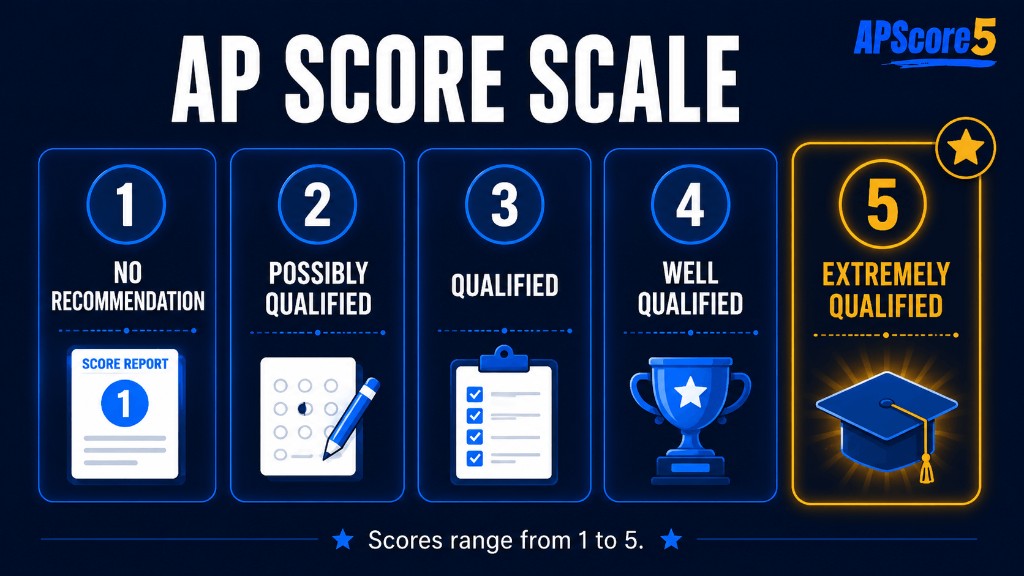
| Score | Meaning | College Credit |
|---|---|---|
| 5 | Extremely well qualified | Yes (most colleges) |
| 4 | Well qualified | Yes (many colleges) |
| 3 | Qualified | Sometimes |
| 2 | Possibly qualified | Rarely |
| 1 | No recommendation | No |
AP scores are usually released in early to mid July through the College Board portal. Release commonly rolls out over multiple days rather than one universal timestamp. Students should verify account access ahead of time so they can view scores immediately.
There are typically no weekend score releases, and timing can vary slightly by account and processing order. If you plan to retest, register for next year's AP exam after checking current AP exam dates.
Each AP exam blends multiple-choice and free-response performance into a composite score. That composite is then converted to a final 1 to 5 AP score using statistical methods and annual calibration. Your AP score is not based on your classroom curve and is not capped by your school average.
Colleges use AP scores for credit, course placement, or both. Many institutions publish subject-by-subject credit charts showing exactly which score earns credit.
Checking policy early helps students decide whether to retake a subject, send scores, or plan around entry-level course waivers.
Students usually get one free score send each year if selected before the June cutoff. Additional score reports generally cost $15 each. If you are applying to multiple colleges, plan score sends early so you can avoid rush decisions and extra fees.
Yes. Score cancellation (about $10) removes the score from your AP record permanently. Score withholding (about $10 per college) hides a score from selected schools. Both options have deadlines and forms, so submit requests as soon as you decide. As exam day approaches, review what to bring on test day and keep a linked checklist with your dates.
On many AP subjects, roughly 10% to 20% of students score a 5, but each subject has a different distribution. A 5 in one subject may represent a different percentile than a 5 in another. Do not compare subjects directly without context.
Use your own target subject and college policy as your benchmark instead of broad comparisons. For subject prep context, AP Biology students often score differently by unit weighting, AP Human Geography scoring trends depend on model application, and AP CSP scoring is tied to both exam and performance task readiness.
Build momentum with daily practice, do weak-topic review, add full practice tests, and create a free account to track progress.
A score of 3 is generally considered passing, but each college controls credit policy.
Most AP scores are released in early to mid July.
Colleges usually receive the scores you choose to send.
A 3 is a valid result and can be useful, though many selective schools prefer 4 or 5 for credit.
Yes, students can retake AP exams in future test years.
Use College Board score-send services and add each recipient institution.
Daily practice beats last-minute cramming. Try APScore5 free.
Start Free Practice →Score release and sending policies live on College Board; colleges set credit separately.
Last verified: May 10, 2026 against the page above.