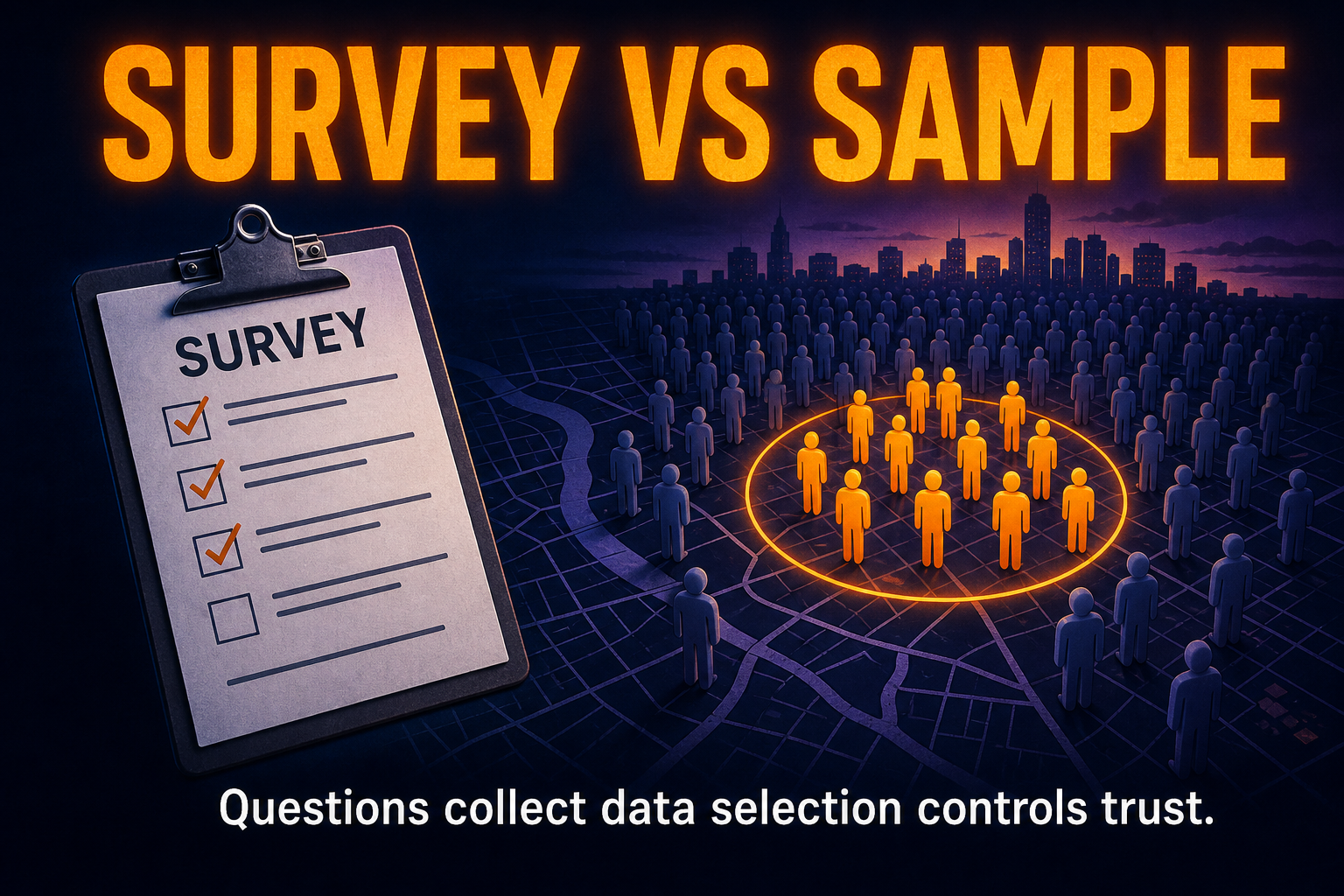
Learn how geographers use surveys, samples, random selection, response patterns, and bias checks to study people's opinions, behaviors, perceptions, needs, movement, and lived experiences across places.
Updated June 5, 2026 · Reviewed by APScore5 Editorial Team
Survey data asks people questions, while sampling determines whether the people asked fairly represent the larger population or place being studied.
Quick answer
⚡
What Are Survey Data and Sampling in AP Human Geography?
Survey data is information collected by asking people questions about opinions, behaviors, movement, needs, perceptions, or experiences. Sampling is the process of choosing a smaller group of people or places to represent a larger population. In AP Human Geography, students must evaluate whether the sample is large enough, representative, fairly selected, and free from major bias.
AP exam clue
If the prompt mentions respondents, questionnaires, sample size, random selection, nonresponse, or missing groups, it is testing survey data and sampling.
Survey data is collected by asking people questions.
Sampling means studying part of a population to understand the whole population.
A strong sample is both large enough and representative.
Sampling bias happens when the people surveyed do not fairly represent the population being studied.
Survey data can be quantitative, qualitative, or both.
Memory Shortcut
Survey = ask people. Sample = who you ask.
Survey asks questions.
Sample selects respondents.
Random sampling reduces bias.
Bad samples distort conclusions.
Always ask who is missing.
Start Here: How to Use This Survey Data Guide
Learn the difference between survey data and sampling.
Review sample size, representativeness, and random sampling.
Study bias types such as sampling, nonresponse, self-selection, and technology bias.
Compare survey data with census, quantitative, and qualitative data.
Finish with MCQs, flashcards, and FRQ practice.
Do Not Confuse Survey Data With Census, Quantitative, or Qualitative Data
Descriptive evidence from words, interviews, observations, field notes, and open-ended responses.
Evaluate any source with the data reliability and bias guide after you check who was surveyed and who is missing.
Section 1
📖
Survey Data Definition
Survey data is information collected by asking people questions. Geographers use survey data to study opinions, behaviors, perceptions, needs, movement patterns, migration decisions, service access, sense of place, and lived experiences. Survey data is a core spoke inside the Geographic Data and Technology cluster and often pairs with qualitative geographic data and quantitative geographic data when you explain what people report.
Survey data
Information collected by asking people questions.
Survey
A research tool that asks a set of questions to gather information from respondents.
Respondent
A person who answers survey questions.
Questionnaire
The list of questions used in a survey.
Closed-ended question
A question with fixed answer choices that can often be counted.
Open-ended question
A question where respondents answer in their own words.
Response
An answer given by a survey participant.
Survey mode
The way a survey is delivered, such as online, paper, phone, or in person.
Survey responses can feed GIS layers and spatial analysis when planners map where needs cluster across neighborhoods.
Section 2
🎯
Sampling Definition
Sampling is the process of choosing a smaller group of people or places to represent a larger population. Geographers use sampling because they usually cannot ask every person in a city, region, country, or neighborhood.
Population
The full group being studied.
Sample
The smaller group actually surveyed.
Sample size
The number of people or places included in the sample.
Sampling frame
The list or source from which the sample is selected.
Representativeness
How well the sample matches the larger population.
Margin of error
A measure of uncertainty in survey estimates, usually used in more advanced survey reporting.
Sampling = studying part of a population to understand the whole population.
AP Exam Tip
A large sample is not automatically good. A sample must also represent the population and places being studied.
Survey data comes from asking questions, while sampling determines whether the respondents fairly represent the larger population.
Evaluate whether a sample is trustworthy using the data reliability and bias guide before you generalize results to a whole city or region.
Section 3
🗺️
Why Survey Data Matters in Human Geography
Human geography studies people and places. Many geographic questions require understanding what people do, think, prefer, need, or experience. Surveys help collect that information directly from people, especially when the information is not visible in a map, satellite image, or census table.
Migration
Why did people move?
Transportation
How do people commute and what barriers do they face?
Gentrification
How do residents experience neighborhood change?
Food access
How far do people travel for groceries?
Public services
Which neighborhoods lack parks, clinics, schools, or transit?
Sense of place
How do people perceive or value a place?
Language and culture
What languages are used at home or in community spaces?
Environmental justice
How do residents experience pollution, risk, or health impacts?
Survey data helps geographers understand opinions, behaviors, perceptions, service needs, and lived experiences that maps and census tables may not show.
Survey evidence complements census data when you need opinions, perceptions, or behaviors that official counts do not capture at scale of analysis.
Section 4
📊
Sample Size and Representativeness
Sample size is the number of people or locations included in a survey. Larger sample sizes can improve reliability, but only if the sample represents the larger population. A large sample from one wealthy suburb does not represent an entire metropolitan area.
Sample size
Meaning
How many people or places were surveyed.
AP clue
Very small samples may be unstable or unreliable.
Representativeness
Meaning
How well the sample matches the larger population.
AP clue
Even a large sample can be biased if important groups or places are missing.
AP Exam Tip
For AP Human Geography, the best answer usually explains both size and representation.
A strong survey needs enough responses and a representative mix of people, places, neighborhoods, and demographic groups.Section 5
🔀
Sampling Methods AP Students Should Know
Method
How it works
Advantage
Limitation
Random sampling
Every eligible person or location has an equal chance of being selected
Reduces researcher selection bias
Requires a complete sampling frame
Stratified sampling
The population is divided into groups, then sampled within each group
Improves representation across subgroups or neighborhoods
Requires knowing the important groups in advance
Systematic sampling
Every nth person, house, or location is selected
Simple and organized
Can be biased if there is a hidden pattern
Cluster sampling
Groups or areas are selected, then people inside those clusters are surveyed
Efficient for large geographic areas
May miss variation between clusters
Convenience sampling
Researchers survey people who are easiest to reach
Fast and cheap
Often biased toward accessible places or people
Snowball sampling
Respondents help recruit other respondents
Useful for hard-to-reach groups
Not easily generalizable
AP Exam Tip
Random and stratified sampling usually reduce bias; convenience and voluntary online samples often increase bias.
Section 6
⚠️
Sampling Bias in AP Human Geography
Sampling bias happens when the people or places surveyed do not fairly represent the larger population being studied. If important groups are missing, the results can be misleading even when the sample is large.
Who was surveyed → Who was missing → How the result is distorted
Example: If a city surveys only people at a downtown train station, the sample overrepresents train riders and underrepresents drivers, cyclists, pedestrians, remote workers, and people who live far from rail lines. The survey may overestimate public transit use.
Sampling bias occurs when the survey sample misses important people, places, or groups, causing misleading geographic conclusions.
Technology bias also appears in geotagged data when smartphone users are overrepresented in volunteered geographic information.
Location metadata raises separate geospatial privacy concerns when repeated check-ins or GPS traces could identify individuals.
Section 7
🚫
Survey Bias Types
Sampling bias
The sample does not represent the larger population.
Example: Surveying only train riders to estimate how an entire city commutes.
Nonresponse bias
People who do not answer differ from people who respond.
Example: Busy parents, shift workers, or renters may skip surveys.
Self-selection bias
People choose whether to participate.
Example: Only residents strongly opposed to a project complete a voluntary survey.
Technology bias
The survey mode excludes people without technology access.
Example: Online-only surveys miss people without reliable internet.
Question wording bias
The wording pushes respondents toward a certain answer.
Example: "Do you support this dangerous development project?"
Social desirability bias
People answer in ways they think sound acceptable.
Example: Respondents overstate recycling or understate prejudice.
Location bias
The survey location affects who is included.
Example: Surveying at a mall misses residents who shop elsewhere.
Time-of-day bias
The survey time excludes people with different schedules.
Example: Midday surveys miss night-shift workers.
Survey bias can come from who is selected, who responds, how the survey is delivered, where it is conducted, or how questions are worded.
Use the data reliability and bias checklist to name who is missing and how the conclusion changes on FRQs.
Section 8
🔢
Can Survey Data Be Quantitative or Qualitative?
Survey data can be quantitative, qualitative, or both. Closed-ended survey questions often produce quantitative data because the answers can be counted. Open-ended survey questions often produce qualitative data because respondents explain experiences, perceptions, or reasons in their own words.
Response type
Example
Data type
AP clue
Numerical answer
"I commute 35 minutes."
Quantitative
Number, measure, count.
Category answer
"I drive to work."
Quantitative when counted
Percent or frequency by category.
Likert-scale answer
"Safety rating: 4 out of 5."
Quantitative summary with limits
Rating scale, compressed opinion.
Open-ended answer
"I avoid the park because it feels unsafe."
Qualitative
Description, perception, lived experience.
A survey is a collection method; quantitative and qualitative describe the type of response the survey produces.
Survey data collects information from a sample. Census data attempts to count or describe the entire population, usually through an official government process. Surveys are often more flexible and can ask about opinions or behaviors, while census data is broader and more official.
Feature
Survey Data
Census Data
Goal
Study a sample
Count or describe the whole population
Source
Governments, researchers, firms, schools, NGOs
Usually government statistical agencies
Best for
Opinions, behavior, perceptions, service needs
Official population and housing patterns
Strength
Flexible and targeted
Broad, official, geographic coverage
Limitation
Sampling bias and nonresponse bias
Undercounting, outdated data, scale and category issues
AP clue
Sample, respondents, questionnaire
Official count, tract, block, demographic table
Census data is stronger for official population counts, while survey data is stronger for flexible questions about opinions, behaviors, perceptions, and needs.
Mix of neighborhoods, ages, incomes, languages, and groups
Multiple response modes such as paper, phone, online, and in-person
Clear and neutral question wording
Low nonresponse rate
Accessible language options
Transparent methods
Weak survey signs
Convenience sample from one place
Tiny sample size
Online-only collection
Missing neighborhoods or groups
Leading or loaded questions
High nonresponse rate
No method explanation
Claims are broader than the sample allows
AP Exam Tip
A strong survey should match the research question. A neighborhood survey can answer a neighborhood question, but not a whole-city question.
Section 11
❌
Common Survey Data and Sampling Mistakes
Saying "the survey is biased" without explaining how
Fix: Name who is missing and how the result changes.
Confusing sample size with sample quality
Fix: A big sample can still be biased if it is not representative.
Treating all surveys as unreliable
Fix: Surveys can be strong when sampling and question design are careful.
Forgetting surveys can be quantitative
Fix: Numerical survey responses can be counted, averaged, mapped, and compared.
Forgetting surveys can be qualitative
Fix: Open-ended responses can explain perception and lived experience.
Confusing surveys with census data
Fix: A survey samples part of a population; a census tries to count the whole population.
Ignoring question wording
Fix: Leading questions can shape answers.
Missing the geographic scale
Fix: A sample from one neighborhood cannot automatically describe the whole city.
Common Mistake: Writing that a survey is biased without naming who was surveyed, who was left out, and how the missing group distorts the geographic conclusion.
Section 12
🎯
AP Exam Strategy for Survey Data and Sampling
In MCQs
Identify survey data from clues about asking people questions.
Identify sampling from clues about who was selected.
Watch for bias from location, technology, voluntary response, or missing groups.
Compare surveys with census, quantitative, and qualitative data.
Ask whether the sample matches the population being studied.
Example: An online park-access survey may have technology bias because residents without reliable internet are less likely to respond. This may underrepresent lower-income or elderly residents, causing the city to underestimate park-access problems in those neighborhoods. A stronger method would combine online, paper, phone, and in-person surveys across all neighborhoods.
Prompt: A city wants to understand why some neighborhoods have lower access to public parks. Researchers survey 1,000 residents about park use, travel distance, safety concerns, and transportation access. Most survey responses come from residents who completed an online form.
A. Define survey data.
B. Explain how survey data could help the city understand park access.
C. Explain one possible source of sampling bias in the scenario.
D. Explain why sample size alone does not guarantee reliable results.
Suggested answer:
A. Survey data is information collected by asking people questions about their behaviors, opinions, experiences, or needs.
B. Survey data could show how far residents travel to reach parks, whether they feel safe using parks, and whether transportation limits their access. This helps identify which neighborhoods face barriers to park use.
C. The survey may have technology bias because most responses came from an online form. Residents without reliable internet access, older residents, or lower-income residents may be underrepresented.
D. Even though 1,000 responses may seem large, the results can still be biased if the sample does not represent the whole city. If responses mostly come from internet users or certain neighborhoods, the survey may not accurately reflect residents with the greatest park access problems.
Rubric
Part A: Must mention asking people questions and the kinds of information collected.
Part B: Must connect survey data to specific decisions about park access.
Part C: Must name a specific bias source and explain who is underrepresented.
Part D: Must explain that representativeness, not size alone, drives reliability.
Survey Data and Sampling Practice Questions for AP Human Geography
Use these survey data and sampling practice questions to test whether you can identify questionnaires, sample bias, random sampling, census comparisons, quantitative vs qualitative responses, and strong FRQ writing moves.
Survey data is information collected by asking people questions. Geographers use it to study opinions, behaviors, experiences, needs, perceptions, and movement patterns across places.
What is an example of survey data?
Asking residents how they commute to work, how far they travel for groceries, or why they moved to a city are examples of survey data. The answers can be numerical, descriptive, or both.
What is sampling in geography?
Sampling is collecting data from a smaller group of people or places to represent a larger population. Geographers use it because they usually cannot ask every person in a city or country.
What is sample size?
Sample size is the number of people or locations included in a survey. Larger sample sizes can improve reliability, but only if the sample represents the population.
What is sampling bias in AP Human Geography?
Sampling bias happens when a survey includes people or places that do not represent the larger population. For example, surveying only train riders will overestimate public transit use.
Why does sample size matter in geographic research?
Sample size matters because very small samples may produce unstable or unreliable results. However, a large sample can still be biased if it leaves out important groups.
What is random sampling?
Random sampling is a method where every person or location in the population has an equal chance of being selected. It helps reduce sampling bias.
What is stratified sampling?
Stratified sampling divides the population into important groups, such as neighborhoods or income categories, and then samples within each group to improve representation.
Can survey data be quantitative?
Yes. Survey data can be quantitative if answers are numerical, such as commute time, household size, income, rating scales, or distance traveled.
Can survey data be qualitative?
Yes. Survey data can be qualitative if answers are descriptive, such as explaining why someone migrated or how they feel about neighborhood change.
Why are surveys useful in human geography?
Surveys collect information directly from people. They help geographers understand behaviors, opinions, perceptions, and needs that may not appear in maps or census data.
What is the difference between a survey and a census?
A survey samples a portion of the population. A census tries to count or describe the entire population, usually through an official government process.
How should students explain sampling bias in an AP FRQ?
Students should identify who was surveyed, who was left out, and how the missing group could distort the geographic conclusion.