📝 AP Exam Registration
Finalize your exam order before key deadlines.
Read more →AP Exam Resources
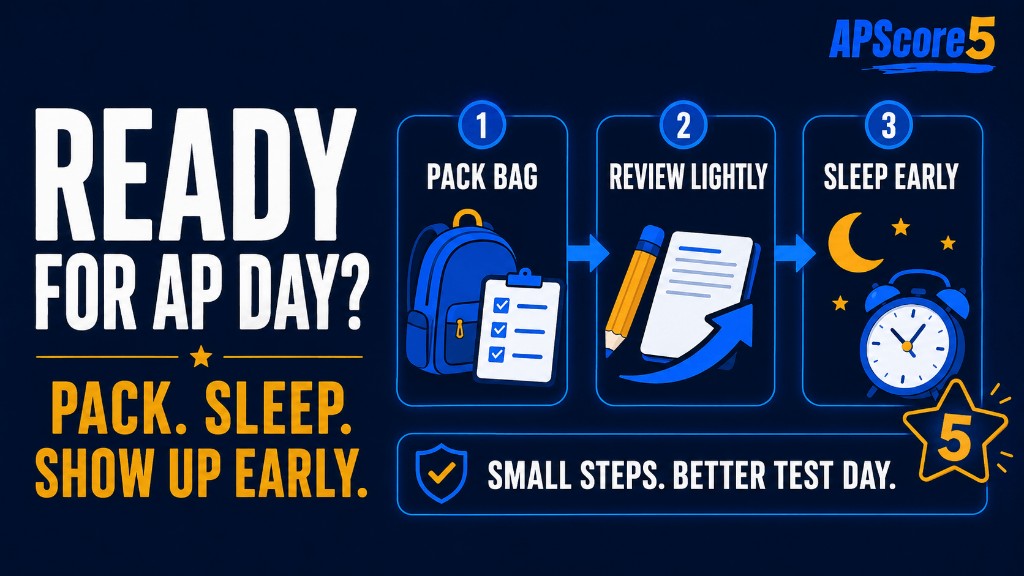
Test-day calm comes from packing once and routing nerves into a single light review target. Below: the usual bring / leave-home lists, then “room reality” notes coaches wish students knew earlier, subject-linked refreshers on APScore5, and a night-before block you can paste into your notes app.
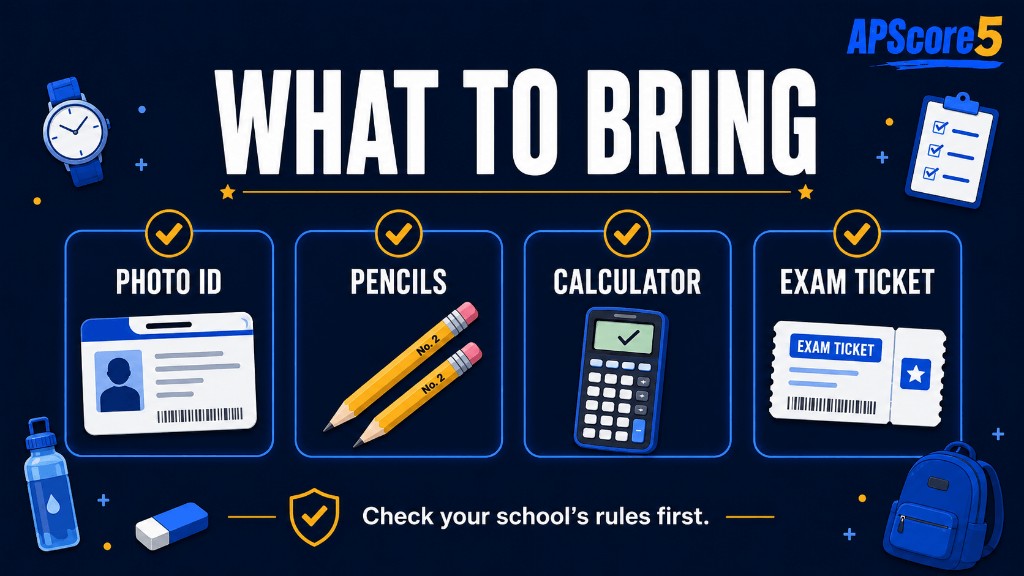
Your coordinator tells you whether each subject is paper-and-pencil, fully digital (Bluebook or school-managed testing app), or split across a mixed week. Use this table before you pack.
| Topic | Paper-and-pencil | Digital exam | Hybrid / mixed week |
|---|---|---|---|
| Writing & scratch work | #2 pencils; work in the exam booklet unless instructions say otherwise | On-screen typing and digital tools—no scratch paper you brought from home | Pack pencils and the charged device kit on the correct days |
| Power & accessories | N/A | Fully charged device and charger required for exam day per College Board digital rules | Charge nightly; label chargers so you do not grab the wrong cable |
| Pre-exam tech | N/A | Install updates and confirm login before you leave home | Switch mental checklists between analog and digital subjects |
| Calculators | Physical calculator when allowed | Follow on-screen calculator policy for that subject | Confirm each exam’s rules separately |
College Board policies define allowed tools. These notes focus on what still trips students up when the rules are technically followed.
Instead of rereading an entire unit the night before, hit one high-leverage gap: population and migration for AP Human Geography, mitosis vs meiosis for AP Biology, or algorithms and programming for AP CSP—then stop and sleep.
The easiest way to reduce test-day stress is to pack correctly the night before after you register for your AP exam and confirm your scheduled exam date. Bring approved tools, keep prohibited items out of your desk area, and confirm your check-in process.
| Bring ✓ | Don't Bring ✗ |
|---|---|
| Photo ID | Phone |
| AP ID label | Smartwatch or fitness tracker |
| Multiple #2 pencils | Headphones |
| Blue or black ink pens | Scratch paper |
| Approved calculator (if needed) | Books or notes |
| Eraser | Electronic dictionary |
| Analog watch | Food or drink at desk |
| Water and snack for break | Unapproved electronics |
College Board’s AP Exam Terms and Conditions list items you may not bring to the test or access during breaks. The full list is longer than a pocket card; these are the categories students most often forget:
Also read What to Bring on AP Exam Day and digital exam packing for format-specific notes.
Independent of College Board: these are the packing mistakes we see most often when schools follow standard proctor scripts.
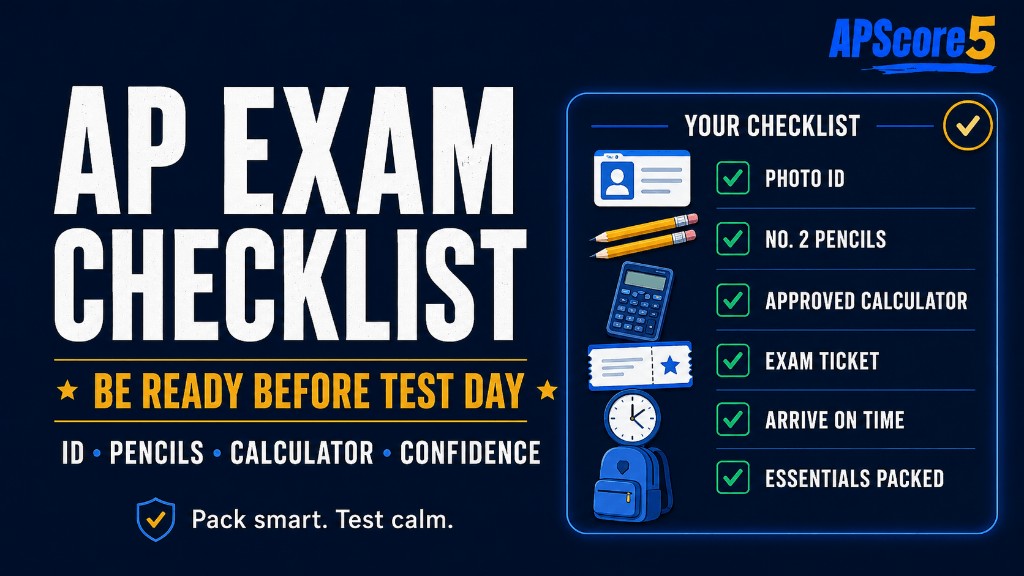
Your coordinator tells you whether each AP exam is paper-and-pencil, digital (school-managed device or College Board testing software), or a mix across the same week. Layer these format-specific checks on top of the universal bring / leave-home list above.
Most schools require school-issued or government-issued photo identification. External testers usually need valid photo ID in all cases. Expired IDs can cause check-in delays or denial, so confirm your document date in advance.
Calculator policy depends on AP subject. Some exams require graphing tools, others allow basic calculators, and some prohibit calculators entirely.
| Subject | Calculator Allowed? |
|---|---|
| AP Calculus AB/BC | Graphing calculator required |
| AP Statistics | Graphing calculator required |
| AP Physics | Scientific or graphing |
| AP Biology | 4-function or scientific |
| AP Chemistry | 4-function or scientific |
| AP Human Geography | Not allowed |
| AP CSP | Not allowed |
Always verify current official policy before exam week, including each exam fee policy at your school.
Wear comfortable clothes and bring layers. For course-specific prep, review the AP Biology calculator policy, plan for the AP Human Geography exam (no calculator), and check guidance for the AP Computer Science Principles exam. Exam rooms can be colder or warmer than expected. Avoid items that may trigger extra security checks in your location.
Do not spend hours comparing answers. Remember scores release in July, so next-step planning matters more than post-exam debate. If you have another AP exam, redirect energy to your next subject. Post-exam focus should stay on your remaining schedule and short daily practice rhythm. You can also create a free account to keep progress organized.
Phones are not allowed in active testing conditions and must be stored away.
A valid photo ID is often required, especially for external testers.
College Board’s Terms list food and drink among items you may not bring or access during the test or breaks; many schools still coordinate snack plans outside the testing room—follow your coordinator’s instructions.
Use only calculators allowed for your specific AP subject.
Arrive about 30 minutes early for check-in.
Late entry policies vary, and some schools may not admit very late students.
Yes. College Board’s exam-day and digital exam guidance tells students to bring a fully charged approved testing device and a charger. Hybrid administrations add paper-and-pencil items (such as pencils and pens) for the booklet portions while still using Bluebook rules for the digital portions—confirm your mix on My AP and in coordinator emails.
The AP Exam Terms and Conditions (Section 2) list items you may not bring or access during the test or breaks, including extra phones and communication gear, most wearable tech, unauthorized scratch paper, mechanical pencils, many styluses, headphones, and more. Some prohibitions have accommodation exceptions described in the Terms.
Use these College Board pages for authoritative rules; APScore5 summarizes for habit-building only.
Last verified: May 10, 2026 against the pages above (Terms updated April 27, 2026 on AP Students).
Daily practice beats last-minute cramming. Try APScore5 free.
Start Free Practice →