Learn how official population and housing data help geographers map demographics, compare places, study density, plan services, draw districts, and evaluate limitations such as undercounting and outdated data.
Updated June 5, 2026 · Reviewed by APScore5 Editorial Team
Census data uses official population and housing information to help geographers map demographic patterns, plan services, and study change across places.
Quick answer
⚡
What Is Census Data in AP Human Geography?
Census data is official population and housing information collected by a government. In AP Human Geography, census data helps geographers study population distribution, density, age, income, housing, language, migration, political representation, and demographic patterns across places and scales.
AP exam clue
If the prompt mentions official population counts, demographic tables, tracts, blocks, redistricting, or government data, think census data.
Census data is official population and housing data collected by a government.
It is usually quantitative because it includes counts, rates, percentages, and demographic categories.
Census data can be mapped by country, state, county, city, census tract, block group, or census block.
Geographers use census data to study density, inequality, urban growth, migration, service needs, and representation.
Census data is useful, but it can be limited by undercounting, outdated counts, scale problems, privacy rules, and changing categories.
How Census Data Fits the Data Cluster
Census data
Official population and housing data collected by a government.
A method for checking whether any data source is accurate, current, representative, and appropriate.
Memory Shortcut
Census data = official counts about people and places.
Census counts population.
Census describes households.
Census maps demographics.
Census guides services.
Census affects representation.
Start Here: How to Use This Census Data Guide
Learn the simple definition of census data.
Review census variables such as age, income, housing, and language.
Understand census tracts, census blocks, and scale.
Compare census data with survey data and quantitative data.
Finish with MCQs, flashcards, and FRQ practice.
Section 1
📖
Census Data Definition
Census data is official information collected by a government to count and describe a population. It usually includes where people live and demographic characteristics such as age, sex, race, ethnicity, household size, income, education, employment, housing, language, and migration. Census data is a supporting spoke inside the Geographic Data and Technology cluster—it is the official government source, not the same topic as the broader quantitative geographic data guide.
Census data
Official population and housing information collected by a government.
Demographic data
Information about population characteristics such as age, income, language, household size, and employment.
Census tract
A small geographic area used to organize and report census data, often useful for neighborhood-level analysis.
Census block
One of the smallest geographic units used for census reporting.
Population count
The number of people living in a place.
Housing data
Information about households, housing units, occupancy, tenure, and vacancy.
Enumeration
The process of officially counting people or households.
Undercount
When some people or households are missed in the count.
Census data includes population and housing information tied to specific places. It often reports counts, percentages, medians, and categories that geographers can map, compare, and analyze.
Total population
Example
How many people live in a country, state, city, county, tract, or block.
Age
Example
Median age, child population, elderly population, or age cohorts.
Sex
Example
Population counts by sex for population pyramids or demographic analysis.
Race and ethnicity
Example
Categories used to study cultural patterns, segregation, representation, and inequality.
Household size
Example
People per household, crowding, or changing family structure.
Income
Example
Median household income by tract or county.
Education
Example
Share of adults with high school or college education.
Employment
Example
Labor force participation, industries, or unemployment patterns.
Housing type
Example
Owner-occupied, renter-occupied, vacancy, housing units, or structure type.
Migration or residence
Example
Where people lived previously or whether an area is gaining population.
Language
Example
Language spoken at home or need for bilingual services.
Commute
Example
Travel mode, commute time, or car access.
Census data includes population, age, income, housing, language, commute, and other demographic variables that can be mapped and compared.Section 3
📍
Census Data Examples AP Students Should Know
Population density by census tract
Use
Identify dense neighborhoods and plan transit or services.
Median income by county
Use
Compare economic patterns and inequality.
Percent elderly by neighborhood
Use
Plan clinics, senior services, sidewalks, and transit access.
Households without vehicles
Use
Find places where public transportation access matters most.
Percent renter-occupied housing
Use
Study housing markets, displacement, and urban change.
Language spoken at home
Use
Plan bilingual services, schools, and outreach.
Household size
Use
Study crowding, housing demand, and family structure.
Population growth by county
Use
Compare fast-growing suburbs with shrinking rural areas.
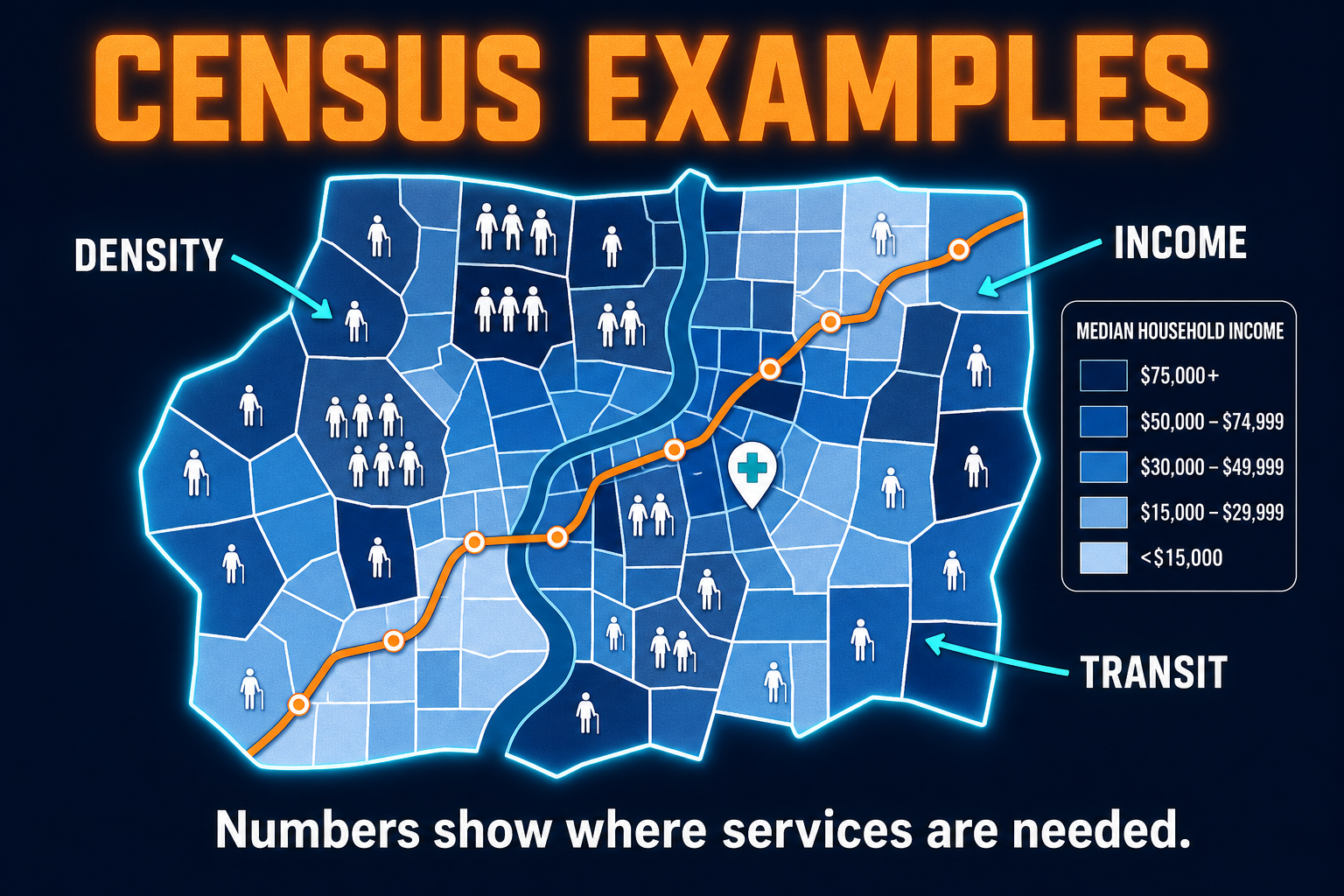
Census data examples include population density, income, age structure, housing, language, commuting, and service access patterns.
Pair census examples with scale of analysis so citywide averages do not hide tract-level need.
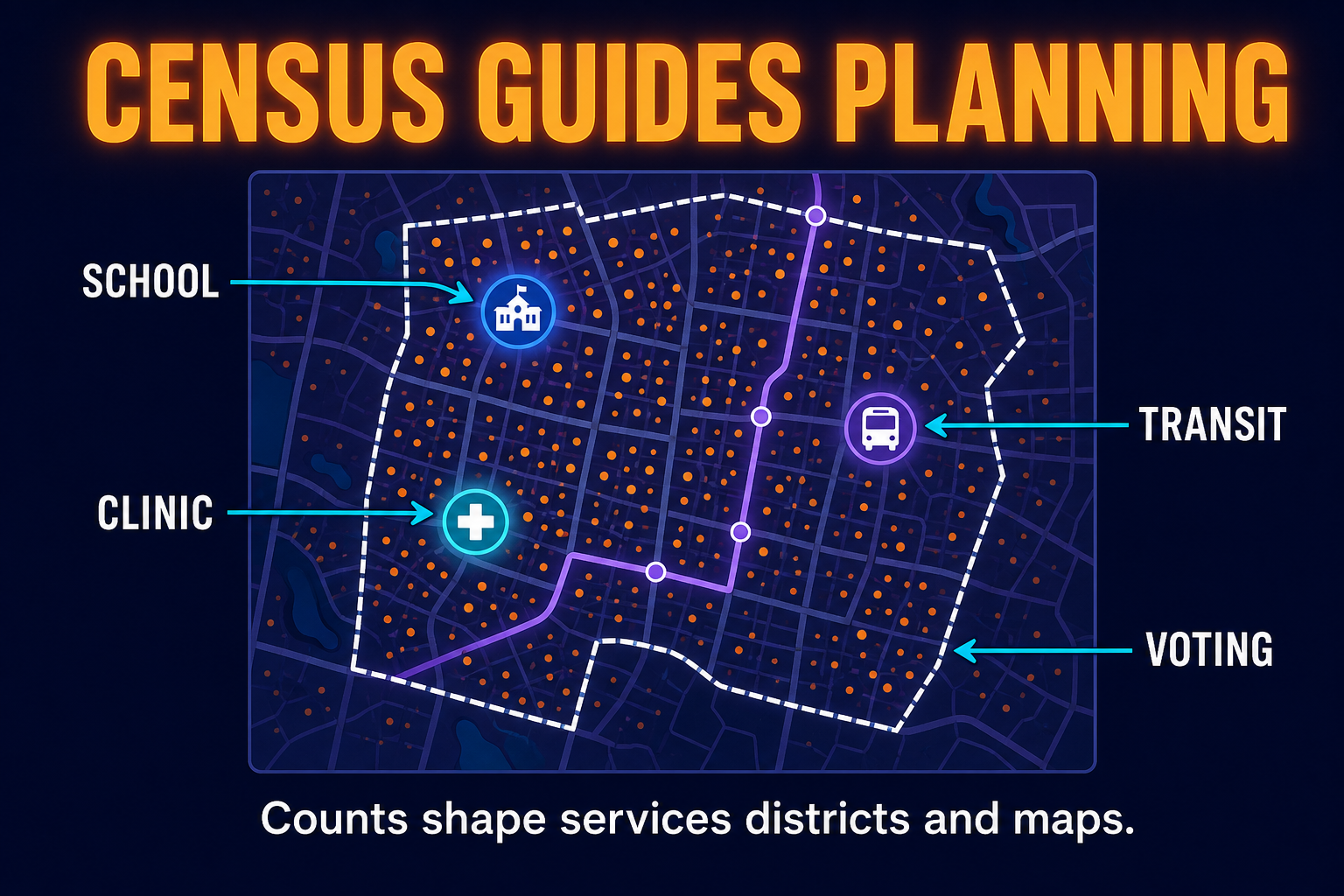
Geographers use census data to compare places, map demographic patterns, study inequality, plan public services, analyze political representation, and support GIS analysis.
Population distribution
Use
Show where people live and how settlement is arranged.
Population density
Use
Calculate people per unit of land area.
Urban planning
Use
Plan schools, roads, transit, parks, utilities, and clinics.
Public services
Use
Identify neighborhoods that need libraries, hospitals, cooling centers, or childcare.
Political representation
Use
Support apportionment, redistricting, and voting district analysis.
Migration analysis
Use
Study population growth, decline, and movement.
Inequality analysis
Use
Map income, housing, education, and service gaps.
Emergency planning
Use
Identify vulnerable populations for evacuation or disaster response.
GIS analysis
Use
Join census tables to tract or block boundaries for choropleth and overlay analysis.
Market and development studies
Use
Analyze consumer geography, labor force, housing demand, and regional development.
Geographers use census data to study population patterns, plan services, analyze inequality, support GIS, and understand political representation.
Census data is reported at different geographic scales. Smaller units reveal local patterns, while larger units show broader regional trends. AP questions often test whether students understand that scale affects what a pattern shows.
Nation
Use
Total U.S. population.
State
Use
Population growth by state.
County
Use
Median income by county.
City or place
Use
Age structure inside a city.
Census tract
Use
Neighborhood-level poverty or density.
Block group
Use
Small-area demographic patterns.
Census block
Use
Very local population and housing counts.
Definitions
Census tract: A small statistical area used to organize and report census data, often useful for neighborhood-level analysis.
Census block: One of the smallest geographic units used for census reporting, often similar to a city block in urban areas.
Census tracts, block groups, and census blocks help geographers move from broad population patterns to neighborhood-level analysis.
Scale choices matter on the scale of analysis guide when you move from national totals to neighborhood patterns.
Section 6
⚖️
Census Data vs Survey Data
Census data attempts to count or describe an entire population. Survey data collects information from a sample. Census data is usually better for official population counts and geographic denominators, while survey data can ask more specific or flexible questions.
Feature
Census Data
Survey Data
Goal
Count or describe the whole population
Estimate patterns from a sample
Collected by
Usually government statistical agencies
Governments, researchers, firms, schools, or organizations
Scope
Broad population and housing information
Focused questions on specific topics
Strength
Official denominators and broad geographic coverage
Flexible and faster for targeted questions
Limitation
Expensive, slower, and still vulnerable to undercounts
Sampling bias and response bias
AP clue
Population count, tract, block, official table
Sample, respondents, questionnaire, margin of error
Most census data is quantitative geographic data because it uses numbers tied to places. It includes counts, percentages, rates, medians, and categories that can be counted, mapped, compared, and analyzed.
Important distinction: Census data is the official government source. Quantitative geographic data is the broader category of numerical evidence. Data reliability and bias is how you evaluate whether any source can be trusted.
Census data
Official population and housing data collected by a government.
A method for checking whether any data source is accurate, current, representative, and appropriate.
A census table showing population density, median income, or percent elderly is quantitative geographic data. Read the full quantitative geographic data guide for rates, densities, indexes, and comparison skills beyond official census tables. Evaluate limits with data reliability and bias.
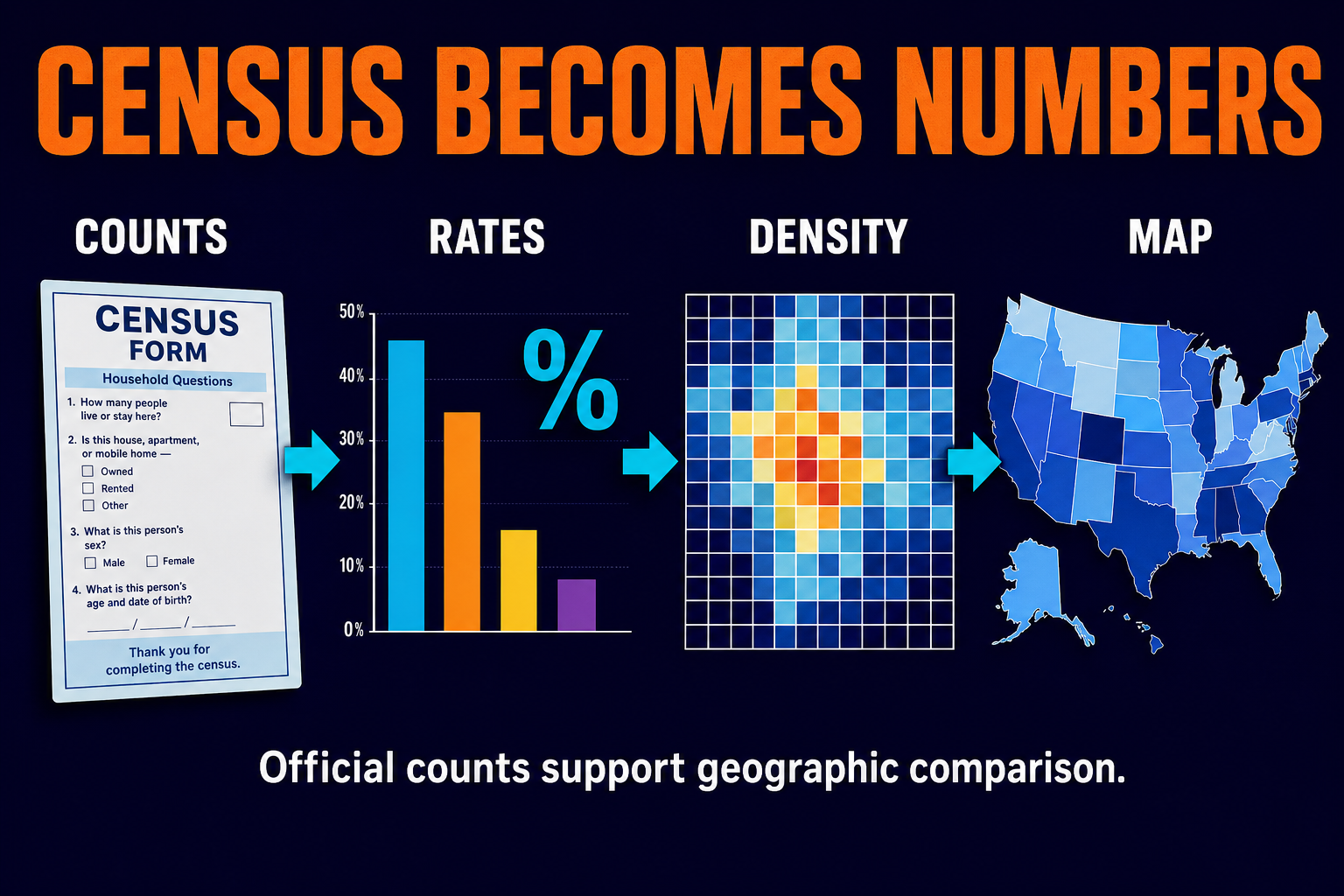
Census data often becomes quantitative geographic evidence when official counts are converted into percentages, rates, densities, and mapped comparisons.Section 8
💪
Benefits and Limitations of Census Data
Benefits
Official source
Broad coverage
Standardized categories
Useful at multiple geographic scales
Supports population density calculations
Helps plan services and infrastructure
Supports redistricting and apportionment
Works well with GIS and maps
Enables comparisons across places
Helps measure change over time
Limitations
Some groups may be undercounted
Data can become outdated
National or citywide averages can hide neighborhood variation
Categories may not fully match lived identities
Privacy protections can limit detail
Census boundaries may not match lived neighborhoods
Political stakes can influence counting debates
Counts show where people live, not always why patterns exist
AP Exam Tip
Official does not mean perfect. Strong answers can say census data is useful because it is official and broad, but limited by undercounting, scale, outdated data, or category problems.
Compare census privacy rules with geospatial privacy when exam prompts ask how location-linked datasets protect or expose people.
Practice evaluating limits on the data reliability and bias page before treating census tables as complete truth.
Section 9
🗳️
Census Data and Political Geography
Census data affects political geography because population counts are used for apportionment, redistricting, district population equality, voting representation, and funding allocation. Undercounting can reduce a community's political power or public resources.
Apportionment
Meaning
The process of allocating representatives among states or regions based on population.
Redistricting
Meaning
The redrawing of electoral district boundaries after population counts change.
Funding allocation
Meaning
Using population data to distribute money for schools, roads, transit, health, housing, and public services.
Representation
Meaning
Accurate counts help communities receive political voice and public resources.
Section 10
⚠️
Common Census Data Mistakes
Calling census data perfect
Fix: Official data can still have undercounts, outdated values, or category limits.
Confusing census data with survey data
Fix: A census tries to count the whole population; a survey uses a sample.
Ignoring scale
Fix: Citywide averages can hide tract-level inequality.
Repeating numbers without meaning
Fix: Connect the number to services, planning, representation, or a spatial pattern.
Forgetting undercounting
Fix: Some groups may be missed, including homeless residents, migrants, remote communities, or people who distrust forms.
Treating categories as neutral
Fix: Race, ethnicity, household, and language categories reflect form design and may not match lived identity perfectly.
Ignoring date
Fix: Old data may not reflect current migration, housing, or population growth.
Forgetting maps
Fix: Census data often appears in choropleth maps, GIS layers, dot maps, cartograms, and tables.
Common Mistake: Treating census data as perfect official truth without naming undercounting, outdated data, or scale limits.
Section 11
🎯
AP Exam Strategy for Census Data
In MCQs
Identify census data from clues about official population counts, demographic tables, tracts, blocks, or government collection.
Recognize that census data is usually quantitative.
Compare census data with survey data.
Interpret census tract maps and demographic tables.
Evaluate limitations such as undercounting, outdated data, and scale.
In FRQs
Define census data.
Identify the census variable used.
Describe the spatial pattern.
Explain the planning, political, or service implication.
Explain one limitation such as undercounting, old data, scale, or category limits.
Example: A tract-level census map showing high percentages of elderly residents near downtown could help planners locate clinics, transit stops, or senior services. However, if the data are outdated or undercount renters and homeless residents, the city may underestimate need in some neighborhoods.
Prompt: A city government uses census data to decide where to build a new public health clinic. The data includes population density, median income, age structure, percentage of elderly residents, and percentage of households without cars.
A. Define census data.
B. Explain how census data could help the city choose a clinic location.
C. Explain why census tract data may be more useful than citywide data.
D. Explain one limitation of using census data for this decision.
Suggested answer:
A. Census data is official population and housing information collected by a government. It includes demographic and geographic information such as population, age, income, household size, housing, and location.
B. Census data could show which neighborhoods have high population density, lower median income, many elderly residents, or many households without cars. These indicators can help identify places with greater need for a nearby public health clinic.
C. Census tract data may be more useful than citywide data because it reveals neighborhood-level differences. Citywide averages can hide areas with high elderly populations, low incomes, or low vehicle access.
D. One limitation is undercounting. Some groups, such as homeless residents, migrants, renters, or people who distrust government forms, may be missed, causing the city to underestimate need in some areas.
Rubric
Part A: Must mention official government-collected population or housing data.
Part B: Must connect one or more census variables to a clinic siting decision.
Part C: Must explain why smaller-scale tract data reveals local variation better than citywide data.
Part D: Must explain a valid limitation such as undercounting, outdated data, scale, privacy, or category limits.
Census Data Practice Questions for AP Human Geography
Use these census data practice questions to test whether you can identify official population counts, interpret tract maps, compare census and survey data, and explain limitations such as undercounting and outdated data.
Census data is official population and housing information collected by a government. In AP Human Geography, it helps geographers study population distribution, density, age, income, housing, migration, language, and demographic patterns.
What is a simple definition of census data?
Census data means official counted information about people and households in a place.
What is an example of census data in AP Human Geography?
Population density by census tract, median income by county, percent urban by state, or age structure by neighborhood are examples of census data.
Is census data quantitative geographic data?
Yes. Census data is usually quantitative because it uses numbers, counts, rates, percentages, and categories tied to places.
How do geographers use census data?
Geographers use census data to compare places, map population patterns, study demographic change, plan services, analyze inequality, and support GIS analysis.
What is a census tract?
A census tract is a small geographic area used to organize and report census data, often useful for neighborhood-level analysis.
What is a census block?
A census block is one of the smallest geographic units used by the census. It provides very local population and housing information.
What is the difference between census data and survey data?
Census data attempts to count an entire population, while survey data collects information from a sample of people.
Can census data be biased or unreliable?
Yes. Census data can undercount homeless residents, migrants, remote communities, language-minority groups, or people who do not respond.
How does census data appear on the AP Human Geography exam?
It may appear in maps, tables, population density questions, demographic indicators, GIS layers, choropleth maps, and FRQs about data reliability or spatial patterns.
What is one limitation of census data?
Census data can become outdated, hide local variation when aggregated, or undercount groups that are hard to reach.
How should students write about census data in an FRQ?
Students should identify the census variable, describe the spatial pattern, explain the geographic significance, and mention one limitation such as scale, undercounting, or outdated data.