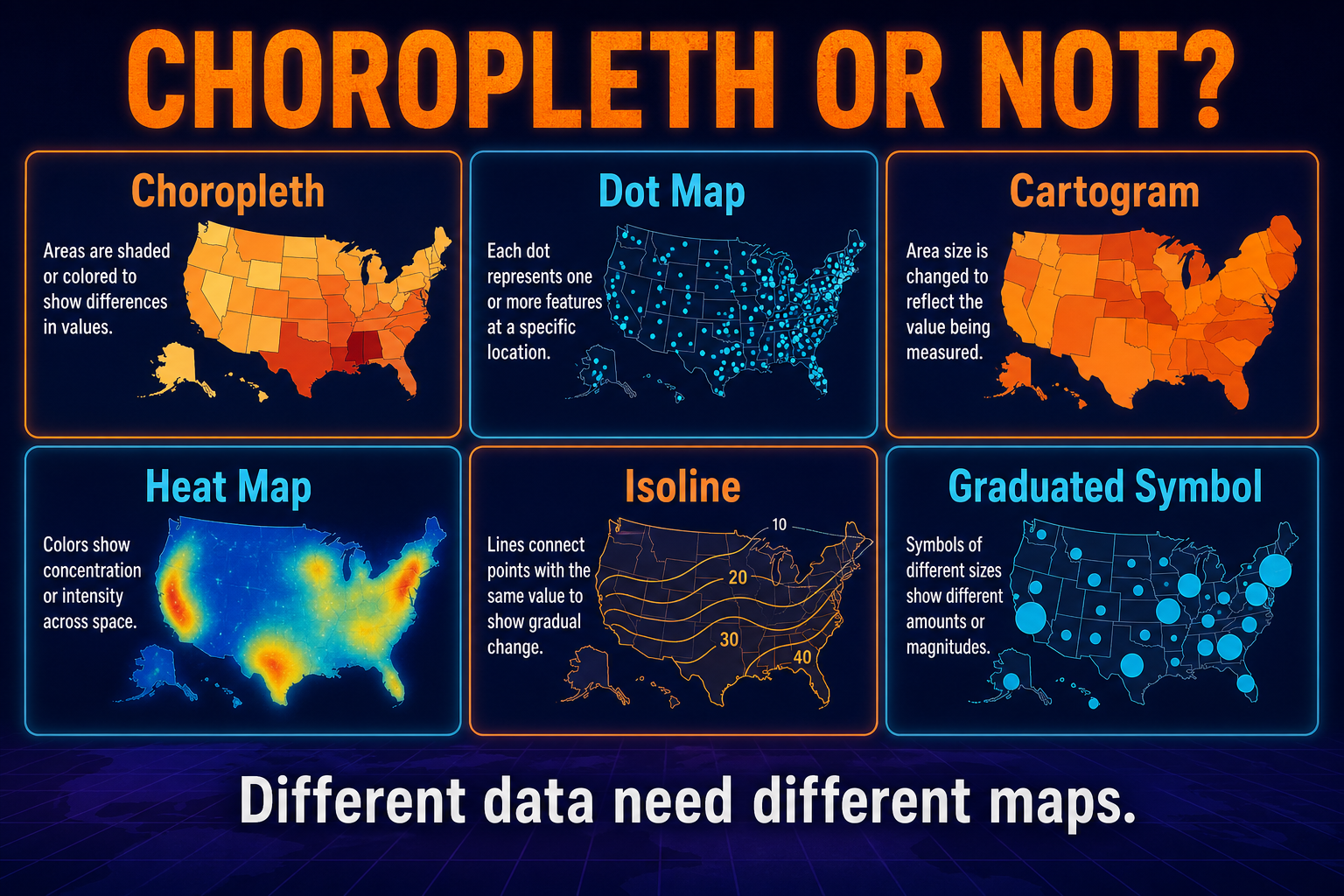
Learn how choropleth maps use color shading to show rates, percentages, density, and regional patterns across predefined areas such as states, counties, countries, and census tracts.
Updated June 5, 2026 · Reviewed by APScore5 Editorial Team
Choropleth maps use color shading to compare values across predefined regions such as states, counties, countries, or census tracts.
Quick answer
⚡
What Is a Choropleth Map in AP Human Geography?
A choropleth map is a thematic map that uses color shading to show data values across predefined regions such as states, counties, countries, census tracts, or ZIP codes. In AP Human Geography, choropleth maps are best for rates, percentages, densities, and ratios, not raw totals.
Memory Shortcut
Choropleth = color by region.
Color shows the value.
Region shows the reporting unit.
Legend explains the meaning.
Scale affects the pattern.
Definition
📖
Choropleth Map Definition
A choropleth map is a thematic map that fills predefined geographic areas with color or shading based on a data value. The areas might be countries, states, counties, census tracts, school districts, or ZIP codes. The map's legend tells the reader what each color range means.
Color shading
Each area receives one color based on its data value.
Predefined regions
The map uses existing boundaries such as counties, states, or countries.
Rates and ratios
Choropleths work best when data are normalized, such as percent unemployed or people per square mile.
Legend intervals
The legend groups values into color categories.
Internal variation
One color can hide important variation inside a region.
Choropleth maps connect a data table to a set of geographic boundaries. Each polygon gets one value and one color. For example, every county might be shaded based on unemployment rate, median income, population density, or disease rate.
A choropleth map assigns one color class to each region based on the value shown in the legend.
AP Exam Tip
If the data are rates by region, a choropleth map is usually a strong choice. If the data are raw counts at point locations, use a graduated symbol map instead.
Follow these steps whenever an AP stimulus asks you to interpret a shaded regional map.
Step 1
Read the title.
Step 2
Identify the variable.
Step 3
Check the legend and units.
Step 4
Notice whether values are rates, percentages, densities, or raw counts.
Step 5
Describe where high and low values are clustered. Pair this step with the clustered vs dispersed patterns guide when dot maps or settlement photos show bunching or wide spacing.
Step 6
Explain one possible reason for the pattern.
Step 7
Mention one limitation, such as hidden internal variation.
Strong choropleth interpretation moves from title and legend to pattern, explanation, and limitation.
Weak answer: The dark areas are high.
Strong AP answer: The darkest counties have the highest unemployment rates, and they appear clustered in the rural western part of the state. This pattern may reflect limited job opportunities or distance from major urban labor markets. However, the map may hide variation within each county.
Section 4
📊
Real-World Choropleth Map Examples
These examples show why choropleth maps dominate election coverage, public health dashboards, and development atlases.
Choropleth maps are common in election maps, health dashboards, income maps, density maps, and development indicators.
Election results by state or county
Variable
Vote share or winning party.
Reporting unit
State or county.
Why
Each region receives one color based on election data.
COVID-19 cases per 100,000 residents by county
Variable
Case rate per 100,000.
Reporting unit
County.
Why
Normalized health data attached to county polygons.
Median household income by census tract
Variable
Median income.
Reporting unit
Census tract.
Why
Income rates mapped to small reporting units.
Population density by state
Variable
People per square mile.
Reporting unit
State.
Why
Density is a rate derived from totals divided by area.
Human Development Index by country
Variable
HDI score.
Reporting unit
Country.
Why
Development indicator compared across nations.
Unemployment rate by county
Variable
Percent unemployed.
Reporting unit
County.
Why
Economic rate mapped to administrative boundaries.
Life expectancy by country
Variable
Years lived.
Reporting unit
Country.
Why
Health outcome compared across countries.
Carbon emissions per capita by country
Variable
CO₂ per person.
Reporting unit
Country.
Why
Per-capita rate avoids raw total bias.
When you cite examples on FRQs, name the variable, reporting unit, and normalization — the same habits you use in distribution and data reliability review.
Section 5
⚖️
Choropleth Maps vs Other Map Types
Choropleth maps shade regions, while other map types use dots, symbols, distortion, gradients, or lines to show different kinds of geographic data.
A bivariate choropleth map shows two variables at the same time using a combined color legend. For example, one color direction may show income while another shows education level. These maps can reveal relationships between two variables, but they are harder to read.
AP Warning: Bivariate choropleths are powerful but easy to misread. Always check both axes of the legend.
Section 7
💪
Strengths and Limitations of Choropleth Maps
Strengths
Easy to read at a glance
Good for comparing regions
Works well for rates and percentages
Familiar in news and policy maps
Useful with census and administrative data
Limitations
Hides variation inside regions
Can mislead with raw counts
Large regions dominate visually
Legend breaks can change the story
Color choices can confuse readers
Results can change when boundaries change
Choropleth maps can hide local variation because each region receives only one color, even when conditions differ inside that region.
AP Exam Tip
The most important choropleth limitation for AP Human Geography is internal variation: one shaded county, state, or country can contain very different neighborhoods or communities.
Section 8
⚠️
Common Choropleth Map Mistakes
Using raw totals
Fix: Use rates, percentages, density, or ratios.
Skipping the legend
Fix: Always check what the color categories mean.
Assuming darker always means worse
Fix: Darker means whatever the legend says.
Treating regions as uniform
Fix: Remember that one color hides internal variation.
Ignoring scale of analysis
Fix: A county map and state map can show different patterns.
Confusing choropleths with heat maps
Fix: Choropleths use fixed boundaries; heat maps use smooth gradients.
Fix: Ask who collected the data, when, and at what scale.
Section 9
📝
AP Exam Strategy for Choropleth Maps
In MCQs
Identify the map type.
Interpret the legend.
Choose rates instead of raw counts.
Compare choropleths with dot maps or cartograms.
Recognize hidden internal variation.
In FRQs
Define choropleth map.
Describe the spatial pattern.
Explain one cause or consequence.
Explain one limitation.
Legend → Pattern → Explanation → Limitation
Example: The choropleth map shows unemployment rate by county. The darkest counties are clustered in the rural south, suggesting higher unemployment there. However, the map may hide variation within each county because every county is shaded with only one color.
Choropleth stimuli also appear in later units — link your answer to AP Human Geography themes such as population, urban inequality, and development.
FRQ practice
📋
Choropleth Maps FRQ Practice
Prompt: Choropleth maps are commonly used in news media, public health, and AP Human Geography stimuli.
A. Define choropleth map.
B. Describe one specific real-world example of how a choropleth map can be used.
C. Explain one limitation of choropleth maps.
Suggested answer:
A. A choropleth map is a thematic map that uses color shading to display rates or values by predefined regions such as states, counties, or countries.
B. A public health department might use a county choropleth map to show influenza hospitalizations per 100,000 residents so officials can identify areas with higher rates.
C. Choropleth maps can hide internal variation because one color represents an entire region, even though neighborhoods inside that region may differ.
Rubric
Part A: Must mention color shading and predefined regions.
Part B: Must name a variable and geographic unit.
Part C: Must explain a real limitation such as internal variation, MAUP, misleading raw totals, or legend bin manipulation.
Use these choropleth map practice questions to test whether you can identify choropleth maps, interpret legends, compare map types, and explain choropleth limitations.
A choropleth map is a thematic map that uses color shading to show data values across predefined regions such as states, counties, countries, census tracts, or ZIP codes.
What is a choropleth map example?
Examples include a county map of COVID-19 cases per 100,000 residents, a state map of unemployment rates, a country map of Human Development Index, or a census tract map of median income.
What is a choropleth map best used for?
A choropleth map is best used for rates, percentages, densities, or ratios across predefined regions.
Why are choropleth maps not good for raw counts?
Raw counts can make larger or more populated regions appear more important simply because they contain more people or cover more area. Rates and percentages allow fairer comparisons.
What is the biggest limitation of choropleth maps?
The biggest limitation is that choropleth maps hide internal variation. One shaded region may contain very different neighborhoods or communities.
What is the difference between a choropleth map and a dot distribution map?
A choropleth map shades entire regions based on values, while a dot distribution map uses dots to show where features are located or clustered.
What is the difference between a choropleth map and a cartogram?
A choropleth map preserves the shape of regions and uses color shading. A cartogram distorts region size or shape based on a data variable.
What is a bivariate choropleth map?
A bivariate choropleth map shows two variables at once using a combined color legend, often arranged as a 3-by-3 or 4-by-4 color grid.
How do choropleth maps appear on the AP Human Geography exam?
They appear in map interpretation questions, Unit 1 spatial thinking questions, and later units involving population, urban inequality, public health, elections, and development indicators.