Space
The framework of location, distance, arrangement, movement, and connection.
AP Human Geography · Unit 1 · Thinking Geographically
Learn how geographers use space to analyze locations, distances, arrangements, activity spaces, accessibility, networks, and spatial relationships across places and scales.
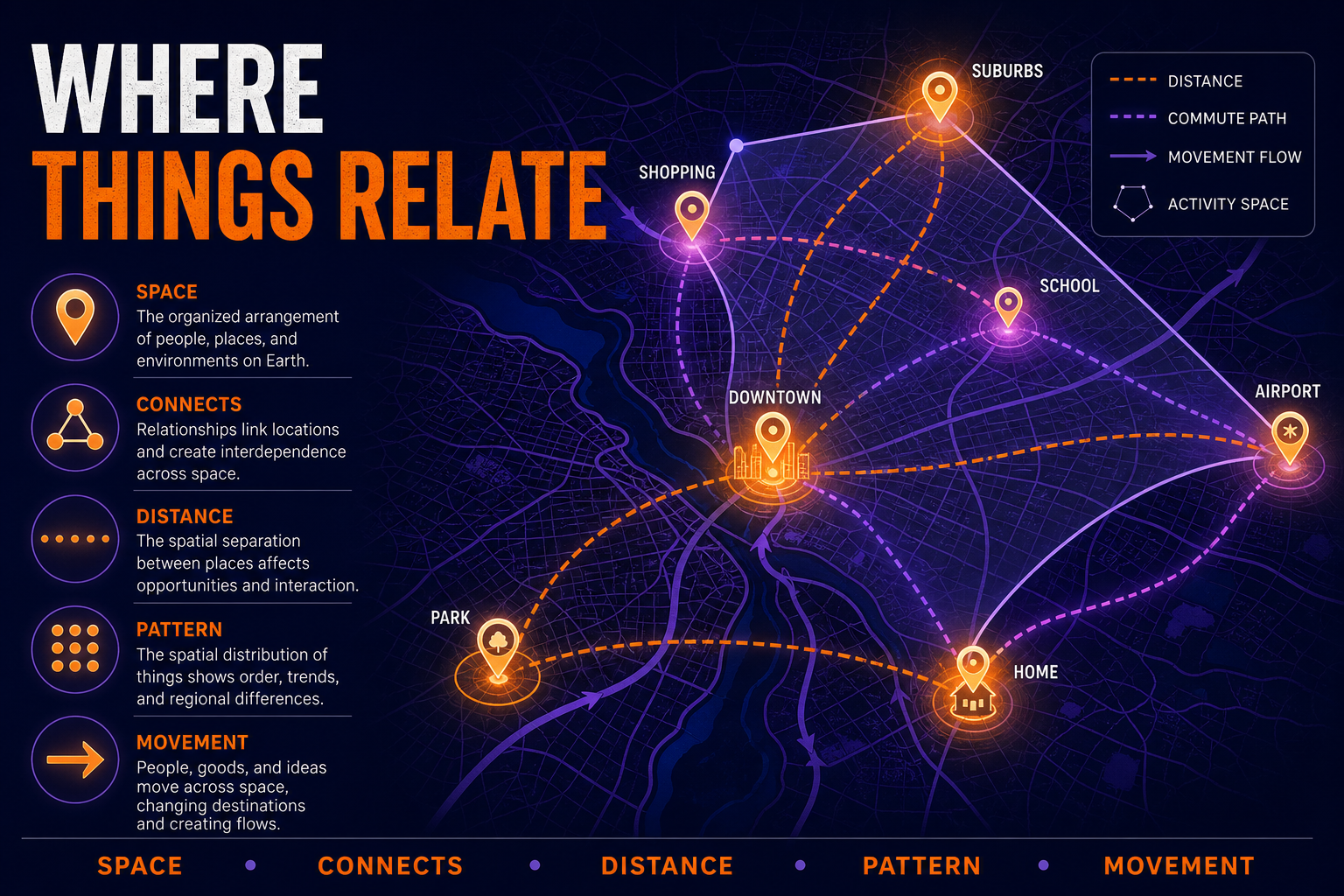
Space is the abstract area in which geographic phenomena exist, move, interact, and relate to one another. In AP Human Geography, space includes locations, distances, directions, arrangements, networks, activity spaces, accessibility, and spatial relationships. Space is different from place because space focuses on arrangement and connection, while place focuses on meaning and identity.
If the prompt asks about distance, arrangement, networks, movement, accessibility, or spatial relationships, it is testing space.
The framework of location, distance, arrangement, movement, and connection.
The meaning, identity, character, and lived experience of a location.
The visible pattern of how features are spread across space.
The method for explaining spatial patterns using evidence, scale, and relationships.
Space = where + distance + pattern + connection.
Space is the abstract geographic area in which people, places, objects, activities, flows, and processes exist and relate. Geographers use space to study where things are, how far apart they are, how they are arranged, and how they interact.
The abstract area in which geographic phenomena exist, move, and relate.
Where something is.
How far apart things are.
The orientation or path from one location to another.
How things are organized across an area.
How places, people, or phenomena are linked.
The area a person regularly uses in daily life.
How locations influence or relate to one another.
Space connects to absolute location and relative location when you describe where phenomena occur and how they relate across an area.
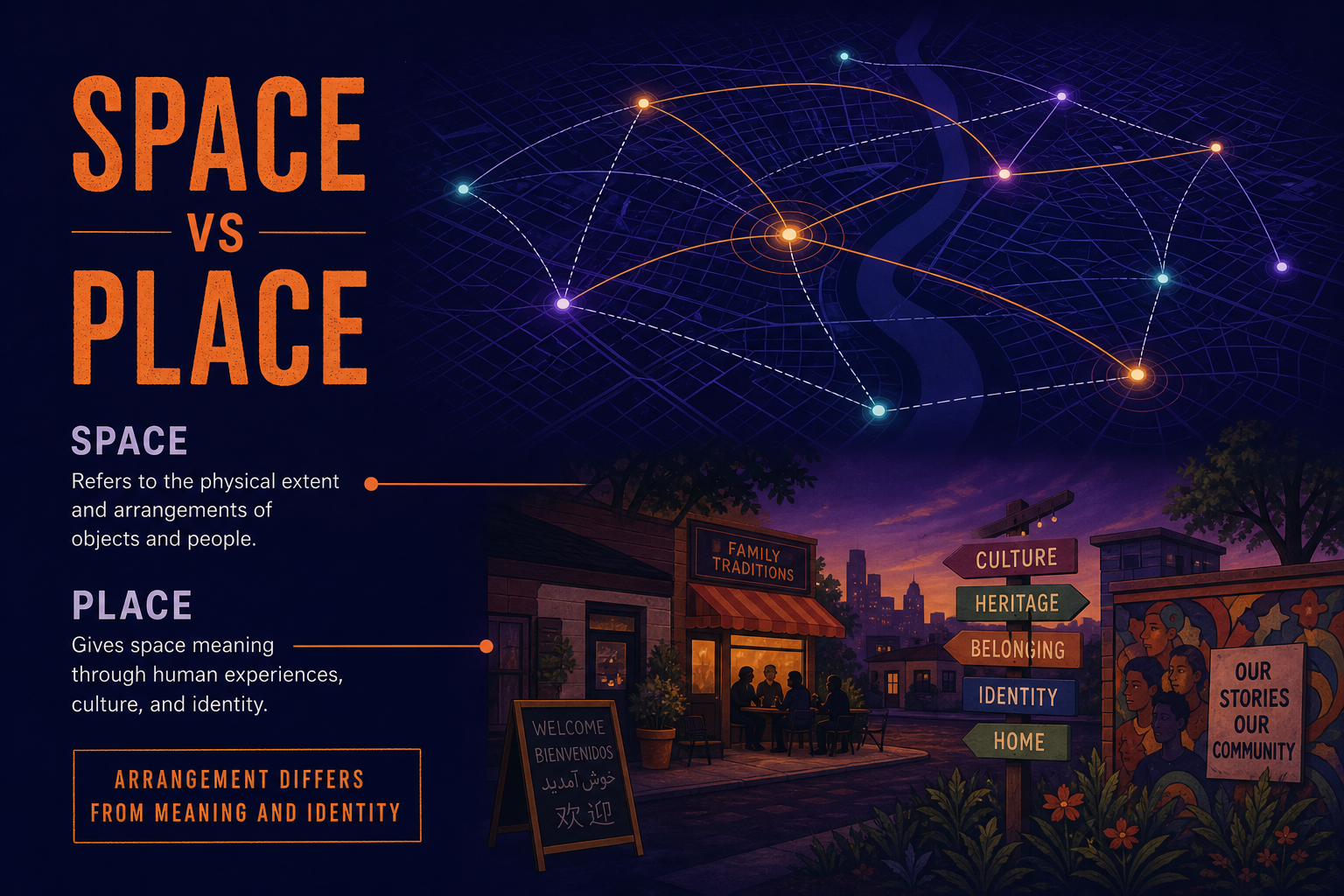
Space and place are related but not the same. Space focuses on location, distance, arrangement, and connection. Place focuses on meaning, identity, character, culture, and human experience.
| Concept | Main Focus | AP Example | Exam Clue |
|---|---|---|---|
| Space | Location, distance, arrangement, connection | A commuter's daily route between home, school, and work | Where, how far, how arranged, how connected. |
| Place | Meaning, identity, traits, sense of place | A neighborhood's cultural identity, architecture, food, and memories | Meaning, character, identity, cultural landscape. |
| Both together | A meaningful location connected to other places | A Chinatown district as both a cultural place and a spatial node | Physical layout plus human meaning. |
If the prompt asks about arrangement, distance, networks, or movement, think space. If it asks about meaning, identity, or character, think place.
Read the full place guide when a prompt asks about meaning, identity, or cultural landscape—not only arrangement across an area.
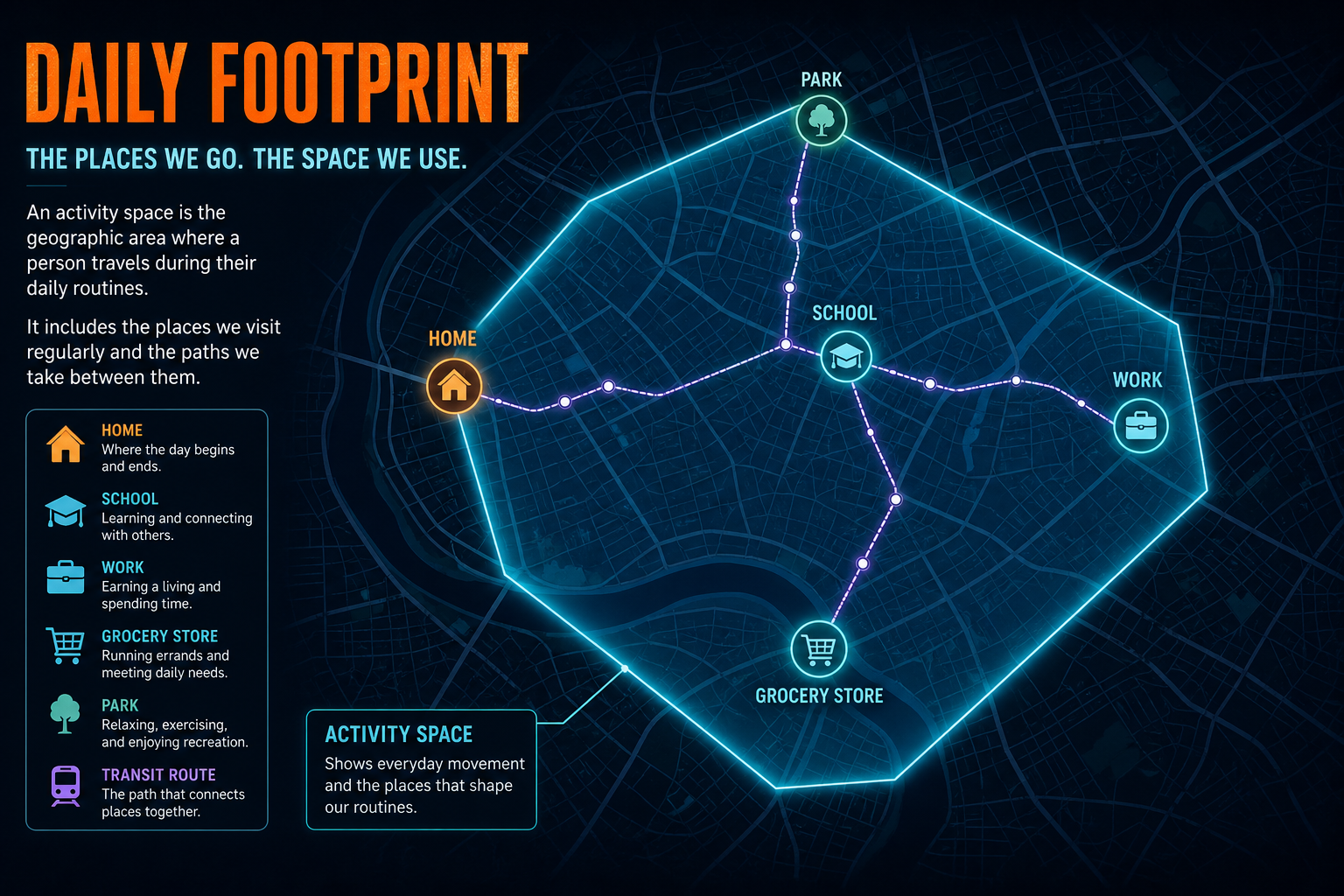
Activity space is the area a person regularly travels through or uses in daily life. It includes home, school, work, stores, parks, religious sites, transit routes, social spaces, service locations, and digital spaces. Activity space reveals how mobility, infrastructure, income, safety, disability access, and technology shape everyday geography.
Role: Anchor point for daily movement.
Role: Major repeated destination.
Role: Places for food, healthcare, banking, childcare, and errands.
Role: Paths that expand or limit reachable destinations.
Role: Friends, family, recreation, worship, and community networks.
Role: Online school, remote work, video calls, delivery apps, and social media can expand virtual activity space.
When a prompt describes a person's weekly routine, commute, errands, or service access, use activity space vocabulary.
| Persona | Typical footprint |
|---|---|
| Suburban teen with a car | Typically has a wider social and job-search activity space. |
| Urban commuter | Often follows linear paths along rail or bus corridors. |
| Rural farmer | Activity space links farm, supplier towns, and seasonal markets. |
| Remote worker | Digital activity space can cross continents while physical movement may shrink. |
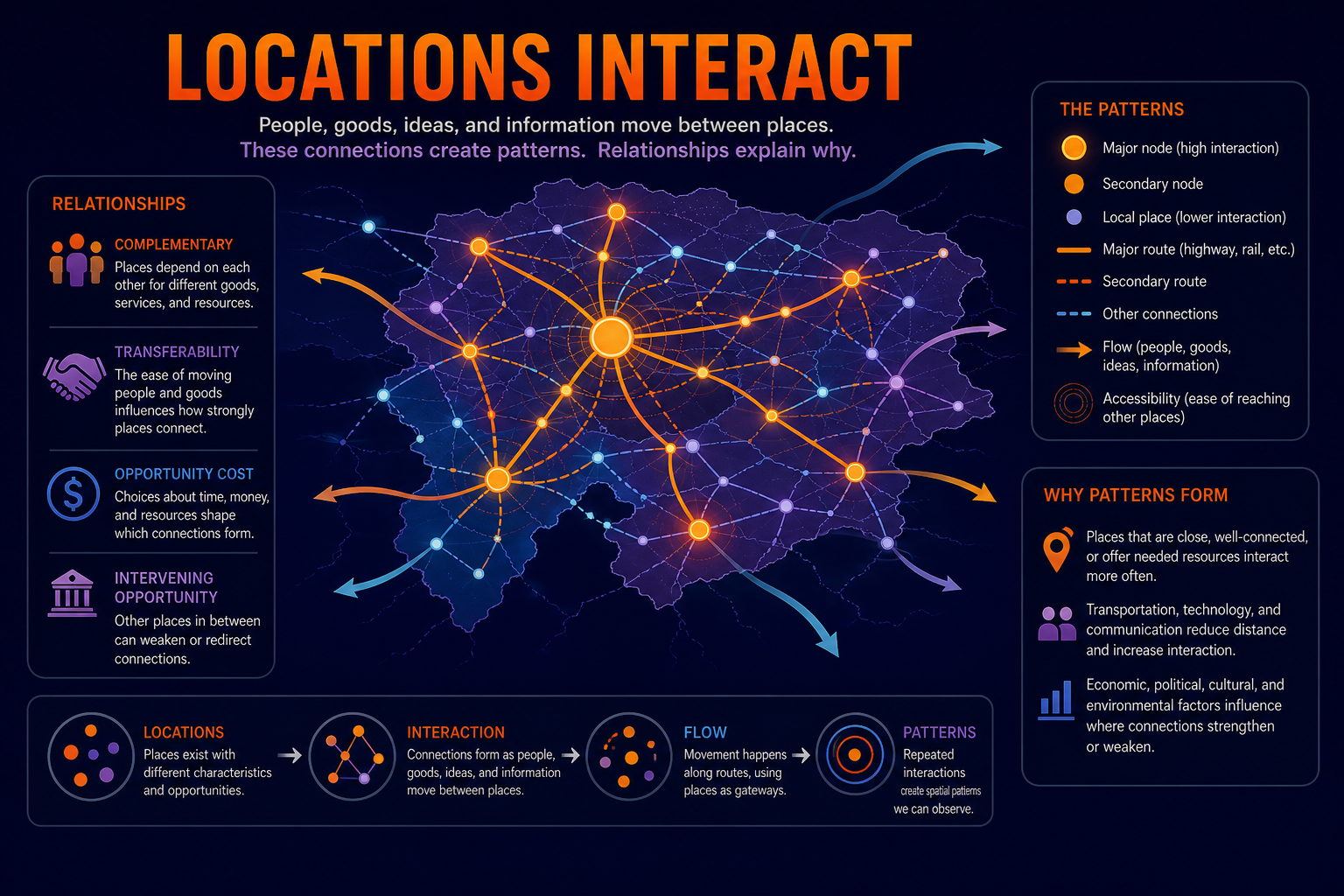
Spatial relationships describe how locations, places, or phenomena influence one another across space. These relationships help explain why one location affects another, why patterns form, and how movement occurs.
Meaning: How close things are.
Example: Homes near a school have shorter commutes.
Meaning: Whether places share a border or touch.
Example: Neighboring countries may trade or conflict more often.
Meaning: How strongly places are linked.
Example: A rail line connects suburbs to a city center.
Meaning: How easy it is to reach something.
Example: A clinic may be close in miles but hard to reach without transit.
Meaning: How places are ranked or nested.
Example: Small towns connect to regional cities, which connect to global cities.
Meaning: Movement of people, goods, money, ideas, or information.
Example: Commuter flows link residential areas to job centers.
Meaning: Two patterns appear near or related to each other.
Example: Industrial zones and pollution exposure may overlap.
Meaning: A route through which culture, disease, technology, or innovation spreads.
Example: A language spreads along migration corridors.
Distance is one of the most important ways geographers understand space. AP Human Geography often tests whether students can distinguish absolute distance, relative distance, and cognitive distance.
| Distance Type | Meaning | Example | AP Clue |
|---|---|---|---|
| Absolute distance | Measurable physical distance | Ten miles from home to school | Miles, kilometers, map scale. |
| Relative distance | Distance measured by time, cost, effort, or accessibility | A 20-minute train ride vs a 60-minute drive | Minutes, cost, effort, travel time. |
| Cognitive distance | Distance as people perceive it | A place feels far because transfers are stressful or unsafe | Feels close, feels far, perceived distance. |
| Friction of distance | The slowing or limiting effect of distance | Fewer people use a service as travel time increases | Interaction decreases with separation. |
Pair distance types with distance decay and time-space compression when prompts ask how separation or technology changes interaction.
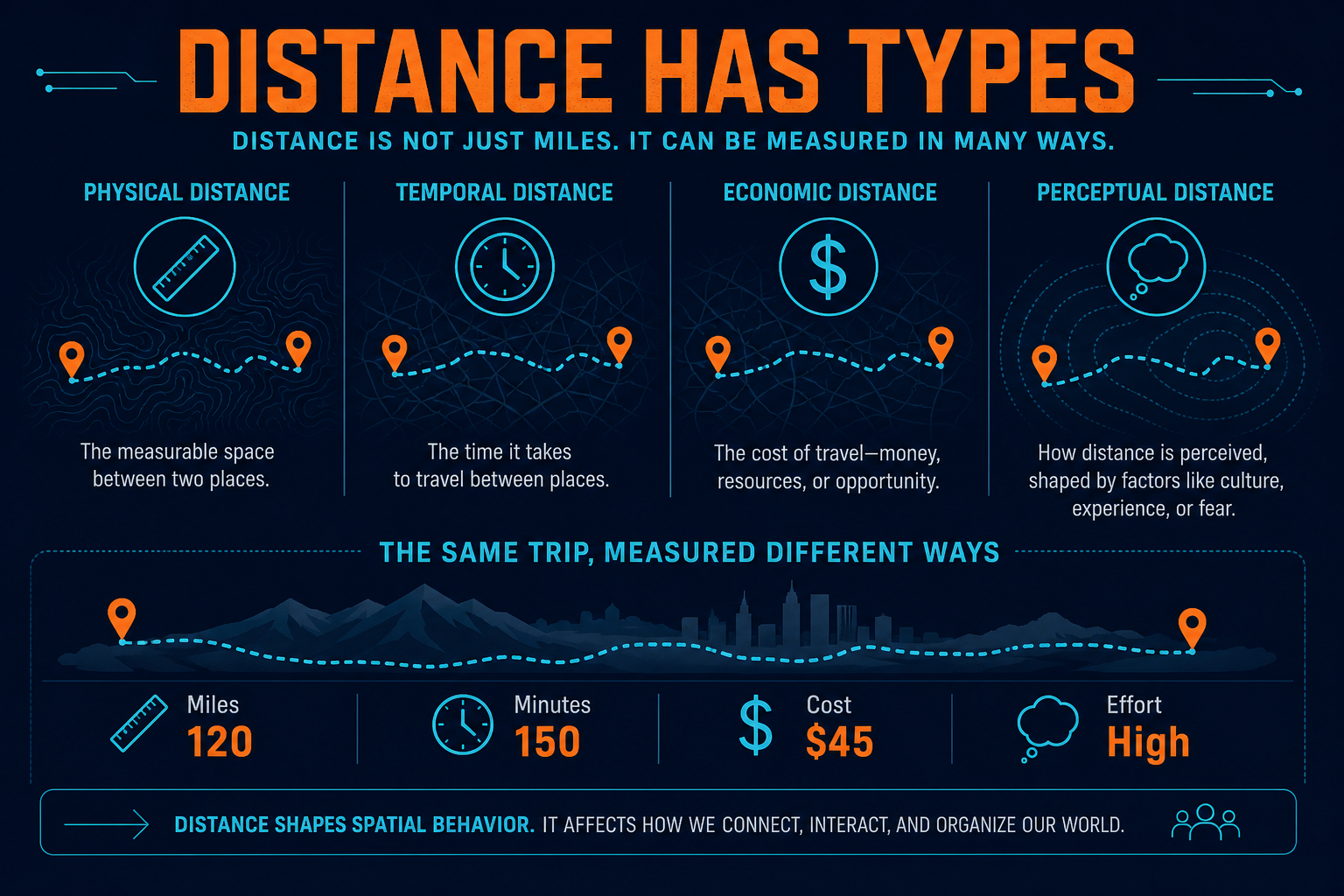
Accessibility means how easy it is to reach opportunities, services, or destinations. Mobility means the ability to move through space. Two places may be close in absolute distance but unequal in accessibility if transit is weak, roads are unsafe, costs are high, or barriers block movement.
If a prompt mentions service access, transit, commute times, food deserts, healthcare access, or unequal opportunity, use accessibility and activity space.
Distribution describes how something is spread across space. Space is the broad framework; distribution is the pattern within that framework. When students describe clustered, dispersed, linear, or random patterns, they are using space to analyze arrangement.
Things are close together.
Things are spread apart.
Things follow a line, road, river, coastline, or corridor.
No clear pattern.
Many things occur in one area.
The visible arrangement of features in space.
Compare distribution and clustered vs dispersed patterns when a map shows uneven spacing rather than only naming that things are spread out.
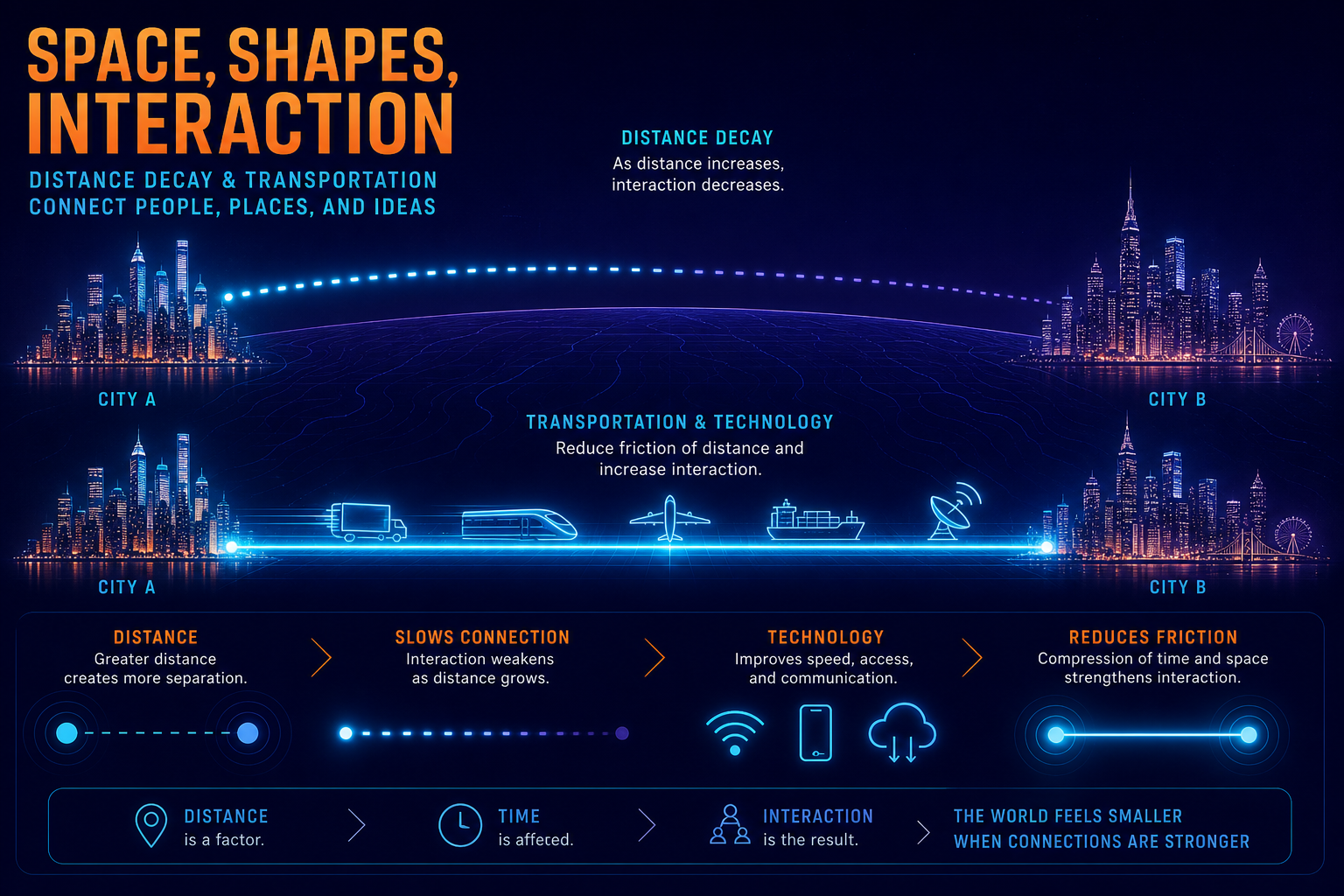
Space connects directly to distance decay and time-space compression. Distance decay means interaction often decreases as distance increases. Time-space compression means technology reduces the time, cost, or effort of interacting across distance. Both concepts rely on spatial relationships.
| Concept | Meaning | Space Connection |
|---|---|---|
| Space | Where things exist and relate | Provides the framework for location, distance, and connection. |
| Distance decay | Interaction usually decreases as distance increases | Shows how separation affects interaction across space. |
| Time-space compression | Technology reduces relative distance | Changes how people experience space. |
| Relative distance | Distance measured by time, cost, or effort | Explains why some places feel closer than miles suggest. |
Do not say technology removes space. Say it changes relative distance and interaction across space.
Review distance decay, time-space compression, and spatial analysis when an FRQ asks how technology or separation changes interaction across space. Scale of analysis affects which spatial patterns you can see at local, regional, or global levels.
A student sleeps in a dorm, attends classes, works at an off-campus café, visits the gym, shops for food, and sees friends across town.
Satellite imagery updates hazard maps after floods or hurricanes.
AP exam clue: Technology changes how quickly people understand space.
Delivery drivers' routes shift based on apps, congestion, and demand.
AP exam clue: Digital systems reshape physical movement.
Exclusive economic zones turn ocean areas into political and resource spaces.
AP exam clue: Space can be legally organized and contested.
Skybridges, high-rise housing, rooftop farming, and underground transit create three-dimensional urban space.
AP exam clue: Not all spatial relationships are flat.
Remote work expands digital activity space while reducing some physical commuting.
AP exam clue: Technology changes relative distance unevenly.
Cities temporarily converted curb lanes into dining and pedestrian space.
AP exam clue: Policy can reorganize public space.
Low-income neighborhoods may be closer to industrial zones or highways.
AP exam clue: Spatial relationships can reveal inequality.
Workers may live far from job centers or lack transit routes to reach them.
AP exam clue: Accessibility matters more than miles alone.
Fix: Space focuses on arrangement and connection; place focuses on meaning and identity.
Fix: Space includes relationships, movement, networks, and patterns.
Fix: Minutes, cost, effort, and accessibility often matter more than miles.
Fix: Daily routines show how people actually use space.
Fix: Technology reduces friction for some people and flows, but space still matters.
Fix: Use specific pattern terms such as clustered, dispersed, linear, or concentrated.
Fix: Activity space differs by income, safety, disability access, transit, and digital access.
Fix: Link space to distribution, distance decay, time-space compression, spatial analysis, and accessibility.
Example: A student's activity space includes the dorm, classrooms, job, grocery store, and friends' apartments. Bus routes and bike lanes connect these locations, while travel time and cost shape which opportunities are accessible. This shows that space is not only physical area but also the relationships and movement patterns linking places.
Use maps and map interpretation and geographic data and technology when a stimulus combines spatial relationships with mapped evidence. Return to the AP Human Geography course hub for all seven units.
Activity space refers to:
A. Space is the abstract geographic area in which people, places, objects, activities, flows, and processes exist and relate. It includes location, distance, arrangement, movement, and connection.
B. Activity space is the area a person regularly uses in daily life. In this scenario, the student's activity space includes the dorm, classrooms, off-campus job, grocery store, gym, and friends' apartments.
C. Connectivity is one spatial relationship. Roads, sidewalks, bike lanes, or bus routes connect the student's destinations and affect how easily the student can move between them.
D. Time-space compression could change the student's experience of space by reducing the time or effort needed to connect with distant people or services. For example, online classes, video calls, messaging, or delivery apps can expand the student's virtual activity space even if physical travel remains local.
Use these space practice questions to test definitions, space vs place, activity space, spatial relationships, distance types, accessibility, and FRQ reasoning.
Use these flashcards to review space vocabulary, activity space, spatial relationships, distance types, accessibility, and AP exam clues.
Space is the abstract area in which geographic phenomena exist, move, interact, and relate to one another. It includes locations, distances, directions, arrangements, networks, activity spaces, accessibility, and spatial relationships.
Space means where things are, how far apart they are, how they are arranged, and how they connect.
Space emphasizes abstract relationships, distance, arrangement, and movement. Place emphasizes meaning, identity, character, culture, and lived experience.
Activity space is the area a person regularly uses in daily life, including home, school, work, stores, parks, transit routes, social spaces, and digital spaces.
Spatial relationships describe how locations influence or relate to one another through proximity, adjacency, connectivity, accessibility, hierarchy, flow, or spatial association.
Absolute distance is measurable physical distance, such as miles or kilometers. Relative distance is measured by time, cost, effort, accessibility, or perceived closeness.
Cognitive distance is perceived distance. A place may feel farther away because of transfers, stress, danger, cost, unfamiliarity, or inconvenience.
Distance decay explains that interaction often decreases as distance increases. Space provides the framework for understanding how separation affects interaction.
Time-space compression explains how technology reduces relative distance and changes how people experience space through faster transportation, communication, logistics, and digital connection.
Space is important because most geographic questions ask where things are, how far apart they are, how they are arranged, how they connect, and how people move through them.
Yes. Space appears across population, migration, culture, politics, agriculture, urban geography, and economic development because all of these units involve spatial patterns and relationships.
Students should define space, identify locations and distances, name a spatial relationship, explain movement or accessibility, and connect the pattern to geographic significance.