What enters the system?
Identify the data, user action, variable value, list item, sensor reading, or event that enters the program or algorithm. Say it in plain language before you trace or defend design choices.
One clear path through AP Computer Science Principles: creative development, data, algorithms, programming, networks, cybersecurity, computing impact, and Create performance task prep. Built for busy students who need consistency, not cramming.
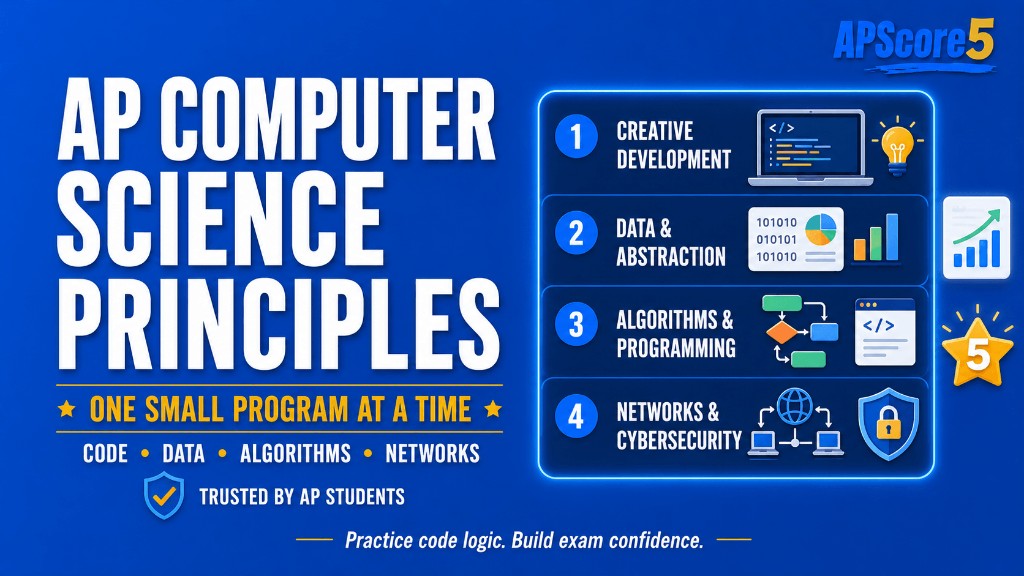
Think of AP CSP as the course that asks not just “can you code?” but “can you think like a computer scientist?” Students need to explain algorithms, reason through code, understand data and networks, and connect computing decisions to real-world impact.
Use this loop on MCQs, written prompts, and project reflections so your reasoning stays complete: input → process → output → impact. It pairs naturally with the five big ideas and with the Algorithms and Programming habits you build when you practice lists, loops, and procedures.
Identify the data, user action, variable value, list item, sensor reading, or event that enters the program or algorithm. Say it in plain language before you trace or defend design choices.
Trace sequencing, selection, iteration, procedures, and list operations step by step. On the exam, “process” is often where students win or lose points—especially when loops repeat more times than expected.
Name the displayed result, returned value, updated variable, filtered list, stored score, or visible behavior after the last meaningful step—not what you wish the program did.
Tie the computing decision to users, communities, privacy, bias, security, reliability, or tradeoffs. This is the bridge to Impact of Computing prompts and to responsible Create Task reflections.
Practice this skill: high-frequency CSP terms · 20-question diagnostic
AP Computer Science Principles is often considered one of the more accessible AP courses, but it still requires careful practice. The biggest challenge is not memorizing terms — it is tracing code, understanding algorithms, explaining data, and preparing the Create performance task.
AP CSP is a beginner-friendly programming and computing course. You will write small programs, work with real data, design simple algorithms, and submit one major project — the Create Performance Task — that becomes part of your AP score. No prior coding experience is required.
AP CSP is organized around five Big Ideas. The end-of-course AP exam tests all five, and the Create Task project draws on Algorithms and Programming most heavily. The full unit roadmap is below.
Creative Development
Data
Algorithms & Programming
Computer Systems & Networks
Impact of Computing
Most AP CSP programming questions are not testing advanced coding. They are testing whether you can follow variables, lists, loops, conditionals, and procedures carefully.
score ← 0
FOR EACH item IN list
  IF item > 10
    score ← score + 1
DISPLAY score
This code counts how many values in the list are greater than 10. It does not add the values themselves. That distinction shows up often when practicing Unit 3 MCQs.
Students see score ← score + 1 and assume the program sums list values. Here it increments a counter—only items that satisfy the condition matter.
Practice this skill: Unit 3 diagnostic · pillar flashcards
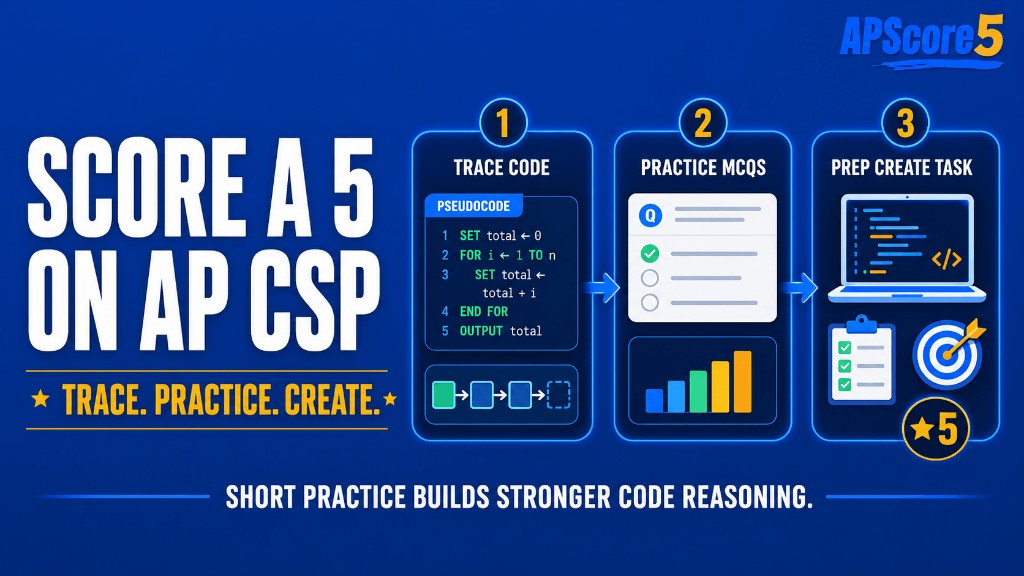
AP CSP has two graded pieces: a 70-question multiple-choice exam in May, and the Create Performance Task you upload during the school year. Both reward the same habits.
Most lost AP CSP points come from a few repeat mistakes. Knowing what they are is half the fix.
Every study plan should start with the scoreboard. AP CSP includes a multiple-choice exam and the Create performance task.
| Section | Questions | Time | Weight |
|---|---|---|---|
| End-of-course Exam | 70 multiple-choice questions | 2 hours | 70% |
| Create Performance Task | Program code, video, and written responses | Completed in class | 30% |
| Total | Exam + project | Course-based prep | 100% |
Use this roadmap to understand what each AP Computer Science Principles unit covers, why it matters on the exam, and the mistake students often make. Unit-specific pages can go deeper without this pillar competing with them.
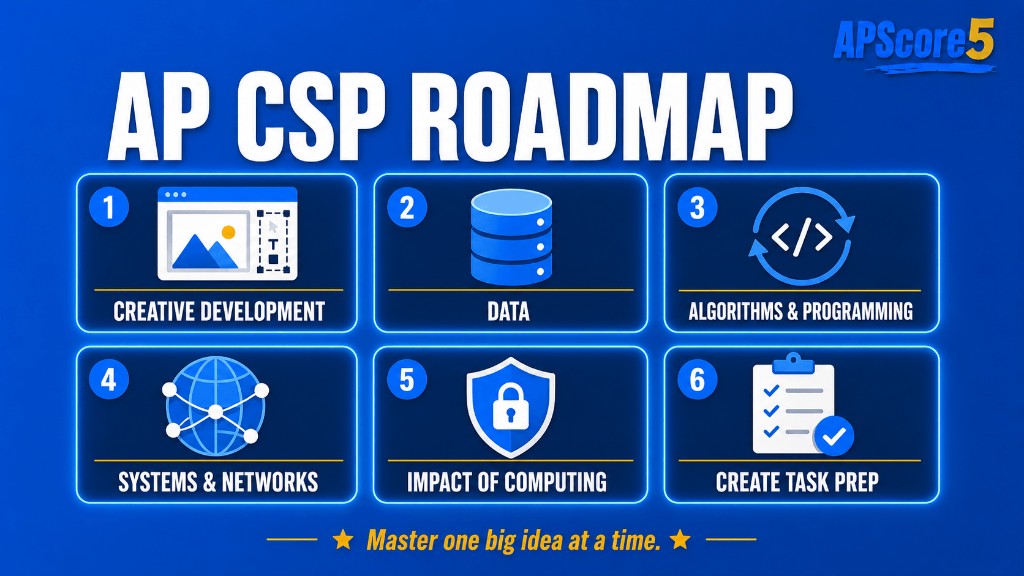
Design programs with a purpose, collaborate, test, debug, and improve computing artifacts.
Learn binary, abstraction, data compression, metadata, visualizations, and how data reveals patterns.
Trace variables, conditionals, loops, lists, procedures, algorithms, simulations, and program logic.
Understand the internet, protocols, packets, IP addresses, DNS, fault tolerance, and network paths.
Study cybersecurity, privacy, digital divide, bias, crowdsourcing, legal issues, and computing innovation.
Plan a program, include input/output, lists, procedures, algorithms, and prepare clear written responses.
The Create Performance Task is easier when students design the program around the requirements from the beginning instead of trying to force requirements into the project later. Anchor planning in Unit 1: Creative Development (purpose, testing, iteration), then implement logic with the same vocabulary you use on the exam.
What problem, interest, or user need does the program address?
How does the user or data source change what the program does next?
What does the program display, return, or visibly change after processing?
What collection stores multiple items the program reads, filters, or updates?
What reusable student-developed procedure helps manage complexity?
Where do sequencing, selection, and iteration work together on real data?
What inputs prove the program behaves as intended—including edge cases?
Can you explain the code aloud without jargon-only sentences?
Weak idea: A calculator with only fixed buttons and no meaningful list.
Better idea: A study quiz app that stores questions in a list, selects questions based on user input, tracks score with variables, and gives feedback using conditionals and loops.
Do not wait until the end to add a list or procedure. Build the project around them early so testing, video capture, and written responses stay honest.
Practice this skill: Unit 3 programming MCQs · pillar diagnostic
Pair this framework with AP CSP Unit 2: Data so vocabulary like metadata, compression, and visualization connects to real stimuli.
Computers store numbers, text, images, audio, and video as bits and structured formats. Expect prompts about binary, compression tradeoffs, metadata, tables, and how abstraction hides underlying detail.
Data can be incomplete, biased, duplicated, outdated, or sampled from limited groups. Naming those limits is often worth more than repeating the chart title.
Look for patterns, trends, outliers, correlations, and what a visualization emphasizes versus what it hides—skills you reinforce with Unit 2 practice MCQs.
Ask who collected the data, why it was collected, what is missing, who is excluded, and how it could be misused—before you draw social conclusions.
Assuming a data visualization proves causation. AP CSP often expects you to separate correlation, bias, and limitation—and to say what extra evidence would be needed.
Practice this skill: Unit 2 flashcards · Unit 2 learning hub
Impact prompts often blend networking facts with social outcomes—review how packets cross the internet, how DNS resolves names, and how encryption relates to trust—then ground societal angles with Unit 5 core concepts such as beneficial versus harmful effects, algorithmic bias, privacy tradeoffs, and the digital divide.
Vague claims like “technology helps people.” Name the specific innovation, the specific group affected, and the specific benefit or harm.
Practice this skill: Unit 4 internet & DNS context · course comparisons
Flip one card at a time to build the vocabulary foundation students need for MCQs, code tracing, data questions, networks, cybersecurity, and Create task explanations.
A 60-second signup gives students a personal study map, saved practice, and a progress bar for every unit.
Start Free — Track My Progress →Answer one question at a time. The diagnostic includes 20 questions across algorithms, data, internet, cybersecurity, impacts, and Create task logic so students can quickly see where they should review next.
Embed a 60–90 second overview here with lazy-load when the real video is ready.
Do one flashcard session, one MCQ, and one quick correction from a missed question. The goal is consistency, not marathon studying.
They review wrong answers, trace code step by step, explain the algorithm in one sentence, and return to weak topics after a short gap.
These quick comparison answers help students choose the right AP path and give search engines clear, snippet-ready answers. Deep definitions such as algorithm, abstraction, binary, packet switching, DNS, encryption, and digital divide should live on separate microtopic pages.
AP Computer Science Principles is broader and more beginner-friendly, while AP Computer Science A is more programming-intensive and Java-focused. AP CSP is better for students who want computing concepts, data, internet, impact, and a project. AP CSA is better for students who want deeper coding and object-oriented programming.
| Course | Best for students who like | Main challenge |
|---|---|---|
| AP Computer Science Principles | Computing concepts, data, programming, networks, cybersecurity, and impact | Tracing code and explaining Create task choices |
| AP Computer Science A | Java programming, classes, methods, arrays, and object-oriented design | Writing and tracing longer Java programs |
AP Computer Science Principles focuses on computing systems, algorithms, programming, data, cybersecurity, and societal impact. AP Statistics focuses on collecting data, probability, inference, and statistical reasoning.
| Course | Focus | Typical question style |
|---|---|---|
| AP Computer Science Principles | Computing systems, algorithms, data, networks, security, and impact | Trace code, interpret data, and explain computing effects |
| AP Statistics | Data collection, probability, inference, and statistical conclusions | Reading scenarios, choosing methods, and explaining results |
Choose AP Computer Science Principles first if you want a practical tech course with programming, data, networks, and a project. Choose AP Human Geography first if you prefer social science, maps, population, culture, cities, and development.
| Course | Better fit | Study style |
|---|---|---|
| AP Computer Science Principles | Students who like technology, coding logic, data, and project work | Daily code tracing, vocabulary review, and Create task prep |
| AP Human Geography | Students who like maps, population, culture, cities, and development | Vocabulary, models, examples, and FRQ explanations |
Use these logistics guides before your final review week so there are no surprises on registration, fees, or test-day rules.
AP Computer Science Principles is manageable for beginners, but students still need to practice code tracing, algorithms, data, networks, cybersecurity, and Create task explanations.
AP Computer Science Principles has five big ideas: Creative Development, Data, Algorithms and Programming, Computer Systems and Networks, and Impact of Computing. Students also complete the Create performance task.
The AP Computer Science Principles exam includes 70 multiple-choice questions in 2 hours. The Create performance task is completed separately and is part of the AP score.
Study a little every day. Trace code, review one concept, answer practice questions, correct mistakes, and explain algorithms clearly.
Many students find Algorithms and Programming and the Create task difficult because they require precise code tracing and clear written explanations.
AP Computer Science Principles is broader and more beginner-friendly. AP Computer Science A is more programming-intensive and Java-focused. The harder course depends on whether the student prefers broad concepts or deeper coding.
You can browse and try some practice without an account, but a free account saves progress, tracks weak areas, and helps build a personalized study path.
The fastest way to improve your AP CSP score is to start with the foundation. Unit 1 teaches how programs are planned, tested, debugged, and improved — the same thinking you need for the Create task.
Learn program purpose, collaboration, testing, debugging, iteration, and how computing artifacts are designed for real users.
Test your understanding instantly and see how AP CSP questions connect purpose, logic, data, and impact.
Five minutes a day compounds into stronger code tracing, better Create task explanations, and more confidence by exam day.
⏱ Takes less than 5 minutes to get started
Most students should start with Unit 1 — don’t skip the creative development foundation.
Start Unit 1 Now →