AP Human Geography · Unit 1 · Thinking Geographically
Relative Location in AP Human Geography
Learn how relative location explains where a place is by using nearby places, routes, landmarks, borders, regions, and connections instead of coordinates alone.
Updated June 6, 2026 · Reviewed by APScore5 Editorial Team
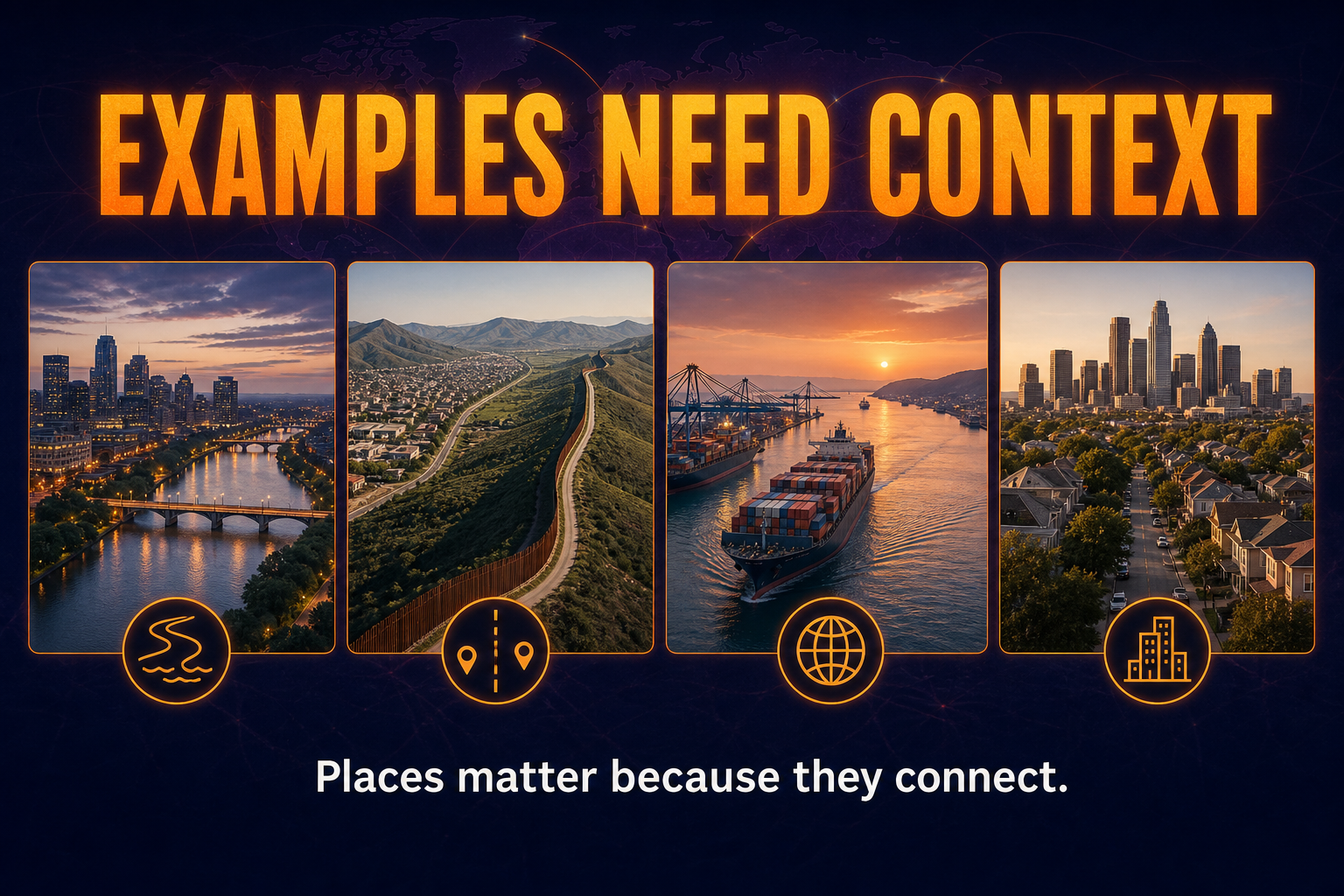
Relative location explains where a place sits using nearby rivers, highways, borders, markets, ports, and neighboring cities—not coordinates alone.
Quick answer
⚡
What Is Relative Location in AP Human Geography?
Relative location describes where a place is by explaining its relationship to other places, landmarks, routes, borders, regions, or networks. In AP Human Geography, relative location helps explain why a place matters because it shows accessibility, connections, trade routes, migration paths, site and situation, and changing relationships over time.
AP exam clue
If a prompt uses words like near, along, between, across from, north of, connected to, bordering, or beside, it is probably testing relative location.
Relative location uses relationships to other places—not coordinates alone.
Strong answers stack direction, distance, landmarks, routes, boundaries, and regions.
Situation is relative location applied to settlements and economic connections.
Relative location can change when infrastructure, borders, or hub status shifts.
Pair relative location with absolute location when prompts need both precision and significance.
The meaning, identity, character, culture, and lived experience of a location.
Pair relative location with absolute location when a prompt needs both coordinate precision and relational significance.
Summary
📽️
Relative Location Summary Slide
Review relative location vocabulary, examples, and AP exam clues in this slide walkthrough before you dive into the full guide below.
Section 1
📖
Relative Location Definition
Relative location is the position of a place expressed through relationships to other locations, landmarks, transportation routes, political boundaries, or cultural and economic ties. Geographers use relative location because people usually explain where things are by what is nearby or connected—not by reading off coordinates.
Relative location
Position described using relationships to other places or features.
Situation
A settlement's relative location and connections to resources, routes, and markets.
Cardinal direction
North, south, east, or west relative to another place.
Landmark
A known feature used to anchor a location description.
Adjacency
Sharing a border or touching another place on the map.
Corridor
A route such as a river, highway, or rail line linking places.
Reference place
The nearby city, region, or feature used to describe position.
Significance
Why the spatial relationship matters economically, politically, or culturally.
Relative location connects to space, place, and spatial analysis when you explain how locations relate across an area.
Section 2
⚖️
Relative vs Absolute Location
Absolute location and relative location answer different questions. Absolute location pinpoints a place with coordinates. Relative location explains how a place connects to neighbors, routes, resources, and markets. Many AP prompts want relative reasoning when they ask about situation, trade, migration, or industrial growth.
Concept
Definition
Example
AP clue
Relative location
Position using relationships to other places
Mexico sits south of the United States along a long land border
Situation, borders, routes, nearby regions
Absolute location
Exact coordinates such as latitude and longitude
19.4326° N, 99.1332° W for Mexico City
Coordinates, GPS, map grid
Best use
Explain significance, connectivity, and interaction
Why Pittsburgh grew at a three-river junction near coal
Trade, migration, industry, situation
Best use (absolute)
Measure precise position on Earth
Plotting a city on a GIS layer
Latitude, longitude, coordinate pairs
AP Exam Tip
If the prompt names latitude/longitude or asks for coordinates, use absolute location. If it asks how a place connects to trade routes, borders, or neighboring regions, use relative location.
Absolute location uses coordinates for precision; relative location uses surroundings and connections to explain significance.
Read the full absolute location guide when prompts ask for coordinates, latitude and longitude, or GPS precision.
Section 3
🧭
How to Describe Relative Location
Strong relative location answers stack multiple methods instead of relying on one vague phrase. On FRQs, use at least two references when a rubric asks you to describe relative location.
Method
Meaning
Example
Cardinal direction
North/south/east/west relationships
Houston is southeast of Dallas.
Distance
How far from a reference place
Boston is about 200 miles from New York City.
Landmark
A known feature nearby
The clinic is beside the transit plaza.
Route
Road, rail, or river line
The town sits on Interstate 35.
Boundary
Political edge or border
El Paso borders Mexico.
Region
Larger familiar area
Chicago anchors the Midwest.
Adjacency
Touching neighbors
Canada lies north of the contiguous United States.
AP Exam Tip
Use at least two methods when a prompt asks for relative location. One thin reference such as south of Canada usually earns partial credit—not full credit.
Strong AP answers stack direction, distance, landmarks, routes, and significance. Use the sentence builder to practice FRQ-style wording, then apply the pattern on the FRQ preview below.
Choose one clue from each row, then read the generated sentence as an AP-style relative location answer.
Relative Location Examples AP Students Should Know
Country scale
Mexico is south of the United States, north of Central America, and between the Pacific Ocean and the Gulf of Mexico.
State scale
Texas lies along the Gulf Coast and borders Mexico, New Mexico, Oklahoma, Arkansas, and Louisiana.
City scale
Chicago sits along the southwestern shore of Lake Michigan in the Great Lakes region.
Neighborhood scale
Brooklyn lies across the East River from Manhattan.
Trade route
Singapore sits near major shipping routes linking the Indian and Pacific Oceans.
Border city
El Paso is located on the U.S.-Mexico border near Ciudad Juárez.
River city
Pittsburgh is located where the Allegheny and Monongahela Rivers meet to form the Ohio River.
Campus scale
The science building is east of the library and across from the main quad.
None of these examples require coordinates. Each stresses relationships—direction, shared borders, corridors, or neighboring economies.
Level up your examples: Start with a basic line, then add one more connection. Basic: Singapore sits on major shipping routes. Stronger: Singapore sits between Indian Ocean shipping lanes and Pacific manufacturing hubs.
Relative location examples scale from countries and cities to ports, chokepoints, and everyday neighborhood directions.Section 5
🏭
Pittsburgh Relative Location Example
Pittsburgh's absolute location gives its exact coordinates. Its relative location explains why it became important. Pittsburgh is located where three rivers meet, near coal resources, and along transportation corridors connecting Atlantic markets with the interior United States.
River convergence
Three rivers meet, aiding water access and transport.
Coal proximity
Western Pennsylvania coal deposits fed steam-era factories.
Transportation corridor
East-west links helped move goods between Atlantic ports and interior markets.
Market access
Position between coast and interior connected Pittsburgh to broader trade networks.
Industrial clustering
Rivers, coal, and corridors supported steel and manufacturing growth.
AP-style takeaway: Pittsburgh's situation, or relative location to rivers, coal, transport corridors, and markets, helps explain industrial growth better than coordinates alone.
Section 6
🔄
Relative Location Can Change Over Time
Relative location can change even when absolute location stays the same. New highways, rail lines, airports, bridges, canals, ports, borders, trade agreements, or digital infrastructure can make a place more connected or less connected.
Highway construction
Effect: A town becomes more accessible to commuters and logistics firms.
Airport hub growth
Effect: A city becomes more connected to national and global flows.
New bridge or tunnel
Effect: Two places become easier to reach.
Border change
Effect: A place may become more central or more isolated.
Port expansion
Effect: A coastal city gains stronger trade connections.
Time-space compression
Effect: Faster transportation and communication make distant places feel closer.
Highways, airports, borders, and hub status can change how a place connects even when coordinates stay fixed.
Time-Space Compression explains how faster transport and communication can change relative location.
Section 7
🏞️
Site and Situation
Site and situation are often tested with relative location. Site means the physical characteristics of a place. Situation means the place's relative location and external connections.
Term
Meaning
Example
AP Clue
Site
Physical characteristics of a place
Harbor, river, hill, soil, climate
Landforms, climate, water, resources.
Situation
External connections and relative location
Near coal fields, ports, rivers, markets, or trade routes
Connections, accessibility, surroundings.
Relative location
Position compared with other places
Between two cities, along a river, near a border
Near, along, between, connected to.
AP Exam Tip
When explaining city growth, site describes what is physically there; situation explains what the place connects to.
Site describes local physical traits; situation describes relative location and connections to trade networks and neighbors.Section 8
🌐
Why Relative Location Matters
Trade
Relative location near ports, rivers, roads, or chokepoints can support trade.
Migration
People move along routes and toward connected places.
Urban growth
Cities grow when they are accessible to jobs, resources, markets, or transportation.
Culture
Ideas and cultural traits spread through connected places.
Politics
Borders, neighbors, and strategic locations shape power and conflict.
Services
Hospitals, schools, and stores depend on accessibility and nearby populations.
Agriculture
Farms benefit from access to markets, roads, and water.
Disaster planning
Relative location to flood zones, shelters, roads, and hospitals shapes risk.
Relative location can shape interaction patterns, while distance decay explains why interaction often weakens as distance increases. Use spatial analysis when you explain patterns and relationships across places.
Section 9
❌
Common Relative Location Mistakes
Only using coordinates
Fix: Coordinates are absolute location. Add nearby places and connections.
Saying near without context
Fix: Name what it is near and why that matters.
Confusing site and situation
Fix: Site is physical traits; situation is external connections.
Forgetting relative location can change
Fix: Infrastructure and borders can change how connected a place is.
Giving one weak clue
Fix: Stack direction, distance, route, landmark, border, region, and significance.
Confusing relative location with relative distance
Fix: Relative location is position by relationship; relative distance measures time, cost, or effort.
Ignoring scale
Fix: Relative location can be described at campus, city, regional, national, or global scale.
Not explaining significance
Fix: Connect relative location to trade, migration, accessibility, growth, or interaction.
Common Mistake: Writing only one relative reference such as south of Canada when the rubric expects stacked evidence with significance.
Section 10
🎯
AP Exam Strategy for Relative Location
In MCQs
Look for words like near, along, between, across from, north of, connected to, or border.
Distinguish relative location from latitude and longitude.
Connect relative location to situation.
Watch for examples involving rivers, ports, borders, highways, markets, and trade routes.
Connect relative location to accessibility and interaction.
In FRQs
Define relative location.
Identify a reference place or feature.
Add direction, distance, route, or boundary.
Explain why the relationship matters.
Connect to trade, migration, urban growth, industry, services, or political power.
Place → Reference → Connection → Significance
Example: Pittsburgh's relative location at the meeting point of three rivers and near coal resources improved transportation and resource access, helping explain its historic industrial growth.
Prompt: A city is located near a major river, at the intersection of two highways, and within a few hours of several large markets.
A. Define relative location.
B. Explain how the city's relative location could support economic growth.
C. Explain how relative location is different from absolute location.
D. Explain one way the city's relative location could change over time.
Suggested answer:
A. Relative location is the position of a place described by its relationship to other places, landmarks, routes, borders, regions, or networks.
B. The city's location near a river and at a highway intersection could support economic growth by improving transportation, trade, commuting, shipping, and access to nearby markets.
C. Relative location describes where a place is compared with other places or features, while absolute location gives an exact position such as coordinates or a street address.
D. The city's relative location could change if a new airport, bridge, rail line, highway, port, border policy, or trade route makes it more connected or less connected to other places.
Rubric
Part A: Must define relative location using relationship to other places or features.
Part B: Must connect location relationships to trade, transportation, access, markets, industry, or growth.
Part C: Must distinguish relationship-based location from exact coordinate/address location.
Part D: Must explain how infrastructure, borders, routes, technology, or policy can change connections.
Relative Location Practice Questions for AP Human Geography
Use these relative location practice questions to test definitions, absolute vs relative comparisons, site and situation, changing connectivity, and FRQ writing skills.
Use these flashcards to review relative location vocabulary, site and situation, Pittsburgh and Singapore examples, changing connectivity, and AP exam clues.
Related Unit 1 TopicsMore related Unit 1 topicsFAQ
❓
Relative Location FAQ
What is relative location in AP Human Geography?
Relative location is the position of a place described by its relationship to other places, landmarks, routes, borders, regions, or networks. It explains where something is using context instead of coordinates alone.
What is a simple definition of relative location?
Relative location means where a place is compared with other places or features nearby.
What is an example of relative location?
An example is: Mexico is south of the United States, north of Central America, and between the Pacific Ocean and the Gulf of Mexico.
How do you describe relative location?
Use direction, distance, landmarks, routes, borders, regions, nearby places, or connections. Strong answers also explain why the relationship matters.
What is the difference between relative and absolute location?
Absolute location gives an exact position using coordinates, address, or grid reference. Relative location describes position by relationship to other places or features.
Can relative location change over time?
Yes. Relative location can change when new highways, airports, rail lines, bridges, borders, trade routes, or technologies change how places connect.
What is the difference between site and situation?
Site describes the physical characteristics of a place, while situation describes its relative location and external connections to other places.
Is relative location the same as situation?
They are closely related. Situation is a type of relative location used to explain how a settlement connects to surrounding features, resources, routes, and markets.
Why does relative location matter for cities?
Relative location helps explain city growth because access to rivers, ports, roads, rail lines, markets, resources, and trade routes can increase interaction and economic opportunity.
How does relative location connect to time-space compression?
Time-space compression can change relative location by making distant places feel closer through faster transportation, communication, logistics, and digital technology.
What is the strongest AP writing formula for relative location?
Use this formula: place, reference point, connection, and significance.
How should students write about relative location in an FRQ?
Students should define relative location, name nearby places or features, explain the connection, and describe why that location relationship matters.