Map Scale and Generalization in AP Human Geography
Learn how map scale controls area and detail, why large-scale maps show small areas, why small-scale maps show large areas, and how cartographers generalize information to make maps readable.
Updated June 5, 2026 · Reviewed by APScore5 Editorial Team
Map scale controls how much area and detail a map shows, while generalization simplifies features so maps remain readable.
Quick answer
⚡
What Is Map Scale in AP Human Geography?
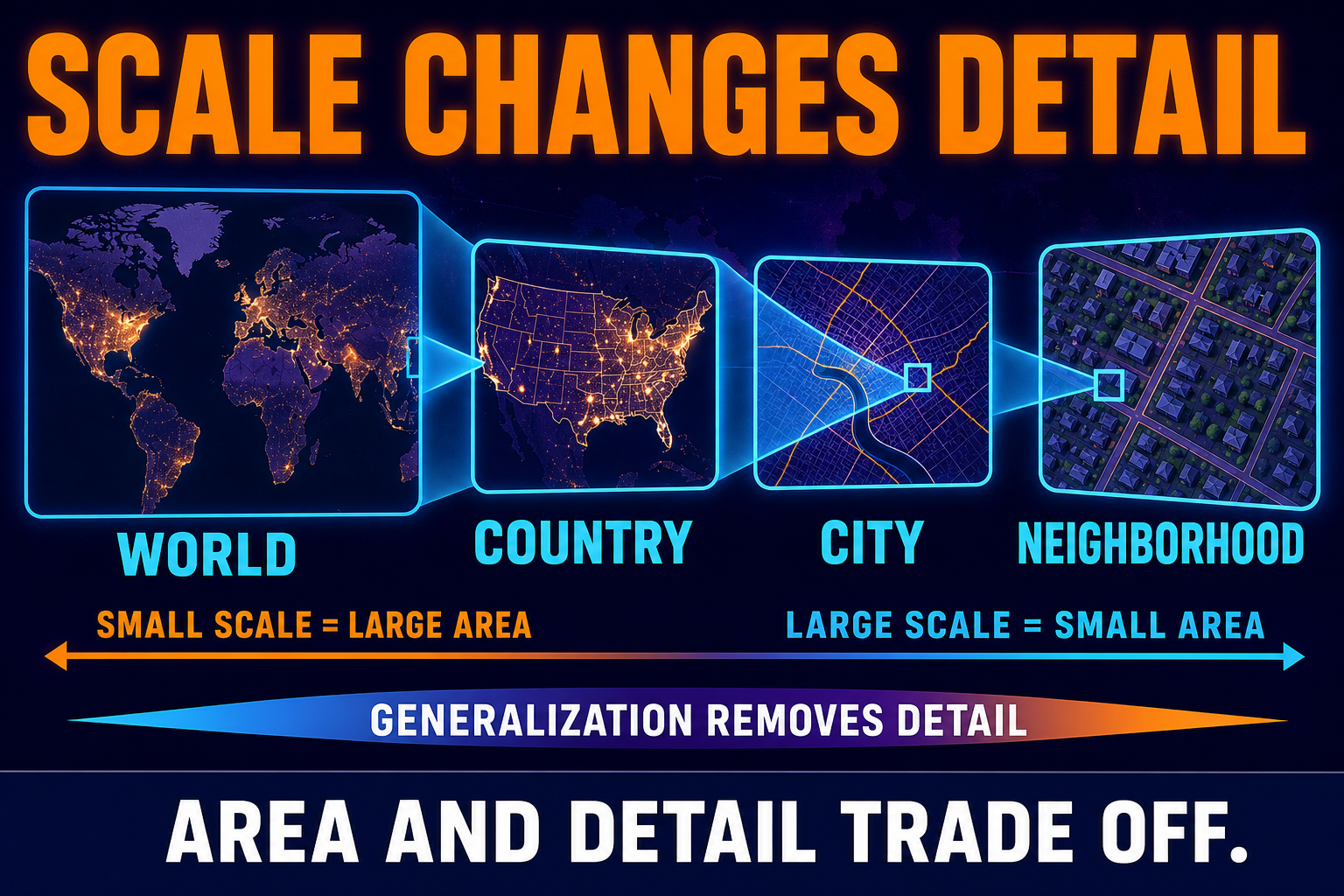
Map scale is the relationship between distance on a map and distance on Earth. A large-scale map shows a small area with more detail, such as a neighborhood map. A small-scale map shows a large area with less detail, such as a world map. Generalization is the process of simplifying features so a map stays readable at its chosen scale.
Map scale compares map distance to real-world distance.
Large-scale maps show small areas with more detail.
Small-scale maps show large areas with less detail.
Generalization simplifies or removes detail.
Do not confuse map scale with scale of analysis.
Memory Shortcut
Large-scale = small area, more detail. Small-scale = large area, less detail.
Large fraction = large scale.
Large scale zooms in.
Small scale zooms out.
Generalization increases as maps zoom out.
Start Here: How to Use This Scale Guide
Memorize that large-scale maps show small areas with more detail.
Memorize that small-scale maps show large areas with less detail.
Compare map scale with scale of analysis.
Learn how generalization simplifies map detail.
Finish with MCQs, flashcards, and FRQ practice.
Section 1
📖
Map Scale Definition
Map scale is the relationship between distance on a map and distance on Earth. Cartographers express scale in words, ratios, or scale bars so readers can judge how much area a map covers and how much detail it can show. Pair scale vocabulary with introduction to maps and map purpose and geographic questions on the Maps and Map Interpretation path.
Written scale
Uses words, such as 1 inch equals 1 mile.
Representative fraction
Uses a ratio, such as 1:24,000.
Graphic scale
Uses a scale bar that remains useful if the map is resized.
Large-scale map
Shows a small area with more detail.
Small-scale map
Shows a large area with less detail.
Generalization
Simplifying map features so the map remains readable.
Scale also connects to map projections because flattening Earth forces choices about area, distance, and detail at every zoom level.
AP Human Geography stimuli usually show scale in one of three formats. Read the legend and scale bar before you interpret distance, density, or pattern.
Written scale
Uses words, such as 1 inch equals 1 mile.
Representative fraction
Uses a ratio, such as 1:24,000.
Graphic scale
Uses a scale bar that remains useful if the map is resized.
Scale format
Example
AP exam clue
Written scale
1 inch = 1 mile
Easy to read; check unit conversions.
Representative fraction
1:24,000
Larger second number means smaller detail.
Graphic scale
Labeled bar line
Still works if the map is resized.
Section 3
⚖️
Large-Scale vs Small-Scale Maps
The AP exam traps students who think large-scale means a large area. In geography, large-scale maps show small areas with more detail, while small-scale maps show large areas with less detail.
Feature
Large-scale map
Small-scale map
Area shown
Small area
Large area
Detail
More detail
Less detail
Example
Neighborhood or campus map
World or country map
Scale fraction
Larger fraction, such as 1:10,000
Smaller fraction, such as 1:50,000,000
Generalization
Less generalization
More generalization
AP warning
Large-scale does not mean large area
Small-scale does not mean small area
AP Exam Tip
Large-scale does not mean large area. A neighborhood map is large-scale. A world map is small-scale.
Large-scale maps show small areas with more detail, while small-scale maps show large areas with less detail.
Move down the scale ladder from global to local and detail increases. Move up the ladder and generalization usually increases too.
Local scale
Example
Neighborhood map.
Detail shown
Streets, buildings, bus stops.
City scale
Example
Urban transportation map.
Detail shown
Districts, major roads, transit routes.
Regional scale
Example
State or metro area map.
Detail shown
Counties, highways, major cities.
National scale
Example
Country map.
Detail shown
States, regions, national patterns.
Global scale
Example
World map.
Detail shown
Continents, countries, global patterns.
The scale ladder helps students see how geographic detail changes from local to global maps.
Compare ladder thinking with distribution patterns and choropleth maps when a stimulus jumps between national and neighborhood views.
Section 5
🔍
Map Scale vs Scale of Analysis
Map scale describes the map-to-ground distance relationship. Scale of analysis describes the geographic level where data is summarized. The two ideas interact but are not the same.
Concept
Definition
Example
Common mistake
Map scale
Distance relationship between map and Earth
1 inch = 1 mile
Confusing scale fraction with data level
Scale of analysis
Level at which data is studied
County, state, national, global
Assuming national data shows local variation
AP Exam Tip
Do not confuse map scale with scale of analysis. National averages can hide neighborhood variation even when the map itself is large-scale.
Read the dedicated scale of analysis guide for FRQ language on hidden local variation.
Section 6
💡
Why Scale Matters on the AP Exam
Different scales reveal or hide different geographic patterns. Strong answers name the scale, describe the visible pattern, and explain what detail may be missing.
A national unemployment map can hide county-level job loss.
A state health map can hide neighborhood disease clusters.
A city transit map can reveal service gaps that a regional map hides.
A global development map can hide regional differences inside countries.
Map generalization is the process of simplifying real-world features so a map stays readable at its chosen scale. Cartographers select, smooth, group, exaggerate, or omit details so readers can see the main pattern.
AP Exam Tip
Generalization is necessary, not a mistake. The exam wants you to explain both the benefit and the limitation.
Generalization simplifies map features by selecting, smoothing, grouping, exaggerating, or omitting details.Section 8
📊
Types of Map Generalization
These seven methods appear in MCQs and FRQs when stimuli ask how a map was simplified.
Selection
Choosing which features to include.
Simplification
Reducing detail in lines or shapes.
Classification
Grouping data into categories.
Symbolization
Using symbols or colors to represent features.
Exaggeration
Making important features larger than true scale.
Aggregation
Combining smaller features into larger groups.
Omission
Leaving out details that are not needed for the map's purpose.
Section 9
🔗
How Scale and Generalization Work Together
As a map covers more area, cartographers usually generalize more and show less local detail. A city street map can show bus stops and alleys. A national map must omit most of that detail to stay legible.
Example: A small-scale national map shows broad regional unemployment patterns but generalizes local variation. A large-scale city map can reveal neighborhood unemployment clusters that the national map hides.
As a map covers more area, it usually needs more generalization and shows less local detail.
Pair this idea with isoline maps and cartograms when comparing how different map families trade detail for pattern clarity.
Section 10
💪
Strengths and Limitations of Generalization
Benefits
Makes maps readable
Reduces clutter
Highlights the map's purpose
Helps compare broad patterns
Works well at small scales
Makes complex data easier to understand
Limitations
Hides local detail
Can oversimplify complex patterns
May introduce bias
Can erase small communities or features
Can make boundaries look cleaner than reality
Can change the reader's interpretation
Section 11
⚠️
Common Map Scale and Generalization Mistakes
Thinking large-scale means large area
Fix: Large-scale maps show small areas with more detail.
Thinking small-scale means small area
Fix: Small-scale maps show large areas with less detail.
Confusing map scale with scale of analysis
Fix: Map scale is distance. Scale of analysis is data level.
Ignoring the scale bar
Fix: Always check the map's scale before estimating distance.
Assuming generalized maps are wrong
Fix: Generalization is necessary, but it has limitations.
Forgetting that scale changes patterns
Fix: Local patterns may disappear on regional or national maps.
Treating national averages as local truth
Fix: National data can hide local variation.
Ignoring what was omitted
Fix: Ask what the map leaves out and why.
Common Mistake: Treating large-scale as large area is one of the fastest ways to lose points on Unit 1 map MCQs.
Section 12
📝
AP Exam Strategy for Map Scale and Generalization
In MCQs
Identify large-scale vs small-scale maps.
Interpret scale bars and ratios.
Explain why detail changes by scale.
Distinguish map scale from scale of analysis.
Recognize generalization methods.
In FRQs
Define map scale.
Compare large-scale and small-scale maps.
Explain how scale changes visible patterns.
Explain one benefit or limitation of generalization.
Example: A small-scale national map shows broad regional unemployment patterns but generalizes local variation. A large-scale city map can reveal neighborhood unemployment clusters that the national map hides.
Use these map scale and generalization practice questions to test large-scale vs small-scale reasoning, scale of analysis traps, and generalization methods.
Map scale practice helps students explain how area, detail, scale of analysis, and generalization affect map interpretation.
Map scale shows how distance on a map compares to distance in the real world.
What is a large-scale map?
A large-scale map shows a small area with lots of detail, such as a neighborhood, campus, or city block map.
What is a small-scale map?
A small-scale map shows a large area with less detail, such as a national map, continental map, or world map.
Why is a world map small-scale?
A world map is small-scale because it covers a very large area and must leave out many details.
Why is a neighborhood map large-scale?
A neighborhood map is large-scale because it covers a small area and can show detailed features like streets, buildings, parks, and bus stops.
What is map generalization?
Map generalization is the process of simplifying real-world features so they can be shown clearly on a map.
Why do maps use generalization?
Maps use generalization to reduce clutter, improve readability, and focus on the map's main purpose.
What is the difference between map scale and scale of analysis?
Map scale describes the relationship between map distance and real-world distance, while scale of analysis describes the geographic level at which data is studied.
Why does scale matter on the AP Human Geography exam?
Scale matters because different scales can reveal or hide different geographic patterns.