Quantitative Geographic Data in AP Human Geography
Learn how geographers use numbers, counts, rates, percentages, density, ratios, and indexes to compare places, identify spatial patterns, measure change, and support AP-style geographic claims.
Updated June 5, 2026 · Reviewed by APScore5 Editorial Team
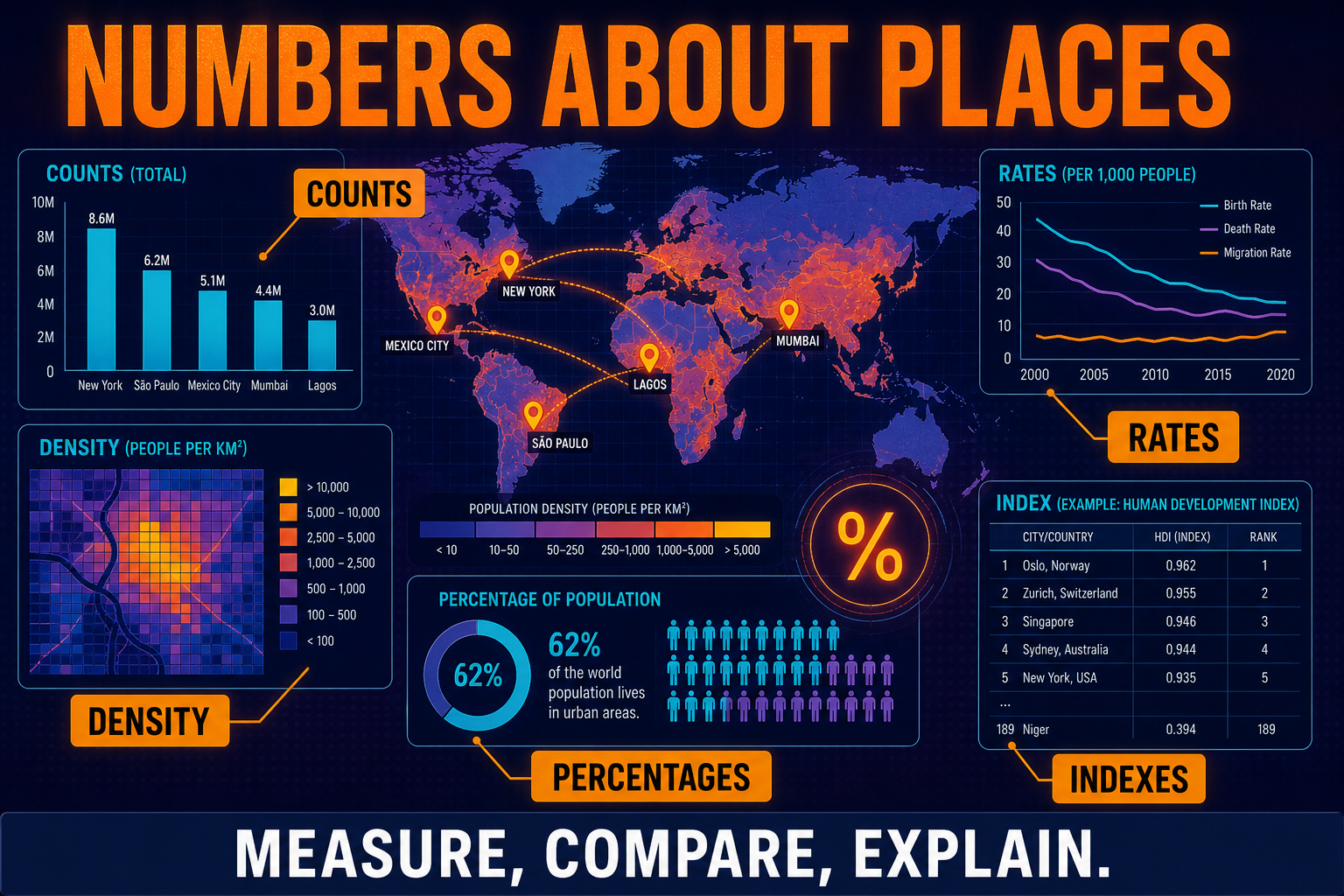
Quantitative geographic data uses numbers such as counts, rates, percentages, density, and indexes to compare places and explain spatial patterns.
Quick answer
⚡
What Is Quantitative Geographic Data in AP Human Geography?
Quantitative geographic data is numerical information connected to places, regions, populations, environments, or spatial patterns. In AP Human Geography, quantitative data includes counts, rates, percentages, densities, ratios, indexes, and measurements such as population density, birth rate, migration rate, GDP per capita, median income, life expectancy, and percent urban.
Quantitative geographic data means numbers about places.
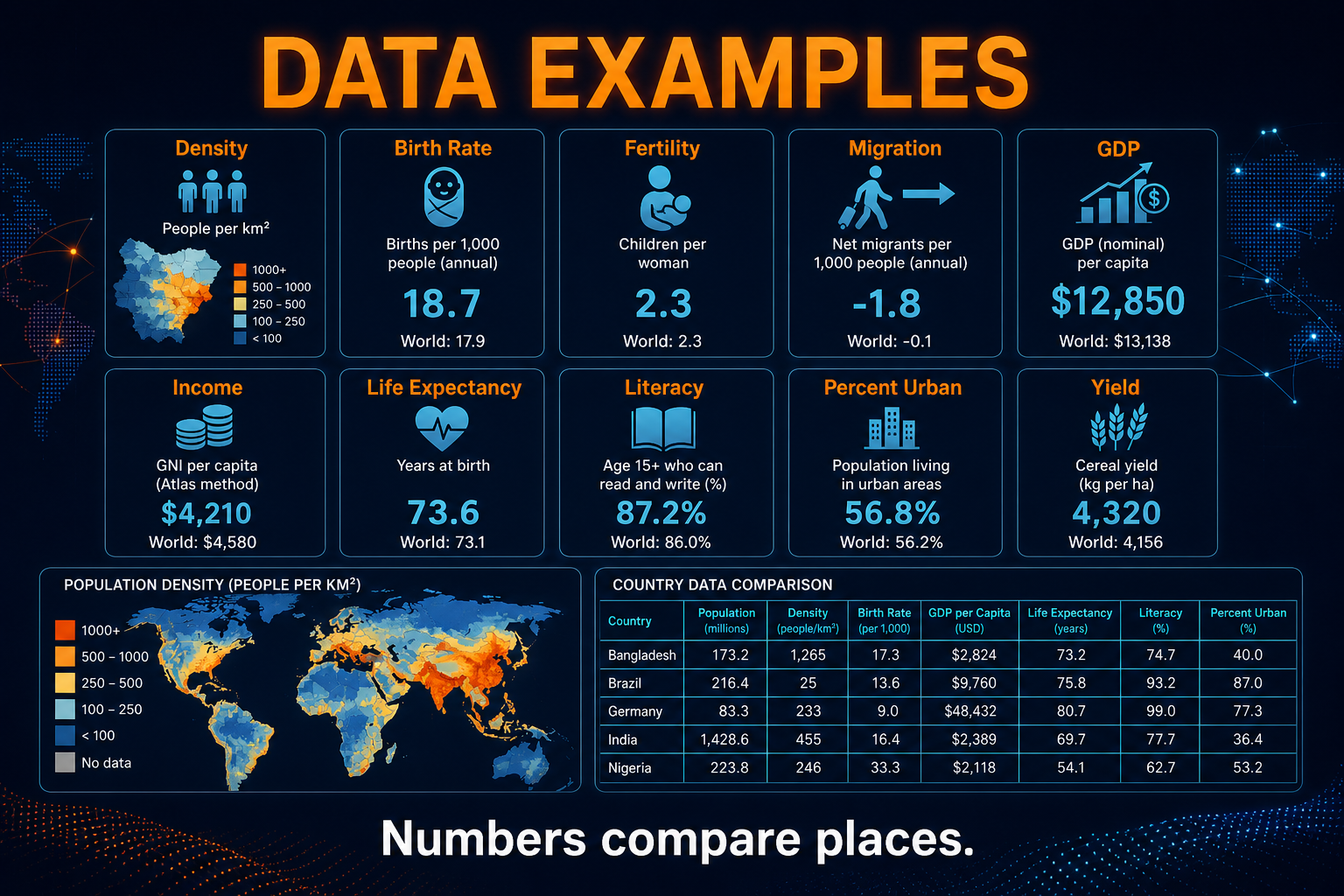
Common examples include population density, birth rate, migration rate, GDP per capita, life expectancy, and percent urban.
Quantitative data helps geographers compare places, measure change, and identify spatial patterns.
It appears in tables, graphs, charts, population pyramids, choropleth maps, dot maps, cartograms, and GIS layers.
Numbers are useful, but they can hide scale problems, inequality, bias, outdated data, and lived experience.
Memory Shortcut
Quantitative = quantity = numbers.
Counts tell how many.
Rates tell how often.
Percentages tell share.
Density tells amount per area.
Indexes combine multiple measures.
Start Here: How to Use This Quantitative Data Guide
Learn that quantitative geographic data means numbers about places.
Review common examples like density, rates, percentages, and indexes.
Compare quantitative data with qualitative geographic data.
Study how numbers appear in maps, tables, charts, and AP stimuli.
Finish with MCQs, flashcards, and FRQ practice.
Section 1
📖
Quantitative Geographic Data Definition
Quantitative geographic data is numerical information connected to location, place, region, population, environment, or spatial process. It includes values that can be counted, measured, calculated, compared, graphed, mapped, or analyzed statistically. Start on the Geographic Data and Technology path, then compare GIS, GPS, and remote sensing data tools.
Count
A total number, such as total population or number of farms.
Rate
A value measured per unit, such as births per 1,000 people.
Percentage
A share of a whole, such as percent urban or percent literate.
Density
A value per unit area, such as people per square mile.
Ratio
A comparison between two quantities, such as dependency ratio.
Index
A combined measure using multiple indicators, such as HDI.
Per capita
A value divided by population, such as GDP per capita.
Time series
Numerical data recorded across multiple dates to show change over time.
Quantitative data can appear as raw counts, normalized rates, percentages, densities, ratios, indexes, or measurements. Normalized data is often more useful for comparing places because it adjusts for population size, land area, or another base.
Counts
Total population, total farms, total migrants, total stores.
Rates
Birth rate, death rate, migration rate, unemployment rate.
Percentages
Percent urban, percent literate, percent using internet.
Densities
Population density, housing density, road density.
Per capita values
GDP per capita, emissions per capita, income per capita.
Indexes
Human Development Index or composite vulnerability index.
Measurements
Distance, travel time, rainfall, pollution concentration.
Change over time
Population growth rate or urban expansion between two years.
AP Exam Tip
For comparisons, rates, percentages, densities, and per capita values are often stronger than raw counts because they adjust for size.
Quantitative geographic data can appear as counts, rates, percentages, densities, ratios, indexes, measurements, and values over time.
A data source is quantitative when it uses numbers that can be counted, measured, calculated, graphed, compared across places, or mapped with consistent units.
Fast test: If you can graph it, rank it, average it, calculate it, or map it as a numeric class, it is probably quantitative geographic data.
It is numerical
10,000 people per square mile.
It uses a unit
Dollars per person, births per 1,000 people, percent urban.
It can be compared
Country A has a higher fertility rate than Country B.
It can be mapped
Counties shaded by median income.
It can be graphed
A line chart of migration over time.
It can be calculated
Density = population divided by land area.
Quantitative geographic data is recognizable because it uses numbers, units, comparisons, calculations, maps, charts, or graphs.
These examples appear across AP Human Geography units—in population, development, urban, agricultural, and economic geography stimuli.
Population density
People per square mile or square kilometer.
Birth rate
Births per 1,000 people per year.
Death rate
Deaths per 1,000 people per year.
Total fertility rate
Average number of births per woman.
Migration rate
Net migrants per 1,000 people.
GDP per capita
Economic output divided by population.
Median household income
Middle income value for households in a place.
Life expectancy
Average expected years of life at birth.
Literacy rate
Percent of adults who can read and write.
Percent urban
Share of population living in urban areas.
Agricultural yield
Crop output per acre or hectare.
Internet access rate
Percent of households with broadband access.
Common quantitative geographic data examples include density, rates, income, GDP per capita, life expectancy, literacy, percent urban, and agricultural yield.
Compare density and income patterns using scale of analysis so national averages do not hide neighborhood variation.
Section 5
🗺️
What Quantitative Geographic Data Shows
Quantitative data helps geographers describe spatial patterns, compare places, measure change, classify regions, test relationships, and support evidence-based claims.
Spatial concentration
High population density near coasts or cities.
Regional difference
Higher life expectancy in one region than another.
Change over time
Urban population share rising across decades.
Inequality
Median income varies by neighborhood.
Development patterns
GDP per capita, literacy, and life expectancy differ by country.
Movement
Migration rates show population gain or loss.
Access
Broadband, hospital beds, school seats, or transit stops per population.
Environmental variation
Rainfall, air pollution, or flood risk values differ across space.
Numbers in GIS layers and maps and map interpretation help planners allocate services and test geographic theories. When location-linked feeds are counted or mapped, they can also supply quantitative patterns—see geotagged data in the data technology cluster.
Section 6
⚖️
Quantitative vs Qualitative Geographic Data
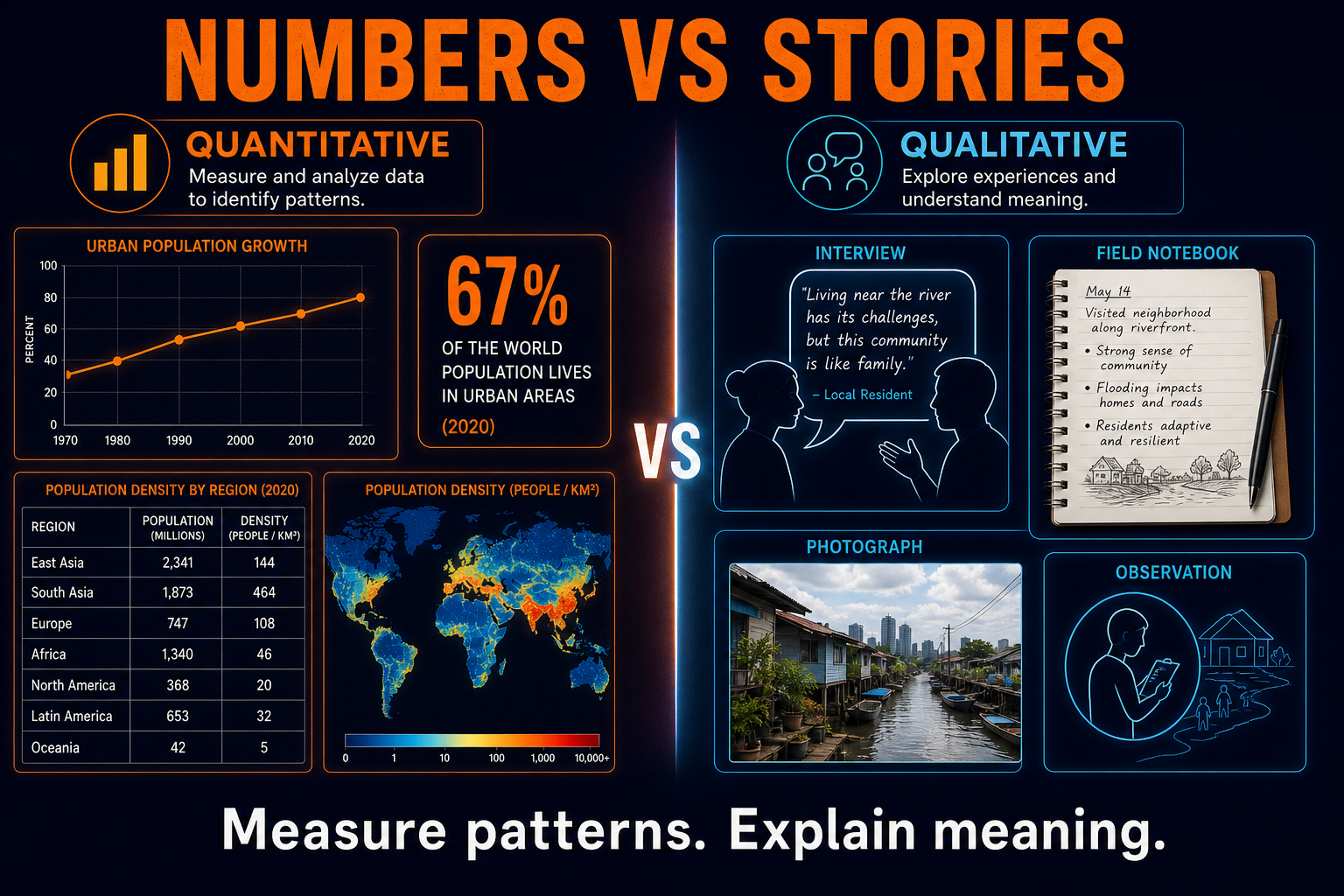
Quantitative data uses numbers. Qualitative data uses descriptions, observations, images, interviews, field notes, and narratives. Strong geography often combines both: numbers show the pattern, while qualitative evidence helps explain meaning, perception, and lived experience.
Feature
Quantitative Geographic Data
Qualitative Geographic Data
Main form
Numbers, counts, rates, percentages
Descriptions, interviews, observations, images
Example
Population density by county
Resident interviews about neighborhood change
Best for
Measuring and comparing patterns
Explaining meaning and perception
AP clue
Tables, charts, statistics, maps with numeric legends
Field notes, photos, narratives, open-ended responses
Strength
Easy to compare across places
Adds context and human experience
Limitation
Can hide local variation or lived experience
Harder to generalize or map consistently
Read the dedicated qualitative geographic data guide when a prompt asks how people experience a pattern numbers alone cannot show. Counted survey responses are quantitative when collected fairly—see survey data and sampling for who is asked and how samples are chosen. Official population counts come from census data.
Quantitative data measures patterns with numbers, while qualitative data explains meaning through observations, interviews, photos, and descriptions.Section 7
📝
How Quantitative Data Appears on the AP Exam
Quantitative data appears in AP Human Geography as tables, bar charts, line graphs, scatterplots, pie charts, population pyramids, choropleth maps, dot distribution maps, cartograms, flow maps, GIS dashboards, demographic indicators, development indicators, and migration statistics.
In MCQs
Identify the variable shown.
Interpret a map legend or graph.
Compare two places using values.
Identify a spatial pattern.
Explain why a value is high or low.
Recognize whether data are normalized.
Evaluate limitations such as scale, source, or outdated data.
In FRQs
Cite a number correctly.
Describe the pattern shown.
Explain a likely geographic cause.
Connect the value to a process, model, or theory.
Explain one limitation of the data.
Number → Unit → Pattern → Explanation → Geographic significance → Limitation
Example: Country A has a total fertility rate of 5.1 births per woman, which is much higher than Country B's 1.7. This suggests faster natural increase in Country A, possibly because of lower access to contraception, lower female education, or agricultural labor needs. However, the national average may hide regional or urban-rural differences.
For FRQs, do not just quote a number. Explain the pattern, connect it to a geographic process, and name one limitation.
Quantitative data is powerful for comparison and measurement, but numbers can hide scale problems, bias, outdated data, inequality, and lived experience.
Evaluate reliability with the data reliability and bias guide before treating any statistic as complete truth.
Section 9
⚠️
Common Quantitative Data Mistakes
Repeating the number without explaining it
Fix: Describe the pattern and geographic significance.
Confusing quantitative with qualitative
Fix: Quantitative means numbers; qualitative means descriptions.
Treating numbers as perfect truth
Fix: Numbers can be biased, outdated, incomplete, or measured differently.
Ignoring scale
Fix: National averages can hide regional or neighborhood variation.
Comparing raw counts unfairly
Fix: Use rates, percentages, densities, or per capita values when size differs.
Forgetting units
Fix: Always include units such as per 1,000 people, percent, per square mile, or dollars per person.
Ignoring source and date
Fix: Ask who collected the data, how, and when.
Missing lived experience
Fix: Use qualitative evidence when the prompt asks how people experience a pattern.
Common Mistake: Comparing raw population counts between a large country and a small city without using rates, percentages, or per capita values.
Section 10
🎯
AP Exam Strategy for Quantitative Geographic Data
In MCQs
Look for units, values, and legends.
Check whether data are raw counts or normalized values.
Compare places using the same measurement.
Identify the strongest pattern before reading answer choices.
Watch for scale and source limitations.
In FRQs
Quote the number with its unit.
Describe the spatial pattern.
Compare values accurately.
Explain a geographic cause or consequence.
Add a limitation when asked.
Number → Pattern → Explanation → Significance → Limitation
Example: A county with 8,000 people per square mile has much higher density than a county with 400 people per square mile. This pattern may reflect urbanization, job concentration, transit access, and compact housing. However, density alone does not show income, housing quality, or residents' lived experience.
Prompt: A geographer studies urban growth in two metropolitan areas. The geographer uses population density, median income, commute time, and percentage of residents living in apartments.
A. Define quantitative geographic data.
B. Identify one example of quantitative data from the scenario.
C. Explain how population density can help geographers understand urban growth.
D. Explain one limitation of using median income to understand urban conditions.
Suggested answer:
A. Quantitative geographic data is numerical information connected to places or spatial patterns, such as counts, rates, percentages, densities, or measurements.
B. Population density is an example of quantitative data because it measures the number of people per unit of land area.
C. Population density can show where people are concentrated within a metropolitan area. Increasing density may indicate urban growth near downtown areas, transit corridors, job centers, or places with many housing options.
D. Median income may hide inequality within a city. A place can have a relatively high median income while still containing low-income residents who face housing insecurity or limited access to services.
Rubric
Part A: Must mention numerical data and connect it to places, regions, or spatial patterns.
Part B: Must identify one valid quantitative indicator from the scenario.
Part C: Must explain how density helps identify concentration, urban growth, or spatial pattern.
Part D: Must explain a valid limitation such as hidden inequality, local variation, scale, or missing lived experience.
Quantitative Geographic Data Practice Questions for AP Human Geography
Use these quantitative geographic data practice questions to test whether you can identify numerical data, compare values, recognize units, interpret maps and tables, and explain limitations such as scale, bias, averages, and outdated data.
What is quantitative geographic data in AP Human Geography?
Quantitative geographic data is numerical information connected to places, regions, populations, environments, or spatial patterns. It includes counts, rates, percentages, densities, ratios, indexes, and measurements.
What is a simple example of quantitative geographic data?
Population density is a simple example. If a city has 10,000 people per square mile, that number is quantitative geographic data tied to a specific place.
Is population density quantitative data?
Yes. Population density is quantitative because it measures the number of people per unit of land area, such as people per square mile or people per square kilometer.
Is census data quantitative?
Most census data is quantitative because it includes numerical information such as population size, age, income, household size, housing units, and demographic percentages.
Can a map show quantitative data?
Yes. Choropleth maps, dot distribution maps, cartograms, graduated symbol maps, flow maps, and GIS layers can all display quantitative geographic data.
What is the difference between quantitative and qualitative geographic data?
Quantitative geographic data uses numbers, such as density, income, or birth rate. Qualitative geographic data uses descriptions, interviews, observations, photographs, field notes, or narratives.
Why do geographers use quantitative data?
Geographers use quantitative data to compare places, measure change over time, identify spatial patterns, classify regions, support claims with evidence, and make planning decisions.
What is one limitation of quantitative geographic data?
One limitation is that numbers can hide human experience or local variation. A national average, median income, or regional percentage may mask inequality inside smaller places.
How does quantitative data appear on the AP Human Geography exam?
Quantitative data appears in tables, graphs, bar charts, line charts, pie charts, population pyramids, choropleth maps, dot maps, cartograms, GIS layers, and demographic indicators.
What is the AP writing formula for quantitative geographic data?
Use Number → Unit → Pattern → Explanation → Geographic significance → Limitation. Do not just repeat the number; explain what it shows and why it matters.
Where else does quantitative data show up in AP Human Geography?
Quantitative data appears across every AP Human Geography unit, including population pyramids, fertility rates, migration rates, language and religion percentages, election margins, agricultural yields, urban population shares, HDI, and GDP per capita.