Pattern
What is happening in the data, map, pyramid, or migration flow?
Population distribution, density, pyramids, the Demographic Transition Model, migration, and policies—with MCQs, flashcards, and FRQ-style reasoning aligned to the AP Human Geography exam.
Updated May 31, 2026 • Reviewed by APScore5 Editorial Team
12 connected guides. Follow them in order or jump to where you need help.
Start with pyramids and density, then DTM stages and theory guides, then migration, policies, and full practice on this hub.
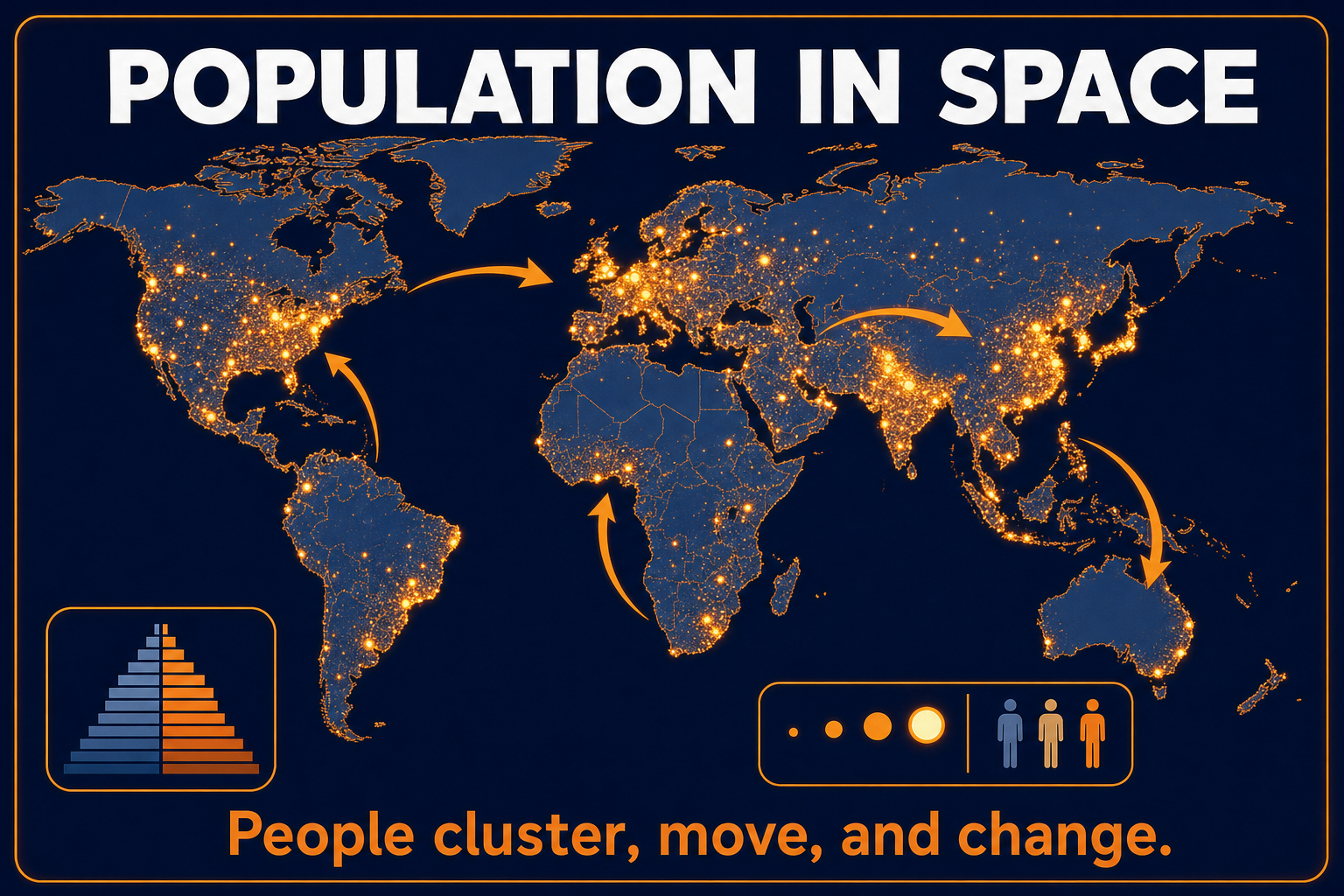
For the AP exam, Unit 2 is not just vocabulary. You need to interpret population pyramids, compare population density types, explain the Demographic Transition Model, apply Malthusian Theory (population vs. food supply, positive and preventive checks), evaluate pronatalist and antinatalist policies, and connect migration to economic, political, cultural, and environmental effects.
For stage-by-stage CBR/CDR reasoning, use the DTM stages guide (main stage reference), the DTM overview, and all Unit 2 deep-dive pages below.
A strong Unit 2 answer usually follows Pattern → Cause → Effect → Geographic scale. Example: If a country has a narrow base on its population pyramid, the pattern is low birth rates. A likely cause is later marriage, higher education, urbanization, or contraception access. The effect may be aging, labor shortages, or pension pressure—stated at local to national scale depending on the prompt.
What is happening in the data, map, pyramid, or migration flow?
Which demographic or migration process explains it (fertility, mortality, DTM stage, policy, push/pull)?
What changes for people, land, services, economy, or culture?
Is the pattern local, national, regional, or global? Name the scale in your reasoning.
Link Unit 2 to Unit 1 spatial thinking when prompts ask how data is shown or how scale changes the story.
Use this page as a guided path. Start with population distribution and density. Then move into pyramids, the Demographic Transition Model, epidemiological transition, Malthus and Boserup, population policies, and migration. Finish with flashcards, MCQs, FRQs, and linked deep-dive guides.
Population distribution, density types, and population pyramids.
DTM stages, country examples, and epidemiological transition.
Push and pull factors, pronatalist/antinatalist policy, and migration effects.
Use the diagnostic, flashcards, MCQs, and FRQ scenarios.
Each card below pairs a core concept with an AP-style trap students miss on MCQs and FRQs.
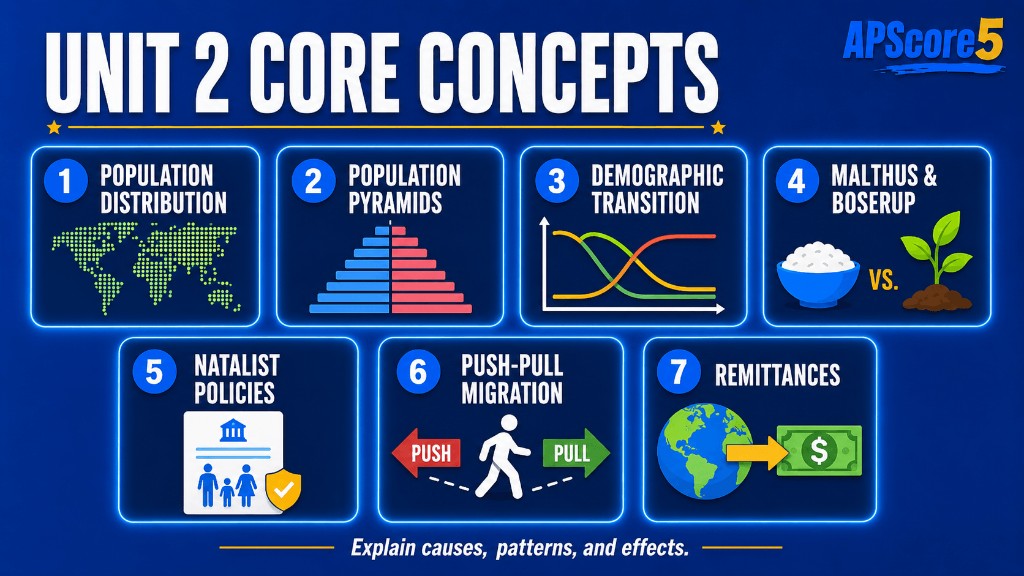
Population distribution describes where people live. Population density measures how crowded people are in an area. Compare arithmetic density (people per total land), physiological density (people per arable land), and agricultural density (farmers per arable land)—each reveals different pressure on land and resources.
Population composition is age and sex structure. A population pyramid helps predict future needs. A wide base usually means high birth rates and youth dependency. A narrow base may signal low fertility and aging. A bulge in working-age cohorts can mean a demographic dividend; a large elderly cohort raises healthcare and pension demand.
The Demographic Transition Model (DTM) shows how birth rates, death rates, and natural increase shift as a society develops. Early stages: high birth and death rates. Middle stages: rapid growth when death rates fall before birth rates. Later stages: low birth and death rates, slow or negative growth, and often aging populations.
Malthusian Theory argues population could outrun food supply, producing scarcity or crisis. Boserup argued pressure could spur innovation—irrigation, fertilizers, better seeds, labor-saving tools. AP tasks often ask you to compare these views, not just define them.
Malthusian Theory study guide → Malthus vs Boserup on this page →
Pronatalist policies encourage births (leave, childcare, payments). Antinatalist policies discourage births (education, contraception access, incentives). Tie each policy to a demographic problem: aging, dependency ratio, rapid growth, gender imbalance, or service strain.
Push factors drive people out (conflict, unemployment, disasters, instability). Pull factors attract people in (jobs, safety, education, family reunification, services). Most moves involve multiple interacting factors—not only economics.
Migration reshapes origin and destination regions. Origins may gain remittances or lose talent (brain drain). Destinations may gain workers and diversity but face housing or service pressure. Name effects on both sides when the rubric asks for impacts.
Direct answer: Use this hub for vocabulary, practice, and FRQ structure—then open the guides below when you need stage-by-stage DTM help, country examples, disease transitions, or the next unit in the course.
Recommended order for DTM-heavy weeks: DTM stages → country examples → DTM practice MCQs. Pair mortality prompts with the epidemiological transition model.
On this page: population density types · pyramid checklist · DTM summary · push and pull factors · 50 Unit 2 MCQs · FRQ scenarios
Start every pyramid question by stating what the shape implies for birth rates, death rates, dependency, and future service needs—then support with age-cohort evidence from the graphic.
For a full walkthrough, open our Population Pyramids mini-course — four linked guides with Niger, USA, and Japan examples, a matching quiz, and 90+ practice items.
Start with the how to read population pyramids guide (5-step method) or the AP Human Geography exam guide for FRQ scoring language.
Compare pyramid shapes to real countries in the DTM country examples guide (Niger vs Japan and more).
Population patterns and migration explain how people distribute across space, and AP answers should connect demographic concepts to evidence such as pyramids, density data, DTM stages, policies, or migration flows.
| Concept Pair | Difference | AP Clue |
|---|---|---|
| Arithmetic vs physiological density | Arithmetic uses total land; physiological uses arable land | crowding vs food pressure |
| Stage 2 vs Stage 3 DTM | Stage 2 keeps high birth + falling death; Stage 3 shows falling birth | fastest growth vs slowing growth |
| Push vs pull | Push leaves origin; pull attracts to destination | out vs in |
| Malthus vs Boserup | Malthus stresses limits; Boserup stresses innovation | scarcity vs intensification |
| Natural increase vs total growth | Natural increase is births minus deaths only | excludes migration |
Use Pattern → Cause → Effect → Scale as your default FRQ and multi-step MCQ structure.
What is happening, or where on Earth is it visible (map, pyramid, table)?
Which demographic or migration process explains it (DTM stage, density type, policy, push/pull)?
What happens to people, land, services, economy, or culture?
Local, national, regional, or global—be explicit.
Fix: After you define a term, add how or why the process works in the scenario.
Fix: Link shape to dependency ratio, labor force, schools, healthcare, or pensions.
Fix: Add political, social, cultural, environmental, or forced-migration factors when relevant.
Fix: Match the prompt to arithmetic vs physiological vs agricultural density.
Fix: State whether the pattern is local, national, regional, or global.
Unit 3 Cultural Patterns builds on migration and identity—preview it after you can explain Unit 2 migration effects clearly.
Direct answer: Population distribution shows where people cluster or spread out; population density measures how many people relate to land or farmland in ways that exam questions specify—always match the density type to what the prompt measures.
Clustered settlement near water, fertile plains, or trade routes is common in textbook examples, while sparse populations appear in harsh climates or rugged terrain—always tie pattern to resource access and historical economic activity at the scale shown.
Direct answer: Population composition is the age-sex structure of a group; a population pyramid turns that structure into a forecast tool for dependency, labor supply, and service needs.
Compare male and female bars when the chart splits sides—gender imbalances may reflect migration, policy, or cultural factors. Always state whether you are describing rapid growth, slow growth, or contraction implied by the cohort sizes.
For timed practice, run the five-step pyramid checklist, then confirm one consequence (schools, jobs, healthcare, housing, or pensions) in the same paragraph.
Direct answer: The Demographic Transition Model orders stages by how birth rates and death rates interact—natural increase spikes when mortality drops before fertility declines.
In early stages, high crude birth and death rates limit growth. In middle stages, falling death rates drive rapid population growth. In later stages, low birth and death rates produce slow growth, zero growth, or shrinkage; populations often age because cohorts from earlier high-fertility periods move up the pyramid.
The epidemiological transition describes shifting causes of death—from infectious disease burdens toward chronic, aging-related illnesses—as healthcare, sanitation, and nutrition improve. Pair it with DTM when a prompt links mortality change to development.
Full DTM study guide DTM stages Country examples DTM practice MCQs Epidemiological transition
Direct answer: Malthusian theory stresses limits: population pressure can outrun food supply without preventive or positive checks. Boserup theory stresses response: denser populations can accelerate agricultural innovation and intensification.
Strong comparison paragraphs give both mechanisms—scarcity and incentive to innovate—then judge which fits the scenario (climate shock vs rising yields from irrigation, for example).
Neo-Malthusian theory updates Malthus for modern environmental limits: water, energy, land, climate, and biodiversity—not only food—plus per-capita consumption in wealthy countries. Use it when prompts mention sustainability, ecological footprint, or resource stress beyond famine.
Full Malthusian Theory study guide → Malthusian theory on the AP exam Malthusian theory vs Boserup theory Neo-Malthusian theory Avoid compare-only mistakes →
Direct answer: Pronatalist policies reward or encourage births to raise fertility or slow aging; antinatalist policies aim to lower birth rates when rapid growth strains resources or services.
Pronatal tools include paid parental leave, childcare subsidies, tax credits, or housing incentives. Antinatal tools include family-planning education, contraception access, later marriage norms reinforced by messaging, or—in extreme documented historical cases—coercive limits that AP prompts may reference critically.
Grade-ready sentences tie policy to problem: low fertility and pension stress may invite pronatalism; youth bulges and service gaps may invite antinatalism—always note possible social side effects (gender norms, rural–urban gaps).
Direct answer: Push and pull factors explain why people leave an origin and why they choose a destination. Exam-grade answers stack categories—economic, political, environmental, social/cultural—rather than relying on a single label.
Distinguish forced migration (coercion, persecution, removal) from voluntary migration (choice constrained by opportunity costs). Distinguish internal migration (within a country) from international migration (across borders)—scale and policy differ.
Direct answer: Migration reallocates labor and skills; remittances are private transfers from migrants to households in origin communities—often stabilizing consumption or funding education.
Brain drain names the loss of skilled workers from origins; destinations may gain productivity but face integration costs. Destination regions can see wage effects, housing demand, and cultural innovation—origin regions can see caregiving gaps or shifted gender roles when working-age adults leave.
Exam habit: Answer both origin and destination effects unless the prompt scopes one side.
Use this table as a rapid scan before flashcards and MCQs. Pair each term with a sentence of geographic evidence on test day—not an isolated definition.
| Term | Student-friendly meaning | AP exam use |
|---|---|---|
| Arithmetic density | People per unit of total land. | Compare crowding across countries of different size. |
| Physiological density | People per unit of farmland. | Explain food-system pressure on arable land. |
| Agricultural density | Farmers per unit of farmland. | Show labor intensity vs mechanization. |
| Dependency ratio | Youth + elderly compared with working-age cohorts. | Link to taxes, schools, pensions, labor supply. |
| Population pyramid | Age-sex graphic for a population. | Infer growth, aging, shocks; predict service needs. |
| Fertility rate | Births per woman over her lifetime (measure varies by prompt). | Explain pyramid base width and policy responses. |
| Mortality rate | Deaths relative to population in a period. | Pair with development, disease burden, aging. |
| Natural increase rate | Births minus deaths (no migration). | Separate from total growth when migration matters. |
| Demographic Transition Model | Stages of birth/death rate change over development. | Explain timing of growth and aging—not migration alone. |
| Epidemiological transition | Shift in main causes of death as development rises. | Connect mortality decline to DTM stages. |
| Malthusian theory | Population can exceed resource growth; checks follow. | Argue scarcity risks; contrast with innovation stories. |
| Boserup theory | Population pressure can spur agricultural innovation. | Explain intensification and technology adoption. |
| Pronatalist policy | Government incentives to raise births. | Tie to aging, low fertility, labor needs. |
| Antinatalist policy | Government efforts to lower births. | Tie to rapid growth, youth bulges, service strain. |
| Push factor | Condition that encourages leaving. | Layer economic, political, environmental causes. |
| Pull factor | Attraction drawing migrants in. | Pair jobs, safety, kin networks, services. |
| Forced migration | Movement driven by coercion or acute insecurity. | Distinguish from voluntary economic migration. |
| Voluntary migration | Chosen moves weighing opportunities and risks. | Still constrained—avoid oversimplified “free choice.” |
| Internal migration | Move within one country. | Urbanization, stage-based policies, distance decay. |
| International migration | Move across borders. | Visas, refugees, remittances, border effects. |
| Remittances | Money sent home by migrants. | Household stability vs reliance on outflows. |
| Brain drain | Skilled workers leaving origins. | Loss of human capital; possible return migration. |
Mixed review: AP HUG Unit 1 practice · Course hub: AP Human Geography · Practice tests hub
Every 5th card shows an ad placeholder with a 3-second delay before next card.
Before starting MCQs, can you answer these without notes?
If you cannot answer 4 of 6, review the concept cards and glossary before starting MCQs.
50 questions with rising difficulty and live scoring.
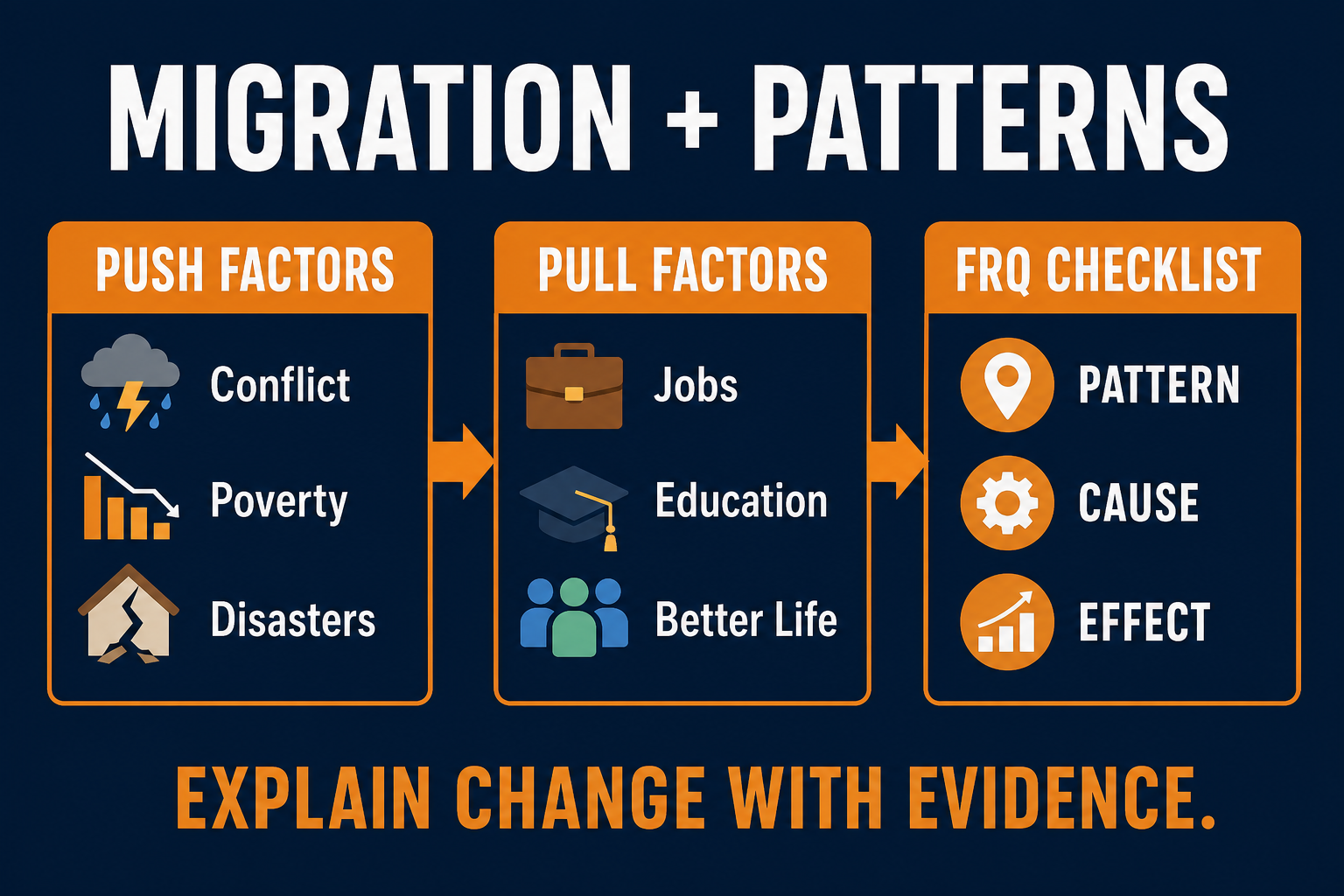
After MCQs, write 2–4 sentences that name a pattern, anchor it in geographic evidence from the prompt, and state an effect at the right scale—the same sequence as the Unit 2 answer formula.
For every scenario, follow this structure:
Claim: State your answer clearly.
Evidence: Cite specific details from the prompt (cohort, rate, region, or policy).
Reasoning: Explain how and why geographic evidence supports your claim.
Prompt: A country shows low birth rates, an aging population, and rising pension pressure. Explain this pattern.
Strong response
Claim: The country is likely in a late DTM stage with a high old-age dependency burden.
Evidence: Birth rates are low while the share of older residents is increasing.
Reasoning: Fewer births narrow the pyramid base, so a smaller working-age share supports more retirees—raising fiscal stress at the national scale.
Read the prompt, then cover Pattern → Cause → Effect → Scale in your own words.
Prompt: A country’s population pyramid has a narrow base and a large elderly population. Explain one likely cause and one likely consequence.
Strong answer: The narrow base suggests low birth rates, which may result from urbanization, higher education, delayed marriage, or access to contraception. A larger elderly population can increase healthcare spending and pension pressure because fewer working-age people support more retired people.
Prompt: Explain one positive and one negative effect of international migration on a migrant-sending country.
Strong answer: One positive effect is that migrants may send remittances home, supporting household income and local businesses. One negative effect is brain drain, where the origin country loses educated or skilled workers, reducing its labor capacity.
Prompt: Explain why a government might adopt a pronatalist policy.
Strong answer: A government may adopt a pronatalist policy if fertility is below replacement and the population is aging. Benefits such as childcare support, parental leave, or child payments may encourage more births, helping reduce future labor shortages.
AP graders reward evidence-linked geographic reasoning—not lists of terms. Practicing this structure after MCQs builds the skills needed to earn full points on test day.
Review core terms from the first two sections.
Answer 10 questions and review explanations.
Revisit missed items and explain each correction.
Mix flashcards and practice for retention.
Run a timed mini-set and check accuracy.
Repeat weak-topic practice before next unit.
Create a free account to keep your score history and practice streak.
Build cumulative accuracy by mixing Unit 1–2 concepts each day instead of reviewing one section in isolation. Rotate Unit 1 practice with this page’s flashcards and Unit 2 MCQs. Add DTM practice MCQs when pyramids and stages are your weak spot.
Answers match what AP Human Geography students ask most about population, migration, and the DTM—with links to deeper guides on this site.
Unit 2 is moderate difficulty: the vocabulary is manageable, but MCQs and FRQs test whether you can explain patterns with evidence—pyramids, density types, DTM stages, and migration—not whether you can recite definitions alone.
Start with the 10-question diagnostic, then 50 Unit 2 MCQs and the Pattern → Cause → Effect → Scale formula.
Unit 2 covers where people live, how populations grow or age, and why people migrate. You interpret population pyramids, compare density measures, apply the Demographic Transition Model, evaluate population policies, and analyze migration push and pull factors with effects on origin and destination regions.
Jump to population distribution, composition & pyramids, DTM summary, or push and pull factors.
The DTM describes how crude birth rates and crude death rates change as societies develop, producing stages from high stationary through rapid growth, slowing growth, low stationary, and possible decline. AP answers must justify a stage with rate direction or pyramid shape and note that migration can bend growth the model alone would not predict.
Study: DTM stages (main guide) · country examples · DTM practice test
Read the title for place and year, inspect the base for fertility signals, inspect the top for aging, look for cohort bulges or gaps from shocks or migration, then connect shape to dependency and service needs at the correct scale. Strong responses add one consequence such as schools, jobs, healthcare, or pensions.
Use the five-step pyramid checklist on this page and compare shapes in DTM country examples.
Arithmetic density is people per total land area; physiological density is people per arable land; agricultural density is farmers per arable land. Each answers a different geographic question about crowding, food pressure, and farming intensity—match the density type named in the stimulus.
Review definitions in population density types and the must-know terms table.
Stage 2 keeps high birth rates while death rates fall, producing the fastest natural increase. Stage 3 shows falling birth rates with low death rates, so growth continues but slows. The common trap is calling Stage 2 low birth—birth rates stay high until Stage 3.
See rate patterns for every stage in the DTM stages guide.
Unit 2 explains voluntary and forced migration, remittances, brain drain, and push-pull factors with origin and destination effects. Unit 3 builds on migration through cultural diffusion, identity, and language—after you can explain demographic causes in Unit 2, preview how migration reshapes cultural landscapes.
On this page: push and pull factors · migration effects. Next: Unit 3 cultural patterns.
The epidemiological transition model tracks how main causes of death shift from infectious disease toward chronic and lifestyle disease as development rises. Pair it with the DTM when a prompt links mortality decline, public health, or aging to population change.
Read the full guide: epidemiological transition model. Pair with DTM on this page.
Third-party sites host flashcard decks for Unit 2 topics. This page keeps 60 explained flashcards, a 10-question diagnostic, 50 MCQs with reasoning, FRQ-style scenarios, and linked DTM cluster guides in one study flow.
On-page: 60 flashcards · FRQ scenarios. Deep dives: Unit 2 study guides.
Released AP Human Geography exams do not publish secure multiple-choice keys. The legal substitute is explained practice—use the diagnostic and 50 MCQs on this page and study why each wrong choice fails.
Alternate Unit 1 map and scale practice with Unit 2 pyramids, density, DTM, and migration each week. Run the Units 1–2 cumulative review on this page, then move to Unit 3 when you can explain migration effects without notes.
Unit 1 review · Units 1–2 cumulative review · Unit 3 preview
Use this page as the hub: section summaries, glossary, pyramid checklist, answer formula, flashcards, practice questions, FRQ scenarios, and deep links to the DTM and epidemiological transition study guides.
Open all Unit 2 study guides or start with DTM overview.
Keep your momentum. Continue directly into Unit 3 so your review stays connected across concepts and exam skills.