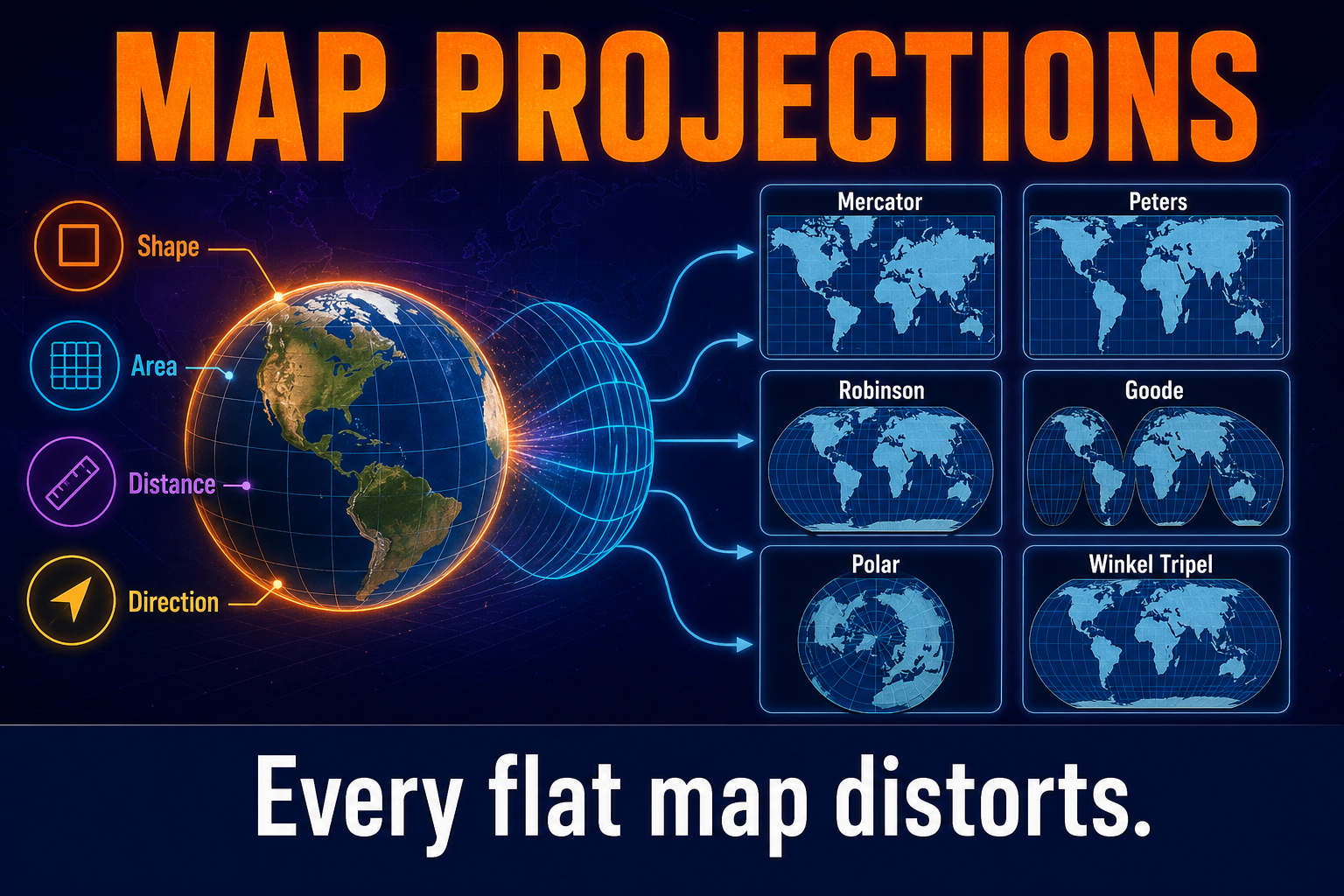
Map Projections Practice Questions and Answers
Question 1: What is a map projection?
- A. A photograph of Earth taken from satellite
- B. A mathematical method for displaying a curved Earth on a flat surface (correct)
- C. A type of thematic map showing data patterns
- D. A scale that compares map distance to ground distance
Correct answer: B. A mathematical method for displaying a curved Earth on a flat surface
Explanation: A projection is the math that flattens a curved surface onto paper or a screen. The other choices describe imagery, thematic maps, and map scale — different concepts.
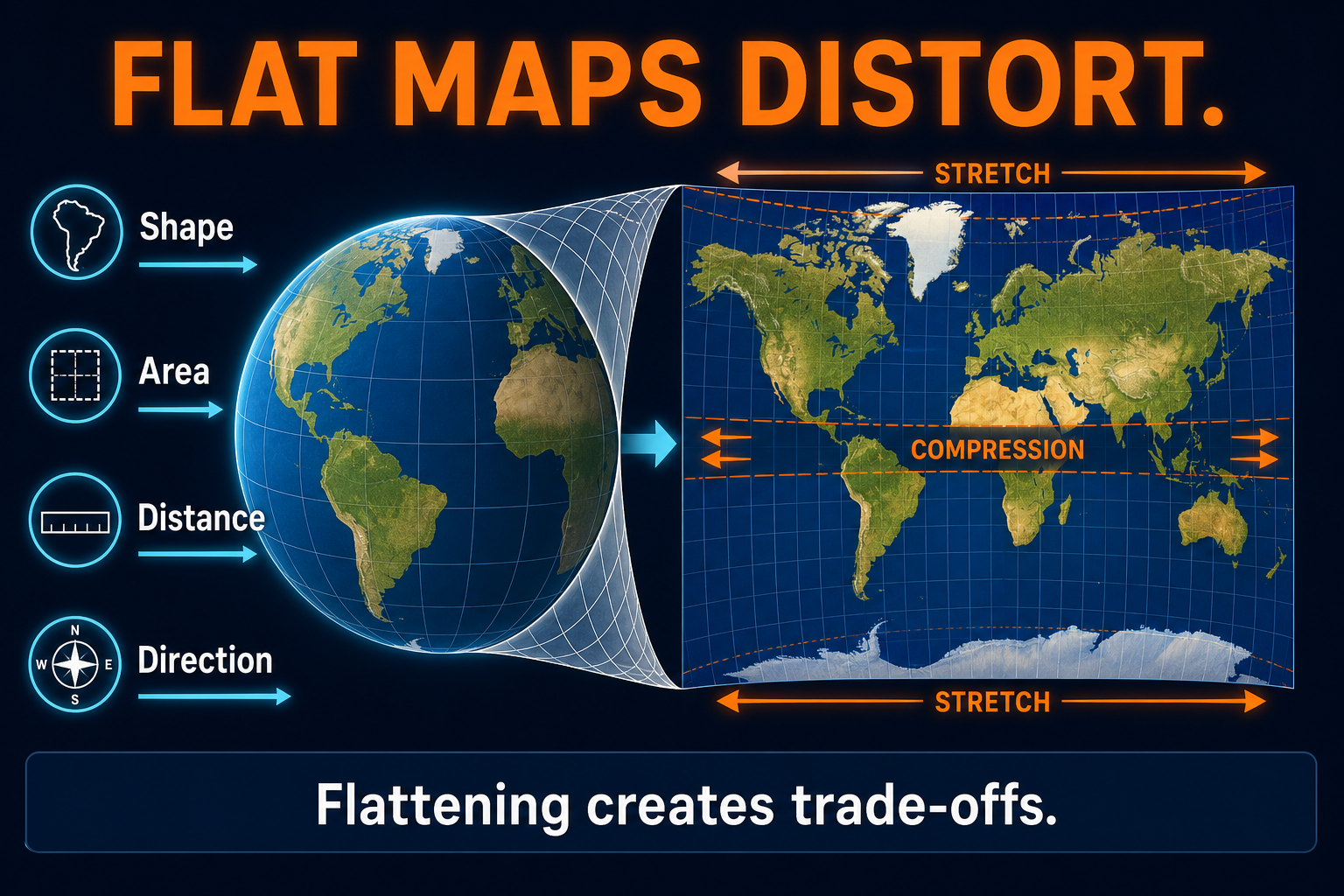
Question 2: Why must every map projection introduce some distortion?
- A. Because of human error in drawing maps
- B. Because Earth's curved surface cannot be flattened without some stretch, shrink, or tear (correct)
- C. Because computer software is imprecise
- D. Because Earth's shape changes over time
Correct answer: B. Because Earth's curved surface cannot be flattened without some stretch, shrink, or tear
Explanation: A sphere has curvature in every direction; a plane has none, so flattening always distorts something. This is a mathematical fact, not a technique problem.
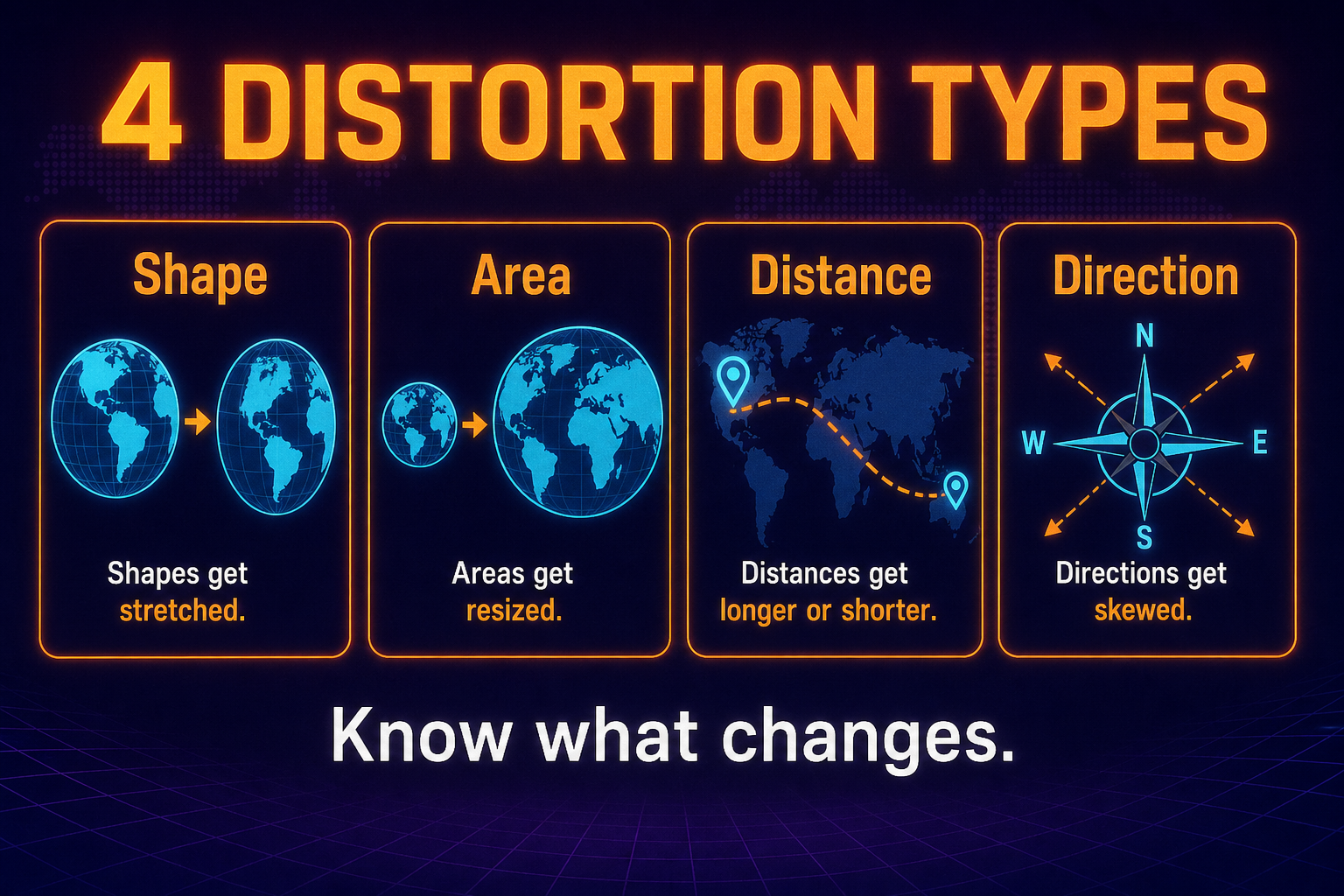
Question 3: Which of the following is NOT one of the four properties a projection can preserve?
- A. Shape
- B. Area
- C. Color (correct)
- D. Direction
Correct answer: C. Color
Explanation: The four geometric properties are shape, area, distance, and direction. Color is a stylistic choice, not a geometric property of the projection.
Question 4: A projection that preserves area is called:
- A. Conformal
- B. Equal-area (equivalent) (correct)
- C. Equidistant
- D. Azimuthal
Correct answer: B. Equal-area (equivalent)
Explanation: Equal-area (also called equivalent) projections preserve relative size. Conformal preserves shape, equidistant preserves certain distances, and azimuthal preserves direction from a center point.
Question 5: Which statement about map projections is most accurate?
- A. At least one projection preserves all four properties simultaneously
- B. No projection can preserve all four properties at the same time (correct)
- C. Only globes preserve any geometric property accurately
- D. Conformal and equal-area projections are the same thing
Correct answer: B. No projection can preserve all four properties at the same time
Explanation: Mathematically, no flat map can be both conformal and equal-area, much less preserve all four properties. The cartographer always picks which property to keep and which to sacrifice.
Question 6: Tissot's indicatrix is used to:
- A. Calculate map scale
- B. Visualize the type and amount of distortion across a projection (correct)
- C. Identify a country's political boundaries
- D. Correct color errors on maps
Correct answer: B. Visualize the type and amount of distortion across a projection
Explanation: Tissot's indicatrix places identical circles on the globe and shows how each one warps when projected, exposing distortion location-by-location.
Question 7: On a Tissot's indicatrix overlay, what does it mean if every circle remains a circle but their sizes vary?
- A. The projection is conformal but not equal-area (correct)
- B. The projection is equal-area but not conformal
- C. The projection is both conformal and equal-area
- D. The projection has no distortion at all
Correct answer: A. The projection is conformal but not equal-area
Explanation: Circles staying circular indicates shape (angle) preservation — that is conformality. Different sizes mean area is not preserved.
Question 8: If circles on a projection become ellipses but all have the same area as the original, the projection is:
- A. Conformal
- B. Equal-area (correct)
- C. Equidistant
- D. Azimuthal
Correct answer: B. Equal-area
Explanation: Same area but distorted shape is the signature of an equal-area projection — areas are preserved at the cost of shape fidelity.
Question 9: Why is it mathematically impossible for any flat map to preserve both shape and area everywhere?
- A. Because cartographers haven't found the right formula yet
- B. Because Gauss's Theorema Egregium proves a sphere cannot be flattened isometrically (correct)
- C. Because Earth is not a perfect sphere
- D. Because computer screens have limited resolution
Correct answer: B. Because Gauss's Theorema Egregium proves a sphere cannot be flattened isometrically
Explanation: Gauss's theorem shows that surfaces with different curvature (sphere vs plane) cannot be mapped isometrically onto each other. The constraint is geometric, not technical.
Question 10: An equidistant projection preserves:
- A. Distance, but only along certain specific lines (correct)
- B. Distance everywhere on the map
- C. Shape and area together
- D. Direction from any starting point
Correct answer: A. Distance, but only along certain specific lines
Explanation: Equidistant projections preserve distance only from a chosen point or along chosen meridians — no flat map can preserve all distances everywhere.
Question 11: On a polar azimuthal equidistant projection, what is preserved?
- A. All distances on the map
- B. Distance and direction measured from the center point (correct)
- C. Area of every region
- D. Shape of every continent
Correct answer: B. Distance and direction measured from the center point
Explanation: Azimuthal projections preserve direction from the center; an equidistant variant additionally preserves distance from that center point along radial lines.
Question 12: Which AP-style claim about projection distortion is wrong?
- A. All maps lie, but in known and intentional ways
- B. Every projection sacrifices at least one geometric property
- C. Mercator distorts area more severely near the equator than near the poles (correct)
- D. A globe preserves all properties without distortion
Correct answer: C. Mercator distorts area more severely near the equator than near the poles
Explanation: Mercator's area distortion grows toward the poles, not toward the equator — that's why Greenland looks enormous and Africa stays roughly true to size.
Question 13: A projection that preserves shape (angles) is called:
- A. Conformal (correct)
- B. Equivalent
- C. Compromise
- D. Interrupted
Correct answer: A. Conformal
Explanation: Conformal projections preserve local angles, which means small features keep their true shapes. Mercator and Lambert Conformal Conic are classic examples.
Question 14: What is the Mercator projection best known for preserving?
- A. Area
- B. Shape and constant compass direction (correct)
- C. Distance between any two points
- D. Equator length only
Correct answer: B. Shape and constant compass direction
Explanation: Mercator is conformal, so shapes stay locally true, and its defining feature is that any straight line on the map is a route of constant compass bearing.
Question 15: On a Mercator map, Greenland appears roughly the size of Africa. Africa is actually about how many times larger?
- A. 2 times larger
- B. 5 times larger
- C. 14 times larger (correct)
- D. 50 times larger
Correct answer: C. 14 times larger
Explanation: Africa's area is roughly 30.4 million km² versus Greenland's 2.2 million km² — a ratio close to 14 to 1. Mercator's area inflation hides this completely.
Question 16: Why was the Mercator projection originally developed in 1569?
- A. To support European colonialism
- B. For nautical navigation, because rhumb lines appear as straight lines (correct)
- C. To accurately compare country sizes
- D. For aerial photography
Correct answer: B. For nautical navigation, because rhumb lines appear as straight lines
Explanation: Gerardus Mercator designed it for sailors: any straight line on a Mercator map is a constant-bearing course, ideal for compass navigation. Its political effects came later.
Question 17: Which feature is most severely distorted on a Mercator map?
- A. Equatorial regions like central Africa
- B. Polar regions like Antarctica and Greenland (correct)
- C. Compass directions
- D. Coastline shapes
Correct answer: B. Polar regions like Antarctica and Greenland
Explanation: Mercator's scale increases with latitude, so polar regions are wildly inflated — Antarctica becomes a band along the bottom and Greenland looks oversized.
Question 18: Why do most online mapping services like Google Maps use a Mercator-based projection (Web Mercator)?
- A. It is the most accurate projection for area
- B. Its conformality means shapes stay correct at every zoom level (correct)
- C. It is the fastest projection to render
- D. It was the first projection ever created
Correct answer: B. Its conformality means shapes stay correct at every zoom level
Explanation: Web maps zoom continuously, and a conformal projection keeps local shapes (and 90° angles) consistent at every scale. Area accuracy isn't needed for street-level navigation.
Question 19: A critique of Mercator from a cultural-geography perspective is that:
- A. It exaggerates the size of high-latitude regions, visually inflating European and North American power (correct)
- B. It is too colorful for academic use
- C. It does not show the equator
- D. It cannot be displayed digitally
Correct answer: A. It exaggerates the size of high-latitude regions, visually inflating European and North American power
Explanation: Because Mercator inflates high-latitude landmasses, regions historically associated with Western power appear disproportionately large compared to equatorial regions like Africa.
Question 20: Which of these is NOT an accurate description of the Mercator projection?
- A. Cylindrical
- B. Conformal
- C. Equal-area (correct)
- D. Useful for navigation
Correct answer: C. Equal-area
Explanation: Mercator preserves shape, not area — it is conformal but emphatically not equal-area. The other three descriptors are correct.
Question 21: On a Mercator map, lines of latitude and longitude meet at:
- A. 60-degree angles
- B. Right angles (90 degrees) everywhere (correct)
- C. Curves that vary by location
- D. Single points
Correct answer: B. Right angles (90 degrees) everywhere
Explanation: Mercator is cylindrical, so meridians and parallels intersect at perfect right angles across the entire map — a direct consequence of its conformality.
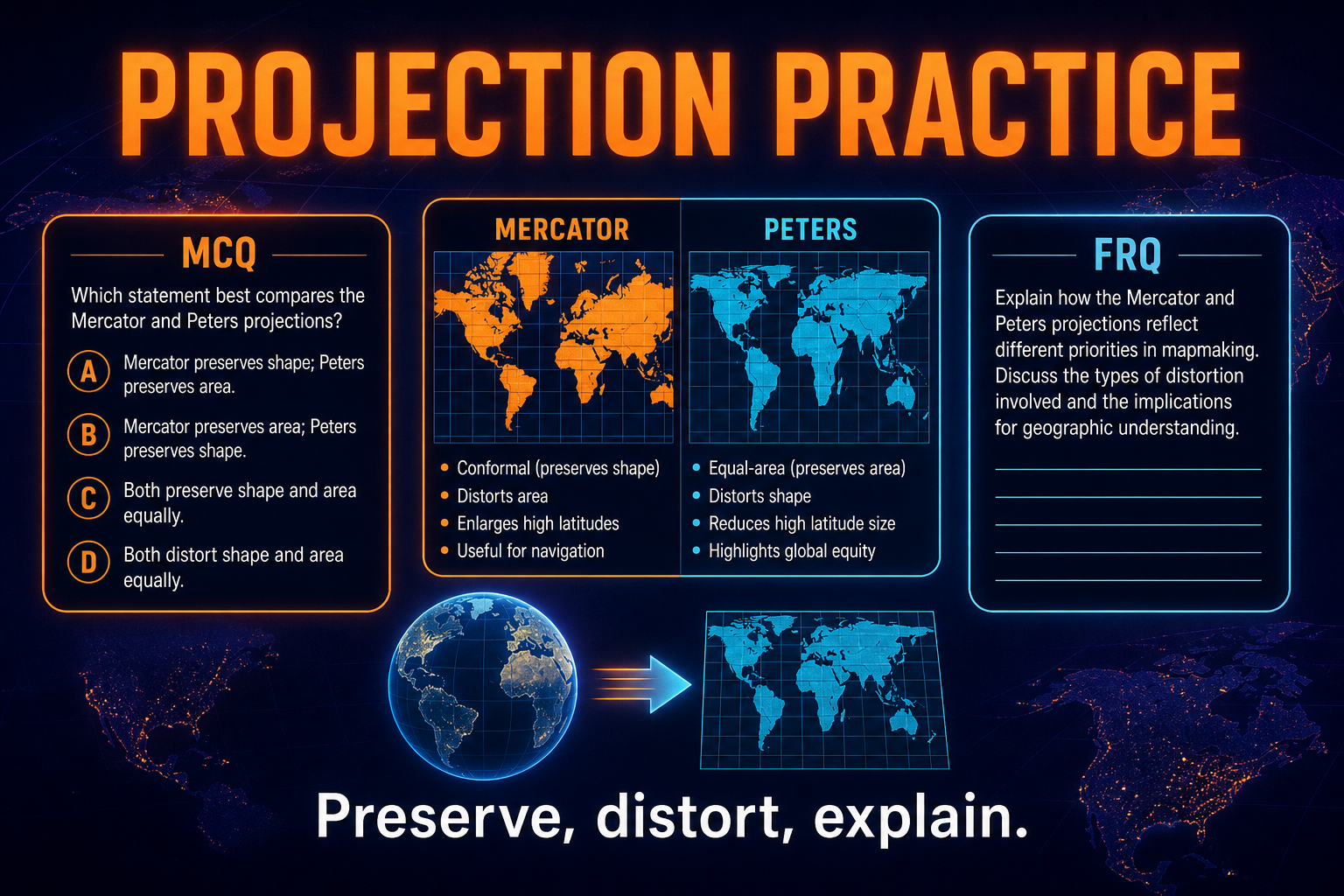
Question 22: The Gall-Peters projection preserves which property?
- A. Shape
- B. Area (correct)
- C. Direction
- D. Distance
Correct answer: B. Area
Explanation: Gall-Peters is an equal-area projection — every country appears at its true size relative to others, although shapes are stretched to make this possible.
Question 23: Compared to Mercator, the Gall-Peters projection makes which continent visibly larger?
- A. Greenland
- B. Antarctica
- C. Africa (correct)
- D. Europe
Correct answer: C. Africa
Explanation: Mercator inflates high-latitude landmasses while equatorial regions like Africa stay closer to true size. Switching to Peters reveals Africa's actual enormity in comparison.
Question 24: What is the main weakness of the Gall-Peters projection?
- A. It distorts area
- B. It distorts shape, with continents looking stretched near the equator (correct)
- C. It cannot show the entire world
- D. It cannot be drawn by hand
Correct answer: B. It distorts shape, with continents looking stretched near the equator
Explanation: Equal-area accuracy comes at the cost of shape fidelity; tropical landmasses look elongated and polar regions look squashed under Peters.
Question 25: Why was Gall-Peters promoted as a politically corrective projection in the 1970s?
- A. To remove all distortion from world maps
- B. To counter Mercator's inflation of European and North American landmasses (correct)
- C. To make the projection easier to print
- D. To replace globes in classrooms
Correct answer: B. To counter Mercator's inflation of European and North American landmasses
Explanation: Arno Peters argued that Mercator's area distortion biased students toward seeing wealthy northern countries as proportionally larger than southern ones. Equal-area corrects that visual.
Question 26: Boston Public Schools made headlines in 2017 when they switched their classroom maps from Mercator to:
- A. Robinson
- B. Gall-Peters (correct)
- C. Goode homolosine
- D. Polar azimuthal
Correct answer: B. Gall-Peters
Explanation: The Boston decision aimed to give students a more accurate sense of relative country sizes, particularly highlighting Africa, which is severely under-sized on Mercator.
Question 27: The Robinson projection is best described as:
- A. An equal-area projection
- B. A compromise projection that distorts every property only slightly (correct)
- C. A conformal projection used for navigation
- D. An interrupted projection
Correct answer: B. A compromise projection that distorts every property only slightly
Explanation: Robinson preserves no single property exactly, but spreads the distortion thinly across all of them — making it visually pleasing but unsuitable for precise measurement.
Question 28: National Geographic adopted Robinson as their standard world map in:
- A. 1922
- B. 1988, replacing van der Grinten (correct)
- C. 2010
- D. Never
Correct answer: B. 1988, replacing van der Grinten
Explanation: Nat Geo adopted Robinson in 1988, replacing the older van der Grinten projection. They held it as the standard until switching to Winkel Tripel in 1998.
Question 29: What is unusual about the way the Robinson projection was constructed?
- A. It was derived from a single elegant equation
- B. It was built by trial and error to look visually pleasing, not from one closed-form formula (correct)
- C. It is interrupted at the oceans
- D. It uses three different cones
Correct answer: B. It was built by trial and error to look visually pleasing, not from one closed-form formula
Explanation: Arthur Robinson tuned the projection by eye until it looked right, defining it through tabulated coordinates rather than a single equation. That's why it is sometimes called "the artistic projection."
Question 30: On a Robinson projection, the poles are represented as:
- A. Single points
- B. Lines, with the polar regions flattened into the top and bottom edges (correct)
- C. Circles in the center
- D. Not shown at all
Correct answer: B. Lines, with the polar regions flattened into the top and bottom edges
Explanation: Robinson is pseudocylindrical with curved meridians and straight parallels; the poles become line segments, which is part of why polar regions look softer than on Mercator.
Question 31: What makes the Goode homolosine projection distinctive?
- A. It is conformal
- B. It is interrupted, with cuts running through the oceans to preserve continental shape and area (correct)
- C. It distorts every property severely
- D. It is used only for navigation
Correct answer: B. It is interrupted, with cuts running through the oceans to preserve continental shape and area
Explanation: Goode splits the oceans rather than the continents, so landmasses keep both their true sizes and their natural shapes. The trade-off is that the oceans are torn apart.
Question 32: The Goode homolosine projection is mainly used for:
- A. Maritime navigation
- B. Thematic maps where both continental shape and area must be honest (correct)
- C. Polar exploration maps
- D. Real-time weather forecasting
Correct answer: B. Thematic maps where both continental shape and area must be honest
Explanation: Goode is the standard for thematic continental maps because it preserves area exactly while keeping continents recognizably shaped — perfect for showing population, climate zones, or biomes.
Question 33: Why is the Goode homolosine projection a poor choice for maps about ocean currents?
- A. It distorts ocean colors
- B. The interrupted cuts split the oceans, breaking continuous oceanic features (correct)
- C. It cannot represent water
- D. It is not equal-area
Correct answer: B. The interrupted cuts split the oceans, breaking continuous oceanic features
Explanation: The whole point of Goode is to sacrifice the oceans to preserve the continents. Anything where the ocean's continuity matters — currents, marine migration, shipping routes — fails on Goode.
Question 34: The name "homolosine" reflects the fact that Goode's projection combines:
- A. A cylinder and a cone
- B. The Mollweide and sinusoidal projections, applied to different latitude bands (correct)
- C. Conformal and equal-area properties
- D. Mercator and Robinson
Correct answer: B. The Mollweide and sinusoidal projections, applied to different latitude bands
Explanation: Goode uses Mollweide for high latitudes and sinusoidal for low latitudes — both are equal-area, so the resulting hybrid stays equal-area while minimizing shape distortion in each zone.
Question 35: A polar (azimuthal) projection is centered on:
- A. The equator
- B. One of Earth's poles or another single chosen point (correct)
- C. The Prime Meridian
- D. The International Date Line
Correct answer: B. One of Earth's poles or another single chosen point
Explanation: Azimuthal projections project from a single tangent point — usually a pole — and preserve direction from that point. Polar versions are simply azimuthal projections centered on the North or South Pole.
Question 36: On a polar azimuthal projection, lines of longitude appear as:
- A. Straight horizontal lines
- B. Concentric circles
- C. Straight lines radiating outward like spokes from the center (correct)
- D. Curved S-shapes
Correct answer: C. Straight lines radiating outward like spokes from the center
Explanation: On a polar projection, meridians become spokes from the central pole, and parallels become concentric circles around it. That spoke-and-ring pattern is the immediate visual giveaway.
Question 37: Polar azimuthal projections are most useful for:
- A. Showing the entire world at once with minimal distortion
- B. Navigation in equatorial regions
- C. Mapping polar regions, aviation routes, and showing direction from a center point (correct)
- D. Comparing country populations
Correct answer: C. Mapping polar regions, aviation routes, and showing direction from a center point
Explanation: Azimuthal projections preserve direction from the center, which is critical for great-circle flight routes, polar exploration, and any map where the central focus is the story.
Question 38: What projection is depicted on the United Nations flag?
- A. Mercator
- B. Polar azimuthal equidistant centered on the North Pole (correct)
- C. Goode homolosine
- D. Robinson
Correct answer: B. Polar azimuthal equidistant centered on the North Pole
Explanation: The U.N. emblem uses a polar azimuthal equidistant projection — distance from the North Pole is true along every radial line, symbolizing global unity from a single shared point.
Question 39: The Winkel Tripel projection is best described as:
- A. An equal-area projection
- B. A compromise projection that minimizes area, direction, and distance distortion at the same time (correct)
- C. A conformal projection for navigation
- D. An interrupted projection
Correct answer: B. A compromise projection that minimizes area, direction, and distance distortion at the same time
Explanation: "Tripel" means triple — Winkel designed it to compromise across area, direction, and distance simultaneously. It preserves none exactly but is unusually balanced.
Question 40: National Geographic switched from Robinson to Winkel Tripel as their world map standard in:
- A. 1969
- B. 1988
- C. 1998 (correct)
- D. 2015
Correct answer: C. 1998
Explanation: Nat Geo adopted Winkel Tripel in 1998 because it produces measurably less overall distortion than Robinson. It remains their standard, so most modern textbook world maps are Winkel Tripel.
Question 41: Which projection family wraps a cylinder around the globe before unrolling it?
- A. Cylindrical (correct)
- B. Conic
- C. Planar
- D. Pseudocylindrical
Correct answer: A. Cylindrical
Explanation: Cylindrical projections — Mercator, Peters, Miller — conceptually wrap a cylinder around the equator. Their grids of meridians and parallels meet at right angles.
Question 42: Conic projections are most accurate for which kind of region?
- A. Polar regions
- B. Equatorial regions
- C. Mid-latitude regions, like the contiguous United States or Europe (correct)
- D. Oceans
Correct answer: C. Mid-latitude regions, like the contiguous United States or Europe
Explanation: A cone tangent to a mid-latitude band touches the globe most cleanly there, so distortion is minimized in that strip. The U.S. Geological Survey often uses conic projections for national maps.
Question 43: Which projection is an example of a conic projection?
- A. Mercator
- B. Goode homolosine
- C. Lambert Conformal Conic (correct)
- D. Polar azimuthal
Correct answer: C. Lambert Conformal Conic
Explanation: Lambert Conformal Conic is the textbook conic projection and a U.S. mapping standard. Albers Equal-Area is another well-known conic.
Question 44: A planar (azimuthal) projection works best when:
- A. Mapping the entire world at once
- B. The map is centered on a single focal point, especially a pole (correct)
- C. Showing strict mid-latitude regions
- D. Displaying ocean currents in the tropics
Correct answer: B. The map is centered on a single focal point, especially a pole
Explanation: A plane only touches the globe at one point, so distortion grows outward from that point. That makes planar projections ideal for polar maps or any single-focus visualization.
Question 45: On a cylindrical projection, lines of latitude and longitude:
- A. Curve toward the poles
- B. Always meet at right angles to form a rectangular grid (correct)
- C. Converge at the center of the map
- D. Are not shown
Correct answer: B. Always meet at right angles to form a rectangular grid
Explanation: Cylindrical projections produce a rectangular graticule with parallels and meridians at 90°. That perpendicular grid is how you spot a cylindrical projection at a glance.
Question 46: A sailor wants a chart on which a constant compass course appears as a straight line. The best projection is:
- A. Mercator (correct)
- B. Peters
- C. Goode homolosine
- D. Albers Equal-Area
Correct answer: A. Mercator
Explanation: Mercator was specifically built for this navigation use case — its rhumb-line property is the reason it became the historical sailor's standard.
Question 47: A geographer wants a thematic map of global population density that fairly compares country sizes. The best projection is:
- A. Mercator
- B. An equal-area projection like Gall-Peters or Goode (correct)
- C. Polar azimuthal
- D. Lambert Conformal Conic
Correct answer: B. An equal-area projection like Gall-Peters or Goode
Explanation: Comparing sizes fairly demands an equal-area projection. Choosing Mercator would inflate Russia, Canada, and Greenland and visually downplay equatorial countries.
Question 48: A pilot is plotting a long-haul great-circle route from New York to Tokyo. Which projection is most useful?
- A. Mercator
- B. Goode homolosine
- C. Gnomonic (azimuthal), where great circles appear as straight lines (correct)
- D. Robinson
Correct answer: C. Gnomonic (azimuthal), where great circles appear as straight lines
Explanation: Gnomonic projections turn great circles — the shortest paths between two points on Earth — into straight lines, making route planning trivially geometric. Mercator's rhumb lines are simpler to steer but longer than great circles.
Question 49: An atlas publisher wants a single world-map projection that looks aesthetically balanced and is reasonably honest about every property. The likely choice is:
- A. Mercator or Peters
- B. Robinson or Winkel Tripel (correct)
- C. Polar azimuthal
- D. Lambert Conformal Conic
Correct answer: B. Robinson or Winkel Tripel
Explanation: Compromise projections like Robinson and Winkel Tripel are designed exactly for this use case — visually pleasing world maps with no single severe distortion.
Question 50: A researcher needs a map that preserves both continental area and continental shape simultaneously, accepting that the oceans may look broken up. The best choice is:
- A. Mercator
- B. Robinson
- C. Goode homolosine (correct)
- D. Gall-Peters
Correct answer: C. Goode homolosine
Explanation: Goode's interrupted design sacrifices the oceans precisely so the continents can keep both true area and natural shape. Peters keeps area but distorts shape; Robinson compromises everything.