Cell Communication
Skill: Explain why cells use signals.
AP Biology · Unit 4 Practice Hub
AP Biology Unit 4 practice should test more than definitions. Strong questions ask you to follow signals from receptor to response, identify feedback loops, explain cell-cycle control, predict checkpoint consequences, and connect failed regulation to cancer or apoptosis. Use this page to practice the full Cell Communication and Cell Cycle unit with mixed MCQs, explanations, topic links, and mistake tracking.
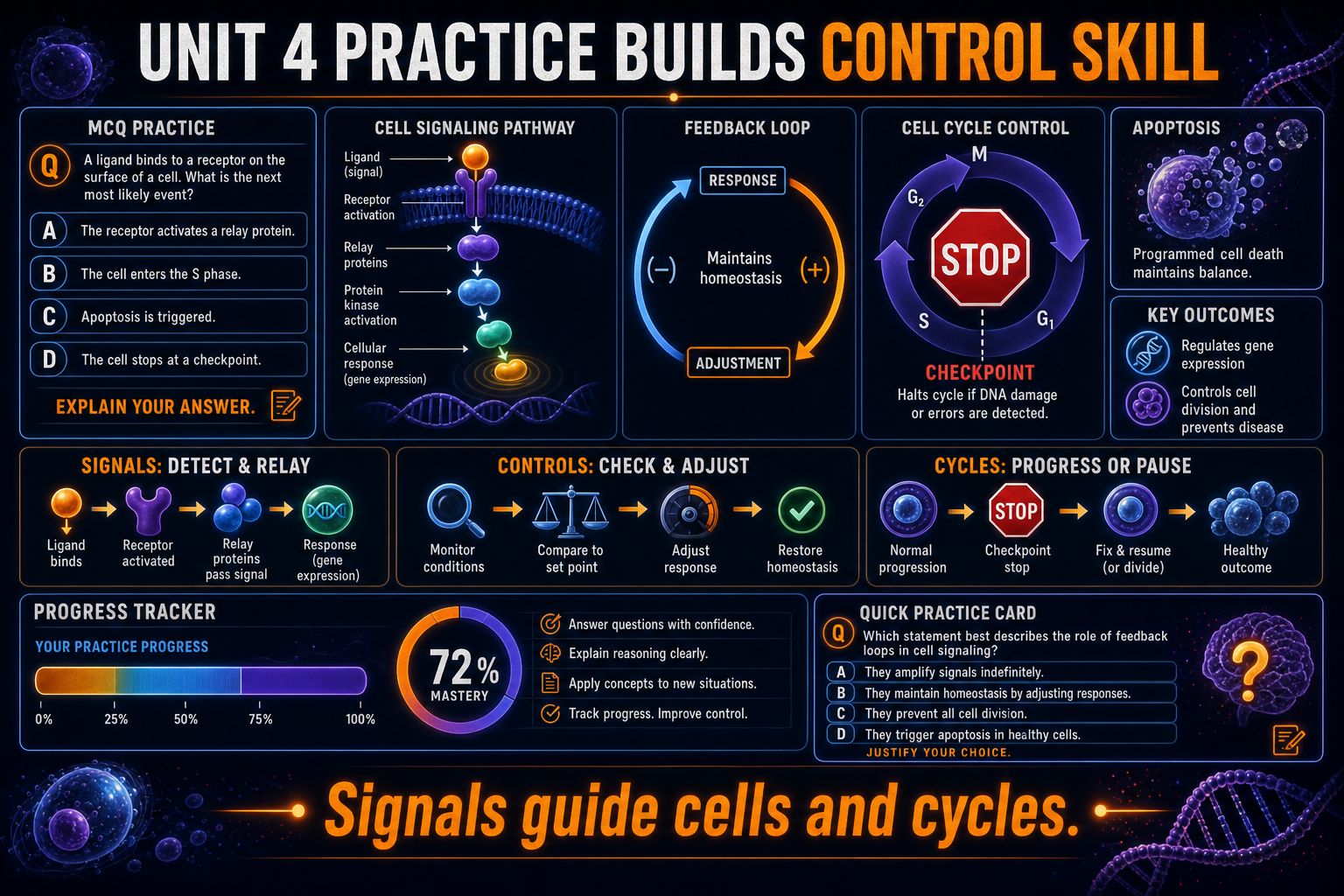
The previous guide, Apoptosis, completed the final concept page in the Unit 4 hub. This page mixes the whole unit together the way AP Biology does: signaling, feedback, cell cycle, checkpoints, cancer, and apoptosis. After this page, use the Unit 4 FRQ page to practice longer written explanations.
AP Biology Unit 4 practice should include cell communication, ligands, receptors, signal transduction, feedback loops, cell cycle phases, checkpoints, cyclins and CDKs, cancer regulation, and apoptosis. The best practice questions ask students to trace cause-and-effect through a pathway rather than just define terms. Unit 4 practice should mix MCQs, explanations, short FRQ reasoning, and topic review links.
Unit 4 practice should mix signaling, feedback, cell cycle, and regulation.
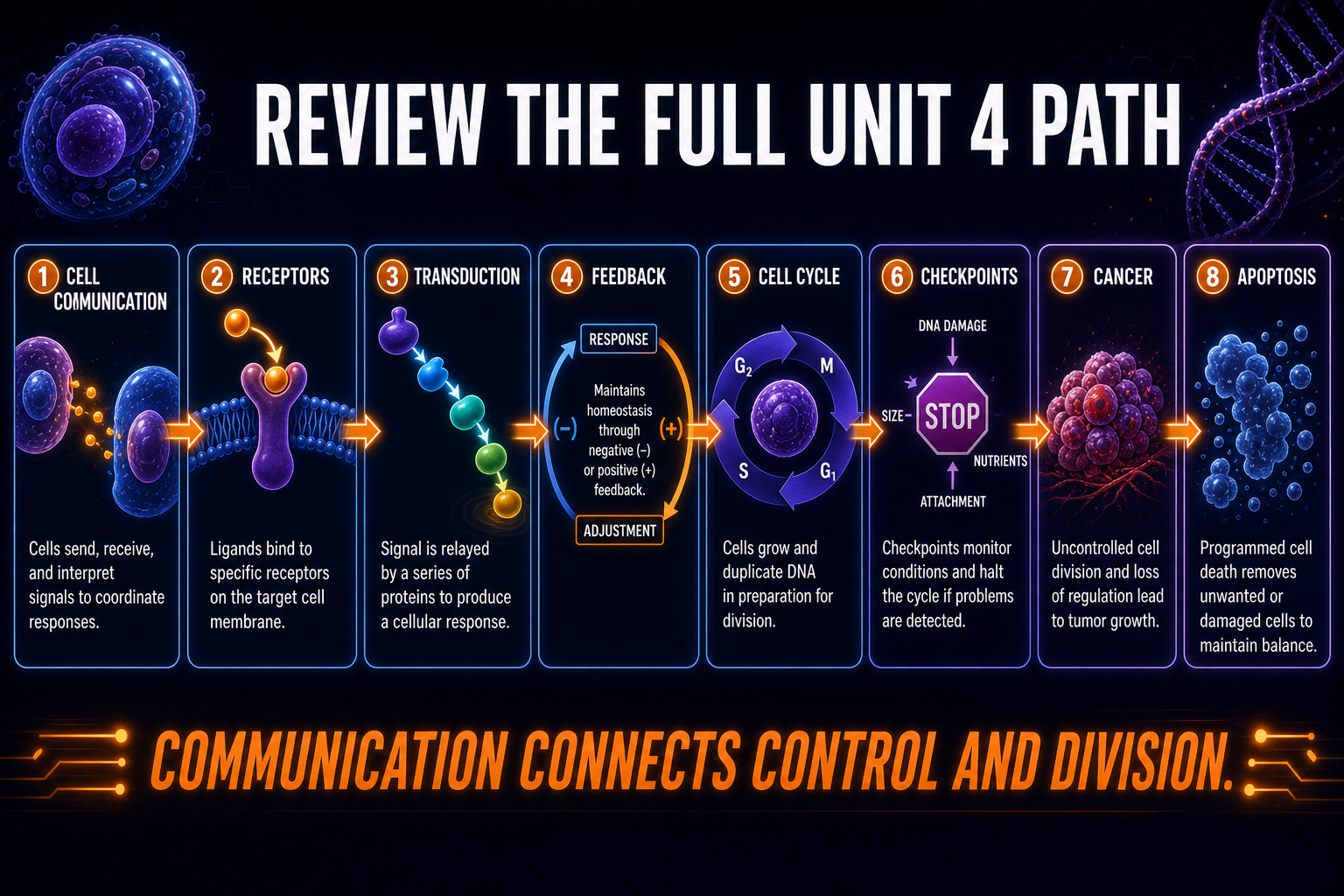
Unit 4 connects cell signals, feedback control, division, cancer, and apoptosis.
Unit 4 is about how cells receive information, process it, and respond. The first half focuses on communication and signaling pathways. The second half connects regulation to the cell cycle, checkpoints, cancer, and apoptosis.
Skill: Explain why cells use signals.
Skill: Identify how signals bind targets.
Skill: Trace the three-part signaling pathway.
Skill: Follow multi-step intracellular pathways.
Skill: Distinguish negative and positive feedback.
Skill: Track G1, S, G2, M, and cytokinesis.
Skill: Explain control of cell-cycle progression.
Skill: Predict what happens when regulation fails.
Select the type of clue you missed to get a recommended review page and a one-sentence fix.
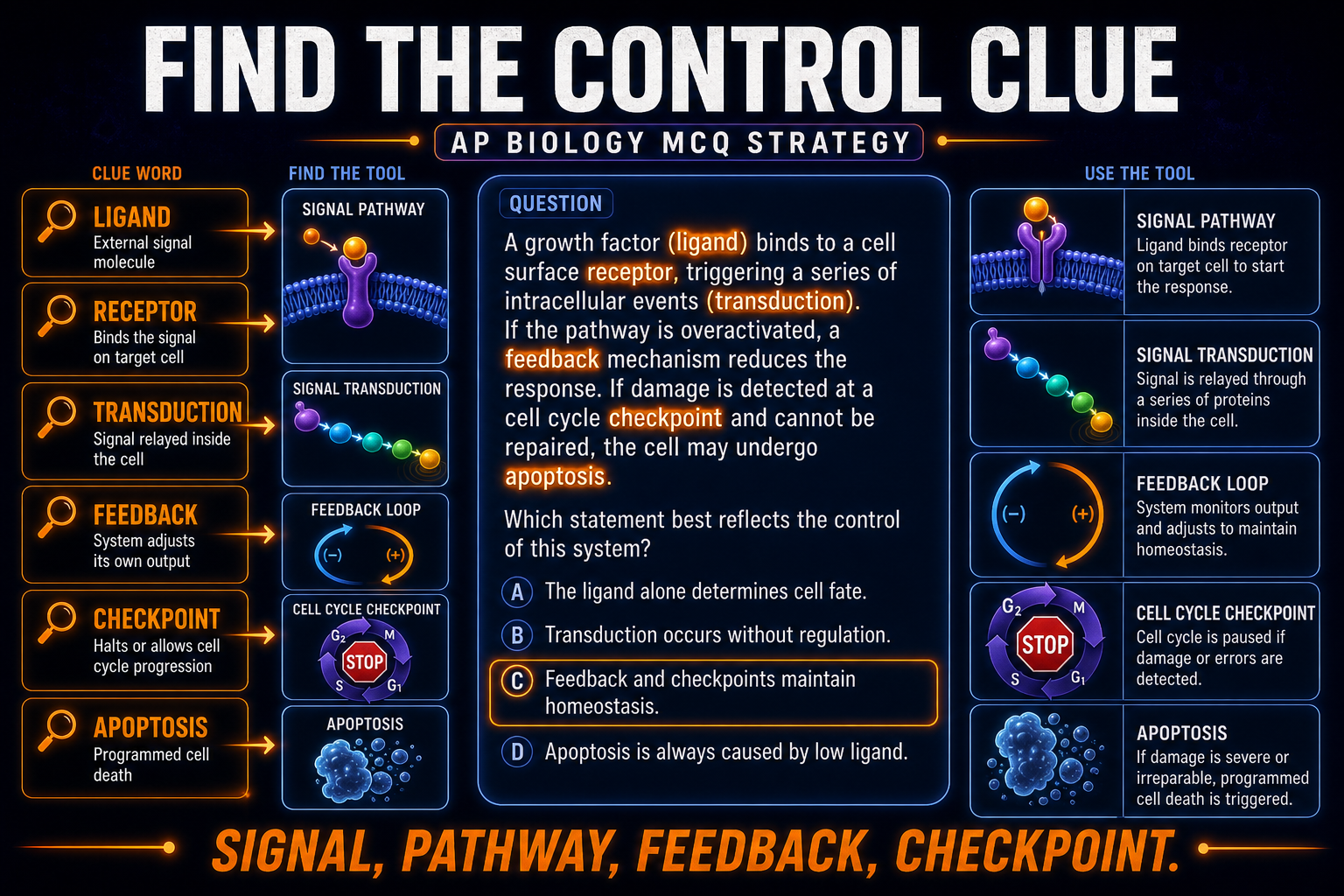
Read the clue first, then choose the correct control system.
Unit 4 MCQs usually contain clue words that tell you which tool to use. Ligand, receptor, and second messenger clues point to signaling. Feedback, set point, and homeostasis clues point to control loops. G1, S, G2, M, checkpoint, cyclin, CDK, cancer, and apoptosis clues point to cell-cycle regulation.
Examples: ligand, receptor, pathway, response
Use: Cell communication reasoning
Examples: second messenger, kinase, phosphorylation, amplification
Use: Signal transduction reasoning
Examples: homeostasis, set point, reduces change, amplifies change
Use: Feedback loop reasoning
Examples: checkpoint, cyclin, CDK, DNA damage, mitosis
Use: Cell-cycle regulation reasoning
| Topic | Must-know idea | Common AP mistake | Review link |
|---|---|---|---|
| Cell Communication | Cells receive and respond to signals | Ignoring target cell specificity | Review → |
| Ligands and Receptors | Ligands bind specific receptors | Saying every cell responds to every signal | Review → |
| Reception, Transduction, Response | Signal pathway order matters | Skipping transduction | Review → |
| Cell Signaling Pathways | Relay molecules pass signals | Treating pathways as one-step | Review → |
| Feedback Mechanisms | Loops regulate systems | Confusing negative and positive feedback | Review → |
| Negative Feedback | Reduces change | Saying negative means bad | Review → |
| Positive Feedback | Amplifies change | Saying positive means good | Review → |
| Cell Cycle | G1, S, G2, M, cytokinesis | DNA replication during mitosis | Review → |
| Cell Cycle Phases | G1, S, G2, M, cytokinesis order | DNA replication during mitosis | Review → |
| Mitosis in the Cell Cycle | M phase chromosome separation and spindle checkpoint | Confusing mitosis with cytokinesis or S phase | Review → |
| Cell Cycle Checkpoints | Stop unsafe progression | Memorizing names only | Review → |
| Cyclins and CDKs | Protein switches control progression | Saying cyclins are enzymes | Review → |
| Signal Amplification | One signal activates many targets | Saying ligand gets bigger | Review → |
| Second Messengers | Small intracellular relays | Calling ligand second messenger | Review → |
| Phosphorylation Cascade | Kinases add phosphate groups | Phosphorylation always activates | Review → |
| Kinases and Phosphatases | Kinases add; phosphatases remove phosphates | Confusing kinase and phosphatase roles | Review → |
| Tyrosine Kinase Receptors | Dimerize and phosphorylate tyrosines | Confusing RTKs with GPCRs | Review → |
| Ion Channel Receptors | Ligand opens pore; ions move on gradient | Saying ligand moves through the pore | Review → |
| Intracellular Receptors | Lipid-soluble ligands bind inside; change gene expression | Treating steroid hormones like membrane-only signals | Review → |
| Cancer Regulation | Failed control causes risk | Cancer is only fast division | Review → |
| Apoptosis | Programmed cell death | Confusing apoptosis with necrosis | Review → |
Answer all 24 questions. Choices shuffle on reload—read the clue, pick an answer, then review the explanation and topic link.
Q1. Why do multicellular organisms rely on cell communication?
EasyTopic: Cell communication purpose
Q2. A hormone binds only to cells with a matching receptor. This best illustrates:
EasyTopic: Ligand-receptor specificity
Q3. In a signaling pathway, reception refers to:
EasyTopic: Reception step
Q4. Which process best describes signal transduction?
MediumTopic: Transduction step
Q5. The response stage of cell signaling may include:
EasyTopic: Response step
Q6. A mutation blocks a key relay protein in a G protein-coupled receptor pathway. The most likely result is:
MediumTopic: Cell signaling pathway consequence
Q7. Signal amplification allows one ligand-receptor interaction to:
MediumTopic: Signal amplification
Q8. Cyclic AMP (cAMP) functions in many pathways as a:
MediumTopic: Second messenger cAMP
Q9. If adenylyl cyclase is blocked in a GPCR pathway, the best prediction is:
HardTopic: cAMP Signaling Pathway
Q10. If Ca2+ cannot bind its target protein after a calcium signal, the best prediction is:
HardTopic: Calcium Signaling Pathway
Q11. Calcium ions (Ca2+) can act as second messengers because they:
MediumTopic: Calcium ions as second messengers
Q12. A phosphorylation cascade typically involves:
HardTopic: Phosphorylation cascade
Q13. Which pairing is correct?
MediumTopic: Kinase vs phosphatase
Q14. A phosphatase is blocked after a signaling pathway activates target proteins. The best prediction is:
HardTopic: Kinases and Phosphatases
Q15. A thermostat turns off the heater when room temperature rises above the set point. This is:
EasyTopic: Negative feedback
Q16. During childbirth, uterine contractions stimulate more contractions. This is an example of:
EasyTopic: Positive feedback
Q17. Which statement best compares negative and positive feedback?
MediumTopic: Feedback loop comparison
Q18. Which order correctly lists major phases of the eukaryotic cell cycle?
EasyTopic: Cell cycle phase order
Q19. DNA replication occurs primarily during:
EasyTopic: S phase DNA replication
Q20. Mitosis and cytokinesis differ because:
EasyTopic: Mitosis vs cytokinesis
Q21. The G1 checkpoint is important because it:
MediumTopic: G1 checkpoint
Q22. The G2 checkpoint mainly ensures that:
MediumTopic: G2 checkpoint
Q23. The M checkpoint (spindle checkpoint) prevents a cell from proceeding until:
MediumTopic: M checkpoint
Q24. What happens if spindle fibers fail to attach to chromosomes before separation?
HardTopic: Mitosis in the Cell Cycle
Q25. Cyclins and CDKs control the cell cycle because:
HardTopic: Cyclins and CDKs
Q26. A cell bypasses the G1 checkpoint despite severe DNA damage. A likely long-term consequence is:
HardTopic: Cancer and checkpoint failure
Q27. Apoptosis is best described as:
EasyTopic: Apoptosis
Q28. Which comparison between apoptosis and necrosis is correct?
MediumTopic: Apoptosis vs necrosis
Q29. A growth factor binds a receptor tyrosine kinase, but tyrosine phosphorylation is blocked. The best prediction is:
MediumTopic: RTK Signaling
Q30. A ligand binds an ion channel receptor, but the channel cannot open. The best prediction is:
MediumTopic: Ion Channel Receptors
Q31. Why can steroid hormones bind intracellular receptors?
MediumTopic: Intracellular Receptors
| Question | Correct answer | Topic | Review link |
|---|---|---|---|
| 1 | A | Cell communication purpose | Review → |
| 2 | A | Ligand-receptor specificity | Review → |
| 3 | A | Reception step | Review → |
| 4 | A | Transduction step | Review → |
| 5 | A | Response step | Review → |
| 6 | A | Cell signaling pathway consequence | Review → |
| 7 | A | Signal amplification | Review → |
| 8 | A | Second messenger cAMP | Review → |
| 9 | A | cAMP Signaling Pathway | Review → |
| 10 | A | Calcium Signaling Pathway | Review → |
| 11 | A | Calcium ions as second messengers | Review → |
| 12 | A | Phosphorylation cascade | Review → |
| 13 | A | Kinase vs phosphatase | Review → |
| 14 | A | Kinases and Phosphatases | Review → |
| 15 | A | Negative feedback | Review → |
| 16 | A | Positive feedback | Review → |
| 17 | A | Feedback loop comparison | Review → |
| 18 | A | Cell cycle phase order | Review → |
| 19 | A | S phase DNA replication | Review → |
| 20 | A | Mitosis vs cytokinesis | Review → |
| 21 | A | G1 checkpoint | Review → |
| 22 | A | G2 checkpoint | Review → |
| 23 | A | M checkpoint | Review → |
| 24 | A | Mitosis in the Cell Cycle | Review → |
| 25 | A | Cyclins and CDKs | Review → |
| 26 | A | Cancer and checkpoint failure | Review → |
| 27 | A | Apoptosis | Review → |
| 28 | A | Apoptosis vs necrosis | Review → |
| 29 | A | RTK Signaling | Review → |
| 30 | A | Ion Channel Receptors | Review → |
| 31 | A | Intracellular Receptors | Review → |
A ligand binds to a receptor on a target cell and activates an intracellular pathway.
Reception occurs when the ligand binds its specific receptor on the target cell. During transduction, relay proteins, second messengers, or phosphorylation cascades spread and amplify the signal so one binding event activates many intracellular targets. If receptor shape changes and the ligand cannot bind, transduction does not begin and the cell will not carry out the normal response.
A body system detects that a variable has moved away from a set point and triggers a response that brings the variable back toward normal.
This is negative feedback because the response works against the initial change and moves the variable back toward the set point. That stabilization helps maintain homeostasis. If the response pathway is blocked, the correction cannot occur and the variable may remain too high or too low.
A cell has DNA damage before entering S phase. A checkpoint protein detects the damage.
The G1 checkpoint detects DNA damage before the cell enters S phase. The cell should not enter S phase because replicating damaged DNA would pass mutations to daughter cells. If the damage cannot be repaired, the cell may remain arrested, continue repair attempts, or undergo apoptosis to prevent harmful division.
A mutation causes a growth pathway to remain active and also prevents apoptosis.
An always-active growth pathway can signal the cell to divide even without normal external cues. Blocking apoptosis prevents removal of abnormal cells, so damaged cells survive and may divide. Daughter cells may inherit the same mutations and form a growing population of improperly regulated cells.
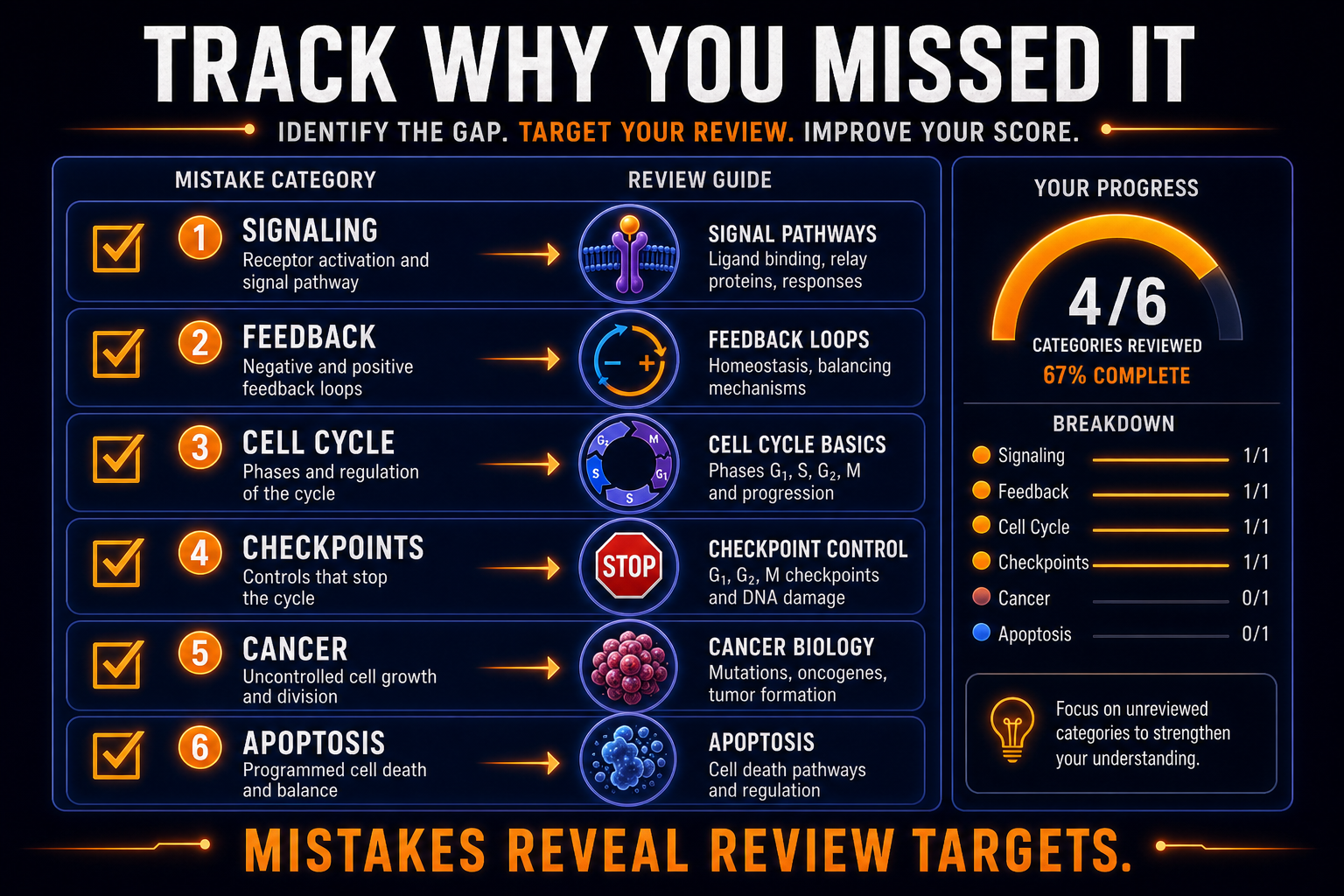
Track the reason for each missed question, not just the score.
Review: Cell Communication Ligands and Receptors Reception/Transduction/Response
Review: Feedback Mechanisms Negative Feedback Positive Feedback
Review: Cell Cycle
Review: Signal Amplification Second Messengers Phosphorylation Cascade
Checked: 0 mistakes tracked
Meaning: Reception
Meaning: Transduction
Meaning: Response
Meaning: Negative feedback
Meaning: Positive feedback
Meaning: S phase
Meaning: M checkpoint
Meaning: Protein regulation of cell cycle
Meaning: Second messenger
Meaning: Phosphorylation cascade
Meaning: Checkpoint failure or cancer
Meaning: Apoptosis
Take all 24 MCQs without notes.
Use the mistake tracker to classify missed questions.
Review the linked concept page for your weakest category.
Do the short FRQ checks and compare your answer to the rubric.
AP Biology Unit 4 practice includes cell communication, signal transduction, feedback mechanisms, cell cycle regulation, checkpoints, cancer, and apoptosis. Strong practice questions ask you to trace cause-and-effect through pathways. You should practice both MCQs and short written explanations.
Start by learning the pathway order: reception, transduction, and response. Then review feedback loops, cell cycle checkpoints, and cancer regulation. After practice, sort your mistakes by topic and review the linked guide.
Many students struggle with signal transduction, second messengers, phosphorylation cascades, and checkpoint regulation. Feedback loops can also be tricky because “negative” does not mean bad. The best fix is to identify the control system before answering.
A strong first set is 20–30 mixed MCQs plus a few short FRQ checks. The number matters less than the review process. If you miss several questions from one category, return to that concept page before doing more practice.
Read the clue words before choosing an answer. Words like ligand, receptor, cAMP, kinase, checkpoint, cyclin, and apoptosis usually reveal the topic. Then apply the correct pathway or control logic.
Use cause-and-effect language. Identify the signal, pathway, checkpoint, or control mechanism, then explain the predicted response. Avoid listing vocabulary without explaining how the parts connect.
A common mistake is skipping transduction and jumping directly from ligand binding to response. AP Biology often wants the intermediate pathway, such as relay proteins, second messengers, or phosphorylation. Another common mistake is confusing apoptosis with necrosis.
Yes. Feedback mechanisms are a major part of AP Biology Unit 4. You should know how negative feedback restores conditions and how positive feedback amplifies a response.
Unit 4 connects to cancer through failed signaling, failed checkpoints, overactive cyclins or CDKs, inactive tumor suppressors, and blocked apoptosis. Cancer questions usually test regulation failure, not just rapid cell division. Always explain which control failed.
Review every missed question and classify the mistake by topic. Then study the matching Unit 4 guide and try a short FRQ explanation. After that, move to the Unit 4 FRQ page for longer written practice.