Identify
Name the process, structure, or molecule.
AP Biology · Unit 4 FRQ Practice
AP Biology Unit 4 FRQs test whether you can explain cell communication and cell-cycle regulation with clear cause-and-effect reasoning. Strong answers trace reception, transduction, and response; compare feedback loops; predict checkpoint consequences; and connect failed regulation to cancer or apoptosis. This page gives you practice prompts, scoring guides, sample answers, and a writing coach for Unit 4 free response questions.
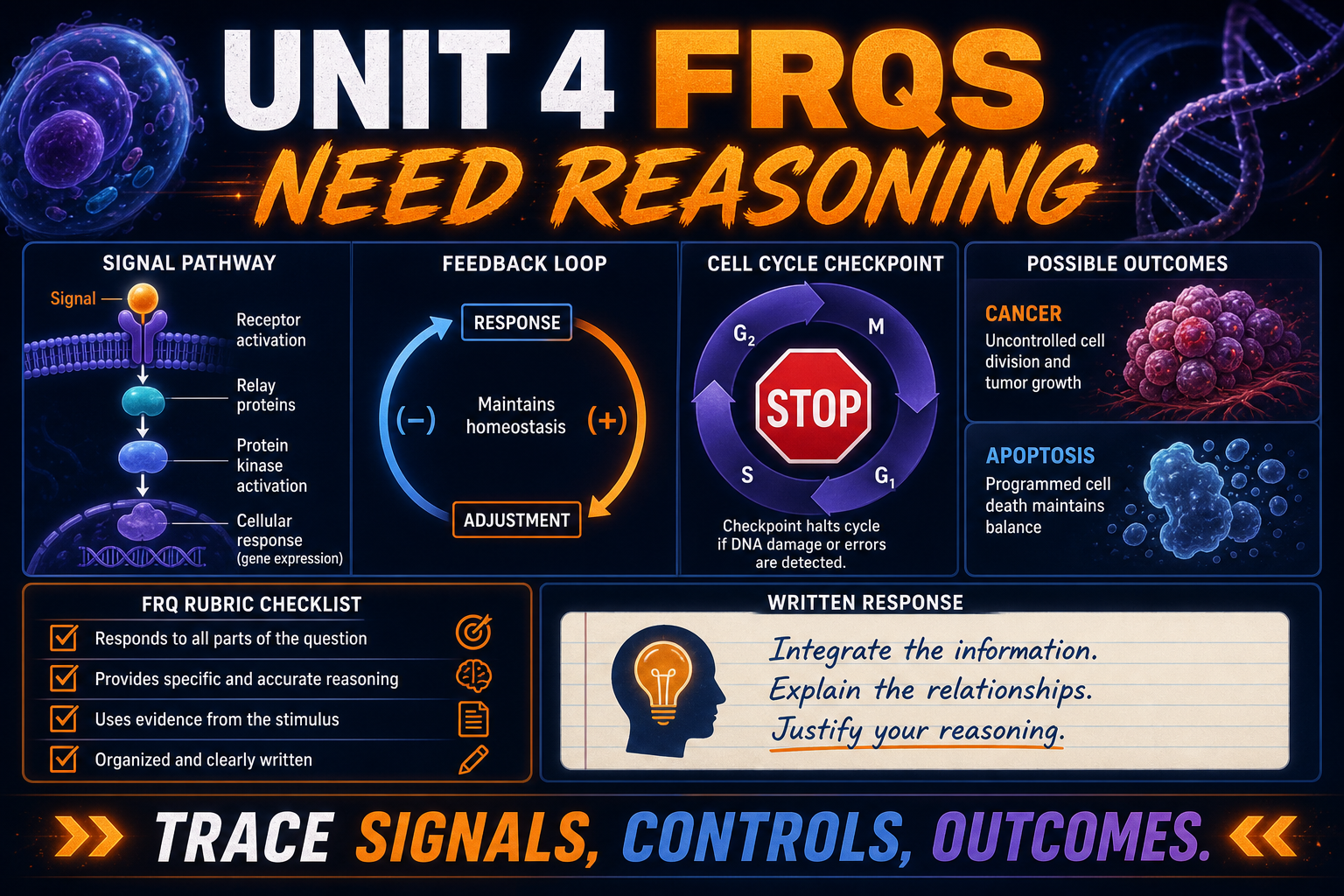
The previous page, Unit 4 Practice Questions, mixed MCQs and short checks across the full unit. This page focuses on longer free response practice, where students must explain mechanisms in complete biological reasoning. Use it after reviewing signaling, feedback, cell cycle checkpoints, cancer, and apoptosis.
To answer AP Biology Unit 4 FRQs, identify the biological process, explain the mechanism, use evidence from the prompt, and predict the result of a change. For cell communication, trace reception, transduction, and response. For cell cycle questions, explain how checkpoints, cyclins, CDKs, apoptosis, or cancer regulation affect cell behavior.
Name the process, explain the mechanism, and predict the outcome.
Build a strong FRQ sentence by choosing a topic, task verb, and evidence type. Use the frame as a starting point, then add prompt-specific details.
Generated sentence frame
Select options above, then generate a sentence frame.
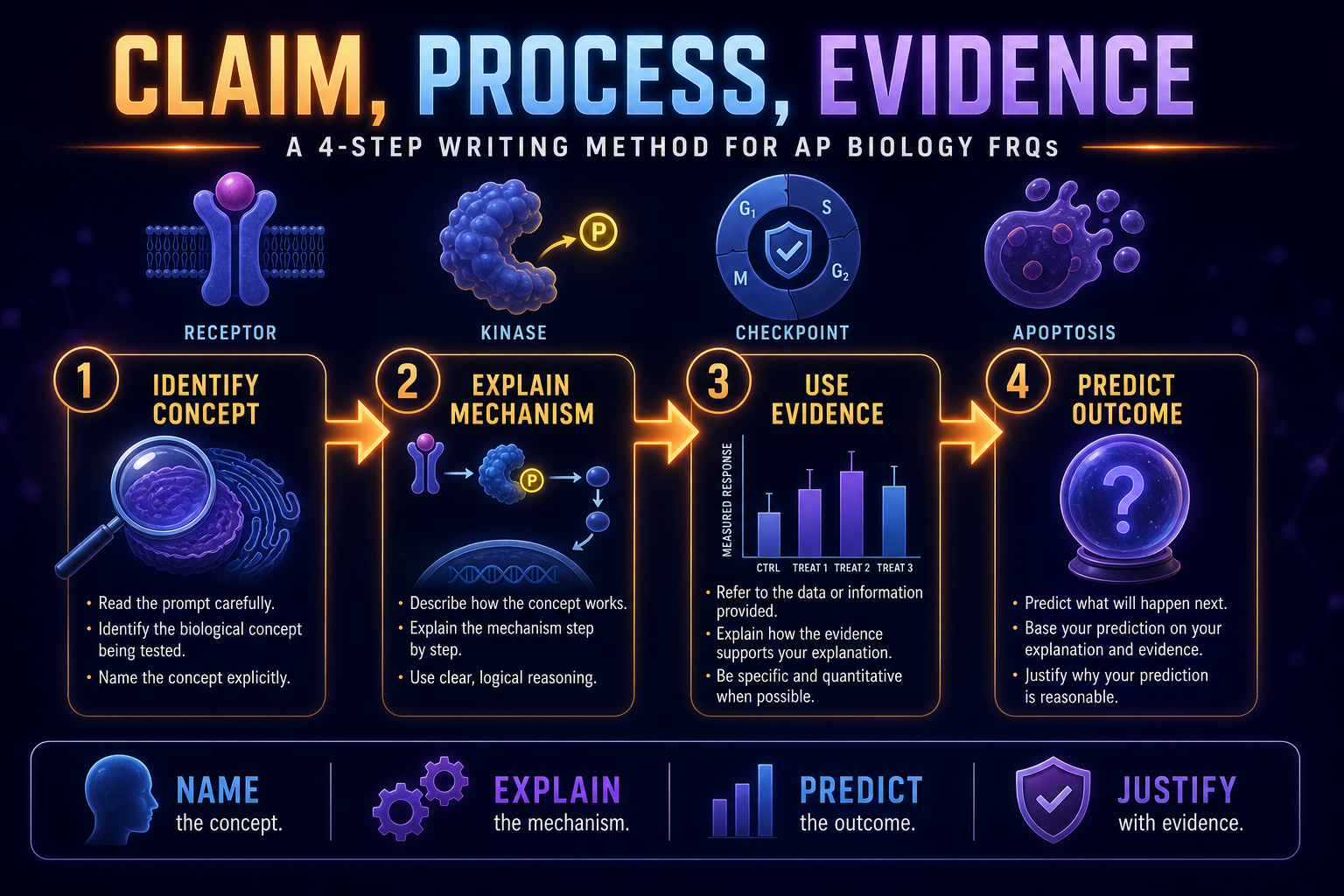
Strong Unit 4 FRQs identify, explain, use evidence, and predict.
Most Unit 4 FRQs reward mechanism-based reasoning. Naming a term is only the first step. To earn explanation points, connect the term to what changes in the cell and why that change affects the response.
Name the process, structure, or molecule.
State what it does.
Connect the cause to the effect.
Say what changes if the pathway is blocked or overactive.
Use evidence from the prompt.
| Verb | What it asks | Strong Unit 4 example |
|---|---|---|
| Identify | Name the answer | The receptor is involved in reception. |
| Describe | State features or role | The receptor binds a specific ligand. |
| Explain | Give cause-and-effect | If the receptor changes shape, the ligand may not bind and the pathway may not activate. |
| Predict | State likely result | The cellular response will decrease. |
| Justify | Support with evidence | Because cAMP activates downstream kinases, lower cAMP reduces target protein activation. |
| Compare | Show similarity/difference | Negative feedback reduces change, while positive feedback amplifies change. |
Answer each prompt in your own words before opening the rubric or sample. Use the review links to revisit weak topics.
A hormone binds to a receptor on the surface of a target cell. Binding activates a G protein pathway that increases cAMP levels. cAMP activates protein kinases that phosphorylate target proteins, producing a cellular response.
A. Reception. B. cAMP acts as a second messenger that activates protein kinases inside the cell, allowing the signal to be relayed and amplified. C. Phosphorylation adds a phosphate group that can change target protein shape or activity, turning the response on or off. D. If the receptor cannot change shape after binding, the G protein pathway may not activate, cAMP may not increase, and the final cellular response will decrease.
Review: Ligands and Receptors · Reception, Transduction, Response · Second Messengers · Phosphorylation Cascade
A biological system detects that blood glucose has increased after a meal. A hormone is released, causing body cells to take up more glucose and blood glucose returns toward its set point.
A. Negative feedback. B. The hormone response causes cells to take up glucose, which reduces the original increase in blood glucose. C. If target cells cannot respond, glucose uptake does not increase and blood glucose remains high. D. This helps maintain homeostasis because the response opposes the initial change and returns blood glucose toward its set point.
Review: Feedback Mechanisms · Negative Feedback · Cell Communication
A cell has DNA damage before entering S phase. A checkpoint protein normally stops the cell cycle to allow repair. A mutation prevents this checkpoint protein from functioning.
A. The G1 checkpoint (or DNA damage checkpoint before S phase). B. Entering S phase with damaged DNA allows the damage to be replicated, so mutations may be copied into new DNA strands. C. Daughter cells may inherit the same DNA damage or mutations. D. If the checkpoint fails, damaged cells can continue dividing, increasing the chance of uncontrolled growth and cancer.
Review: Cell Cycle · Cell Cycle Checkpoints · Cancer and Cell Cycle Regulation
Cyclin levels rise before a cell-cycle transition. Cyclin binds to a CDK, forming an active complex that phosphorylates target proteins. A mutation causes the cyclin level to remain high.
A. Cyclins are proteins whose levels rise and fall during the cell cycle to control when transitions occur. B. CDKs are inactive until cyclin binds; only then can they phosphorylate target proteins, so their activity depends on cyclin. C. Constantly high cyclin may keep CDK active too long, causing the cell to progress even when conditions are unsafe. D. Checkpoints detect problems such as DNA damage and pause the cycle until repair occurs or apoptosis is triggered.
Review: Cyclins and CDKs · Cell Cycle Checkpoints · Cancer and Cell Cycle Regulation
A cell has severe DNA damage that cannot be repaired. A signaling pathway activates programmed cell death, but a mutation blocks the final death response.
A. Apoptosis. B. Apoptosis removes damaged or unnecessary cells in a controlled way, preventing harmful mutations from being passed to daughter cells. C. If apoptosis is blocked, damaged cells may survive and continue dividing, increasing cancer risk. D. Apoptosis is programmed and orderly with little inflammation, while necrosis is uncontrolled cell death that can damage surrounding tissue.
Review: Apoptosis · Cancer and Cell Cycle Regulation · Cell Signaling Pathways
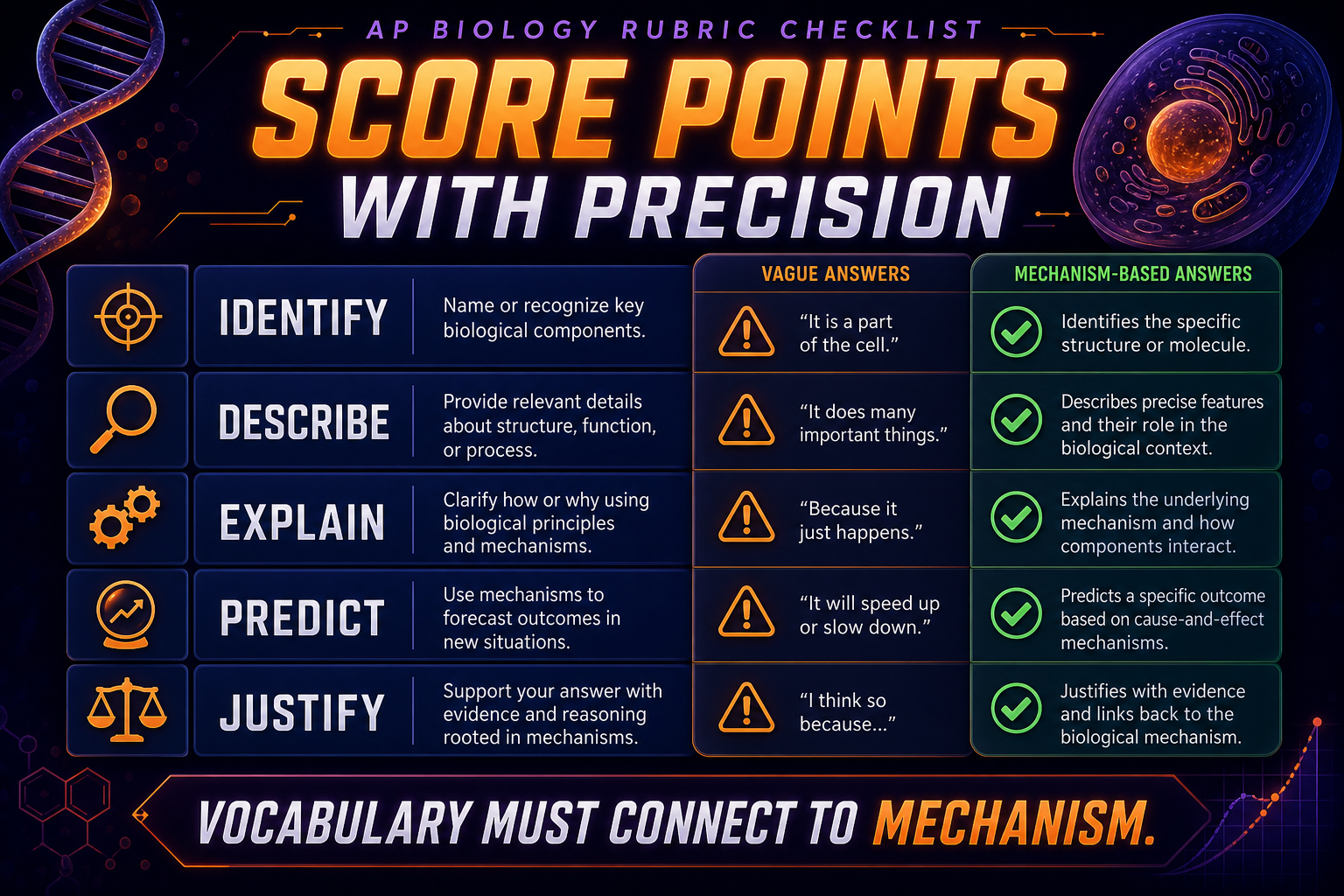
Score points by connecting vocabulary to mechanism.
Use these phrases as models for mechanism-based sentences—not scripts to memorize.
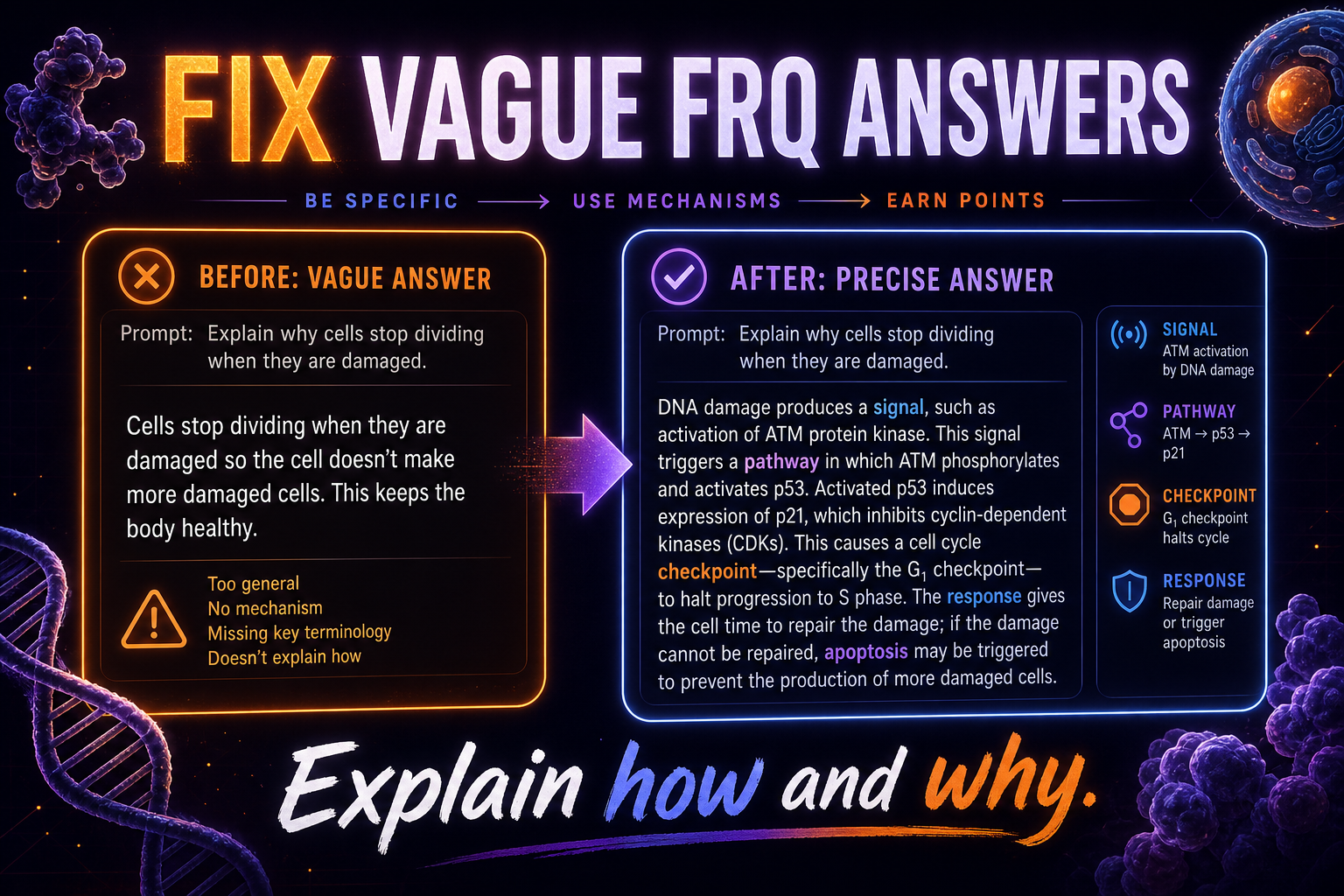
Vague answers become stronger when they explain the mechanism.
Before: “The signal does not work.”
After: If the receptor changes shape, the ligand may not bind, so the signal transduction pathway will not activate and the cellular response will decrease.
Before: “The checkpoint stops cancer.”
After: The checkpoint pauses the cell cycle when DNA damage is detected, giving the cell time to repair damage or trigger apoptosis before division.
Before: “cAMP makes the response happen.”
After: cAMP acts as a second messenger that activates downstream proteins, allowing the signal to be relayed and amplified inside the cell.
Before: “Apoptosis kills bad cells.”
After: Apoptosis removes damaged or unsafe cells in a controlled way, reducing the chance that mutations are passed to daughter cells.
| FRQ clue | Topic to review |
|---|---|
| ligand, receptor, target cell | Ligands and Receptors |
| reception, transduction, response | Reception, Transduction, Response |
| second messenger, cAMP, Ca2+ | Second Messengers |
| GPCR, adenylyl cyclase, cAMP, PKA, ATP to cAMP | cAMP Signaling Pathway |
| Ca2+, calcium channels, internal stores, cytosolic calcium, calcium target proteins | Calcium Signaling Pathway |
| kinase, phosphate, phosphatase | Phosphorylation Cascade |
| kinase, phosphatase, ATP, phosphorylation, dephosphorylation, pathway reset | Kinases and Phosphatases |
| dimerization, tyrosine, phosphorylation, docking proteins | Tyrosine Kinase Receptors |
| ligand-gated channel, ion movement, membrane potential, channel blocker | Ion Channel Receptors |
| steroid hormone, lipid-soluble, nonpolar ligand, nuclear receptor, gene expression | Intracellular Receptors |
| set point, homeostasis | Feedback Mechanisms |
| reduces change | Negative Feedback |
| amplifies change | Positive Feedback |
| G1, S, G2, M | Cell Cycle |
| G1, S, G2, M phase, cytokinesis, DNA replication, chromosome separation | Cell Cycle Phases |
| M phase, mitosis, spindle fibers, chromosome separation, cytokinesis | Mitosis in the Cell Cycle |
| DNA damage, spindle | Cell Cycle Checkpoints |
| cyclin, CDK | Cyclins and CDKs |
| oncogene, tumor suppressor | Cancer and Cell Cycle Regulation |
| programmed cell death | Apoptosis |
Meaning: Explain target cell specificity.
Meaning: Predict downstream response decreases or changes.
Meaning: Explain intracellular relay and amplification.
Meaning: Downstream proteins may not be phosphorylated.
Meaning: Negative feedback.
Meaning: Positive feedback.
Meaning: Checkpoint, repair, or apoptosis.
Meaning: Cancer regulation failure.
Choose one FRQ and answer without notes.
Compare your answer to the rubric.
Rewrite one weak sentence using the mistake fixer.
Review the linked topic page and try another FRQ.
AP Biology Unit 4 FRQs can include cell communication, signal transduction, feedback mechanisms, cell cycle regulation, checkpoints, cancer, and apoptosis. Many prompts ask students to predict what happens when a pathway is blocked or overactive. Strong answers explain mechanisms, not just vocabulary.
Start by identifying reception, transduction, or response. Then explain how the signal moves from receptor activation to an intracellular change. If the prompt changes a receptor or pathway protein, predict how the final response changes.
Trace the pathway in order from receptor to relay molecule to response. Include second messengers, phosphorylation, or amplification if the prompt mentions them. Avoid jumping directly from ligand binding to response without explaining the pathway.
Identify whether the loop is negative or positive feedback. Explain whether the response reduces the original change or amplifies it. Then connect the feedback loop to homeostasis or a specific endpoint.
Name the checkpoint involved and state what it checks. Then explain what happens if the checkpoint works or fails. For DNA damage questions, connect checkpoint failure to mutation transfer or cancer risk.
Explain that cyclins activate CDKs and that active CDKs phosphorylate target proteins. Then connect phosphorylation to cell-cycle progression. If cyclin or CDK regulation fails, predict unsafe progression or reduced progression.
Identify the failed control, such as an oncogene, tumor suppressor, checkpoint, or apoptosis pathway. Explain the normal role of that control. Then predict how failure changes cell division or cancer risk.
Define apoptosis as programmed cell death. Explain why removing damaged or unnecessary cells protects the organism. If apoptosis is blocked, predict that damaged cells may survive and continue dividing.
The biggest mistake is using vocabulary without explaining the mechanism. Saying “transduction happens” or “the checkpoint fails” is usually not enough. You need to explain how that change affects the cell response.
Practice writing one clear cause-and-effect sentence for every answer part. Use the prompt evidence and connect it to a biological mechanism. Then compare your response to a rubric and rewrite weak sentences.