What is a feedback mechanism in biology?
A feedback mechanism is a biological process where the output loops back to influence further activity, either reducing or amplifying the original change. Feedback mechanisms maintain homeostasis mainly through negative feedback, which reverses deviation from a setpoint, and selectively through positive feedback, which amplifies a stimulus until a tightly regulated process finishes.
A feedback mechanism detects a change, sends signals through a control center, and triggers a response that either reverses the change (negative feedback) or amplifies it (positive feedback).
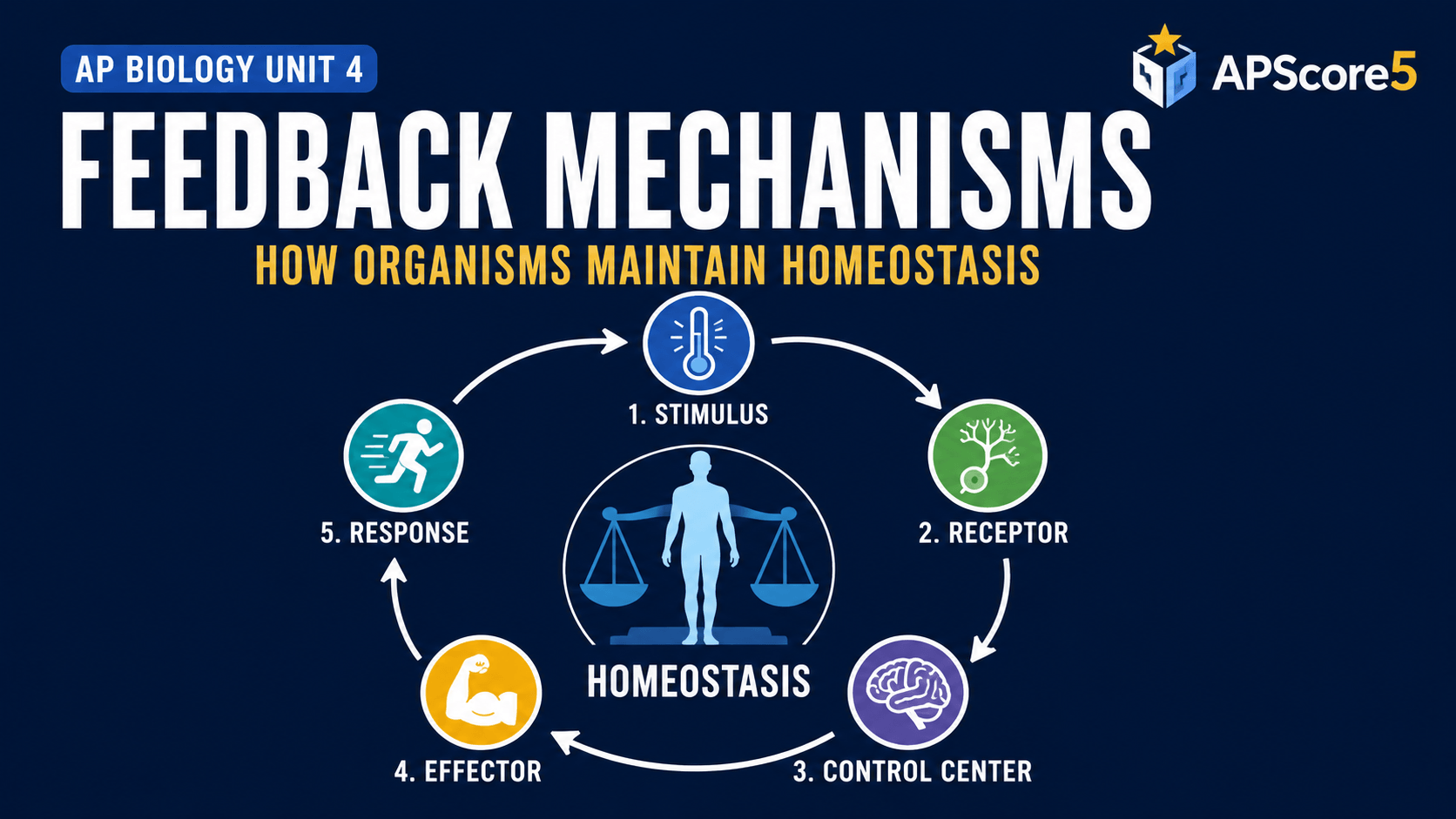
Plain-language snapshot
Simple definition: A feedback loop uses information about the result of a process to adjust the process itself—like a thermostat turning heat off when a room hits its target temperature.
Feedback mechanisms at a glance
This feedback mechanisms biology table compares negative feedback and positive feedback by direction, stability, and role on the exam.
| Feature | Negative feedback | Positive feedback |
|---|---|---|
| Direction | Opposes the original change | Amplifies the original change |
| Purpose | Maintain homeostasis | Drive a process to completion |
| Frequency | Very common | Less common |
| Stability | Stable around a setpoint | Runs to an endpoint |
| Example | Thermoregulation | Uterine contractions |
- Negative feedback acts like a thermostat—reverses change.
- Positive feedback acts like an amplifier—strengthens change.
- Both share the same five components with opposite net effects.
- Most feedback systems are negative because cells need stable chemistry.
The same architecture appears from glucose control to hormone axes—only the direction of the response changes.
Why are feedback mechanisms important?
Feedback mechanisms keep organisms alive when the outside world shifts. Without loops, core temperature would track weather, glucose would swing wildly after meals, and hormone secretion would lack shutdown signals.
Homeostasis—stable internal conditions—relies heavily on negative feedback. Enzymes need narrow temperature and pH ranges; cells need steady fuel; endocrine signals must turn off. Each case uses a loop that senses deviation and corrects it.
Positive feedback serves different goals: processes that must finish completely—labor, clot sealing, full depolarization—not ongoing stability.
This ties to Unit 4 cell communication: feedback is an ancient regulatory layer that still works beside modern signal transduction networks.
Glucose setpoints you regulate here sit downstream of how leaves made sugar in the first place—skim Calvin cycle outputs feeding respiration when FRQs chain metabolism.
Membrane-linked sensors often depend on aqueous chemistry—when prompts stress IV fluids or kidney osmolarity, pair hormone loops with water as a biological solvent reasoning.
What are the components of a feedback mechanism?
Key idea: Every feedback mechanism in biology uses the same five parts—name them on FRQs and you earn structure points.
Think thermostat logic: sense, compare to setpoint, command effectors, measure again.
- Stimulus — deviation that starts regulation (temperature climbs).
- Sensor (receptor) — detects change and signals inward.
- Control center — integrates input versus setpoint (often hypothalamus or endocrine tissue).
- Effector — executes the compensatory change (gland, muscle, vessel).
- Response — reduces (negative) or amplifies (positive) the original stimulus.
For a deeper look at set points, sensors, control centers, and effectors, use the Homeostasis and Feedback Loops guide.
| Component | Role | Temperature example |
|---|---|---|
| Stimulus | Change to regulate | Core temperature rises |
| Sensor | Detects deviation | Hypothalamic thermoreceptors |
| Control center | Compares to setpoint | Hypothalamus integrator |
| Effector | Produces output | Sweat glands, skin vessels |
| Response | Corrects stimulus | Sweating and vasodilation cool the body |
How does negative feedback work?
Negative feedback AP Biology describes loops that oppose change to hold a setpoint—the backbone of homeostasis.
The response reduces or reverses the initiating stimulus. Temperature rises → cooling responses → temperature falls toward normal.
Why it dominates: proteins function in narrow ranges; glucose must stay usable for glycolysis; blood pH must stay near 7.4. Negative feedback keeps variables inside those windows while the environment fluctuates.
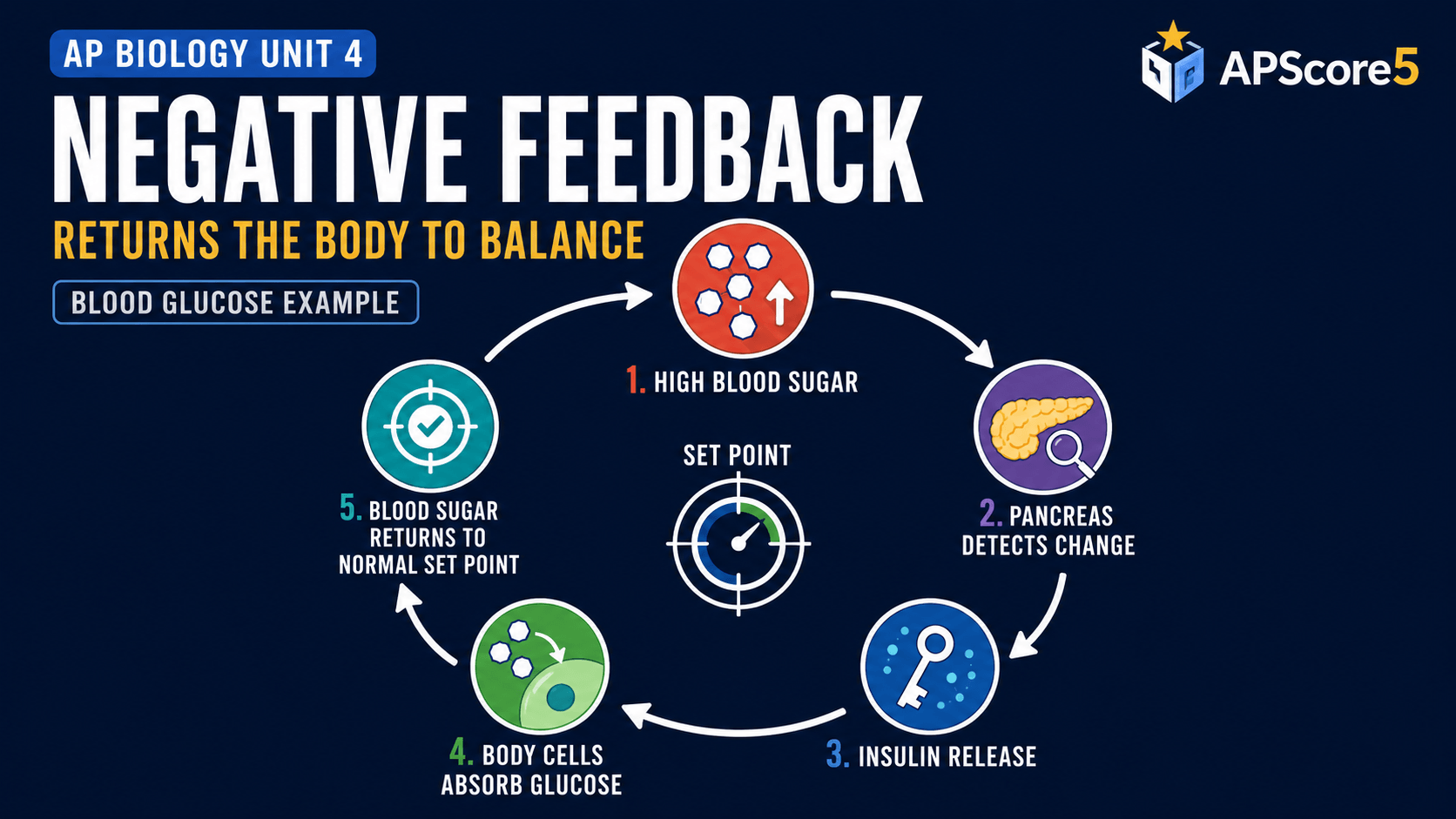
Common physiological negative loops include thermoregulation, glucose (insulin/glucagon), blood pressure, thyroid (TSH/T3/T4), cortisol (HPA), and calcium.
Each follows detect → integrate → effect → diminished stimulus.
How does positive feedback work?
Positive feedback AP Biology amplifies a deviation until a defined endpoint—rare but essential when completion matters more than steady state.
The response enhances the stimulus until the job finishes or the stimulus disappears.
Why rarity? Runaway amplification is dangerous for core variables like temperature. Positive loops appear where biology needs irreversible completion: seal a wound, deliver a baby, fire an action potential reliably.
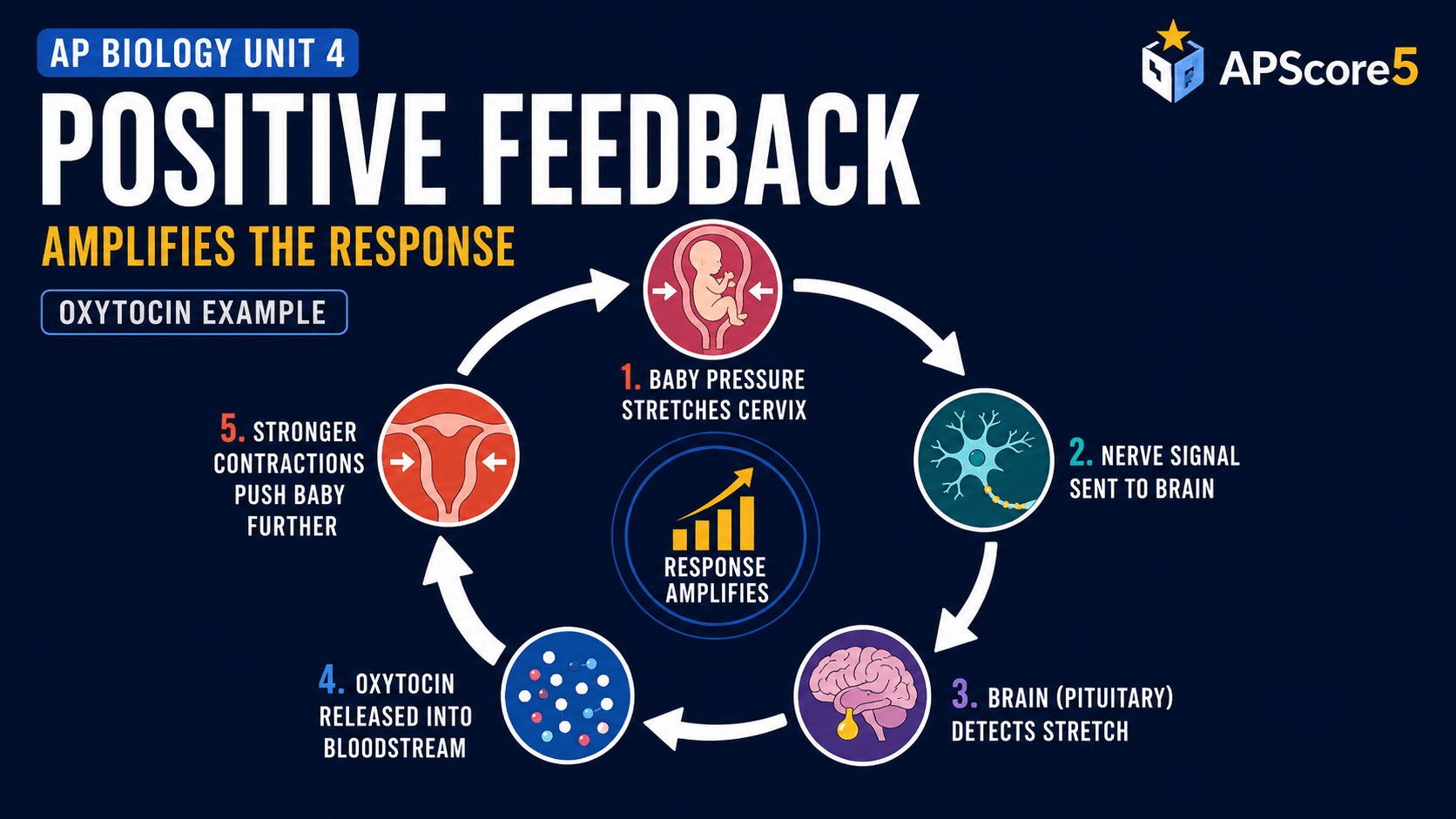
Classic examples: uterine stretch → oxytocin → stronger contractions; clotting factors recruit more platelets; suckling reinforces milk ejection; Na⁺ channels reinforce depolarization during the rising phase of a spike; ethylene coordinates fruit ripening.
What are negative feedback examples in the body?
Feedback mechanisms in the body recycle the same logic across organs. Below are the AP-ready stories.
How is blood glucose regulated?
The pancreas coordinates opposing hormones:
- High glucose (post-meal): β-cells release insulin → uptake and glycogen storage → glucose falls.
- Low glucose (fasting): α-cells release glucagon → liver glycogen breakdown → glucose rises.
Feedback loops glucose and glucagon target roughly 70–110 mg/dL. Broken insulin signaling yields diabetes—type 1 (no insulin) or type 2 (resistance).
How does thermoregulation use feedback?
The hypothalamus integrates thermal input:
- Too hot: sweat plus vasodilation removes heat.
- Too cold: shivering plus vasoconstriction conserves heat.
Setpoint ~37 °C; fever resets the target upward during infection while loops still operate.
How does thyroid hormone feedback operate?
The feedback mechanism of thyroid hormone uses TRH → TSH → T3/T4. Elevated thyroid hormone inhibits TRH and TSH—pure negative feedback. Disorders shift hormone levels when sensing or secretion breaks.
How does cortisol feedback operate?
The HPA axis runs CRH → ACTH → cortisol. Cortisol inhibits CRH and ACTH, terminating acute stress signaling; chronic stress can dysregulate rhythm.
Does the menstrual cycle mix feedback types?
The feedback mechanism in menstrual cycle regulation involves estrogen, progesterone, FSH, and LH with phase-dependent negative and brief positive feedback on LH—know that both modes can appear in one integrated timeline.
What are positive feedback examples in the body?
Childbirth and oxytocin
- Fetal head stretches cervix.
- Hypothalamus/pituitary release oxytocin.
- Stronger contractions increase stretch.
- Loop ends when delivery removes mechanical stimulus.
Blood clotting cascade
Platelet activation recruits factors and more platelets until the wound is sealed—endpoint stops amplification.
Lactation reflex
Suckling triggers prolactin/oxytocin; milk removal sustains stimulation until feeding stops.
Action potentials
Threshold Na⁺ entry opens more Na⁺ channels—local positive feedback for rapid depolarization until inactivation and K⁺ exit restore resting potential.
Fruit ripening
Ethylene from ripening tissue accelerates ripening neighbors—“one bad apple” is chemistry, not morality.
How do feedback mechanisms maintain homeostasis?
Negative feedback tolerates small oscillations while continuously nudging variables back toward setpoints.
| Variable | Setpoint | Feedback sketch | If broken |
|---|---|---|---|
| Temperature | ~37 °C | Hypothalamus + skin/vessels/muscles | Heat illness or hypothermia risk |
| Blood glucose | 70–110 mg/dL | Pancreas + liver hormones | Hyperglycemia patterns of diabetes |
| Blood pH | 7.35–7.45 | Lungs/kidneys/buffers | Acid–base emergencies |
| Blood pressure | ~120/80 mmHg | Baroreflex + renal output | Hypertension or shock physiology |
| Thyroid hormone | Narrow band | HPT axis inhibition | Hyper- or hypothyroid states |
| Cortisol | Diurnal rhythm | HPA inhibition | Cushing’s or Addison’s patterns |
Exam pattern: Disease stems from broken loops—link symptom direction to missing inhibition or excessive drive.
How do positive and negative feedback compare?
This positive feedback mechanism vs negative feedback mechanism summary matches how AP frames contrast questions.
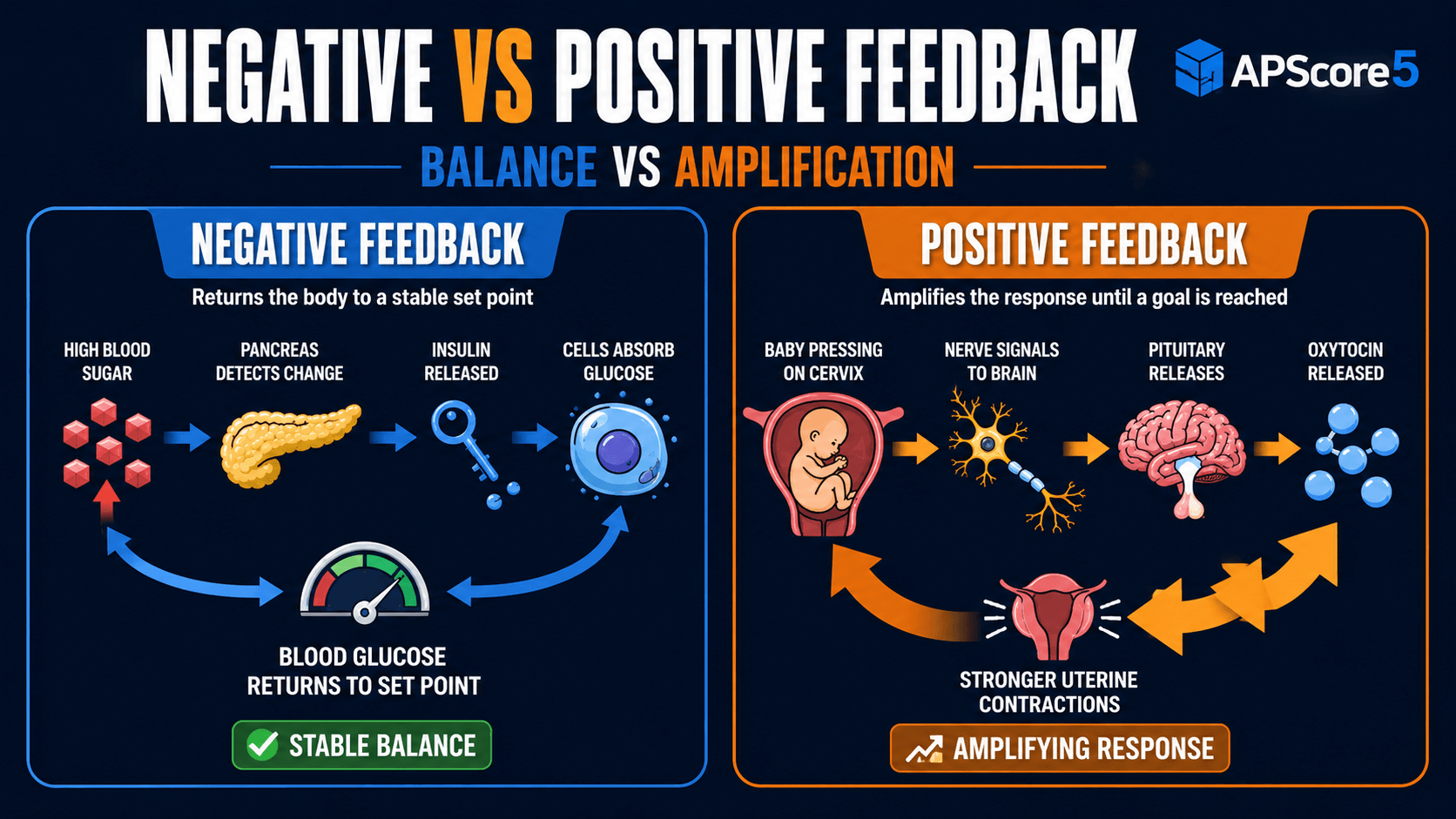
| Feature | Negative | Positive |
|---|---|---|
| Effect on stimulus | Reduces it | Amplifies it |
| Purpose | Stability | Completion |
| Frequency | High | Lower |
| Endpoint | Setpoint band | Definite finish |
| Examples | Glucose, temperature, thyroid, cortisol | Labor, clotting, spike rising phase |
Takeaway: components match; the net direction relative to the stimulus differs.
Where else do feedback mechanisms appear?
Endocrine control: Most glands use feedback mechanism in endocrine system wiring—pituitary bridges hypothalamus with thyroid, adrenal cortex, and gonads.
Nerve impulses: Rising phase of the spike uses fast positive feedback; overall firing rate can still be regulated downstream.
Plants: Ethylene ripening is positive; guard-cell turgor loops regulate stomatal aperture negatively relative to water-status signals.
Ecology: Predator–prey dynamics show delayed negative feedback at population scales.
Gene expression: Operons such as trp shut synthesis when product concentration is high—negative feedback on transcription in bacteria. See Unit 6 gene expression.
Disease lenses: Diabetes and thyroid disorders become clearer when you sketch the intact loop first, then erase the broken arrow.
How does feedback appear on the AP Biology exam?
Template sentence: A feedback mechanism routes output back to input; negative loops oppose deviation for homeostasis; positive loops amplify until completion; always five named parts.
Multiple-choice prompts
- Which maintains homeostasis? → Negative.
- Which amplifies? → Positive.
- Hypothalamus role? → Often integrator.
- Broken insulin feedback? → Diabetes phenotypes.
- Positive example? → Labor, clotting, spike rise, ethylene.
- Negative example? → Temperature, glucose, thyroid, cortisol.
Free-response prompts
- Draw or annotate missing loop components.
- Predict outcomes when a sensor or effector fails.
- Compare two scenarios with different directions.
- Design experiments testing hormone–variable relationships.
Test yourself in 5 seconds
A person eats a high-carbohydrate meal, and blood glucose spikes. Which response fits best?
How does feedback compare to cell signaling—and what mistakes cost points?
| Feature | Feedback mechanisms | Cell communication |
|---|---|---|
| Scale | Whole-organism variables | Cell-to-cell messages |
| Goal | Hold or finish processes | Coordinate cellular responses |
| Parts | Five-component loop | Ligand, receptor, transduction |
| Timing | Seconds to hours | Milliseconds to minutes for many ligands |
| Tie-in | Signaling pathways execute the effector arm inside feedback loops. | |
Both live in Unit 4 because regulation spans molecules and systems.
Common mistakes that lose FRQ credit
- Calling negative feedback “bad”—it is usually protective.
- Calling positive feedback “morally good”—it describes amplification, not ethics.
- Omitting one of the five named components.
- Claiming homeostasis means zero fluctuation—stable means corrected oscillation.
- Forgetting hypothalamus/pituitary roles in neural–endocrine loops.
- Reversing insulin vs glucagon triggers.
- Labeling action potential rise as negative feedback—it is regenerative depolarization.
How should you read diagrams—and which drills build fluency?
Diagram items usually hide one missing box—map stimulus → sensor → control → effector → response before answering.
Oscillating hormones near a flat target suggest intact negative feedback; flat lines can mean failure to respond; runaway slopes suggest broken inhibition or inappropriate positive drive.
Inverse TSH vs T4 patterns diagnose thyroid axis disruption; glucose–insulin curves show meal timing versus fasting; cortisol curves highlight circadian rhythm versus chronic elevation.
For case prompts, list variable → direction → loop type → intact versus broken arm.
Notebook drills that translate to FRQs
Sketch loops before peeking at solutions—muscle memory beats rereading.
- Diagram drills: Draw temperature, glucose, and thyroid loops with every label; highlight inhibitory arrows on endocrine axes.
- Disease reversals: For diabetes, hyperthyroidism, or Cushing patterns, mark which arrow is weak or stuck on.
- Writing discipline: Use precise verbs (inhibits, stimulates, releases, ceases) and always present five components in order when asked for mechanism structure.
Feedback mechanisms flashcards (22)
Flip through every card—ads appear every fifth navigation with a short countdown, matching the site-wide practice cadence.
Feedback mechanisms practice MCQs (16)
Work each rationale—pattern recognition on loop direction saves minutes on exam day.
How should you answer feedback FRQs?
Prompt focus: type 1 diabetes removes insulin; explain lost negative feedback on glucose.
Sample outline: (A) define homeostasis; list five parts applied to glucose. (B) meal → insulin → uptake/storage → lowered glucose. (C) without insulin, glucose stays high; injections restore effector output. (D) stability requires negative dominance; positive suits discrete completions.
Rubric mindset: definitions, complete loop, prediction, contrast—four conceptual bundles.
Unit 4 path: previous and next
Follow the Unit 4 sequence—each page links forward so you can study signaling, feedback, and the cell cycle in order.
- Cellular respiration overview — ATP supply that feedback-regulated glucose supports.
- AP Biology hub — course-wide navigation.
Feedback mechanisms FAQ
What is a feedback mechanism in biology?
A feedback mechanism is a biological process where the output of a system loops back to influence further activity. It uses five components—stimulus, sensor, control center, effector, and response—to either reverse changes (negative feedback) or amplify them (positive feedback).
What are feedback mechanisms in biology?
Feedback mechanisms are control loops that maintain homeostasis (negative feedback) or drive processes to completion (positive feedback). Examples include blood glucose regulation, thyroid hormone control, cortisol management, body temperature regulation, childbirth, and blood clotting.
What is a feedback mechanism in science?
A feedback mechanism is any system where output information is used to control further activity. In biology, the most common form is negative feedback maintaining homeostasis.
How do feedback mechanisms maintain homeostasis?
Negative feedback detects deviations from a setpoint and triggers responses that reverse the deviation. For example, when blood glucose rises after a meal, insulin is released to lower it back to the setpoint.
Why are feedback mechanisms important?
They are essential for life. Without negative feedback, body temperature, blood glucose, blood pH, hormone levels, and other variables would drift uncontrollably. Even small deviations can damage cells, denature proteins, or stop enzyme reactions. Feedback keeps everything stable.
What are negative feedback mechanisms?
Negative feedback mechanisms reverse a change to maintain a setpoint. The response opposes the original stimulus. Examples: body temperature regulation, blood glucose (insulin/glucagon), thyroid hormone (HPT axis), cortisol (HPA axis), and blood pressure regulation.
What are examples of negative feedback mechanisms?
Blood glucose regulation by insulin and glucagon, body temperature regulation by hypothalamus and sweating/shivering, thyroid hormone regulation through the HPT axis, cortisol regulation through the HPA axis, blood pressure regulation by baroreceptors and the kidneys, and calcium ion regulation by parathyroid hormone.
What is a positive feedback mechanism?
Positive feedback amplifies a stimulus, driving a process to completion. The response enhances the original change. Classic examples include childbirth contractions (oxytocin), blood clotting cascade, milk letdown during nursing, action potentials in neurons, and fruit ripening (ethylene gas).
What is the difference between positive and negative feedback?
Negative feedback reverses change to maintain stability (homeostasis). Positive feedback amplifies change to drive a process to a definite endpoint. Negative is dominant in biology because life needs stability; positive is reserved for processes that must run to completion.
What are the components of a feedback mechanism?
Five components: (1) stimulus—the change that triggers the loop, (2) sensor—detects the change, (3) control center—processes the information, (4) effector—carries out the response, (5) response—reverses or amplifies the original change.
How does insulin and glucagon feedback work?
After a meal, blood glucose rises. The pancreas releases insulin (β-cells), which signals body cells to absorb glucose and the liver to store glycogen. Glucose drops back to setpoint. Between meals, blood glucose falls, and the pancreas releases glucagon (α-cells), which signals the liver to break down glycogen and release glucose. Together, insulin and glucagon maintain blood glucose at ~70-110 mg/dL.
How does the thyroid hormone feedback loop work?
The hypothalamus releases TRH, which signals the pituitary to release TSH, which signals the thyroid to release T3 and T4. High T3/T4 levels feed back to inhibit both TRH and TSH release. Low T3/T4 levels remove the inhibition, restarting the loop. This negative feedback keeps thyroid hormone levels stable.
What is the HPA axis (cortisol feedback loop)?
The HPA axis is the hypothalamus-pituitary-adrenal feedback loop that regulates cortisol release in response to stress. Stress triggers CRH from the hypothalamus → ACTH from the pituitary → cortisol from the adrenal glands. High cortisol feeds back to inhibit CRH and ACTH, ending the stress response. This is a classic negative feedback loop.
What happens when feedback mechanisms fail?
Diseases result. Diabetes (type 1) is broken insulin feedback. Hyperthyroidism is overactive thyroid feedback. Cushing's syndrome is excess cortisol from broken HPA feedback. Addison's disease is insufficient cortisol. Most endocrine disorders reflect feedback loops gone wrong.
Why is most feedback in biology negative?
Because life depends on stable internal conditions. Enzymes, proteins, and cells function only within narrow ranges of temperature, pH, and ion concentrations. Negative feedback maintains these stable conditions by reversing deviations from a setpoint. Positive feedback would push conditions further from the safe range, which would be lethal in most situations.