Ion channel opens
Ion channel receptor pathway is likely.
AP Biology · Unit 4 Phase 2 Deep Dive
Ion channel receptors are membrane receptors that open or close channels when they receive a signal. When a ligand binds to a ligand-gated ion channel, ions can move across the membrane and quickly change cell activity. In AP Biology Unit 4, the key skill is explaining how ligand binding changes channel shape, ion movement, membrane potential, and the final cellular response.
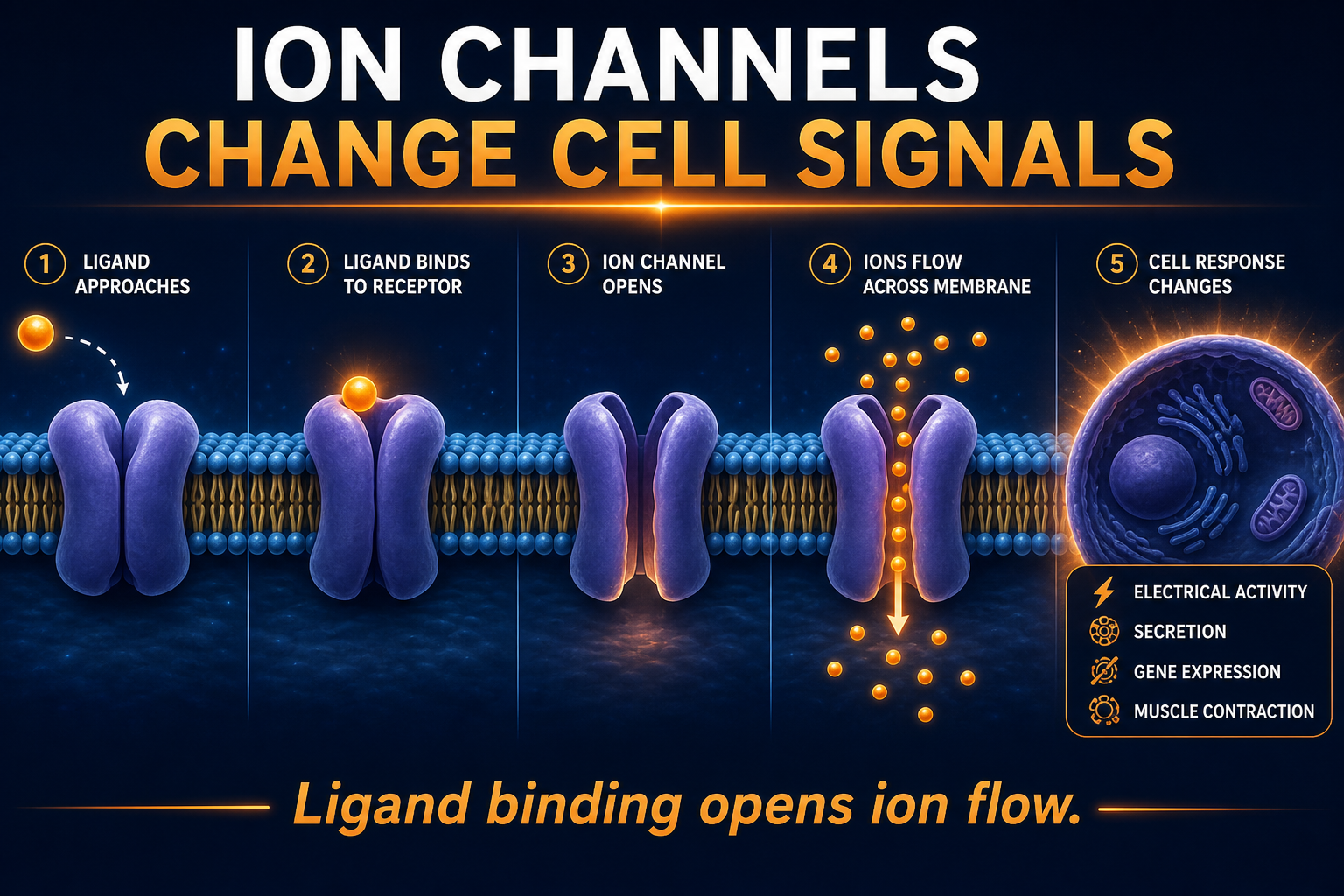
The core Unit 4 pages explain ligands, receptors, and signal transduction. This Phase 2 deep dive focuses on ion channel receptors, which create fast responses by changing ion movement across membranes. Ion channel receptors pair well with GPCRs and tyrosine kinase receptors because all three show different ways that reception can trigger transduction.
Ion Channel Receptors
Ligand-gated ion flow.
Core guide: Ligands and Receptors. Related: Cell Signaling Pathways.
Ion channel receptors are membrane receptors that open or close ion channels in response to a signal. When a ligand binds to a ligand-gated ion channel, ions move across the membrane down an electrochemical gradient. This ion movement can quickly change membrane potential, protein activity, or the cell's response.
Ion channel receptors convert ligand binding into ion flow.
Set ligand, channel, and gradient conditions—then read channel state, ion flow, and response.
Channel: Closed
Ion flow: No flow
Ligand absent — channel closed. No ion flow. No response.
Response: No response
Ion channel receptors are membrane proteins that allow specific ions to cross the membrane when the channel is open. Some ion channels open when a ligand binds. Others respond to voltage or mechanical changes, but AP Biology signal-transduction questions often focus on ligand-gated ion channels.
On the cell communication hub, you learned that signals must be received before a response can occur. Ion channel receptors make that link very direct: the same protein that receives the signal also forms the pore that changes ion movement. That is why many neurons, muscle cells, and endocrine targets use ligand-gated channels when speed matters.
Map how binding becomes a cellular change on reception, transduction, and response—an ion channel receptor shows reception leading directly to transduction because ligand binding changes channel shape and ion flow.
An ion channel receptor changes cell signaling by controlling ion movement.
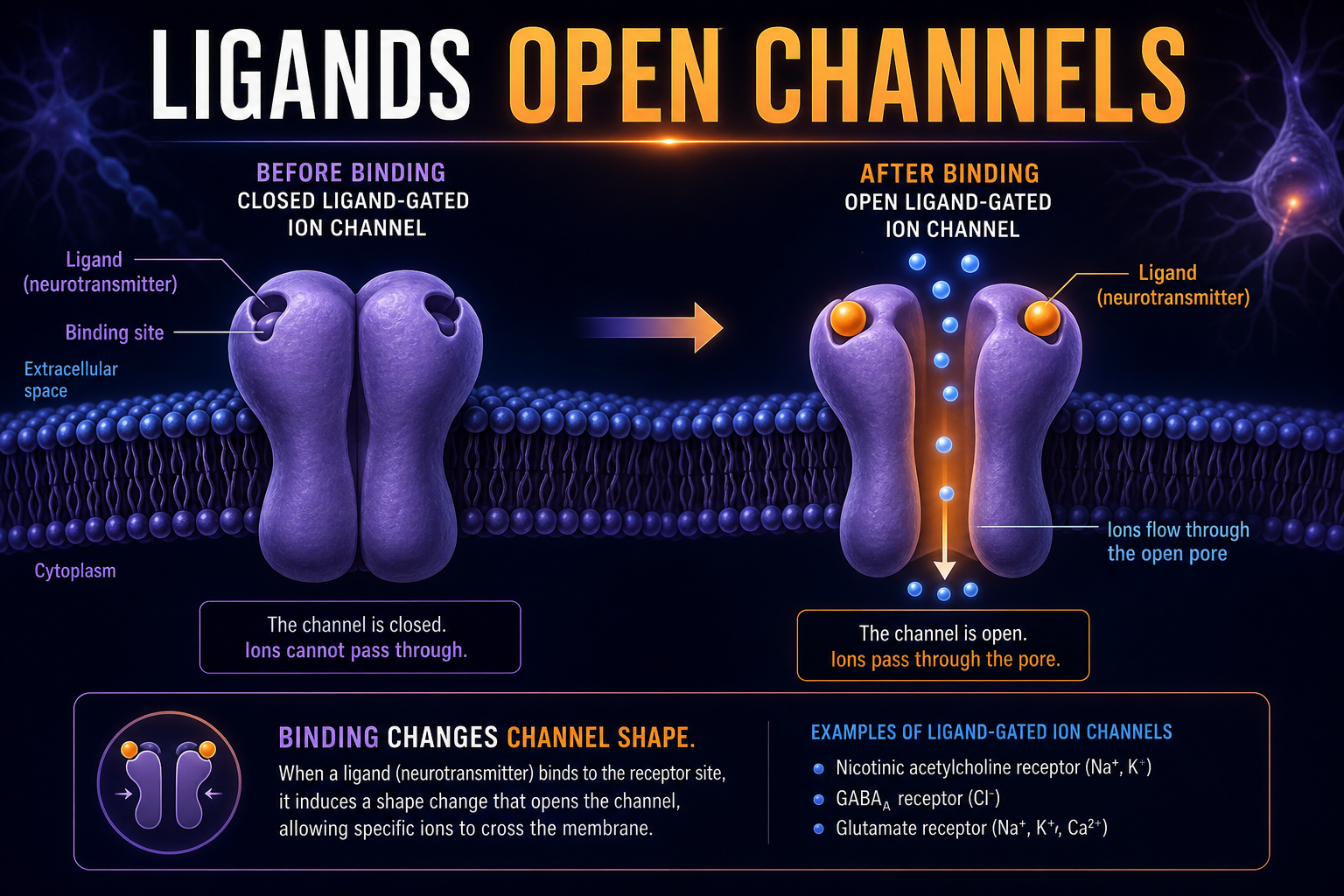
A ligand-gated ion channel opens or closes when a specific ligand binds. The ligand does not need to carry ions itself. Instead, it changes the receptor's shape so ions can move through the channel.
Think of the channel as a gated door in the membrane. Before binding, the door may stay closed. After the correct ligand attaches, the protein rearranges and the pore opens. If the wrong ligand binds, the door may stay closed because receptor specificity still applies.
Review ligands and receptors when you explain how one signal matches one receptor type. Neurotransmitters, hormones, and local signaling molecules can all use ligand-gated channels when the prompt mentions rapid membrane changes.
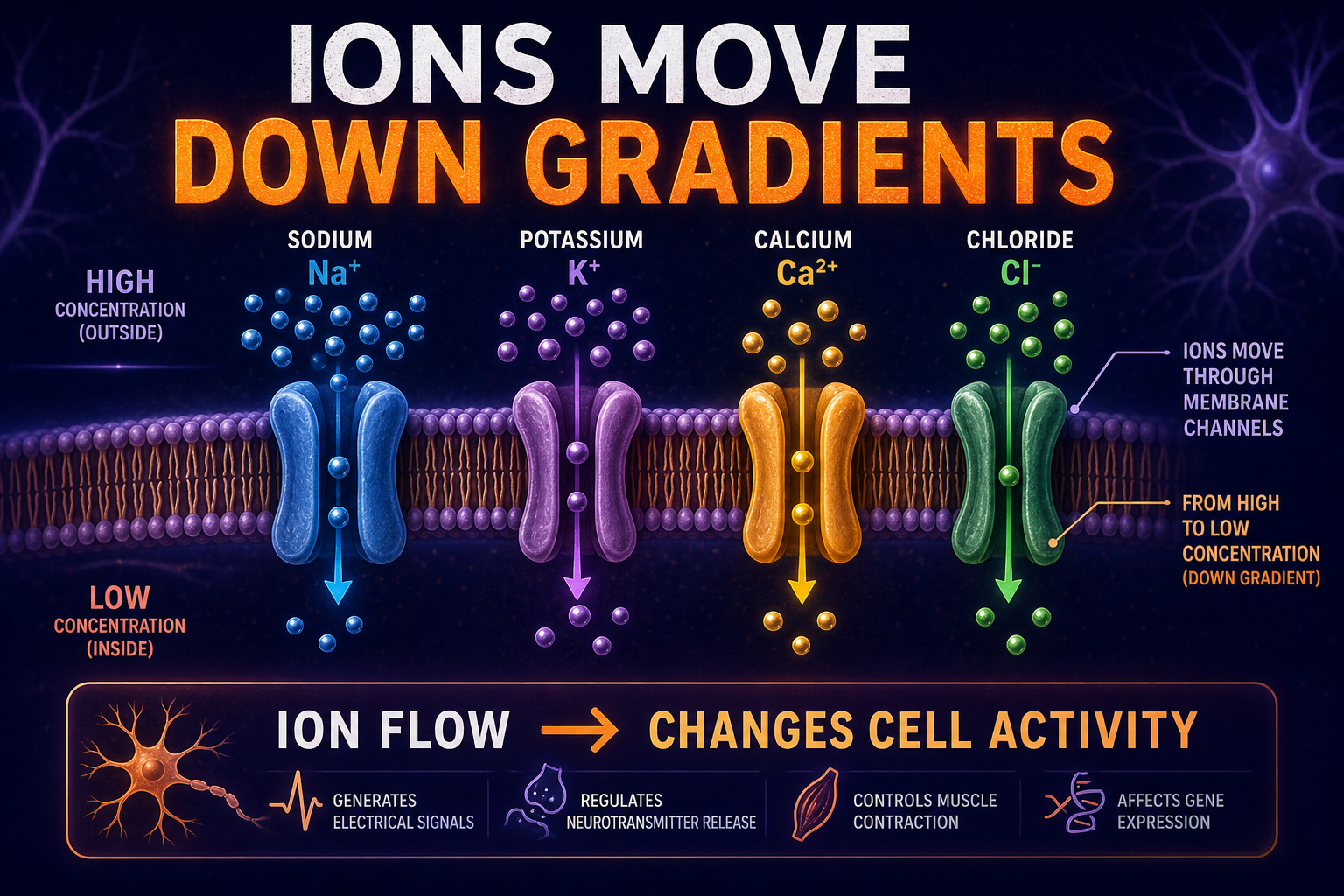
Ions usually move through open channels down their electrochemical gradients. This means movement depends on concentration differences and charge differences across the membrane. If a channel is closed or blocked, ions cannot move through that pathway even if a gradient exists.
Sodium, potassium, calcium, and chloride are common ions in AP Biology prompts. The direction of movement depends on both concentration and charge. A positive ion moving into a negatively charged region may be favored even when concentration alone would predict the opposite. That combined effect is the electrochemical gradient students must mention on FRQs.
Because ions have charge, ion movement can change the electrical difference across the membrane. This is called membrane potential. In excitable cells, changes in membrane potential can create rapid responses.
When sodium enters through an open channel, the inside of the cell may become less negative relative to the outside. When chloride enters, the inside may become more negative. AP prompts often ask you to predict whether the response increases, decreases, or stops when ion flow changes direction or stops entirely.
Ion channels can change cell behavior by changing charge distribution across the membrane.
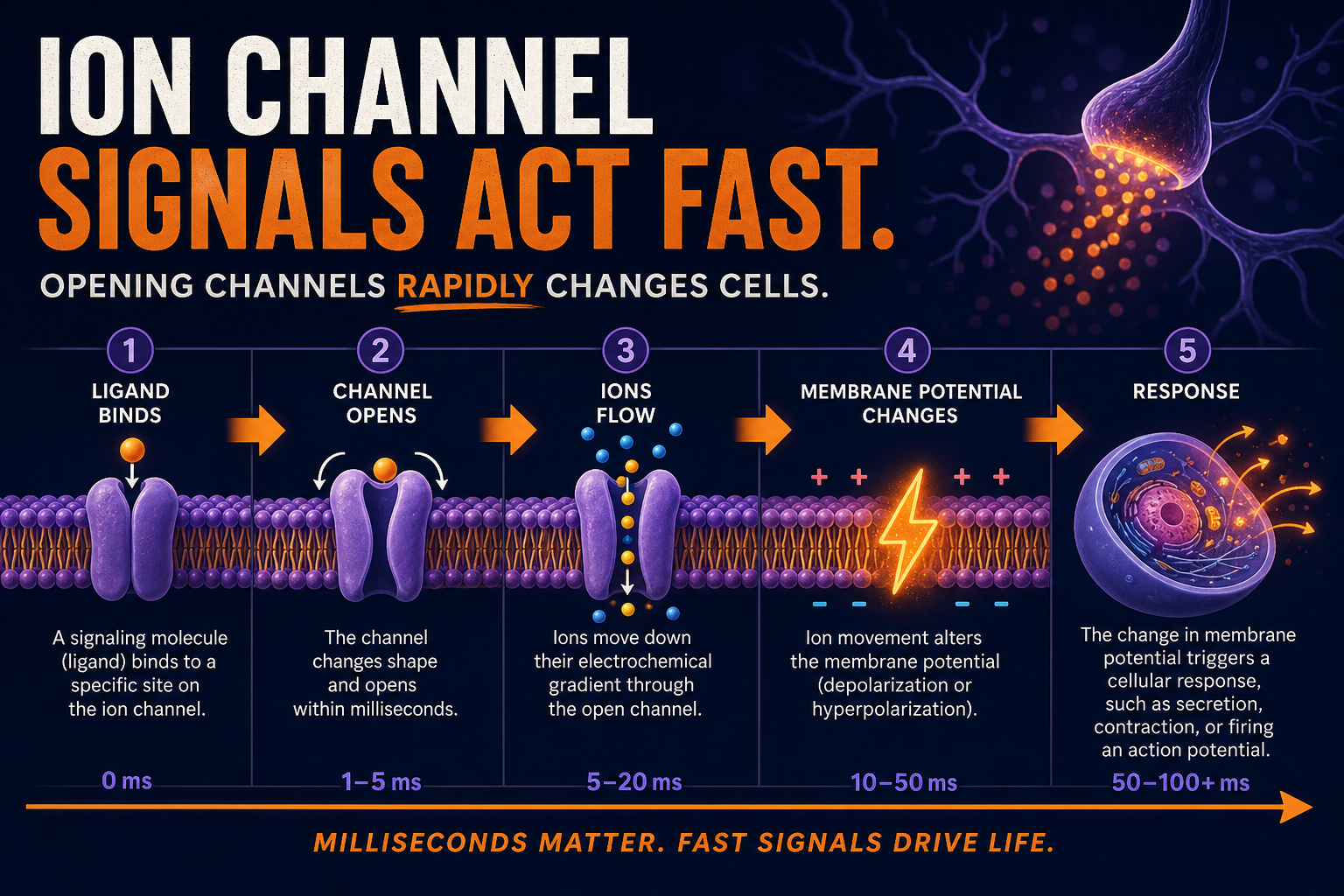
Ion channel receptors can create fast responses because opening a channel immediately changes ion flow. The cell does not always need a long cascade before the response begins. This makes ion channels useful in rapid communication systems.
Compare that speed with a GPCR pathway that must activate a G protein and may rely on second messengers before the full response appears. Ion channels are not always faster in every cell type, but the AP exam loves contrasts between immediate pore opening and multi-step relay signaling.
Ion movement can change membrane potential, activate proteins, alter enzyme activity, or affect downstream signaling. The exact response depends on which ion moves and which cell type receives the signal. AP Biology questions usually ask students to predict whether the response increases, decreases, or disappears if the channel is blocked.
In synapses, opening channels can depolarize the postsynaptic cell. In glands, calcium entry through channels can trigger secretion. Some calcium signaling pathways depend on Ca2+ channels that open and increase cytosolic calcium concentration. Always name the ion and the direction of movement when the prompt gives you that information. Then connect the ion change to the observable response the question describes.
Practice predicting outcomes on the Unit 4 practice questions page and trace full written answers on the Unit 4 FRQ guide.
Ion channel receptors, GPCRs, and receptor tyrosine kinases are all receptor types, but their transduction mechanisms differ. Ion channel receptors directly change ion flow. GPCRs activate G proteins, while RTKs dimerize and phosphorylate tyrosine residues.
Intracellular receptors differ from ion channel receptors because they usually regulate gene expression rather than directly changing ion flow. Keeping those four receptor families straight helps you pick the right mechanism when a prompt names GDP, tyrosine phosphorylation, ion movement, or steroid hormones.
| Receptor type | Main mechanism | AP clue |
|---|---|---|
| Ion channel receptor | Opens or closes ion channel | ions move, membrane potential |
| GPCR | Activates G protein | GDP/GTP, cAMP |
| Tyrosine kinase receptor | Dimerizes and phosphorylates | dimer, tyrosine, kinase |
| Intracellular receptor | Binds ligand inside cell | steroid, gene expression |
Compare G protein-coupled receptors and tyrosine kinase receptors when a prompt mixes receptor types.
Ion channel receptor pathway is likely.
Ligand binding controls channel shape.
Ion flow is the transduction effect.
Charged ions are changing electrical conditions.
Ion flow and response may decrease.
Even an open channel may produce little or no net ion movement.
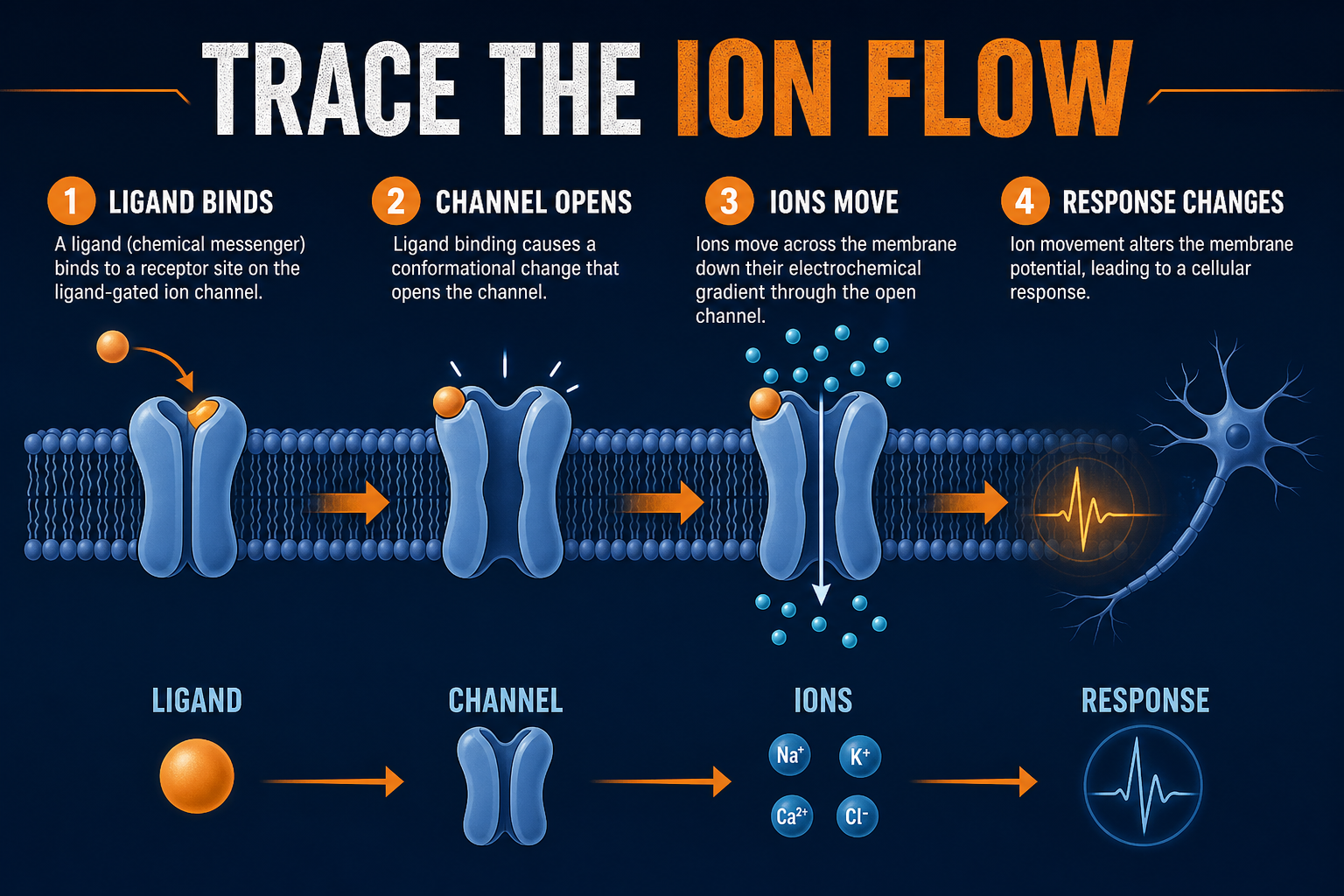
Name the signal and receptor type.
Connect binding to pore state.
Include the gradient when ions move.
Finish with a clear outcome.
When ___ binds the ion channel receptor, the channel ___. This allows ___ ions to ___. As a result, the cell response ___.
Fix: The ligand usually binds the receptor; ions move through the channel.
Fix: Ions move through open channels down electrochemical gradients.
Fix: Ion channels change ion flow; GPCRs activate G proteins.
Fix: Ion channels open pores; RTKs dimerize and phosphorylate.
Fix: If a channel is blocked, ions may not flow even if ligand binds.
Fix: Some channels respond to voltage or mechanical signals, but AP Biology often tests ligand-gated channels.
Answer all eight questions. Choices shuffle on reload—trace the pathway, not the letter.
More drills: Unit 4 practice questions or the Unit 4 FRQ guide.
Open each card, draft your response, then reveal the rubric and sample.
A neurotransmitter binds to a ligand-gated ion channel on a target cell. The channel opens and sodium ions move into the cell.
When the neurotransmitter binds the ion channel receptor, reception occurs because the ligand matches the receptor. Ligand binding changes the channel shape so it opens, which is part of transduction. Sodium ions move into the cell through the open channel down their electrochemical gradient. This ion influx can change membrane potential and trigger the cellular response. If a drug blocks the pore, sodium cannot move through the channel even if the ligand binds, so the response may decrease or fail.
Status: Draft your answer first—then open the rubric or sample.
A ligand binds normally to an ion channel receptor, but a mutation prevents the channel from changing shape and opening.
The ligand can still bind, but the mutation stops the channel from opening, so ions cannot move through that pathway. Without normal ion flow, membrane potential or other responses may not change as expected, so the cellular response may be weak or absent. In a GPCR pathway, ligand binding activates a G protein and often uses second messengers such as cAMP instead of opening an ion pore directly. Ion channel receptors change ion flow fast at the membrane; GPCRs relay signals through G proteins inside the cell.
Status: Draft your answer first—then open the rubric or sample.
Ion channel receptors are membrane receptors that open or close channels in response to a signal. When open, they allow specific ions to move across the membrane. This ion movement can quickly change cell activity.
A ligand-gated ion channel is a channel that opens or closes when a ligand binds. The ligand changes the receptor's shape. Ions then move through the channel if a gradient exists.
Usually, no. The ligand binds to the receptor and changes the channel shape. Ions, not the ligand, move through the channel.
Ions move through open channels down their electrochemical gradients. This depends on concentration differences and charge differences across the membrane. If the gradient is removed, net ion movement may decrease.
Ions have electrical charge, so ion movement can change charge distribution across the membrane. This changes membrane potential. In some cells, that change can trigger a rapid response.
Ion channel receptors directly control ion flow through a channel. GPCRs activate G proteins and often use second messengers such as cAMP. The key difference is channel opening versus G protein activation.
Ion channel receptors open or close pores for ions. Tyrosine kinase receptors dimerize and phosphorylate tyrosine residues. Both are receptors, but they use different transduction mechanisms.
If the channel is blocked, ions may not move through it even if the ligand binds. The change in membrane potential or cellular response may decrease. AP Biology often asks students to predict this consequence.
Ion channel responses can be fast because opening a channel immediately changes ion movement. The cell may not need a long relay cascade before the response begins. This makes ion channels useful for rapid signaling.
Trace the pathway in order: ligand binding, channel opening or closing, ion movement, and cellular response. Include the ion gradient if the prompt mentions ion movement. Then predict what happens if the channel is blocked or cannot open.