G1
Cell grows and carries out normal functions
AP Biology · Unit 4 Phase 2 Deep Dive
Cell cycle phases happen in a specific order: G1, S, G2, M phase, and cytokinesis. G1 supports cell growth, S phase copies DNA, G2 prepares for division, M phase separates chromosomes, and cytokinesis divides the cytoplasm. In AP Biology Unit 4, the key skill is knowing what happens in each phase and predicting what changes when a phase or checkpoint fails.
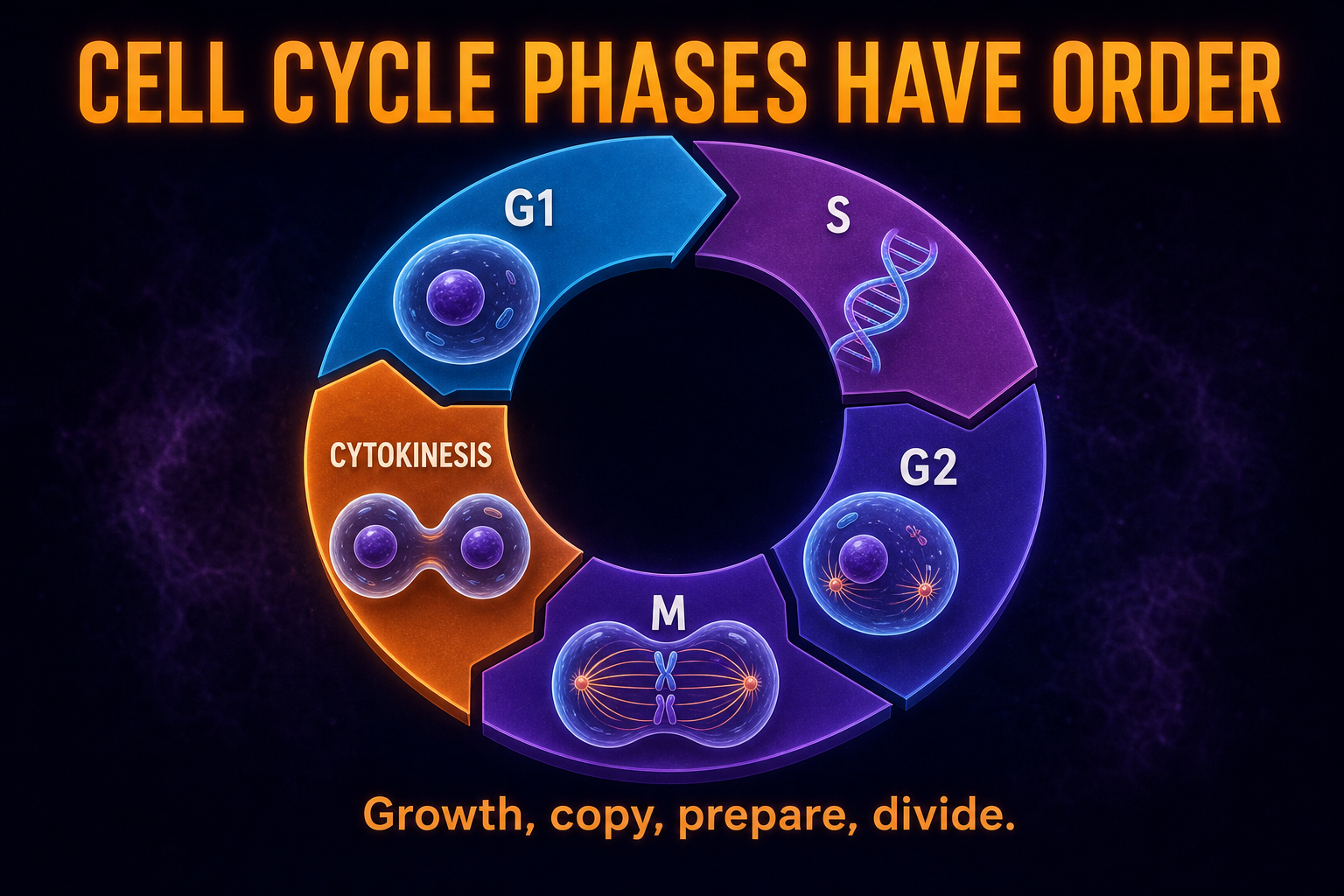
The core Cell Cycle page explains the broad idea of cell growth, DNA replication, division, and regulation. This Phase 2 page zooms in on the order and role of each phase. Use it when a prompt asks what happens in G1, S, G2, M phase, or cytokinesis.
Cell Cycle Phases
Phase-by-phase sequence.
Regulation links: Cyclins and CDKs push phase transitions, and cancer and cell cycle regulation shows what happens when control fails.
Use the Cell Cycle guide to learn the broad AP Biology overview of cell growth, DNA replication, division, and regulation. Use this Cell Cycle Phases guide when you need to distinguish G1, S, G2, M phase, and cytokinesis in order and predict what happens when a phase is blocked or skipped.
| Page | Best for | Link |
|---|---|---|
| Cell Cycle | Broad overview: cell cycle purpose, regulation, and checkpoints | Open guide |
| Cell Cycle Phases | Phase details: G1, S, G2, M, and cytokinesis sequence | You are here |
| Cell Cycle Checkpoints | Regulation points that stop unsafe progression | Open guide |
| Cyclins and CDKs | Protein regulators that push phase transitions | Open guide |
The cell cycle phases are G1, S, G2, M phase, and cytokinesis. G1 is cell growth, S phase is DNA replication, G2 is preparation for division, M phase separates chromosomes, and cytokinesis divides the cytoplasm. AP Biology often tests phase order and asks students to predict what happens if DNA replication, chromosome separation, or cytokinesis fails.
G1 grows, S copies DNA, G2 prepares, M separates, cytokinesis splits.
Click phases in order: G1 → S → G2 → M → Cytokinesis. Then choose a blocked phase to predict consequences.
DNA replication must happen before chromosome separation.
Click the first phase: G1.
Progress: Growth
The cell cycle moves through a sequence of events. Interphase includes G1, S, and G2. M phase and cytokinesis then complete cell division.
Cell grows and carries out normal functions
DNA is replicated
Cell prepares for division
Chromosomes are separated
Cytoplasm divides into daughter cells
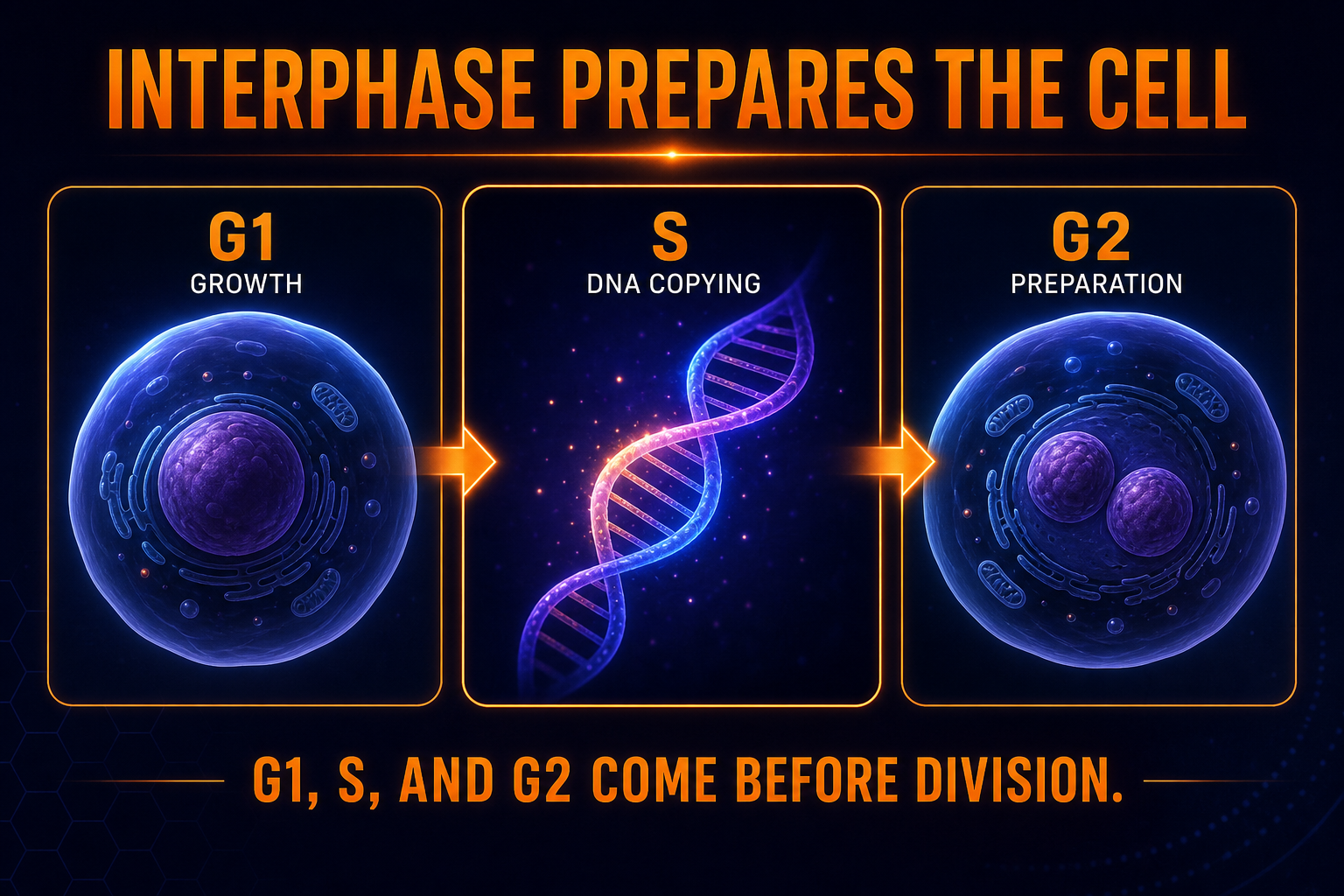
Interphase is not a resting stage. During interphase, the cell grows, copies DNA, and prepares for division. G1, S, and G2 together make up interphase.
In G1, the cell grows and performs normal cellular activities. The cell may also receive signals that influence whether it should continue toward DNA replication. If conditions are not favorable, the cell may pause before entering S phase.
The G1 checkpoint helps control entry into S phase when damage or poor conditions are detected.
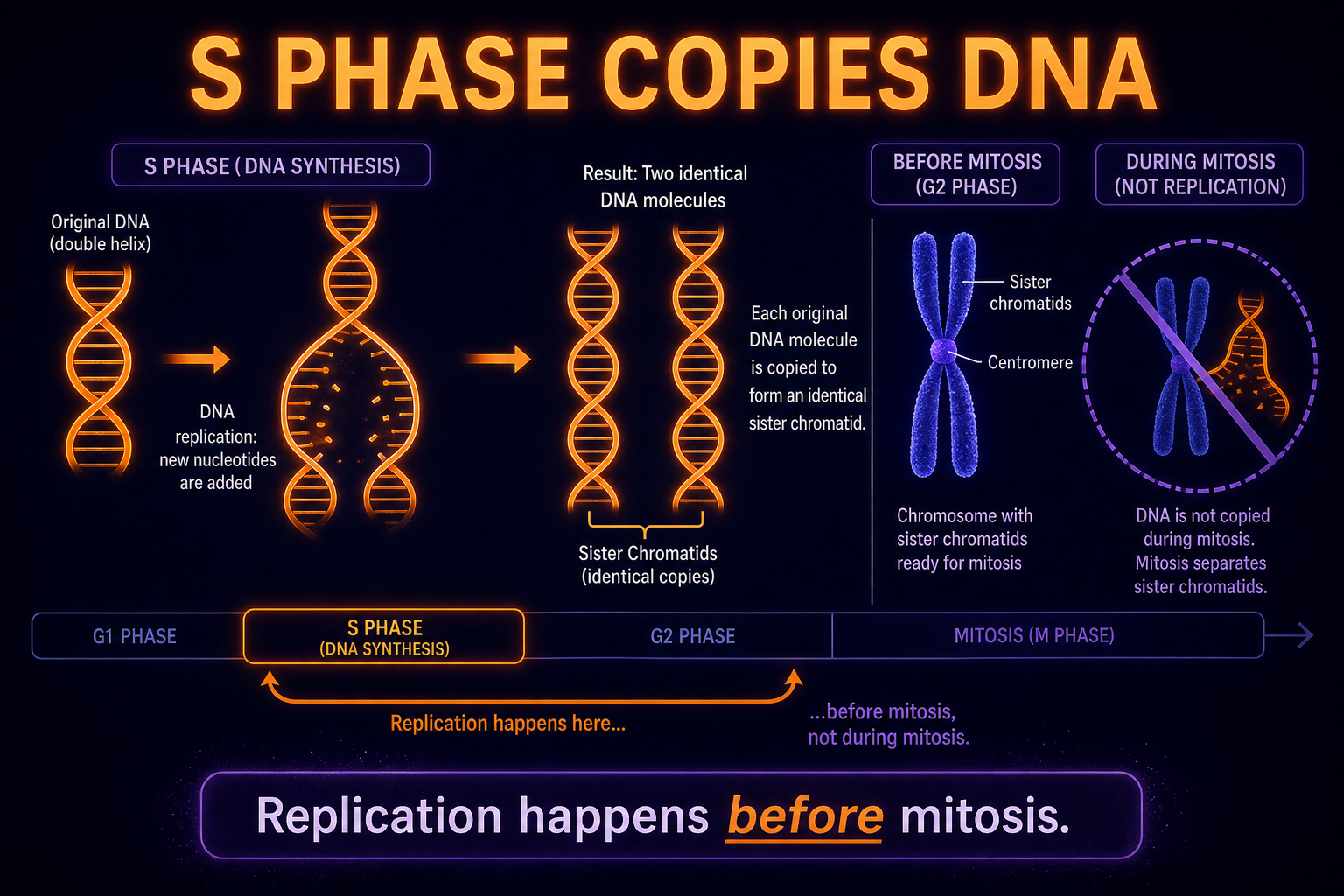
S phase is when DNA is copied. This produces duplicated chromosomes that can later be separated during M phase. A common AP Biology mistake is saying DNA replication happens during mitosis; it happens before mitosis, during S phase.
In G2, the cell prepares for chromosome separation and division. The cell checks whether DNA replication was completed correctly and whether the cell is ready for mitosis. If DNA is damaged or replication is incomplete, progression should pause.
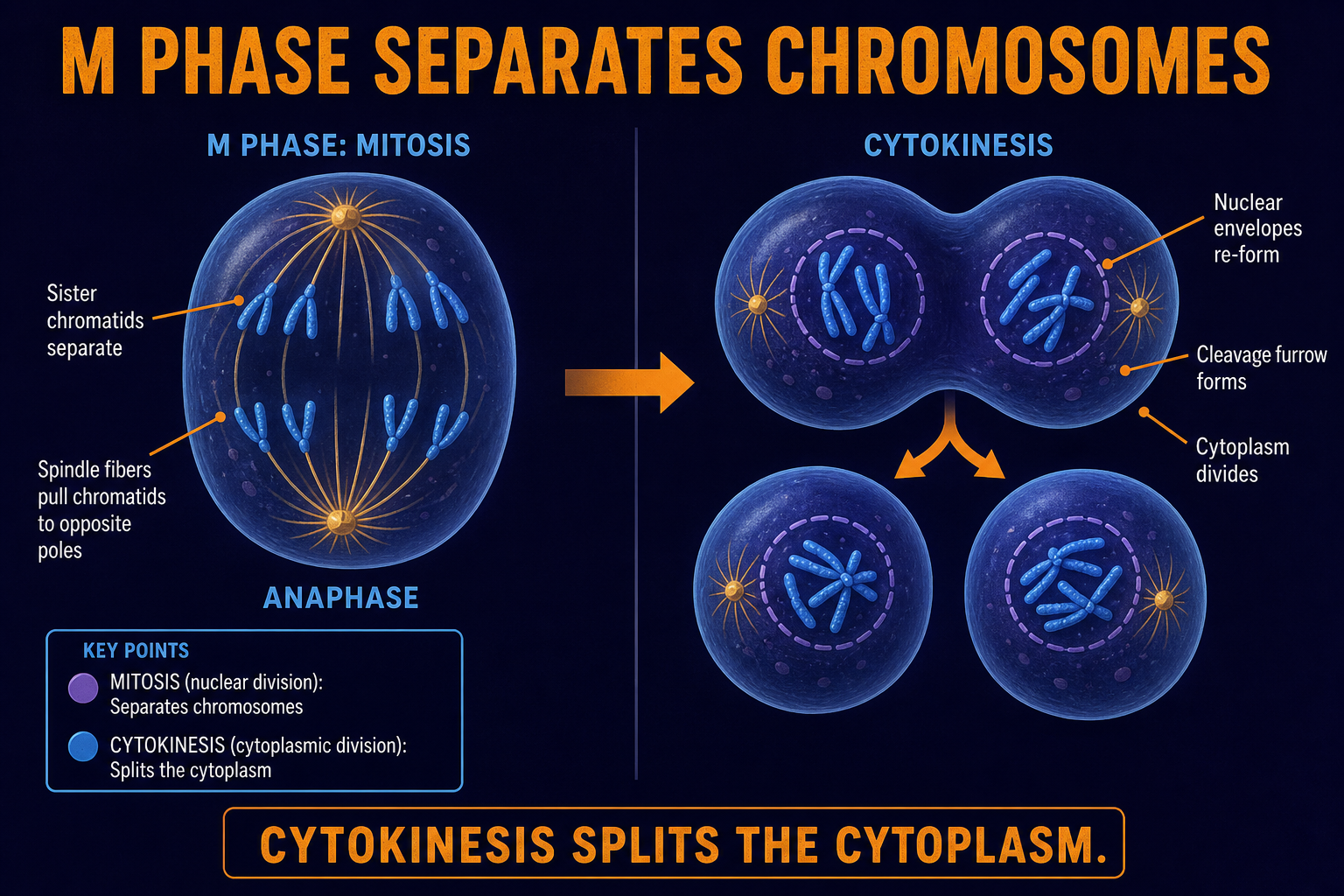
M phase includes mitosis, when duplicated chromosomes are separated into two nuclei. M phase is about nuclear and chromosome division, not DNA replication. AP Biology questions often ask students to connect M phase to chromosome movement and spindle attachment.
Mitosis is the chromosome-separation part of M phase, and the Mitosis in the Cell Cycle guide explains how spindle attachment and checkpoint control affect daughter cells.
Cytokinesis divides the cytoplasm and physically separates the cell into two daughter cells. It usually follows mitosis. If cytokinesis fails, a cell may have divided nuclei but not complete separation into two cells.
Checkpoints help ensure that cells do not move into the next phase when conditions are unsafe. The G1 checkpoint helps control entry into S phase, the G2 checkpoint checks DNA replication and damage before mitosis, and the M checkpoint checks chromosome attachment. These checkpoints connect phase order to cancer prevention.
Study cell cycle checkpoints for stop/go logic and cyclins and CDKs for the proteins that drive phase transitions.
S phase.
G1 phase.
G2 phase.
M phase.
Cytokinesis.
G2 checkpoint may stop progression.
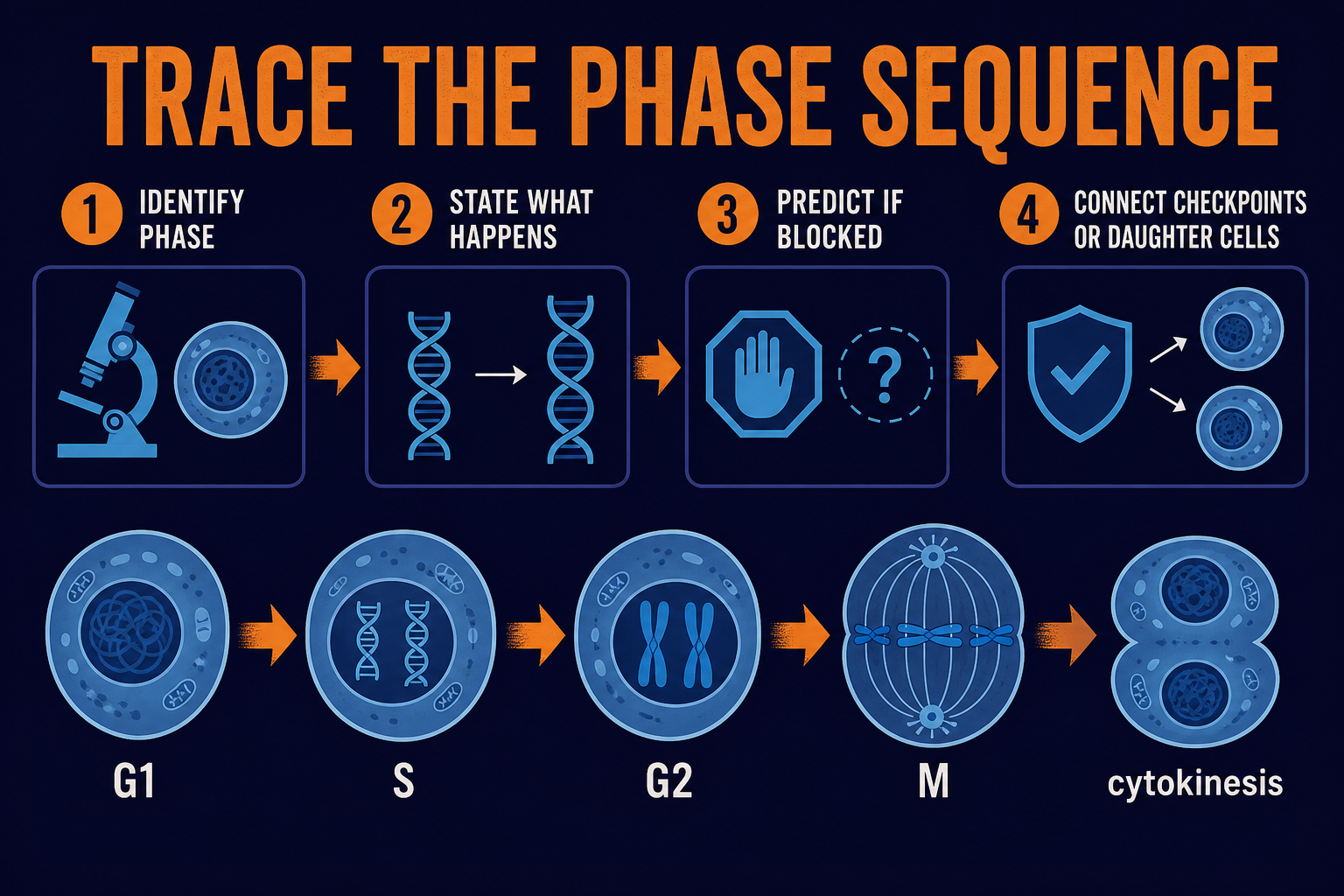
Name G1, S, G2, M phase, or cytokinesis.
Connect growth, DNA copying, preparation, or division.
Show why order matters before mitosis or cytokinesis.
Link to checkpoints or daughter-cell outcomes.
The cell is in ___ phase because ___. Normally, this phase ___. If this step fails, the cell may ___ because ___.
Fix: DNA replication happens in S phase before mitosis.
Fix: M phase separates chromosomes; cytokinesis divides cytoplasm.
Fix: Interphase includes growth, DNA replication, and preparation.
Fix: G2 helps prepare the cell for mitosis and checks replication problems.
Fix: Checkpoints regulate whether the cell can move to the next phase.
Fix: The Cell Cycle page is the broad guide; this page focuses on phase sequence and phase-specific predictions.
Answer all eight questions. Choices shuffle on reload—focus on phase order, not letter memorization.
More drills: Unit 4 practice questions or the Unit 4 FRQ guide.
Open each card, draft your response, then reveal the rubric and sample.
A cell completes G1 and enters S phase. A mutation prevents DNA replication from being completed.
DNA replication normally occurs during S phase. If replication is incomplete, the cell may lack fully duplicated chromosomes needed for mitosis, so separating chromosomes in M phase could produce daughter cells with incorrect DNA content. A functioning G2 checkpoint should detect incomplete or damaged DNA and pause the cycle before the cell enters M phase.
Status: Draft your answer first—then open the rubric or sample.
A cell separates duplicated chromosomes but fails to complete cytokinesis.
Chromosomes are separated during M phase, which includes mitosis. Cytokinesis divides the cytoplasm and separates the cell into two daughter cells after nuclear division. If cytokinesis fails, the cell may contain two nuclei in one cytoplasm, so the organism does not get two fully separate daughter cells.
Status: Draft your answer first—then open the rubric or sample.
The main phases are G1, S, G2, M phase, and cytokinesis. G1, S, and G2 together make up interphase. M phase and cytokinesis complete cell division.
During G1, the cell grows and carries out normal functions. The cell may also receive signals that affect whether it continues toward DNA replication. If conditions are not right, the cell can pause before S phase.
S phase is when DNA replication occurs. The cell copies its DNA so duplicated chromosomes can later be separated. This happens before mitosis, not during mitosis.
During G2, the cell prepares for mitosis. It checks that DNA replication is complete and that the cell is ready for chromosome separation. Problems in G2 can stop progression into M phase.
M phase includes mitosis, when duplicated chromosomes are separated into two nuclei. It is not the phase where DNA is copied. M phase prepares the genetic material for two daughter cells.
Cytokinesis is the division of the cytoplasm. It usually follows mitosis and separates one cell into two daughter cells. If cytokinesis fails, the cell may not fully split.
No. Interphase includes G1, S, and G2, which are active stages of growth, DNA replication, and preparation. Calling interphase inactive is a common AP Biology mistake.
DNA replication happens during S phase. This must happen before chromosomes can be separated during M phase. If replication is incomplete, checkpoints should stop the cell from continuing.
Checkpoints monitor whether the cell is ready to move to the next phase. They can stop progression if DNA is damaged, replication is incomplete, or chromosomes are not attached correctly. This helps prevent unsafe division.
Identify the phase first, then state what normally happens during that phase. Next, explain why that phase matters for later cell-cycle events. Finish by predicting what changes if the phase is blocked or fails.