Kinase inactive
A phosphorylation step may fail.
AP Biology · Unit 4 Learning Journey
Cell signaling pathways explain how a signal becomes a specific cell response. After a receptor detects a signal, pathway proteins, phosphorylation steps, second messengers, and amplification can move the message through the target cell. In AP Biology, the key skill is tracing how one pathway step affects the next.
The previous guide, Reception, Transduction, and Response, introduced the three-part signaling sequence. This page zooms into the pathway itself: how proteins, phosphate groups, second messengers, and amplification move the signal inside the target cell. After this page, study Feedback Mechanisms to see how cells use signaling to stabilize or amplify biological change.

Cell Signaling Pathways
How pathway parts shape cell outcomes.
A cell signaling pathway is a series of molecular steps that relays information from a signal to a cell response. After reception, internal pathway molecules pass the message through the cell using protein activation, phosphorylation, second messengers, or amplification. The pathway matters because changing one step can change the final response.
A pathway connects signal detection to cell action.
The pathway begins when the receptor detects the signal. This can change the receptor's shape or activity and start the internal relay.
Relay proteins pass the message through the cell. AP Biology questions often test what happens when one protein in the chain is missing or inactive.
Phosphorylation adds phosphate groups to proteins. Kinases often use ATP to activate or change pathway proteins.
Second messengers are small molecules that spread and amplify signals inside the cell. Examples include cAMP and calcium ions.
The pathway ends with a response such as enzyme activation, gene expression, secretion, movement, growth, or division.
A signaling pathway works like a cause-and-effect chain. A receptor detects a signal, internal proteins pass the message, and the final cell response changes. AP Biology usually asks students to identify the affected pathway step and predict how the response changes. In a receptor tyrosine kinase pathway, ligand binding causes dimerization and phosphorylation, creating docking sites for relay proteins.
In an ion channel receptor pathway, ligand binding opens or closes a channel, changing ion movement and the cellular response.
In an intracellular receptor pathway, a lipid-soluble ligand enters the cell and the receptor-ligand complex can regulate gene expression.
Cell signaling pathways connect signal detection to response.
If one pathway step changes, every downstream step may also change.
The cAMP signaling pathway is a common example of signal transduction because it connects receptor activation to second messenger production and kinase activity.
The calcium signaling pathway is a common example of signal transduction because Ca2+ movement can activate target proteins and change the cell response.
Connect this logic to ligand-receptor binding at the start of the chain and to reception, transduction, and response when you label each stage on an FRQ.

Cascades pass signals from one protein to the next.
A cascade is a pathway where one molecule activates another molecule, which activates another. This structure lets cells control timing, direction, and strength of the response. Cascades also make pathway diagrams easier to test because AP questions can remove or block one step.
When a question removes Protein B from the middle of a chain, predict what happens to every step after it—not only the final response. That downstream reasoning is the heart of cell signaling cascade questions.

Kinases can switch pathway proteins on or off.
Phosphorylation adds a phosphate group to a protein. In many signaling pathways, kinases use ATP to phosphorylate target proteins, which can change protein shape or activity. Phosphatases can remove phosphate groups and help turn signaling steps off. Many signaling pathways use kinases and phosphatases to control whether relay proteins are phosphorylated or reset.
ATP for phosphorylation connects Unit 4 signaling to cellular energetics in Unit 3. For a focused kinase-relay drill, see the phosphorylation cascade deep dive.
| Term | Role | AP clue |
|---|---|---|
| Kinase | Adds phosphate | Protein activation or ATP use |
| Phosphatase | Removes phosphate | Signal shutoff or reset |
| Phosphorylation | Changes protein activity | Pathway step turns on or off |
| ATP | Supplies phosphate energy | Unit 3 connection |

Second messengers spread signals inside the cell.
Second messengers are small internal molecules that help transmit and amplify a signal. They can move through the cytoplasm more easily than large proteins. AP Biology often uses examples like cAMP or calcium ions to test whether students understand internal signal relay.
Review the dedicated second messengers guide when you need more examples of how reception triggers cytoplasmic spread.
Signal amplification happens when one activated molecule triggers many downstream molecules. This allows a small external signal to produce a large internal response. Amplification is especially important in pathways where one ligand-receptor event activates many enzymes or second messengers.
See signal amplification for more AP-style examples of one receptor event activating many internal targets.
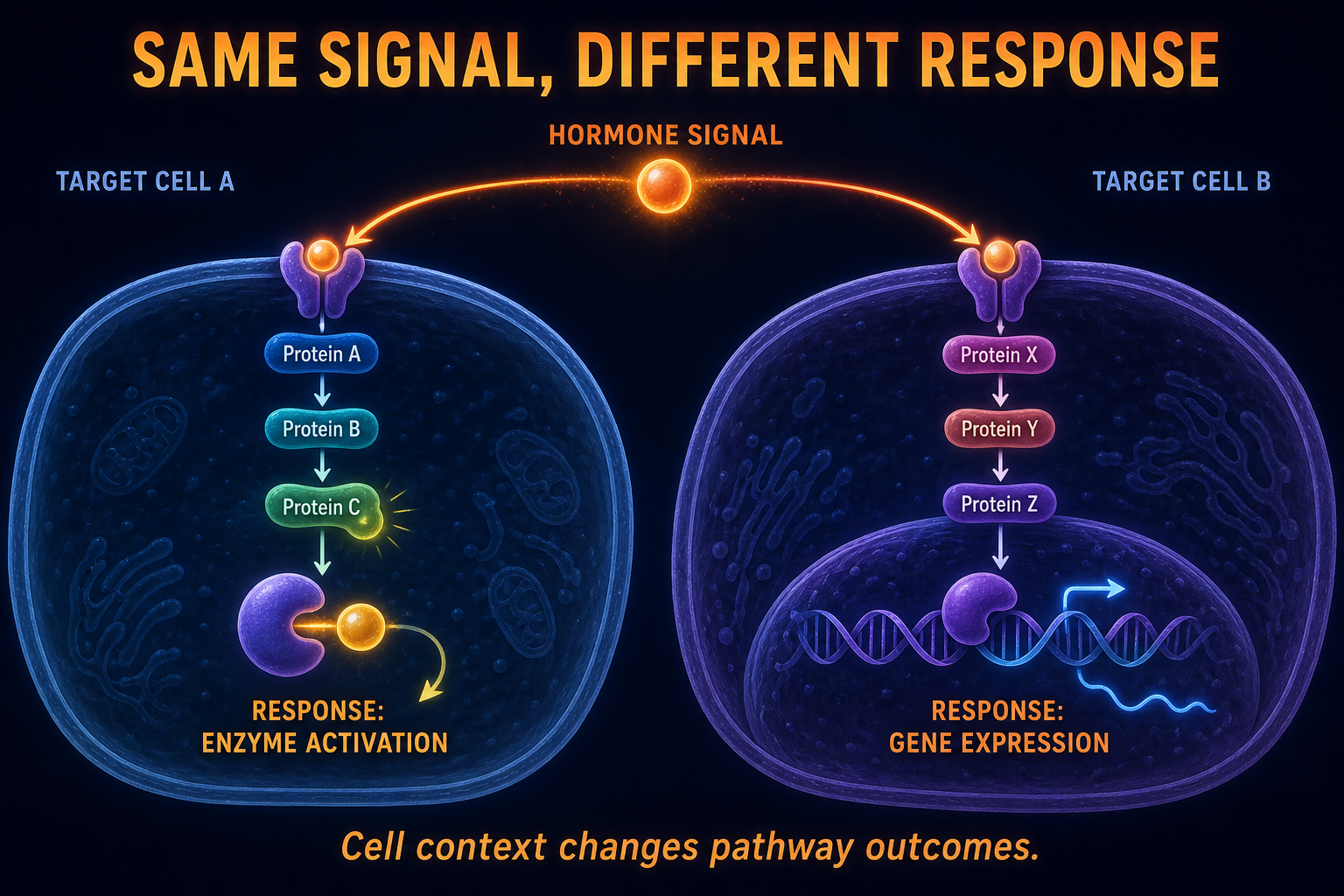
Different cells can use different pathway parts.
The same signal can cause different responses in different cells because cells may have different receptors, relay proteins, transcription factors, enzymes, or target genes. AP Biology often tests this by asking why one cell type responds differently than another. The answer usually depends on pathway components inside the target cell.
When two tissues share a receptor but differ in transcription factors, the pathway may end in different gene-expression outcomes. Link that idea to transcription versus translation when the response changes protein production.
Pathways can fail at the receptor, relay protein, second messenger, phosphorylation step, or final response. If an upstream step fails, downstream steps may not happen. If a late step fails, the pathway may start normally but the final effect may change.
| Failed part | What changes | Likely AP prediction |
|---|---|---|
| Receptor | Signal not detected | Pathway may not start |
| Relay protein | Message stops mid-pathway | Downstream response may fail |
| Kinase | Protein not phosphorylated | Activation may not occur |
| Second messenger | Signal does not spread | Response may be weaker |
| Target gene/enzyme | Final effect blocked | Response changes even if pathway starts |
A phosphorylation step may fail.
The pathway may shut off too quickly.
A second messenger step may be disrupted.
Reception may work, so check transduction.
Downstream pathway steps may not activate.
The cells may have different pathway components.
Name the receptor, kinase, relay protein, second messenger, or target gene.
State its role in transduction or response.
Trace effects on later pathway steps.
State the final outcome with evidence.

If ___ is inactive, then ___ cannot activate normally. This changes ___ downstream, so the final cell response will ___.
The signal starts communication; the pathway relays it inside the cell.
Reception detects the signal; the pathway moves the message inward.
Phosphorylation changes protein activity; amplification multiplies the effect.
A receptor detects the signal, while a second messenger spreads the signal inside the cell.
Fix: Binding starts signaling, but pathway steps can still fail.
Fix: Always predict what happens after the changed step.
Fix: Kinases add phosphates; phosphatases remove them.
Fix: Second messengers act inside the cell after reception.
Fix: Amplification increases internal pathway effect, not ligand size.
Fix: Different cells can respond differently to the same signal.
Revealed: 0 of 4 scenarios
A ligand binds normally, but Protein B is missing.
Answer: Reception works, but the pathway may stop before downstream steps activate.
A kinase cannot use ATP.
Answer: Phosphorylation may fail, so target proteins may not activate normally.
Calcium ions do not increase after receptor activation.
Answer: A second messenger step may be disrupted.
Two cell types receive the same hormone but respond differently.
Answer: They may have different receptors, relay proteins, transcription factors, or target genes.
Answer all eight questions. Choices shuffle on reload—focus on mechanism, not letter memorization.
More drills: Unit 4 practice questions, practice by topic, or daily AP Biology practice.
Open each card, draft your response, then reveal the rubric and sample. For more free-response practice, open the Unit 4 FRQ guide. Connect pathway logic to feedback mechanisms when loops regulate the response.
A receptor binds its ligand normally, but a kinase in the signaling pathway is inactive.
Reception still works because the ligand binds normally, so transduction is most directly affected. The inactive kinase cannot phosphorylate its target protein, so relay proteins downstream may not activate. Without those activated steps, the final cell response may be weakened, absent, or changed depending on which kinase failed.
Status: Draft your answer first—then open the rubric or sample.
Two cell types have the same receptor for a hormone, but they produce different responses.
The same hormone can cause different responses because the two cell types may have different relay proteins, transcription factors, enzymes, or target genes even when they share the same receptor. One cell type might activate a pathway that changes enzyme activity, while the other activates genes for a different protein set. Data showing different mRNA or protein levels after the same hormone treatment would support different internal pathway outcomes.
Status: Draft your answer first—then open the rubric or sample.
A cell signaling pathway is a series of molecular steps that connects signal detection to a cell response. After a receptor is activated, internal molecules pass the message through the target cell. AP Biology often tests whether you can predict how changing one pathway step affects later steps.
The signal is the message that starts communication, such as a hormone or growth factor. The pathway is the internal chain of events that carries that message after reception. A signal can be present, but the response may still fail if the pathway is disrupted.
A signaling cascade is a pathway where one molecule activates another molecule in sequence. Cascades help cells control timing and direction of a response. They also make it easier for one blocked step to affect many downstream events.
Phosphorylation adds a phosphate group to a protein, often changing its shape or activity. Kinases usually perform this step, and phosphatases can reverse it. On AP Biology questions, phosphorylation often explains how one pathway protein activates the next.
Second messengers are small molecules that help relay a signal inside the cell. They can spread quickly through the cytoplasm and often amplify the signal. Common AP Biology examples include cAMP and calcium ions.
Signal amplification occurs when one signaling event activates many internal molecules. This allows a small amount of signal to create a larger response inside the cell. It does not mean the ligand gets bigger; it means the pathway effect multiplies.
Different cells may have different receptors, relay proteins, enzymes, transcription factors, or target genes. Because of those internal differences, the same external signal can lead to different outcomes. AP Biology often tests this idea with two cell types exposed to the same hormone.
If a kinase is inactive, it may fail to phosphorylate its target protein. That can stop or weaken downstream pathway steps. The final response may be reduced, absent, or changed depending on where the kinase acts.
Some signaling pathways end by activating transcription factors or other molecules that affect genes. That can change which proteins the cell makes. This is how a signal outside the cell can eventually alter gene expression inside the nucleus.
Start by identifying the pathway part that changed, such as a receptor, kinase, second messenger, or target gene. Then explain what that part normally does and predict what happens downstream. Finish by connecting the pathway change to the final cell response.