RoadmapOrigins
Know: Domestication creates surplus and sedentary settlement; hearths show where plants and animals were first controlled.
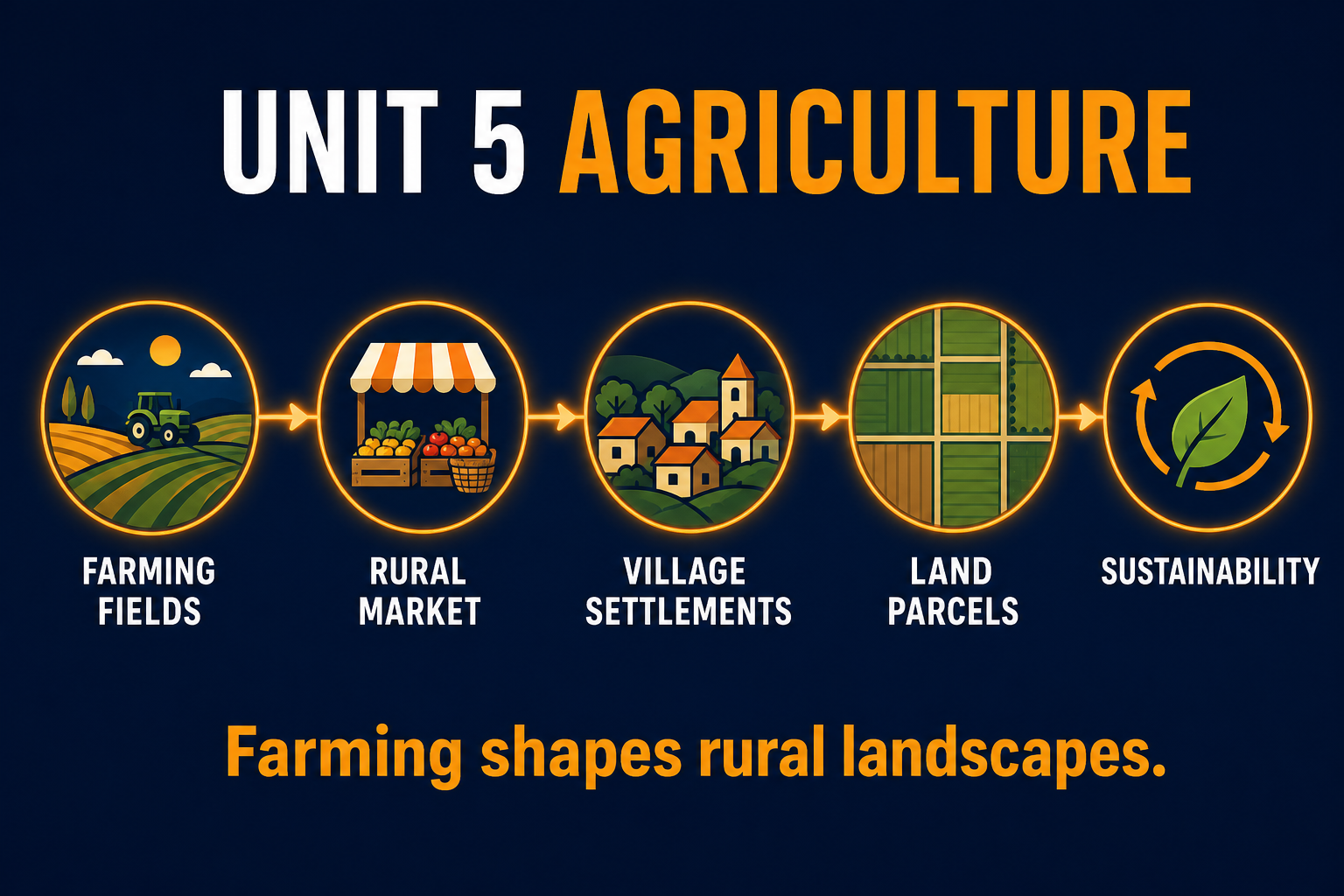
AP usually tests: Matching crops/animals to hearths; explaining independent invention vs. diffusion.AP Human Geography Unit 5 explains how agriculture and rural landscapes take shape: domestication and diffusion, rural settlement and parcel systems, spatial models like Von Thünen, major farming regions, modern food systems, and environmental outcomes.
Updated May 10, 2026 • Reviewed by APScore5 Editorial Team
Students often treat Unit 5 like a vocabulary list. On the exam, most misses come from mixing categories: hearth vs. diffusion, First vs. Second Agricultural Revolution vs. Green Revolution, settlement pattern vs. survey system, or memorizing rings without bid-rent reasoning.
AP Human Geography rewards why agriculture appears in certain places: transportation cost and perishability near cities, colonial land tenure shaping plantations, seasonal labor tied to migration and demographic change, cultural preferences from food culture and diffusion, and policies or conflicts over land from political control. If you train yourself to name the mechanism—not just the term—you will feel the unit “click.”
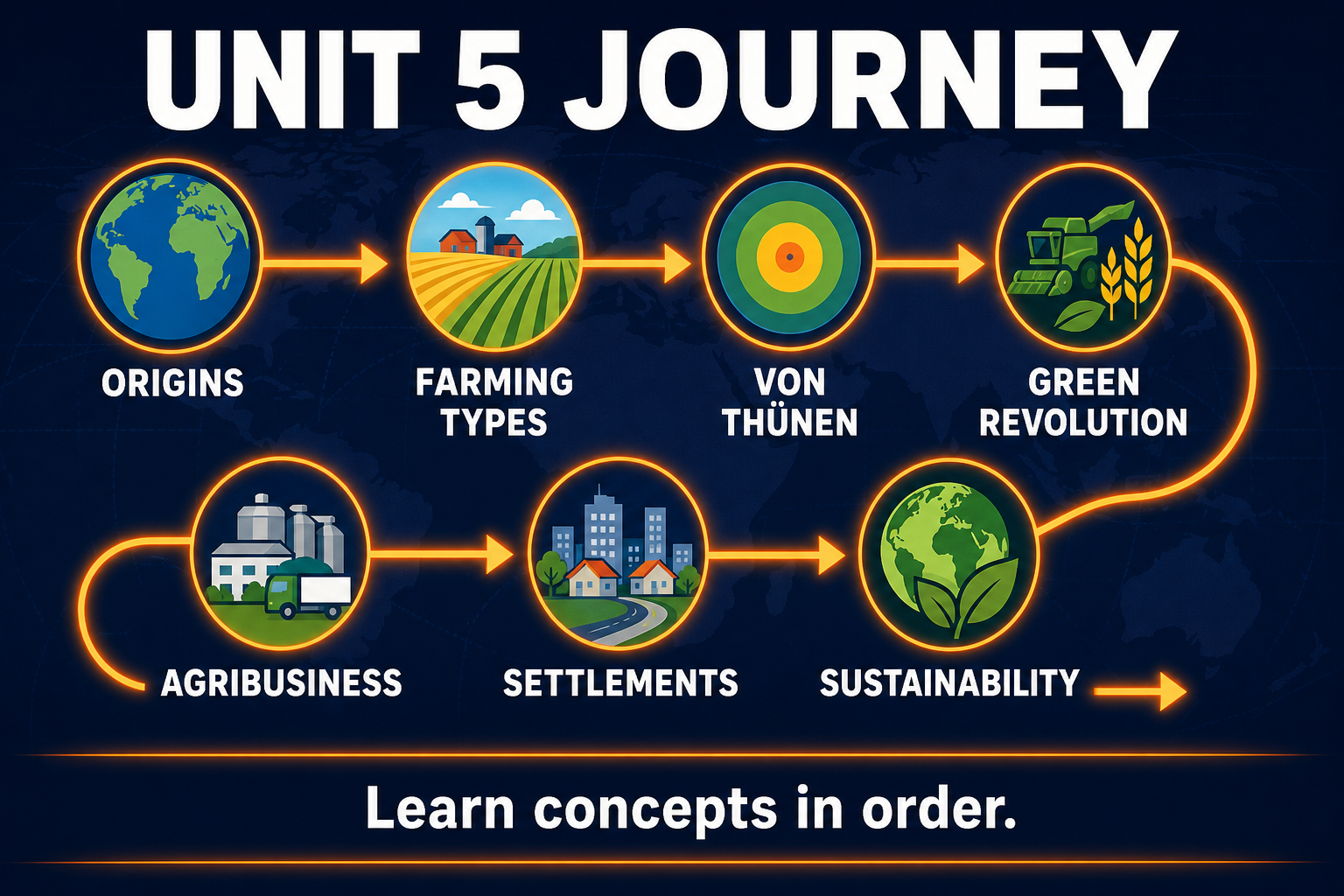
A single narrative flow you can redraw on scratch paper before an FRQ.

Know: Domestication creates surplus and sedentary settlement; hearths show where plants and animals were first controlled.
AP usually tests: Matching crops/animals to hearths; explaining independent invention vs. diffusion.Know: Ideas, seeds, and breeds move via migration, trade, and empire—fast after contact.
AP usually tests: Columbian Exchange pathways; cultural/ecological effects, not just lists.Know: Clustered, linear, and dispersed layouts reflect terrain, defense, and farm technology.
AP usually tests: Map interpretation; linking layout to environment or history.Know: Von Thünen explains rent vs. distance with perishability and transport cost.
AP usually tests: Which use sits closest to market and why; modern factors that bend rings.Know: Each region bundles climate, labor intensity, and market orientation.
AP usually tests: Identify region from description; explain labor or climate fit.Know: Commodity chains, agribusiness, and global trade connect farms to consumers.
AP usually tests: Scale, integration, and uneven benefits—ties to Unit 7 development.Know: Irrigation, chemicals, and expansion drive soil, water, and climate pressures.
AP usually tests: Match problem to process (salinization vs. erosion); cite place-based examples.Humans selectively breeding plants and herding animals so species meet human needs; enables surplus food and permanent settlement.
Crop hearths spotlight plant origins (wheat, rice, maize); animal hearths spotlight livestock origins (sheep, cattle, llamas). AP stimuli often isolate one.
Land goes to whoever can pay the most net profit at a location—often highest near the central market for perishable or intensive uses.
Availability, access, utilization, and stability over time—national production alone does not guarantee security.
These cards stay on this page—no dead-end URLs.
Use the first ten items as a fast weakness map before diving into the Von Thünen module.
Agriculture arose independently where environments allowed experimentation; ideas and genetic material then moved along migration and trade routes.
After 1492, Atlantic circuits rewrote diets, disease burdens, and labor systems—compare with our standalone Columbian Exchange guide.
Transport cost and spoilage still anchor MCQs even when highways and cold chains bend real landscapes.
Domestication, industrial-era intensification, and HYV packages each shifted labor, land, and inputs differently.
Large firms coordinate inputs, processing, and retail—preview full commodity-chain vocabulary in Unit 7.
Food insecurity persists where poverty, prices, or conflict block distribution—even when national calories look sufficient.
Domestication means selective breeding of plants and managed herds of animals until species depend on human care. It produced storable surplus, supported denser populations introduced in Unit 2, and encouraged permanent settlements reflected in cultural landscapes.
Crop hearths spotlight where staple plants were first controlled; animal hearths do the same for livestock. Questions often isolate one category—read stimuli carefully.
Multiple independent hearths existed because post-Pleistocene climates varied and different communities experimented with local floras and faunas—diffusion later blended packages through trade, migration, and especially Atlantic exchange shaped by colonial expansion and land control.
Fertile Crescent: wheat, barley; sheep and goats.
Southeast Asia: rice and root crops.
Mesoamerica: maize, beans, squash (“three sisters”).
Central Andes: potatoes, quinoa; llamas and alpacas.
Sub-Saharan Africa: sorghum, millet, yams among diverse centers.
High-yield Keep eras separated—dates blur quickly under pressure.

| Revolution | Main change | Where / when (associate loosely) | AP-style prompt fragment | Common mistake |
|---|---|---|---|---|
| First Agricultural Revolution | Plant + animal domestication; villages; surplus enabling specialization. | Multiple hearths from roughly 10,000 BCE onward. | “Explain how domestication shifted settlement.” | Calling every early farm boost “Green Revolution.” |
| Second Agricultural Revolution | Higher productivity via crop rotation, enclosure, draft animals, early mechanization, improved transport to cities. | Often tied to northwest European farming change and rising urban demand. | “Why could fewer farmers feed industrial workers?” | Mixing this era with mid-1900s HYV packages. |
| Green Revolution | High-yield varieties + irrigation + synthetic fertilizer + pesticides → sharp yield gains. | Cold War-era spread across parts of Latin America and Asia (timing varies by country). | “Evaluate productivity gains vs. environmental or equity outcomes.” | Saying it was purely beneficial—AP expects tradeoffs. |
Student insight: AP readers reward nuanced Green Revolution answers: more calories per hectare alongside groundwater stress, chemical runoff, input debt, and uneven adoption between wealthier and poorer farmers.
Settlement pattern describes where homes and farmsteads sit relative to each other; survey system describes how property lines are drawn legally on cadastral maps. Confusing the two costs easy points.
Looks like: tight villages surrounded by fields.
Often seen: irrigation communities, shared defense, some plantation housing.
Why: mutual labor, water management, or historic cores.
Looks like: isolated homesteads across countryside.
Often seen: large mechanized farms, ranchlands.
Why: maximize field access; reflects enclosure-style consolidation.
Looks like: buildings strung along a road or waterway.
Often seen: steep valleys, levees, transportation corridors.
Why: follows usable land strips.
Looks like: irregular polygons following landmarks.
Where: eastern U.S., historic colonies.
Why: rapid colonial surveying along rivers and ridges.
Looks like: rectangular grids on maps.
Where: much U.S. Midwest / Great Plains after federal surveys.
Why: standardized parcels for sale and rail-era farming.
Looks like: narrow strips perpendicular to a river or road.
Where: French colonial heritage areas (e.g., Louisiana ribbon farms).
Why: each household touches water access along the frontage.

Model questionJohann Heinrich von Thünen’s isolated-state model places a single central market on uniform farmland with uniform transport costs to the edge. Farmers bid for land until rent equals profit; activities willing to pay most locate closest.
Bid-rent in plain language: Every land use competes for sites. Uses with higher transport costs per mile or faster spoilage need to minimize distance, so they outbid others near the city. Extensive ranching tolerates cheap peripheral land because animals walk to weight and meat ships less frequently than daily milk runs.
Modern bends: refrigeration, interstate trucking, container shipping, subsidies favoring certain crops, multiple urban markets, soil quality breaks, and global soy or palm circuits—the pure bull’s-eye rarely appears—but bid-rent logic remains how AP scores reasoning.
Skim vertically before MCQ blocks—focus on climate + labor + market link.
| Region / system | One-sentence definition | Typical setting | AP clue |
|---|---|---|---|
| Shifting cultivation | Rotate plots as soils fatigue; long fallow cycles. | Humid low-latitude frontiers. | Looks for forest-fallow timing, not permanent terraces. |
| Pastoral nomadism | Herders move animals seasonally for pasture. | Arid/semi-arid margins. | High mobility; conflict over corridors appears in stimuli. |
| Plantation agriculture | Large estate focused on export specialty crop. | Often tropical coastal/lowlands. | Tie to colonial land tenure + wage labor. |
| Mixed crop & livestock | Farms integrate crops + animals for fertilizer & feed rotation. | Eastern U.S., Western Europe variants. | Moderate density; diversified income streams. |
| Dairy farming | Milk-oriented production near urban arc. | Temperate areas with city access. | Von Thünen zone language. |
| Grain farming | Extensive cereal fields, mechanized harvest. | Prairie belts (steppe climates). | Economies of scale; global commodity ties. |
| Mediterranean agriculture | Winter rain / summer dry specialties—fruit, vines, olives. | Mediterranean climate shores. | Luxury horticulture + ranching mix. |
| Commercial gardening / truck farming | Fruits & veg for nearby metros (“truck” = haul). | Peri-urban belts. | High inputs + rapid logistics. |
| Intensive subsistence wet rice | Small plots, heavy labor, multiple crops/year. | Monsoon river basins. | Yield per hectare high; income per worker modest. |
| Extensive commercial agriculture | Large land area per unit output; lower labor intensity. | Prairie ranching, some wheat belts. | Land inexpensive compared with labor. |
Modern prompts stitch agriculture to labor migration, infrastructure, and markets—threads that continue into Unit 6 cities (peri-urban land competition) and especially Unit 7 industrial and economic development (commodity chains and agribusiness). Hold these definitions together:
Food security means people can obtain safe, nutritious food throughout the year. Break it into four pillars:

Examples AP loves: Food deserts (affordable nutritious retail scarce); famine when entitlement collapses; price spikes after fuel shocks; conflict blocking corridors; climate stress lowering reliability even when calories exist nationally.
Trade policy, subsidies, and corporate concentration influence what reaches shelves. When prompts embed maps of ports or highways, connect infrastructure investment to access inequalities introduced earlier—then jump to environmental outcomes below.
Open each card to pair cause → outcome → clue.
Cause: clearing for pasture, soy, palm, or shifting cultivation edges.
Result: habitat loss, runoff spikes, carbon release.
AP clue: Link land tenure + export demand.
Cause: bare fields, steep slopes, drought-fallowed ground.
Result: sedimentation, lost topsoil, downstream damage.
AP clue: Tie to tillage practice or storm timing.
Cause: prolonged drought + overgrazing/arable pressure.
Result: productive land degrades toward desert-like conditions.
AP clue: Sahel narratives vs. salinization—don’t conflate.
Cause: irrigation in dry climates without drainage.
Result: salt crusts, yield collapse.
AP clue: Arid irrigation districts; relate to Green Revolution water demand.
Cause: deep groundwater pumping for thirsty HYV crops.
Result: falling water tables, land subsidence, dry wells.
AP clue: Ogallala-style stressed basins.
Cause: nitrogen/phosphorus surplus leaving fields.
Result: algal blooms, hypoxic “dead zones.”
AP clue: Downstream water body on map.
Cause: repeated chemical applications.
Result: pests rebound; farmers escalate sprays or swap chemistry.
AP clue: monoculture context.
Cause: habitat clearing + simplified rotations.
Result: fewer pollinators, genetic uniformity risk.
AP clue: Compare seed diversity before/after hybrid adoption.
Cause: enteric fermentation in large herds.
Result: greenhouse contributions from commercial ranching/dairy.
AP clue: Connect diet change + export beef demand.
Cause: large dams, canals, river diversion.
Result: disrupted deltas, fisheries loss, geopolitical tension.
AP clue: Map of downstream shrinkage.
Read like a conversation, not another checklist.
Students often think: “Green Revolution helped every farmer.”
AP wants you to realize: Yield gains cluster where irrigation + credit existed; others fell behind or went into input debt.
Students often think: “Von Thünen is outdated.”
AP wants you to realize: Rings distort in reality, but bid-rent reasoning still explains peri-urban horticulture vs. extensive ranchland.
Students often think: “Food desert means zero food.”
AP wants you to realize: It signals limited access to affordable nutritious food—often dollar-store calories instead.
Students often think: “Subsistence = primitive.”
AP wants you to realize: Intensive wet-rice systems can be sophisticated, labor-heavy, and low cash income simultaneously.
Students often think: “Commercial farms are automatically greener.”
AP wants you to realize: High output can pair with monocropping, chemical reliance, and water stress—name tradeoffs.
Students often think: “Settlement pattern = survey system.”
AP wants you to realize: Pattern = village layout; survey = property grid rules.
Students often think: “Organic = zero impact.”
AP wants you to realize: Different input mix—still land and labor footprints.
Each card back uses two sentences so you remember both definition and how AP asks it.
Fifty MCQs with rotated answer letters and explanations that tell you why, not just what.
FRQ skillStructure answers as Claim → Evidence → Geographic reasoning. Avoid lab-report tone; name processes and places.
Prompt: A metro spreads into peri-urban farmland. Dairy relocates outward while specialty vegetables stay close.
Prompt: A government subsidizes HYV seed, fertilizer, and irrigation expansion.
Prompt: National calorie balances look fine, yet low-income neighborhoods report hunger.
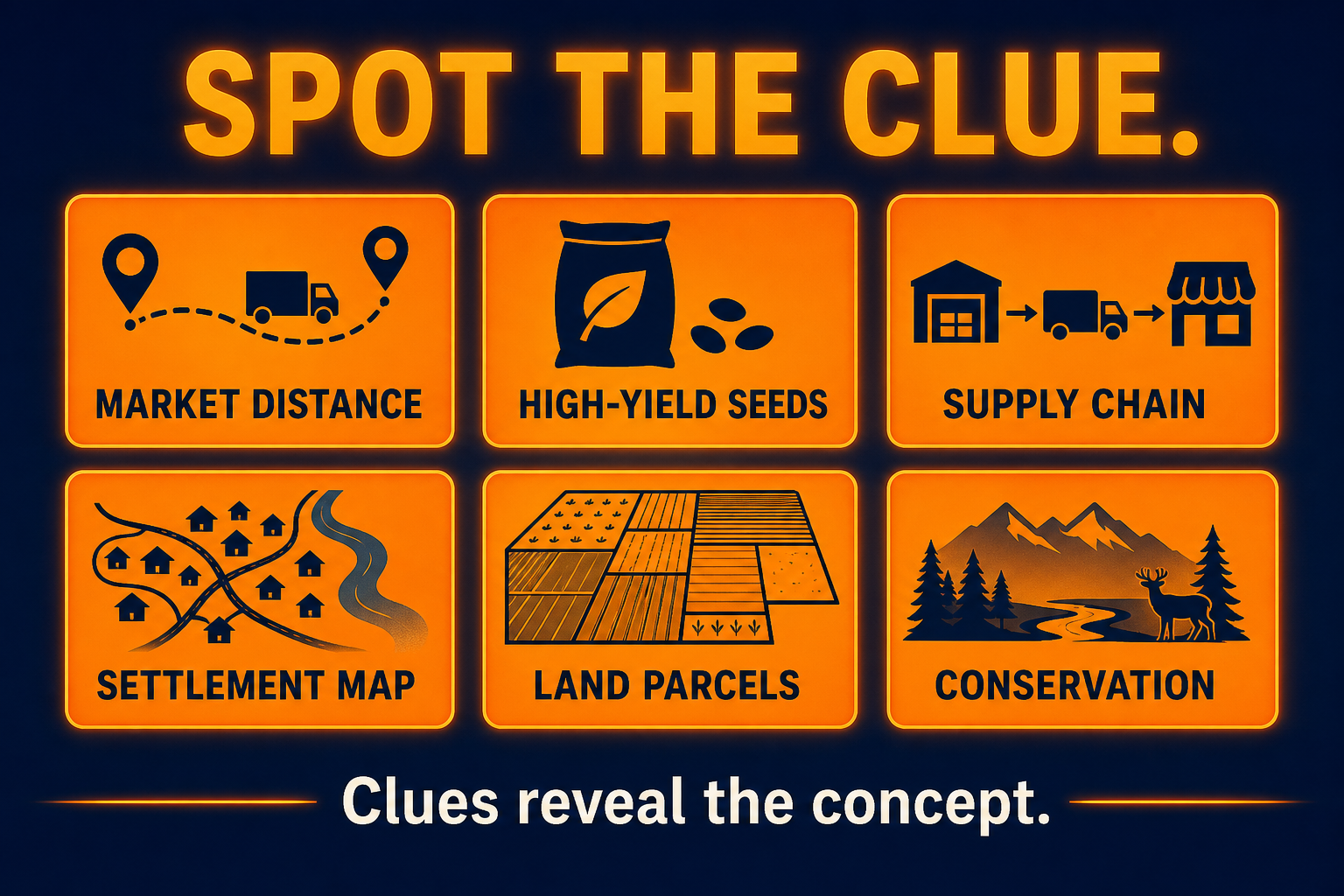
Look for: color patches switching from horticulture to ranch.
Concept hook: Von Thünen sectors vs. physical breaks.
Look for: nucleated dots vs. scattered homesteads.
Concept hook: clustered vs. dispersed patterns.
Look for: rainfall seasonality vs. crop choice.
Concept hook: Mediterranean vs. moist subtropical farming.
Look for: arrows from port → interior processing.
Concept hook: commodity chains & economies of scale.
Look for: transit voids, SNAP-qualified stores sparse.
Concept hook: food desert / access pillar.
Look for: canals upstream, shrinking water body downstream.
Concept hook: salinization + water conflict.
Run 30 random flashcards, re-read the three revolutions table, then knock out questions 1–10 slowly.
Reread the Von Thünen module, rehearse the dairy vs. ranch narrative aloud, then drill MCQs tagged easy/medium until explanations feel automatic.
Pick one scenario, write three sentences only, compare to the strong pattern, revise with one extra place-based detail.
It explores how agriculture reshapes rural space: domestication and diffusion, settlement and survey systems, Von Thünen land rent, farming regions, global food systems, and environmental outcomes.
A bid-rent model where perishable, transport-sensitive activities outbid others for land near a central market; extensive ranching locates farther out where acreage is cheaper.
A mid-1900s yield surge built on high-yield seeds, irrigation, fertilizer, and pesticides—major calorie gains with uneven economic and environmental side effects.
They describe spatial layouts—clustered villages, dispersed homesteads, or linear strings—reflecting terrain, technology, and historical land division.
Subsistence prioritizes household consumption; commercial farming sells most output. Either can be labor-intensive; market orientation differs.
Beyond low production—poverty, conflict, price shocks, poor infrastructure, or disasters can block access, stability, or safe utilization.
Chain concepts (hearth → diffusion → landscape), rehearse Von Thünen reasoning aloud, rotate flashcards + MCQs, and practice short FRQ paragraphs with real mechanisms.
Create a free account to track streaks, revisit missed MCQs, and pair this unit with full practice tests when you are ready for mixed review.
Unit 1: Thinking Geographically · Unit 2: Population & Migration · Unit 3: Cultural Patterns · Unit 4: Political Patterns
Unit 5: Agriculture (you are here)
It can feel dense because several topics sound similar—models, revolutions, and settlement vocabulary overlap. Students improve fastest when they practice explaining why patterns appear on the landscape instead of only naming terms.
Expect Von Thünen-style reasoning about distance, perishability, and bid-rent. Green Revolution tradeoffs and rural settlement versus survey systems also appear frequently.
Yes. AP Human Geography often pairs hearths with crops or animals and expects you to connect climates and labor systems to agricultural regions.
Higher agricultural productivity, enclosure, and rural labor release helped feed industrial labor forces and shaped commodity chains that Unit 7 explores in economic geography.
Mixing settlement layout with legal survey systems, or assuming higher yields always mean sustainability without naming environmental or equity tradeoffs.
Modern transport and trade bend real-world rings, but AP still rewards bid-rent logic—who can pay highest rent near the market when goods are perishable or costly to move.
No. Classic AP answers acknowledge yield gains alongside irrigation stress, chemical runoff, debt loads for inputs, and uneven benefits across farmers.
Write Claim, Evidence, Geographic reasoning paragraphs that tie map clues to processes—distance from markets, diffusion routes, labor migration, or policy—and revise using the exemplars on this page.
Other platforms host flashcard-style sets. This page keeps 60 flashcards with explanations, 50 MCQs with reasoning, and FRQ-style prompts together for one study flow.
Real AP exam questions stay secure. Use the 50 practice MCQs here with explanations as a legal prep equivalent.
Mix spatial skills from Unit 1, population and migration from Unit 2, cultural geography from Unit 3, political patterns from Unit 4, and agriculture from Unit 5 in short daily sessions with cumulative review.
Urban land use picks up where peri-urban agriculture leaves off—distance decay, zoning, and bid-rent show up again in new forms.