Enzyme activity changes
Pathways may activate or inhibit key enzymes quickly.
AP Biology · Unit 4 Learning Journey
Reception, transduction, and response are the three steps that turn a signal into a cell action. Reception detects the signal, transduction relays the message inside the cell, and response changes what the cell does. In AP Biology, the key skill is explaining how one step causes the next.
The previous guide, Ligands and Receptors, explained how a signal matches a receptor. This page shows what happens after that match: the signal is received, relayed inside the target cell, and converted into a response. After this page, study Cell Signaling Pathways to see how different pathway parts create specific cell outcomes.

Reception, Transduction, Response
Detect, relay, and change cell activity.
Reception is when a target cell detects a signal using a receptor. Transduction is the relay of that signal inside the cell through pathway molecules. Response is the final change in cell activity, such as altered enzyme activity, gene expression, secretion, movement, or division.
Reception detects. Transduction relays. Response changes the cell.
Reception begins when a signaling molecule binds to a receptor or when a receptor detects a signal. This step determines whether the target cell can even start the pathway.
Transduction moves the message through the cell. It often uses protein shape changes, phosphorylation, second messengers, or relay proteins.
Response is the cell's final action. A response may change enzyme activity, gene expression, secretion, movement, cell growth, or division.
Some pathways amplify a signal, meaning one signal can trigger many internal molecules. This is why a small signal can produce a large cell response.
If reception, transduction, or response fails, the final outcome may change. AP questions often ask which step broke and what happens next.
Reception is the first stage of cell signaling. It depends on a target cell having a receptor that can detect the signal. If the receptor is missing, blocked, or changed, the pathway may never begin. A receptor tyrosine kinase is a strong example of reception leading to transduction because ligand binding causes dimerization and phosphorylation on the cytoplasmic side.
An ion channel receptor shows reception leading directly to transduction because ligand binding changes channel shape and ion flow.
Intracellular receptors are a special case because reception can occur inside the cell after a lipid-soluble ligand crosses the membrane.
On AP Biology exams, reception transduction response questions often start after ligand binding. Connect reception to ligands and receptors when you explain why only some cells respond, and review proteins when receptors or pathway proteins change shape.

Reception fails if the signal cannot bind or the receptor cannot detect it.
Transduction is the internal relay step. After reception, the signal is passed through molecules inside the cell. This may involve phosphorylation, protein activation, second messengers, or a chain of pathway proteins.
Energy for phosphorylation connects signaling to cellular energetics in Unit 3. Deep dives on second messengers and phosphorylation cascades show how one receptor event can amplify inside the cell.

| Transduction feature | What it means | AP clue |
|---|---|---|
| Relay proteins | Pass the signal forward | One protein activates another |
| Phosphorylation | Adds phosphate groups | Kinase or ATP may appear |
| Second messengers | Small internal signaling molecules | cAMP or calcium may appear |
| Amplification | Signal gets larger | One event triggers many molecules |
Response is the final result of signaling. The response might happen quickly, such as changing enzyme activity, or more slowly, such as changing gene expression. AP Biology often asks students to predict the response when a signaling step is changed.
Gene-expression responses link to transcription versus translation in Unit 6. Division responses connect to the cell cycle when growth signals push a cell toward mitosis.
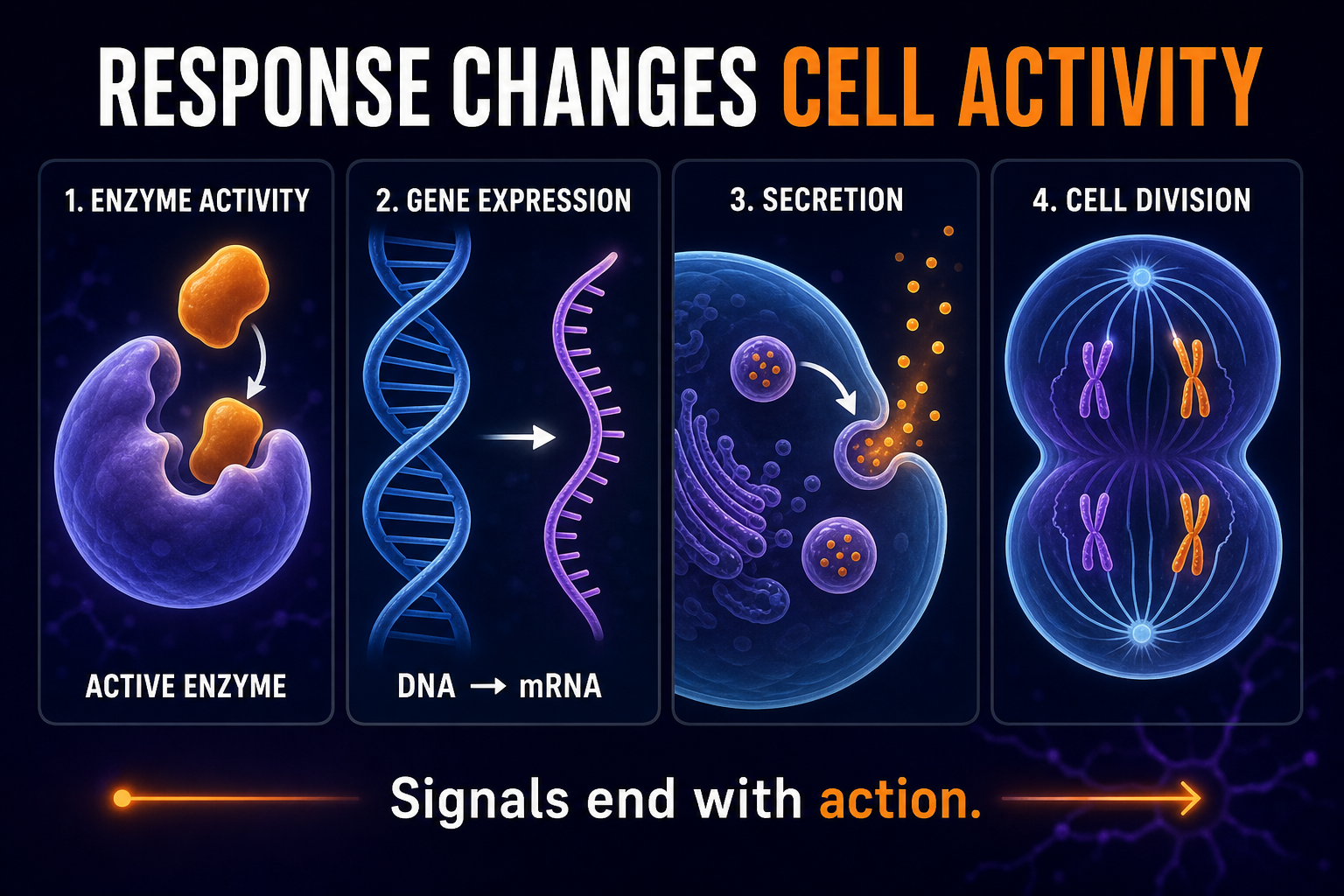
Pathways may activate or inhibit key enzymes quickly.
Transcription factors can turn target genes on or off.
Cells may export hormones, neurotransmitters, or digestive enzymes.
Membrane potential or calcium levels can shift fast.
Signaling can promote or limit growth before division.
Growth signals can push cells toward the cell cycle.
| Step | Main job | Where it happens | AP clue |
|---|---|---|---|
| Reception | Detect signal | Receptor surface or inside cell | Ligand binds receptor |
| Transduction | Relay signal | Inside target cell | Kinase, second messenger, cascade |
| Response | Change activity | Cytoplasm, membrane, or nucleus | Enzyme, gene, secretion, division |
When you review cell signaling steps, label each arrow in a diagram as reception, transduction, or response before you predict outcomes. That habit keeps signal transduction pathway reasoning organized on both MCQs and FRQs.

AP Biology often tests pathways by changing one part of the system. If reception fails, the cell may not detect the signal. If transduction fails, the signal may bind but not move through the pathway. If response fails, the cell may receive and relay the signal but still fail to complete the final action.
| Failed step | What goes wrong | Predicted result |
|---|---|---|
| Reception | Signal is not detected | Pathway may not start |
| Transduction | Internal relay breaks | Signal binds but response may not happen |
| Response | Final action is blocked | Pathway works but effect changes |
| Amplification | Signal is not multiplied | Response may be weaker |
Exam prompts rarely name all three stages at once. Instead, they describe a change—blocked receptor, inactive kinase, missing second messenger, or altered gene expression—and expect you to map that clue to the right stage before you predict the final cell communication pathway outcome.
Reception fails.
Reception likely works.
Transduction may fail.
Internal relay may be disrupted.
A response occurred.
The response may involve cell-cycle regulation.
Name reception, transduction, or response.
State the job of the stage in a working pathway.
Connect the break to downstream effects.
Predict enzyme, gene, secretion, or division outcomes.

If ___ is disrupted, then ___ cannot occur normally. This affects ___ because ___. As a result, the cell response will ___.
Reception detects the signal; transduction relays it inside the cell.
Transduction is the pathway; response is the final cell action.
Binding starts signaling but does not automatically guarantee the response.
Amplification means the internal pathway multiplies the signal effect.
Fix: Always explain how the signal moves from receptor to response.
Fix: Binding is reception; response happens later.
Fix: Identify the failed step before predicting the outcome.
Fix: Some responses change enzymes, ion channels, or secretion.
Fix: One signal can produce a large response through relay pathways.
Fix: A blocked receptor may prevent the pathway from starting.
Revealed: 0 of 4 scenarios
A ligand cannot bind to its receptor.
Answer: Reception fails, so the signaling pathway may not start.
A ligand binds, but a kinase in the pathway is inactive.
Answer: Reception works, but transduction may fail.
A pathway reaches the nucleus and changes transcription.
Answer: The response involves altered gene expression.
Calcium ions cannot be released inside the cell.
Answer: A second messenger step in transduction may be disrupted.
Answer all eight questions. Choices shuffle on reload—focus on mechanism, not letter memorization.
More drills: Unit 4 practice questions, practice by topic, or daily AP Biology practice.
Open each card, draft your response, then reveal the rubric and sample. For more free-response practice, open the Unit 4 FRQ guide. Connect signaling to mitosis versus meiosis when division is part of the prompt.
A signaling molecule binds normally to a receptor, but a relay protein inside the target cell is inactive.
Transduction is most directly affected because the signal is received at the receptor but cannot be relayed through the inactive pathway protein. Ligand binding completes reception, yet the message may not reach enzymes or genes that carry out the response. The target cell might show no normal response, a weaker response, or a different response than expected when the relay step fails.
Status: Draft your answer first—then open the rubric or sample.
A mutation prevents a receptor from binding its ligand.
Reception is affected because the receptor cannot bind the ligand. Without successful reception, the signal may not enter the transduction pathway, so relay proteins and second messengers may not be activated as they would normally. The final cell response would likely not occur or would be greatly reduced because the pathway never starts in the usual way.
Status: Draft your answer first—then open the rubric or sample.
Reception, transduction, and response are the three main stages of cell signaling. Reception detects the signal, transduction relays the message inside the target cell, and response is the final change in cell activity. AP Biology questions usually ask you to explain how one stage leads to the next.
During reception, a target cell detects a signal using a receptor. The receptor may be on the cell surface or inside the cell, depending on the signal. If the receptor is missing or blocked, the pathway may not start.
Transduction is the relay of the signal inside the cell. It often involves pathway proteins, phosphorylation, second messengers, or signal amplification. This step connects receptor binding to the final cell response.
Response is the cell's final action after signaling. It may involve enzyme activity, gene expression, secretion, movement, growth, or division. In AP Biology, the response is often what you are asked to predict after a pathway change.
Transduction matters because receptor binding alone does not explain how the inside of the cell changes. The transduction pathway carries and often amplifies the signal. Without this relay step, a cell may detect a signal but fail to produce the expected response.
Signal amplification happens when one signaling event activates many internal molecules. This lets a small amount of signal create a larger cell response. AP Biology may test amplification using kinase cascades, second messengers, or pathway diagrams.
If reception fails, the cell may not detect the signal at all. That can happen when the receptor is missing, blocked, or shaped incorrectly. The pathway may never begin, so transduction and response may not occur normally.
If transduction fails, the signal may be received but not passed through the cell correctly. That means the receptor can bind the ligand, but the final response may be reduced, changed, or absent. On AP Biology questions, this often points to a broken relay protein, kinase, or second messenger step.
A cell response could be a change in enzyme activity, gene expression, secretion, movement, or division. For example, a signaling pathway might activate a transcription factor that changes which genes are expressed. The key is that the response is the final effect of the pathway.
Start by identifying which stage is affected: reception, transduction, or response. Then explain what that stage normally does and predict how the next step changes. Finish by connecting the pathway change to the final cell behavior.