“cAMP increases”
Second messenger signaling is likely.
AP Biology · Unit 4 Learning Journey
Second messengers are small intracellular molecules that relay signals from activated receptors to targets inside the cell. They help spread and amplify signals during signal transduction, allowing one external signal to affect many internal proteins. In AP Biology Unit 4, the key skill is explaining how second messengers connect reception to a larger cellular response.
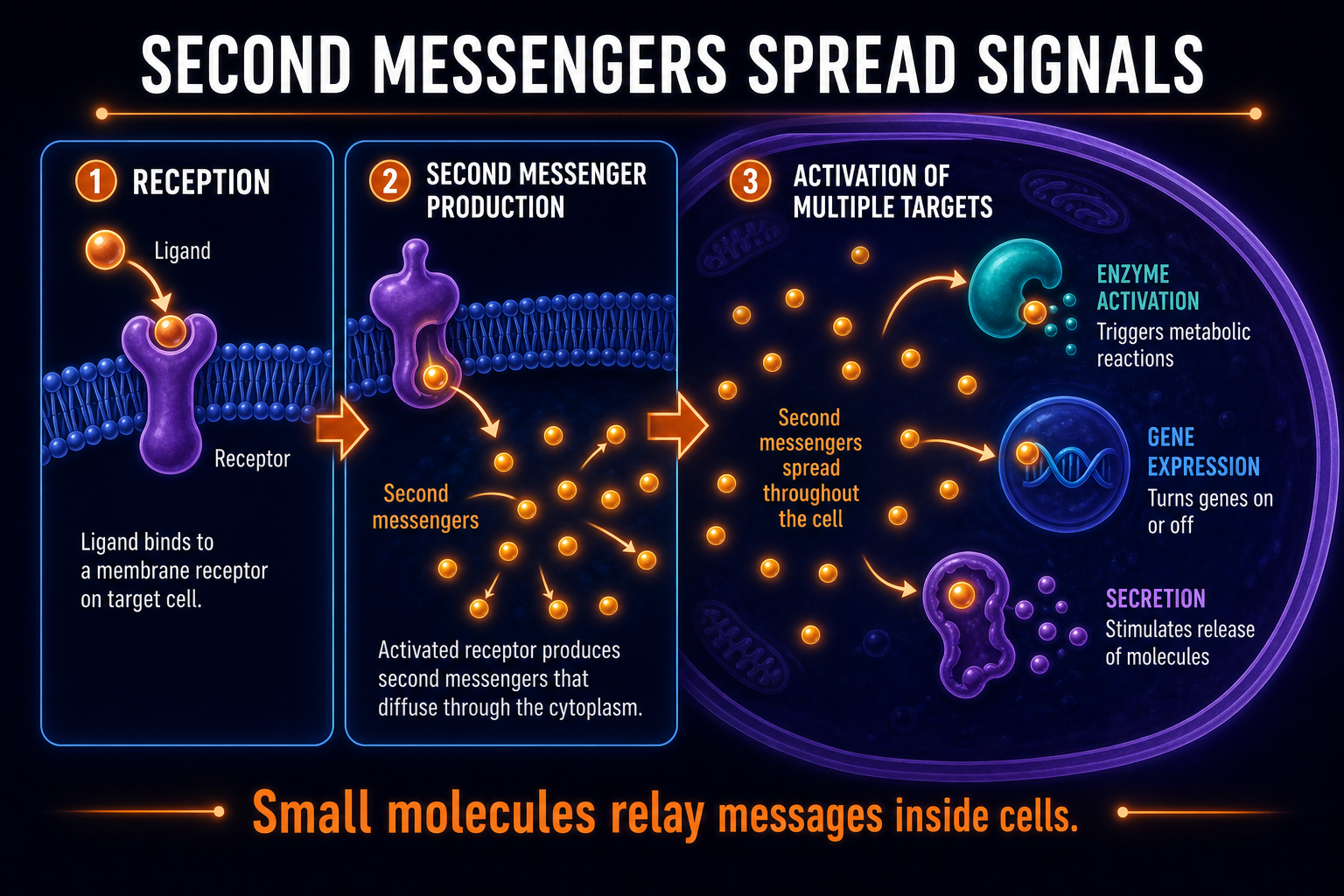
The previous guide, Signal Amplification, explained how one signal can create a large response. Second messengers are one major way cells accomplish that amplification inside the cytoplasm. After this page, study Phosphorylation Cascade to see how protein kinases pass and multiply signals through phosphorylation.
Second Messengers
Small molecules spread signals.
Second messengers are small molecules or ions inside the cell that relay signals after a receptor is activated. They help carry information from the cell membrane to intracellular targets and can amplify the signal by spreading to many proteins. Common AP Biology examples include cAMP and calcium ions.
Second messengers relay receptor signals inside the cell.
The first messenger is the extracellular signal, such as a hormone or ligand. It usually binds to a receptor on the cell surface.
When the ligand binds, the receptor changes shape or activates an internal pathway. This connects reception to transduction.
A second messenger is produced or released inside the cell. It spreads the signal to intracellular targets.
Many second messenger molecules can be made from one receptor event. This helps amplify the original signal.
Second messengers activate target proteins, enzymes, channels, or gene-regulation pathways. The final result is a cellular response.
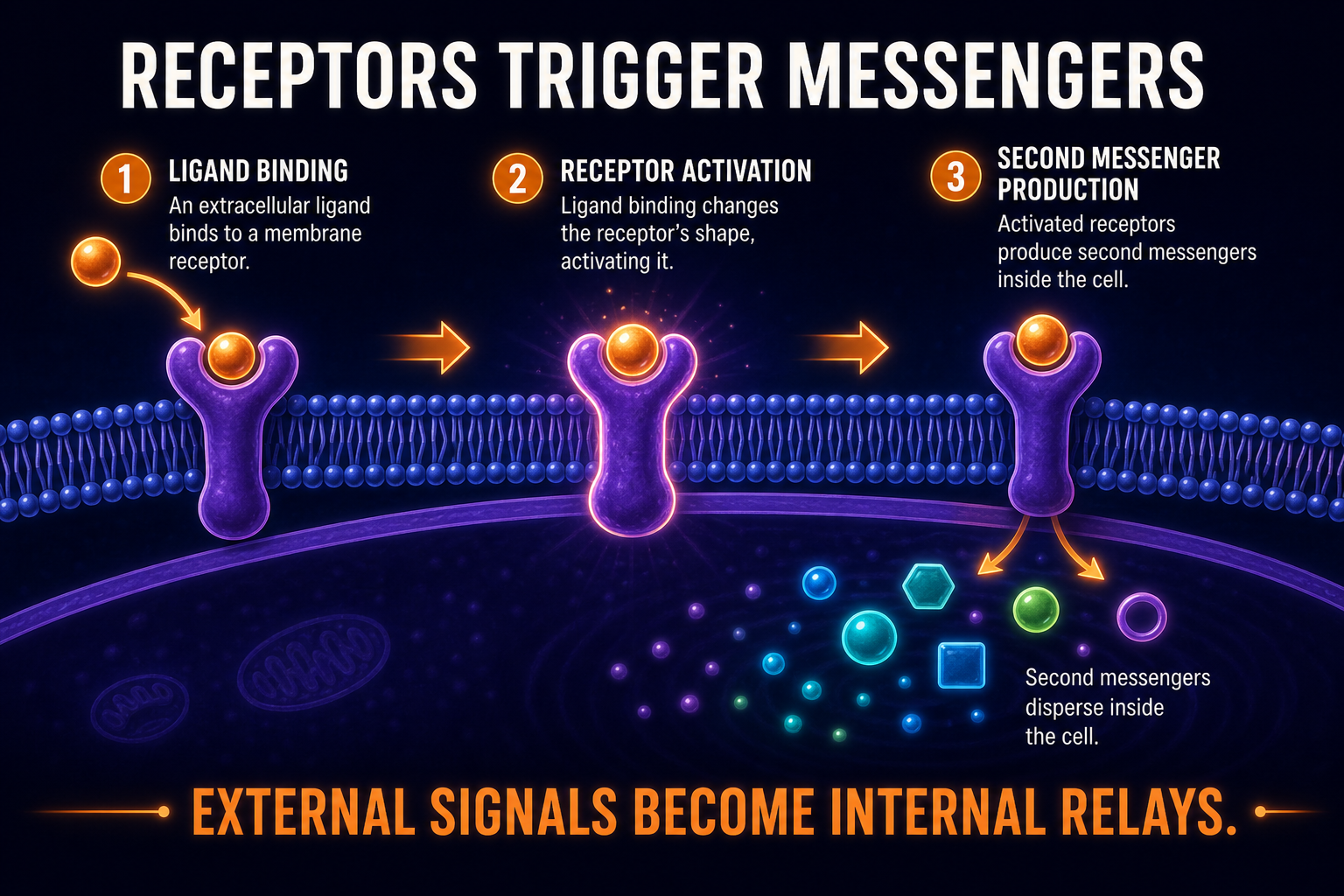
Second messengers usually appear after a receptor detects an external signal. The ligand does not need to enter the cell; instead, receptor activation triggers an internal relay. This allows an outside signal to cause a response inside the cell.
Reception depends on specific ligand-receptor matching and sits inside the broader reception, transduction, response sequence.
Second messengers connect receptor activation to internal cell responses.
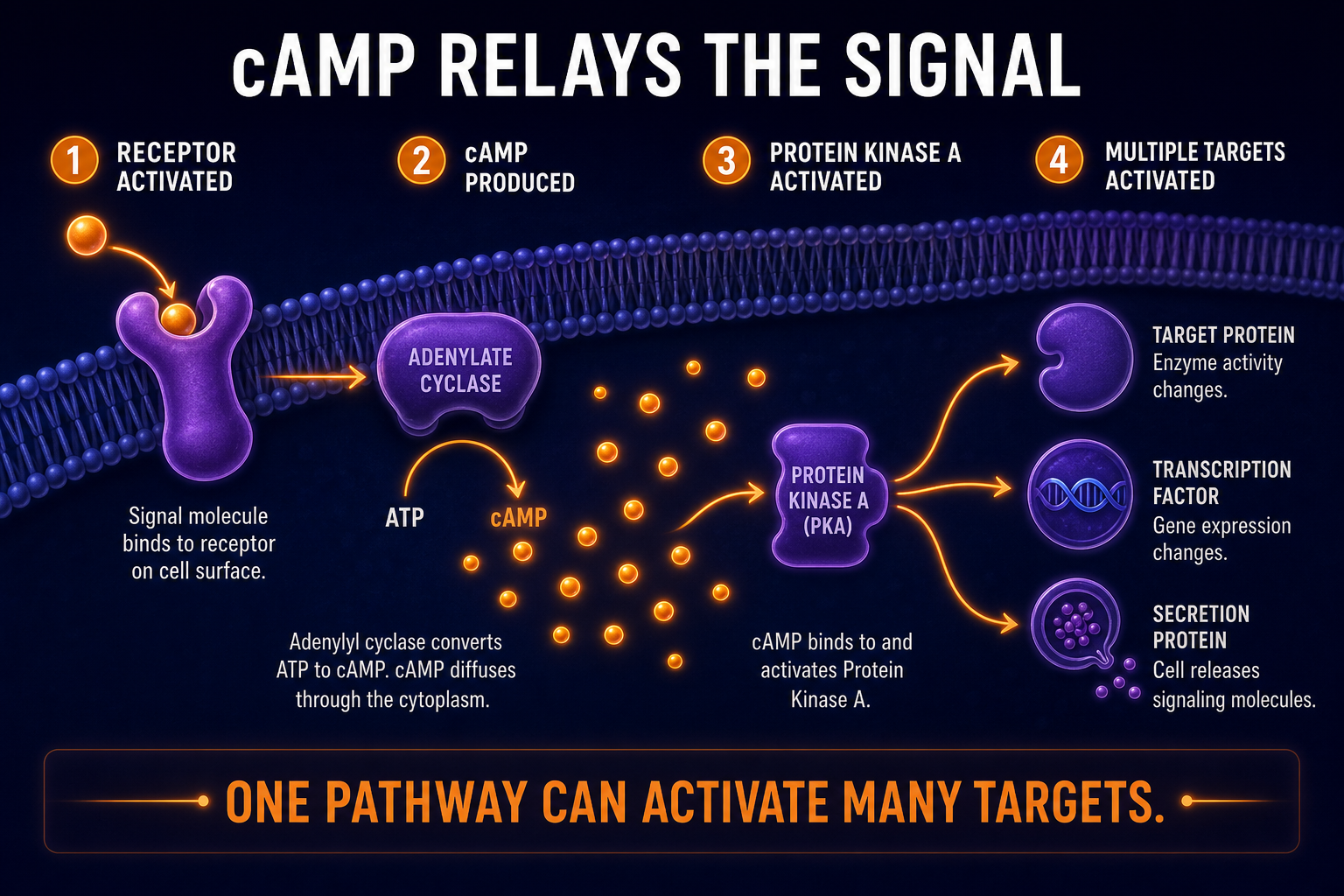
cAMP, or cyclic AMP, is a common second messenger in cell signaling pathways. It can activate protein kinases and help pass the signal to downstream targets. AP Biology questions may use cAMP as an example of how one receptor event leads to many internal changes.
For a step-by-step example, the cAMP signaling pathway shows how GPCR activation can lead to adenylyl cyclase activity, cAMP production, PKA activation, and target phosphorylation.
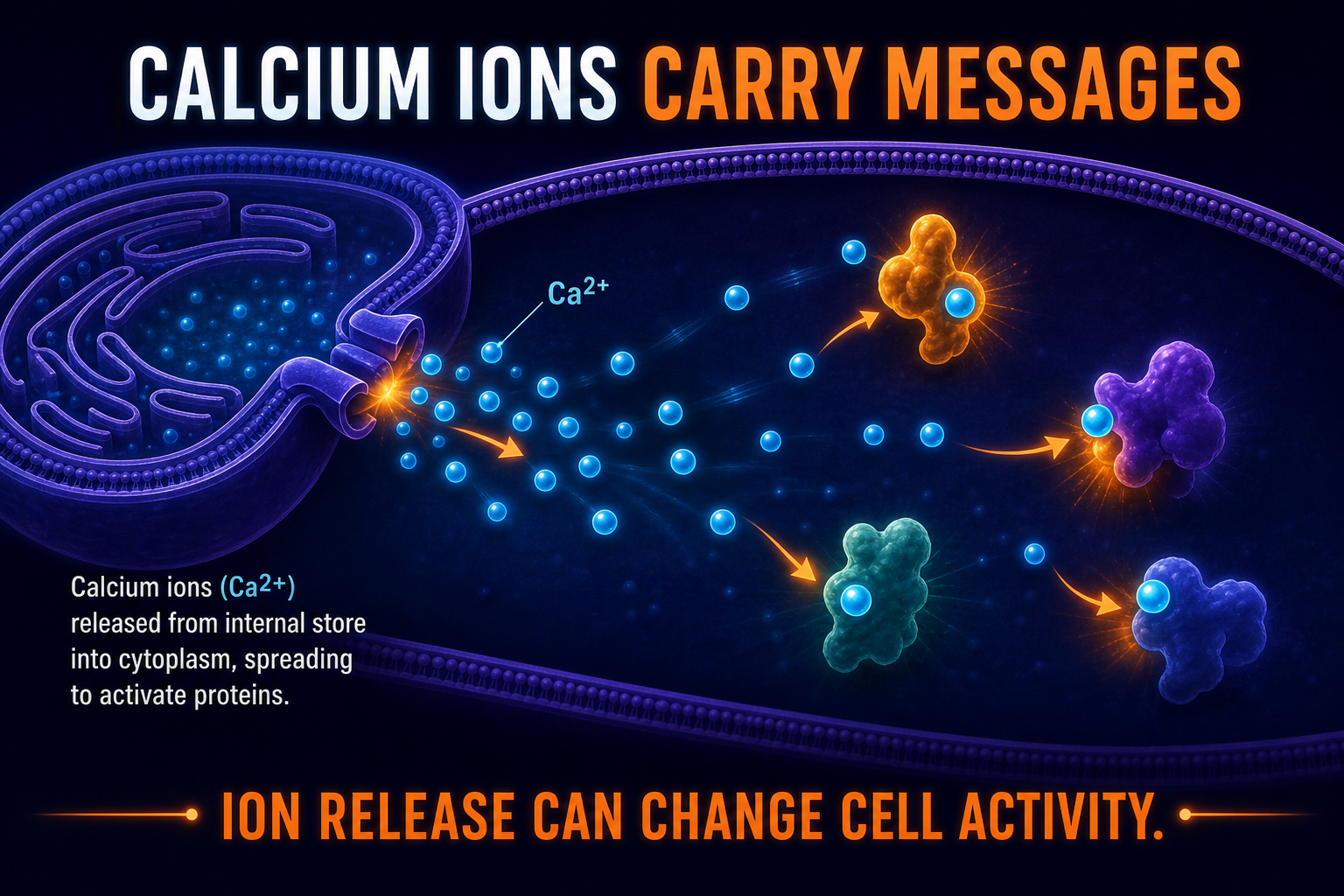
Calcium ions can act as second messengers when released from internal stores or moved across membranes. A change in cytoplasmic Ca2+ concentration can activate proteins and trigger responses. Because ion concentration can change quickly, calcium is useful for rapid signaling.
For a step-by-step example, the Calcium Signaling Pathway guide shows how Ca2+ release or entry changes cytosolic concentration and activates target proteins.
Calcium signals work by changing ion concentration inside the cell.
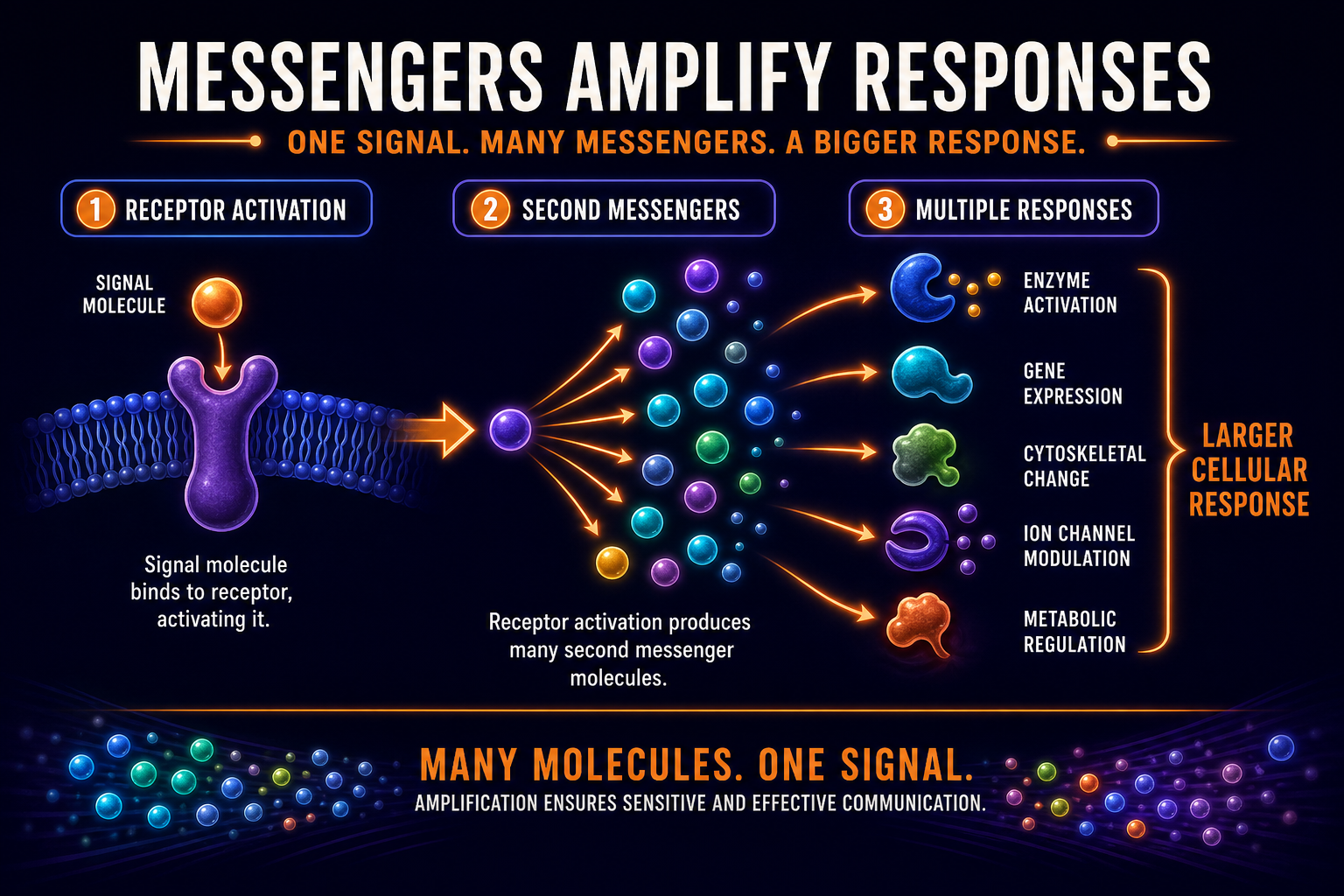
Second messengers amplify signals because one activated receptor can cause production or release of many intracellular messenger molecules. Those messengers can then activate many targets. This helps explain how a small amount of external signal can create a large cellular response.
This connects directly to signal amplification logic on the AP exam.
Second messengers are part of the transduction step of cell communication. They do not usually act as the original external signal; instead, they pass the message inside the cell. Their effects can lead to enzyme activation, ion channel changes, secretion, metabolism changes, or gene expression changes.
Pathway context matters on cell signaling pathways FRQs when you trace reception through transduction to response.
| Second messenger | Where it acts | Common AP clue |
|---|---|---|
| cAMP | Cytoplasm | Activates kinase pathways |
| Ca2+ | Cytoplasm | Ion concentration changes |
| IP3 | Intracellular membranes | Releases calcium from stores |
| DAG | Membrane-associated signaling | Helps activate protein kinase pathways |
Second messengers and relay proteins both help move signals inside the cell, but they are not the same. Second messengers are usually small molecules or ions, while relay proteins are proteins that pass the signal through shape change or phosphorylation. Both can be involved in the same pathway.
Kinase relay chains are covered in the phosphorylation cascade guide.
| Feature | Second messengers | Relay proteins |
|---|---|---|
| Type | Small molecule or ion | Protein |
| Mobility | Often spread quickly | Often interact step-by-step |
| Example | cAMP, Ca2+ | Kinase, G protein |
| Role | Relay and amplify | Relay, activate, phosphorylate |
| AP clue | Small intracellular molecule | Protein cascade or phosphorylation |
Second messenger signaling is likely.
Ca2+ is acting as a second messenger.
A receptor may trigger internal messengers.
Signal amplification may involve second messengers.
Second messenger clue.
A second messenger may activate a kinase pathway.
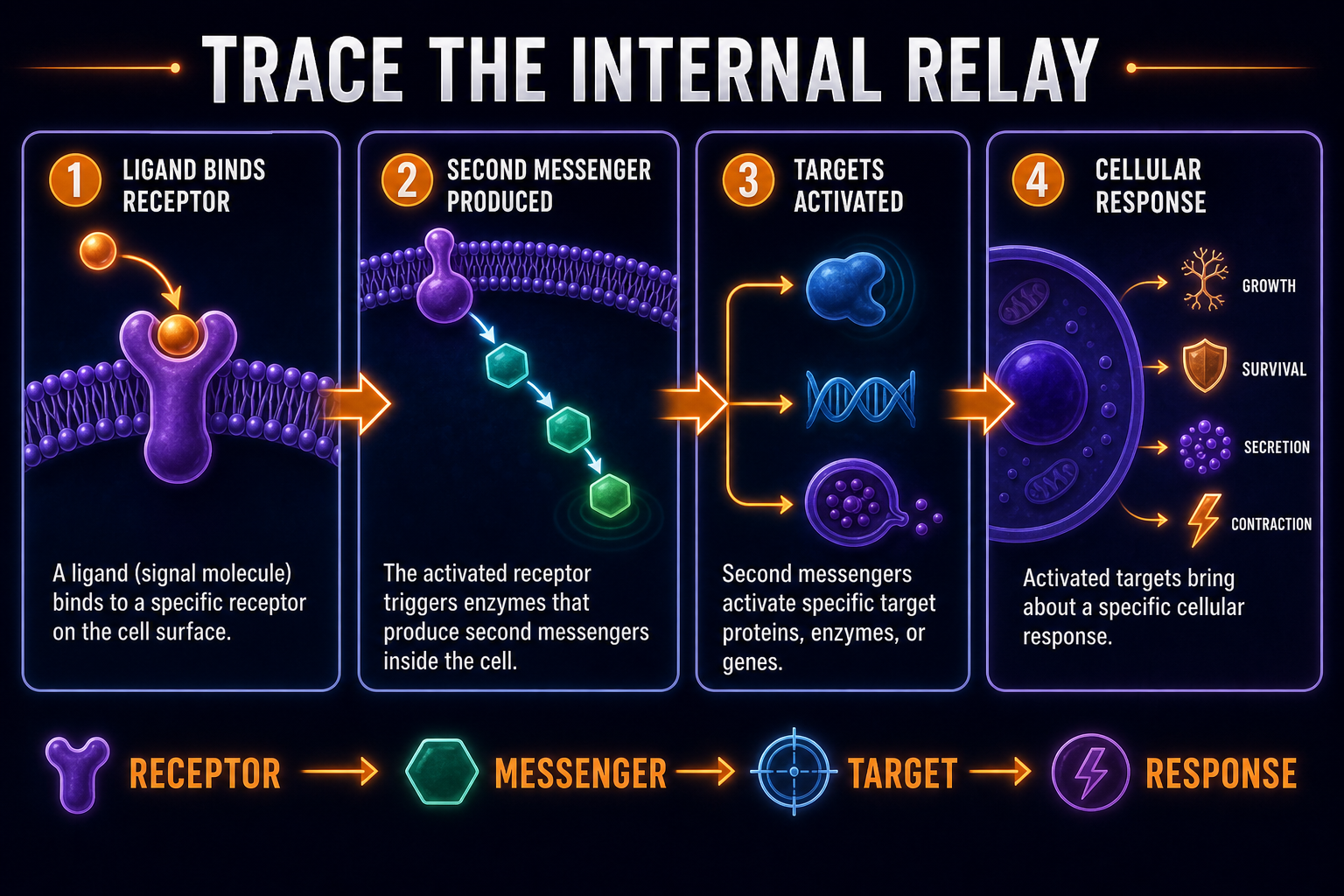
Name the ligand and where it binds.
Describe production or release inside the cell.
Show cytoplasmic relay or kinase activation.
State the final outcome the cell produces.
The ligand binds to ___. This activates ___, causing ___ to act as a second messenger. The second messenger activates ___, leading to ___.
Fix: The ligand is the first messenger; the second messenger acts inside the cell.
Fix: Many second messengers are small molecules or ions.
Fix: Second messengers can be produced in large numbers to amplify signals.
Fix: Second messengers usually act after receptor activation.
Fix: cAMP is a signaling molecule; ATP is often an energy-related molecule and precursor.
Fix: Always connect second messenger activity to a target and response.
Revealed: 0 of 4 scenarios
A hormone binds a receptor but does not enter the cell.
Answer: The receptor can still trigger second messengers inside the cell.
cAMP levels rise in the cytoplasm after receptor activation.
Answer: cAMP is acting as a second messenger.
Calcium ions are released from internal stores and activate proteins.
Answer: Calcium ions can act as second messengers.
One receptor event produces many intracellular molecules.
Answer: This shows signal amplification using second messengers.
Answer all eight questions. Choices shuffle on reload—focus on second messenger logic, not letter memorization.
More drills: Unit 4 practice questions, practice by topic, or daily AP Biology practice.
Open each card, draft your response, then reveal the rubric and sample. For more free-response practice, open the Unit 4 FRQ guide.
A hormone binds to a membrane receptor. After receptor activation, cAMP levels increase inside the cell and several protein kinases become active.
The hormone is the first messenger because it binds the receptor from outside the cell. cAMP is the second messenger because it is produced inside the cell after receptor activation and relays the signal. cAMP spreads through the cytoplasm and activates protein kinases, passing the signal to downstream targets. If cAMP could not be produced, the receptor might bind the hormone but kinases would not activate efficiently, so the cellular response would be weak or absent.
Status: Draft your answer first—then open the rubric or sample.
A receptor pathway causes calcium ions to be released into the cytoplasm. The calcium ions activate proteins that change cell behavior.
Calcium ions can function as second messengers because receptor activation causes their release into the cytoplasm, where a change in Ca2+ concentration activates target proteins. Calcium release amplifies the signal because one receptor event can release many ions that spread and activate multiple proteins, producing a larger response. If calcium release were blocked, downstream proteins would not activate properly and the cell would show a weak or absent change in behavior despite receptor activation.
Status: Draft your answer first—then open the rubric or sample.
Second messengers are small molecules or ions that relay signals inside the cell after a receptor is activated. They help connect the external signal to intracellular targets. Common examples include cAMP and calcium ions.
They are called second messengers because the original signal outside the cell is the first messenger. The second messenger carries the message inside the cell. This allows a ligand to affect cell behavior without entering the cell.
Yes. cAMP is a common second messenger that helps transmit signals inside the cell. It often activates protein kinases that lead to a cellular response.
Yes. Calcium ions can act as second messengers when their concentration changes inside the cell. Calcium release can activate proteins and trigger rapid cellular responses.
One activated receptor can lead to the production or release of many second messenger molecules. Those molecules can spread and activate many targets. This makes the final response larger than the original signal.
No. Ligands are usually external signals that bind receptors, while second messengers act inside the cell. The ligand starts the pathway, and the second messenger helps carry it internally.
Many second messengers are not proteins. They are often small molecules or ions, such as cAMP or Ca2+. Relay proteins can work with second messengers, but they are a different category.
Second messengers act inside the cell, often in the cytoplasm. They can activate proteins, enzymes, channels, or pathways that produce a cellular response. Their mobility helps spread the signal.
FRQs may describe a ligand binding a receptor and then an internal molecule like cAMP increasing. A strong answer identifies the second messenger and explains how it relays or amplifies the signal. It should also predict what happens if that messenger is blocked.
If second messenger signaling fails, the receptor may detect the signal but the cell may not respond properly. Downstream proteins may not activate, so the response can be weak or absent. AP Biology often asks students to predict this pathway consequence.