Prophase
Chromosomes condense
AP Biology · Unit 4 Phase 2 Deep Dive
Mitosis is the part of M phase that separates duplicated chromosomes into two nuclei. It happens after DNA has already been copied during S phase and before or alongside cytokinesis, which divides the cytoplasm. In AP Biology Unit 4, the key skill is explaining how mitosis fits into the regulated cell cycle and predicting what happens when chromosome separation or spindle checkpoint control fails.
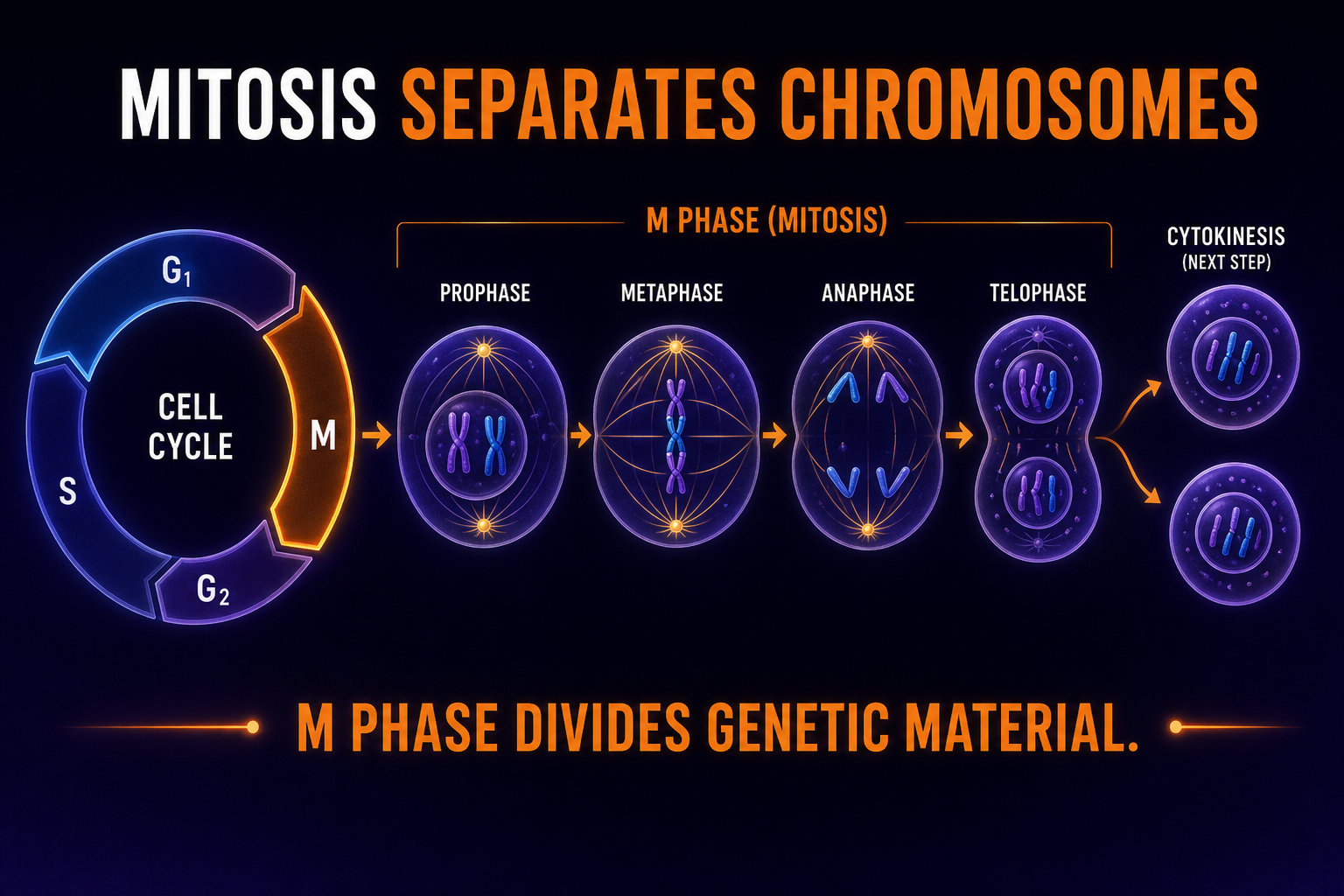
The core Cell Cycle page explains why cells grow, copy DNA, and divide under regulation. The Cell Cycle Phases page explains the order of G1, S, G2, M phase, and cytokinesis. This Phase 2 page focuses on mitosis as the chromosome-separation part of M phase and connects it to checkpoints, spindle attachment, and daughter cell outcomes.
Mitosis in the Cell Cycle
M phase deep dive.
Regulation links: Cell Cycle Checkpoints, Cyclins and CDKs, and Cancer and Cell Cycle Regulation.
Use the Cell Cycle guide for the broad Unit 4 overview of growth, replication, division, and regulation. Use the Cell Cycle Phases guide to distinguish G1, S, G2, M phase, and cytokinesis in order. Use this Mitosis in the Cell Cycle guide when you need to understand how mitosis fits inside M phase, how chromosomes separate, and how mitosis connects to checkpoints and regulated cell division. Use the Unit 5 Mitosis vs Meiosis guide only when comparing two division processes.
| Page | Best for | Link |
|---|---|---|
| Cell Cycle | Broad Unit 4 overview of growth, replication, division, and regulation | Open guide |
| Cell Cycle Phases | Phase order: G1, S, G2, M, cytokinesis | Open guide |
| Mitosis in the Cell Cycle | M phase chromosome separation and checkpoint consequences | You are here |
| Mitosis vs Meiosis | Unit 5 comparison between two division processes | Open guide |
Mitosis is the chromosome-separation part of M phase in the cell cycle. It occurs after DNA replication in S phase and helps divide duplicated chromosomes into two nuclei. AP Biology tests mitosis in Unit 4 by asking how regulated chromosome separation, spindle attachment, checkpoints, and cytokinesis affect daughter cell outcomes.
Mitosis separates chromosomes during M phase.
Toggle each condition, then choose a mutation scenario to predict daughter cell outcomes.
Not ready for chromosome separation.
Progress: Not ready
Mitosis separates duplicated chromosomes into two nuclei. It does not copy DNA; that happens earlier in S phase. Mitosis helps ensure each daughter cell receives a complete set of genetic information.
Mitosis separates duplicated chromosomes; S phase copies DNA.
See the Cyclins and CDKs guide for how kinase control helps push cells into M phase before mitosis begins.
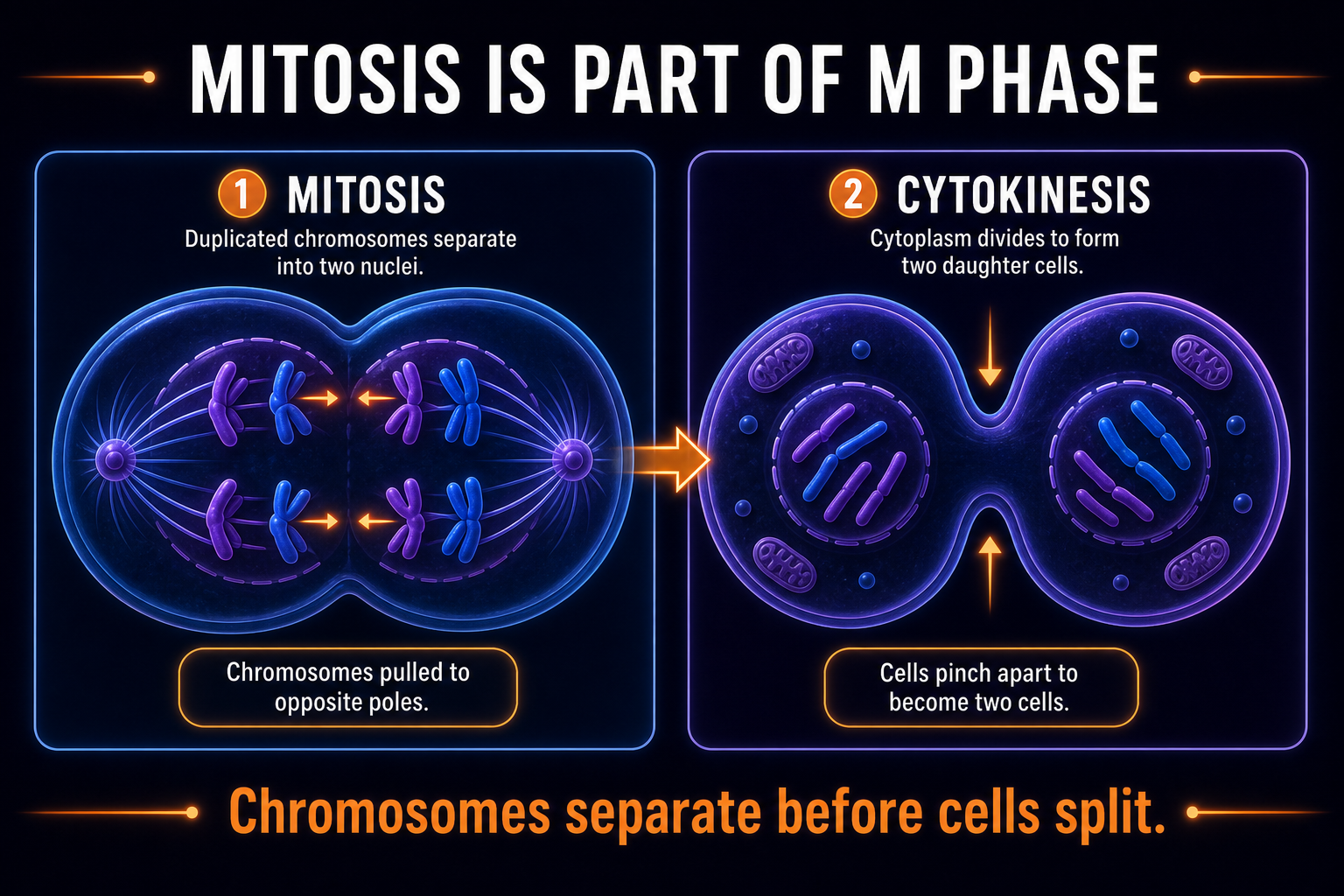
M phase includes mitosis and cytokinesis. Mitosis handles chromosome and nuclear division. Cytokinesis handles cytoplasm division. AP Biology often tests whether students can separate these two events.
Compare phase order on the Cell Cycle Phases guide.
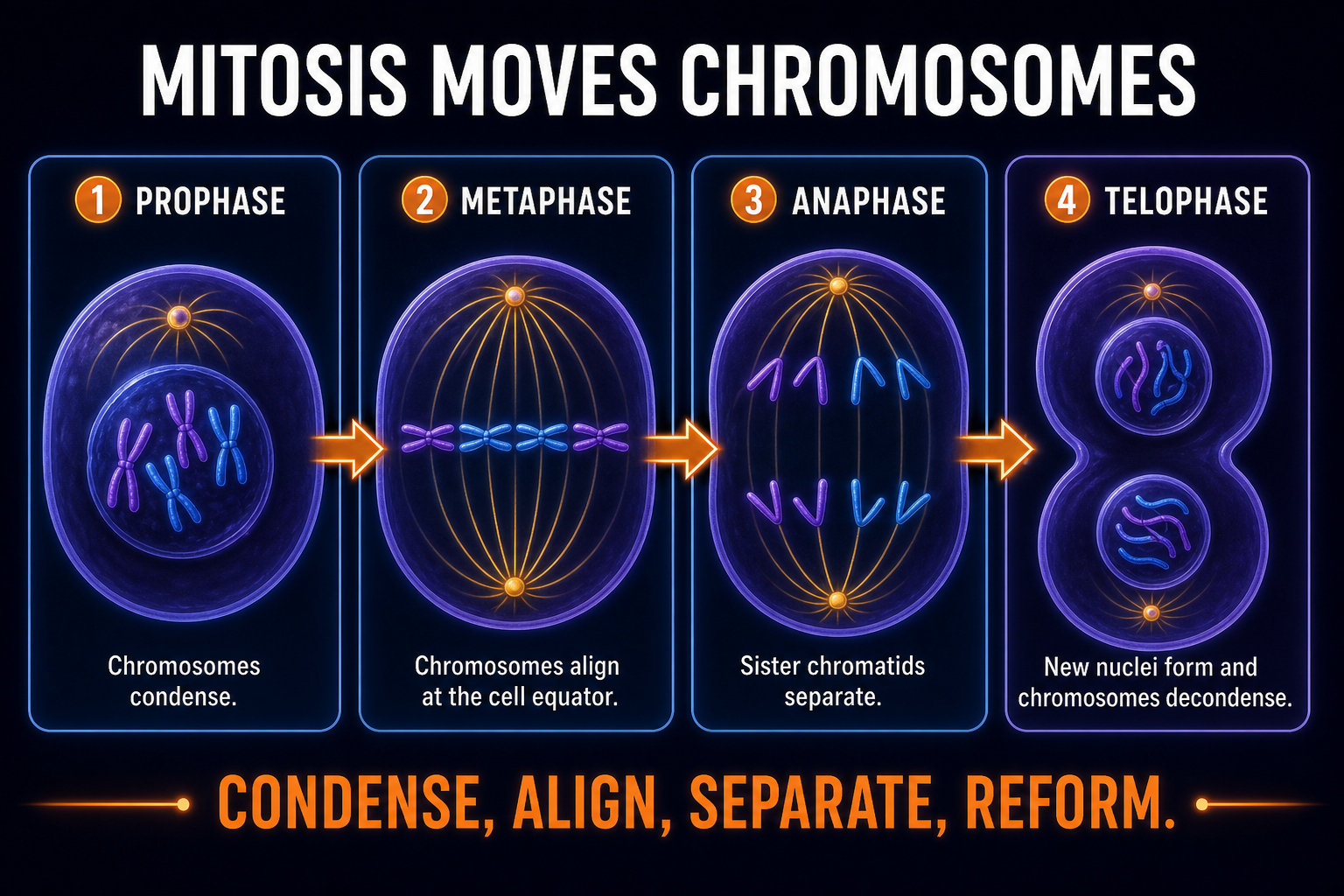
During mitosis, chromosomes condense, align, separate, and become organized into two nuclei. The exact stage names are useful, but AP Biology usually cares most about the logic: copied chromosomes must be separated accurately before the cell fully divides.
Chromosomes condense
Chromosomes align
Sister chromatids separate
Nuclei reform
Mitosis and cytokinesis are related but not identical. Mitosis separates chromosomes into nuclei. Cytokinesis divides the cytoplasm and physically separates the cell. If cytokinesis fails, chromosome separation may occur without complete cell splitting.
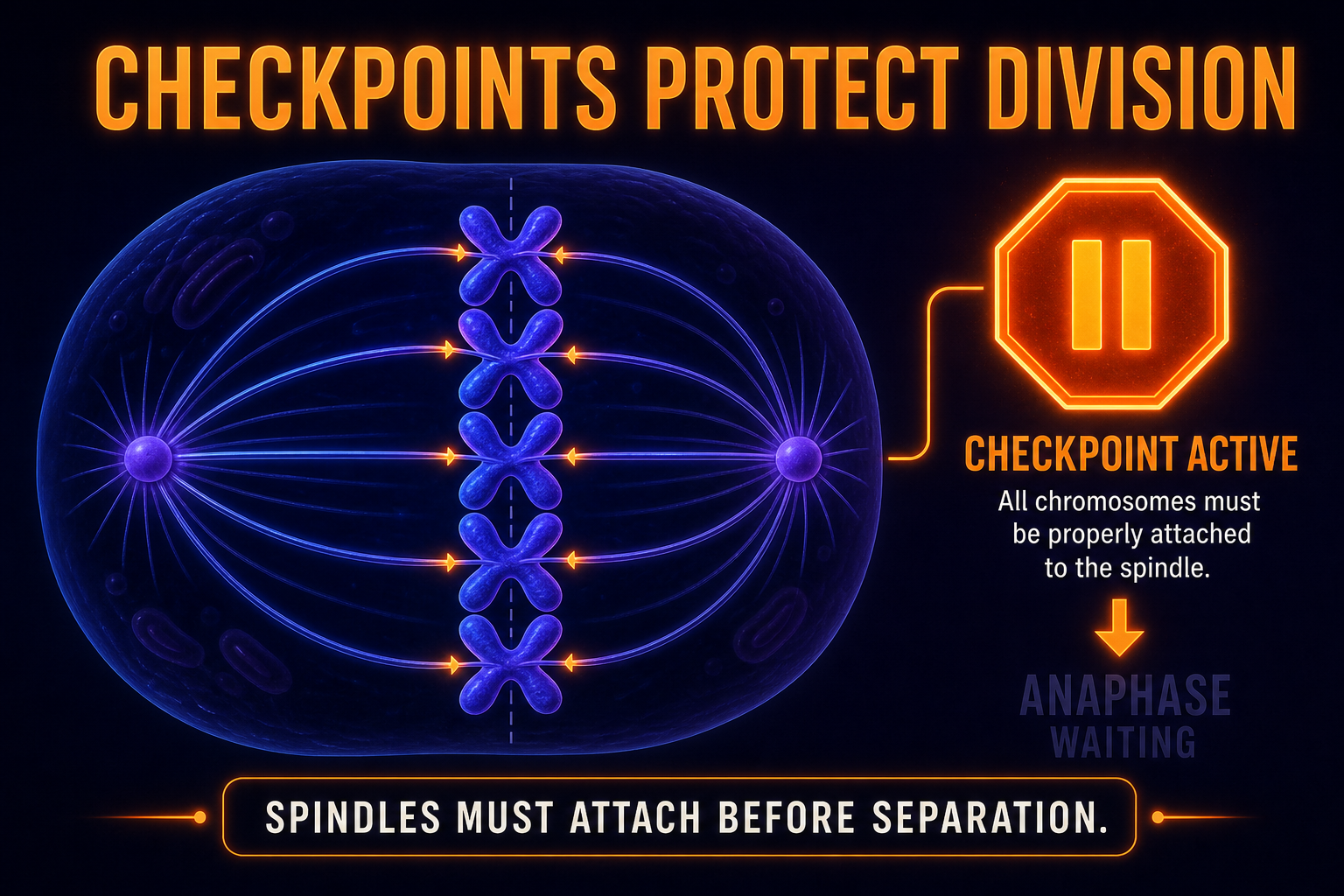
The M checkpoint, also called the spindle checkpoint, checks whether chromosomes are properly attached to spindle fibers before separation. If chromosomes are not attached correctly, the checkpoint should stop progression. This prevents daughter cells from receiving abnormal chromosome numbers.
Study the full checkpoint logic on Cell Cycle Checkpoints.
If chromosomes do not separate correctly, daughter cells may receive too many or too few chromosomes. If the checkpoint fails, abnormal cells may continue dividing. If cytokinesis fails, one cell may contain multiple nuclei or abnormal cell structure.
Cancer is not simply “mitosis happening fast.” It involves failures in regulation, checkpoints, growth control, apoptosis, and cell-cycle control. If cells with chromosome errors continue dividing, genetic instability can increase.
Connect failed division control to Cancer and Cell Cycle Regulation.
This Unit 4 page focuses on mitosis as part of regulated cell-cycle progression. The Unit 5 Mitosis vs Meiosis page compares two division processes and their inheritance outcomes. Do not use this page as a full meiosis comparison page.
For inheritance comparisons, use Mitosis vs Meiosis.
Mitosis or M phase.
S phase, not mitosis.
M checkpoint.
Cytokinesis.
Daughter cells may receive abnormal chromosome numbers.
Unsafe division may continue.
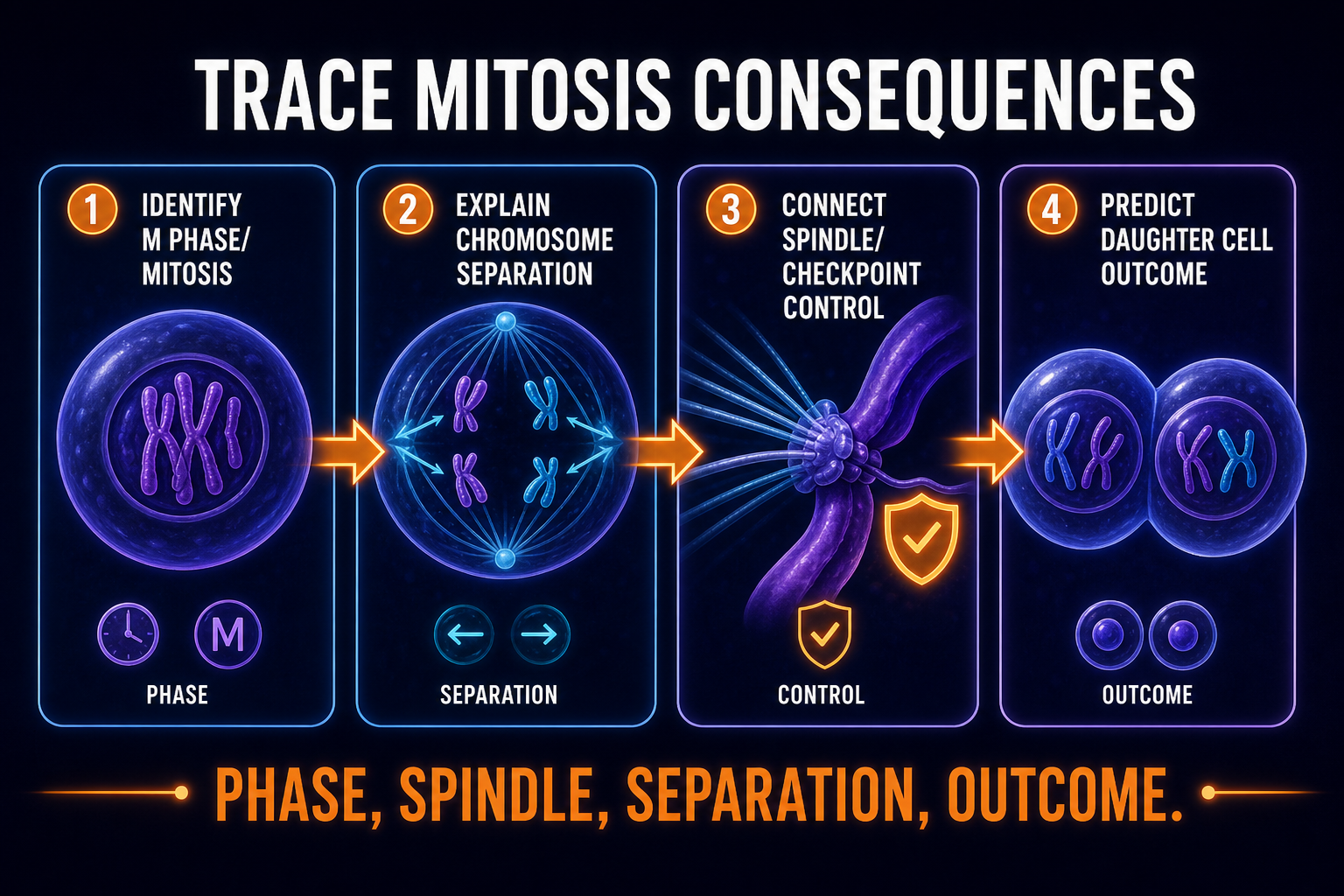
Name M phase, mitosis, spindle attachment, or cytokinesis.
Explain chromosome separation or checkpoint control.
Connect attachment to safe separation.
Link failed separation to abnormal chromosome numbers.
The cell is in ___ because ___. Normally, mitosis ___. If ___ fails, daughter cells may ___ because ___.
Fix: DNA replication happens during S phase before mitosis.
Fix: Mitosis separates chromosomes; cytokinesis divides cytoplasm.
Fix: This Unit 4 page focuses on mitosis inside the regulated cell cycle.
Fix: Chromosomes should attach correctly before separation.
Fix: Cancer involves failed regulation, checkpoint failure, growth signals, and apoptosis.
Fix: Failed separation can produce abnormal chromosome distribution.
Answer all eight questions. Choices shuffle on reload—trace M phase logic, not the letter.
More drills: Unit 4 practice questions or the Unit 4 FRQ guide.
Open each card, draft your response, then reveal the rubric and sample.
A cell has completed S phase and enters M phase. A checkpoint detects that several chromosomes are not attached to spindle fibers.
The M checkpoint, also called the spindle checkpoint, is involved. The cell should not continue to chromosome separation because chromosomes that are not attached to spindle fibers may not move to opposite poles correctly. If the checkpoint fails, sister chromatids may separate unevenly, and daughter cells may receive too many or too few chromosomes.
Status: Draft your answer first—then open the rubric or sample.
A cell separates duplicated chromosomes but fails to complete cytokinesis.
Mitosis separates duplicated chromosomes into two nuclei, while cytokinesis divides the cytoplasm and physically separates the cell. If cytokinesis fails, the cell may contain two nuclei in one cytoplasm. This is a Unit 4 cell-cycle regulation topic because it concerns how M phase events and division steps are controlled inside the normal cell cycle, not a Unit 5 comparison of mitosis and meiosis for inheritance outcomes.
Status: Draft your answer first—then open the rubric or sample.
Mitosis is the part of M phase that separates duplicated chromosomes into two nuclei. It happens after DNA has already been copied in S phase. In Unit 4, mitosis is tested as part of regulated cell-cycle progression.
No. The cell cycle includes G1, S, G2, M phase, and cytokinesis. Mitosis is only the chromosome-separation part of M phase.
No. DNA replication happens during S phase before mitosis begins. Mitosis separates the duplicated chromosomes that were already copied.
Mitosis separates chromosomes into nuclei. Cytokinesis divides the cytoplasm and physically separates the cell. They are connected events but not the same process.
The M checkpoint, or spindle checkpoint, is important during mitosis. It helps ensure chromosomes are properly attached to spindle fibers before separation. If attachment is wrong, the cell should pause.
Daughter cells may receive abnormal chromosome numbers. This can affect cell function or survival. If abnormal cells continue dividing, regulation problems may increase.
Cancer involves failed regulation of cell growth and division. If checkpoints fail, cells with DNA damage or chromosome errors may continue through division. Mitosis is one part of that larger regulation problem.
Cell Cycle Phases explains the full sequence of G1, S, G2, M, and cytokinesis. This page focuses specifically on mitosis inside M phase and how chromosome separation is regulated. Use both pages together for Unit 4 practice.
This Unit 4 page explains mitosis as part of cell-cycle regulation. The Unit 5 Mitosis vs Meiosis page compares two division processes and inheritance outcomes. This page should not be used as a full meiosis comparison guide.
Identify where the cell is in the cell cycle, then explain what mitosis normally does. Connect spindle attachment or checkpoint control to chromosome separation. Finish by predicting how daughter cells are affected if the process fails.