“One ligand causes many responses”
Signal amplification is likely.
AP Biology · Unit 4 Learning Journey
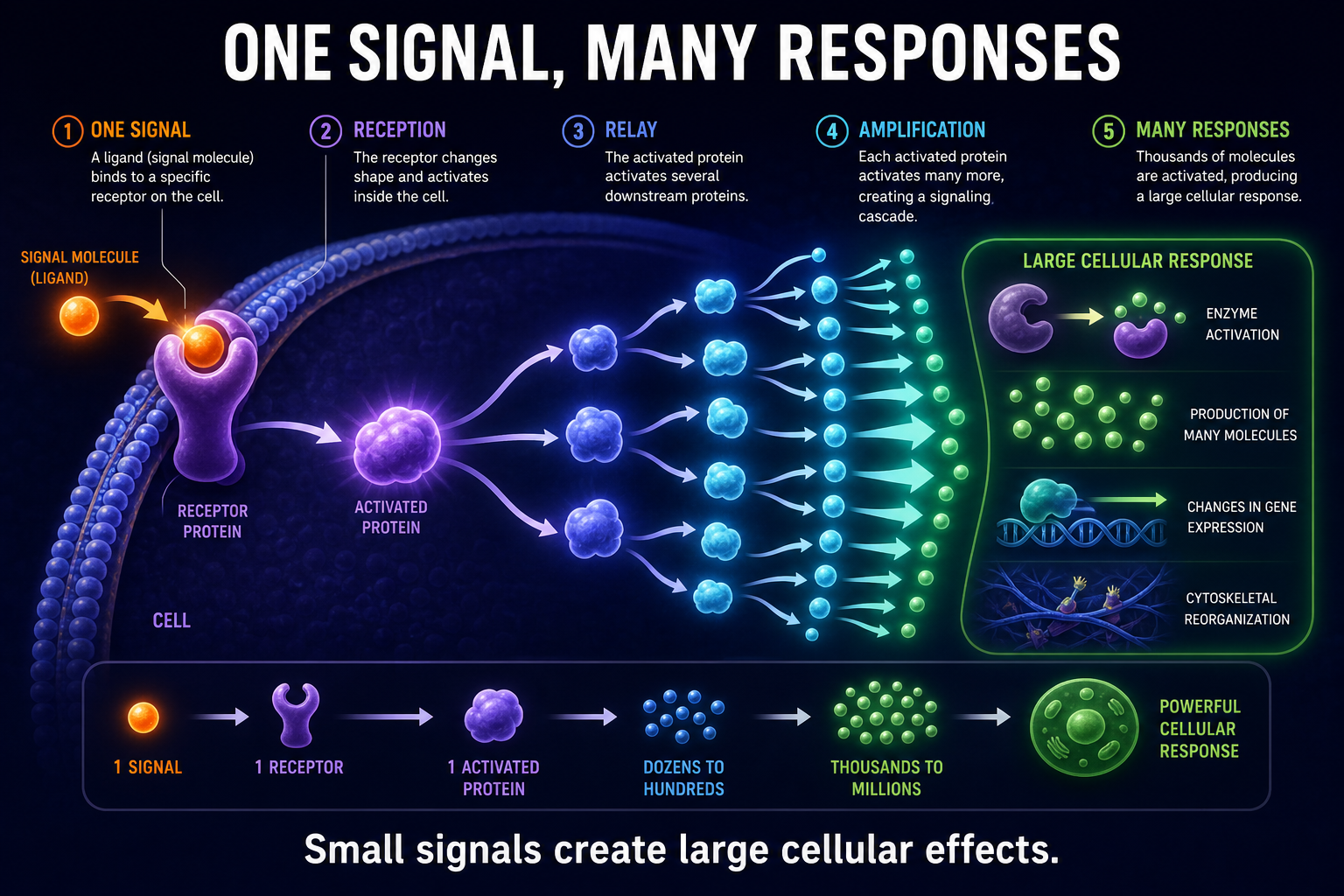
Signal amplification is how a small external signal can produce a large cellular response. One ligand binding to one receptor can activate many relay proteins, second messengers, or kinases inside the cell. In AP Biology Unit 4, the key skill is explaining how signal transduction pathways multiply the original signal before producing a response.
The previous guide, Cyclins and CDKs, explained how regulatory proteins control cell-cycle transitions. This page returns to the cell signaling side of Unit 4 and explains how signal transduction pathways make a signal stronger. After this page, study Second Messengers to learn how small molecules spread signals inside the cell.
Signal Amplification
Small signals, large responses.
Signal amplification is the process where one signaling event activates many downstream molecules, producing a much larger cellular response. For example, one activated receptor can activate several relay proteins, second messengers, or kinases. AP Biology tests signal amplification by asking students to trace how a small signal becomes a large response.
Signal amplification turns one signal into many activated targets.
Amplification begins when a ligand binds to a receptor. This is the reception step of cell communication.
The receptor changes shape or becomes active. That activation starts an intracellular signal transduction pathway.
Relay proteins pass the signal from one molecule to another. One activated relay protein may activate several downstream molecules.
Second messengers are small molecules that can spread quickly inside the cell. They help amplify signals by activating many targets.
Kinases can phosphorylate multiple proteins. A cascade can multiply the signal at each step.
Amplification helps a small external signal produce a strong response such as enzyme activation, secretion, or changed gene expression.
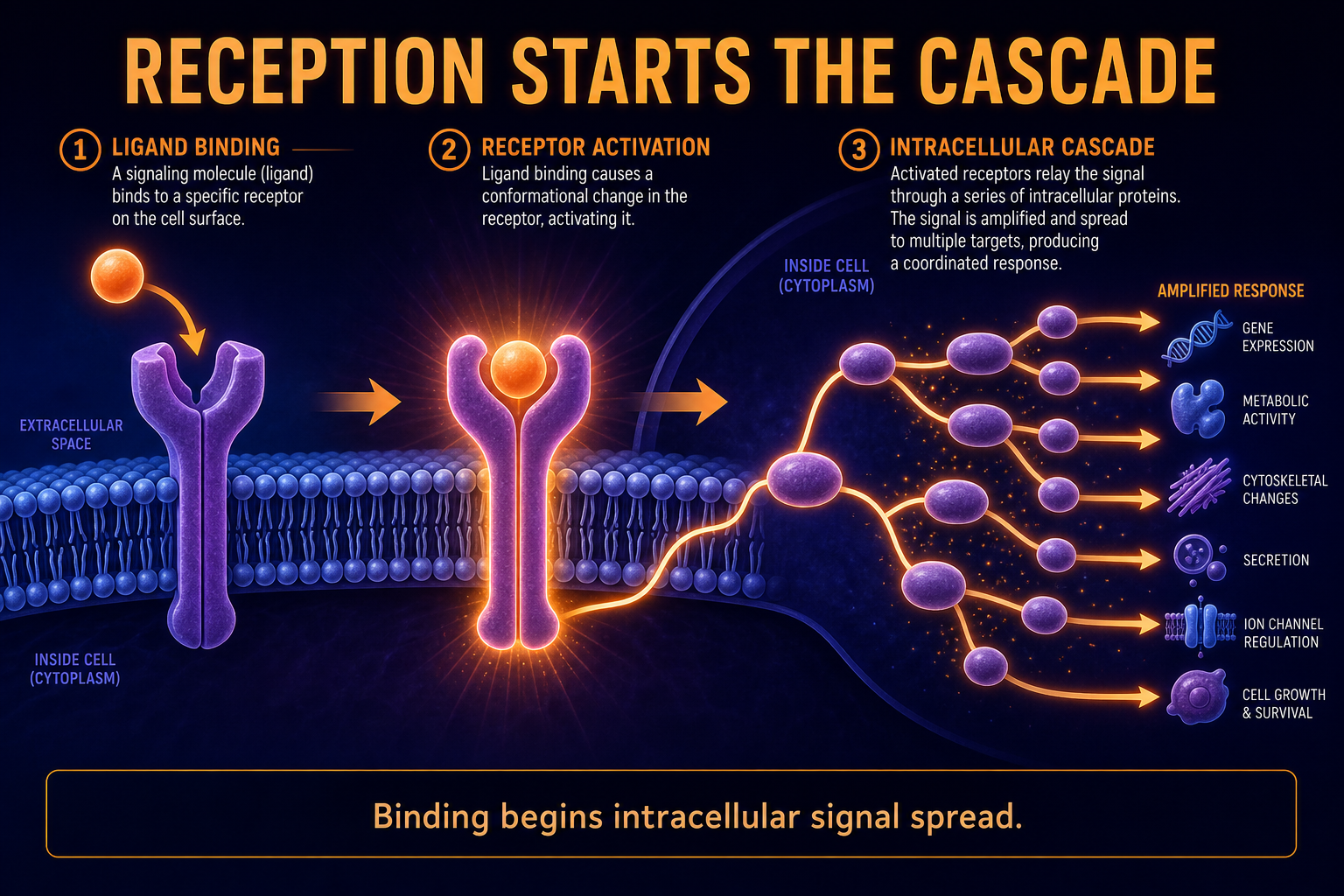
Signal amplification usually begins with reception. A ligand binds to a receptor, causing the receptor to change shape or activate. That receptor can then trigger multiple intracellular events, so the signal becomes larger as it moves through the pathway.
Reception depends on specific ligand-receptor matching and sits inside the broader reception, transduction, response sequence.
Amplification begins when receptor activation starts a signal transduction pathway.
Relay proteins transfer information through the cell. In many pathways, one activated protein activates several downstream proteins. This creates a branching effect where the original signal is multiplied.
Branching relay logic is a core feature of cell signaling pathways on the AP exam.
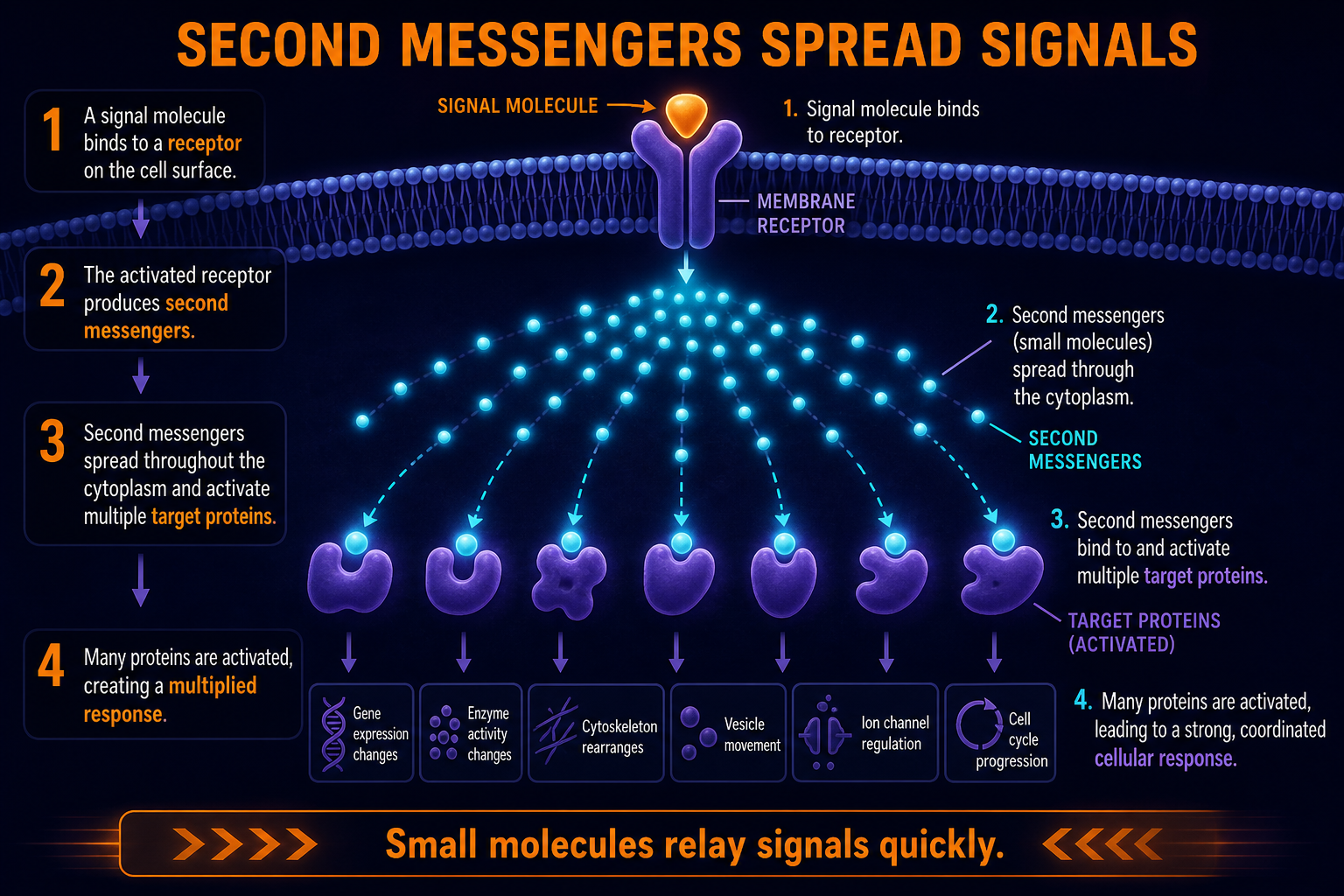
Second messengers are small intracellular molecules that help relay and amplify signals. Because they can be produced in large numbers and spread through the cytoplasm, they can activate many target proteins. AP Biology often connects second messengers to rapid signal transduction.
The cAMP pathway can amplify a signal because one activated receptor can lead to many cAMP molecules and many phosphorylated target proteins.
Calcium signaling can amplify a response when a small upstream signal causes a larger Ca2+ release that activates multiple target proteins.
Next guide: Second Messengers
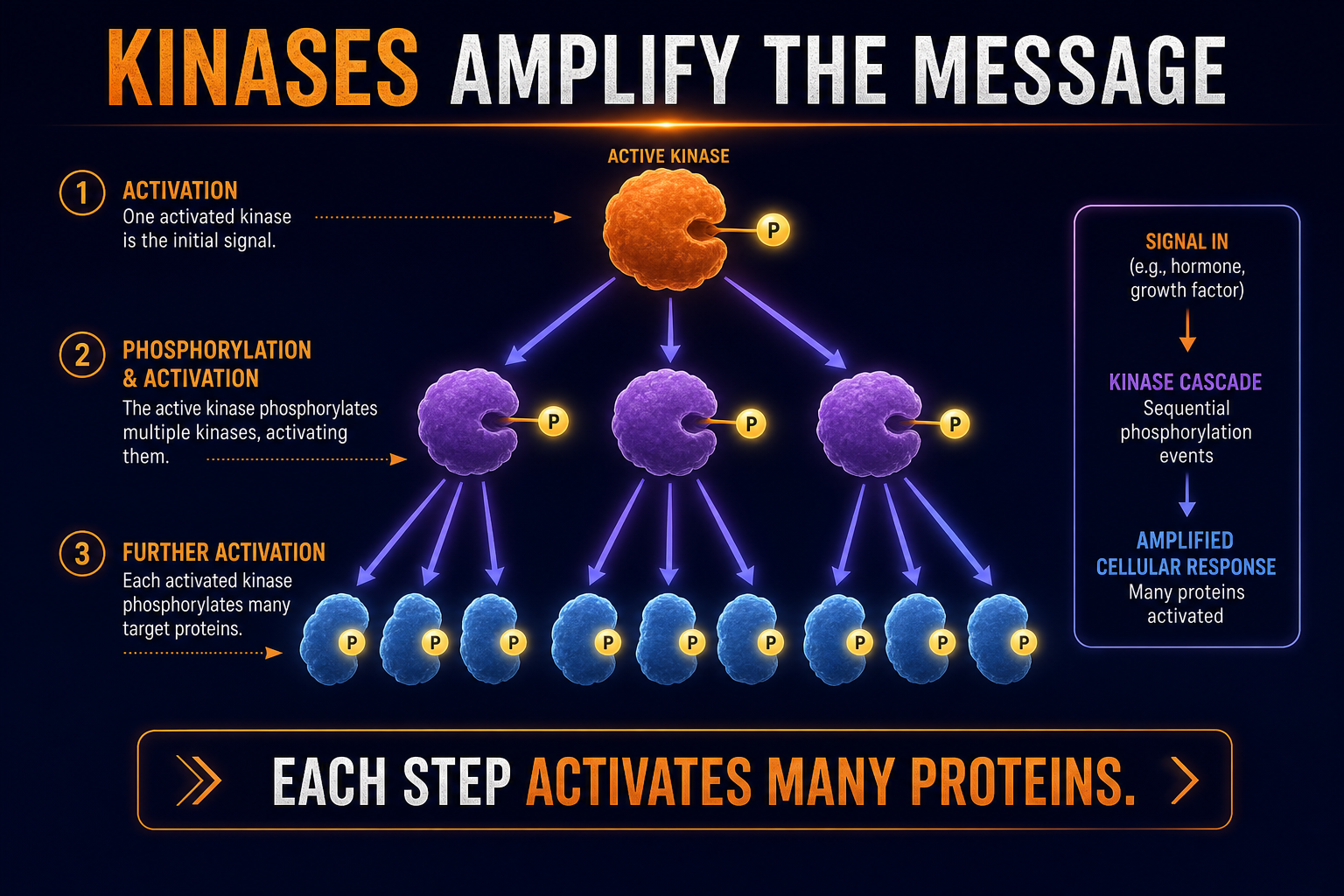
A phosphorylation cascade is a series of protein activations, often involving kinases. One kinase can activate many molecules of the next kinase, and each of those can activate even more targets. This creates strong signal amplification.
Full guide: Phosphorylation Cascade
Signal amplification allows cells to respond strongly to small amounts of signal. This is useful when hormones, neurotransmitters, or other signaling molecules are present at low concentrations. Without amplification, a weak external signal might not produce enough internal change to affect cell behavior.
Amplification also connects to how feedback mechanisms later adjust pathway output once a strong response begins.
Amplification makes small signals biologically powerful.
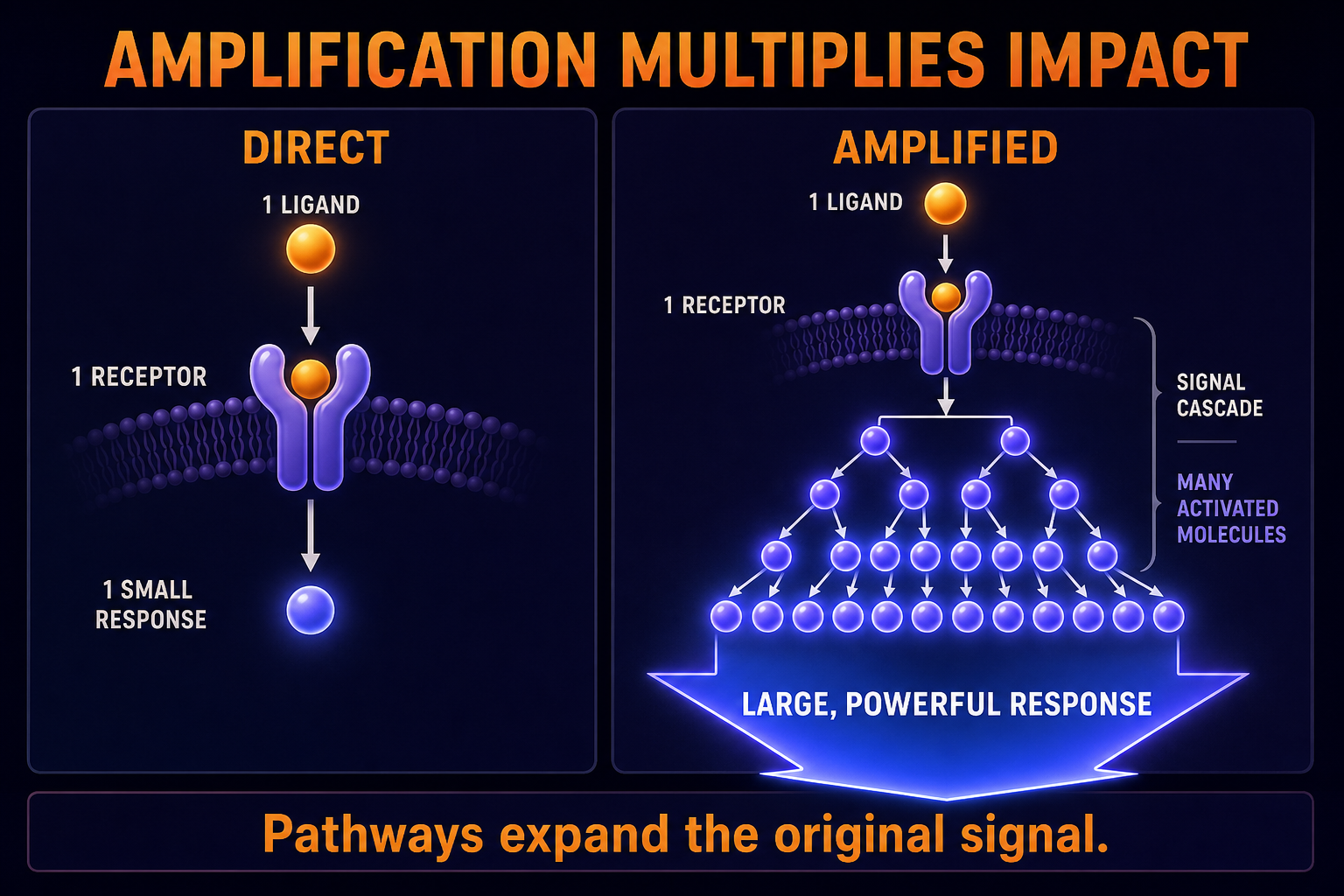
Some responses are more direct, while others use multi-step pathways that amplify the signal. In an amplified pathway, each step can increase the number of active molecules. This means the final response can be much larger than the original signal. RTK signaling can amplify a signal when phosphorylated receptor sites recruit relay proteins that activate downstream kinase cascades.
| Feature | Direct response | Amplified pathway |
|---|---|---|
| Signal size | Often one-to-one | Multiplied through steps |
| Speed | Can be fast | Can be fast or staged |
| Molecules involved | Fewer | Many relay molecules |
| AP clue | Simple receptor effect | Cascade, second messenger, kinase |
| Outcome | Limited response | Larger cellular response |
Signal amplification is likely.
Intracellular signal spread is occurring.
Phosphorylation amplification is involved.
Amplification explains the effect.
Signal transduction is multiplying the signal.
Each step may activate many molecules.
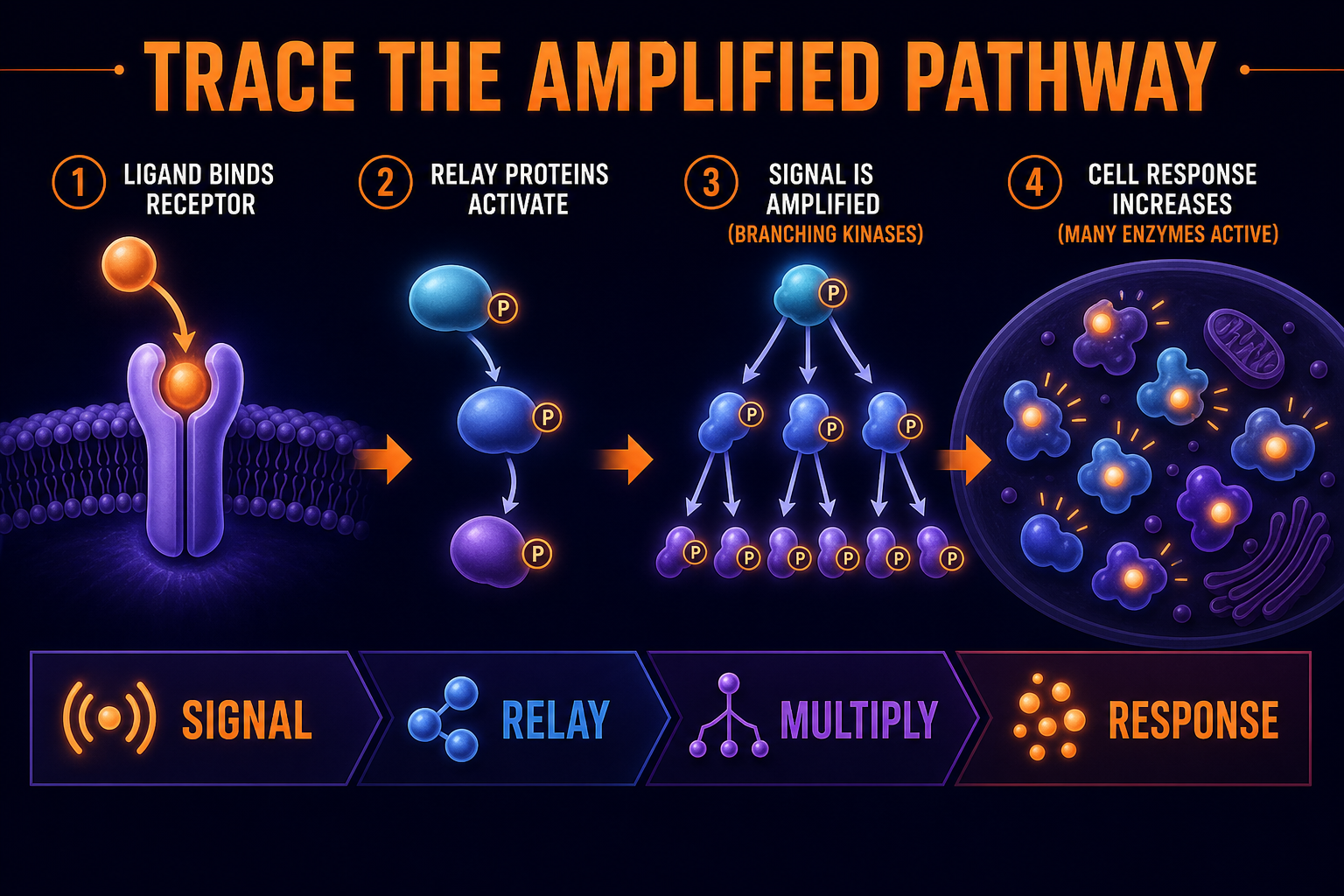
Name the ligand and where it binds.
Describe transduction starting after reception.
Show branching or cascade logic.
State the final outcome the cell produces.
When ___ binds to ___, the receptor ___. This activates ___, which amplifies the signal by ___. The final response is larger because ___.
Fix: The intracellular response gets larger, not the ligand.
Fix: Amplification begins after reception activates a pathway.
Fix: Amplification often uses relay proteins, second messengers, or kinases.
Fix: Kinase cascades are a major amplification mechanism.
Fix: Different pathways vary in strength, speed, and targets.
Fix: Always connect amplification to a cellular outcome.
Revealed: 0 of 4 scenarios
One hormone molecule causes activation of many enzyme molecules.
Answer: This is signal amplification because one signal produces many activated targets.
A receptor activates a protein that activates several more proteins.
Answer: This shows relay protein amplification inside a signal transduction pathway.
Many small intracellular molecules spread after receptor activation.
Answer: These are likely second messengers amplifying the signal.
A kinase activates several downstream kinases.
Answer: This is a phosphorylation cascade that amplifies the pathway.
Answer all eight questions. Choices shuffle on reload—focus on amplification logic, not letter memorization.
More drills: Unit 4 practice questions, practice by topic, or daily AP Biology practice.
Open each card, draft your response, then reveal the rubric and sample. For more free-response practice, open the Unit 4 FRQ guide.
A hormone binds to a receptor on a target cell. After binding, the pathway activates many intracellular enzymes and produces a large response.
When the hormone binds the receptor, reception occurs. The activated receptor triggers signal transduction, and relay proteins or second messengers multiply the signal so many intracellular enzymes become active. This amplification lets a small amount of hormone produce a large cellular response. If the receptor failed to activate relay proteins, the pathway would not spread efficiently and the cell would show a weak or incomplete response despite hormone binding.
Status: Draft your answer first—then open the rubric or sample.
A signaling pathway uses a phosphorylation cascade. One active kinase activates several molecules of the next kinase.
The pathway amplifies the signal because each active kinase phosphorylates and activates several molecules of the next kinase, so the number of active proteins increases at each step. Phosphorylation adds phosphate groups that change target protein shape or activity, propagating the signal. If one kinase is blocked, downstream kinases and targets would not activate efficiently, so the final cellular response would be much smaller or absent.
Status: Draft your answer first—then open the rubric or sample.
Signal amplification is when one signaling event activates many downstream molecules. This allows a small external signal to produce a large cellular response. AP Biology often tests this in signal transduction pathways.
Signal amplification lets cells respond strongly even when only a small amount of signal is present. It makes pathways more efficient because one receptor event can activate many internal targets. This is especially useful for hormone and enzyme responses.
Signal amplification usually happens during transduction, after a ligand binds to a receptor. The receptor activates relay proteins, second messengers, or kinases inside the cell. The signal becomes larger as it moves through the pathway.
Second messengers can be produced in large numbers after receptor activation. Because they are small and mobile, they can spread through the cytoplasm and activate many target proteins. This helps multiply the original signal.
In a phosphorylation cascade, one kinase can activate several downstream proteins. Each activated protein can then activate even more targets. This step-by-step multiplication increases the final response.
No. Signal amplification does not make the ligand itself stronger. It increases the intracellular response triggered by the ligand-receptor interaction.
Signal transduction is the full process of passing a signal inside the cell. Signal amplification is one feature of some transduction pathways where the signal becomes multiplied. Not every pathway amplifies to the same degree.
A common example is a hormone binding to one receptor and activating a cascade of intracellular proteins. Another example is a kinase cascade where each kinase activates several downstream proteins. Both examples produce a larger response than the original signal alone.
FRQs often ask students to explain how one signal causes a large response. A strong answer names the receptor, the relay pathway, and the amplification mechanism. It should also connect amplification to the final cellular response.
If amplification fails, the cell may produce a weak or incomplete response. A receptor may bind normally, but downstream targets may not activate enough to change cell behavior. AP Biology questions may ask you to predict this kind of pathway consequence.