Steroid hormone
Intracellular receptor is likely.
AP Biology · Unit 4 Phase 2 Deep Dive
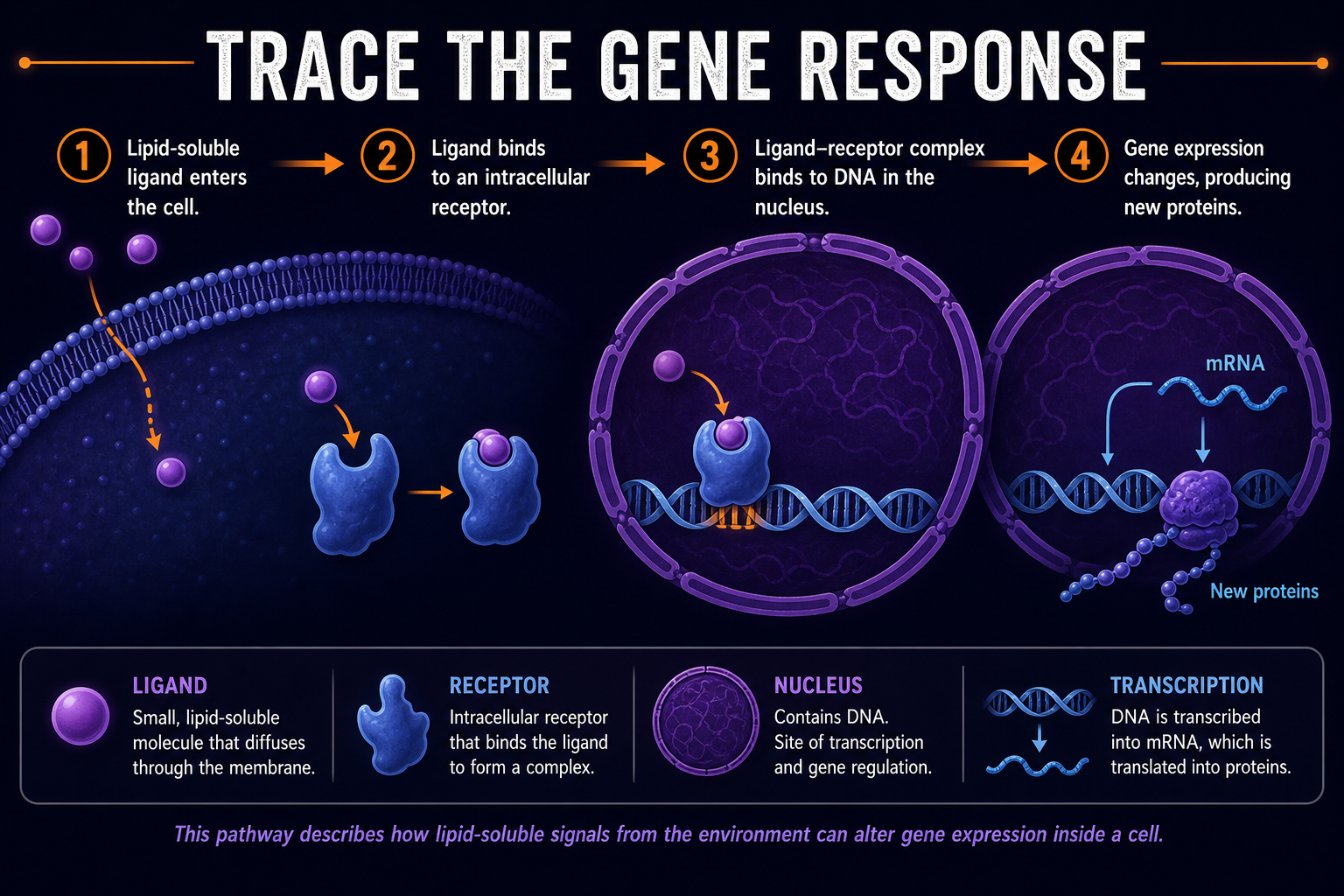
Intracellular receptors are receptors located inside the cell, often in the cytoplasm or nucleus. They usually bind small nonpolar ligands, such as steroid hormones, that can cross the plasma membrane. In AP Biology Unit 4, the key skill is explaining how ligand entry, receptor binding, nuclear movement, and gene expression produce a slower but often longer-lasting cellular response.
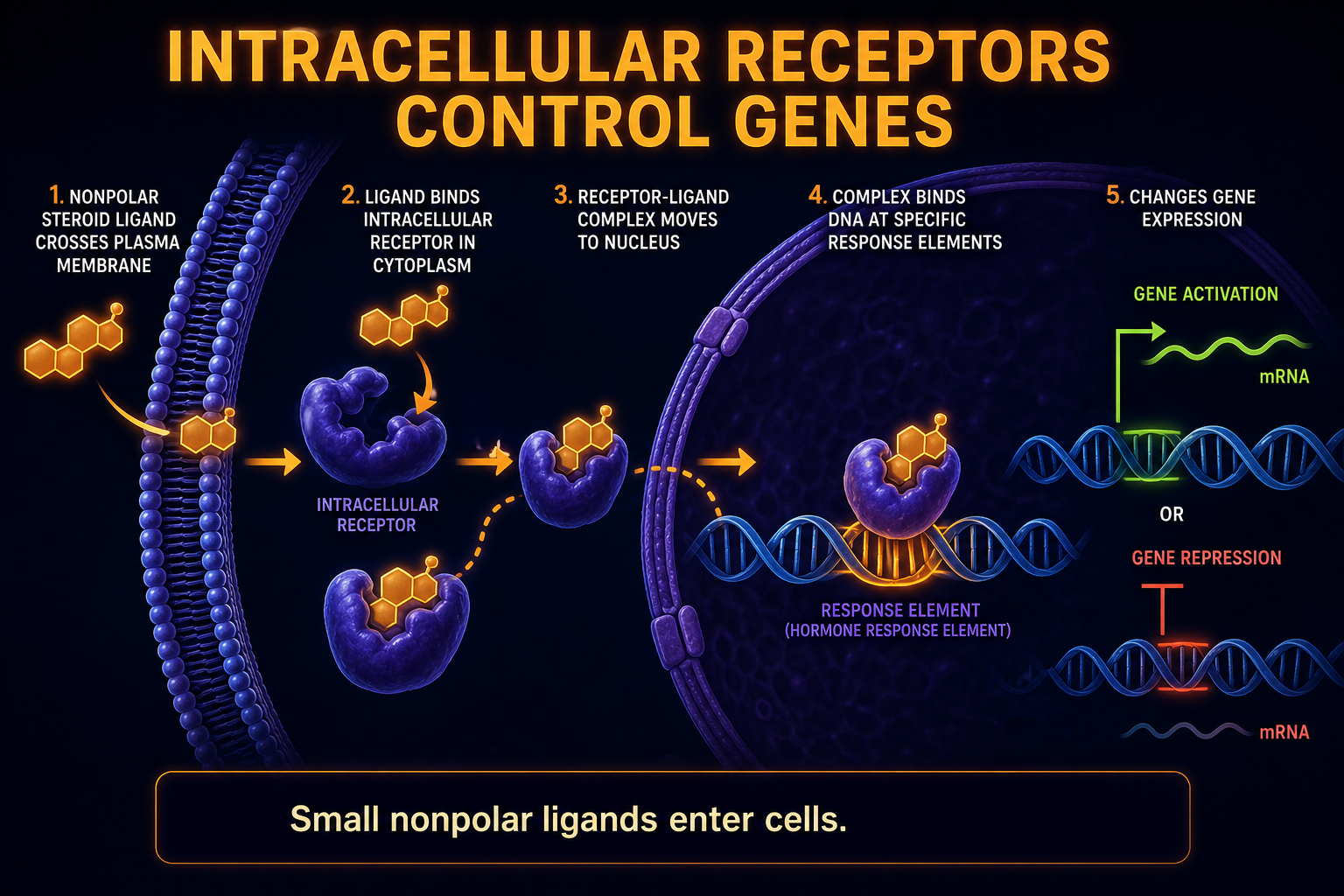
The receptor deep-dive pages show different ways cells receive signals. GPCRs activate G proteins, RTKs dimerize and phosphorylate, ion channel receptors change ion flow, and intracellular receptors bind ligands inside the cell. Intracellular receptors are especially important because they connect cell signaling to gene expression.
Intracellular Receptors
Steroid and gene-expression signals.
Core guide: Ligands and Receptors. Related: Reception, Transduction, Response.
Intracellular receptors are receptors located inside the cell that bind ligands able to cross the plasma membrane. Many intracellular receptor ligands are small, nonpolar, or lipid-soluble, such as steroid hormones. After binding, the receptor-ligand complex can affect gene expression by interacting with DNA or transcription-related proteins.
Intracellular receptors let lipid-soluble signals control gene expression.
Check each pathway step in order to see whether gene expression changes.
No gene expression change yet.
Response: No response
Intracellular receptors are receptor proteins found inside the cell rather than on the cell surface. Some are in the cytoplasm, while others are in the nucleus. They bind ligands that can pass through the plasma membrane.
On the cell communication guide, you learned that target cell response depends on which receptor a cell has. Intracellular receptors explain how some hormones change long-term cell behavior by regulating genes, not only by opening channels or activating G proteins.
Connect reception location to pathway logic on reception, transduction, and response. For intracellular receptors, reception can occur inside the cell after a lipid-soluble ligand crosses the membrane.
An intracellular receptor binds a signal inside the cell.
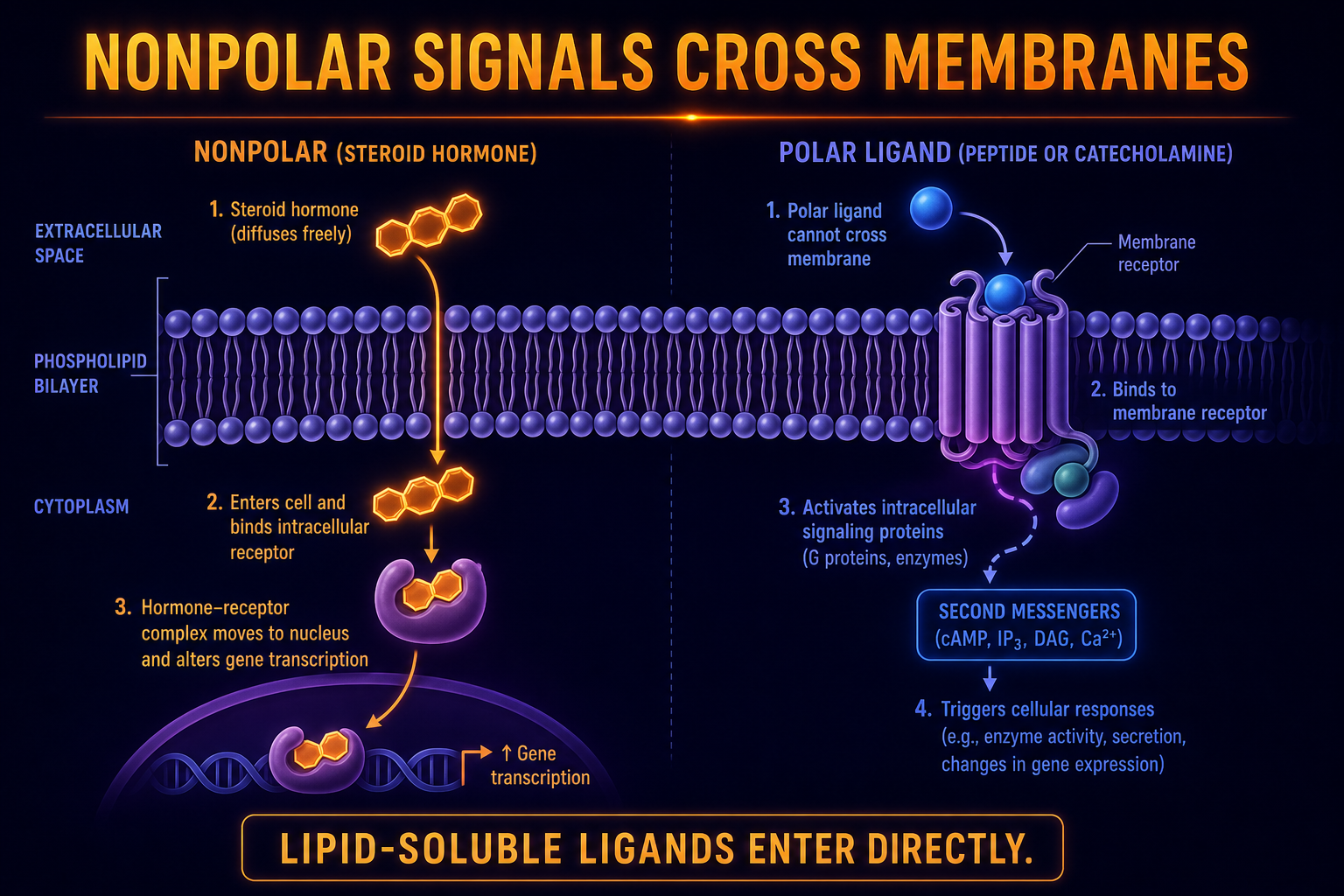
The plasma membrane has a hydrophobic interior, so small nonpolar molecules can often cross more easily than large polar molecules. Steroid hormones are common examples of lipid-soluble signals. Polar ligands usually need surface receptors because they cannot easily pass through the membrane.
Some small nonpolar ligands, such as steroid hormones, can cross the plasma membrane and bind intracellular receptors instead of surface receptors. Review ligands and receptors when you match signal chemistry to receptor location.
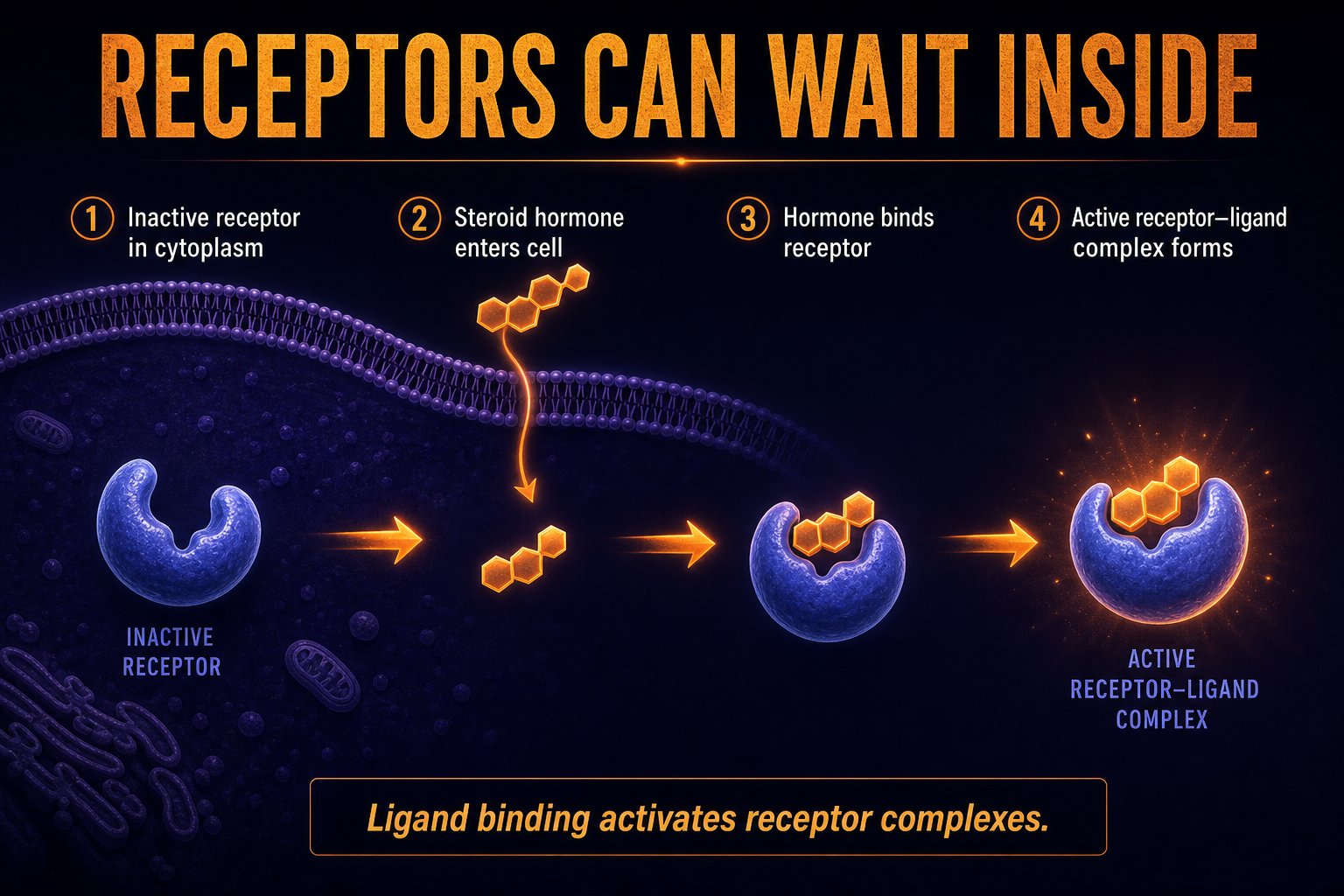
Some intracellular receptors wait in the cytoplasm until the ligand enters the cell. When the ligand binds, the receptor changes shape and forms an active receptor-ligand complex. This complex may then move into the nucleus to affect gene expression.
Some intracellular receptors are already located in the nucleus. When the ligand binds, the receptor can interact with DNA or proteins involved in transcription. This allows the signal to change which genes are expressed.
Nuclear receptors connect signaling directly to transcription control.
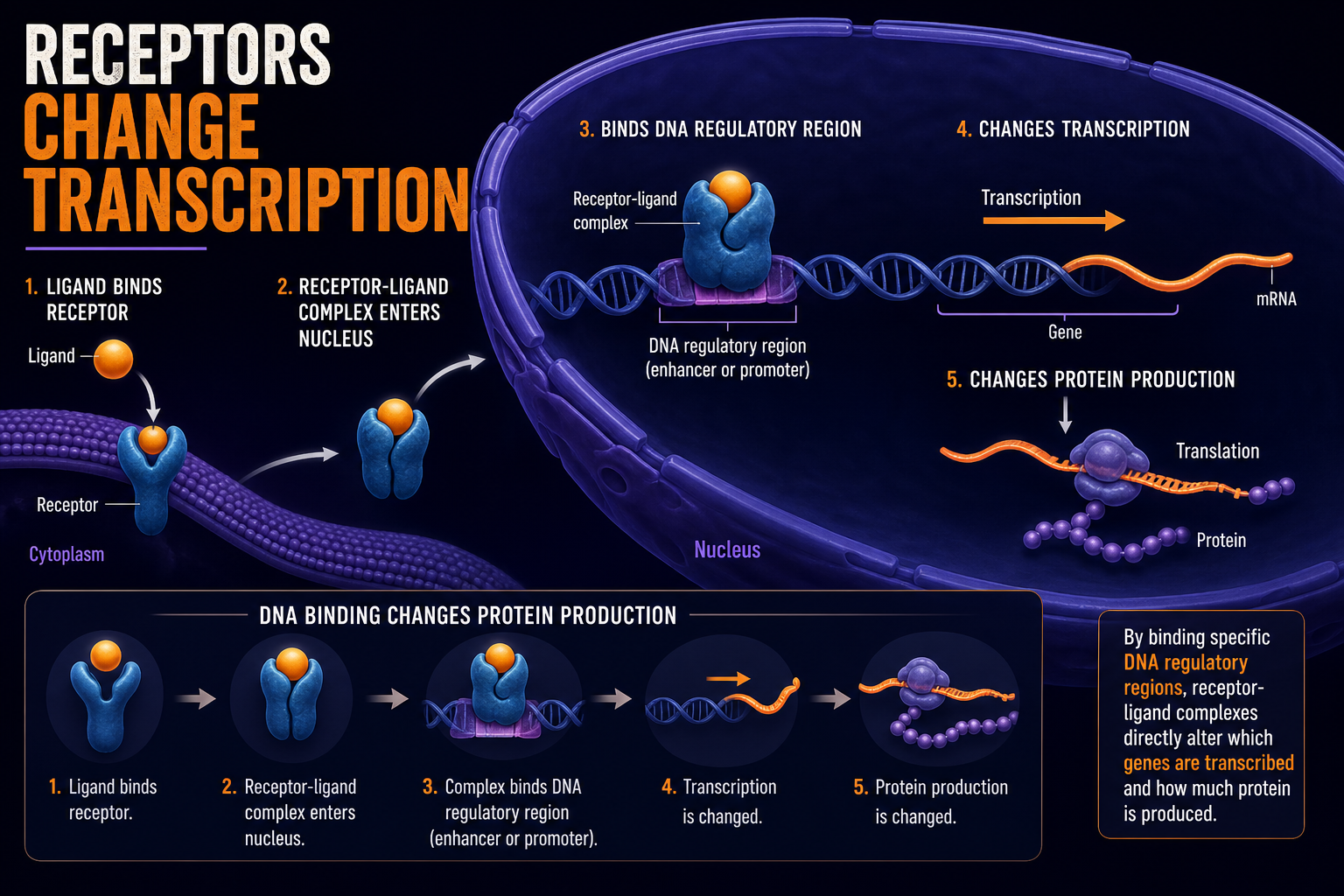
A receptor-ligand complex can act as a transcription regulator. It may increase or decrease transcription of specific genes, which changes the amount of certain proteins made by the cell. This is why intracellular receptor responses can affect long-term cell behavior.
The same story often appears on FRQs: ligand entry, receptor binding, nuclear action, and changed protein production. Map how different receptor types fit together on cell signaling pathways.
Intracellular receptor pathways often affect transcription and protein production. Because making RNA and proteins takes time, the response may be slower than opening an ion channel. However, the response can also last longer because it changes gene expression.
Practice predictions on the Unit 4 practice questions page and written tracing on the Unit 4 FRQ guide.
Membrane receptors detect signals outside the cell and start transduction pathways across the membrane. Intracellular receptors bind signals after those signals enter the cell. AP Biology often tests whether students recognize which ligands require surface receptors and which can cross the membrane.
Intracellular receptors differ from ion channel receptors because they usually regulate gene expression rather than directly changing ion flow. Unlike GPCRs, intracellular receptors bind ligands inside the cell and often regulate transcription. Unlike receptor tyrosine kinases, intracellular receptors do not need a membrane-spanning receptor when the ligand can cross the membrane.
| Receptor type | Ligand location | Main mechanism | AP clue |
|---|---|---|---|
| Intracellular receptor | Inside cell | Changes gene expression | steroid, nonpolar, nucleus |
| GPCR | Outside cell | Activates G protein | GDP/GTP, cAMP |
| RTK | Outside cell | Dimerizes and phosphorylates | tyrosine, kinase |
| Ion channel receptor | Outside cell | Opens or closes channel | ion flow, membrane potential |
Intracellular receptor is likely.
The signal may cross the membrane.
Intracellular receptor pathway.
Gene expression regulation.
Nuclear receptor or intracellular receptor response.
A membrane receptor is more likely.
Name lipid-soluble or nonpolar chemistry.
Cytoplasm or nucleus.
Activation and nuclear movement if needed.
Finish with gene expression outcome.
Because ___ is lipid-soluble, it can ___. It binds ___ inside the cell. The receptor-ligand complex then ___, causing ___.
Fix: Some receptors are inside the cytoplasm or nucleus.
Fix: Polar ligands usually need surface receptors.
Fix: Many intracellular receptors affect transcription.
Fix: Steroid hormones can enter cells; cAMP is a second messenger made inside the cell.
Fix: Gene expression responses can be slower but longer lasting.
Fix: Usually the receptor-ligand complex affects DNA or transcription.
Answer all eight questions. Choices shuffle on reload—trace the pathway, not the letter.
More drills: Unit 4 practice questions or the Unit 4 FRQ guide.
Open each card, draft your response, then reveal the rubric and sample.
A steroid hormone enters a target cell and binds to a receptor in the cytoplasm. The receptor-ligand complex moves into the nucleus and changes transcription of a gene.
The steroid hormone is lipid-soluble and nonpolar, so it can pass through the hydrophobic interior of the plasma membrane into the cytoplasm. The intracellular receptor binds the hormone and changes shape, forming an active receptor-ligand complex. When the complex enters the nucleus, it can bind DNA or transcription regulators and change transcription of the target gene. If the complex cannot enter the nucleus, DNA binding and transcription may not change normally, so the long-term cellular response may be reduced or absent.
Status: Draft your answer first—then open the rubric or sample.
A polar signaling molecule and a nonpolar steroid hormone are both released near a target cell.
The nonpolar steroid hormone is more likely to bind an intracellular receptor because it can cross the plasma membrane and bind a receptor inside the cell. The polar signaling molecule likely needs a membrane receptor because it cannot easily pass through the hydrophobic bilayer. The steroid pathway often changes transcription and protein production, so the response may be slower but can last longer. The polar signal may use a faster membrane pathway such as ion channels or second messengers, producing a quicker cellular change.
Status: Draft your answer first—then open the rubric or sample.
Intracellular receptors are receptors found inside the cell, usually in the cytoplasm or nucleus. They bind ligands that can cross the plasma membrane. Many examples involve steroid hormones or other lipid-soluble signals.
Steroid hormones are small and nonpolar, so they can pass through the hydrophobic interior of the plasma membrane. Once inside, they can bind receptors in the cytoplasm or nucleus. This is different from many polar signals that need membrane receptors.
Intracellular receptors can be located in the cytoplasm or the nucleus. A cytoplasmic receptor may move into the nucleus after ligand binding. A nuclear receptor can affect transcription more directly.
A receptor-ligand complex can bind DNA or interact with transcription machinery. This can increase or decrease transcription of specific genes. The result is a change in protein production.
No. Intracellular receptors are inside the cell, while membrane receptors are embedded in the plasma membrane. The type of receptor depends partly on whether the ligand can cross the membrane.
GPCRs are membrane receptors that activate G proteins and often use second messengers. Intracellular receptors bind ligands inside the cell and often affect gene expression. The location and mechanism are different.
Ion channel receptors open or close channels for ions and can create fast responses. Intracellular receptors usually regulate transcription, which can take longer. Both are signal receptors, but they change the cell in different ways.
If the receptor is blocked, the ligand may enter the cell but fail to activate gene regulation. Transcription of target genes may not change normally. The final cellular response may be reduced or absent.
Many intracellular receptor pathways change transcription and protein production. These steps take longer than opening an ion channel or activating a short relay pathway. The response may be slower but can last longer.
Trace the pathway in order: ligand crosses the membrane, binds an intracellular receptor, forms a receptor-ligand complex, and changes gene expression. Explain why the ligand can cross the membrane. Then predict what happens if receptor binding, nuclear entry, or DNA binding is blocked.