Prophase
chromosomes condense
AP Biology · Unit 4 Learning Journey
The cell cycle is the ordered sequence of events that lets a cell grow, copy DNA, and divide. Interphase prepares the cell through G1, S phase, and G2, while mitosis and cytokinesis create daughter cells. In AP Biology Unit 4, the key skill is explaining how checkpoints and signals control whether the cycle continues or stops.
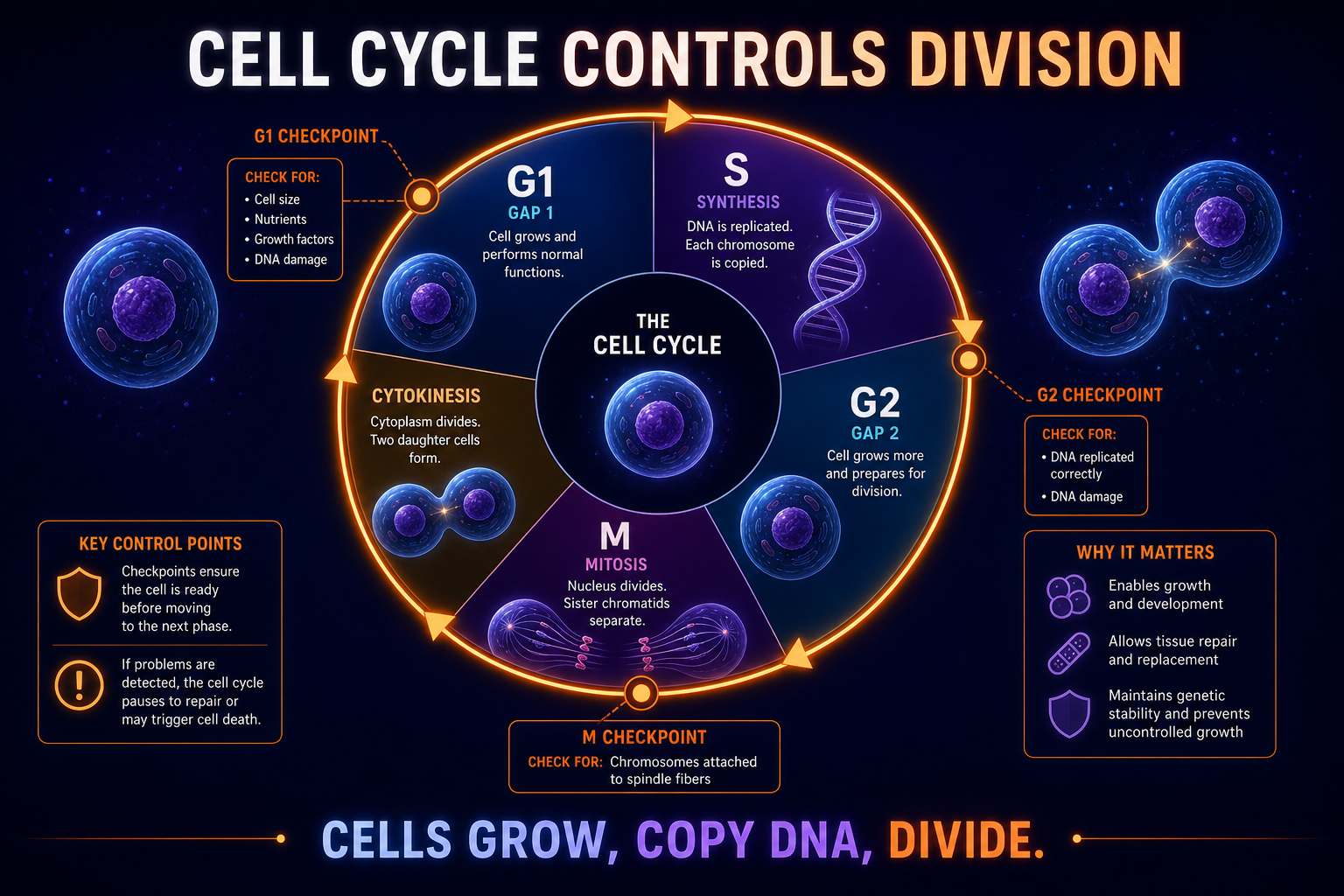
The previous guide, Positive Feedback, finished the feedback-loop part of Unit 4. This page begins the cell-cycle part of the unit by showing how cells move through growth, DNA replication, mitosis, and cytokinesis. After this page, study Cell Cycle Checkpoints to understand how cells decide whether it is safe to continue dividing.
Cell Cycle
Growth, DNA copying, and division.
The cell cycle is the ordered process a cell follows to grow, copy its DNA, and divide. It includes interphase, made of G1, S phase, and G2, followed by M phase and cytokinesis. AP Biology tests whether students can connect cell-cycle phases to checkpoints, regulation, DNA replication, mitosis, and cancer.
The cell cycle grows cells, copies DNA, and divides cells.
G1 is the first growth phase. The cell grows, performs normal functions, and checks whether conditions are right for DNA replication.
S phase is when DNA is replicated. Each chromosome is copied so sister chromatids can later separate during mitosis.
G2 is the final preparation phase before mitosis. The cell checks DNA replication and prepares division machinery.
M phase includes mitosis, where the nucleus divides. Chromosomes are separated into two nuclei.
Cytokinesis divides the cytoplasm and produces two daughter cells. It usually follows mitosis.
Checkpoints are control points that stop or delay the cell cycle if DNA damage, incomplete replication, or spindle problems are detected.
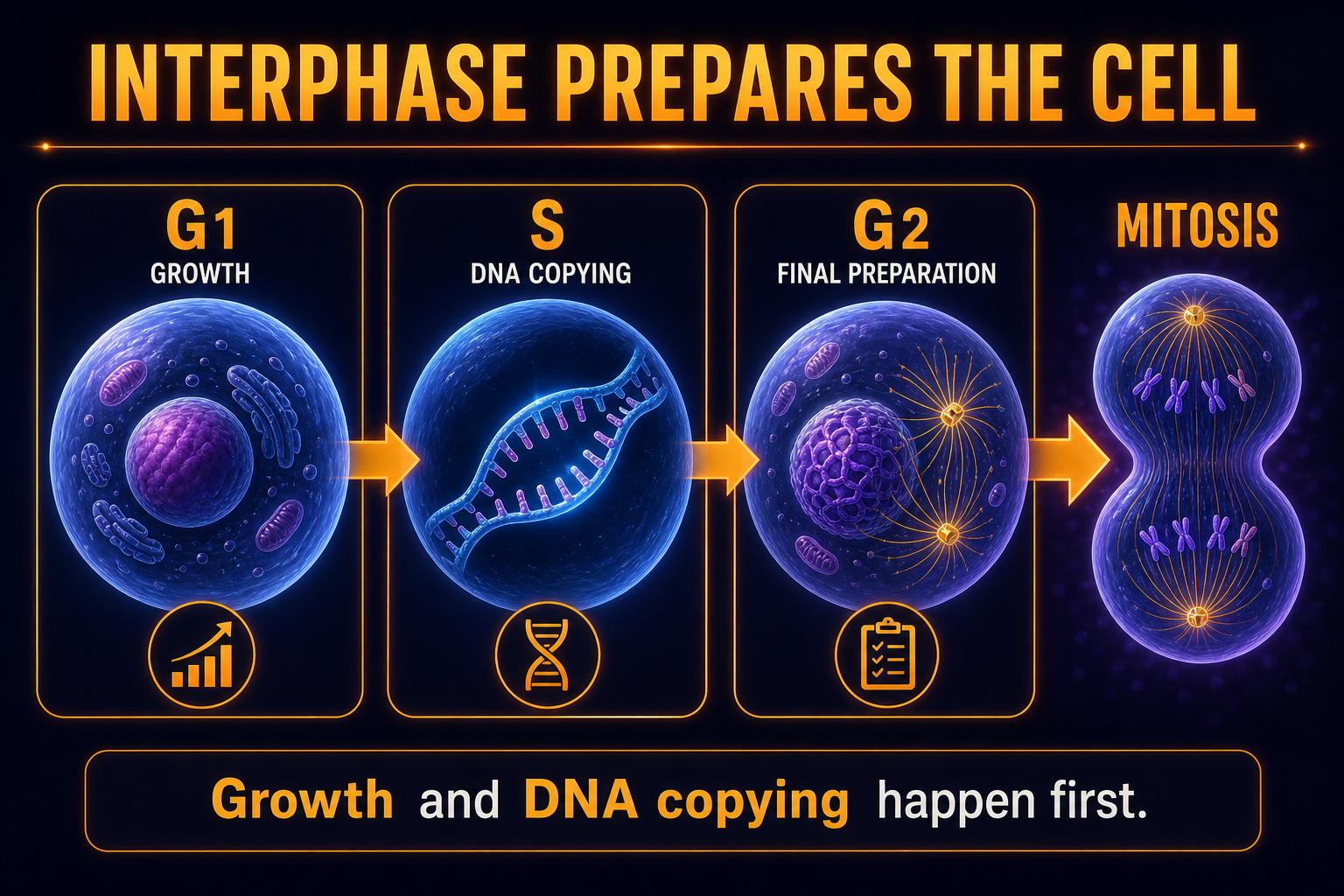
Interphase is the longest part of the cell cycle for many cells. During interphase, the cell grows, copies DNA, and prepares for mitosis. AP Biology often tests interphase by asking which phase includes DNA replication or cell growth.
For a phase-by-phase breakdown of G1, S, G2, M phase, and cytokinesis, use the Cell Cycle Phases guide.
Signaling from cell communication and feedback mechanisms can influence whether a cell commits to division during interphase.
Interphase is not resting; it prepares the cell for division.
G1 is the first growth phase after cell division. The cell increases in size, performs normal functions, and receives signals that influence whether it should continue toward DNA replication. The G1 checkpoint is important because it helps prevent damaged or unready cells from entering S phase.
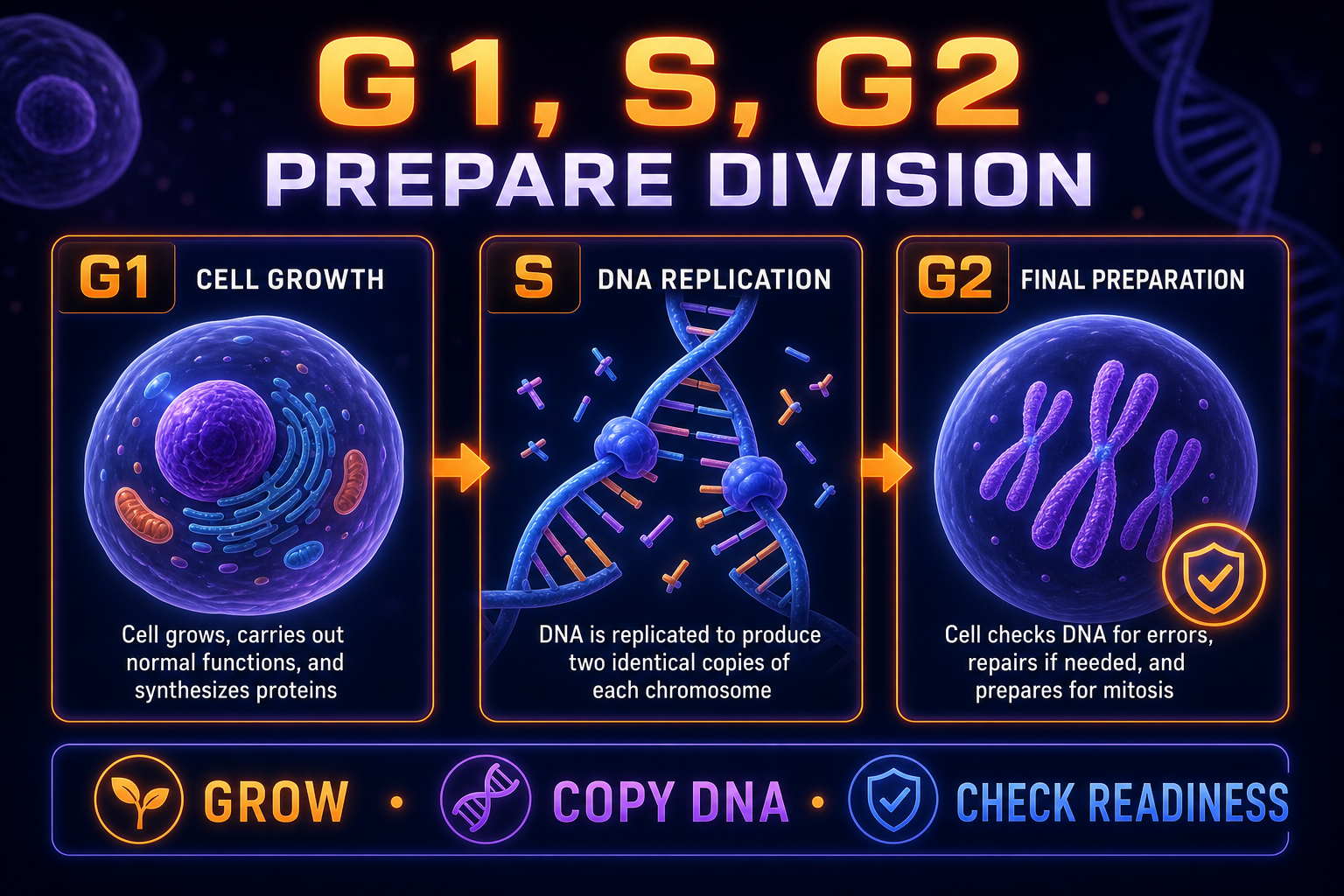
S phase is when DNA replication occurs. Each chromosome is copied to form sister chromatids. This matters because mitosis later separates those sister chromatids into daughter cells.
S phase copies DNA before mitosis.
G2 is the second growth phase and final preparation stage before mitosis. The cell checks whether DNA replication is complete and whether DNA damage is present. If problems are found, the cell cycle can pause for repair before entering M phase.
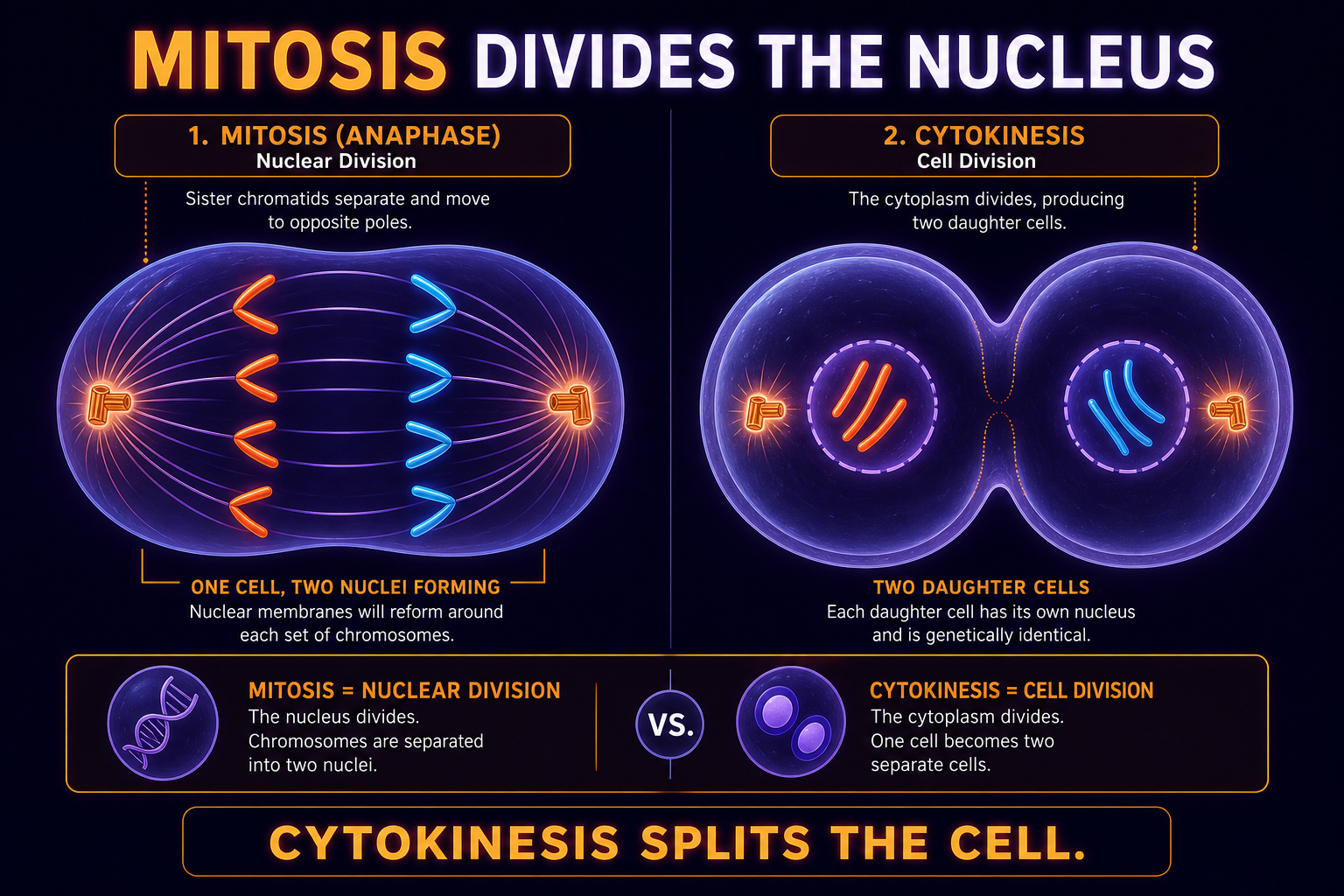
M phase includes mitosis, the process that divides the nucleus. During mitosis, chromosomes condense, line up, separate, and form two nuclei. AP Biology often asks students to connect mitosis with chromosome movement and daughter-cell formation.
For a deeper look at chromosome separation during M phase, review Mitosis in the Cell Cycle.
chromosomes condense
chromosomes line up
sister chromatids separate
nuclei reform
Cytokinesis is the division of the cytoplasm after mitosis. In animal cells, the membrane pinches inward. In plant cells, a cell plate forms. Cytokinesis produces two daughter cells after nuclear division is complete.
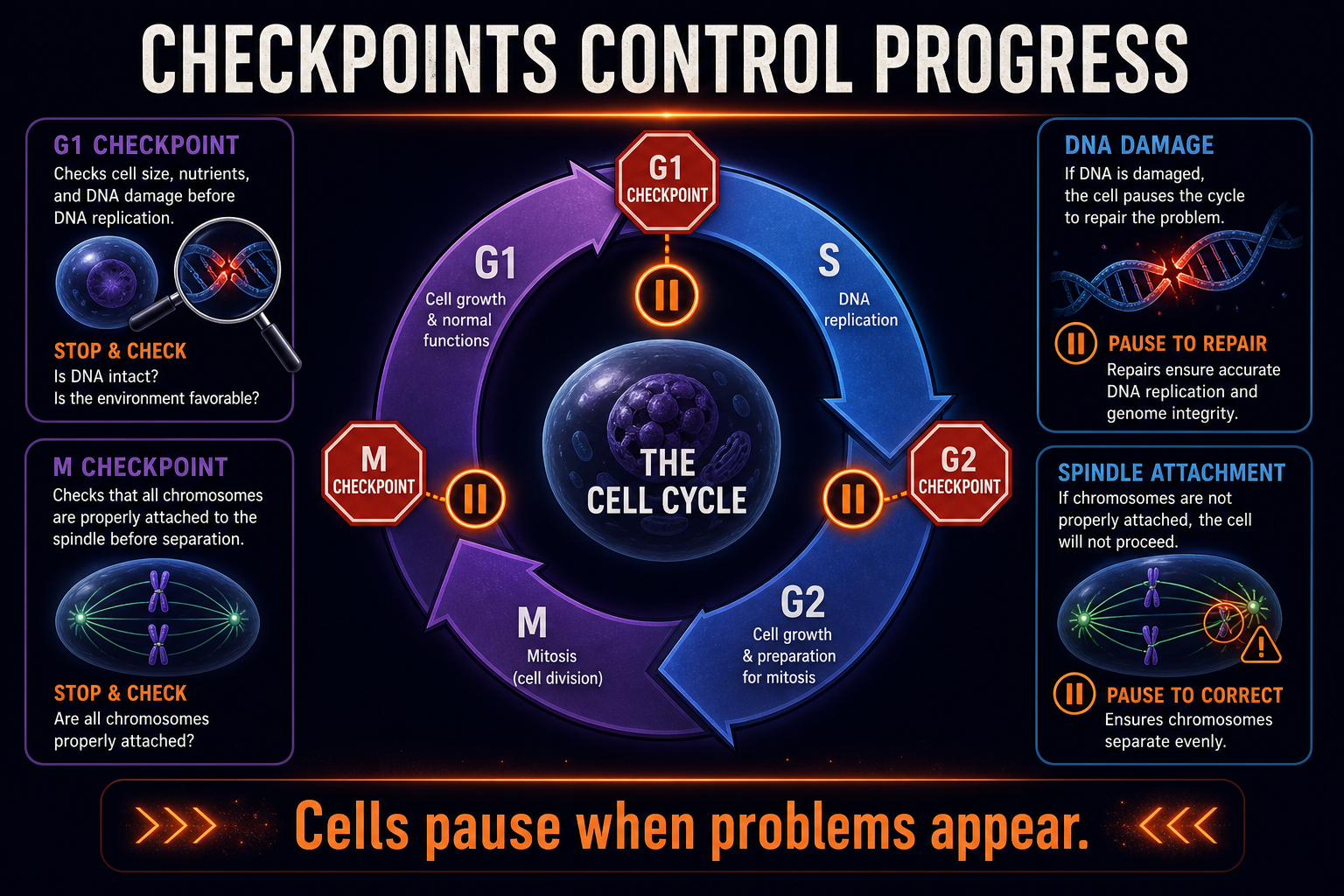
Checkpoints are control points that help determine whether the cell cycle should continue. The G1 checkpoint checks growth conditions and DNA damage, the G2 checkpoint checks DNA replication, and the M checkpoint checks spindle attachment. These checkpoints reduce the chance that damaged cells divide.
For a deeper look at each control point, see the cell cycle checkpoints guide and how cyclins and CDKs regulate progression.
Cancer can result when cell-cycle regulation fails. If growth signals stay active, checkpoints are bypassed, tumor suppressor genes fail, or damaged cells avoid apoptosis, cells may divide uncontrollably. AP Biology questions often ask students to explain cancer as failed regulation, not just fast cell division.
Study cancer and cell cycle regulation for mutation scenarios, and apoptosis for how programmed cell death removes damaged cells.
S phase is being tested.
G1 phase is likely.
G2 phase is likely.
Anaphase of mitosis is likely.
M checkpoint is being tested.
Cancer or failed regulation may be involved.
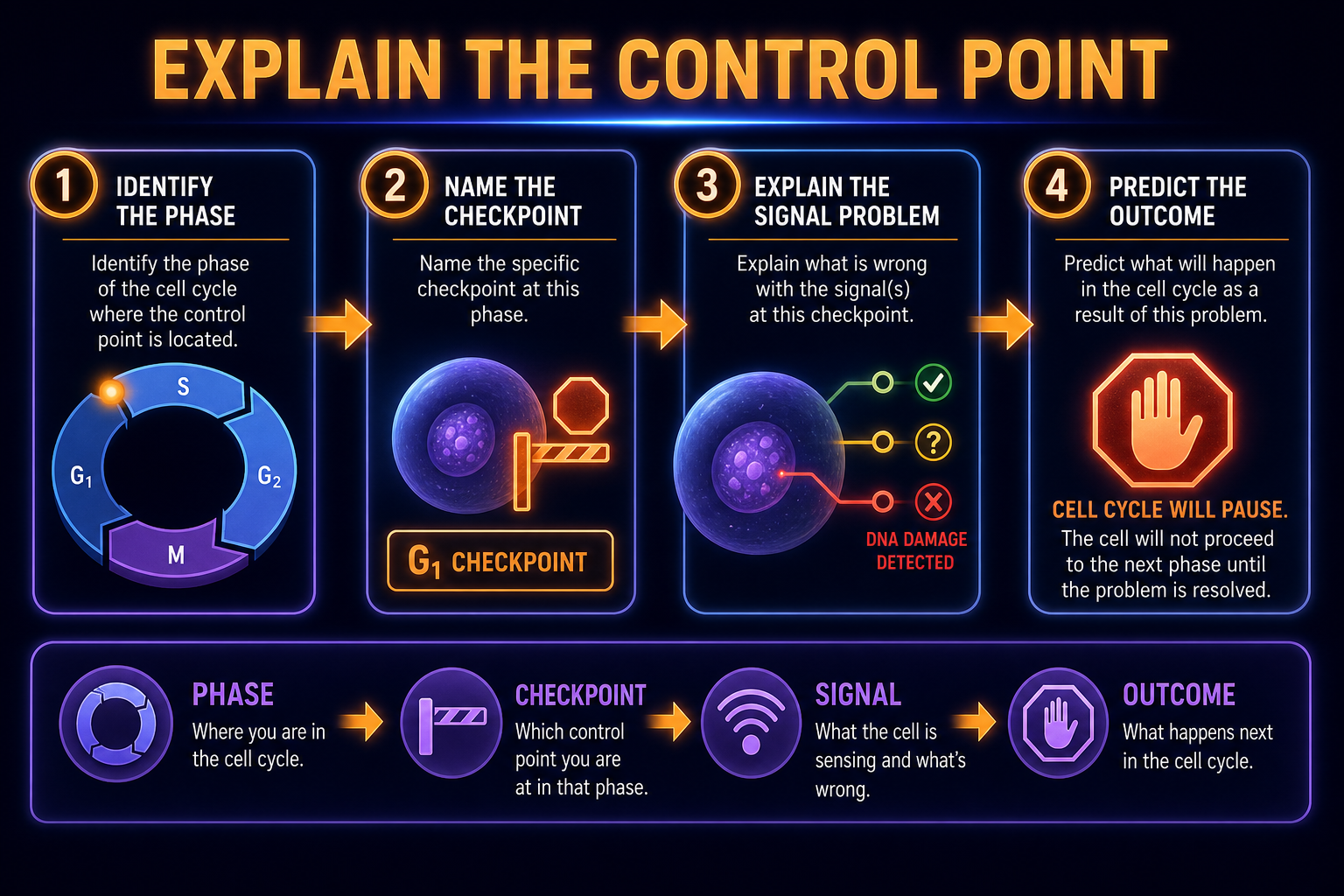
Name where the event occurs.
Describe what normally happens there.
Explain what controls progression.
Describe what changes if regulation fails.
During ___ phase, the cell ___. The checkpoint matters because ___. If this control fails, the result may be ___.
Fix: Interphase includes growth, DNA replication, and preparation.
Fix: DNA replication happens during S phase before mitosis.
Fix: Mitosis divides the nucleus; cytokinesis divides the cell.
Fix: Cell-cycle progression is regulated, not automatic.
Fix: Cancer involves failed regulation of growth, checkpoints, apoptosis, or signaling.
Fix: Mitosis makes body cells; meiosis makes gametes.
Revealed: 0 of 4 scenarios
A cell copies all of its DNA before division.
Answer: This happens during S phase.
A cell checks whether DNA is damaged before copying it.
Answer: This is connected to G1 checkpoint control.
Sister chromatids move to opposite sides of the cell.
Answer: This happens during anaphase of mitosis.
A checkpoint fails and a cell with damaged DNA keeps dividing.
Answer: This can contribute to cancer because regulation has failed.
Answer all eight questions. Choices shuffle on reload—focus on phase logic, not letter memorization.
More drills: Unit 4 practice questions, practice by topic, or daily AP Biology practice.
Open each card, draft your response, then reveal the rubric and sample. For more free-response practice, open the Unit 4 FRQ guide.
A cell receives signals to divide and enters the cell cycle. Before mitosis, it must grow, copy DNA, and check whether DNA replication is complete.
DNA replication occurs during S phase. The G2 checkpoint matters because it checks whether DNA replication is complete and whether damage is present before mitosis begins. If DNA damage is not repaired before division, daughter cells may inherit mutations, which can contribute to failed regulation and cancer over time.
Status: Draft your answer first—then open the rubric or sample.
A mutation causes a cell-cycle checkpoint protein to stop functioning. Cells with damaged DNA continue dividing.
A cell-cycle checkpoint normally pauses the cycle when DNA is damaged, replication is incomplete, or spindle attachment is incorrect. If a checkpoint fails, cells with damaged DNA may still divide, passing errors to daughter cells. Over time, accumulated mutations and loss of control can lead to unregulated division characteristic of cancer.
Status: Draft your answer first—then open the rubric or sample.
The cell cycle is the ordered sequence of events that lets a cell grow, copy DNA, and divide. It includes interphase, mitosis, and cytokinesis. AP Biology focuses on how the cycle is regulated by checkpoints and signals.
The main phases are G1, S phase, G2, M phase, and cytokinesis. G1, S, and G2 make up interphase. M phase includes mitosis, and cytokinesis divides the cytoplasm.
Interphase is when the cell grows, copies DNA, and prepares for division. It includes G1, S phase, and G2. It is not a resting phase because major preparation events happen there.
S phase is when DNA replication occurs. Each chromosome is copied to form sister chromatids. This prepares chromosomes to separate properly during mitosis.
Mitosis divides the nucleus and separates chromosomes into two nuclei. Cytokinesis divides the cytoplasm and produces two daughter cells. They are related but not the same process.
Checkpoints help the cell decide whether it is safe to continue the cycle. They can pause the cycle if DNA is damaged, replication is incomplete, or spindle attachment is incorrect. This helps prevent damaged cells from dividing.
Cancer can happen when cell-cycle regulation fails. Cells may divide even when DNA is damaged or growth signals are abnormal. AP Biology answers should explain the failed control mechanism, not just say cells divide quickly.
The G1 checkpoint checks whether the cell is ready to copy DNA. It responds to cell size, nutrients, signals, and DNA damage. If conditions are not safe, the cell may pause instead of entering S phase.
The M checkpoint checks whether chromosomes are correctly attached to spindle fibers. This helps ensure sister chromatids separate properly. If the checkpoint fails, daughter cells may receive abnormal chromosome numbers.
Start by naming the phase or checkpoint involved. Then explain what normally happens at that step and predict what changes if regulation fails. Strong answers connect checkpoints to DNA damage, chromosome separation, or cancer risk.