Growth and division
Cells need signals to know when to grow or divide.
AP Biology · Unit 4 Learning Journey
Cell communication explains how cells send, receive, and respond to information. In AP Biology Unit 4, this topic matters because a signal outside a cell can change enzyme activity, gene expression, secretion, movement, growth, or division inside the cell.
The Unit 4 hub introduces the full cell communication and cell cycle sequence on the AP Biology course. This page starts the first major idea: how cells communicate. Next, study ligands and receptors, then reception, transduction, and response. Later guides connect signaling to feedback mechanisms, the cell cycle, and cell-cycle checkpoints.

Cell Communication
How cells send and receive signals.
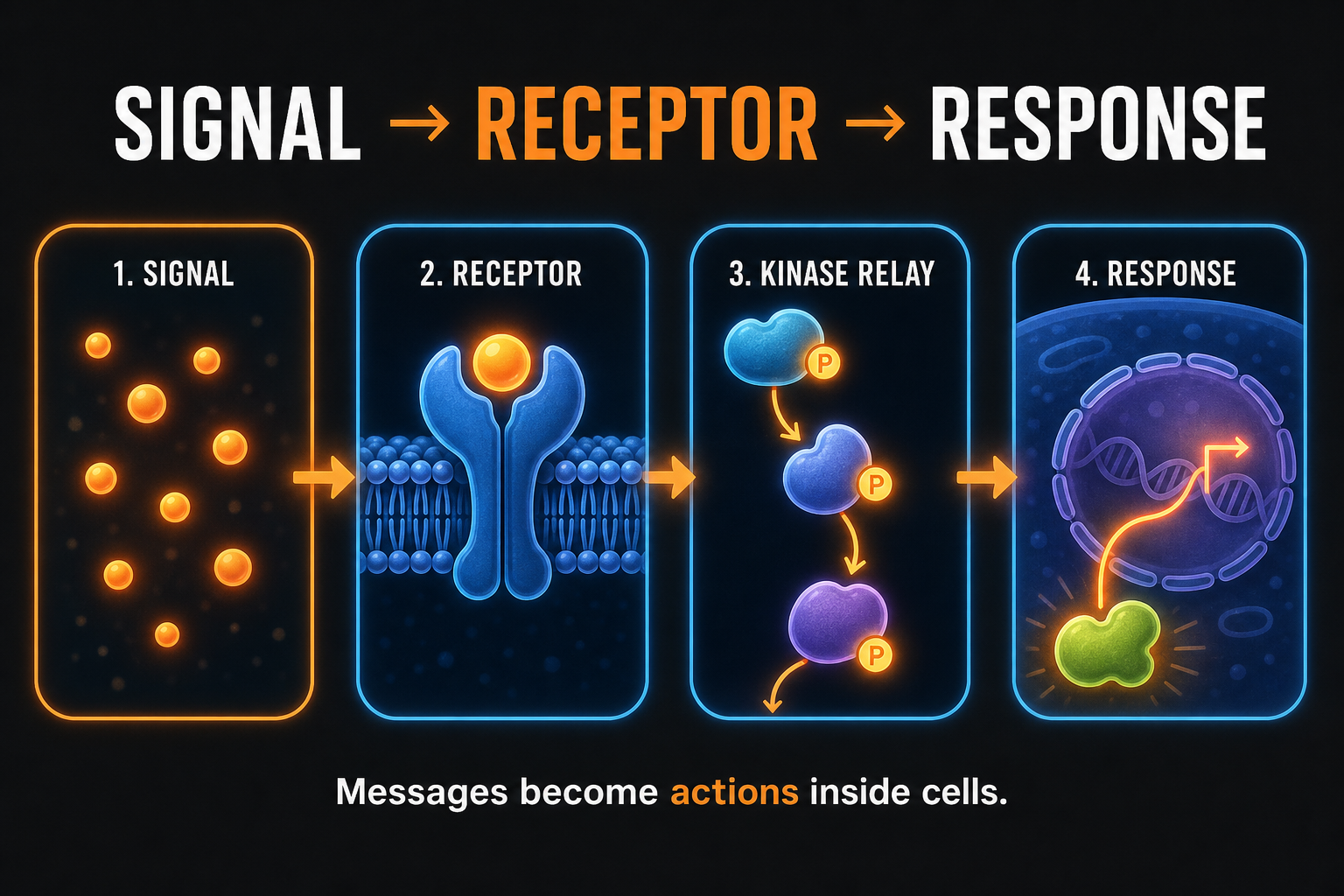
Cell communication is the process by which cells send, receive, and respond to signals. A signaling cell releases or displays a signal, a target cell detects that signal using a receptor, and the target cell produces a response. In AP Biology, students must explain the pathway from signal to receptor to response, not just memorize vocabulary.
Cell communication means cells use signals to coordinate responses.
A signal is information sent by one cell or the environment. Signals can be hormones, neurotransmitters, growth factors, or other molecules.
A receptor is a protein that detects a specific signal. Only cells with the matching receptor can respond.
A target cell is a cell that has the receptor needed to detect a signal.
A pathway relays the signal inside the cell, often using protein changes, phosphorylation, or second messengers.
A response is the cell’s action, such as changing gene expression, enzyme activity, secretion, movement, or division.
Cells communicate because multicellular organisms need coordination. Cells must know when to grow, divide, repair tissue, respond to infection, release hormones, open ion channels, or change gene expression. Receptors are proteins, so receptor shape connects to Unit 1 protein structure. Phosphorylation connects signaling to ATP from Unit 3. Growth signals can affect cell-cycle checkpoints.
Cells need signals to know when to grow or divide.
Immune cells coordinate attacks with chemical signals.
Endocrine signals regulate distant tissues.
Neurons use neurotransmitters at synapses.
Feedback loops use signals to stabilize variables.
Signals guide differentiation and tissue formation.
Quick answer: Only target cells respond because they have the receptor that matches the signal. Cells without the receptor usually cannot detect the signal or start the pathway.

| Term | Meaning | AP clue |
|---|---|---|
| Signal | Message molecule | What information is being sent? |
| Receptor | Protein that detects signal | Which cell can receive it? |
| Target cell | Cell with matching receptor | Which cell responds? |
| Response | Final cell action | What changed inside the cell? |
Many receptors sit at the plasma membrane, which ties Unit 4 to selective permeability in Unit 2.
Target cell response can also depend on receptor location; intracellular receptors respond to ligands that can cross the plasma membrane.
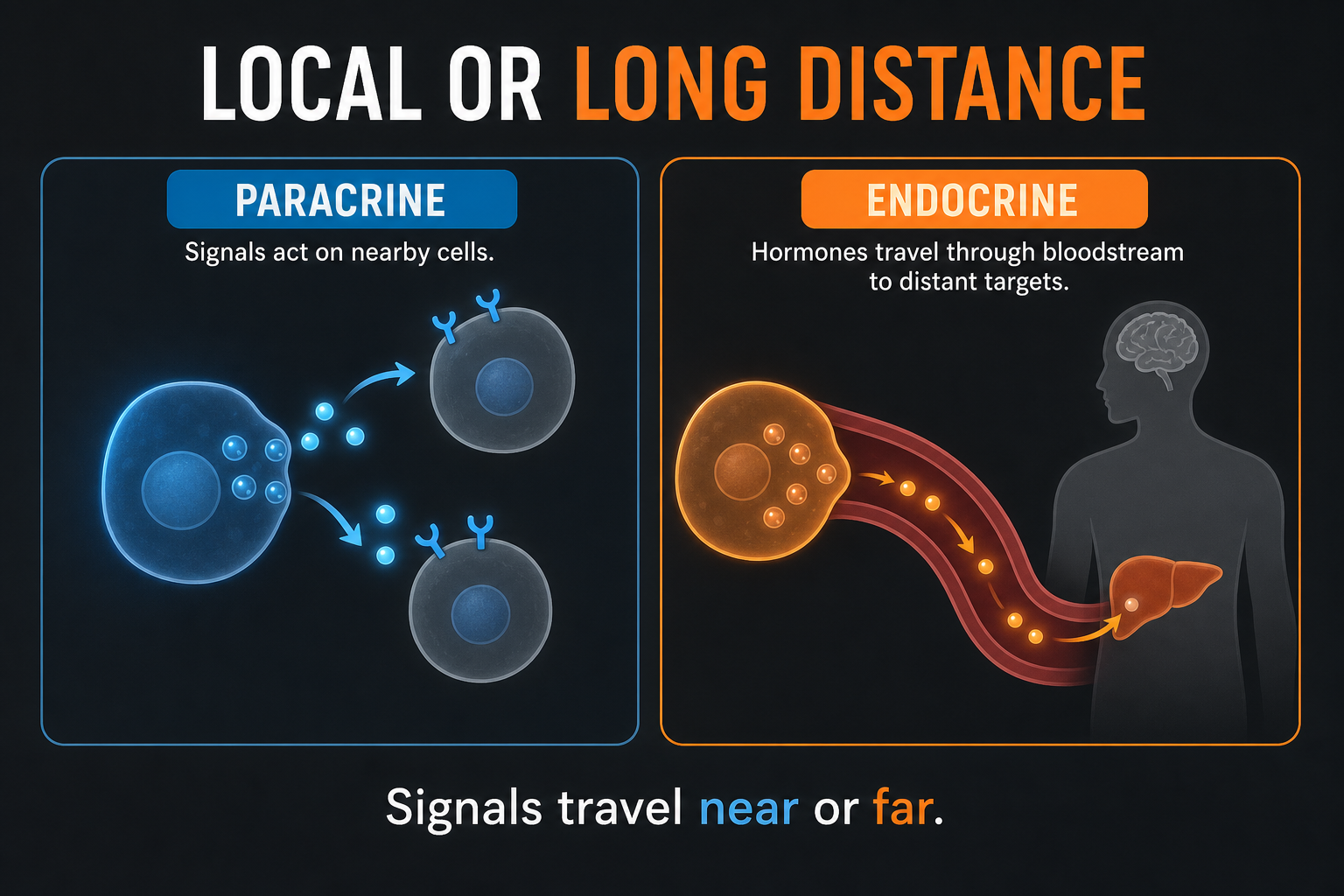
AP Biology focuses less on memorizing every label and more on understanding distance, receptor matching, and response. Compare local and long-distance examples on the exam, then connect to cell signaling pathways for full pathway logic.
| Type | How it works | AP example |
|---|---|---|
| Direct contact | Cells touch | Immune cells or gap junctions |
| Local signaling | Nearby cells communicate | Paracrine signals |
| Long-distance signaling | Signals travel through body | Hormones |
| Synaptic signaling | Neuron signals across synapse | Neurotransmitters |
This prepares you for ligands and receptors and reception, transduction, and response. Gene-expression responses preview transcription versus translation in Unit 6.
AP Biology often tests cell communication by asking what happens when one step fails. If the receptor is missing or blocked, the cell may not detect the signal. If the receptor works but a pathway protein is inactive, transduction may fail. If the pathway works but the response gene or enzyme does not change, the final response may not occur.

| Failed Step | What Goes Wrong | AP Prediction |
|---|---|---|
| Reception fails | Signal cannot bind or be detected | Target cell may not respond |
| Transduction fails | Internal relay does not work | Signal binds but response may not happen |
| Response fails | Final cell action does not occur | Gene expression, enzyme activity, or division may not change |
The target cell cannot detect the signal.
Reception fails, so the pathway may not start.
More target-cell response may occur if receptors are available.
The cell is not a target cell for that signal.
The signaling pathway produced a response.
Transduction may fail even if the signal binds.
Identify the signaling molecule or stimulus.
Explain which cell can detect the signal.
Describe reception, transduction, or a relay protein.
State what changes inside the cell or if division is affected.

Because the target cell has a receptor for ___, the signal can ___. This causes ___ inside the cell, leading to ___.
Signal is the message; receptor is the receiver.
Signaling cell sends; target cell responds.
Communication is the process; response is the result.
Communication can trigger division; the cell cycle is the division process.
Fix: Only cells with matching receptors respond.
Fix: Always identify what detects the signal.
Fix: Explain the pathway step between them.
Fix: Most receptors are proteins, not genes.
Fix: Response depends on receptors and pathway function.
Fix: AP questions often ask which cell can respond.
Revealed: 0 of 4 scenarios
A hormone is present, but a cell does not respond.
Answer: The cell may lack the correct receptor, so it is not a target cell.
A receptor is blocked by a drug.
Answer: Reception fails, so the signal may not start the pathway.
A receptor binds the signal, but no response occurs.
Answer: A transduction protein or second messenger step may be disrupted.
A mutation changes receptor shape.
Answer: The signal may no longer bind correctly.
Answer all eight questions. Choices shuffle on reload—focus on mechanism, not letter memorization.
More drills: Unit 4 practice questions, practice by topic, or daily AP Biology practice.
Open each card, draft your response, then reveal the rubric and sample. For more free-response practice, open the Unit 4 FRQ guide. Connect signaling to mitosis versus meiosis when division is part of the prompt.
A signaling molecule binds to a receptor on one cell type but does not affect another nearby cell type.
Only the cell type with the matching receptor is a target cell, so it can detect the signaling molecule and start the pathway. The nearby cell type likely lacks that receptor, so it does not respond even when the signal is present. If the receptor were blocked, reception would fail and the pathway would not start. After successful signaling, the target cell might increase enzyme activity, change gene expression, secrete a product, or prepare to divide.
Status: Draft your answer first—then open the rubric or sample.
A mutation changes the shape of a receptor protein involved in growth signaling.
Receptor shape allows a specific signal to bind, so only matching signals start the pathway. A mutation that changes receptor shape may prevent binding, so reception fails even if the growth signal is present. Without proper transduction, the cell may not activate growth-promoting responses. If growth signaling cannot turn on, the cell may not enter division when it should; in other cases, broken regulation could contribute to abnormal division, linking signaling errors to cell-cycle control.
Status: Draft your answer first—then open the rubric or sample.
Cell communication is the process by which cells send, receive, and respond to signals. A signaling cell releases or displays a signal, a target cell detects it with a receptor, and the target cell produces a response such as changed enzyme activity, gene expression, or division.
Cells communicate to coordinate growth, defense, repair, hormone responses, nerve activity, and homeostasis in multicellular organisms.
A target cell is a cell that has the receptor needed to detect a specific signal and produce a response.
Only cells with the matching receptor usually respond. Cells without that receptor are typically not target cells for that signal.
Receptors are proteins that detect specific signals. They determine which cells can respond and start signal transduction inside the cell.
The signal is the message molecule; the receptor is the protein that detects it on or in the target cell.
Examples include hormones, neurotransmitters, growth factors, immune signals, and local paracrine signals between neighboring cells.
After reception, transduction relays and often amplifies the signal inside the cell before the final response occurs.
Growth and division signals can activate pathways that push a cell through interphase and checkpoints when conditions allow.
Name the signal, identify the receptor or target cell, explain a pathway step, and predict the response or consequence if a step fails.