“Growth signal stays active”
Overactive signaling or oncogene may be involved.
AP Biology · Unit 4 Learning Journey
Cancer is not simply fast cell division; it is failed regulation of cell signaling, checkpoints, cell-cycle proteins, DNA repair, and apoptosis. Mutations can make growth signals stay on, checkpoints fail, tumor suppressor genes stop working, or damaged cells avoid programmed cell death. In AP Biology Unit 4, the key skill is explaining which control failed and predicting how that failure changes cell behavior.
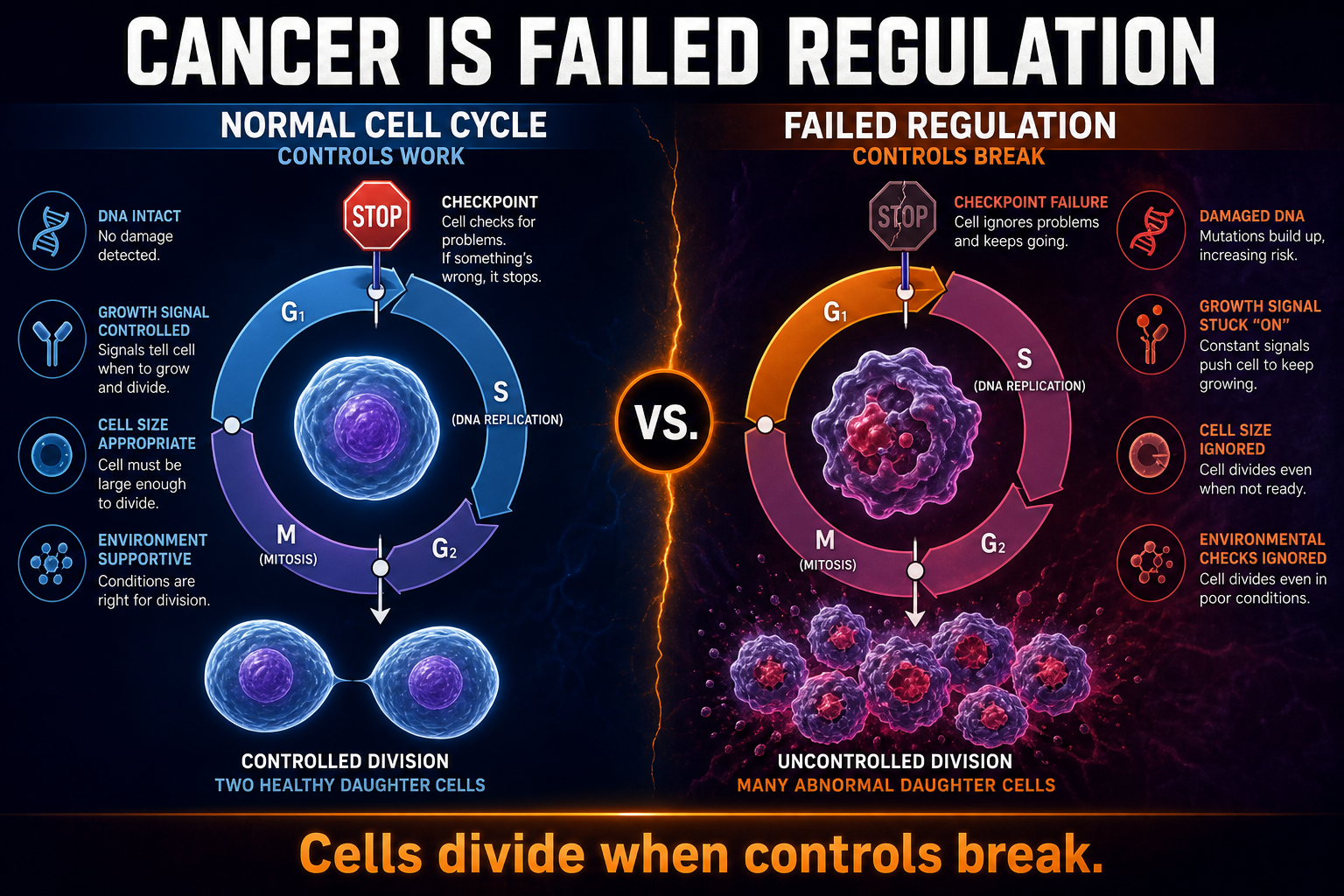
The previous guide, Phosphorylation Cascade, explained how signaling pathways relay and amplify information through protein regulation. This page shows why regulation matters: if growth signals, checkpoints, cyclins, CDKs, or apoptosis fail, cells may divide when they should stop. After this page, study Apoptosis to understand how programmed cell death protects the organism.
Cancer and Cell Cycle Regulation
When controls fail, division continues.
Cancer and cell cycle regulation connect because cancer can occur when cells divide despite damaged DNA, abnormal growth signals, failed checkpoints, or blocked apoptosis. Mutations can activate oncogenes, disable tumor suppressor genes, or disrupt cyclin-CDK control. AP Biology expects students to explain cancer as a failure of regulation, not simply as rapid cell division.
Cancer happens when cell division controls fail.
Toggle regulatory failures to see how cancer risk builds when controls break:
All controls are functioning normally—the cell cycle is regulated.
Healthy cells divide only when signals and conditions support division. Cancer can develop when regulatory systems fail and cells keep dividing despite damage or missing stop signals. This failure can involve signaling pathways, checkpoints, cyclin-CDK activity, tumor suppressors, oncogenes, or apoptosis.
Review the full cell cycle sequence to see where each control normally acts.
Cancer is best explained as loss of control over cell growth and division.
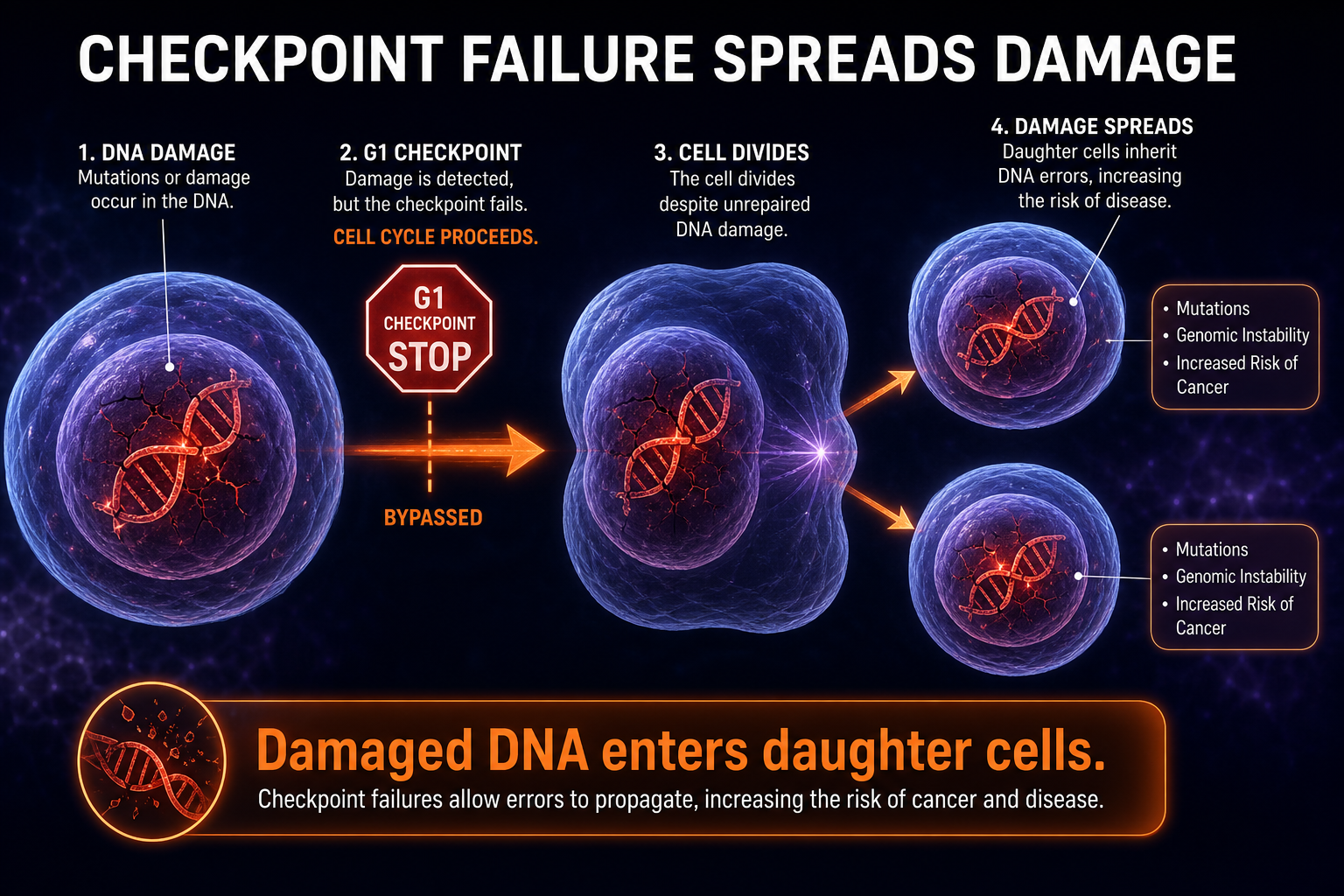
Cell cycle checkpoints normally pause the cycle when DNA is damaged, replication is incomplete, or chromosomes are attached incorrectly. If checkpoint proteins fail, damaged cells may continue into division. Cancer-related regulation often involves unsafe movement through cell cycle phases, especially when checkpoints fail to stop damaged cells. Failed checkpoint control during mitosis can allow chromosome separation errors to produce abnormal daughter cells. This can pass mutations to daughter cells and increase cancer risk.
See the dedicated cell cycle checkpoints guide for G1, G2, and M checkpoint logic on FRQs.
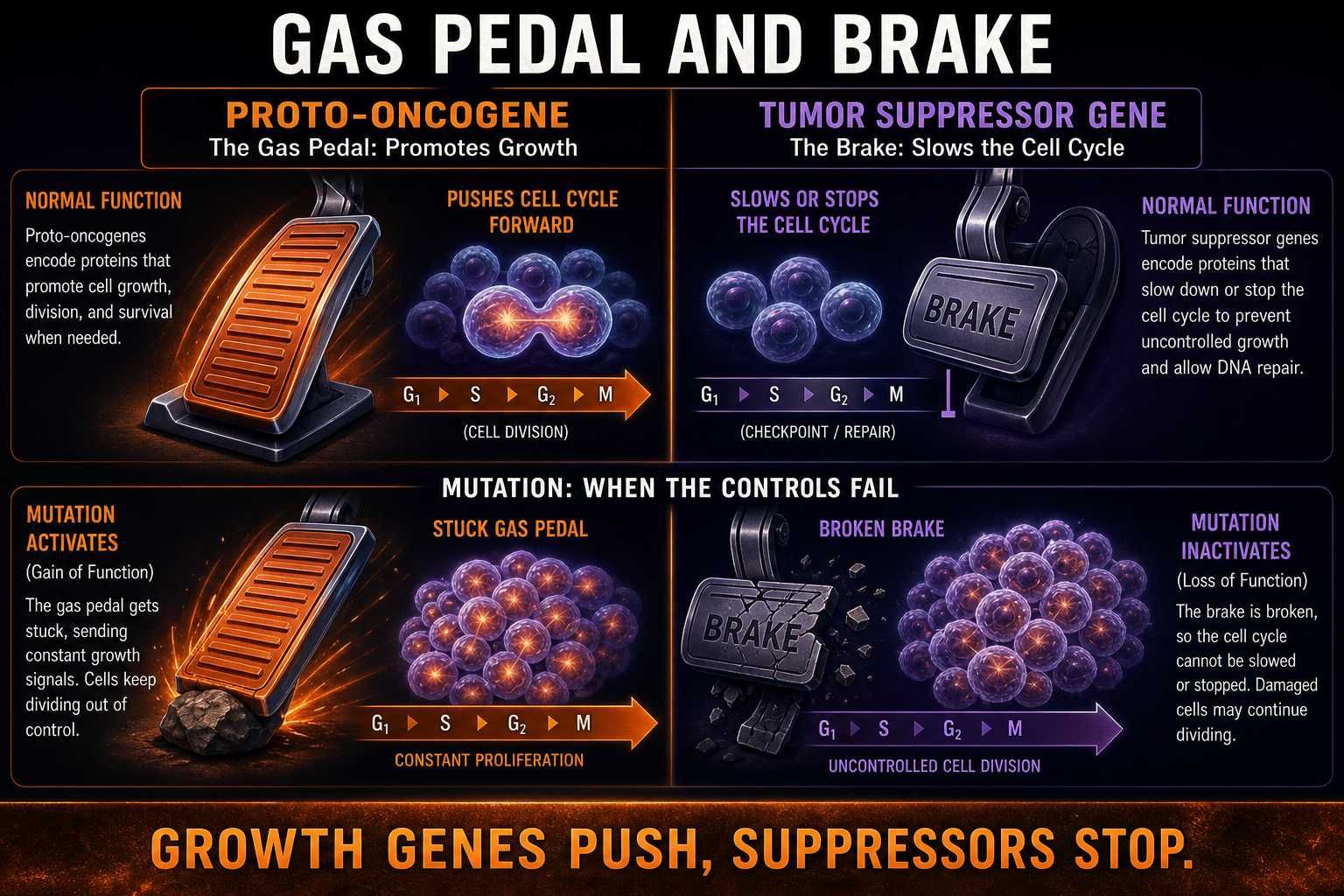
Proto-oncogenes are normal genes that help promote cell growth and division when appropriate. If a mutation makes a proto-oncogene overactive, it can become an oncogene. An oncogene can push the cell cycle forward even when the cell should not divide.
A proto-oncogene is normal; an oncogene is an overactive cancer-promoting version.
Tumor suppressor genes help slow the cell cycle, repair DNA, or trigger apoptosis. They act like brakes on cell division. If tumor suppressor genes are damaged or inactive, cells may lose important stop signals.
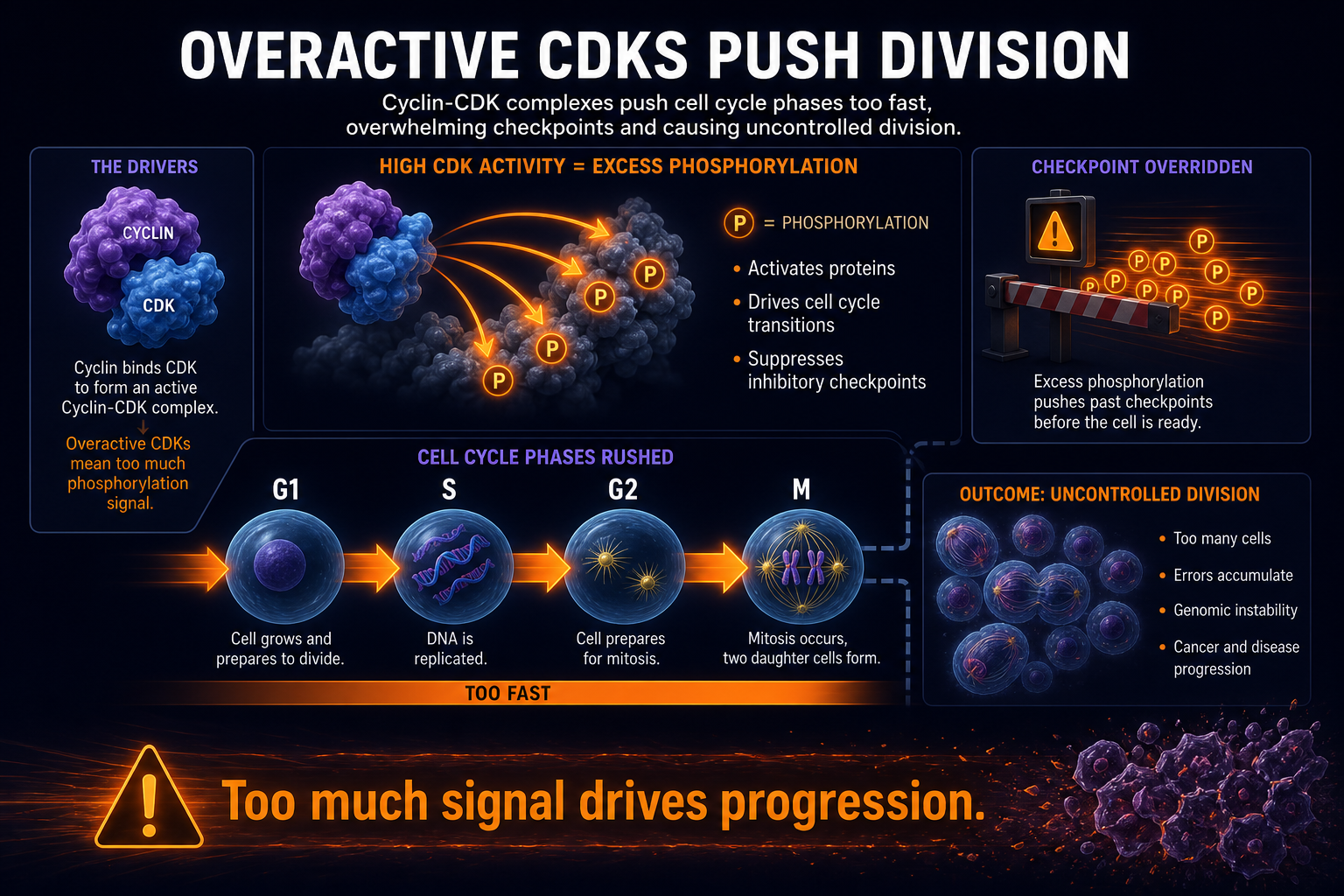
Cyclins and CDKs normally regulate when cells move through cell-cycle transitions. If cyclins are overproduced or CDKs are overactive, the cell may progress through the cycle too easily. This can be dangerous when checkpoints should stop division.
Review cyclins and CDKs for how these proteins normally push phase transitions.
Apoptosis is programmed cell death that can remove damaged or unsafe cells. Cancer cells may avoid apoptosis, allowing them to survive and continue dividing when they should be eliminated. This is why apoptosis is a major protective process in multicellular organisms.
Continue to the next guide: Apoptosis.
Cell signaling pathways control how cells respond to growth factors, hormones, and environmental signals. If a receptor or pathway stays active when it should turn off, the cell may behave as if it is constantly receiving a growth signal. AP Biology may connect cancer to abnormal reception, transduction, amplification, phosphorylation, or response. Abnormal kinase or phosphatase activity can keep growth pathways active too long, increasing cancer risk when other controls fail. Overactive receptor tyrosine kinase signaling can keep growth pathways active, which may increase cancer risk when other controls fail.
Trace full pathways in the cell signaling pathways guide when a prompt mentions receptors or kinases.
| Regulation failure | What changes | AP clue |
|---|---|---|
| Overactive receptor | Constant growth signaling | Signal stuck on |
| Overactive kinase | Pathway keeps activating targets | Phosphorylation stays high |
| Failed checkpoint | Damaged cells keep dividing | DNA damage ignored |
| Inactive tumor suppressor | Cell loses brake control | Stop signal lost |
| Blocked apoptosis | Damaged cell survives | Cell avoids death |
Overactive signaling or oncogene may be involved.
Damaged cells may continue dividing.
The cell has lost an important brake.
Cell-cycle progression may be overactive.
Damaged cells may survive instead of being removed.
Mutation risk and cancer risk increase.
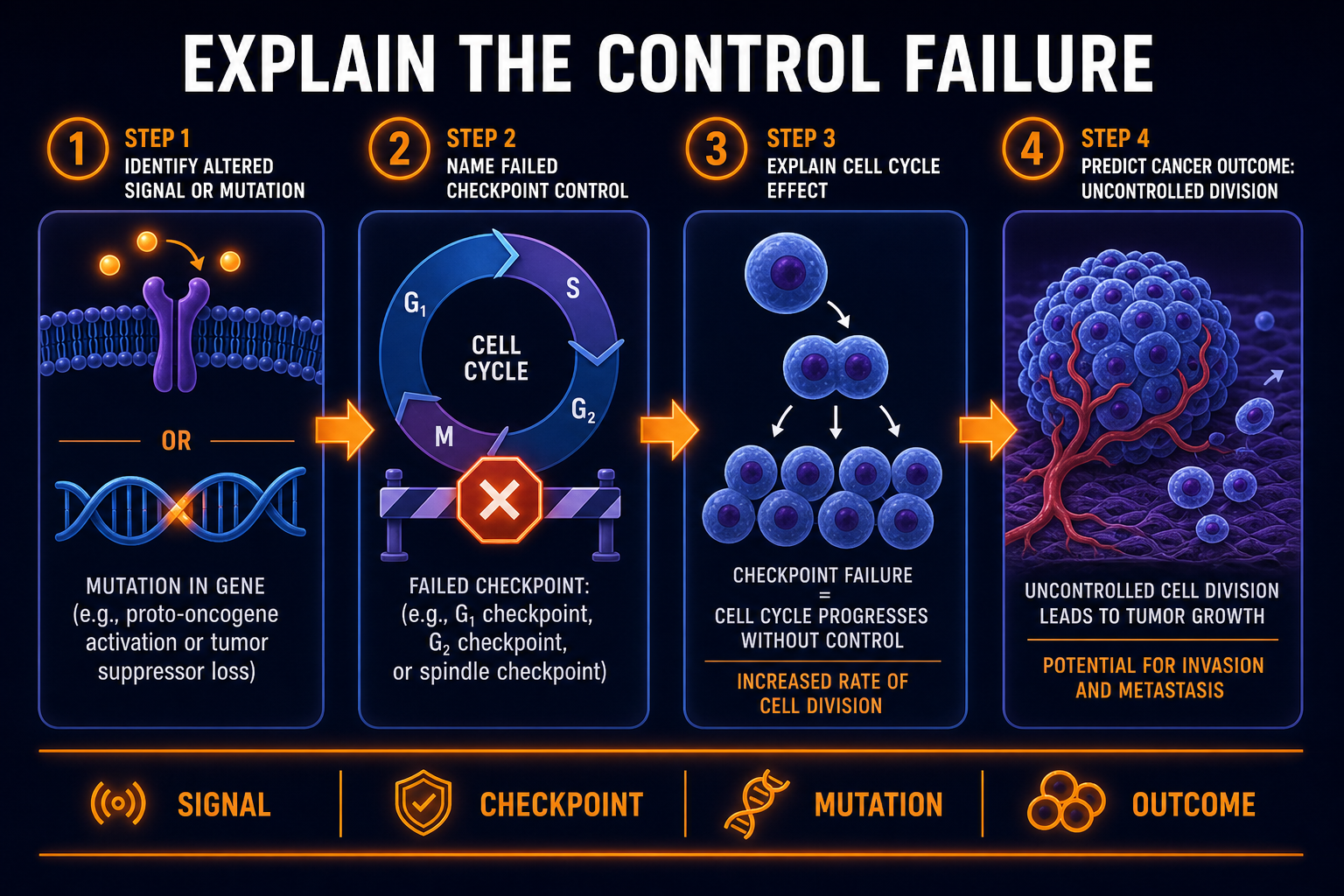
Name the failed control first.
Explain what should happen when regulation works.
Connect the mutation to division behavior.
Finish with a clear outcome prediction.
Normally, ___ helps regulate ___. If ___ fails, the cell may ___. This can increase cancer risk because ___.
Fix: Cancer is failed regulation of growth, checkpoints, signaling, DNA repair, or apoptosis.
Fix: Oncogenes act like stuck gas pedals; tumor suppressors act like brakes.
Fix: Removing damaged cells helps prevent unsafe division.
Fix: Checkpoint failure can allow damaged DNA to pass to daughter cells.
Fix: Cancer usually involves mutations that affect regulation of growth or survival.
Fix: AP Biology wants the failed control and the predicted consequence.
Revealed: 0 of 4 scenarios
A mutation causes a growth-signaling pathway to stay active.
Answer: This can act like an oncogene effect because the cell receives a constant divide signal.
A damaged cell cannot stop at the G1 checkpoint.
Answer: Checkpoint failure can allow damaged DNA to be copied and passed on.
A tumor suppressor protein is inactive.
Answer: The cell loses a brake that normally slows division, repairs DNA, or triggers apoptosis.
A damaged cell avoids programmed cell death.
Answer: Apoptosis avoidance can let unsafe cells survive and keep dividing.
Answer all eight questions. Choices shuffle on reload—focus on regulation logic, not letter memorization.
More drills: Unit 4 practice questions, practice by topic, or daily AP Biology practice.
Open each card, draft your response, then reveal the rubric and sample. For more free-response practice, open the Unit 4 FRQ guide.
A mutation causes a signaling pathway for cell growth to remain active even when no growth factor is present.
The mutation keeps the growth pathway active without a ligand, so the cell receives a constant signal to divide. This can push cell-cycle regulators forward even when conditions are not appropriate, acting like an overactive oncogene effect. Cancer risk increases because cells may divide when they should pause, repair, or undergo apoptosis. If a checkpoint is functioning normally, it could detect DNA damage or division problems and stop the cycle before damaged cells replicate their DNA or divide.
Status: Draft your answer first—then open the rubric or sample.
A tumor suppressor gene is inactivated in a cell with damaged DNA. The cell does not undergo apoptosis and continues dividing.
Tumor suppressor genes normally slow the cell cycle, promote DNA repair, or trigger apoptosis when damage is detected—they act like brakes on division. Apoptosis protects multicellular organisms by removing cells that are too damaged to function safely, preventing those cells from dividing and spreading errors. If the damaged cell keeps dividing, daughter cells may inherit the DNA damage and additional mutations may accumulate, increasing cancer risk in the tissue.
Status: Draft your answer first—then open the rubric or sample.
Cancer relates to the cell cycle because cancer cells divide when normal controls fail. These failures can involve checkpoints, growth signals, cyclins, CDKs, tumor suppressor genes, or apoptosis. AP Biology usually expects a mechanism, not just the phrase “uncontrolled division.”
No. Cancer is better understood as failed regulation of cell growth, division, repair, and survival. Rapid division can be a result, but the cause is usually a control problem.
Proto-oncogenes are normal genes that help promote cell growth and division when appropriate. If they mutate into overactive forms, they can become oncogenes. Oncogenes can push cells to divide when they should not.
Tumor suppressor genes help slow the cell cycle, repair DNA, or trigger apoptosis. They act like brakes on cell division. If they are inactive, cells may lose important stop signals.
Checkpoints can stop the cell cycle when DNA damage or division errors are detected. This gives the cell time to repair damage or trigger apoptosis. If checkpoints fail, damaged cells may continue dividing.
Cyclins and CDKs help push cells through cell-cycle transitions. If they are overactive or not properly regulated, cells may divide too easily. This can increase cancer risk, especially when checkpoints also fail.
Apoptosis removes cells that are too damaged or unsafe to keep functioning. If damaged cells avoid apoptosis, they may survive and divide. This can allow mutations to accumulate.
Cell signaling can contribute to cancer if growth pathways stay active when they should turn off. For example, an overactive receptor or kinase can keep sending “divide” signals. This links Unit 4 signaling to cell-cycle regulation.
Oncogenes are overactive growth-promoting genes, like a stuck gas pedal. Tumor suppressors are growth-limiting genes, like brakes. Cancer risk can increase when gas pedals stick on or brakes fail.
Start by identifying the failed control, such as a checkpoint, oncogene, tumor suppressor, or apoptosis pathway. Explain the normal role of that control and how the failure changes cell behavior. Finish by connecting the change to damaged cells, uncontrolled division, or cancer risk.